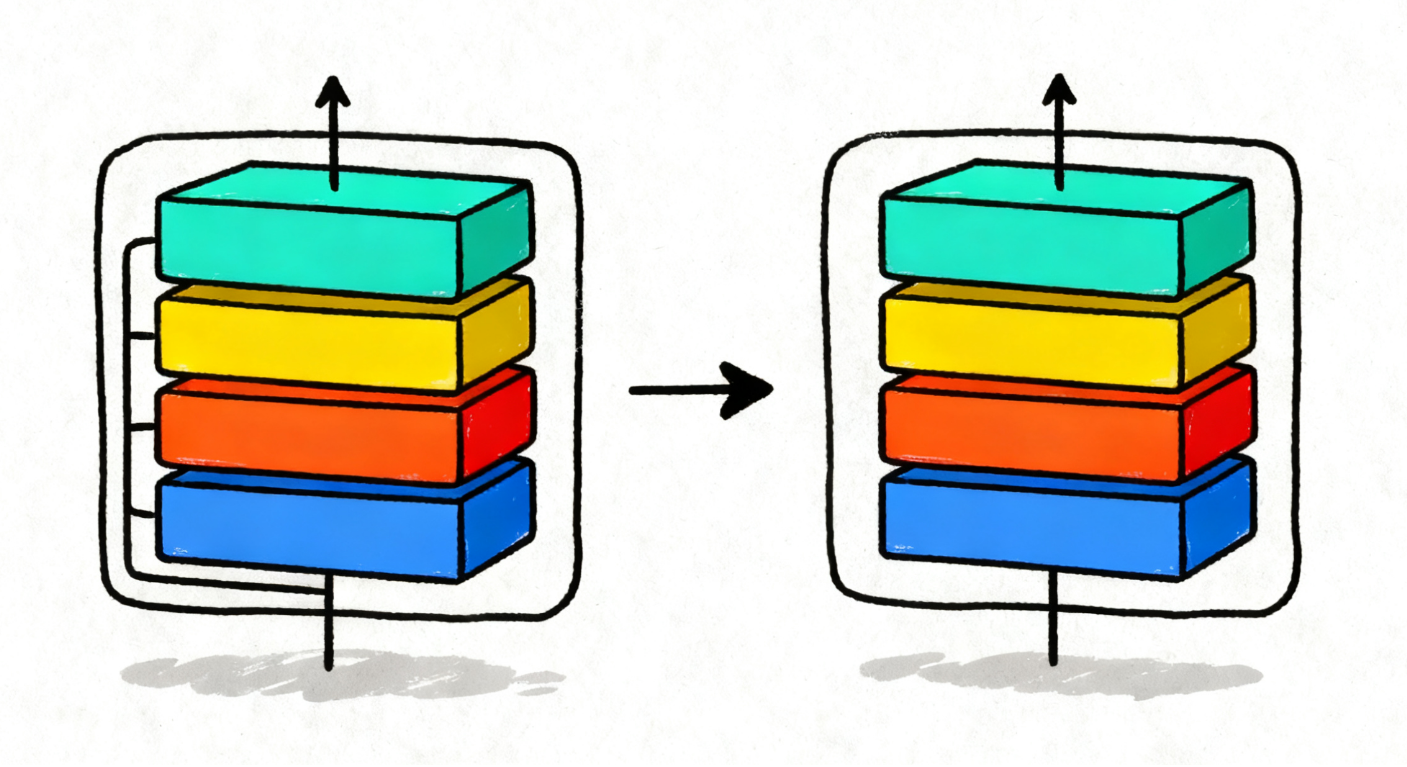
编码器-解码器架构的基本概念
编码器-解码器(Encoder-Decoder)架构是深度学习中的经典范式,在Transformer出现之前就已在机器翻译、文本摘要等序列到序列(Seq2Seq)任务中广泛应用。Transformer架构将这一范式推向了新的高度,通过自注意力机制实现了更强大的序列建模能力。
python
import torch
import torch.nn as nn
import torch.nn.functional as F

class BaseEncoderDecoder(nn.Module):
    """编码器-解码器架构基类"""

    def __init__(self, vocab_size, d_model):
        super(BaseEncoderDecoder, self).__init__()
        self.vocab_size = vocab_size
        self.d_model = d_model

        # 共享的嵌入层
        self.embedding = nn.Embedding(vocab_size, d_model)

        # 位置编码
        self.pos_encoding = PositionalEncoding(d_model)

    def encode(self, src):
        """编码器抽象方法"""
        raise NotImplementedError

    def decode(self, tgt, encoder_output):
        """解码器抽象方法"""
        raise NotImplementedError

    def forward(self, src, tgt):
        encoder_output = self.encode(src)
        decoder_output = self.decode(tgt, encoder_output)
        return decoder_output

class PositionalEncoding(nn.Module):
    """位置编码"""

    def __init__(self, d_model, max_len=5000):
        super(PositionalEncoding, self).__init__()

        pe = torch.zeros(max_len, d_model)
        position = torch.arange(0, max_len, dtype=torch.float).unsqueeze(1)
        div_term = torch.exp(torch.arange(0, d_model, 2).float() *
                           (-torch.log(torch.tensor(10000.0)) / d_model))

        pe[:, 0::2] = torch.sin(position * div_term)
        pe[:, 1::2] = torch.cos(position * div_term)
        pe = pe.unsqueeze(0).transpose(0, 1)

        self.register_buffer('pe', pe)

    def forward(self, x):
        return x + self.pe[:x.size(0), :]

# 测试基础架构
base_model = BaseEncoderDecoder(vocab_size=10000, d_model=512)
print(f"基础编码器-解码器架构创建完成")
print(f"词汇表大小: 10000, 模型维度: 512")
原始Transformer的编码器-解码器架构
完整架构实现
原始Transformer论文提出的是一个完整的编码器-解码器架构,专门为机器翻译任务设计。
python
class TransformerEncoderLayer(nn.Module):
    """Transformer编码器层"""

    def __init__(self, d_model, nhead, d_ff, dropout=0.1):
        super(TransformerEncoderLayer, self).__init__()
        self.self_attn = nn.MultiheadAttention(d_model, nhead, dropout=dropout)
        self.ffn = nn.Sequential(
            nn.Linear(d_model, d_ff),
            nn.ReLU(),
            nn.Dropout(dropout),
            nn.Linear(d_ff, d_model)
        )
        self.norm1 = nn.LayerNorm(d_model)
        self.norm2 = nn.LayerNorm(d_model)
        self.dropout = nn.Dropout(dropout)

    def forward(self, src, src_mask=None, src_key_padding_mask=None):
        # 自注意力子层
        src2, _ = self.self_attn(
            src, src, src,
            attn_mask=src_mask,
            key_padding_mask=src_key_padding_mask
        )
        src = src + self.dropout(src2)
        src = self.norm1(src)

        # 前馈网络子层
        src2 = self.ffn(src)
        src = src + self.dropout(src2)
        src = self.norm2(src)

        return src

class TransformerDecoderLayer(nn.Module):
    """Transformer解码器层"""

    def __init__(self, d_model, nhead, d_ff, dropout=0.1):
        super(TransformerDecoderLayer, self).__init__()
        self.self_attn = nn.MultiheadAttention(d_model, nhead, dropout=dropout)
        self.cross_attn = nn.MultiheadAttention(d_model, nhead, dropout=dropout)
        self.ffn = nn.Sequential(
            nn.Linear(d_model, d_ff),
            nn.ReLU(),
            nn.Dropout(dropout),
            nn.Linear(d_ff, d_model)
        )
        self.norm1 = nn.LayerNorm(d_model)
        self.norm2 = nn.LayerNorm(d_model)
        self.norm3 = nn.LayerNorm(d_model)
        self.dropout = nn.Dropout(dropout)

    def forward(self, tgt, memory, tgt_mask=None, memory_mask=None,
                tgt_key_padding_mask=None, memory_key_padding_mask=None):
        # 自注意力(因果掩码)
        tgt2, _ = self.self_attn(
            tgt, tgt, tgt,
            attn_mask=tgt_mask,
            key_padding_mask=tgt_key_padding_mask
        )
        tgt = tgt + self.dropout(tgt2)
        tgt = self.norm1(tgt)

        # 交叉注意力(编码器-解码器注意力)
        tgt2, _ = self.cross_attn(
            tgt, memory, memory,
            attn_mask=memory_mask,
            key_padding_mask=memory_key_padding_mask
        )
        tgt = tgt + self.dropout(tgt2)
        tgt = self.norm2(tgt)

        # 前馈网络
        tgt2 = self.ffn(tgt)
        tgt = tgt + self.dropout(tgt2)
        tgt = self.norm3(tgt)

        return tgt

class FullTransformer(nn.Module):
    """完整的Transformer编码器-解码器架构"""

    def __init__(self, src_vocab_size, tgt_vocab_size, d_model, nhead,
                 num_encoder_layers, num_decoder_layers, d_ff, max_seq_length=5000):
        super(FullTransformer, self).__init__()

        self.d_model = d_model
        self.src_embedding = nn.Embedding(src_vocab_size, d_model)
        self.tgt_embedding = nn.Embedding(tgt_vocab_size, d_model)
        self.pos_encoding = PositionalEncoding(d_model, max_seq_length)

        # 编码器
        self.encoder_layers = nn.ModuleList([
            TransformerEncoderLayer(d_model, nhead, d_ff)
            for _ in range(num_encoder_layers)
        ])

        # 解码器
        self.decoder_layers = nn.ModuleList([
            TransformerDecoderLayer(d_model, nhead, d_ff)
            for _ in range(num_decoder_layers)
        ])

        self.output_projection = nn.Linear(d_model, tgt_vocab_size)

    def create_src_mask(self, src):
        """创建源序列掩码(可选)"""
        return None

    def create_tgt_mask(self, tgt):
        """创建目标序列因果掩码"""
        seq_len = tgt.size(0)
        mask = torch.triu(torch.ones(seq_len, seq_len), diagonal=1).bool()
        return mask

    def encode(self, src):
        """编码过程"""
        src_emb = self.src_embedding(src) * torch.sqrt(torch.tensor(self.d_model))
        src_emb = self.pos_encoding(src_emb)

        src_mask = self.create_src_mask(src)

        encoder_output = src_emb
        for layer in self.encoder_layers:
            encoder_output = layer(encoder_output, src_mask=src_mask)

        return encoder_output

    def decode(self, tgt, encoder_output):
        """解码过程"""
        tgt_emb = self.tgt_embedding(tgt) * torch.sqrt(torch.tensor(self.d_model))
        tgt_emb = self.pos_encoding(tgt_emb)

        tgt_mask = self.create_tgt_mask(tgt)

        decoder_output = tgt_emb
        for layer in self.decoder_layers:
            decoder_output = layer(
                decoder_output, encoder_output,
                tgt_mask=tgt_mask
            )

        return decoder_output

    def forward(self, src, tgt):
        encoder_output = self.encode(src)
        decoder_output = self.decode(tgt, encoder_output)
        output = self.output_projection(decoder_output)
        return output

# 创建完整Transformer实例
full_transformer = FullTransformer(
    src_vocab_size=10000,
    tgt_vocab_size=10000,
    d_model=512,
    nhead=8,
    num_encoder_layers=6,
    num_decoder_layers=6,
    d_ff=2048
)

print("完整Transformer编码器-解码器架构:")
print(f"编码器层数: 6, 解码器层数: 6")
print(f"注意力头数: 8, 前馈网络维度: 2048")
编码器-only架构模式
BERT架构分析
编码器-only架构专注于理解输入序列的深层表示,适用于分类、标注等理解任务。
python
class EncoderOnlyTransformer(nn.Module):
    """编码器-only架构(BERT风格)"""

    def __init__(self, vocab_size, d_model, nhead, num_layers, d_ff, max_seq_length=512):
        super(EncoderOnlyTransformer, self).__init__()

        self.embedding = nn.Embedding(vocab_size, d_model)
        self.pos_encoding = PositionalEncoding(d_model, max_seq_length)
        self.segment_embedding = nn.Embedding(2, d_model)  # 用于句子对任务

        self.encoder_layers = nn.ModuleList([
            TransformerEncoderLayer(d_model, nhead, d_ff)
            for _ in range(num_layers)
        ])

        self.pooler = nn.Linear(d_model, d_model)  # 用于[CLS]标记
        self.layer_norm = nn.LayerNorm(d_model)

    def forward(self, input_ids, segment_ids=None, attention_mask=None):
        # 词嵌入
        token_emb = self.embedding(input_ids)

        # 位置编码
        token_emb = self.pos_encoding(token_emb)

        # 段嵌入(如果有)
        if segment_ids is not None:
            segment_emb = self.segment_embedding(segment_ids)
            token_emb += segment_emb

        # 通过编码器层
        x = token_emb
        for layer in self.encoder_layers:
            x = layer(x, src_key_padding_mask=attention_mask)

        x = self.layer_norm(x)

        # 池化输出(取[CLS]标记)
        pooled_output = torch.tanh(self.pooler(x[0]))  # 假设[CLS]在位置0

        return {
            'sequence_output': x,
            'pooled_output': pooled_output
        }

class MaskedLanguageModel(nn.Module):
    """掩码语言模型头"""

    def __init__(self, d_model, vocab_size):
        super(MaskedLanguageModel, self).__init__()
        self.dense = nn.Linear(d_model, d_model)
        self.layer_norm = nn.LayerNorm(d_model)
        self.decoder = nn.Linear(d_model, vocab_size)

    def forward(self, sequence_output):
        hidden_states = self.dense(sequence_output)
        hidden_states = F.gelu(hidden_states)
        hidden_states = self.layer_norm(hidden_states)
        logits = self.decoder(hidden_states)
        return logits

# 编码器-only应用示例
encoder_model = EncoderOnlyTransformer(
    vocab_size=30522,
    d_model=768,
    nhead=12,
    num_layers=12,
    d_ff=3072
)

print("\n编码器-only架构特点:")
print("• 双向上下文理解")
print("• 适合分类、标注任务")
print("• 预训练任务: 掩码语言建模")
print("• 典型代表: BERT, RoBERTa, ALBERT")
解码器-only架构模式
GPT架构分析
解码器-only架构专注于自回归生成,每个位置只能关注当前位置及之前的信息。
python
class DecoderOnlyTransformer(nn.Module):
    """解码器-only架构(GPT风格)"""

    def __init__(self, vocab_size, d_model, nhead, num_layers, d_ff, max_seq_length=1024):
        super(DecoderOnlyTransformer, self).__init__()

        self.embedding = nn.Embedding(vocab_size, d_model)
        self.pos_encoding = PositionalEncoding(d_model, max_seq_length)

        # 使用解码器层,但不使用交叉注意力
        self.decoder_layers = nn.ModuleList([
            TransformerDecoderLayer(d_model, nhead, d_ff)
            for _ in range(num_layers)
        ])

        self.layer_norm = nn.LayerNorm(d_model)
        self.lm_head = nn.Linear(d_model, vocab_size)

    def create_causal_mask(self, seq_len):
        """创建因果注意力掩码"""
        mask = torch.triu(torch.ones(seq_len, seq_len), diagonal=1).bool()
        return mask

    def forward(self, input_ids, past_key_values=None):
        seq_len = input_ids.size(0)

        # 嵌入层
        token_emb = self.embedding(input_ids)
        x = self.pos_encoding(token_emb)

        # 因果掩码
        causal_mask = self.create_causal_mask(seq_len)

        # 通过解码器层
        present_key_values = []
        for i, layer in enumerate(self.decoder_layers):
            # 简化实现,实际GPT使用仅自注意力的解码器层
            x = layer(
                x, x,  # 不使用编码器输出
                tgt_mask=causal_mask
            )

        x = self.layer_norm(x)
        logits = self.lm_head(x)

        return {
            'logits': logits,
            'hidden_states': x
        }

class AutoregressiveGenerator:
    """自回归生成器"""

    def __init__(self, model, tokenizer):
        self.model = model
        self.tokenizer = tokenizer

    def generate(self, prompt, max_length=100, temperature=1.0):
        """自回归生成文本"""
        input_ids = self.tokenizer.encode(prompt)
        generated = input_ids.copy()

        for _ in range(max_length):
            # 准备输入
            inputs = torch.tensor([input_ids], dtype=torch.long)

            # 前向传播
            with torch.no_grad():
                outputs = self.model(inputs)
                next_token_logits = outputs['logits'][0, -1, :]

            # 温度采样
            next_token_logits = next_token_logits / temperature
            next_token_probs = F.softmax(next_token_logits, dim=-1)
            next_token = torch.multinomial(next_token_probs, num_samples=1)

            # 更新序列
            next_token_id = next_token.item()
            generated.append(next_token_id)
            input_ids.append(next_token_id)

            # 停止条件(简化)
            if next_token_id == self.tokenizer.eos_token_id:
                break

        return self.tokenizer.decode(generated)

# 解码器-only应用示例
decoder_model = DecoderOnlyTransformer(
    vocab_size=50257,  # GPT-2词汇表大小
    d_model=768,
    nhead=12,
    num_layers=12,
    d_ff=3072
)

print("\n解码器-only架构特点:")
print("• 因果注意力掩码")
print("• 自回归生成")
print("• 适合文本生成任务")
print("• 预训练任务: 语言建模")
print("• 典型代表: GPT系列, BLOOM, LLaMA")
两种模式的对比分析
架构特性详细比较
python
class ArchitectureComparator:
    """架构比较分析"""

    @staticmethod
    def detailed_comparison():
        comparison_data = {
            '组件': ['注意力机制', '上下文方向', '预训练任务', '典型应用', '代表模型'],
            '编码器-only': [
                '双向自注意力',
                '全序列上下文',
                '掩码语言建模',
                '文本分类、NER、QA',
                'BERT、RoBERTa'
            ],
            '解码器-only': [
                '因果自注意力',
                '左侧上下文',
                '语言建模',
                '文本生成、对话',
                'GPT系列、LLaMA'
            ],
            '编码器-解码器': [
                '编码器双向 + 解码器因果',
                '编码全序列 + 解码左侧',
                '序列到序列任务',
                '翻译、摘要、问答',
                'T5、BART、mT5'
            ]
        }

        print("\n三种架构模式详细比较:")
        print("组件\t\t\t编码器-only\t\t解码器-only\t\t编码器-解码器")
        print("-" * 100)

        for i in range(len(comparison_data['组件'])):
            component = comparison_data['组件'][i]
            encoder = comparison_data['编码器-only'][i]
            decoder = comparison_data['解码器-only'][i]
            encoder_decoder = comparison_data['编码器-解码器'][i]

            print(f"{component:15}\t{encoder:15}\t{decoder:15}\t{encoder_decoder:15}")

    @staticmethod
    def performance_characteristics():
        """性能特征分析"""
        characteristics = {
            '训练效率': {
                '编码器-only': '高(可并行处理全序列)',
                '解码器-only': '中(自回归,序列长度相关)',
                '编码器-解码器': '低(两次前向传播)'
            },
            '推理速度': {
                '编码器-only': '快(单次前向)',
                '解码器-only': '慢(逐token生成)',
                '编码器-解码器': '中(编码快,解码慢)'
            },
            '内存使用': {
                '编码器-only': '中等',
                '解码器-only': '高(长序列生成)',
                '编码器-解码器': '高(两个模型)'
            },
            '任务适应性': {
                '编码器-only': '理解任务',
                '解码器-only': '生成任务',
                '编码器-解码器': '序列转换任务'
            }
        }

        print("\n性能特征比较:")
        print("指标\t\t编码器-only\t\t解码器-only\t\t编码器-解码器")
        print("-" * 90)

        for metric, values in characteristics.items():
            print(f"{metric:10}\t{values['编码器-only']:15}\t{values['解码器-only']:15}\t{values['编码器-解码器']:15}")

ArchitectureComparator.detailed_comparison()
ArchitectureComparator.performance_characteristics()
混合架构与统一范式
T5的统一文本到文本框架
python
class UnifiedTextToTextModel(nn.Module):
    """统一文本到文本框架(T5风格)"""

    def __init__(self, vocab_size, d_model, nhead, num_layers, d_ff):
        super(UnifiedTextToTextModel, self).__init__()

        # 共享的编码器-解码器参数
        self.embedding = nn.Embedding(vocab_size, d_model)
        self.pos_encoding = PositionalEncoding(d_model)

        # 统一的Transformer层
        self.transformer_layers = nn.ModuleList([
            T5TransformerLayer(d_model, nhead, d_ff)
            for _ in range(num_layers)
        ])

        self.lm_head = nn.Linear(d_model, vocab_size)

    def forward(self, input_ids, target_ids=None, attention_mask=None):
        # 编码器部分
        encoder_emb = self.embedding(input_ids)
        encoder_output = self.pos_encoding(encoder_emb)

        for layer in self.transformer_layers:
            encoder_output = layer(encoder_output, is_encoder=True)

        # 解码器部分(如果有目标序列)
        if target_ids is not None:
            decoder_emb = self.embedding(target_ids)
            decoder_output = self.pos_encoding(decoder_emb)

            for layer in self.transformer_layers:
                decoder_output = layer(
                    decoder_output, encoder_output, is_encoder=False
                )

            logits = self.lm_head(decoder_output)
            return logits
        else:
            # 仅编码模式
            return encoder_output

class T5TransformerLayer(nn.Module):
    """T5风格的统一Transformer层"""

    def __init__(self, d_model, nhead, d_ff, dropout=0.1):
        super(T5TransformerLayer, self).__init__()
        self.self_attn = nn.MultiheadAttention(d_model, nhead, dropout=dropout)
        self.cross_attn = nn.MultiheadAttention(d_model, nhead, dropout=dropout)
        self.ffn = nn.Sequential(
            nn.Linear(d_model, d_ff),
            nn.ReLU(),  # T5使用ReLU
            nn.Dropout(dropout),
            nn.Linear(d_ff, d_model)
        )
        self.norm1 = nn.LayerNorm(d_model)
        self.norm2 = nn.LayerNorm(d_model)
        self.norm3 = nn.LayerNorm(d_model)
        self.dropout = nn.Dropout(dropout)

    def forward(self, x, encoder_output=None, is_encoder=True):
        if is_encoder:
            # 编码器模式:仅自注意力
            attn_output, _ = self.self_attn(x, x, x)
            x = x + self.dropout(attn_output)
            x = self.norm1(x)
        else:
            # 解码器模式:自注意力 + 交叉注意力
            # 自注意力(带因果掩码)
            seq_len = x.size(0)
            causal_mask = torch.triu(torch.ones(seq_len, seq_len), diagonal=1).bool()
            self_attn_output, _ = self.self_attn(x, x, x, attn_mask=causal_mask)
            x = x + self.dropout(self_attn_output)
            x = self.norm1(x)

            # 交叉注意力
            cross_attn_output, _ = self.cross_attn(x, encoder_output, encoder_output)
            x = x + self.dropout(cross_attn_output)
            x = self.norm2(x)

        # 前馈网络(共享)
        ff_output = self.ffn(x)
        x = x + self.dropout(ff_output)
        x = self.norm3(x)

        return x

# 统一架构示例
unified_model = UnifiedTextToTextModel(
    vocab_size=32128,  # T5词汇表大小
    d_model=512,
    nhead=8,
    num_layers=6,
    d_ff=2048
)

print("\n统一文本到文本框架优势:")
print("• 单一模型处理多种任务")
print("• 统一的预训练目标")
print("• 简化的模型架构")
print("• 更好的知识共享")
实际应用场景分析
任务特定架构选择
python
class TaskSpecificArchitecture:
    """任务特定的架构选择指南"""

    @staticmethod
    def recommend_architecture(task_type, requirements):
        """根据任务需求推荐架构"""
        recommendations = {
            '文本分类': {
                '推荐架构': '编码器-only',
                '理由': '需要理解全文语义,双向上下文很重要',
                '代表模型': 'BERT, RoBERTa',
                '注意事项': '使用[CLS]标记或平均池化'
            },
            '命名实体识别': {
                '推荐架构': '编码器-only',
                '理由': '序列标注任务,需要每个token的上下文信息',
                '代表模型': 'BERT + CRF',
                '注意事项': '使用每个token的隐藏状态'
            },
            '机器翻译': {
                '推荐架构': '编码器-解码器',
                '理由': '典型的序列到序列任务,需要理解源语言并生成目标语言',
                '代表模型': '原始Transformer, T5, mBART',
                '注意事项': '需要对齐的平行语料'
            },
            '文本摘要': {
                '推荐架构': '编码器-解码器 或 解码器-only',
                '理由': '需要理解长文档并生成简洁摘要',
                '代表模型': 'BART, PEGASUS, GPT系列',
                '注意事项': '抽象摘要需要更强的生成能力'
            },
            '对话系统': {
                '推荐架构': '解码器-only',
                '理由': '自回归生成适合多轮对话',
                '代表模型': 'GPT, DialoGPT, BlenderBot',
                '注意事项': '需要控制生成质量和一致性'
            },
            '代码生成': {
                '推荐架构': '解码器-only',
                '理由': '代码具有严格的顺序依赖',
                '代表模型': 'Codex, CodeGen, StarCoder',
                '注意事项': '需要代码特定的分词器和训练数据'
            }
        }

        if task_type in recommendations:
            rec = recommendations[task_type]
            print(f"\n任务: {task_type}")
            print(f"推荐架构: {rec['推荐架构']}")
            print(f"理由: {rec['理由']}")
            print(f"代表模型: {rec['代表模型']}")
            print(f"注意事项: {rec['注意事项']}")
        else:
            print(f"未知任务类型: {task_type}")

# 应用示例
TaskSpecificArchitecture.recommend_architecture('文本分类', {})
TaskSpecificArchitecture.recommend_architecture('机器翻译', {})
TaskSpecificArchitecture.recommend_architecture('对话系统', {})
总结与展望
编码器-解码器架构的两种基本模式代表了Transformer在不同任务上的专业化发展:
核心洞察
- 架构专业化分工:编码器擅长理解,解码器擅长生成,完整架构擅长转换
- 注意力模式决定能力:双向注意力提供深度理解,因果注意力支持可控生成
- 统一化趋势:如T5所示,统一的文本到文本框架正在模糊传统架构边界
未来发展
- 更灵活的架构:动态选择编码/解码模式
- 多模态扩展:统一的视觉-语言编码器-解码器
- 效率优化:稀疏注意力、模型压缩等技术
- 领域自适应:针对特定领域优化的架构变体
理解这两种基本模式及其变体,对于选择适合特定任务的Transformer架构、设计有效的训练策略以及推动模型创新都具有重要意义。