本文记录C++17新特性之__has_include和u8字面量。
文章目录
- [第一章 C++17语言特性](#第一章 C++17语言特性)
-
- [1.10 __has_include](#1.10 __has_include)
-
- [1.10.1 __has_include 实现原理](#1.10.1 __has_include 实现原理)
- [1.10.2 举例](#1.10.2 举例)
- [1.11 u8字符字面量](#1.11 u8字符字面量)
第一章 C++17语言特性
1.10 __has_include
在C++17之前,在编写跨平台代码时,通常面临这样一个难题:如何直到当前环境包含头文件呢?以前我们只依赖构造系统(如CMake)在编译之前进行检测,如:
cpp
#ifdef HAVE_BOOST_OPTIONAL
    #include <boost/optional.hpp>
#else
    #include "s.h"
#endif
这种方式缺点,代码和构建脚本耦合,移植性差,如果用户只想把.hpp 扔进项目中用,还得去配置构建系统。
C++17带来了这种问题的解决办法。
1.10.1 __has_include 实现原理
__has_include 是一个预处理器表达式(Preprocessor Expression),工作原理为:
1 它接受一个头文件名称作为参数(可以是
或 "header")。
2 编译器在预处理阶段尝试在包含路径(Include Paths)中查找这个文件。
3 如果找到了,求值结果为 1(True)。
4 如果没找到,求值结果为 0(False)
1.10.2 举例
示例1:比如std::optional是C++17的,但如果用户环境只有C++14,可以降级使用boost::optional。
cpp
#if __has_include(<optional>)
    #include <optional>
    namespace my_lib { std::optional; }

#elif __has_include(<experimental/optional>)
    // 可能是早期的 C++14/17 过渡环境
#include <experimental/optional>
    namespace my_lib { using std::experimental::optional; }

#elif __has_include(<boost/optional.hpp>)
// 只有 Boost
    #include <boost/optional.hpp>
    namespace my_lib { using boost::optional; }

#else
    // 都没有,报错或者使用简易手写版
    #error "Missing <optional> implementation"
#endif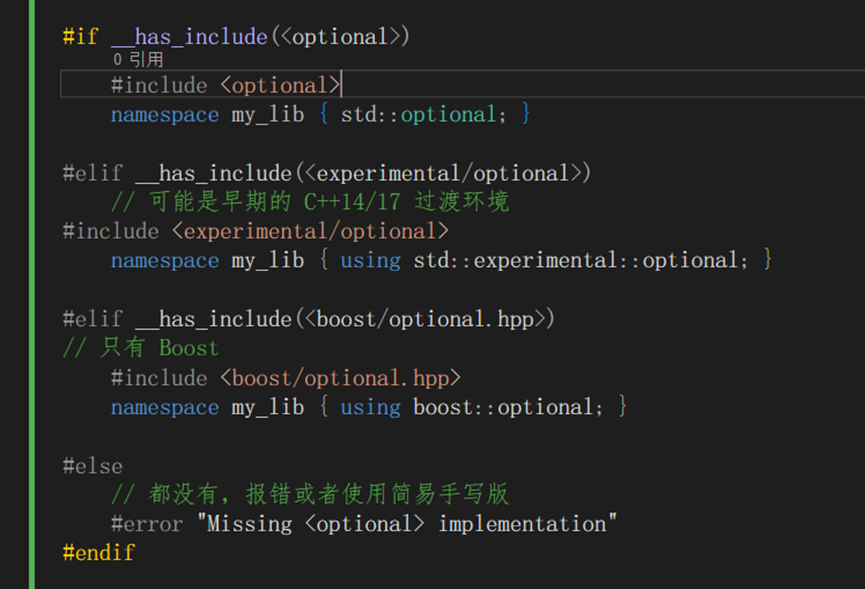
示例2:跨平台文件系统的支持
std::filesystem 的标准化之路非常坎坷,不同编译器头文件位置不同。用 __has_include 可以完美解决:
cpp
#if __has_include(<filesystem>)
    #include <filesystem>
    namespace fs = std::filesystem;

#elif __has_include(<experimental/filesystem>)
    #include <experimental/filesystem>
    namespace fs = std::experimental::filesystem;
#else
    #error "No filesystem support found"

#endif
示例3:检测第三方库是否存在
假设我们写了一个JSON序列化库,如果用户安装了nlohmann/json.hpp,你就提供自动转换支持,否则就不提供。
cpp
#if __has_include(<nlohmann/json.hpp>)
    #include <nlohmann/json.hpp>

    // 只有在检测到头文件时,才定义这个转换函数
    void to_json(nlohmann::json& j, const MyClass& p) {
        j = nlohmann::json{{"name", p.name}, {"id", p.id}};
    }
#endif
这样,你的库就变成了"自适应"的:用户有环境就增强功能,没有就保持精简,无需修改任何构建配置。
1.11 u8字符字面量
在源码中包含非ASCII字符(比如汉字)时,源文件编码与编译器对字符集的解释不统一,导致不同平台/工具链行为不一致。
C++11 引入 u8,在 C++11/14/17 中 u8"..." 的类型是 const charN(即以 UTF‑8 编码的窄字节数组)。C++20 起元素类型改为 char8_t(即 const char8_tN)。
见C++20的char8_t.
C++20已经不支持 u8了。