文章目录
- 前言
- [一、ECS (Entity Component System)是什么?](#一、ECS (Entity Component System)是什么?)
- [二、核心概念:ECS 的"三位一体"](#二、核心概念:ECS 的“三位一体”)
- [二、为什么 ECS 比 OOP 快?(数据导向编程原理)](#二、为什么 ECS 比 OOP 快?(数据导向编程原理))
- [三、Java 代码实现演示](#三、Java 代码实现演示)
- [四、ECS 解决了什么冲突?](#四、ECS 解决了什么冲突?)
- 总结
前言
提示:这里可以添加本文要记录的大概内容:
这是现代高性能游戏引擎(如 Unity DOTS, Overwatch 引擎)的主流架构。它彻底抛弃了 OOP(面
向对象),转向 DOD(数据导向设计)。
原理:
Entity(实体): 只是一个 ID。
Component(组件): 纯数据(如位置数据、血量数据),存放在连续的内存数组中。
System(系统): 纯逻辑。
适用场景: 守望先锋、万人同屏、弹幕游戏。
一、ECS (Entity Component System)是什么?
ECS (Entity Component System) 是一种彻底颠覆传统面向对象编程(OOP)的架构模式。它将数据(Data)与行为(Behavior)彻底分离,核心目的是为了极致的性能(CPU 缓存友好)和极致的解耦。
在游戏开发领域(特别是 Unity DOTS, Overwatch 引擎, Minecraft Bedrock 版),ECS 已经成为处理海量实体(如 10 万个单位同屏)的标准答案。
二、核心概念:ECS 的"三位一体"
传统的 OOP 是把数据和方法封装在一个类里(例如 Player 类有 hp 属性和 move() 方法)。 ECS 则是把它们拆得稀碎:
E - Entity (实体)
- 本质:仅仅是一个 ID(通常是一个 int 或 long)
- 含义:它没有任何数据,也没有任何方法。它只是一个概念上的"容器"索引
- 例子:EntityID = 1001 (代表玩家A)
C - Component (组件)
- 本质:纯数据(Pure Data)
- 含义:它没有方法,没有任何逻辑,只有字段。它是数据的集合
- 例子:
bash
PositionComponent: { x: 10, y: 20 }

VelocityComponent: { dx: 1, dy: 0 }

HealthComponent: { hp: 100, maxHp: 100 }
S - System (系统)
- 本质:纯逻辑(Pure Logic)
- 含义:它不持有状态。它负责筛选出拥有特定组件的实体,并批量处理它们
- 例子:
bash
MovementSystem: 筛选所有拥有 Position 和 Velocity 的实体,执行 pos = pos + vel

DamageSystem: 筛选所有拥有 Health 的实体,处理扣血逻辑
二、为什么 ECS 比 OOP 快?(数据导向编程原理)
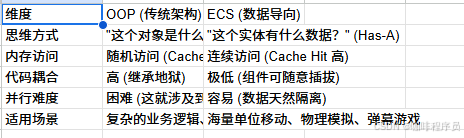
这是 ECS 的核心精髓:内存布局与 CPU 缓存(Cache Locality)。
OOP 的问题:AoS (Array of Structures)
在 OOP 中,你有一个 Player 对象数组。每个对象在堆内存中是散落在不同位置的(虽然数组引用是连续的,但对象本身不是)。 CPU 读取 Player0 时,把整个对象加载到缓存。当你遍历数组只修改 hp 时,CPU 缓存里塞满了不需要的 name, inventory, model 等数据。 结果:大量的 Cache Miss(缓存未命中),CPU 等待内存数据,性能极差
ECS 的优势:SoA (Structure of Arrays)
在 ECS(特别是 Archetype 模式)中,同类组件的数据是紧密连续存储在内存数组中的。 例如,所有人的 Position 数据存放在一个巨大的 float\[\] 数组中。
场景:移动系统需要更新坐标。
过程:CPU 加载 Position 数组。缓存行(Cache Line)里填满的全部是 x, y 数据,没有废数据。
结果:极高的 Cache Hit(缓存命中),加上 CPU 的 SIMD(单指令多数据流)指令优化,性能可以比 OOP 快 10-50 倍。
三、Java 代码实现演示
虽然 Java 的对象头(Object Header)和 GC 机制使得在 Java 中实现极致的内存连续性比 C++/Rust 难,但 ECS 的解耦和并行优势 依然完全适用。
Step 1: 定义组件 (Components)
只包含数据,不包含逻辑。
bash
// 位置组件
class Position {
    public float x, y;
    public Position(float x, float y) { this.x = x; this.y = y; }
}

// 速度组件
class Velocity {
    public float dx, dy;
    public Velocity(float dx, float dy) { this.dx = dx; this.dy = dy; }
}

// 血量组件
class Health {
    public int current;
    public Health(int current) { this.current = current; }
}
Step 2: 定义管理器 (World / Context)
负责存储数据。为了模拟数据导向,我们使用 Map 来分类存储组件(实际高性能 ECS 会使用数组或 ByteBuffer)。
bash
import java.util.*;

class World {
    // 实体 ID 计数器
    private int nextEntityId = 0;

    // 核心存储:组件类型 -> (实体ID -> 组件实例)
    // 这种结构让我们可以快速获取所有拥有某组件的实体
    private Map<Class<?>, Map<Integer, Object>> componentStores = new HashMap<>();

    public int createEntity() {
        return nextEntityId++;
    }

    public <T> void addComponent(int entityId, T component) {
        componentStores.computeIfAbsent(component.getClass(), k -> new HashMap<>())
                       .put(entityId, component);
    }

    // 获取拥有某类型组件的所有数据(模拟 Data Stream)
    @SuppressWarnings("unchecked")
    public <T> Map<Integer, T> getComponents(Class<T> type) {
        return (Map<Integer, T>) componentStores.getOrDefault(type, Collections.emptyMap());
    }
}
Step 3: 定义系统 (Systems)
只包含逻辑,批量处理数据。
java
// 移动系统:只关心 Position 和 Velocity
class MovementSystem {
    public void update(World world, float deltaTime) {
        // 1. 获取所有数据流
        Map<Integer, Position> positions = world.getComponents(Position.class);
        Map<Integer, Velocity> velocities = world.getComponents(Velocity.class);

        // 2. 并不是遍历实体,而是遍历"组件集合"
        // 只有同时拥有 Pos 和 Vel 的实体才会被处理
        for (Integer entityId : positions.keySet()) {
            Velocity vel = velocities.get(entityId);
            if (vel != null) { // 模拟 Join 操作 (Intersection)
                Position pos = positions.get(entityId);

                // 纯数据计算
                pos.x += vel.dx * deltaTime;
                pos.y += vel.dy * deltaTime;
            }
        }
    }
}
Step 4: 运行 ECS
java
public class ECSTest {
    public static void main(String[] args) {
        World world = new World();

        // 创建实体 1 (Player): 有位置、有速度、有血量
        int player = world.createEntity();
        world.addComponent(player, new Position(0, 0));
        world.addComponent(player, new Velocity(1, 0)); // 向右跑
        world.addComponent(player, new Health(100));

        // 创建实体 2 (Tree): 只有位置 (不会移动)
        int tree = world.createEntity();
        world.addComponent(tree, new Position(50, 50));
        // Tree 没有 Velocity 组件,所以 MovementSystem 会自动忽略它

        MovementSystem movementSystem = new MovementSystem();

        // 游戏循环
        for (int i = 0; i < 5; i++) {
            System.out.println("--- Frame " + i + " ---");
            movementSystem.update(world, 1.0f);

            Position pPos = world.getComponents(Position.class).get(player);
            System.out.printf("Player Pos: (%.1f, %.1f)\n", pPos.x, pPos.y);
        }
    }
}
四、ECS 解决了什么冲突?
回到您最初的问题:状态安全(串行) vs 低延迟(并行)。
ECS 天然适合并行化,因为它解决了依赖混乱的问题:
- 数据依赖明确:每个 System 声明了它需要读写哪些组件(例如 MovementSystem 写 Position,读 Velocity)。
- 并行调度:
如果有另一个 RenderSystem 只读取 Position。
调度器可以分析出 MovementSystem 和 RenderSystem 存在数据竞争(一个写一个读),必须串行。
但是!CombatSystem (处理血量) 和 MovementSystem (处理坐标) 操作的是完全不同的组件数组。它们可以在不同的线程上完全并行运行,无需任何锁!
结论:在 ECS 中,您可以轻松实现多线程处理逻辑,只要系统操作的数据不重叠,或者使用"双缓冲"技术(当前帧读,下一帧写)。
总结
什么时候该用 ECS?