一、队列(Queue)
队列的概念:
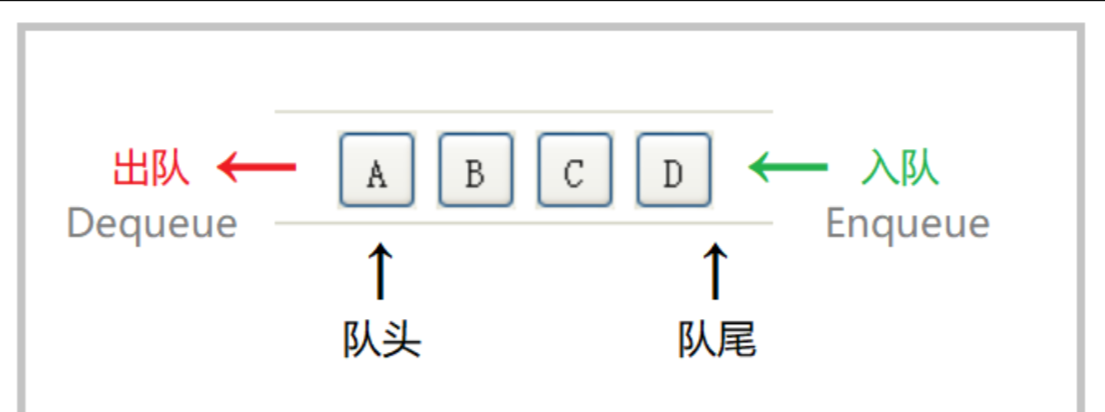
① 队列只允许在一端进行插入数据操作,在另一端进行删除数据操作的特殊线性表。
② 入队列,进行插入 操作的一端称为队尾 。出队列,进行删除 操作的一端称为队头。
③ 队列中的元素遵循先进先出的原则,即 FIFO 原则(First In First Out)
队列的结构:
二、队列的定义
链式队列
cpp
typedef int QueueDataType;   //队列类型

typedef struct QueueNode
{
    struct QueueNode* next;  //指向下一个节点
    QueueDataType data;      //数据
} QueueNode;

typedef struct Queue
{
    QueueNode* pHead;        //头指针
    QueueNode* pTail;        //尾指针
} Queue;
和栈不一样的是,栈使用数组和链表差别不大,只是数组更优。
队列使用数组就很麻烦了,只能使用链表。
为什么定义两个指针?
单链表 我们只定义了一个指针指向头 ,没有定义尾指针 。因为定义尾指针解决不了问题 ,比如尾删和任意位置的插入删除 。(因为即使定义了也找不到尾指针的前一个 )所以我们没有必要定义一个结构体把他们封到一起。这里我们再定义一个头指针 head 一个尾指针 tail ,这两个指针才有意义。因为根据队列的性质 ,我们只会在队尾插入,在队头删除 。所以这个尾指针的价值就得到了完美的体现,实际中定义几个指针是看你的需求确定的。
另外扩展了解一下,实际中我们有时还会使用一种队列叫循环队列。
如操作系统课程讲解生产者消费者模型时可以就会使用循环队列。
环形队列可以使用数组实现 ,也可以使用循环链表实现。
下面的讲解的力扣OJ力扣622题就是设计一种循环队列
三、队列的实现(完整代码)
Queue.h
cpp
#pragma once

#include <stdio.h>
#include <stdlib.h>
#include <assert.h>
#include <stdbool.h>

typedef int QueueDataType;   //队列类型

typedef struct QueueNode
{
    struct QueueNode* next;  //指向下一个节点
    QueueDataType data;      //数据
} QueueNode;

typedef struct Queue//如果不设置成结构体就需要传二级指针,还要传两个参数
{
    QueueNode* pHead;
    QueueNode* pTail;
} Queue;

void QueueInit(Queue* pQ);//初始化队列
void QueueDestroy(Queue* pQ);//销毁队列
bool QueueEmpty(Queue* pQ);//判断队列是否为空
void QueuePush(Queue* pQ, QueueDataType x);//入队
void QueuePop(Queue* pQ);//出队
QueueDataType QueueFront(Queue* pQ);//返回队头数据
QueueDataType QueueBack(Queue* pQ);//返回队尾数据
int QueueSize(Queue* pQ);//返回队列大小
Queue.c
cpp
#include "Queue.h"

void QueueInit(Queue* pQ)
{
    assert(pQ);

    pQ->pHead = pQ->pTail = NULL;
}

void QueueDestroy(Queue* pQ)
{
    assert(pQ);

    QueueNode* cur = pQ->pHead;
    while (cur != NULL)
    {
        QueueNode* curNext = cur->next;  //防止释放cur后找不到其下一个节点
        free(cur);
        cur = curNext;
    }
    pQ->pHead = pQ->pTail = NULL;
}

bool QueueEmpty(Queue* pQ)
{
    assert(pQ);

    return pQ->pHead == NULL;//如果成立则为True,不成立则为False
}

//入队:队尾插入数据,队头出(删)数据。如果是第一个入队的(队列为空)则既要当头又当尾
void QueuePush(Queue* pQ, QueueDataType x)
{
    assert(pQ);

    QueueNode* new_node = (QueueNode*)malloc(sizeof(QueueNode));
    if (new_node == NULL)
    {
        printf("malloc failed!\n");
        exit(-1);
    }
    new_node->data = x;     //待插入的数据
    new_node->next = NULL;  //新的数据指向空

    if (pQ->pHead == NULL)//情况1: 队列为空
    {
        pQ->pHead = pQ->pTail = new_node;
    }
    else //情况2: 队列不为空   队尾入数据
    {
        pQ->pTail->next = new_node;  //在现有尾的后一个节点放置new_node
        pQ->pTail = new_node;        //更新pTail,使它指向新的尾
    }
}

void QueuePop(Queue* pQ) // 出队:队尾入数据,队头出(删)数据
{
    assert(pQ);
    assert(!QueueEmpty(pQ));

    QueueNode* headNext = pQ->pHead->next; //队头出数据,防止释放pHead后找不到其下一个节点
    free(pQ->pHead);
    pQ->pHead = headNext;                  //更新头

    if (pQ->pHead == NULL)//删完之后(队列空了)pHead == NULL 了 pTail 还是野指针
    {
        pQ->pTail = NULL;//处理一下尾指针,将尾指针置空
    }
}

QueueDataType QueueFront(Queue* pQ) //返回队头数据
{
    assert(pQ);
    assert(!QueueEmpty(pQ));

    return pQ->pHead->data;
}

QueueDataType QueueBack(Queue* pQ) //返回队尾数据
{
    assert(pQ);
    assert(!QueueEmpty(pQ));

    return pQ->pTail->data;
}

int QueueSize(Queue* pQ) //返回队列大小
{
    assert(pQ);

    int count = 0;
    QueueNode* cur = pQ->pHead;
    while (cur != NULL)
    {
        count++;
        cur = cur->next;
    }
    return count;
}
Test.c
cpp
#include "Queue.h"

void TestQueue1()
{
    Queue q;
    QueueInit(&q);

    QueuePush(&q, 1);
    QueuePush(&q, 2);
    QueuePush(&q, 3);
    QueuePush(&q, 4);

    QueuePop(&q);
    QueuePop(&q);
    QueuePop(&q);
    QueuePop(&q);
    //QueuePop(&q);

    QueueDestroy(&q);
}

void TestQueue2()
{
    Queue q;
    QueueInit(&q);

    QueuePush(&q, 1);
    QueuePush(&q, 2);
    //QueueDataType front = QueueFront(&q);
    //printf("%d ", front);
    //QueuePop(&q);  //pop掉去下一个

    QueuePush(&q, 3);
    QueuePush(&q, 4);

    //假设先入了1 2,让1出来,再继续入,它的顺序还是不会变。永远保持先进先出
    while (!QueueEmpty(&q))
    {
        QueueDataType front = QueueFront(&q);
        printf("%d ", front);
        QueuePop(&q);  //pop掉去下一个
    }
    printf("\n");

    QueueDestroy(&q);
}

int main(void)
{
    //TestQueue1();
    TestQueue2();
    return 0;
}
四、力扣OJ题
力扣链接:225. 用队列实现栈
难度简单
请你仅使用两个队列实现一个后入先出(LIFO)的栈,
并支持普通栈的全部四种操作(push、top、pop 和 empty)。
实现 MyStack 类:
- void push(int x) 将元素 x 压入栈顶。
- int pop() 移除并返回栈顶元素。
- int top() 返回栈顶元素。
- boolean empty() 如果栈是空的,返回 true ;否则,返回 false 。
注意:
你只能使用队列的基本操作 ------ 也就是 push to back、peek/pop from front、size 和
is empty 这些操作。
你所使用的语言也许不支持队列。 你可以使用 list (链表)或者 deque(双端队列)来模拟一个队列 , 只要是标准的队列操作即可。
示例:
输入:
"MyStack", "push", "push", "top", "pop", "empty"
\[\], \[1\], \[2\], \[\], \[\], \[\]
输出:
null, null, null, 2, 2, false
解释:
MyStack myStack = new MyStack();
myStack.push(1);
myStack.push(2);
myStack.top(); // 返回 2
myStack.pop(); // 返回 2
myStack.empty(); // 返回 False
提示:
- 1 <= x <= 9
- 最多调用100 次 push、pop、top 和 empty
- 每次调用 pop 和 top 都保证栈不为空
(选C给的代码:)
cpp
typedef struct {

} MyStack;


MyStack* myStackCreate() {

}

void myStackPush(MyStack* obj, int x) {

}

int myStackPop(MyStack* obj) {

}

int myStackTop(MyStack* obj) {

}

bool myStackEmpty(MyStack* obj) {

}

void myStackFree(MyStack* obj) {

}

/**
 * Your MyStack struct will be instantiated and called as such:
 * MyStack* obj = myStackCreate();
 * myStackPush(obj, x);

 * int param_2 = myStackPop(obj);

 * int param_3 = myStackTop(obj);

 * bool param_4 = myStackEmpty(obj);

 * myStackFree(obj);
*/
解析代码:
核心思路:
(先入先出转为先入后出)
1.入数据,往不为空的队列入,保持另一个队列为空
2.出数据,依次出队头的数据,转移到另一个队列保存,只剩最后一个时Pop掉
和上一篇栈的OJ题一样,用C++写就很好写,但用C写就要自己创建 栈/队列
把我们刚才写的Queue.h和Queue.c复制粘贴过去后删掉头文件就行了
cpp
typedef int QueueDataType;   //队列类型

typedef struct QueueNode
{
    struct QueueNode* next;  //指向下一个节点
    QueueDataType data;      //数据
} QueueNode;

typedef struct Queue//如果不设置成结构体就需要传二级指针,还要传两个参数
{
    QueueNode* pHead;
    QueueNode* pTail;
} Queue;

void QueueInit(Queue* pQ);//初始化队列
void QueueDestroy(Queue* pQ);//销毁队列
bool QueueEmpty(Queue* pQ);//判断队列是否为空
void QueuePush(Queue* pQ, QueueDataType x);//入队
void QueuePop(Queue* pQ);//出队(删数据)
QueueDataType QueueFront(Queue* pQ);//返回队头数据
QueueDataType QueueBack(Queue* pQ);//返回队尾数据
int QueueSize(Queue* pQ);//返回队列大小

void QueueInit(Queue* pQ)
{
    assert(pQ);

    pQ->pHead = pQ->pTail = NULL;
}

void QueueDestroy(Queue* pQ)
{
    assert(pQ);

    QueueNode* cur = pQ->pHead;
    while (cur != NULL)
    {
        QueueNode* curNext = cur->next;  //防止释放cur后找不到其下一个节点
        free(cur);
        cur = curNext;
    }
    pQ->pHead = pQ->pTail = NULL;
}

bool QueueEmpty(Queue* pQ)
{
    assert(pQ);

    return pQ->pHead == NULL;//如果成立则为True,不成立则为False
}

//入队:队尾插入数据,队头出(删)数据。如果是第一个入队的(队列为空)则既要当头又当尾
void QueuePush(Queue* pQ, QueueDataType x)
{
    assert(pQ);

    QueueNode* new_node = (QueueNode*)malloc(sizeof(QueueNode));
    if (new_node == NULL)
    {
        printf("malloc failed!\n");
        exit(-1);
    }
    new_node->data = x;     //待插入的数据
    new_node->next = NULL;  //新的数据指向空

    if (pQ->pHead == NULL)//情况1: 队列为空
    {
        pQ->pHead = pQ->pTail = new_node;
    }
    else //情况2: 队列不为空   队尾入数据
    {
        pQ->pTail->next = new_node;  //在现有尾的后一个节点放置new_node
        pQ->pTail = new_node;        //更新pTail,使它指向新的尾
    }
}

void QueuePop(Queue* pQ) // 出队:队尾入数据,队头出(删)数据
{
    assert(pQ);
    assert(!QueueEmpty(pQ));

    QueueNode* headNext = pQ->pHead->next; //队头出数据,防止释放pHead后找不到其下一个节点
    free(pQ->pHead);
    pQ->pHead = headNext;                  //更新头

    if (pQ->pHead == NULL)//删完之后(队列空了)pHead == NULL 了 pTail 还是野指针
    {
        pQ->pTail = NULL;//处理一下尾指针,将尾指针置空
    }
}

QueueDataType QueueFront(Queue* pQ) //返回队头数据
{
    assert(pQ);
    assert(!QueueEmpty(pQ));

    return pQ->pHead->data;
}

QueueDataType QueueBack(Queue* pQ) //返回队尾数据
{
    assert(pQ);
    assert(!QueueEmpty(pQ));

    return pQ->pTail->data;
}

int QueueSize(Queue* pQ) //返回队列大小
{
    assert(pQ);

    int count = 0;
    QueueNode* cur = pQ->pHead;
    while (cur != NULL)
    {
        count++;
        cur = cur->next;
    }
    return count;
}

typedef struct {
    Queue q1;
    Queue q2;
} MyStack;


MyStack* myStackCreate() {
    MyStack* st = (MyStack*)malloc(sizeof(MyStack));
    QueueInit(&st->q1);//q1是结构体,还要取地址
    QueueInit(&st->q2);//q2是结构体,还要取地址
    return st;
}

void myStackPush(MyStack* obj, int x) {
    if (!QueueEmpty(&obj->q1))//q1不为空(入到q1)
    {
        QueuePush(&obj->q1, x);
    }
    else//q2不为空(入到q2),或者两个都为空(入到哪都行)
    {
        QueuePush(&obj->q2, x);
    }
}

int myStackPop(MyStack* obj) {
    //题目要求int pop() 移除并返回栈顶元素。
    //法一:
    //if (!QueueEmpty(&obj->q1))//q1不为空,转移到q2保存,只剩最后一个时Pop掉
    //{
    //    while (QueueSize(&obj->q1) > 1)
    //    {
    //        QueuePush(&obj->q2, QueueFront(&obj->q1));//从q1取数据Push到q2
    //        QueuePop(&obj->q1);
    //    }
    //    int ret = QueueFront(&obj->q1);
    //    QueuePop(&obj->q1);//题目要求int pop() 移除并返回栈顶元素。
    //    return ret;
    //}
    //else//q2不为空,转移到q1保存,只剩最后一个时Pop掉
    //{
    //    while (QueueSize(&obj->q2) > 1)
    //    {
    //        QueuePush(&obj->q1, QueueFront(&obj->q2));//从q2取数据Push到q1
    //        QueuePop(&obj->q2);
    //    }
    //    int ret = QueueFront(&obj->q2);
    //    QueuePop(&obj->q2);
    //    return ret;
    //}
    //法二:
    Queue* emptyQ = &obj->q1;//假设q1为空 q2非空
    Queue* nonemptyQ = &obj->q2;
    if (!QueueEmpty(&obj->q1))//假设失败,倒过来
    {
        emptyQ = &obj->q2;
        nonemptyQ = &obj->q1;
    }
    while (QueueSize(nonemptyQ) > 1)
    {
        QueuePush(emptyQ, QueueFront(nonemptyQ));//从非空队列取数据Push到空队列
        QueuePop(nonemptyQ);
    }
    int ret = QueueFront(nonemptyQ);
    QueuePop(nonemptyQ);
    return ret;
}

int myStackTop(MyStack* obj) {
    //题目要求int top() 返回栈顶元素。(队列尾)队列不能删尾,能取尾
    if (!QueueEmpty(&obj->q1))//q1不为空
    {
        return QueueBack(&obj->q1);
    }
    else//q2不为空
    {
        return QueueBack(&obj->q2);
    }
}

bool myStackEmpty(MyStack* obj) {
    return QueueEmpty(&obj->q1) && QueueEmpty(&obj->q2);
}

void myStackFree(MyStack* obj) {
    QueueDestroy(&obj->q1);
    QueueDestroy(&obj->q2);
    free(obj);
}
解析代码:(看题解的思路)(两个队列)
用C++写后看题解,然后用C语言写,穿越回来贴一下:
cpp
typedef int QueueDataType;   //队列类型

typedef struct QueueNode
{
    struct QueueNode* next;  //指向下一个节点
    QueueDataType data;      //数据
} QueueNode;

typedef struct Queue//如果不设置成结构体就需要传二级指针,还要传两个参数
{
    QueueNode* pHead;
    QueueNode* pTail;
} Queue;

void QueueInit(Queue* pQ);//初始化队列
void QueueDestroy(Queue* pQ);//销毁队列
bool QueueEmpty(Queue* pQ);//判断队列是否为空
void QueuePush(Queue* pQ, QueueDataType x);//入队
void QueuePop(Queue* pQ);//出队(删数据)
QueueDataType QueueFront(Queue* pQ);//返回队头数据
QueueDataType QueueBack(Queue* pQ);//返回队尾数据
int QueueSize(Queue* pQ);//返回队列大小

void QueueInit(Queue* pQ)
{
    assert(pQ);

    pQ->pHead = pQ->pTail = NULL;
}

void QueueDestroy(Queue* pQ)
{
    assert(pQ);

    QueueNode* cur = pQ->pHead;
    while (cur != NULL)
    {
        QueueNode* curNext = cur->next;  //防止释放cur后找不到其下一个节点
        free(cur);
        cur = curNext;
    }
    pQ->pHead = pQ->pTail = NULL;
}

bool QueueEmpty(Queue* pQ)
{
    assert(pQ);

    return pQ->pHead == NULL;//如果成立则为True,不成立则为False
}

//入队:队尾入数据,队头出(删)数据。如果是第一个入队的(队列为空)则既要当头又当尾
void QueuePush(Queue* pQ, QueueDataType x)
{
    assert(pQ);

    QueueNode* new_node = (QueueNode*)malloc(sizeof(QueueNode));
    if (new_node == NULL)
    {
        printf("malloc failed!\n");
        exit(-1);
    }
    new_node->data = x;     //待插入的数据
    new_node->next = NULL;  //新的数据指向空

    if (pQ->pHead == NULL)//情况1: 队列为空
    {
        pQ->pHead = pQ->pTail = new_node;
    }
    else //情况2: 队列不为空   队尾入数据
    {
        pQ->pTail->next = new_node;  //在现有尾的后一个节点放置new_node
        pQ->pTail = new_node;        //更新pTail,使它指向新的尾
    }
}

void QueuePop(Queue* pQ) // 出队:队尾入数据,队头出(删)数据
{
    assert(pQ);
    assert(!QueueEmpty(pQ));

    QueueNode* headNext = pQ->pHead->next; //队头出数据,防止释放pHead后找不到其下一个节点
    free(pQ->pHead);
    pQ->pHead = headNext;                  //更新头

    if (pQ->pHead == NULL)//删完之后 pHead == NULL 了 pTail 还是野指针
    {
        pQ->pTail = NULL;//处理一下尾指针,将尾指针置空
    }
}

QueueDataType QueueFront(Queue* pQ) //返回队头数据
{
    assert(pQ);
    assert(!QueueEmpty(pQ));

    return pQ->pHead->data;
}

QueueDataType QueueBack(Queue* pQ) //返回队尾数据
{
    assert(pQ);
    assert(!QueueEmpty(pQ));

    return pQ->pTail->data;
}

int QueueSize(Queue* pQ) //返回队列大小
{
    assert(pQ);

    int count = 0;
    QueueNode* cur = pQ->pHead;
    while (cur != NULL)
    {
        count++;
        cur = cur->next;
    }
    return count;
}

typedef struct {    //C++看题解的思路 push麻烦了点,但其它都简单了
    Queue q1;
    Queue q2;
} MyStack;


MyStack* myStackCreate() {
    MyStack* st = (MyStack*)malloc(sizeof(MyStack));
    QueueInit(&st->q1);//q1是结构体,还要取地址
    QueueInit(&st->q2);//q2是结构体,还要取地址
    return st;
}

void myStackPush(MyStack* obj, int x) {
    /*if (!QueueEmpty(&obj->q1))//q1不为空(入到q1)
    {
        QueuePush(&obj->q1, x);
    }
    else//q2不为空(入到q2),或者两个都为空(入到哪都行)
    {
        QueuePush(&obj->q2, x);
    }*/

    //C++看题解的思路
    QueuePush(&obj->q2, x); // q2入队列
    while (!QueueEmpty(&obj->q1)) // 把q1的元素全入到q2
    {
        QueuePush(&obj->q2, QueueFront(&obj->q1));
        QueuePop(&obj->q1);
    }
    //swap(q1, q2); // 交换q1和q2,保证q1任何时候都是栈的属性
    //没有交换函数,此时q1为空,把q2元素push到q1,然后pop掉q2即可
    while(!QueueEmpty(&obj->q2))
    {
        QueuePush(&obj->q1, QueueFront(&obj->q2));
        QueuePop(&obj->q2);
    }
}

int myStackPop(MyStack* obj) {
    //题目要求int pop() 移除并返回栈顶元素。
    //法一:
    //if (!QueueEmpty(&obj->q1))//q1不为空,转移到q2保存,只剩最后一个时Pop掉
    //{
    //    while (QueueSize(&obj->q1) > 1)
    //    {
    //        QueuePush(&obj->q2, QueueFront(&obj->q1));//从q1取数据Push到q2
    //        QueuePop(&obj->q1);
    //    }
    //    int ret = QueueFront(&obj->q1);
    //    QueuePop(&obj->q1);//题目要求int pop() 移除并返回栈顶元素。
    //    return ret;
    //}
    //else//q2不为空,转移到q1保存,只剩最后一个时Pop掉
    //{
    //    while (QueueSize(&obj->q2) > 1)
    //    {
    //        QueuePush(&obj->q1, QueueFront(&obj->q2));//从q2取数据Push到q1
    //        QueuePop(&obj->q2);
    //    }
    //    int ret = QueueFront(&obj->q2);
    //    QueuePop(&obj->q2);
    //    return ret;
    //}

    //法二:
    /*Queue* emptyQ = &obj->q1;//假设q1为空 q2非空
    Queue* nonemptyQ = &obj->q2;
    if (!QueueEmpty(&obj->q1))//假设失败,倒过来
    {
        emptyQ = &obj->q2;
        nonemptyQ = &obj->q1;
    }
    while (QueueSize(nonemptyQ) > 1)
    {
        QueuePush(emptyQ, QueueFront(nonemptyQ));//从非空队列取数据Push到空队列
        QueuePop(nonemptyQ);
    }
    int ret = QueueFront(nonemptyQ);
    QueuePop(nonemptyQ);
    return ret;*/

    //C++看题解的思路
    int r = QueueFront(&obj->q1);
    QueuePop(&obj->q1);
    return r;
}

int myStackTop(MyStack* obj) {
    //题目要求int top() 返回栈顶元素。(队列尾)队列不能删尾,能取尾
    /*if (!QueueEmpty(&obj->q1))//q1不为空
    {
        return QueueBack(&obj->q1);
    }
    else//q2不为空
    {
        return QueueBack(&obj->q2);
    }*/

    //C++看题解的思路
    return QueueFront(&obj->q1);
}

bool myStackEmpty(MyStack* obj) {
    //return QueueEmpty(&obj->q1) && QueueEmpty(&obj->q2);

    //C++看题解的思路
    return QueueEmpty(&obj->q1);
}

void myStackFree(MyStack* obj) {
    QueueDestroy(&obj->q1);
    QueueDestroy(&obj->q2);
    free(obj);
}
解析代码:(看题解的思路)(一个队列)
使用一个队列时,为了满足栈的特性,即最后入栈的元素最先出栈,同样需要满足队列前端的元素是最后入栈的元素。
入栈操作时,首先获得入栈前的元素个数 n,然后将元素入队到队列,再将队列中的前 n 个元素(即除了新入栈的元素之外的全部元素)依次出队并入队到队列,此时队列的前端的元素即为新入栈的元素,且队列的前端和后端分别对应栈顶和栈底。
由于每次入栈操作都确保队列的前端元素为栈顶元素,因此出栈操作和获得栈顶元素操作都可以简单实现。出栈操作只需要移除队列的前端元素并返回即可,获得栈顶元素操作只需要获得队列的前端元素并返回即可(不移除元素)。
由于队列用于存储栈内的元素,判断栈是否为空时,只需要判断队列是否为空即可。
cpp
typedef int StackDataType;

typedef struct Stack
{
    StackDataType* array;  //数组
    int top;               //栈顶
    int capacity;          //容量
} Stack;

void StackInit(Stack* ps);
void StackDestroy(Stack* ps);
void StackPush(Stack* ps, StackDataType x);
bool StackEmpty(Stack* ps);
void StackPop(Stack* ps);
StackDataType StackTop(Stack* ps);
int StackSize(Stack* ps);

void StackInit(Stack* ps)//初始化
{
    assert(ps);
    ps->array = NULL;
    ps->top = 0;  // ps->top = -1
    ps->capacity = 0;
}

void StackDestroy(Stack* ps)//销毁
{
    assert(ps);

    free(ps->array);
    ps->array = NULL;
    ps->capacity = ps->top = 0;
}

void StackPush(Stack* ps, StackDataType x)//进栈
{
    assert(ps);
    if (ps->top == ps->capacity)
    {
        int new_capacity = ps->capacity == 0 ? 4 : ps->capacity * 2;
        StackDataType* tmp_arr =(StackDataType *) realloc(ps->array, sizeof(StackDataType) * new_capacity);
        if (tmp_arr == NULL)
        {
            printf("realloc failed!\n");
            exit(-1);
        }
        // 更新
        ps->array = tmp_arr;
        ps->capacity = new_capacity;
    }

    ps->array[ps->top] = x;// 填入数据
    ps->top++;
}

bool StackEmpty(Stack* ps)//判断栈是否为空
{
    assert(ps);

    return ps->top == 0; //等于0就是空,就是真
}

void StackPop(Stack* ps)// 出栈
{
    assert(ps);
    //assert(ps->top > 0);  //防止top为空
    assert(!StackEmpty(ps));

    ps->top--;
}

StackDataType StackTop(Stack* ps)//返回栈顶数据
{
    assert(ps);
    //assert(ps->top > 0);  //防止top为空
    assert(!StackEmpty(ps));

    return ps->array[ps->top - 1];
}

int StackSize(Stack* ps) //计算栈的大小
{
    assert(ps);

    return ps->top;// 因为我们设定top是指向栈顶的下一个,所以top就是size
}

typedef struct {
    Stack pushST;
    Stack popST;
} MyQueue;


MyQueue* myQueueCreate() {
    MyQueue* q = (MyQueue*)malloc(sizeof(MyQueue));
    StackInit(&q->pushST);
    StackInit(&q->popST);

    return q;
}

void myQueuePush(MyQueue* obj, int x) {
    StackPush(&obj->pushST, x);
}

int myQueuePop(MyQueue* obj) {
    //int pop() 从队列的开头移除并返回元素
    //如果popST中没有数据,就把pushST的数据拿过去
    //这样popST的数据就符合先进先出了
    if (StackEmpty(&obj->popST))
    {
        while (!StackEmpty(&obj->pushST))
        {
            StackPush(&obj->popST, StackTop(&obj->pushST));
            StackPop(&obj->pushST);
        }
    }
    //有数据就直接出(删后返回)
    int ret = StackTop(&obj->popST);
    StackPop(&obj->popST);
    return ret;
}

int myQueuePeek(MyQueue* obj) {
    //int peek() 返回队列开头的元素
    //如果popST中没有数据,就把pushST的数据拿过去
    if (StackEmpty(&obj->popST))
    {
        while (!StackEmpty(&obj->pushST))
        {
            StackPush(&obj->popST, StackTop(&obj->pushST));
            StackPop(&obj->pushST);
        }
    }
    return StackTop(&obj->popST);//不删,直接取
}

bool myQueueEmpty(MyQueue* obj) {
    return StackEmpty(&obj->pushST) && StackEmpty(&obj->popST);
}

void myQueueFree(MyQueue* obj) {
    StackDestroy(&obj->pushST);
    StackDestroy(&obj->popST);
    free(obj);
}

/**
 * Your MyQueue struct will be instantiated and called as such:
 * MyQueue* obj = myQueueCreate();
 * myQueuePush(obj, x);

 * int param_2 = myQueuePop(obj);

 * int param_3 = myQueuePeek(obj);

 * bool param_4 = myQueueEmpty(obj);

 * myQueueFree(obj);
*/力扣链接:622. 设计循环队列
难度中等
设计你的循环队列实现。 循环队列是一种线性数据结构,其操作表现基于 FIFO(先进先出)原则并且队尾被连接在队首之后以形成一个循环。它也被称为"环形缓冲器"。
循环队列的一个好处是我们可以利用这个队列之前用过的空间。在一个普通队列里,一旦一个队列满了,我们就不能插入下一个元素,即使在队列前面仍有空间。但是使用循环队列,我们能使用这些空间去存储新的值。
你的实现应该支持如下操作:
- MyCircularQueue(k): 构造器,设置队列长度为 k 。
- Front: 从队首获取元素。如果队列为空,返回 -1 。
- Rear: 获取队尾元素。如果队列为空,返回 -1 。
- enQueue(value): 向循环队列插入一个元素。如果成功插入则返回真。
- deQueue(): 从循环队列中删除一个元素。如果成功删除则返回真。
- isEmpty(): 检查循环队列是否为空。
- isFull(): 检查循环队列是否已满。
示例:
MyCircularQueue circularQueue = new MyCircularQueue(3); // 设置长度为 3
circularQueue.enQueue(1); // 返回 true
circularQueue.enQueue(2); // 返回 true
circularQueue.enQueue(3); // 返回 true
circularQueue.enQueue(4); // 返回 false,队列已满
circularQueue.Rear(); // 返回 3
circularQueue.isFull(); // 返回 true
circularQueue.deQueue(); // 返回 true
circularQueue.enQueue(4); // 返回 true
circularQueue.Rear(); // 返回 4
提示:
- 所有的值都在 0 至 1000 的范围内;
- 操作数将在 1 至 1000 的范围内;
- 请不要使用内置的队列库。
cpptypedef struct { } MyCircularQueue; MyCircularQueue* myCircularQueueCreate(int k) { } bool myCircularQueueEnQueue(MyCircularQueue* obj, int value) { } bool myCircularQueueDeQueue(MyCircularQueue* obj) { } int myCircularQueueFront(MyCircularQueue* obj) { } int myCircularQueueRear(MyCircularQueue* obj) { } bool myCircularQueueIsEmpty(MyCircularQueue* obj) { } bool myCircularQueueIsFull(MyCircularQueue* obj) { } void myCircularQueueFree(MyCircularQueue* obj) { } /** * Your MyCircularQueue struct will be instantiated and called as such: * MyCircularQueue* obj = myCircularQueueCreate(k); * bool param_1 = myCircularQueueEnQueue(obj, value); * bool param_2 = myCircularQueueDeQueue(obj); * int param_3 = myCircularQueueFront(obj); * int param_4 = myCircularQueueRear(obj); * bool param_5 = myCircularQueueIsEmpty(obj); * bool param_6 = myCircularQueueIsFull(obj); * myCircularQueueFree(obj); */
这道题用数组 和链表 都能实现,各有优劣
要注意下面的判空和判满问题:
判空和判满问题可以使用添加一个size解决,但比较官方是多开一个空间:
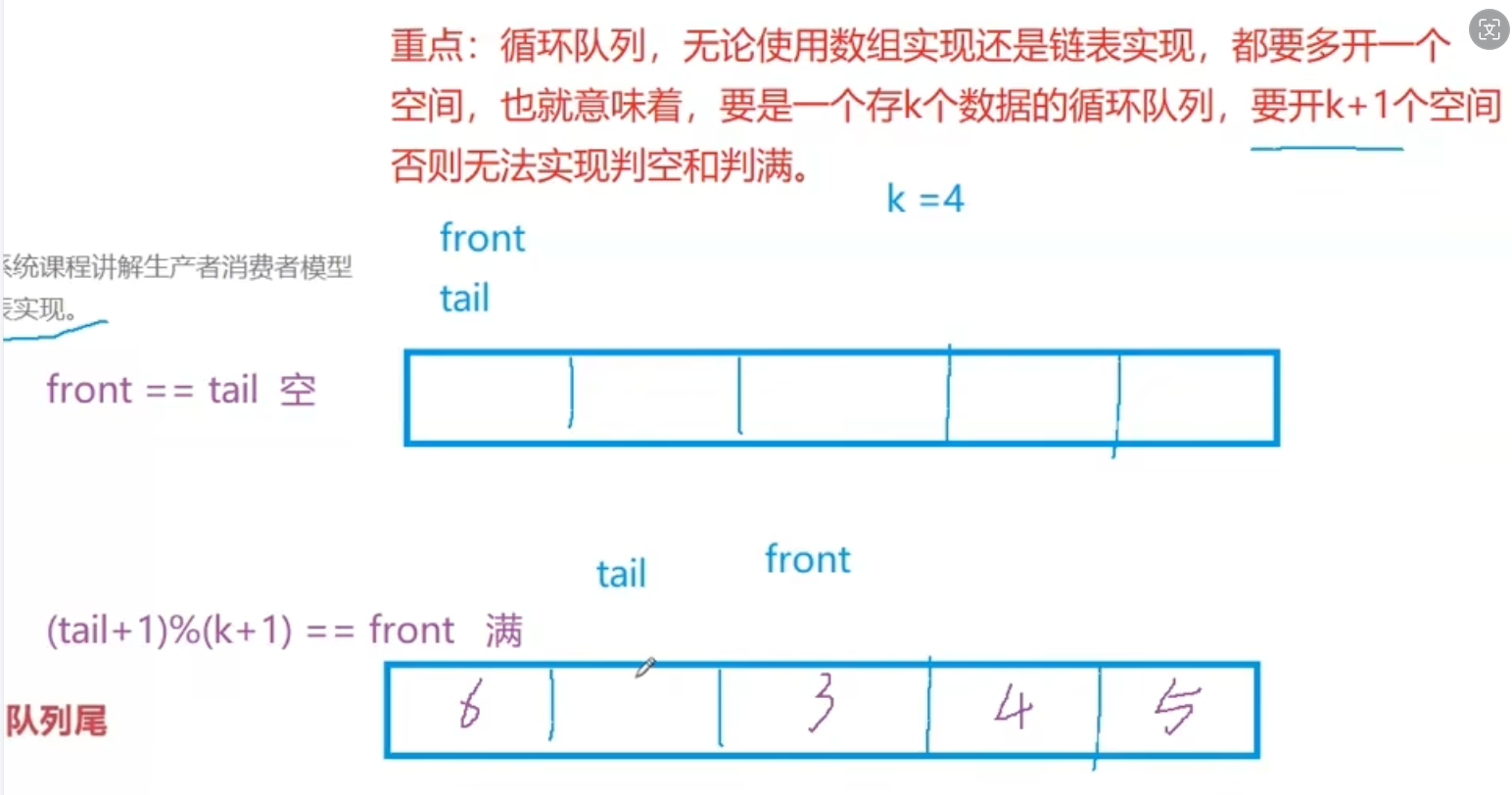
【0】 【1】 【2】 【3】 【4】
一般情况tail+1等于front 如上面tail 是【1】,front是【2】(1+1)%(4+1)==2也是满
但是如果tail是【4】,front是【0】,tail+1等于front就不能判断
用上面的公式(4+1)%(4+1)==0 就是满
链表空的情况和上面一样,满的情况是这样:
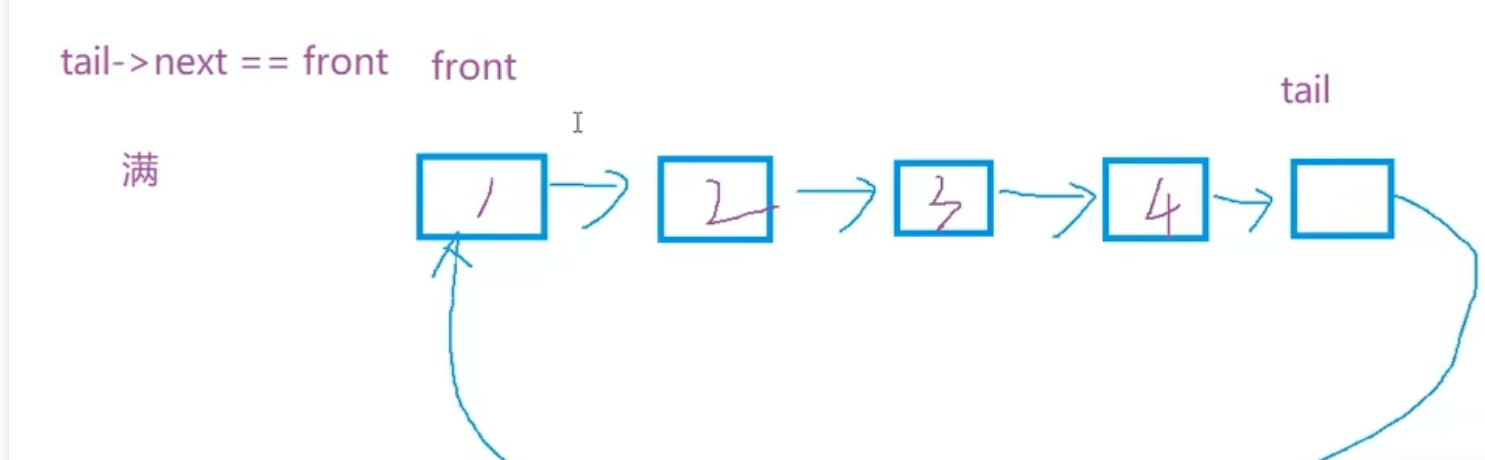
数组实现 函数bool myCircularQueueDeQueue(MyCircularQueue* obj)的图:
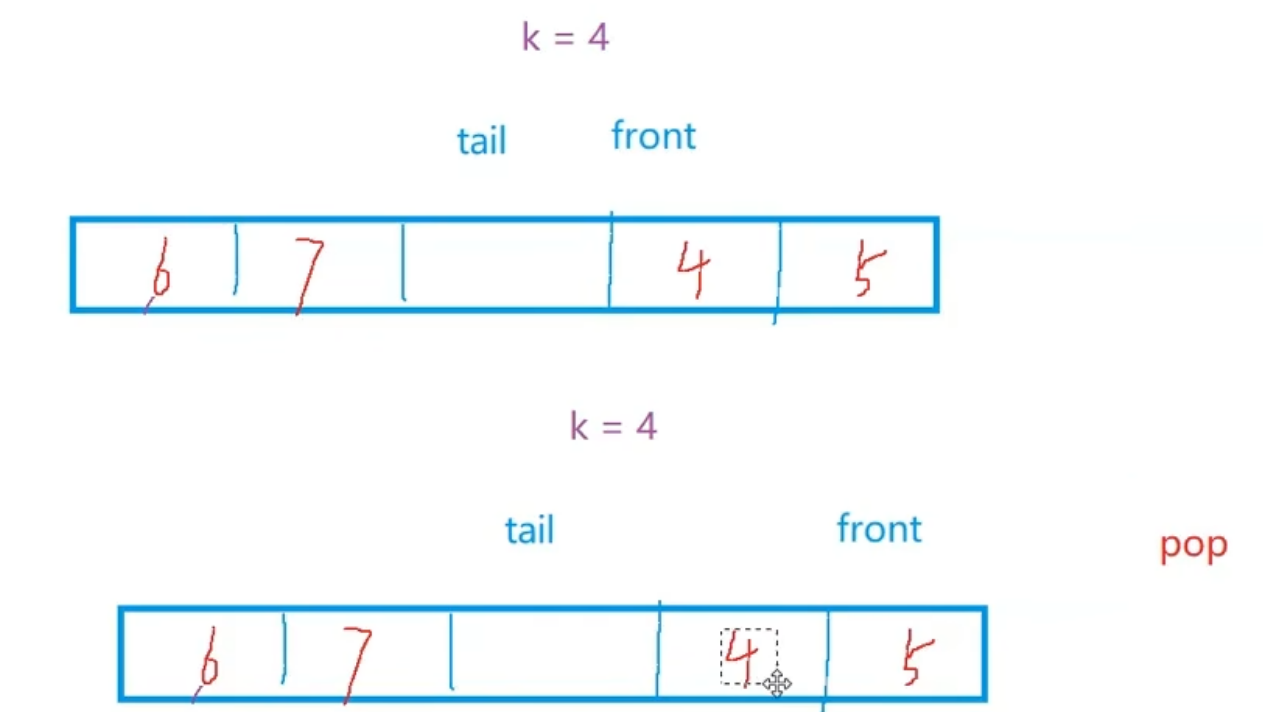
数组实现的代码:(有空可以写写链表实现的)
cpp
typedef struct {
    //匿名结构体
    int* arr;
    int front;
    int tail;
    int k;
} MyCircularQueue;
bool myCircularQueueIsEmpty(MyCircularQueue* obj);//可以先实现这两个 声明后下面可以用
bool myCircularQueueIsFull(MyCircularQueue* obj);

MyCircularQueue* myCircularQueueCreate(int k) {
    MyCircularQueue* cq = (MyCircularQueue*)malloc(sizeof(MyCircularQueue));
    //OJ题一般都会开辟空间成功,不用判空了
    cq->arr = (int*)malloc(sizeof(int) * (k + 1));//初始化 开k+1个空间
    cq->front = cq->tail = 0;
    cq->k = k;
    return cq;
}

bool myCircularQueueEnQueue(MyCircularQueue* obj, int value) {
    //enQueue(value): 向循环队列插入一个元素。如果成功插入则返回真。
    //(失败返回假)满了就失败
    //先滑到下面实现myCircularQueueIsFull和myCircularQueueIsEmpty,记得在上面声明
    if (myCircularQueueIsFull(obj))
    {
        return false;
    }
    obj->arr[obj->tail] = value;
    obj->tail++;
    obj->tail %= (obj->k + 1);//超出k+1就模到0从头开始,没超,模和没模一样
    return true;
}

bool myCircularQueueDeQueue(MyCircularQueue* obj) {
    //deQueue(): 从循环队列中删除一个元素。如果成功删除则返回真。
    if (myCircularQueueIsEmpty(obj))
    {
        return false;
    }
    obj->front++;  //不理解可以看上面的图
    obj->front %= (obj->k + 1); //超出k+1就模到0从头开始,没超,模和没模一样
    return true;
}

int myCircularQueueFront(MyCircularQueue* obj) {
    //Front: 从队首获取元素。如果队列为空,返回 -1 。
    if (myCircularQueueIsEmpty(obj))
    {
        return -1;
    }
    return obj->arr[obj->front];
}

int myCircularQueueRear(MyCircularQueue* obj) {
    //Rear: 获取队尾元素。如果队列为空,返回 -1 。
    if (myCircularQueueIsEmpty(obj))
    {
        return -1;
    }
    if (obj->tail == 0)//如果tail在0上,返回tail的上一个就是k
    {
        return obj->arr[obj->k];
    }
    else
    {
        return obj->arr[obj->tail - 1];
    }
}

bool myCircularQueueIsEmpty(MyCircularQueue* obj) {
    return obj->front == obj->tail; //看上面图的判空和判满条件
}

bool myCircularQueueIsFull(MyCircularQueue* obj) {
    return (obj->tail + 1) % (obj->k + 1) == obj->front;
}

void myCircularQueueFree(MyCircularQueue* obj) {
    free(obj->arr);
    free(obj);      //有两层  结构体里面有个数组
}
第三章完。
这一章大作业就是自己实现一个栈和队列。
下一章:树和二叉树。