- 导入与初始化
bash
from __future__ import unicode_literals, print_function, division  # 确保Python 2/3兼容性
from io import open  # 解决文件编码问题
import unicodedata  # 处理Unicode字符
import string  # 字符集操作
import re  # 正则表达式
import random  # 随机数生成

import torch  # PyTorch核心库
import torch.nn as nn  # 神经网络模块
from torch import optim  # 优化器
import torch.nn.functional as F  # 功能函数(如softmax)

# 设置设备(GPU优先,无GPU则用CPU)
device = torch.device("cuda" if torch.cuda.is_available() else "cpu")
print(device) # 输出当前设备(如 cuda:0 或 cpu)- 语言处理类(Lang)
bash
class Lang:
    def __init__(self, name):
        self.name = name  # 语言名称(如 'eng')
        self.word2index = {}  # 词 -> 索引(如 "hello" -> 5)
        self.word2count = {}  # 词 -> 出现次数(用于构建词汇表)
        self.index2word = {0: "SOS", 1: "EOS"}  # 索引 -> 词(SOS=开始, EOS=结束)
        self.n_words = 2  # 词汇表大小(初始包含SOS/EOS)

    def addSentence(self, sentence):
        # 将句子拆分为单词,逐个添加到词汇表
        for word in sentence.split(' '):
            self.addWord(word)  # 调用addWord处理单个词

    def addWord(self, word):
        # 如果词不在词汇表中,添加并初始化计数
        if word not in self.word2index:
            self.word2index[word] = self.n_words
            self.word2count[word] = 1
            self.index2word[self.n_words] = word
            self.n_words += 1
        else:
self.word2count[word] += 1 # 已存在词,计数+1- 文本预处理函数
3.1 Unicode转ASCII
bash
def unicodeToAscii(s):
    # 将Unicode字符(如 é)转为ASCII(如 e)
    # unicodedata.normalize('NFD', s):分解字符(如 é -> e + ̌)
    # category(c) != 'Mn':过滤掉非字母符号(如重音符号)
    return ''.join(
        c for c in unicodedata.normalize('NFD', s)
        if unicodedata.category(c) != 'Mn'
    )
3.2 文本标准化
bash
def normalizeString(s):
    # 1. 转小写 + 去前后空格
    s = unicodeToAscii(s.lower().strip())
    # 2. 用空格分隔标点(如 "Hello!" -> "Hello !")
    s = re.sub(r"([.!?])", r" \1", s)
    # 3. 移除非字母/标点字符(保留a-zA-Z.!?)
    s = re.sub(r"[^a-zA-Z.!?]+", r" ", s)
return s- 数据加载与过滤
4.1 读取语料库
bash
def readLangs(lang1, lang2, reverse=False):
    print("Reading lines...")

    # 读取文件(如 'eng-fra.txt'),按行分割
    lines = open('%s-%s.txt'%(lang1,lang2), encoding='utf-8').read().strip().split('\n')

    # 每行按制表符分割成 [源语言, 目标语言]
    pairs = [[normalizeString(s) for s in l.split('\t')] for l in lines]

    # 创建语言对象(根据是否反转语言顺序)
    if reverse:
        pairs = [list(reversed(p)) for p in pairs]  # 交换源/目标语言
        input_lang  = Lang(lang2)  # 输入语言 = 目标语言
        output_lang = Lang(lang1)  # 输出语言 = 源语言
    else:
        input_lang  = Lang(lang1)  # 输入语言 = 源语言
        output_lang = Lang(lang2)  # 输出语言 = 目标语言

    return input_lang, output_lang, pairs
4.2 过滤语料
bash
MAX_LENGTH = 10  # 最大句子长度(超过则丢弃)

eng_prefixes = (
    "i am ", "i m ",
    "he is", "he s ",
    "she is", "she s ",
    "you are", "you re ",
    "we are", "we re ",
    "they are", "they re "
)

def filterPair(p):
    # 条件1: 源句长度 < MAX_LENGTH
    # 条件2: 目标句长度 < MAX_LENGTH
    # 条件3: 目标句以指定前缀开头(如 "i am" -> "je suis")
    return len(p[0].split(' ')) < MAX_LENGTH and \
           len(p[1].split(' ')) < MAX_LENGTH and p[1].startswith(eng_prefixes)

def filterPairs(pairs):
    return [pair for pair in pairs if filterPair(pair)]  # 保留符合条件的pair
4.3 数据预处理
bash
def prepareData(lang1, lang2, reverse=False):
    input_lang, output_lang, pairs = readLangs(lang1, lang2, reverse)
    print("Read %s sentence pairs" % len(pairs))

    # 应用过滤器
    pairs = filterPairs(pairs[:])  # [:] 防止修改原列表
    print("Trimmed to %s sentence pairs" % len(pairs))

    # 将所有句子添加到语言对象中(构建词汇表)
    for pair in pairs:
        input_lang.addSentence(pair[0])  # 源句
        output_lang.addSentence(pair[1])  # 目标句

    print("Counted words:")
    print(input_lang.name, input_lang.n_words)  # 源语言词汇量
    print(output_lang.name, output_lang.n_words)  # 目标语言词汇量

return input_lang, output_lang, pairs- 模型架构
5.1 编码器(EncoderRNN)
bash
class EncoderRNN(nn.Module):
    def __init__(self, input_size, hidden_size):
        super(EncoderRNN, self).__init__()
        self.hidden_size = hidden_size  # 隐藏层维度
        self.embedding = nn.Embedding(input_size, hidden_size)  # 词嵌入层
        self.gru = nn.GRU(hidden_size, hidden_size)  # GRU单元(输入/输出维度=hidden_size)

    def forward(self, input, hidden):
        # 1. 词嵌入: [1] -> [1, hidden_size]
        embedded = self.embedding(input).view(1, 1, -1)  # 重塑为(batch=1, seq_len=1, hidden_size)
        # 2. 通过GRU: 输出[1,1,hidden_size], 隐藏状态[1,1,hidden_size]
        output, hidden = self.gru(embedded, hidden)
        return output, hidden

    def initHidden(self):
        # 初始化隐藏状态(全0张量)
        return torch.zeros(1, 1, self.hidden_size, device=device)
5.2 注意力解码器(AttnDecoderRNN)
bash
class AttnDecoderRNN(nn.Module):
    def __init__(self, hidden_size, output_size, dropout_p=0.1, max_length=MAX_LENGTH):
        super(AttnDecoderRNN, self).__init__()
        self.hidden_size = hidden_size
        self.output_size = output_size  # 目标词汇表大小
        self.dropout_p = dropout_p
        self.max_length = max_length

        # 层定义
        self.embedding = nn.Embedding(self.output_size, self.hidden_size)  # 目标词嵌入
        self.attn = nn.Linear(self.hidden_size * 2, self.max_length)  # 注意力权重计算
        self.attn_combine = nn.Linear(self.hidden_size * 2, self.hidden_size)  # 注意力加权后融合
        self.dropout = nn.Dropout(self.dropout_p)
        self.gru = nn.GRU(self.hidden_size, self.hidden_size)
        self.out = nn.Linear(self.hidden_size, self.output_size)  # 输出层

    def forward(self, input, hidden, encoder_outputs):
        # 1. 词嵌入 + Dropout
        embedded = self.embedding(input).view(1, 1, -1)
        embedded = self.dropout(embedded)

        # 2. 计算注意力权重
        # 输入: [hidden_size] (当前隐藏状态) + [hidden_size] (嵌入词) -> [hidden_size*2]
        # 通过self.attn -> [max_length] (每个编码器输出的权重)
        attn_weights = F.softmax(self.attn(torch.cat((embedded[0], hidden[0]), 1)), dim=1)

        # 3. 加权求和(用注意力权重加权编码器输出)
        # attn_weights: [1, max_length] -> [1, 1, max_length]
        # encoder_outputs: [max_length, hidden_size] -> [1, max_length, hidden_size]
        attn_applied = torch.bmm(attn_weights.unsqueeze(0), encoder_outputs.unsqueeze(0))  # [1,1,hidden_size]

        # 4. 融合嵌入词 + 注意力输出
        output = torch.cat((embedded[0], attn_applied[0]), 1)  # [1, hidden_size*2]
        output = self.attn_combine(output).unsqueeze(0)  # [1,1,hidden_size]

        # 5. 通过GRU和输出层
        output = F.relu(output)
        output, hidden = self.gru(output, hidden)
        output = F.log_softmax(self.out(output[0]), dim=1)  # [output_size]

        return output, hidden, attn_weights  # 注意力权重用于可视化

    def initHidden(self):
return torch.zeros(1, 1, self.hidden_size, device=device)- 数据转换函数
bash
def indexesFromSentence(lang, sentence):
    # 将句子转为词汇索引列表(如 "hello world" -> [5, 12])
    return [lang.word2index[word] for word in sentence.split(' ')]

def tensorFromSentence(lang, sentence):
    # 1. 获取索引列表
    indexes = indexesFromSentence(lang, sentence)
    # 2. 添加EOS标记(结束符)
    indexes.append(EOS_token)
    # 3. 转为张量 (seq_len, 1) 用于批次处理
    return torch.tensor(indexes, dtype=torch.long, device=device).view(-1, 1)

def tensorsFromPair(pair):
    # 将pair转为编码器输入和解码器目标
    input_tensor = tensorFromSentence(input_lang, pair[0])
    target_tensor = tensorFromSentence(output_lang, pair[1])
return (input_tensor, target_tensor)- 训练循环
7.1 单轮训练(含教师强制)
bash
teacher_forcing_ratio = 0.5  # 教师强制概率(50%用真实目标,50%用模型预测)

def train(input_tensor, target_tensor, encoder, decoder, encoder_optimizer, decoder_optimizer, criterion, max_length=MAX_LENGTH):
    # 1. 初始化编码器隐藏状态
    encoder_hidden = encoder.initHidden()

    # 2. 清空梯度
    encoder_optimizer.zero_grad()
    decoder_optimizer.zero_grad()

    input_length = input_tensor.size(0)  # 源句长度
    target_length = target_tensor.size(0)  # 目标句长度

    # 3. 初始化编码器输出(全0张量)
    encoder_outputs = torch.zeros(max_length, encoder.hidden_size, device=device)

    loss = 0  # 累计损失

    # 4. 编码器前向传播
    for ei in range(input_length):
        encoder_output, encoder_hidden = encoder(input_tensor[ei], encoder_hidden)
        encoder_outputs[ei] = encoder_output[0, 0]  # 保存每个时间步的输出

    # 5. 解码器初始化
    decoder_input = torch.tensor([[SOS_token]], device=device)  # SOS作为初始输入
    decoder_hidden = encoder_hidden  # 用编码器最终隐藏状态

    # 6. 教师强制决策
    use_teacher_forcing = True if random.random() < teacher_forcing_ratio else False

    if use_teacher_forcing:
        # 教师强制:用真实目标词作为下一轮输入
        for di in range(target_length):
            decoder_output, decoder_hidden, _ = decoder(
                decoder_input, decoder_hidden, encoder_outputs)
            loss += criterion(decoder_output, target_tensor[di])  # 计算损失
            decoder_input = target_tensor[di]  # 下一轮输入 = 真实目标词
    else:
        # 无教师强制:用模型预测的词作为下一轮输入
        for di in range(target_length):
            decoder_output, decoder_hidden, _ = decoder(
                decoder_input, decoder_hidden, encoder_outputs)
            loss += criterion(decoder_output, target_tensor[di])

            # 获取预测词的索引(top1)
            topv, topi = decoder_output.topk(1)
            decoder_input = topi.squeeze().detach()  # 丢弃梯度(不参与反向传播)

            # 如果预测到EOS,提前结束
            if decoder_input.item() == EOS_token:
                break

    # 7. 反向传播 + 优化
    loss.backward()
    encoder_optimizer.step()
    decoder_optimizer.step()

    return loss.item() / target_length  # 平均损失
7.2 训练迭代主循环
bash
def trainIters(encoder, decoder, n_iters, print_every=1000, plot_every=100, learning_rate=0.01):
    start = time.time()
    plot_losses = []  # 记录损失用于绘图
    print_loss_total = 0
    plot_loss_total = 0

    # 初始化优化器(SGD)
    encoder_optimizer = optim.SGD(encoder.parameters(), lr=learning_rate)
    decoder_optimizer = optim.SGD(decoder.parameters(), lr=learning_rate)

    # 从语料库随机抽取n_iters个样本
    training_pairs = [tensorsFromPair(random.choice(pairs)) for _ in range(n_iters)]
    criterion = nn.NLLLoss()  # 负对数似然损失(适合分类任务)

    for iter in range(1, n_iters + 1):
        training_pair = training_pairs[iter - 1]
        input_tensor, target_tensor = training_pair

        # 执行单轮训练
        loss = train(input_tensor, target_tensor, encoder, decoder,
                    encoder_optimizer, decoder_optimizer, criterion)

        # 累计损失
        print_loss_total += loss
        plot_loss_total += loss

        # 每print_every轮打印损失
        if iter % print_every == 0:
            print_loss_avg = print_loss_total / print_every
            print_loss_total = 0
            print('%s (%d %d%%) %.4f' % (
                timeSince(start, iter / n_iters),  # 已用时间
                iter, iter / n_iters * 100,  # 进度百分比
                print_loss_avg  # 平均损失
            ))

        # 每plot_every轮记录损失(用于绘图)
        if iter % plot_every == 0:
            plot_loss_avg = plot_loss_total / plot_every
            plot_losses.append(plot_loss_avg)
            plot_loss_total = 0

return plot_losses # 返回损失列表- 评估与可视化
8.1 评估函数
bash
def evaluate(encoder, decoder, sentence, max_length=MAX_LENGTH):
    with torch.no_grad():  # 禁用梯度计算(评估时不需要)
        input_tensor = tensorFromSentence(input_lang, sentence)
        input_length = input_tensor.size()[0]

        # 初始化编码器
        encoder_hidden = encoder.initHidden()
        encoder_outputs = torch.zeros(max_length, encoder.hidden_size, device=device)

        # 编码器前向
        for ei in range(input_length):
            encoder_output, encoder_hidden = encoder(input_tensor[ei], encoder_hidden)
            encoder_outputs[ei] += encoder_output[0, 0]  # 累加输出

        # 解码器初始化
        decoder_input = torch.tensor([[SOS_token]], device=device)
        decoder_hidden = encoder_hidden
        decoded_words = []  # 保存预测词
        decoder_attentions = torch.zeros(max_length, max_length)  # 注意力权重矩阵

        # 解码过程
        for di in range(max_length):
            decoder_output, decoder_hidden, decoder_attention = decoder(
                decoder_input, decoder_hidden, encoder_outputs)

            # 记录注意力权重
            decoder_attentions[di] = decoder_attention.data
            topv, topi = decoder_output.data.topk(1)  # 选最高概率词

            # 如果预测到EOS,停止
            if topi.item() == EOS_token:
                decoded_words.append('<EOS>')
                break
            else:
                decoded_words.append(output_lang.index2word[topi.item()])

            decoder_input = topi.squeeze().detach()  # 用预测词作为下一轮输入

        return decoded_words, decoder_attentions[:di + 1]  # 截断到实际长度
8.2 随机评估
bash
def evaluateRandomly(encoder, decoder, n=5):
    for i in range(n):
        pair = random.choice(pairs)
        print('>', pair[0])  # 源句
        print('=', pair[1])  # 真实目标
        output_words, _ = evaluate(encoder, decoder, pair[0])
        output_sentence = ' '.join(output_words)
print('<', output_sentence) # 预测结果- 模型训练与评估
bash
# 模型参数
hidden_size = 256
encoder1 = EncoderRNN(input_lang.n_words, hidden_size).to(device)
attn_decoder1 = AttnDecoderRNN(hidden_size, output_lang.n_words, dropout_p=0.1).to(device)

# 训练10000轮
plot_losses = trainIters(encoder1, attn_decoder1, 10000, print_every=5000)

# 随机评估5个样本
evaluateRandomly(encoder1, attn_decoder1)

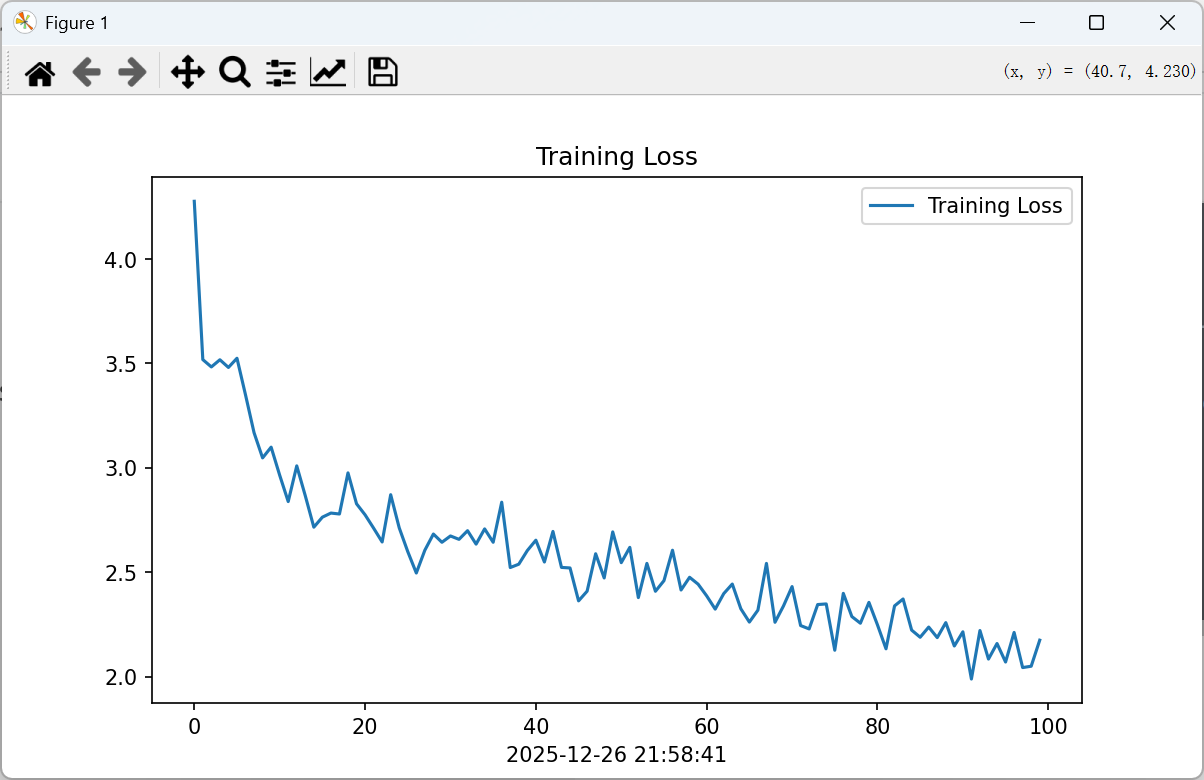
# 保存训练损失图
import matplotlib.pyplot as plt
import warnings
warnings.filterwarnings("ignore")  # 忽略警告

# 设置中文显示(可选)
plt.rcParams['axes.unicode_minus'] = False

# 绘制损失曲线
epochs_range = range(len(plot_losses))
plt.figure(figsize=(8, 3))
plt.plot(epochs_range, plot_losses, label='Training Loss')
plt.legend(loc='upper right')
plt.title('Training Loss')
plt.xlabel(datetime.datetime.now().strftime('%Y-%m-%d %H:%M:%S'))  # 当前时间
plt.show()