目录
[unordered_set 使用](#unordered_set 使用)
[unordered_map 使用](#unordered_map 使用)
[unordered_set 与 unordered_map 模拟实现](#unordered_set 与 unordered_map 模拟实现)
[unordered_set 和 unordered_map 提供迭代器接口](#unordered_set 和 unordered_map 提供迭代器接口)
[unordered_map 的 接口](#unordered_map 的 [ ] 接口)
前置知识:数据结构(十一) 哈希表
unordered_set 使用
cpp
#include <iostream>
#include <unordered_set>
using namespace std;

void test1()
{
	unordered_set<int> st;
	st.insert(1);
	st.insert(3);
	st.insert(2);
	st.insert(4);
	unordered_set<int>::iterator it = st.begin();
	while (it != st.end())
	{
		cout << *it << " ";
		++it;
	}
	cout << endl;
	it = st.find(3);
	if (it != st.end())
		cout << *it << "存在" << endl;
	st.erase(1);
	if (st.count(1))
		cout << "1存在" << endl;
}

// unordered_set 的负载因子最大是1
void test2()
{
	unordered_set<int> st;
	st.insert(1);
	st.insert(3);
	st.insert(2);
	st.insert(4);
	cout << st.load_factor() << endl; //0.5
	cout << st.max_load_factor() << endl; //1
	st.insert(6);
	st.insert(8);
	cout << st.load_factor() << endl; //0.75
	cout << st.max_load_factor() << endl; //1
	st.insert(5);
	st.insert(7);
	cout << st.load_factor() << endl; //1
	cout << st.max_load_factor() << endl; //1
}

void test3()
{
	unordered_set<int> st;
	for (int i = 0; i < 100000; i++)
		st.insert(rand() + i);

	cout << "当前桶数: " << st.bucket_count() << endl;
	cout << "最大桶数: " << st.max_bucket_count() << endl;

	// 安全的检查桶大小
	if (33 < st.bucket_count())
	{
		cout << "33号桶的大小: " << st.bucket_size(33) << endl;
	}

	// 安全的查找元素33
	auto it = st.find(33);
	if (it != st.end())
	{
		cout << "元素33在桶" << st.bucket(33) << "中" << endl;
	}
	else
	{
		cout << "元素33不存在" << endl;
	}
}

int main()
{
	test1();
	test2();
	test3();
	return 0;
}
unordered_map 使用
cpp
#include <iostream>
#include <unordered_map>
using namespace std;

void test1()
{
	unordered_map<int, int> mp;
	mp.insert(make_pair(1, 1));
	mp.insert(make_pair(5, 5));
	mp.insert(make_pair(2, 2));
	mp.insert(make_pair(4, 4));
	mp.insert(make_pair(3, 3));
	unordered_map<int, int>::iterator it = mp.begin();
	while (it != mp.end())
	{
		cout << it->first << ":" << it->second << endl;
		it++;
	}

	it = mp.find(3);
	if (it != mp.end())
	{
		cout << "找到了 " << it->first << ":" << it->second << endl;
	}
	mp.erase(it);
	if (!mp.count(3))
	{
		cout << "没有找到3" << endl;
	}
	mp[3] = 5;
	cout << mp[3] << endl;
}

void test2()
{
	string arr[] = { "香蕉", "甜瓜","苹果", "西瓜", "苹果", "西瓜", "苹果", "苹果", "西瓜", "苹果", "香蕉", "苹果", "香蕉" };
	unordered_map<string, int> mp;
	for (auto& e : arr)
	{
		unordered_map<string, int>::iterator ret = mp.find(e);
		if (ret != mp.end())
		{
			ret->second++;
		}
		else
		{
			mp.insert(make_pair(e, 1));
		}
	}
	for (auto& e : mp)
	{
		cout << e.first << " " << e.second << endl;
	}
}

int main()
{
	test1();
	test2();
	return 0;
}
unordered_set 与 unordered_map 模拟实现
前置知识:STL(六) set 与 map 基本用法 + 模拟实现
模拟实现的整体思路与 set & map 的模拟实现非常类似,因此很多相同的地方就不过多展开介绍了
哈希桶节点的改造
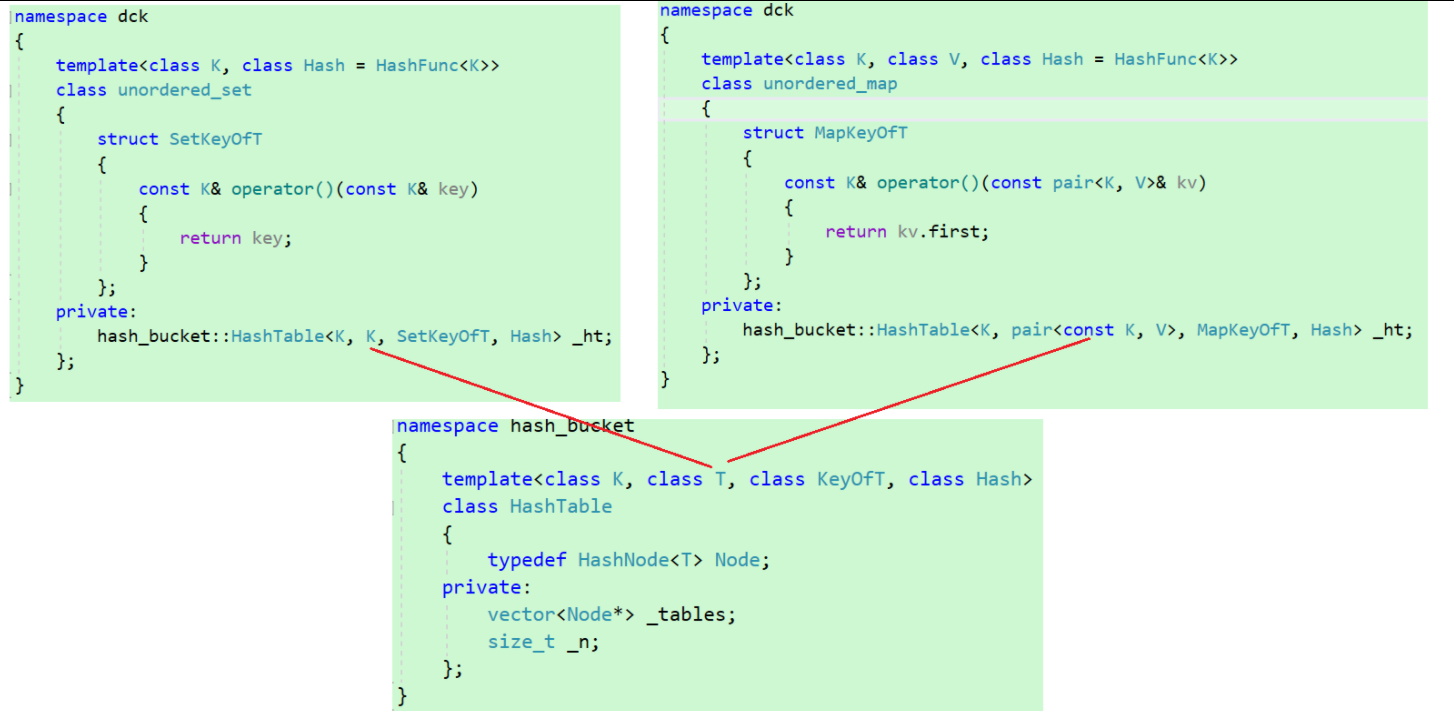
底层哈希桶并不知道封装自己的是 unordered_map 还是 unordered_set,因此将数据类型设为 T
cpp
template<class T>
class HashNode
{
public:
	T _data;
	HashNode<T>* _next;
	HashNode(const T& data)
		:_data(data)
		, _next(nullptr)
	{}
};
封装整体逻辑
-
将 底层哈希表的 Hash模板参数的缺省值作为上层的 unoredered_set / unoredered_map的模板参数的缺省值 更合理
-
哈希表查找 / 删除,直接需要 key 值,因此上层的 unoredered_set / unoredered_map还要有第一个模板参数 K
3.在哈希表 插入 / 查找 时会用到 key 值,因此还需要 KeyOfT 仿函数,获取 key值
迭代器
哈希表的迭代器依旧是一个类,类中封装了节点指针,从而使得迭代器对象可以模拟指针的行为
cpp
template<class T, class Ref, class Ptr>
struct __HTIterator
{
	typedef HashNode<T> Node;
	typedef __HTIterator<T, Ref, Ptr> self;
	Node* _node;

	__HTIterator(Node* node)
		:_node(node)
	{
	}

	Ref operator*()
	{
		return _node->_data;
	}

	Ptr operator->()
	{
		return &_node->_data;
	}

	bool operator!=(const self& s)
	{
		return _node != s._node;
	}
};
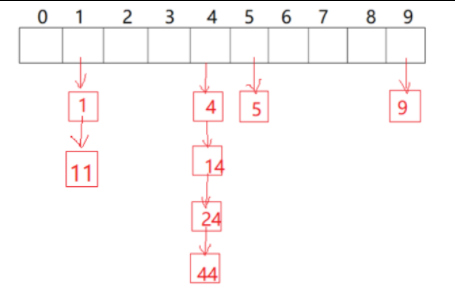
重点来了,迭代器++如何实现? 迭代器++的本质是找下一个节点,而哈希表中如何找当前节点的下一个节点呢?由于我们底层使用的是哈希桶结构,因此找下一个节点分为两种情况:
-
当前节点的下一个节点不为空,那么直接 _node = _node->_next;
-
当前节点的下一个节点为空,说明当前桶已经遍历完了,因此需要寻找下一个有元素的桶,而寻找下一个有元素的桶,显然需要用到 哈希表中的 _tables 数组,
因此我们需要在迭代器中再加入一个成员,那就是哈希表:HashTable<K, T, KeyOfT, Hash>* _pht
因此我们需要将 哈希表的模版参数全部加到 迭代器的模版参数上
cpp
template<class K, class T, class Ref, class Ptr, class KeyOfT, class Hash>
struct __HTIterator
{
	//哈希表迭代器的3个成员变量
	Node* _node;
	const HashTable<K, T, KeyOfT, Hash>* _pht;
	size_t _hashi; //当前节点所在桶的编号
}
此时我们在编译的时候会报错,因为迭代器类 是位于 哈希表类之前的,而迭代器类中也用到了 哈希表类,会有"相互依赖的"问题,也就是编译器在编译 迭代器类的代码时还不认识 哈希表呢,因此需要在迭代器类之前添加哈希表前置声明:
cpp
//迭代器和哈希表相互依赖, 需要前置声明
template<class K, class T, class KeyOfT, class Hash>
class HashTable;
此外,由于我们在迭代器内部会使用到 哈希表的 私有成员_tables,因此还需要将 迭代器类声明为 哈希表的 友元类:
cpp
template<class K, class T, class KeyOfT, class Hash>
class HashTable
{
	//迭代器内部用到了 哈希表的私有成员 _tables, 需要友元声明
	template<class K, class T, class Ref, class Ptr, class KeyOfT, class Hash>
	friend struct __HTIterator;
};
operator++:如果下一个节点为空,需要寻找下一个有元素的桶,因此还需要知道当前桶的编号,我们可以通过下面一行代码来计算出当前桶的编号,但确实比较麻烦,因此我们在迭代器中再加入一个成员:当前节点所在桶的编号:_hashi
cpp
size_t hashi = hf(kot(_node->_data)) % _pht._tables.size();那么在构造迭代器时就需要初始化三个成员
cpp
__HTIterator(Node* node, HashTable<K, T, KeyOfT, Hash>* pht, size_t hashi)
	:_node(node)
	, _pht(pht)
	, _hashi(hashi)
{
}
operator++ 的实现如下:
cpp
typedef __HTIterator<K, T, Ref, Ptr, KeyOfT, Hash> self;
self& operator++()
{
	if (_node->_next)
	{
		_node = _node->_next;
	}
	else //当前桶遍历完了, 寻找下一个有元素的桶
	{
		_hashi++;
		while (_hashi < _pht->_tables.size())
		{
			if (_pht->_tables[_hashi])
			{
				_node = _pht->_tables[_hashi];
				break;
			}
			_hashi++;
		}
		if (_hashi == _pht->_tables.size())
		{
			_node = nullptr;
		}
	}
	return *this;
}
注:需要说明的是我们提供的迭代器访问顺序是 按照桶的编号顺序,而库中迭代器访问顺序是 按照元素的插入顺序
哈希表内部提供迭代器接口
cpp
template<class K, class T, class KeyOfT, class Hash>
class HashTable
{
	typedef HashNode<T> Node;
	//迭代器内部用到了 哈希表的私有成员 _tables, 需要友元声明
	template<class K, class T, class Ref, class Ptr, class KeyOfT, class Hash>
	friend struct __HTIterator;
public:
	typedef __HTIterator<K, T, T&, T*, KeyOfT, Hash> iterator; //普通迭代器
	typedef __HTIterator<K, T, const T&, const T*, KeyOfT, Hash> const_iterator; //const迭代器
public:
	//迭代器接口
	iterator begin() //返回第一个桶的第一个元素
	{
		for (size_t i = 0; i < _tables.size(); i++)
		{
			if (_tables[i])
			{
				return iterator(_tables[i], this, i);
			}
		}
		return end();
	}

	iterator end()
	{
		return iterator(nullptr, this, -1);
	}

	const_iterator begin() const
	{
		for (size_t i = 0; i < _tables.size(); i++)
		{
			if (_tables[i])
			{
				return const_iterator(_tables[i], this, i);
			}
		}
		return end();
	}

	const_iterator end() const
	{
		return const_iterator(nullptr, this, -1);
	}
};
注意,此时编译会有问题,const 版本的 begin 和 end 接口在返回的时候 构造迭代器 会有权限放大的问题
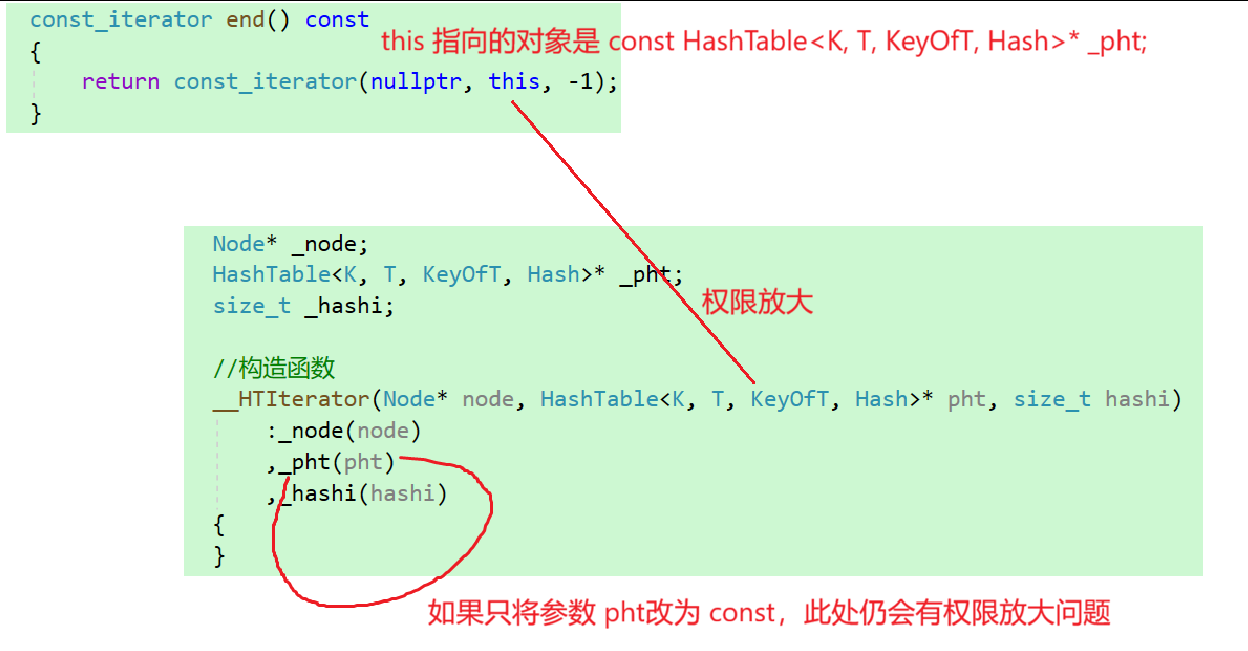
因此我们将构造函数的参数以及 _pht 成员都加上 const
unordered_set 和 unordered_map 提供迭代器接口
**unordered_set:**内部元素不能修改,因此无论是 普通迭代器,还是 const 迭代器,底层封装的都是哈希表的 const 迭代器
cpp
namespace dck
{
	template<class K, class Hash = HashFunc<K>>
	class unordered_set
	{
		struct SetKeyOfT
		{
			const K& operator()(const K& key)
			{
				return key;
			}
		};
	public:
		typedef typename hash_bucket::HashTable<K, K, SetKeyOfT, Hash>::const_iterator iterator;
		typedef typename hash_bucket::HashTable<K, K, SetKeyOfT, Hash>::const_iterator const_iterator;

		const_iterator begin() const
		{
			return _ht.begin();
		}

		const_iterator end() const
		{
			return _ht.end();
		}
	private:
		hash_bucket::HashTable<K, K, SetKeyOfT, Hash> _ht;
	};
}
**unordered_map:**普通迭代器的 key不能修改,value可以修改,const 迭代器 的 key 和 value 都不能修改,因此 普通迭代器底层是哈希表的普通迭代器,const 迭代器底层是哈希表的 const的 迭代器,给 pair 中的 key 带上 const 确保无论是普通迭代器还是 const迭代器,key都无法修改
cpp
namespace dck
{
	template<class K, class V, class Hash = HashFunc<K>>
	class unordered_map
	{
		struct MapKeyOfT
		{
			const K& operator()(const pair<K, V>& kv)
			{
				return kv.first;
			}
		};
	public:
		typedef typename hash_bucket::HashTable<K, pair<const K, V>, MapKeyOfT, Hash>::iterator iterator;
		typedef typename hash_bucket::HashTable<K, pair<const K, V>, MapKeyOfT, Hash>::const_iterator const_iterator;

		iterator begin()
		{
			return _ht.begin();
		}

		iterator end()
		{
			return _ht.end();
		}

		const_iterator begin() const
		{
			return _ht.begin();
		}

		const_iterator end() const
		{
			return _ht.end();
		}
	private:
		hash_bucket::HashTable<K, pair<const K, V>, MapKeyOfT, Hash> _ht;
	};
}
查找接口
哈希表的 Find 接口的返回值我们需要从 bool 改造成 iterator,也要在需要用到 key 的地方将仿函数套上去
cpp
iterator Find(const K& key)
{
	Hash hf;
	KeyOfT kot;
	size_t hashi = hf(key) % _tables.size();
	Node* cur = _tables[hashi];
	while (cur)
	{
		if (kot(cur->_data) == key)
			return iterator(cur, this, hashi);
		cur = cur->_next;
	}
	return end();
}
unordered_set / unordered_map 的 find 接口:
cpp
iterator find(const K& key)
{
	return _ht.Find(key);
}
插入接口
哈希表的 Insert 接口的返回值我们 需要从 bool 改造成 pair<iterator,bool>,也要在需要用到 key 的地方将仿函数套上去
cpp
pair<iterator, bool> Insert(const T& data)
{
	KeyOfT kot;
	iterator it = Find(kot(data));
	if (it != end())
		return make_pair(it, false);
	Hash hf;
	if (_n == _tables.size()) //哈希桶的负载因子我们设置为1
	{
		size_t newSize = _tables.size() * 2;
		vector<Node*> newTables;
		newTables.resize(newSize);
		for (size_t i = 0; i < _tables.size(); i++)
		{
			Node* cur = _tables[i];
			while (cur)
			{
				Node* next = cur->_next;
				size_t hashi = hf(kot(cur->_data)) % newSize;
				cur->_next = newTables[hashi];
				newTables[hashi] = cur;
				cur = next;
			}
			_tables[i] = nullptr;
		}
		_tables.swap(newTables);
	}
	//头插新节点
	size_t hashi = hf(kot(data)) % _tables.size();
	Node* newNode = new Node(data);
	newNode->_next = _tables[hashi];
	_tables[hashi] = newNode;
	++_n;
	return make_pair(iterator(newNode, this, hashi), true);
}
unordered_map 的 insert 接口:
cpp
pair<iterator, bool> insert(const pair<K, V>& kv)
{
	return _ht.Insert(kv);
}
unordered_set 的 insert 接口:
cpp
pair<iterator, bool> insert(const K& key)
{
	return _ht.Insert(key);
}
注意,unordered_set 的 insert 接口 采用上面这种写法会直接编译报错
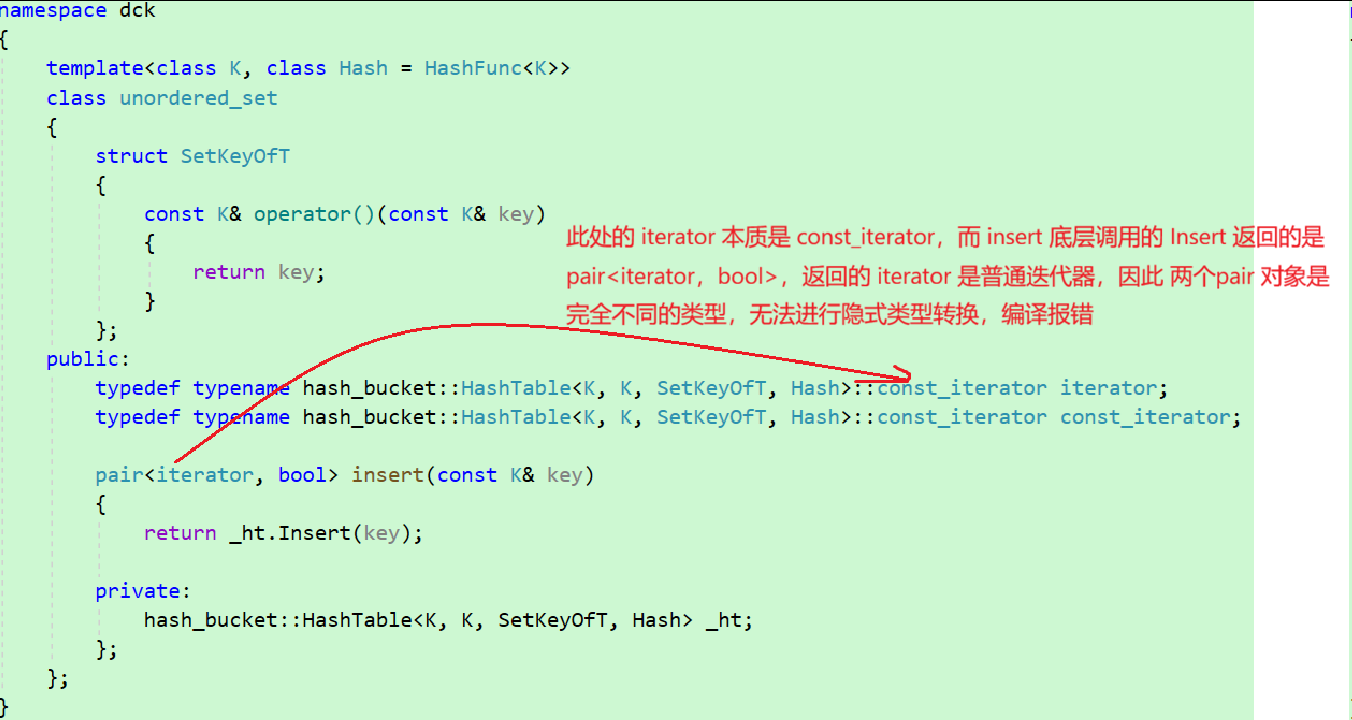
正确的写法:
使用返回的 普通迭代器的三个成员变量构造出 const 迭代器即可
cpp
pair<iterator, bool> insert(const K& key)
{
	auto ret = _ht.Insert(key);
	return pair<const_iterator, bool>(const_iterator(ret.first._node, ret.first._pht, ret.first._hashi), ret.second);
}
删除接口
cpp
bool Erase(const K& key)
{
	Hash hf;
	size_t hashi = hf(key) % _tables.size(); // 映射位置
	Node* prev = nullptr;
	Node* cur = _tables[hashi];
	while (cur)
	{
		if (cur->_kv.first == key)
		{
			if (prev == nullptr) // 处理删除第一个节点的情况
			{
				_tables[hashi] = cur->_next;
			}
			else
			{
				prev->_next = cur->_next;
			}
			delete cur;
			return true;
		}
		prev = cur;
		cur = cur->_next;
	}
	return false;
}
unordered_set / unordered_map 的 erase 接口:
cpp
iterator erase(const K& key)
{
	return _ht.Erase(key);
}
unordered_map 的 接口
cpp
V& operator[](const K& key)
{
	pair<iterator, bool> ret = _ht.Insert(make_pair(key, V()));
	return ret.first->second;
}
测试接口
cpp
#include <unordered_set>
#include "MyUnorderedSet.h"
#include "MyUnorderedMap.h"

void test_unordered_set()
{
	dck::unordered_set<int> st;
	st.insert(4);
	st.insert(1);
	st.insert(2);
	st.insert(3);
	dck::unordered_set<int>::iterator it = st.begin();
	while (it != st.end())
	{
		cout << *it << " ";
		++it;
	}

	cout << endl; //1 2 3 4 (我们自己迭代器的实现按照桶的顺序)

	unordered_set<int> st1;
	st1.insert(4);
	st1.insert(1);
	st1.insert(2);
	st1.insert(3);
	unordered_set<int>::iterator it1 = st1.begin();
	while (it1 != st1.end())
	{
		cout << *it1 << " "; //4 1 2 3 (库中迭代器的实现按照插入顺序)
		++it1;
	}
	cout << endl;
}

//测试 unordered_map 的 const 迭代器
void print(const dck::unordered_map<int, int>& mp)
{
	dck::unordered_map<int, int>::const_iterator it = mp.begin();
	while (it != mp.end())
	{
		cout << it->first << " " << it->second << endl;
		++it;
	}
	cout << endl;
}

void test_unordered_map()
{
	dck::unordered_map<int, int> mp;
	mp.insert(make_pair(4, 4));
	mp.insert(make_pair(1, 1));
	mp.insert(make_pair(2, 2));
	mp.insert(make_pair(3, 3));
	print(mp);
	dck::unordered_map<int, int>::iterator it = mp.begin();
	while (it != mp.end())
	{
		it->first++; //err
		it->second++;
		cout << it->first << " " << it->second << endl;
		++it;
	}

	string arr[] = { "苹果", "西瓜", "苹果", "西瓜", "苹果", "苹果", "西瓜", "苹果", "香蕉", "苹果", "香蕉" };
	dck::unordered_map<string, int> countMap;
	for (auto x : arr)
		countMap[x]++;
	for (auto t : countMap)
	{
		cout << t.first << " " << t.second << endl;
	}
	cout << endl;
}

int main()
{
	test_unordered_set();
	test_unordered_map();
	return 0;
}
哈希桶效率测试
哈希桶中提供 Some 接口测试 哈希桶使用情况、最大桶长度、平均桶长度等指标。
cpp
void Some()
{
	size_t bucketSize = 0;
	size_t maxBucketLen = 0;
	size_t sum = 0;
	double averageBucketLen = 0;

	for (size_t i = 0; i < _tables.size(); i++)
	{
		Node* cur = _tables[i];
		if (cur)
		{
			++bucketSize;
		}

		size_t bucketLen = 0;
		while (cur)
		{
			++bucketLen;
			cur = cur->_next;
		}

		sum += bucketLen;

		if (bucketLen > maxBucketLen)
		{
			maxBucketLen = bucketLen;
		}
	}

	averageBucketLen = (double)sum / (double)bucketSize;

	printf("all bucketSize:%d\n", _tables.size()); //表的大小
	printf("bucketSize:%d\n", bucketSize); //使用了多少个桶
	printf("maxBucketLen:%d\n", maxBucketLen); //最长的桶挂了多少个元素
	printf("averageBucketLen:%lf\n\n", averageBucketLen); //平均桶长度
}
cpp
#include <set>
#include <unordered_set>
#include "HashTable.h"

void test()
{
	const size_t N = 1000000;

	unordered_set<int> us;
	set<int> s;
	hash_bucket::HashTable<int, int> ht;

	vector<int> v;
	v.reserve(N);
	srand(time(0));
	for (size_t i = 0; i < N; ++i)
	{
		//v.push_back(rand()); // N比较大时,重复值比较多
		v.push_back(rand() + i); // 重复值相对少
		//v.push_back(i); // 没有重复,有序
	}

	// 21:15
	size_t begin1 = clock();
	for (auto e : v)
	{
		s.insert(e);
	}
	size_t end1 = clock();
	cout << "set insert:" << end1 - begin1 << endl;

	size_t begin2 = clock();
	for (auto e : v)
	{
		us.insert(e);
	}
	size_t end2 = clock();
	cout << "unordered_set insert:" << end2 - begin2 << endl;

	size_t begin10 = clock();
	for (auto e : v)
	{
		ht.Insert(make_pair(e, e));
	}
	size_t end10 = clock();
	cout << "HashTbale insert:" << end10 - begin10 << endl << endl;


	size_t begin3 = clock();
	for (auto e : v)
	{
		s.find(e);
	}
	size_t end3 = clock();
	cout << "set find:" << end3 - begin3 << endl;

	size_t begin4 = clock();
	for (auto e : v)
	{
		us.find(e);
	}
	size_t end4 = clock();
	cout << "unordered_set find:" << end4 - begin4 << endl;

	size_t begin11 = clock();
	for (auto e : v)
	{
		ht.Find(e);
	}
	size_t end11 = clock();
	cout << "HashTable find:" << end11 - begin11 << endl << endl;

	cout << "插入数据个数:" << us.size() << endl << endl;
	ht.Some();

	size_t begin5 = clock();
	for (auto e : v)
	{
		s.erase(e);
	}
	size_t end5 = clock();
	cout << "set erase:" << end5 - begin5 << endl;

	size_t begin6 = clock();
	for (auto e : v)
	{
		us.erase(e);
	}
	size_t end6 = clock();
	cout << "unordered_set erase:" << end6 - begin6 << endl;

	size_t begin12 = clock();
	for (auto e : v)
	{
		ht.Erase(e);
	}
	size_t end12 = clock();
	cout << "HashTable Erase:" << end12 - begin12 << endl << endl;
}

int main()
{
	test();
	return 0;
}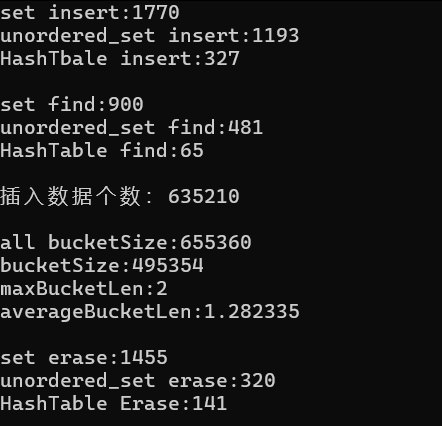
可以看到,在数据量比较大的情况下,unordered_set 的插入、查找、删除等性能都是高于 set 的,并且最长的桶下面只挂了两个元素,平均桶长度只有 1.28 左右,时间复杂度接近 O(1),而我们实现的哈希表之所以比STL库的哈希表还快的主要原因是 库中哈希表的迭代器遍历是按照插入顺序实现的,因此还要额外维护一些信息,执行一些操作,时间复杂度就比较高了
附实现代码
HashTable.h:
cpp
#pragma once

#include <iostream>
#include <vector>
using namespace std;

//哈希函数(默认, 整数)
template<class K>
struct HashFunc
{
	size_t operator()(const K& key)
	{
		return (size_t)key; //将负数转化为正数
	}
};

//类模板特化
template<>
struct HashFunc<string>
{
	//字符串不能直接取模,先用字符串映射一个整形, 就能取模了!
	size_t operator()(const string& key)
	{
		size_t hash = 0;
		for (auto& e : key)
		{
			hash *= 31; //解决字母完全一样但是顺序不一样而导致冲突的问题
			hash += e;
		}
		return hash;
	}
};

//仿函数
//struct HashFuncString
//{
//	size_t operator()(const string& key)
//	{
//		size_t hash = 0;
//		for (auto& e : key)
//		{
//			hash *= 31; //解决字母完全一样但是顺序不一样而导致冲突的问题
//			hash += e;
//		}
//		cout << key << ":" << hash << endl;
//		return hash;
//	}
//};


//哈希桶
namespace hash_bucket
{
	template<class T>
	class HashNode
	{
	public:
		T _data;
		HashNode<T>* _next;
		HashNode(const T& data)
			:_data(data)
			, _next(nullptr)
		{}
	};

	//迭代器和哈希表相互依赖, 需要前置声明
	template<class K, class T, class KeyOfT, class Hash>
	class HashTable;

	template<class K, class T, class Ref, class Ptr, class KeyOfT, class Hash>
	struct __HTIterator
	{
		typedef HashNode<T> Node;
		typedef __HTIterator<K, T, Ref, Ptr, KeyOfT, Hash> self;

		Node* _node;
		const HashTable<K, T, KeyOfT, Hash>* _pht;
		size_t _hashi;

		//构造函数
		__HTIterator(Node* node, const HashTable<K, T, KeyOfT, Hash>* pht, size_t hashi)
			:_node(node)
			,_pht(pht)
			,_hashi(hashi)
		{
		}

		//找下一个节点
		self& operator++()
		{
			if (_node->_next)
			{
				_node = _node->_next;
			}
			else //当前桶遍历完了, 寻找下一个有元素的桶
			{
				_hashi++;
				while (_hashi < _pht->_tables.size())
				{
					if (_pht->_tables[_hashi])
					{
						_node = _pht->_tables[_hashi];
						break;
					}
					_hashi++;
				}
				if (_hashi == _pht->_tables.size())
				{
					_node = nullptr;
				}
			}
			return *this;
		}

		Ref operator*()
		{
			return _node->_data;
		}

		Ptr operator->()
		{
			return &_node->_data;
		}

		bool operator!=(const self& s)
		{
			return _node != s._node;
		}
	};

	template<class K, class T, class KeyOfT, class Hash>
	class HashTable
	{
		typedef HashNode<T> Node;
		//迭代器内部用到了 哈希表的私有成员 _tables, 需要友元声明
		template<class K, class T, class Ref, class Ptr, class KeyOfT, class Hash>
		friend struct __HTIterator;
	public:
		typedef __HTIterator<K, T, T&, T*, KeyOfT, Hash> iterator; //普通迭代器
		typedef __HTIterator<K, T, const T&, const T*, KeyOfT, Hash> const_iterator; //const迭代器
	public:
		//迭代器接口
		iterator begin() //返回第一个桶的第一个元素
		{
			for (size_t i = 0; i < _tables.size(); i++)
			{
				if (_tables[i])
				{
					return iterator(_tables[i], this, i);
				}
			}
			return end();
		}

		iterator end()
		{
			return iterator(nullptr, this, -1);
		}

		const_iterator begin() const
		{
			for (size_t i = 0; i < _tables.size(); i++)
			{
				if (_tables[i])
				{
					return const_iterator(_tables[i], this, i);
				}
			}
			return end();
		}

		const_iterator end() const
		{
			return const_iterator(nullptr, this, -1);
		}
	public:
		//构造函数
		HashTable()
		{
			_tables.resize(10);
		}

		//析构函数
		~HashTable()
		{
			for (size_t i = 0; i < _tables.size(); i++)
			{
				Node* cur = _tables[i];
				while (cur)
				{
					Node* next = cur->_next;
					delete cur;
					cur = next;
				}
				_tables[i] = nullptr;
			}
		}

		//查找函数
		iterator Find(const K& key)
		{
			Hash hf;
			KeyOfT kot;
			size_t hashi = hf(key) % _tables.size();
			Node* cur = _tables[hashi];
			while (cur)
			{
				if (kot(cur->_data) == key)
					return iterator(cur, this, hashi);
				cur = cur->_next;
			}
			return end();
		}

		pair<iterator, bool> Insert(const T& data)
		{
			KeyOfT kot;
			iterator it = Find(kot(data));
			if (it != end())
				return make_pair(it, false);
			Hash hf;
			if (_n == _tables.size()) //哈希桶的负载因子我们设置为1
			{
				size_t newSize = _tables.size() * 2;
				vector<Node*> newTables;
				newTables.resize(newSize);
				for (size_t i = 0; i < _tables.size(); i++)
				{
					Node* cur = _tables[i];
					while (cur)
					{
						Node* next = cur->_next;
						size_t hashi = hf(kot(cur->_data)) % newSize;
						cur->_next = newTables[hashi];
						newTables[hashi] = cur;
						cur = next;
					}
					_tables[i] = nullptr;
				}
				_tables.swap(newTables);
			}
			//头插新节点
			size_t hashi = hf(kot(data)) % _tables.size();
			Node* newNode = new Node(data);
			newNode->_next = _tables[hashi];
			_tables[hashi] = newNode;
			++_n;
			return make_pair(iterator(newNode, this, hashi), true);
		}

		//删除函数
		bool Erase(const K& key)
		{
			Hash hf;
			size_t hashi = hf(key) % _tables.size(); // 映射位置
			Node* prev = nullptr;
			Node* cur = _tables[hashi];
			while (cur)
			{
				if (cur->_kv.first == key)
				{
					if (prev == nullptr) // 处理删除第一个节点的情况
					{
						_tables[hashi] = cur->_next;
					}
					else
					{
						prev->_next = cur->_next;
					}
					delete cur;
					return true;
				}
				prev = cur;
				cur = cur->_next;
			}
			return false;
		}
	private:
		vector<Node*> _tables;
		size_t _n; //当前哈希表中的元素个数
	};
}
MyUnorderedSet.h:
cpp
#pragma once
#include "HashTable.h"

namespace dck
{
	template<class K, class Hash = HashFunc<K>>
	class unordered_set
	{
		struct SetKeyOfT
		{
			const K& operator()(const K& key)
			{
				return key;
			}
		};
	public:
		typedef typename hash_bucket::HashTable<K, K, SetKeyOfT, Hash>::const_iterator iterator;
		typedef typename hash_bucket::HashTable<K, K, SetKeyOfT, Hash>::const_iterator const_iterator;

		pair<iterator, bool> insert(const K& key)
		{
			auto ret = _ht.Insert(key);
			return pair<const_iterator, bool>(const_iterator(ret.first._node, ret.first._pht, ret.first._hashi), ret.second);
		}

		iterator find(const K& key)
		{
			return _ht.Find(key);
		}

		iterator erase(const K& key)
		{
			return _ht.Erase(key);
		}

		const_iterator begin() const
		{
			return _ht.begin();
		}

		const_iterator end() const
		{
			return _ht.end();
		}
	private:
		hash_bucket::HashTable<K, K, SetKeyOfT, Hash> _ht;
	};
}
MyUnorderedMap.h:
cpp
#pragma once

#include "HashTable.h"

namespace dck
{
	template<class K, class V, class Hash = HashFunc<K>>
	class unordered_map
	{
		struct MapKeyOfT
		{
			const K& operator()(const pair<K, V>& kv)
			{
				return kv.first;
			}
		};
	public:
		typedef typename hash_bucket::HashTable<K, pair<const K, V>, MapKeyOfT, Hash>::iterator iterator;
		typedef typename hash_bucket::HashTable<K, pair<const K, V>, MapKeyOfT, Hash>::const_iterator const_iterator;

		pair<iterator, bool> insert(const pair<K, V>& kv)
		{
			return _ht.Insert(kv);
		}

		V& operator[](const K& key)
		{
			pair<iterator, bool> ret = _ht.Insert(make_pair(key, V()));
			return ret.first->second;
		}

		iterator find(const K& key)
		{
			return _ht.Find(key);
		}

		iterator erase(const K& key)
		{
			return _ht.Erase(key);
		}

		iterator begin()
		{
			return _ht.begin();
		}

		iterator end()
		{
			return _ht.end();
		}

		const_iterator begin() const
		{
			return _ht.begin();
		}

		const_iterator end() const
		{
			return _ht.end();
		}
	private:
		hash_bucket::HashTable<K, pair<const K, V>, MapKeyOfT, Hash> _ht;
	};
}