目录
- 前言
- [一、Java Looper 的使用](#一、Java Looper 的使用)
- [二、Looper.prepare() 实现分析](#二、Looper.prepare() 实现分析)
- 三、Looper.loop()
- 四、发送消息
- 五、唤醒后的流程
- 六、参考资料
|----------------------------|
| Android Java Looper 机制 |
前言
一个简单的 main 函数执行完毕后,整个进程也就结束了,为了让一个进程长时间的运行下去,就需要 无限循环加事件通知的机制 ,这类机制的伪代码描述如下:
c
int main()
{
    while(true)
    {
        1. 线程进入休眠状态,等待通知;
        2. 其它地方给当前线程发送通知,线程从休眠中唤醒,读取通知,处理通知
        3. 进入下一个循环
    }

    return 0;
}
在上一节,我们已经了解了 Android Native 层的 Looper 机制,接下来我们接着学习 Android Java 层的 Looper 机制。
这里先给出 Android Java Looper 的整体框架图,接着我们再根据源码逐步分析
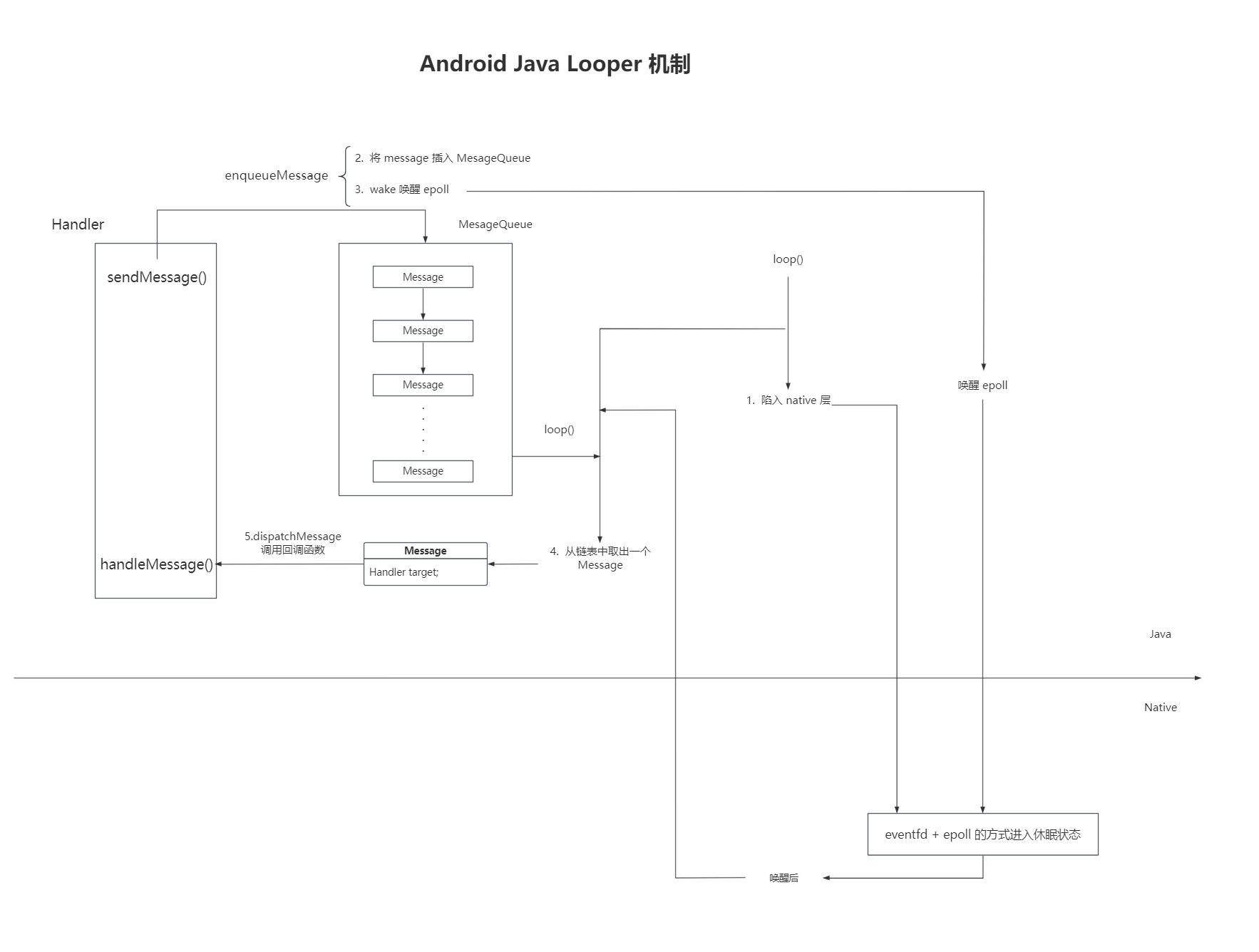
一、Java Looper 的使用
首先我们从一个典型的 Looper 线程来看看 Looper 具体是怎么使用的:
java
// 典型的关于Handler/Looper的线程
class LooperThread extends Thread {

    public Handler mHandler;

    public void run() {

        Looper.prepare();

        mHandler = new Handler() {
            public void handleMessage(Message msg) {
                //定义消息处理逻辑.
                Message msg = Message.obtain();
            }
        };

        Looper.loop();
    }
}

// 其他线程
Message msg = Message.obtain();
msg.what = 2;
msg.obj = "B";
// 向 looper 发送一个消息
looperThread.mHandler.sendMessage(msg);
使用上来说:
- Looper 线程:
调用
Looper.prepare()初始化 Looper初始化一个 Handler 对象
Looper .loop() 进入循环休眠状态
- 其他线程:
获取到 Looper 线程中的 Handler 对象
构建一个 Message 对象
调用 Handler 对象的 sendMessage 发送消息给 Looper
二、Looper.prepare() 实现分析
java
public static void prepare() {
    prepare(true);
}

private static void prepare(boolean quitAllowed) {
    if (sThreadLocal.get() != null) {
        throw new RuntimeException("Only one Looper may be created per thread");
    }
    sThreadLocal.set(new Looper(quitAllowed));
}
prepare 中首先从线程本地数据区取 Looper ,如果没有,就 new 一个 Looper ,并存到线程本地数据区中。
接下来看看 new 一个 Looper 的过程:
java
private Looper(boolean quitAllowed) {
    mQueue = new MessageQueue(quitAllowed);  //创建MessageQueue对象
    mThread = Thread.currentThread();
}
构造函数中,new 了一个 MessageQueue,获取到了当前线程 Thread 对象。
接着看 MessageQueue 的初始化过程:
java
MessageQueue(boolean quitAllowed) {
    mQuitAllowed = quitAllowed;
    mPtr = nativeInit();
}

private native static long nativeInit();
这里调用了 native 方法 nativeInit,对应的 JNI 函数是
android_os_MessageQueue_nativeInit:
c
static jlong android_os_MessageQueue_nativeInit(JNIEnv* env, jclass clazz) {
    NativeMessageQueue* nativeMessageQueue = new NativeMessageQueue();
    if (!nativeMessageQueue) {
        jniThrowRuntimeException(env, "Unable to allocate native queue");
        return 0;
    }

    nativeMessageQueue->incStrong(env);
    return reinterpret_cast<jlong>(nativeMessageQueue);
}
这里,核心内容就是初始化一个 NativeMessageQueue 对象,并将其地址返回给 Java 层。我们接着看 NativeMessageQueue 对象的初始化过程:
c
// NativeMessageQueue 构造函数
NativeMessageQueue::NativeMessageQueue() :
        mPollEnv(NULL), mPollObj(NULL), mExceptionObj(NULL) {
    // 初始化 Native 层的 looper
    mLooper = Looper::getForThread();
    if (mLooper == NULL) {
        mLooper = new Looper(false);
        Looper::setForThread(mLooper);
    }
}
NativeMessageQueue 的构造函数中,从本地线程区获取当前线程的 Looper 对象,没有的话,就初始化一个,并存在线程本地数据区中。
Native 层 Looper 对象的初始化,核心内容就三点:
- 初始化一个
eventfd - 初始化一个
epoll - 把
eventfd放到epoll池中
三、Looper.loop()
初始化工作完成后,我们接着再来看看 loop 方法都执行了哪些操作:
c
public static void loop() {
    // 获取 TLS 存储的 Looper 对象
    final Looper me = myLooper();
    if (me == null) {
        throw new RuntimeException("No Looper; Looper.prepare() wasn't called on this thread.");
    }
    if (me.mInLoop) {
        Slog.w(TAG, "Loop again would have the queued messages be executed"
                + " before this one completed.");
    }

    me.mInLoop = true;

    // Make sure the identity of this thread is that of the local process,
    // and keep track of what that identity token actually is.
    Binder.clearCallingIdentity();
    final long ident = Binder.clearCallingIdentity();

    // Allow overriding a threshold with a system prop. e.g.
    // adb shell 'setprop log.looper.1000.main.slow 1 && stop && start'
    final int thresholdOverride =
            SystemProperties.getInt("log.looper."
                    + Process.myUid() + "."
                    + Thread.currentThread().getName()
                    + ".slow", 0);

    me.mSlowDeliveryDetected = false;

    // 进入无限循环,调用 loopOnce 进入休眠状态
    for (;;) {
        if (!loopOnce(me, ident, thresholdOverride)) {
            return;
        }
    }
}

public static @Nullable Looper myLooper() {
    return sThreadLocal.get();
}
代码很长,但是核心功能就两点:
- 获取 TLS 存储的 Looper 对象
- 进入无限循环,调用
loopOnce进入休眠状态
接下来就来看看 loopOnce 到底是怎么工作的
c
private static boolean loopOnce(final Looper me,
        final long ident, final int thresholdOverride) {

    // 获取 Message,可能阻塞
    Message msg = me.mQueue.next();
    if (msg == null) {
        // No message indicates that the message queue is quitting.
        return false;
    }

    // This must be in a local variable, in case a UI event sets the logger
    final Printer logging = me.mLogging;
    if (logging != null) {
        logging.println(">>>>> Dispatching to " + msg.target + " "
                + msg.callback + ": " + msg.what);
    }
    // Make sure the observer won't change while processing a transaction.
    final Observer observer = sObserver;

    final long traceTag = me.mTraceTag;
    long slowDispatchThresholdMs = me.mSlowDispatchThresholdMs;
    long slowDeliveryThresholdMs = me.mSlowDeliveryThresholdMs;
    if (thresholdOverride > 0) {
        slowDispatchThresholdMs = thresholdOverride;
        slowDeliveryThresholdMs = thresholdOverride;
    }
    final boolean logSlowDelivery = (slowDeliveryThresholdMs > 0) && (msg.when > 0);
    final boolean logSlowDispatch = (slowDispatchThresholdMs > 0);

    final boolean needStartTime = logSlowDelivery || logSlowDispatch;
    final boolean needEndTime = logSlowDispatch;

    if (traceTag != 0 && Trace.isTagEnabled(traceTag)) {
        Trace.traceBegin(traceTag, msg.target.getTraceName(msg));
    }

    final long dispatchStart = needStartTime ? SystemClock.uptimeMillis() : 0;
    final long dispatchEnd;
    Object token = null;
    if (observer != null) {
        token = observer.messageDispatchStarting();
    }
    long origWorkSource = ThreadLocalWorkSource.setUid(msg.workSourceUid);
    try {
        //分发消息,调用 handler 中的回调函数
        msg.target.dispatchMessage(msg);
        if (observer != null) {
            observer.messageDispatched(token, msg);
        }
        dispatchEnd = needEndTime ? SystemClock.uptimeMillis() : 0;
    } catch (Exception exception) {
        if (observer != null) {
            observer.dispatchingThrewException(token, msg, exception);
        }
        throw exception;
    } finally {
        ThreadLocalWorkSource.restore(origWorkSource);
        if (traceTag != 0) {
            Trace.traceEnd(traceTag);
        }
    }
    if (logSlowDelivery) {
        if (me.mSlowDeliveryDetected) {
            if ((dispatchStart - msg.when) <= 10) {
                Slog.w(TAG, "Drained");
                me.mSlowDeliveryDetected = false;
            }
        } else {
            if (showSlowLog(slowDeliveryThresholdMs, msg.when, dispatchStart, "delivery",
                    msg)) {
                // Once we write a slow delivery log, suppress until the queue drains.
                me.mSlowDeliveryDetected = true;
            }
        }
    }
    if (logSlowDispatch) {
        showSlowLog(slowDispatchThresholdMs, dispatchStart, dispatchEnd, "dispatch", msg);
    }

    if (logging != null) {
        logging.println("<<<<< Finished to " + msg.target + " " + msg.callback);
    }

    // Make sure that during the course of dispatching the
    // identity of the thread wasn't corrupted.
    final long newIdent = Binder.clearCallingIdentity();
    if (ident != newIdent) {
        Log.wtf(TAG, "Thread identity changed from 0x"
                + Long.toHexString(ident) + " to 0x"
                + Long.toHexString(newIdent) + " while dispatching to "
                + msg.target.getClass().getName() + " "
                + msg.callback + " what=" + msg.what);
    }

    msg.recycleUnchecked();

    return true;
}
代码很长,核心流程不多:
- 通过 MessageQueue 的 next 方法拿到一个 Message,这里可能会阻塞休眠,具体为什么,后面马上说
- 通过 dispatchMessage 调用 Handler 中的回调方法
接着就来看 mQueue.next() 的实现:
c
Message next() {
    // Return here if the message loop has already quit and been disposed.
    // This can happen if the application tries to restart a looper after quit
    // which is not supported.
    final long ptr = mPtr;
    if (ptr == 0) {
        return null;
    }

    int pendingIdleHandlerCount = -1; // -1 only during first iteration
    int nextPollTimeoutMillis = 0;
    for (;;) {
        if (nextPollTimeoutMillis != 0) {
            Binder.flushPendingCommands();
        }

        // 陷入 Native 层,进入休眠状态
        nativePollOnce(ptr, nextPollTimeoutMillis);

        //......
    }
}

private native void nativePollOnce(long ptr, int timeoutMillis);
这里调用 nativePollOnce 陷入 Native 层,进入休眠状态,nativePollOnce 是一个 Native 方法,对应的 JNI 函数如下:
c
static void android_os_MessageQueue_nativePollOnce(JNIEnv* env, jobject obj,
        jlong ptr, jint timeoutMillis) {
    NativeMessageQueue* nativeMessageQueue = reinterpret_cast<NativeMessageQueue*>(ptr);
    nativeMessageQueue->pollOnce(env, obj, timeoutMillis);
}
通过传入的指针,获取到 Native 层的 NativeMessageQueue 对象,接着调用 NativeMessageQueue 对象的 pollOnce 方法:
c
void NativeMessageQueue::pollOnce(JNIEnv* env, jobject pollObj, int timeoutMillis) {
    mPollEnv = env;
    mPollObj = pollObj;
    // 内部调用 epoll_wait 阻塞
    mLooper->pollOnce(timeoutMillis);
    mPollObj = NULL;
    mPollEnv = NULL;

    if (mExceptionObj) {
        env->Throw(mExceptionObj);
        env->DeleteLocalRef(mExceptionObj);
        mExceptionObj = NULL;
    }
}
这里会调用 Native 层 Looper 的 pollOnce 函数,pollOnce 内部主要是调用 epoll_wait 来进入休眠状态。pollOnce 的具体代码分析可以参考 Android Native Looper 机制 ,这里不再重复。
至此,我们的线程释放 cpu,进入休眠状态。
接下里我们就来看看怎么把休眠中的线程唤醒。
四、发送消息
发送消息大致两步:
- 初始化一个 Handler 对象,覆写 Handler 的 handleMessage 方法
- 构建一个 Message 对象,通过 Handler 的 sendMessage 方法发送消息
Handler 初始化过程
在使用 Looper 的线程中通常会初始化一个 Handler 对象:
java
// new 一个 Handler,覆写 handleMessage 方法
mHandler = new Handler() {
    public void handleMessage(Message msg) {
        //定义消息处理逻辑.
    }
};
Handler 的构造函数:
java
public Handler() {
    this(null, false);
}

public Handler(@Nullable Callback callback, boolean async) {
    //......

    //拿到当前线程的 Looper 对象
    mLooper = Looper.myLooper();
    if (mLooper == null) {
        throw new RuntimeException(
            "Can't create handler inside thread " + Thread.currentThread()
                    + " that has not called Looper.prepare()");
    }
    mQueue = mLooper.mQueue;
    mCallback = callback;
    mAsynchronous = async;
}
初始化过程中,要对 Handler 中有两个重要变量进行赋值:
mLooper:当前线程中的 Looper 对象mQueue:当前线程中的 Looper 对象的MessageQueue成员
做好以上的准备工作后,就可以向 Looper 发送消息了:
java
// 构建一个 Message
Message msg = Message.obtain();
msg.what = 2;
msg.obj = "B";
// 通过 Handler 的 sendMessage 方法发送消息
mHandler.sendMessage(msg);
我们先看看 Message 的初始化过程:
java
// frameworks/base/core/java/android/os/Message.java
public static Message obtain() {
    synchronized (sPoolSync) {
        if (sPool != null) {
            Message m = sPool;
            sPool = m.next;
            m.next = null;
            m.flags = 0; // clear in-use flag
            sPoolSize--;
            return m;
        }
    }
    return new Message();
}
从缓存 sPool 里面取 Message,如果没有的话就 new 一个 Message。
接着我们来看 sendMessage 的过程:
java
// frameworks/base/core/java/android/os/Handler.java
public final boolean sendMessage(@NonNull Message msg) {
    return sendMessageDelayed(msg, 0);
}

public final boolean sendMessageDelayed(@NonNull Message msg, long delayMillis) {
    if (delayMillis < 0) {
        delayMillis = 0;
    }
    return sendMessageAtTime(msg, SystemClock.uptimeMillis() + delayMillis);
}

public boolean sendMessageAtTime(@NonNull Message msg, long uptimeMillis) {
    MessageQueue queue = mQueue;
    if (queue == null) {
        RuntimeException e = new RuntimeException(
                this + " sendMessageAtTime() called with no mQueue");
        Log.w("Looper", e.getMessage(), e);
        return false;
    }
    return enqueueMessage(queue, msg, uptimeMillis);
}

 private boolean enqueueMessage(@NonNull MessageQueue queue, @NonNull Message msg,
        long uptimeMillis) {

    // 注意这里,把 handler 赋值给了 msg 的 target 成员
    msg.target = this;
    msg.workSourceUid = ThreadLocalWorkSource.getUid();

    if (mAsynchronous) {
        msg.setAsynchronous(true);
    }
    return queue.enqueueMessage(msg, uptimeMillis);
}
sendMessage 内部把 handler 赋值给了 msg 的 target 成员,最终调用到 MessageQueue 的 enqueueMessage 方法:
java
boolean enqueueMessage(Message msg, long when) {
    if (msg.target == null) {
        throw new IllegalArgumentException("Message must have a target.");
    }

    synchronized (this) {
        if (msg.isInUse()) {
            throw new IllegalStateException(msg + " This message is already in use.");
        }

        if (mQuitting) {
            IllegalStateException e = new IllegalStateException(
                    msg.target + " sending message to a Handler on a dead thread");
            Log.w(TAG, e.getMessage(), e);
            msg.recycle();
            return false;
        }

        msg.markInUse();
        msg.when = when;
        Message p = mMessages;
        boolean needWake;
        // 把传入的 Message 插入 mMessages 链表
        if (p == null || when == 0 || when < p.when) {
            // New head, wake up the event queue if blocked.
            msg.next = p;
            mMessages = msg;
            needWake = mBlocked;
        } else {
            // Inserted within the middle of the queue.  Usually we don't have to wake
            // up the event queue unless there is a barrier at the head of the queue
            // and the message is the earliest asynchronous message in the queue.
            needWake = mBlocked && p.target == null && msg.isAsynchronous();
            Message prev;

            for (;;) {
                prev = p;
                p = p.next;
                if (p == null || when < p.when) {
                    break;
                }
                if (needWake && p.isAsynchronous()) {
                    needWake = false;
                }
            }
            msg.next = p; // invariant: p == prev.next
            prev.next = msg;
        }

        // 唤醒 native 层的 epoll
        // We can assume mPtr != 0 because mQuitting is false.
        if (needWake) {
            nativeWake(mPtr);
        }
    }
    return true;
}
enqueueMessage 代码有点长,核心逻辑就两点:
- 把传入的 Message 插入 mMessages 链表
- 调用 native 方法
nativeWake唤醒 native 层的 epoll
接下来我们看看 nativeWake 的具体实现:
c
private native static void nativeWake(long ptr);

// nativeWake 对应的 JNI 函数
static void android_os_MessageQueue_nativeWake(JNIEnv* env, jclass clazz, jlong ptr) {
    NativeMessageQueue* nativeMessageQueue = reinterpret_cast<NativeMessageQueue*>(ptr);
    nativeMessageQueue->wake();
}

void NativeMessageQueue::wake() {
    mLooper->wake();
}

// eventfd 写数据,唤醒 epoll
void Looper::wake() {
    uint64_t inc = 1;
    ssize_t nWrite = TEMP_FAILURE_RETRY(write(mWakeEventFd.get(), &inc, sizeof(uint64_t)));
    if (nWrite != sizeof(uint64_t)) {
        if (errno != EAGAIN) {
            LOG_ALWAYS_FATAL("Could not write wake signal to fd %d (returned %zd): %s",
                             mWakeEventFd.get(), nWrite, strerror(errno));
        }
    }
}
nativeWake 最终就是调用 native 层 mLooper 的 wake 函数,在 wake 函数中向 eventfd 写入数据,唤醒与 eventfd 绑定的 epoll 。接下来我们就来看看 epoll 唤醒以后的流程。
五、唤醒后的流程
c
void NativeMessageQueue::pollOnce(JNIEnv* env, jobject pollObj, int timeoutMillis) {
    mPollEnv = env;
    mPollObj = pollObj;
    // Looper 线程阻塞在 Native 层的这里
    mLooper->pollOnce(timeoutMillis);
    mPollObj = NULL;
    mPollEnv = NULL;

    if (mExceptionObj) {
        env->Throw(mExceptionObj);
        env->DeleteLocalRef(mExceptionObj);
        mExceptionObj = NULL;
    }
}
唤醒后,回到上层函数 android_os_MessageQueue_nativePollOnce:
c
static void android_os_MessageQueue_nativePollOnce(JNIEnv* env, jobject obj,
        jlong ptr, jint timeoutMillis) {
    NativeMessageQueue* nativeMessageQueue = reinterpret_cast<NativeMessageQueue*>(ptr);
    nativeMessageQueue->pollOnce(env, obj, timeoutMillis);
}
接着,再回到更上一层 Java 层的 next 方法中:
java
Message next() {
    // Return here if the message loop has already quit and been disposed.
    // This can happen if the application tries to restart a looper after quit
    // which is not supported.
    final long ptr = mPtr;
    if (ptr == 0) {
        return null;
    }

    int pendingIdleHandlerCount = -1; // -1 only during first iteration
    int nextPollTimeoutMillis = 0;
    for (;;) {
        if (nextPollTimeoutMillis != 0) {
            Binder.flushPendingCommands();
        }

        //从这个位置唤醒
        nativePollOnce(ptr, nextPollTimeoutMillis);


        // 从 mMessages 链表中选取一个合适的 message 返回
        synchronized (this) {
            // Try to retrieve the next message.  Return if found.
            final long now = SystemClock.uptimeMillis();
            Message prevMsg = null;
            Message msg = mMessages;
            if (msg != null && msg.target == null) {
                // Stalled by a barrier.  Find the next asynchronous message in the queue.
                do {
                    prevMsg = msg;
                    msg = msg.next;
                } while (msg != null && !msg.isAsynchronous());
            }
            if (msg != null) {
                if (now < msg.when) {
                    // Next message is not ready.  Set a timeout to wake up when it is ready.
                    nextPollTimeoutMillis = (int) Math.min(msg.when - now, Integer.MAX_VALUE);
                } else {
                    // Got a message.
                    mBlocked = false;
                    if (prevMsg != null) {
                        prevMsg.next = msg.next;
                    } else {
                        mMessages = msg.next;
                    }
                    msg.next = null;
                    if (DEBUG) Log.v(TAG, "Returning message: " + msg);
                    msg.markInUse();
                    return msg;
                }
            } else {
                // No more messages.
                nextPollTimeoutMillis = -1;
            }

            // Process the quit message now that all pending messages have been handled.
            if (mQuitting) {
                dispose();
                return null;
            }

            // If first time idle, then get the number of idlers to run.
            // Idle handles only run if the queue is empty or if the first message
            // in the queue (possibly a barrier) is due to be handled in the future.
            if (pendingIdleHandlerCount < 0
                    && (mMessages == null || now < mMessages.when)) {
                pendingIdleHandlerCount = mIdleHandlers.size();
            }
            if (pendingIdleHandlerCount <= 0) {
                // No idle handlers to run.  Loop and wait some more.
                mBlocked = true;
                continue;
            }

            if (mPendingIdleHandlers == null) {
                mPendingIdleHandlers = new IdleHandler[Math.max(pendingIdleHandlerCount, 4)];
            }
            mPendingIdleHandlers = mIdleHandlers.toArray(mPendingIdleHandlers);
        }

        // Run the idle handlers.
        // We only ever reach this code block during the first iteration.
        for (int i = 0; i < pendingIdleHandlerCount; i++) {
            final IdleHandler idler = mPendingIdleHandlers[i];
            mPendingIdleHandlers[i] = null; // release the reference to the handler

            boolean keep = false;
            try {
                keep = idler.queueIdle();
            } catch (Throwable t) {
                Log.wtf(TAG, "IdleHandler threw exception", t);
            }

            if (!keep) {
                synchronized (this) {
                    mIdleHandlers.remove(idler);
                }
            }
        }

        // Reset the idle handler count to 0 so we do not run them again.
        pendingIdleHandlerCount = 0;

        // While calling an idle handler, a new message could have been delivered
        // so go back and look again for a pending message without waiting.
        nextPollTimeoutMillis = 0;
    }
}
唤醒后,一般的流程就是从 mMessages 中找个合适的 message 返回,返回后进入上一层:
java
private static boolean loopOnce(final Looper me,
        final long ident, final int thresholdOverride) {

    // 从这里返回
    Message msg = me.mQueue.next();
    if (msg == null) {
        // No message indicates that the message queue is quitting.
        return false;
    }

    // This must be in a local variable, in case a UI event sets the logger
    final Printer logging = me.mLogging;
    if (logging != null) {
        logging.println(">>>>> Dispatching to " + msg.target + " "
                + msg.callback + ": " + msg.what);
    }
    // Make sure the observer won't change while processing a transaction.
    final Observer observer = sObserver;

    final long traceTag = me.mTraceTag;
    long slowDispatchThresholdMs = me.mSlowDispatchThresholdMs;
    long slowDeliveryThresholdMs = me.mSlowDeliveryThresholdMs;
    if (thresholdOverride > 0) {
        slowDispatchThresholdMs = thresholdOverride;
        slowDeliveryThresholdMs = thresholdOverride;
    }
    final boolean logSlowDelivery = (slowDeliveryThresholdMs > 0) && (msg.when > 0);
    final boolean logSlowDispatch = (slowDispatchThresholdMs > 0);

    final boolean needStartTime = logSlowDelivery || logSlowDispatch;
    final boolean needEndTime = logSlowDispatch;

    if (traceTag != 0 && Trace.isTagEnabled(traceTag)) {
        Trace.traceBegin(traceTag, msg.target.getTraceName(msg));
    }

    final long dispatchStart = needStartTime ? SystemClock.uptimeMillis() : 0;
    final long dispatchEnd;
    Object token = null;
    if (observer != null) {
        token = observer.messageDispatchStarting();
    }
    long origWorkSource = ThreadLocalWorkSource.setUid(msg.workSourceUid);
    try {
        //分发消息,调用 handler 中的回调函数
        msg.target.dispatchMessage(msg);
        if (observer != null) {
            observer.messageDispatched(token, msg);
        }
        dispatchEnd = needEndTime ? SystemClock.uptimeMillis() : 0;
    } catch (Exception exception) {
        if (observer != null) {
            observer.dispatchingThrewException(token, msg, exception);
        }
        throw exception;
    } finally {
        ThreadLocalWorkSource.restore(origWorkSource);
        if (traceTag != 0) {
            Trace.traceEnd(traceTag);
        }
    }
    if (logSlowDelivery) {
        if (me.mSlowDeliveryDetected) {
            if ((dispatchStart - msg.when) <= 10) {
                Slog.w(TAG, "Drained");
                me.mSlowDeliveryDetected = false;
            }
        } else {
            if (showSlowLog(slowDeliveryThresholdMs, msg.when, dispatchStart, "delivery",
                    msg)) {
                // Once we write a slow delivery log, suppress until the queue drains.
                me.mSlowDeliveryDetected = true;
            }
        }
    }
    if (logSlowDispatch) {
        showSlowLog(slowDispatchThresholdMs, dispatchStart, dispatchEnd, "dispatch", msg);
    }

    if (logging != null) {
        logging.println("<<<<< Finished to " + msg.target + " " + msg.callback);
    }

    // Make sure that during the course of dispatching the
    // identity of the thread wasn't corrupted.
    final long newIdent = Binder.clearCallingIdentity();
    if (ident != newIdent) {
        Log.wtf(TAG, "Thread identity changed from 0x"
                + Long.toHexString(ident) + " to 0x"
                + Long.toHexString(newIdent) + " while dispatching to "
                + msg.target.getClass().getName() + " "
                + msg.callback + " what=" + msg.what);
    }

    msg.recycleUnchecked();

    return true;
}
代码很多,核心的流程只有两点:
next()处返回一个合适的 message- 通过
msg.target.dispatchMessage(msg)调用 handler 中的回调
至此,整个 Looper 流程就走完了。
六、参考资料
Android消息机制1-Handler(Java层
Android消息机制2-Handler(Native层)
Android Handler之同步屏障机制(sync barrier)