Rust 提供了一套强大的模块(module)系统,可以将代码按层次分成多个逻辑单元(模块),并管理这些模块之间的可见性(公有(public)或私有(private))。
模块是项(item)的集合,项可以是:函数,结构体,trait,impl 块,甚至其它模块。
10.1 可见性
默认情况下,模块中的项拥有私有的可见性(private visibility),不过可以加上 pub 修饰语来重载这一行为。模块中只有公有的(public)项可以从模块外的作用域访问。
// 10.1节 可见性

// 一个名为 `my_mod` 的模块
mod my_mod {
    // 模块中的项默认具有私有的可见性
    fn private_function() {
        println!("called 'my_mod::private_function()'");
    }

    // 使用 `pub` 修饰语来改变默认可见性。
    pub fn function() {
        println!("called 'my_mod::function()'");
    }

    // 在同一模块中,项可以访问其它项,即使它是私有的。
    pub fn indirect_access() {
        print!("called 'my_mod::indirect_access()', that\n");
        private_function();
    }

    // 模块也可以嵌套
    pub mod nested {
        pub fn function() {
            println!("called 'my_mod::netsted::function()'");
        }

        #[allow(dead_code)]
        fn private_function() {
            println!("called 'my_mod::nested::private_function()'");
        }

        // 使用 `pub(in path)` 语法定义的函数只在给定的路径中可见。
        // `path` 必须是父模块(parent module)或祖先模块(ancestor module)
        pub(in crate::my_mod) fn public_function_in_my_mod() {
            print!("called 'my_mod::nested::public_function_in_my_mod()', that\n >");
            public_function_in_nested()
        }

        // 使用 `pub(self)` 语法定义的函数则只在当前模块中可见。
        pub(self) fn public_function_in_nested() {
            println!("called 'my_mod::nested::public_function_in_nested");
        }

        // 使用 `pub(super)` 语法定义的函数只在父模块中可见。
        pub(super) fn public_function_in_super_mod() {
            println!("called my_mod::nested::public_function_in_super_mod");
        }
    }

    pub fn call_public_function_in_my_mod() {
        print!("called 'my_mod::call_public_function_in_my_mod()', that\n> ");
        nested::public_function_in_my_mod();
        print!("> ");
        nested::public_function_in_super_mod();
    }

    // `pub(crate)` 使得函数只在当前 crate 中可见
    pub(crate) fn public_function_in_crate() {
        println!("called 'my_mod::public_function_in_crate()");
    }

    // 嵌套模块的可见性遵循相同的规则
    mod private_nested{
        #[allow(dead_code)]
        pub fn function() {
            println!("called 'my_mod::private_nested::function()'");
        }
    }
}

fn function() {
    println!("called 'function()'");
}

fn main() {
    // 模块机制消除了相同名字的项之间的歧义。
    function();
    my_mod::function();

    // 公有项,包括嵌套模块内的,都可以在父模块外部访问。
    my_mod::indirect_access();
    my_mod::nested::function();
    my_mod::call_public_function_in_my_mod();

    // pub(crate) 项可以在同一个 crate 中的任何地方访问
    my_mod::public_function_in_crate();

    // pub(in path) 项只能在指定的模块中访问
    // 报错!函数 `public_function_in_my_mod` 是私有的
    //my_mod::nested::public_function_in_my_mod();
    // 试一试 ^ 取消该行的注释

    // 模块的私有项不能直接访问,即便它是嵌套在公有模块内部的

    // 报错!`private_function` 是私有的
    //my_mod::private_function();
    // 试一试 ^ 取消此行注释

    // 报错!`private_function` 是私有的
    //my_mod::nested::private_function();
    // 试一试 ^ 取消此行的注释

    // Error! `private_nested` is a private module
    //my_mod::private_nested::function();
    // 试一试 ^ 取消此行的注释
    println!("Hello Rust");
}

// rustc main.rs
// ./main
编译运行:
PS F:\rustproject\rustbyexample\chapter10\example10_1> rustc main.rs
PS F:\rustproject\rustbyexample\chapter10\example10_1> ./main
called 'function()'
called 'my_mod::function()'
called 'my_mod::indirect_access()', that
called 'my_mod::private_function()'
called 'my_mod::netsted::function()'
called 'my_mod::call_public_function_in_my_mod()', that
> called 'my_mod::nested::public_function_in_my_mod()', that
 >called 'my_mod::nested::public_function_in_nested
> called my_mod::nested::public_function_in_super_mod
called 'my_mod::public_function_in_crate()
Hello Rust
PS F:\rustproject\rustbyexample\chapter10\example10_1>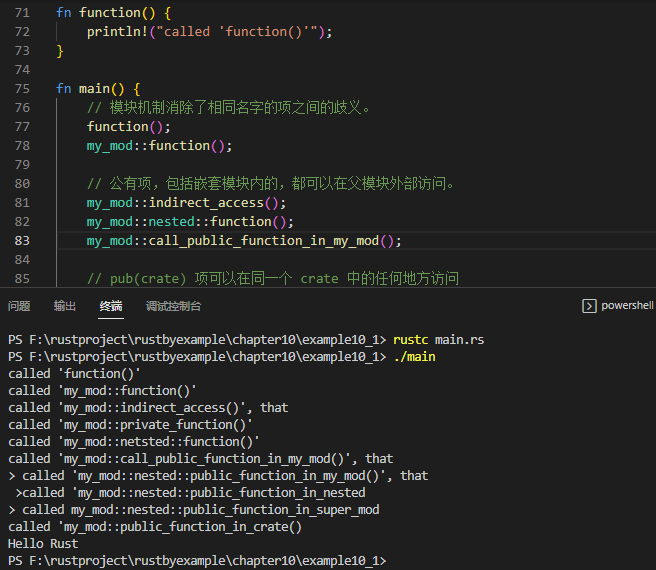
10.2 结构体的可见性
结构体的字段也是一个可见性的层次。字段默认拥有私有的可见性,也可以加上 pub 修饰语来重载该行为。只有从结构体被定义的模块之外访问其字段时,这个可见性才会起作用,其意义是隐藏信息(即封装,encapsulation)。
// 10.2节 结构体的可见性

mod my {
    // 一个公有的结构体,带有一个公有的字段(类型为泛型 `T`)
    pub struct OpenBox<T> {
        pub contents: T,
    }

    // 一个公有的结构体,带有一个私有的字段(类型为泛型 `T`)
    #[allow(dead_code)]
    #[derive(Debug)]
    pub struct ClosedBox<T> {
        contents: T,
    }

    impl<T> ClosedBox<T> {
        // 一个公有的构造器方法
        pub fn new(contents: T) -> ClosedBox<T> {
            ClosedBox {
                contents: contents,
            }
        }
    }
}

fn main() {
    // 带有公有字段的公有结构体,可以像平常一样构造
    let open_box = my::OpenBox{contents: "public information"};

    // 并且它们的字段可以正常访问到。
    println!("The open box contains: {}", open_box.contents);

    // 带有私有字段的公有结构体不能使用字段名来构造。
    // 报错!`ClosedBox` 含有私有字段。
    //let closed_box = my::ClosedBox { contents: "classified information" };
    // 试一试 ^ 取消此行注释

    // 不过带有私有字段的结构体可以使用公有的构造器来创建。
    let _closed_box = my::ClosedBox::new("classified information");
    println!("_closed_box = {:?}", _closed_box);

    // 并且一个结构体中的私有字段不能访问到。
    // 报错!`content` 字段是私有的。
    //println!("The closed box contains: {}", _closed_box.contents);
    // 试一试 ^ 取消此行注释

    println!("Hello Rust");
}

// rustc main.rs
// ./main
编译运行:
PS F:\rustproject\rustbyexample\chapter10\example10_2> rustc main.rs
PS F:\rustproject\rustbyexample\chapter10\example10_2> ./main
The open box contains: public information
_closed_box = ClosedBox { contents: "classified information" }
Hello Rust
PS F:\rustproject\rustbyexample\chapter10\example10_2>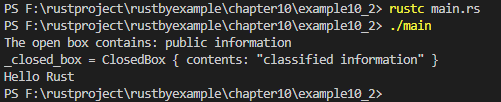
参见:
10.3 use声明
use 声明可以将一个完整的路径绑定到一个新的名字,从而更容易访问。
// 10.3节 声明
// 将 `deeply::nested::function` 路径绑定到 `other_function`。
use deeply::nested::function as other_function;

fn function() {
    println!("called 'function()'");
}

mod deeply {
    pub mod nested {
        pub fn function() {
            println!("called 'deeply::nested::function()'")
        }
    }
}

fn main() {
    // 更容易访问 `deeply::nested::funcion`
    other_function();

    println!("Entering block");
    {
        // 这和 `use deeply::nested::function as function` 等价。
        // 此 `function()` 将遮蔽外部的同名函数。
        use deeply::nested::function;
        function();

        // `use` 绑定拥有局部作用域。在这个例子中,`function()`
        // 的遮蔽只存在这个代码块中。
        println!("Leaving block");
    }

    function();

    println!("Hello Rust");
}

// rustc main.rs
// ./main
编译运行:
PS F:\rustproject\rustbyexample\chapter10\example10_3> rustc main.rs
PS F:\rustproject\rustbyexample\chapter10\example10_3> ./main
called 'deeply::nested::function()'
Entering block
called 'deeply::nested::function()'
Leaving block
called 'function()'
Hello Rust
PS F:\rustproject\rustbyexample\chapter10\example10_3>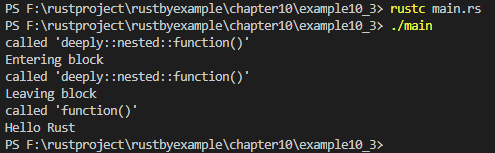
10.4 super和self
可以在路径中使用 super (父级)和 self(自身)关键字,从而在访问项时消除歧义,以及防止不必要的路径硬编码。
// 10.4节 super和self

fn function() {
    println!("called 'function()'");
}

mod cool {
    pub fn function() {
        println!("called 'cool::function()'");
    }
}

mod my {
    fn function() {
        println!("called 'my::function()'");
    }

    mod cool {
        pub fn function() {
            println!("called 'my::cool:function()'");
        }
    }

    pub fn indirect_call() {
        // 让我们从这个作用域中访问所有名为 `function` 的函数!
        print!("called 'my::indirect_call()', that\n> ");

        // `self` 关键字表示当前的模块作用域------在这个例子是 `my`。
        // 调用 `self::function()` 和直接调用 `function()` 都得到相同的结果,
        // 因为他们表示相同的函数。
        self::function();
        function();

        // 我们也可以使用 `self` 来访问 `my` 内部的另一个模块:
        self::cool::function();

        // `super` 关键字表示父作用域(在 `my` 模块外面)。
        super::function();

        // 这将在 *crate* 作用域内绑定 `cool::function` 。
        // 在这个例子中,crate 作用域是最外面的作用域。
        {
            use crate::cool::function as root_function;
            root_function();
        }
    }
}

fn main() {
    my::indirect_call();

    println!("Hello Rust");
}

// rustc main.rs
// ./main
编译运行:
PS F:\rustproject\rustbyexample\chapter10\example10_4> rustc main.rs
PS F:\rustproject\rustbyexample\chapter10\example10_4> ./main
called 'my::indirect_call()', that
> called 'my::function()'
called 'my::function()'
called 'my::cool:function()'
called 'function()'
called 'cool::function()'
Hello Rust
PS F:\rustproject\rustbyexample\chapter10\example10_4>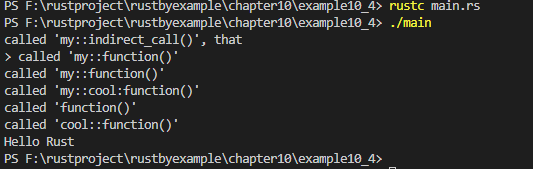
10.5 文件分层
模块可以分配到文件/目录的层次结构中。让我们将《可见性》一节中的例子的代码拆分到多个文件中:
$ tree .
.
|-- my
|   |-- inaccessible.rs
|   |-- mod.rs
|   `-- nested.rs
`-- split.rs
split.rs 的内容:
// 10.5节 文件分层
// 此声明将会查找名为 `my.rs` 或 `my/mod.rs` 的文件,并将该文件的内容放到
// 此作用域中一个名为 `my` 的模块里面。
mod my;

fn function() {
    println!("called 'function()'");
}

fn main() {
    my::function();

    function();

    my::indirect_access();
    my::nested::function();

    println!("Hello Rust");
}

// rustc split.rs
// ./split
my/mod.rs 的内容:
// 类似地,`mod inaccessible` 和 `mod nested` 将找到 `nested.rs` 和
// `inaccessible.rs` 文件,并在它们放到各自的模块中。
mod inaccessible;
pub mod nested;

pub fn function() {
    println!("called 'my::function()'");
}

fn private_function() {
    println!("called 'my::private_function()'");
}

pub fn indirect_access() {
    print!("called 'my::indirect_access()', that\n> ");
    private_function();
}
my/nested.rs 的内容:
pub fn function() {
    println!("called 'my::nested::function()'");
}

#[allow(dead_code)]
fn private_function() {
    println!("called 'my::nested::private_function()'");
}
my/inaccessible.rs 的内容:
#[allow(dead_code)]
pub fn public_function() {
    println!("called 'my::inaccessible::public_function()'");
}
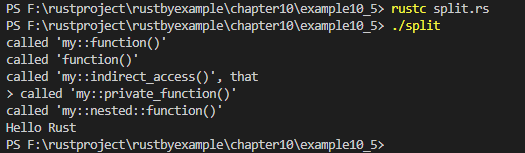
我们看到代码仍然正常运行,就和前面的一样:
PS F:\rustproject\rustbyexample\chapter10\example10_5> rustc split.rs
PS F:\rustproject\rustbyexample\chapter10\example10_5> ./split
called 'my::function()'
called 'function()'
called 'my::indirect_access()', that
> called 'my::private_function()'
called 'my::nested::function()'
Hello Rust
PS F:\rustproject\rustbyexample\chapter10\example10_5>