Rust的原生类型包括标量类型和复合类型。
标量类型
- 有符号整型:i8, i16, i32, i64, isize
- 无符号整型:u8, u16, u32, u64, usize
- 浮点型:f32, f64
- 字符:单个Unicode字符(每个占4字节)
- 布尔型:true, false
- 单元型:()(空元组)
复合类型
- 数组
一组拥有相同类型的对象的集合,在内存中连续存储,大小在编译时会被确定。
切片:类型和数组类似,其大小在编译时不确定。切片是一个双字对象,第一个字是一个指向数据的指针,第二个字是切片的长度。字的宽度和 usize 相同,由处理器架构决定。切片可以用来借用数组的一部分,类型标记为 &T.
- 元组
元组可以包含各种类型的值,使用括号 () 来构成,可以使用元组来返回多个值。
新建文件mytry.rs, 输入如下代码:
rust
fn reverse(pair: (i32, bool)) -> (bool, i32) {
    let (integer, boolean) = pair;
    (boolean, integer)
}

#[derive(Debug)]
struct Matrix(f32, f32, f32, f32);

fn main() {
    let long_tuple = (1u8, 2u16, 3u32, 4u64, -1i8, -2i16, -3i32, -4i64,
                        0.1f32, 0.2f64, 'a', true);
    println!("long tuple first value: {}", long_tuple.0);
    println!("long tuple second value: {}", long_tuple.1);
    let tuple_of_tuples = ((1u8, 2u16, 2u32), (4u64, -1i8), -2i16);
    println!("tuple of tuples: {:?}", tuple_of_tuples);
    let pair = (1, true);
    println!("pair is {:?}", pair);
    println!("the reversed pair is {:?}", reverse(pair));
    println!("one element tuple: {:?}", (5u32,));
    println!("just an integer: {:?}", (5u32));
    let tuple = (1, "hello", 4.5, true);
    let (a, b, c, d) = tuple;
    println!("{:?}, {:?}, {:?}, {:?}", a, b, c, d);
    let matrix = Matrix(1.1, 1.2, 2.1, 2.2);
    println!("{:?}", matrix)
}
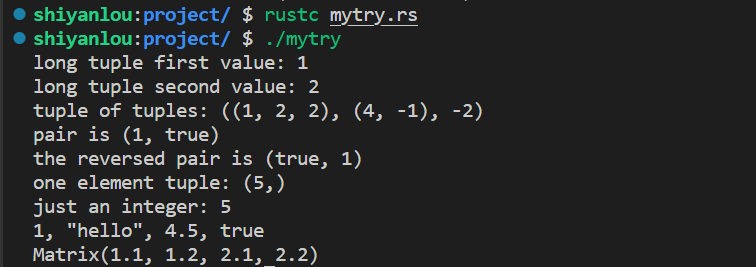
执行结果如下:
修改代码如下:
rust
fn reverse(pair: (i32, bool)) -> (bool, i32) {
    let (integer, boolean) = pair;
    (boolean, integer)
}

use std::fmt; // 添加这行

struct Matrix(f32, f32, f32, f32);

// 添加下述代码
impl fmt::Display for Matrix {
    fn fmt(&self, f: &mut fmt::Formatter) -> fmt::Result {
        write!(f, "({}, {})\n({}, {})", self.0, self.1, self.2, self.3)
    }
}

fn main() {
    let long_tuple = (1u8, 2u16, 3u32, 4u64, -1i8, -2i16, -3i32, -4i64,
                        0.1f32, 0.2f64, 'a', true);
    println!("long tuple first value: {}", long_tuple.0);
    println!("long tuple second value: {}", long_tuple.1);
    let tuple_of_tuples = ((1u8, 2u16, 2u32), (4u64, -1i8), -2i16);
    println!("tuple of tuples: {:?}", tuple_of_tuples);
    let pair = (1, true);
    println!("pair is {:?}", pair);
    println!("the reversed pair is {:?}", reverse(pair));
    println!("one element tuple: {:?}", (5u32,));
    println!("just an integer: {:?}", (5u32));
    let tuple = (1, "hello", 4.5, true);
    let (a, b, c, d) = tuple;
    println!("{:?}, {:?}, {:?}, {:?}", a, b, c, d);
    let matrix = Matrix(1.1, 1.2, 2.1, 2.2);
    println!("{}", matrix)
}
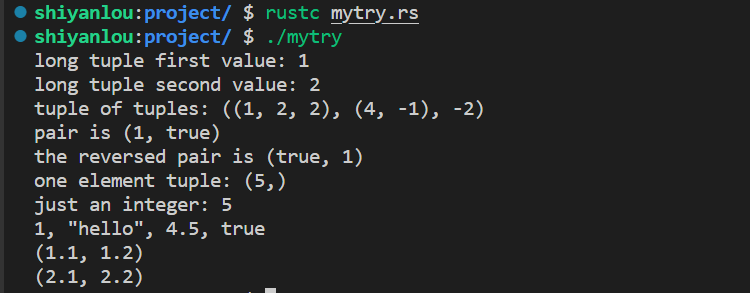
结果如下(使用Display将Matrix按行显示):
修改代码:
rust
fn reverse(pair: (i32, bool)) -> (bool, i32) {
    let (integer, boolean) = pair;
    (boolean, integer)
}

// 添加如下代码
fn transpose(matrix: Matrix) -> Matrix {
    Matrix(matrix.0, matrix.2, matrix.1, matrix.3)
}

use std::fmt;

struct Matrix(f32, f32, f32, f32);

impl fmt::Display for Matrix {
    fn fmt(&self, f: &mut fmt::Formatter) -> fmt::Result {
        write!(f, "({}, {})\n({}, {})", self.0, self.1, self.2, self.3)
    }
}

fn main() {
    let long_tuple = (1u8, 2u16, 3u32, 4u64, -1i8, -2i16, -3i32, -4i64,
                        0.1f32, 0.2f64, 'a', true);
    println!("long tuple first value: {}", long_tuple.0);
    println!("long tuple second value: {}", long_tuple.1);
    let tuple_of_tuples = ((1u8, 2u16, 2u32), (4u64, -1i8), -2i16);
    println!("tuple of tuples: {:?}", tuple_of_tuples);
    let pair = (1, true);
    println!("pair is {:?}", pair);
    println!("the reversed pair is {:?}", reverse(pair));
    println!("one element tuple: {:?}", (5u32,));
    println!("just an integer: {:?}", (5u32));
    let tuple = (1, "hello", 4.5, true);
    let (a, b, c, d) = tuple;
    println!("{:?}, {:?}, {:?}, {:?}", a, b, c, d);
    let matrix = Matrix(1.1, 1.2, 2.1, 2.2);
    println!("Matrix:\n{}", matrix); // 修改这行
    println!("Transpose:\n{}", transpose(matrix)); // 添加这行
}
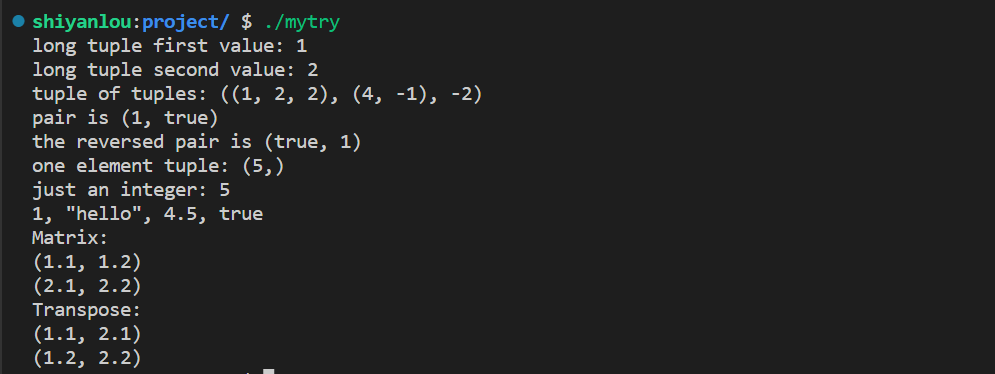
结果如下:
变量可以显示/后缀声明,整型默认i32,浮点型默认f64
字面量和运算符
字面量相当于变量
Rust运算符的优先级和类C语言类似