
目录
[1.1 线程的 "创建 - 销毁" 开销有多高?](#1.1 线程的 “创建 - 销毁” 开销有多高?)
[1.2 线程池的核心思想:"线程复用"](#1.2 线程池的核心思想:“线程复用”)
[1.3 线程池的核心组件](#1.3 线程池的核心组件)
[1.4 线程池的工作流程](#1.4 线程池的工作流程)
[2.1 前置依赖:已封装的工具类](#2.1 前置依赖:已封装的工具类)
[2.1.1 互斥量封装(Lock.hpp)](#2.1.1 互斥量封装(Lock.hpp))
[2.1.2 条件变量封装(Cond.hpp)](#2.1.2 条件变量封装(Cond.hpp))
[2.1.3 日志类简化版(Log.hpp)](#2.1.3 日志类简化版(Log.hpp))
[2.2 线程池核心实现(ThreadPool.hpp)](#2.2 线程池核心实现(ThreadPool.hpp))
[2.3 核心代码关键解析](#2.3 核心代码关键解析)
[2.3.1 线程函数的设计:静态成员函数](#2.3.1 线程函数的设计:静态成员函数)
[2.3.2 任务处理主循环:HandlerTask](#2.3.2 任务处理主循环:HandlerTask)
[2.3.3 任务提交:Enqueue接口](#2.3.3 任务提交:Enqueue接口)
[2.3.4 线程池停止:Stop与Wait](#2.3.4 线程池停止:Stop与Wait)
[3.1 测试代码(main.cpp)](#3.1 测试代码(main.cpp))
[3.2 编译与运行](#3.2 编译与运行)
[3.3 预期运行结果](#3.3 预期运行结果)
[4.1 单例模式核心原理](#4.1 单例模式核心原理)
[4.2 线程安全的单例模式实现:双重检查锁定](#4.2 线程安全的单例模式实现:双重检查锁定)
[4.3 单例式线程池实现(ThreadPool_Singleton.hpp)](#4.3 单例式线程池实现(ThreadPool_Singleton.hpp))
[4.4 单例线程池关键改进](#4.4 单例线程池关键改进)
[4.5 单例线程池测试](#4.5 单例线程池测试)
前言
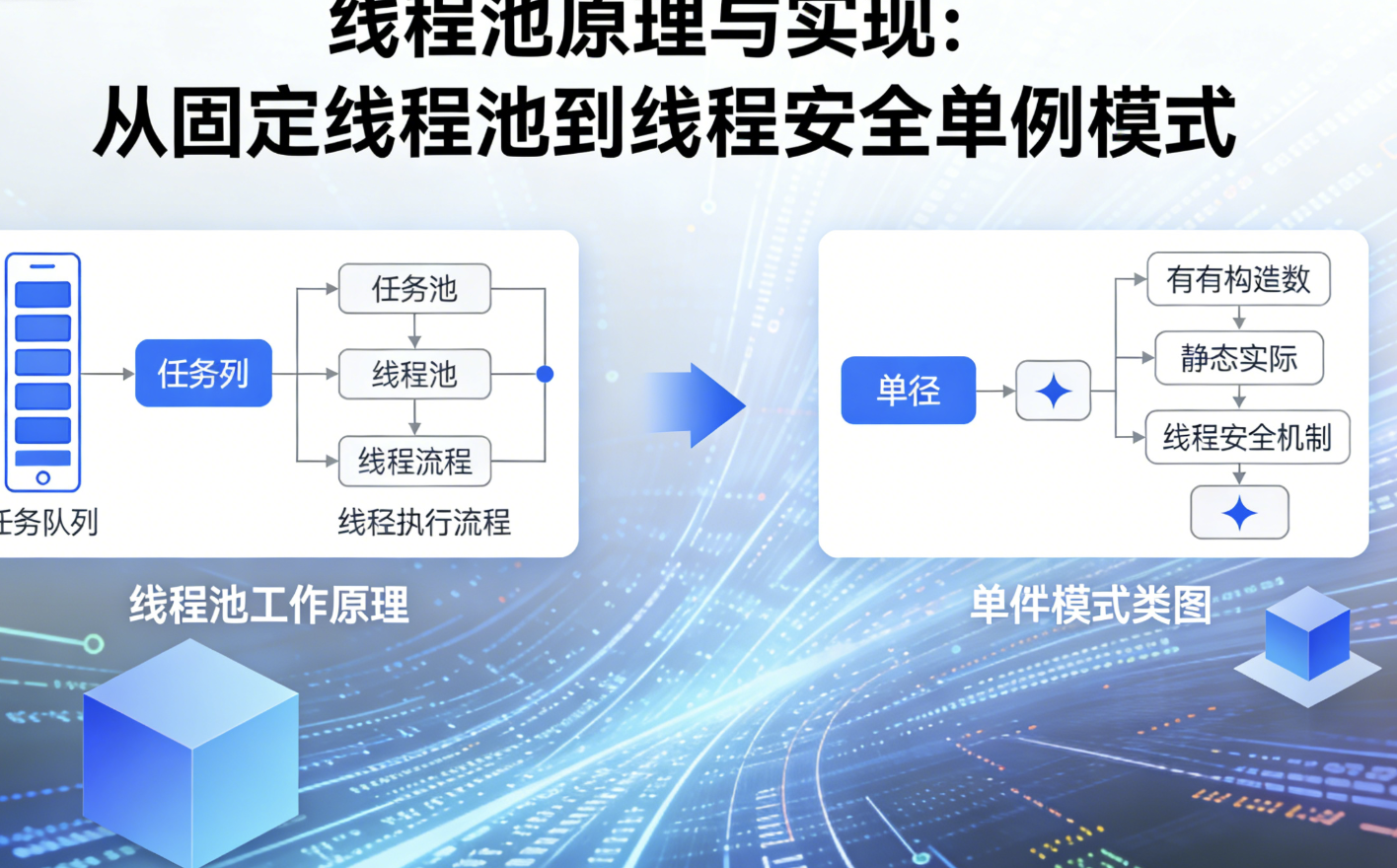
在高并发编程中,线程池绝对是 "性能优化神器"------ 它能避免频繁创建销毁线程的开销,合理利用系统资源,还能快速响应任务请求。但你知道线程池的核心原理是什么吗?如何从零实现一个稳定的固定线程池?又如何将线程池设计为线程安全的单例模式,确保全局唯一实例?
今天这篇文章,就带大家从原理到实战,一步步吃透线程池的设计与实现。我们先拆解线程池的核心组件和工作流程,再动手实现一个支持任务队列、线程管理、条件变量同步的固定线程池,最后升级为线程安全的单例模式,全程干货拉满,建议收藏跟着敲代码!下面就让我们正式开始吧!
一、线程池核心原理:为什么需要线程池?
在讲实现之前,我们先搞懂线程池的 "底层逻辑"------ 为什么高并发场景下必须用线程池,而不是直接创建线程?
1.1 线程的 "创建 - 销毁" 开销有多高?
线程是操作系统的宝贵资源,创建一个线程需要:
- 为线程分配栈空间(默认通常是 2MB);
- 内核创建线程控制块(TCB),维护线程状态、优先级等信息;
- 将线程加入操作系统的调度队列。
而销毁线程时,需要:
- 回收栈空间和 TCB 资源;
- 从调度队列中移除线程。
这些操作都需要内核参与,开销巨大。如果面对的是短时间、高频率的任务(比如 Web 服务器的 HTTP 请求),线程的创建销毁开销可能远超任务本身的执行时间,导致系统性能急剧下降。
1.2 线程池的核心思想:"线程复用"
线程池的本质是**"线程复用 + 任务队列"**:
- 程序启动时,提前创建固定数量的线程,让它们处于休眠状态,等待任务到来;
- 当有新任务时,将任务加入队列,唤醒一个休眠的线程来执行任务;
- 任务执行完毕后,线程不销毁,而是回到休眠状态,等待下一个任务;
- 程序退出时,关闭线程池,等待所有线程执行完任务后再销毁。
这样一来,就避免了频繁创建销毁线程的开销,让线程资源得到重复利用,同时任务队列起到 "缓冲" 作用,平衡任务提交和线程处理的速度。
1.3 线程池的核心组件
一个完整的线程池,必须包含以下 4 个核心组件,缺一不可:
- 线程数组 / 容器:存储所有工作线程,管理线程的创建、启动、停止;
- 任务队列:存储待执行的任务,通常是阻塞队列(无任务时线程阻塞,有任务时唤醒);
- 同步机制:互斥量(保护任务队列的线程安全)+ 条件变量(实现线程的阻塞与唤醒);
- 控制变量:标记线程池的运行状态(是否正在运行)、等待任务的线程数等。
1.4 线程池的工作流程
用一张图就能看懂线程池的完整工作流程:
 具体步骤:
具体步骤:
- 线程池初始化时,创建 N 个工作线程,每个线程启动后进入循环,等待任务;
- 外部线程通过
Enqueue接口提交任务到任务队列;- 提交任务后,通过条件变量唤醒一个正在等待的工作线程;
- 工作线程被唤醒后,从任务队列中取出任务执行;
- 任务执行完毕,工作线程再次进入等待状态;
- 当调用
Stop接口关闭线程池时,设置运行状态为 "停止",唤醒所有工作线程,等待它们执行完剩余任务后退出。
二、从零实现固定线程池:核心代码拆解
了解了原理,我们就动手实现一个固定线程数的线程池 (线程数初始化后固定,不支持动态扩容)。实现基于 C++11 及以上,使用 POSIX 线程库(pthread),结合之前封装的互斥量(Mutex)、条件变量(Cond)和日志系统(Log),保证线程安全和可调试性。
2.1 前置依赖:已封装的工具类
首先,我们需要之前实现的 3 个基础工具类(如果还没有实现,可以直接用下面的简化版本):
- 互斥量类(Lock.hpp):保证临界资源(任务队列)的线程安全;
- 条件变量类(Cond.hpp):实现线程的阻塞与唤醒;
- 日志类(Log.hpp):打印线程池运行日志,方便调试。
2.1.1 互斥量封装(Lock.hpp)
cpp
// Lock.hpp 互斥量与RAII锁守卫封装
#pragma once
#include <iostream>
#include <pthread.h>

namespace LockModule
{
    class Mutex
    {
    public:
        Mutex(const Mutex&) = delete;
        Mutex& operator=(const Mutex&) = delete;

        Mutex()
        {
            if (pthread_mutex_init(&_mutex, nullptr) != 0)
            {
                std::cerr << "Mutex init failed!" << std::endl;
                exit(EXIT_FAILURE);
            }
        }

        void Lock()
        {
            pthread_mutex_lock(&_mutex);
        }

        void Unlock()
        {
            pthread_mutex_unlock(&_mutex);
        }

        pthread_mutex_t* GetMutex()
        {
            return &_mutex;
        }

        ~Mutex()
        {
            pthread_mutex_destroy(&_mutex);
        }

    private:
        pthread_mutex_t _mutex;
    };

    // RAII锁守卫:自动加锁解锁
    class LockGuard
    {
    public:
        LockGuard(const LockGuard&) = delete;
        LockGuard& operator=(const LockGuard&) = delete;

        explicit LockGuard(Mutex& mutex) : _mutex(mutex)
        {
            _mutex.Lock();
        }

        ~LockGuard()
        {
            _mutex.Unlock();
        }

    private:
        Mutex& _mutex;
    };
}
2.1.2 条件变量封装(Cond.hpp)
cpp
// Cond.hpp 条件变量封装
#pragma once
#include <pthread.h>
#include "Lock.hpp"

namespace CondModule
{
    using namespace LockModule;

    class Cond
    {
    public:
        Cond(const Cond&) = delete;
        Cond& operator=(const Cond&) = delete;

        Cond()
        {
            if (pthread_cond_init(&_cond, nullptr) != 0)
            {
                std::cerr << "Cond init failed!" << std::endl;
                exit(EXIT_FAILURE);
            }
        }

        void Wait(Mutex& mutex)
        {
            pthread_cond_wait(&_cond, mutex.GetMutex());
        }

        void Notify()
        {
            pthread_cond_signal(&_cond);
        }

        void NotifyAll()
        {
            pthread_cond_broadcast(&_cond);
        }

        ~Cond()
        {
            pthread_cond_destroy(&_cond);
        }

    private:
        pthread_cond_t _cond;
    };
}
2.1.3 日志类简化版(Log.hpp)
cpp
// Log.hpp 简化版日志类
#pragma once
#include <iostream>
#include <string>
#include <ctime>
#include <sstream>
#include <unistd.h>

namespace LogModule
{
    enum class LogLevel
    {
        DEBUG,
        INFO,
        ERROR
    };

    std::string GetCurrentTime()
    {
        time_t now = time(nullptr);
        struct tm tm;
        localtime_r(&now, &tm);
        char buf[64];
        snprintf(buf, sizeof(buf), "%4d-%02d-%02d %02d:%02d:%02d",
                 tm.tm_year + 1900, tm.tm_mon + 1, tm.tm_mday,
                 tm.tm_hour, tm.tm_min, tm.tm_sec);
        return buf;
    }

    std::string LevelToString(LogLevel level)
    {
        switch (level)
        {
            case LogLevel::DEBUG: return "DEBUG";
            case LogLevel::INFO: return "INFO";
            case LogLevel::ERROR: return "ERROR";
            default: return "UNKNOWN";
        }
    }

    #define LOG(level, msg) do { \
        std::cout << "[" << GetCurrentTime() << "] [" << LevelToString(level) << "] " \
                  << "[" << getpid() << "] " << msg << std::endl; \
    } while(0)
}
2.2 线程池核心实现(ThreadPool.hpp)
线程池的核心是ThreadPool类,模板设计支持任意类型的任务(通过std::function封装),核心接口包括:
- 构造函数:初始化线程数和核心组件;
InitThreadPool:创建工作线程(不启动);Start:启动所有工作线程;Enqueue:提交任务到队列;Stop:关闭线程池;Wait:等待所有线程退出;- 内部函数
HandlerTask:工作线程的任务处理逻辑。
完整代码如下:
cpp
// ThreadPool.hpp 固定线程池实现
#pragma once
#include <iostream>
#include <vector>
#include <queue>
#include <functional>
#include <pthread.h>
#include <unistd.h>
#include "Lock.hpp"
#include "Cond.hpp"
#include "Log.hpp"

using namespace LockModule;
using namespace CondModule;
using namespace LogModule;

// 任务类型:无参数无返回值的函数对象
using Task = std::function<void()>;

template <typename T = Task>
class ThreadPool
{
public:
    // 禁用拷贝和赋值(线程池不能被拷贝)
    ThreadPool(const ThreadPool&) = delete;
    ThreadPool& operator=(const ThreadPool&) = delete;

    // 构造函数:指定线程数,默认10个
    explicit ThreadPool(int thread_num = 10)
        : _thread_num(thread_num), _is_running(false), _wait_thread_num(0)
    {
        if (_thread_num <= 0)
        {
            LOG(LogLevel::ERROR, "Thread number must be positive!");
            exit(EXIT_FAILURE);
        }
        LOG(LogLevel::INFO, "ThreadPool constructed, thread num: " + std::to_string(_thread_num));
    }

    // 初始化线程池:创建工作线程(不启动)
    void InitThreadPool()
    {
        // 预留线程容器空间,避免扩容
        _threads.reserve(_thread_num);
        for (int i = 0; i < _thread_num; ++i)
        {
            // 创建线程,绑定任务处理函数HandlerTask
            pthread_t tid;
            if (pthread_create(&tid, nullptr, ThreadFunc, this) != 0)
            {
                LOG(LogLevel::ERROR, "Create thread " + std::to_string(i) + " failed!");
                exit(EXIT_FAILURE);
            }
            _threads.emplace_back(tid);
            LOG(LogLevel::INFO, "Init thread " + std::to_string(i) + " success, tid: " + std::to_string(tid));
        }
    }

    // 启动线程池:设置运行状态为true,所有线程开始工作
    void Start()
    {
        _is_running = true;
        LOG(LogLevel::INFO, "ThreadPool start running...");
    }

    // 提交任务到队列
    bool Enqueue(const T& task)
    {
        LockGuard lock(_mutex); // 加锁保护任务队列

        // 如果线程池已停止,不接受新任务
        if (!_is_running)
        {
            LOG(LogLevel::ERROR, "ThreadPool has stopped, cannot enqueue task!");
            return false;
        }

        // 将任务加入队列
        _task_queue.push(task);
        LOG(LogLevel::DEBUG, "Enqueue task success, queue size: " + std::to_string(_task_queue.size()));

        // 如果有等待的线程,唤醒一个
        if (_wait_thread_num > 0)
        {
            _cond.Notify();
        }

        return true;
    }

    // 停止线程池:等待所有任务执行完毕后退出
    void Stop()
    {
        LockGuard lock(_mutex);
        if (!_is_running)
        {
            LOG(LogLevel::INFO, "ThreadPool has already stopped!");
            return;
        }

        // 设置运行状态为false,唤醒所有等待的线程
        _is_running = false;
        _cond.NotifyAll();
        LOG(LogLevel::INFO, "ThreadPool stopping, wake up all threads...");
    }

    // 等待所有线程退出
    void Wait()
    {
        for (pthread_t tid : _threads)
        {
            pthread_join(tid, nullptr);
            LOG(LogLevel::INFO, "Thread " + std::to_string(tid) + " exited!");
        }
        _threads.clear();
        LOG(LogLevel::INFO, "All threads exited, thread pool stopped!");
    }

    // 析构函数
    ~ThreadPool()
    {
        if (_is_running)
        {
            Stop();
            Wait();
        }
        LOG(LogLevel::INFO, "ThreadPool destructed!");
    }

private:
    // 线程函数:静态成员函数,通过this指针访问成员变量
    static void* ThreadFunc(void* arg)
    {
        ThreadPool* pool = static_cast<ThreadPool*>(arg);
        pool->HandlerTask(); // 调用成员函数处理任务
        return nullptr;
    }

    // 任务处理逻辑:工作线程的主循环
    void HandlerTask()
    {
        pthread_t tid = pthread_self();
        LOG(LogLevel::INFO, "Thread " + std::to_string(tid) + " started, waiting for tasks...");

        while (true)
        {
            LockGuard lock(_mutex); // 加锁

            // 1. 如果线程池运行中且任务队列为空,线程进入等待状态
            while (_is_running && _task_queue.empty())
            {
                _wait_thread_num++;
                LOG(LogLevel::DEBUG, "Thread " + std::to_string(tid) + " no tasks, wait...");
                _cond.Wait(_mutex); // 解锁并等待,被唤醒后重新加锁
                _wait_thread_num--;
            }

            // 2. 检查线程池是否已停止
            // 如果线程池停止且任务队列为空,线程退出
            if (!_is_running && _task_queue.empty())
            {
                LOG(LogLevel::INFO, "Thread " + std::to_string(tid) + " exit, pool stopped and queue empty!");
                break;
            }

            // 3. 取出任务并执行(此时已加锁,确保任务队列操作安全)
            if (!_task_queue.empty())
            {
                T task = _task_queue.front();
                _task_queue.pop();
                lock.~LockGuard(); // 手动解锁,让其他线程可以操作队列(提前解锁提升性能)

                LOG(LogLevel::DEBUG, "Thread " + std::to_string(tid) + " get task, queue size left: " + std::to_string(_task_queue.size()));
                task(); // 执行任务
            }
            else
            {
                // 极端情况:线程被唤醒但队列空且池未停止,继续循环
                continue;
            }
        }
    }

private:
    int _thread_num;                // 工作线程数
    std::vector<pthread_t> _threads;// 工作线程ID容器
    std::queue<T> _task_queue;      // 任务队列
    Mutex _mutex;                   // 保护任务队列的互斥量
    Cond _cond;                     // 线程阻塞与唤醒的条件变量
    bool _is_running;               // 线程池运行状态(true:运行中,false:已停止)
    int _wait_thread_num;           // 正在等待任务的线程数
};
2.3 核心代码关键解析
2.3.1 线程函数的设计:静态成员函数
由于 POSIX 的**pthread_create要求线程函数是void* ()(void)类型,无法直接调用类的非静态成员函数(非静态成员函数隐含this指针)。因此,我们设计了静态成员函数ThreadFunc** ,通过void* arg参数传入线程池对象指针,再调用非静态成员函数**HandlerTask**处理任务。
2.3.2 任务处理主循环:HandlerTask
这是工作线程的核心逻辑,也是线程池的 "心脏",重点关注 3 点:
- 循环等待任务 :用**while (_is_running && _task_queue.empty())**循环判断,避免 "伪唤醒"(即使线程被意外唤醒,发现队列空或池已停止,会重新等待);
- 提前解锁优化 :取出任务后,手动调用**lock.~LockGuard()**释放互斥量,让其他线程可以同时操作任务队列(任务执行可能耗时,提前解锁能提升并发性能);
- 线程退出条件 :只有当线程池已停止(_is_running = false)且任务队列为空时,线程才退出,确保所有已提交的任务都能执行完毕。
2.3.3 任务提交:Enqueue接口
- 加锁保护任务队列,避免多线程并发提交任务导致队列错乱;
- 提交任务后,只唤醒一个等待的线程(
_cond.Notify()),避免 "惊群效应"(唤醒所有线程导致竞争,浪费 CPU 资源);- 如果线程池已停止,拒绝接受新任务,保证线程池的安全性。
2.3.4 线程池停止:Stop与Wait
Stop:设置**_is_running = false**,唤醒所有等待的线程,让它们检查退出条件;Wait:调用**pthread_join**等待所有线程退出,确保线程资源被正确回收;- 析构函数中自动调用**
Stop和Wait**,避免内存泄漏。
三、线程池测试:验证功能正确性
我们写一个测试程序,验证线程池的任务提交、执行、停止等功能是否正常。
3.1 测试代码(main.cpp)
cpp
// main.cpp 线程池测试程序
#include <iostream>
#include <unistd.h>
#include "ThreadPool.hpp"

// 测试任务1:简单打印信息
void TestTask1(int task_id)
{
    LOG(LogLevel::INFO, "Task " + std::to_string(task_id) + " started, thread tid: " + std::to_string(pthread_self()));
    usleep(100000); // 模拟任务执行耗时(100ms)
    LOG(LogLevel::INFO, "Task " + std::to_string(task_id) + " finished!");
}

// 测试任务2:计算1~n的和
void TestTask2(int n, int task_id)
{
    LOG(LogLevel::INFO, "Task " + std::to_string(task_id) + " (sum 1~" + std::to_string(n) + ") started!");
    int sum = 0;
    for (int i = 1; i <= n; ++i)
    {
        sum += i;
    }
    LOG(LogLevel::INFO, "Task " + std::to_string(task_id) + " result: 1~" + std::to_string(n) + " sum = " + std::to_string(sum));
}

int main()
{
    // 1. 创建线程池(5个工作线程)
    ThreadPool<> pool(5);

    // 2. 初始化并启动线程池
    pool.InitThreadPool();
    pool.Start();

    // 3. 提交10个任务
    for (int i = 0; i < 10; ++i)
    {
        if (i % 2 == 0)
        {
            // 提交任务1:绑定task_id
            pool.Enqueue(std::bind(TestTask1, i));
        }
        else
        {
            // 提交任务2:绑定n和task_id
            pool.Enqueue(std::bind(TestTask2, 10000 + i * 1000, i));
        }
        usleep(50000); // 每隔50ms提交一个任务
    }

    // 4. 等待所有任务执行完毕(这里休眠2秒,实际开发中可通过信号量等机制优化)
    sleep(2);

    // 5. 停止线程池
    LOG(LogLevel::INFO, "Start stopping thread pool...");
    pool.Stop();
    pool.Wait();

    return 0;
}
3.2 编译与运行
编译时需要链接 POSIX 线程库(-lpthread),支持 C++11 及以上:
bash
# 编译命令
g++ main.cpp -o thread_pool_test -std=c++11 -lpthread

# 运行程序
./thread_pool_test
3.3 预期运行结果
- 线程池初始化 5 个工作线程,每个线程启动后进入等待状态;
- 每隔 50ms 提交一个任务,共 10 个任务,线程池会唤醒空闲线程执行任务;
- 任务执行时打印线程 ID 和任务信息,验证线程复用(多个任务可能由同一个线程执行);
- 所有任务执行完毕后,调用
Stop停止线程池,5 个线程依次退出;- 日志中无任务丢失、线程错乱等问题,说明线程池功能正常。
四、升级线程池:线程安全的单例模式
上面实现的线程池,每次使用都需要手动创建对象,无法保证全局唯一实例。在实际开发中,线程池通常是全局唯一 的(多个模块共享一个线程池,避免资源浪费),这就需要用到单例模式。
但普通的单例模式在多线程环境下是线程不安全的 ------ 如果多个线程同时调用**GetInstance,可能会创建多个实例。因此,我们需要实现线程安全的单例模式**。
4.1 单例模式核心原理
单例模式的核心是**"一个类只能创建一个实例"**,实现要点:
- 私有化构造函数、拷贝构造函数、赋值运算符,禁止外部创建对象;
- 提供一个静态成员函数**
GetInstance**,返回唯一实例;- 线程安全:确保多个线程同时调用**
GetInstance**时,只创建一个实例。
4.2 线程安全的单例模式实现:双重检查锁定
最常用的线程安全单例模式是双重检查锁定(Double-Checked Locking),核心逻辑:
cpp
static Singleton* GetInstance()
{
    if (instance == nullptr) // 第一次检查:避免不必要的锁竞争
    {
        LockGuard lock(mutex); // 加锁
        if (instance == nullptr) // 第二次检查:确保只创建一个实例
        {
            instance = new Singleton();
        }
    }
    return instance;
}
- 第一次检查:如果实例已创建,直接返回,避免每次调用都加锁,提升性能;
- 第二次检查:加锁后再次检查,防止多个线程同时通过第一次检查,创建多个实例;
- 注意:实例指针需要用
volatile修饰,避免编译器优化导致的 "指令重排" 问题。
4.3 单例式线程池实现(ThreadPool_Singleton.hpp)
基于之前的固定线程池,修改为线程安全的单例模式:
cpp
// ThreadPool_Singleton.hpp 单例模式线程池
#pragma once
#include <iostream>
#include <vector>
#include <queue>
#include <functional>
#include <pthread.h>
#include <unistd.h>
#include <volatile>
#include "Lock.hpp"
#include "Cond.hpp"
#include "Log.hpp"

using namespace LockModule;
using namespace CondModule;
using namespace LogModule;

using Task = std::function<void()>;

template <typename T = Task>
class ThreadPoolSingleton
{
public:
    // 禁用拷贝和赋值
    ThreadPoolSingleton(const ThreadPoolSingleton&) = delete;
    ThreadPoolSingleton& operator=(const ThreadPoolSingleton&) = delete;

    // 静态成员函数:获取唯一实例
    static ThreadPoolSingleton* GetInstance(int thread_num = 10)
    {
        // 第一次检查:避免不必要的锁竞争
        if (_instance == nullptr)
        {
            LockGuard lock(_instance_mutex); // 加锁
            // 第二次检查:确保只创建一个实例
            if (_instance == nullptr)
            {
                _instance = new ThreadPoolSingleton(thread_num);
                _instance->InitThreadPool();
                _instance->Start();
                LOG(LogLevel::INFO, "Create thread pool singleton success, thread num: " + std::to_string(thread_num));
            }
        }
        LOG(LogLevel::DEBUG, "Get thread pool singleton success!");
        return _instance;
    }

    // 提交任务(与之前一致)
    bool Enqueue(const T& task)
    {
        LockGuard lock(_mutex);
        if (!_is_running)
        {
            LOG(LogLevel::ERROR, "ThreadPool has stopped, cannot enqueue task!");
            return false;
        }
        _task_queue.push(task);
        LOG(LogLevel::DEBUG, "Enqueue task success, queue size: " + std::to_string(_task_queue.size()));
        if (_wait_thread_num > 0)
        {
            _cond.Notify();
        }
        return true;
    }

    // 停止线程池(与之前一致)
    void Stop()
    {
        LockGuard lock(_mutex);
        if (!_is_running)
        {
            LOG(LogLevel::INFO, "ThreadPool has already stopped!");
            return;
        }
        _is_running = false;
        _cond.NotifyAll();
        LOG(LogLevel::INFO, "ThreadPool stopping, wake up all threads...");
    }

    // 等待线程退出(与之前一致)
    void Wait()
    {
        for (pthread_t tid : _threads)
        {
            pthread_join(tid, nullptr);
            LOG(LogLevel::INFO, "Thread " + std::to_string(tid) + " exited!");
        }
        _threads.clear();
        LOG(LogLevel::INFO, "All threads exited, thread pool stopped!");
    }

    // 销毁实例(可选,一般在程序退出时调用)
    static void DestroyInstance()
    {
        LockGuard lock(_instance_mutex);
        if (_instance != nullptr)
        {
            if (_instance->_is_running)
            {
                _instance->Stop();
                _instance->Wait();
            }
            delete _instance;
            _instance = nullptr;
            LOG(LogLevel::INFO, "Destroy thread pool singleton success!");
        }
    }

private:
    // 私有化构造函数:只能通过GetInstance创建实例
    explicit ThreadPoolSingleton(int thread_num = 10)
        : _thread_num(thread_num), _is_running(false), _wait_thread_num(0)
    {
        if (_thread_num <= 0)
        {
            LOG(LogLevel::ERROR, "Thread number must be positive!");
            exit(EXIT_FAILURE);
        }
        LOG(LogLevel::INFO, "ThreadPoolSingleton constructed!");
    }

    // 私有化析构函数
    ~ThreadPoolSingleton()
    {
        LOG(LogLevel::INFO, "ThreadPoolSingleton destructed!");
    }

    // 初始化线程池(与之前一致)
    void InitThreadPool()
    {
        _threads.reserve(_thread_num);
        for (int i = 0; i < _thread_num; ++i)
        {
            pthread_t tid;
            if (pthread_create(&tid, nullptr, ThreadFunc, this) != 0)
            {
                LOG(LogLevel::ERROR, "Create thread " + std::to_string(i) + " failed!");
                exit(EXIT_FAILURE);
            }
            _threads.emplace_back(tid);
            LOG(LogLevel::INFO, "Init thread " + std::to_string(i) + " success, tid: " + std::to_string(tid));
        }
    }

    // 启动线程池(与之前一致)
    void Start()
    {
        _is_running = true;
        LOG(LogLevel::INFO, "ThreadPoolSingleton start running...");
    }

    // 静态线程函数(与之前一致)
    static void* ThreadFunc(void* arg)
    {
        ThreadPoolSingleton* pool = static_cast<ThreadPoolSingleton*>(arg);
        pool->HandlerTask();
        return nullptr;
    }

    // 任务处理逻辑(与之前一致)
    void HandlerTask()
    {
        pthread_t tid = pthread_self();
        LOG(LogLevel::INFO, "Thread " + std::to_string(tid) + " started, waiting for tasks...");

        while (true)
        {
            LockGuard lock(_mutex);
            while (_is_running && _task_queue.empty())
            {
                _wait_thread_num++;
                LOG(LogLevel::DEBUG, "Thread " + std::to_string(tid) + " no tasks, wait...");
                _cond.Wait(_mutex);
                _wait_thread_num--;
            }

            if (!_is_running && _task_queue.empty())
            {
                LOG(LogLevel::INFO, "Thread " + std::to_string(tid) + " exit, pool stopped and queue empty!");
                break;
            }

            if (!_task_queue.empty())
            {
                T task = _task_queue.front();
                _task_queue.pop();
                lock.~LockGuard();

                LOG(LogLevel::DEBUG, "Thread " + std::to_string(tid) + " get task, queue size left: " + std::to_string(_task_queue.size()));
                task();
            }
            else
            {
                continue;
            }
        }
    }

private:
    int _thread_num;                // 工作线程数
    std::vector<pthread_t> _threads;// 工作线程ID容器
    std::queue<T> _task_queue;      // 任务队列
    Mutex _mutex;                   // 保护任务队列的互斥量
    Cond _cond;                     // 条件变量
    bool _is_running;               // 运行状态
    int _wait_thread_num;           // 等待任务的线程数

    // 单例相关静态成员
    static volatile ThreadPoolSingleton* _instance; // 唯一实例指针(volatile避免优化)
    static Mutex _instance_mutex;                   // 保护实例创建的互斥量
};

// 静态成员初始化(类外初始化)
template <typename T>
volatile ThreadPoolSingleton<T>* ThreadPoolSingleton<T>::_instance = nullptr;

template <typename T>
Mutex ThreadPoolSingleton<T>::_instance_mutex;

// 简化调用:定义全局宏
#define THREAD_POOL ThreadPoolSingleton<>::GetInstance()
4.4 单例线程池关键改进
- 私有化构造 / 析构函数 :禁止外部直接创建或销毁实例,只能通过**
GetInstance和DestroyInstance**操作;- 静态实例指针 :**
_instance是静态成员,全局唯一,用volatile**修饰,避免编译器优化导致的指令重排(比如new操作被拆分为 "分配内存 + 初始化对象 + 赋值指针",可能被重排为 "分配内存 + 赋值指针 + 初始化对象",导致其他线程拿到未初始化的实例);- 双重检查锁定 :
GetInstance中两次检查_instance是否为空,结合互斥量_instance_mutex,确保多线程环境下只创建一个实例;- 全局宏定义 :#define THREAD_POOL ThreadPoolSingleton<>::GetInstance(),简化调用,直接用**THREAD_POOL->Enqueue(...)**提交任务。
4.5 单例线程池测试
cpp
// main_singleton.cpp 单例线程池测试
#include <iostream>
#include <unistd.h>
#include "ThreadPool_Singleton.hpp"

void TestTask(int task_id)
{
    LOG(LogLevel::INFO, "Singleton Task " + std::to_string(task_id) + " started, tid: " + std::to_string(pthread_self()));
    usleep(100000);
    LOG(LogLevel::INFO, "Singleton Task " + std::to_string(task_id) + " finished!");
}

int main()
{
    // 1. 多个线程同时获取单例,验证线程安全
    pthread_t t1, t2, t3;

    auto get_pool_and_enqueue = [](void* arg) {
        int thread_id = *(static_cast<int*>(arg));
        // 多个线程同时获取实例并提交任务
        ThreadPoolSingleton<>* pool = ThreadPoolSingleton<>::GetInstance(3);
        for (int i = 0; i < 2; ++i)
        {
            pool->Enqueue(std::bind(TestTask, thread_id * 10 + i));
            usleep(30000);
        }
        return nullptr;
    };

    int id1 = 1, id2 = 2, id3 = 3;
    pthread_create(&t1, nullptr, get_pool_and_enqueue, &id1);
    pthread_create(&t2, nullptr, get_pool_and_enqueue, &id2);
    pthread_create(&t3, nullptr, get_pool_and_enqueue, &id3);

    // 等待线程提交任务
    sleep(2);

    // 2. 停止线程池并销毁实例
    LOG(LogLevel::INFO, "Start stopping singleton thread pool...");
    ThreadPoolSingleton<>::GetInstance()->Stop();
    ThreadPoolSingleton<>::GetInstance()->Wait();
    ThreadPoolSingleton<>::DestroyInstance();

    pthread_join(t1, nullptr);
    pthread_join(t2, nullptr);
    pthread_join(t3, nullptr);

    return 0;
}编译运行:
bash
g++ main_singleton.cpp -o thread_pool_singleton_test -std=c++11 -lpthread
./thread_pool_singleton_test预期结果:
- 3 个线程同时调用**
GetInstance**,但只创建一个线程池实例(日志中只有一次 "Create thread pool singleton success");- 共提交 6 个任务,3 个工作线程复用执行;
- 停止线程池后,实例被正确销毁,无内存泄漏。
五、线程池的进阶优化方向
我们实现的线程池是基础版本,实际生产环境中还可以进行以下优化:
- 动态扩容 / 缩容:根据任务队列长度动态增加或减少工作线程,避免线程过多导致调度开销,或线程过少导致任务堆积;
- 任务优先级 :任务队列改为优先级队列(
std::priority_queue),支持高优先级任务先执行;- 任务超时机制:提交任务时指定超时时间,超时未执行的任务自动取消;
- 异常处理:任务执行过程中抛出异常时,线程池能捕获异常并记录日志,避免线程崩溃;
- 异步任务结果 :支持任务执行后返回结果,通过**
std::future和std::promise**实现;- 线程本地存储(TLS):为每个工作线程分配独立的本地存储,存储线程私有的数据,避免频繁的参数传递。
总结
最后,线程池是 C/C++ 高并发编程的基础组件,掌握其原理和实现,能让你在面试和实际开发中更有竞争力。本文的代码可直接用于项目开发,也可根据需求进行二次优化,建议大家动手敲一遍,加深理解!
如果在实现过程中有任何问题,欢迎在评论区留言讨论,一起学习,一起进步!💪