Pthreads库
pthread_attr() 初始化线程的各项属性
pthread_attr_setdetachstate() 为初始化的线程设置属性
pthread_create() 创建一个线程
| 第一个参数 | 是每个线程的"句柄",对操作系统非常重要,使操作系统能够跟踪线程。 |
| 第二个参数 | 对于所有线程都相同,内容是线程属性 |
| 第三个参数 | 告诉线程要执行的任务 |
| 第四个参数 | 经过一些指针操作后,该参数指向TheParami,每个线程知道自己是谁 |
pthread_attr_destroy()
pthread_join()合并线程
用于将任何给定的线程合并到最初创建它的线程中。你可以将"合并"过程想象成"毁灭"线程,或者父线程"吞食"刚刚创建的线程。
示例
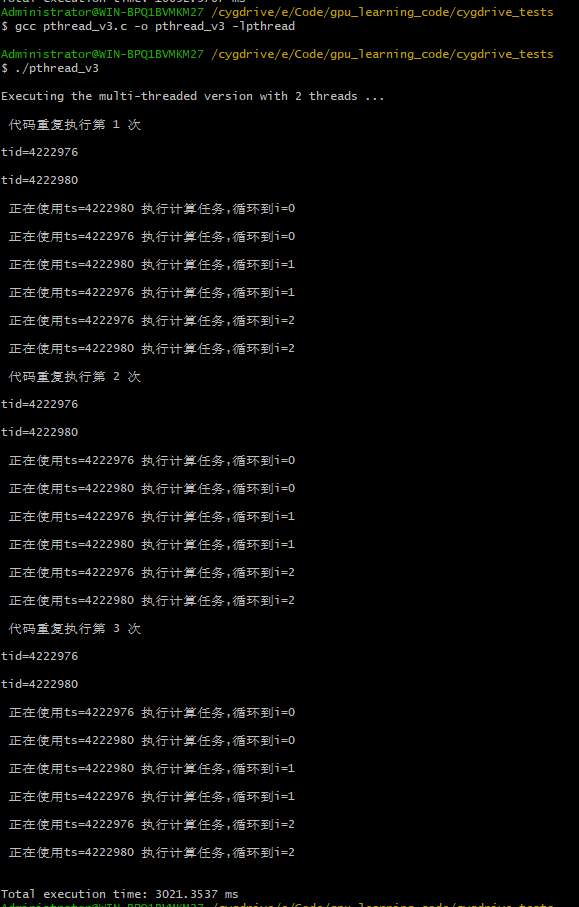
main主函数被重复执行3次,每次执行使用2个线程完成计算任务。
c
#include <pthread.h>
#include <stdint.h>
#include <ctype.h>
#include <stdlib.h>
#include <stdio.h>
#include <sys/time.h>
#include <unistd.h>  // sleep()函数头文件


#define REPS 	     3
#define MAXTHREADS   128

long  			NumThreads=2;         		// Total number of threads working in parallel 并行的线程总数
int 	     	ThParam[MAXTHREADS];		// Thread parameters ...线程参数
pthread_t      	ThHandle[MAXTHREADS];		// Thread handles 线程句柄
pthread_attr_t 	ThAttr;						// Pthread attrributes

void *MTFlip(void* tid)
{
	int i;
	long ts = *((int *) tid);       	// My thread ID is stored here
	printf("\ntid=%d\n",tid);

	for(i=0;i<3;i++){
		sleep(1);
		printf("\n 正在使用ts=%d 执行计算任务,循环到i=%d\n",tid,i);
	}

	pthread_exit(0);
}


int main(int argc, char** argv)
{

	int 				a,i,ThErr;
	struct timeval 		t;
	double         		StartTime, EndTime;
	double         		TimeElapsed;

	if((NumThreads<1) || (NumThreads>MAXTHREADS)){
		printf("\nNumber of threads must be between 1 and %u... Exiting abruptly\n",MAXTHREADS);
		exit(EXIT_FAILURE);
	}
	else{
		if(NumThreads != 1){
			printf("\nExecuting the multi-threaded version with %li threads ...\n",NumThreads);
		}
		else{
			printf("\nExecuting the serial version ...\n");
		}
	}

	gettimeofday(&t, NULL);
	StartTime = (double)t.tv_sec*1000000.0 + ((double)t.tv_usec);

	if(NumThreads >1){

		for(a=0; a<REPS; a++){
			pthread_attr_init(&ThAttr);
			pthread_attr_setdetachstate(&ThAttr, PTHREAD_CREATE_JOINABLE);
			printf("\n 代码重复执行第 %d 次\n",a+1);
			for(i=0; i<NumThreads; i++){
				ThParam[i] = i;
				ThErr = pthread_create(&ThHandle[i], &ThAttr, MTFlip, (void *)&ThParam[i]);
				if(ThErr != 0){
					printf("\nThread Creation Error %d. Exiting abruptly... \n",ThErr);
					exit(EXIT_FAILURE);
				}
			}
			pthread_attr_destroy(&ThAttr);
			for(i=0; i<NumThreads; i++){
				pthread_join(ThHandle[i], NULL);
			}
		}
	}else{
		printf("\n单线程串行执行代码\n");

		}


	gettimeofday(&t, NULL);
	EndTime = (double)t.tv_sec*1000000.0 + ((double)t.tv_usec);
	TimeElapsed=(EndTime-StartTime)/1000.00;
	TimeElapsed/=(double)REPS;

	printf("\n\nTotal execution time: %9.4f ms ",TimeElapsed);

	return (EXIT_SUCCESS);
}
toupper() 小写字母转换为大写字母
C 库函数 int toupper(int c)把小写字母转换为大写字母。
反参:
如果 c 有相对应的大写字母,则该函数返回 c 的大写字母,否则 c 保持不变。返回值是一个可被隐式转换为 char 类型的 int 值。
c
#include <stdio.h>
#include <ctype.h>

int main()
{
   int i = 0;
   char str[] = "runoob";

   while(str[i])
   {
      putchar (toupper(str[i]));
      i++;
   }

  return(0);
}
gettimeofday() 获取到当前时间的秒数
该函数的头文件在/usr/include/sys/time.h头文件中。
函数原型:int gettimeofday(struct timeval*tv, struct timezone *tz);
用到两个结构体: timeval 和 timezone
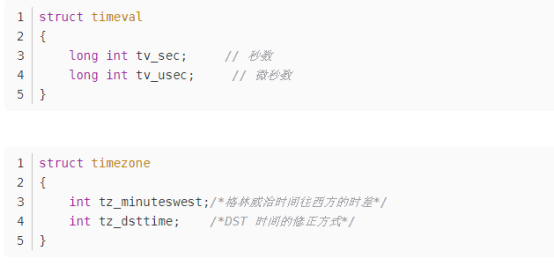
这两个结构体定义在/usr/include/linux/time.h头文件中。
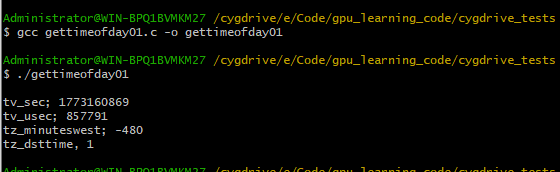
示例2
c
#include <stdio.h>
#include <sys/time.h>
#include <unistd.h>
int main(){
    struct timeval tv;
    struct timezone tz;
    gettimeofday (&tv, &tz);
    printf("\ntv_sec; %d\n", tv.tv_sec);
    printf("tv_usec; %d\n", tv.tv_usec);
    printf("tz_minuteswest; %d\n", tz.tz_minuteswest);
    printf("tz_dsttime, %d\n", tz.tz_dsttime);
}
示例2
c
#include <stdio.h>
#include <sys/time.h>
#include <unistd.h>  // sleep()函数头文件

#define REPS 	     1

int main()
{
	struct timeval 		t;
	double         		StartTime, EndTime;
	double         		TimeElapsed;

	gettimeofday(&t, NULL);
	StartTime = (double)t.tv_sec*1000000.0 + ((double)t.tv_usec);

	sleep(30);  //休眠30秒

	gettimeofday(&t, NULL);
	EndTime = (double)t.tv_sec*1000000.0 + ((double)t.tv_usec);
	TimeElapsed=(EndTime-StartTime)/1000.00;
	TimeElapsed/=(double)REPS;

	printf("\n\nTotal execution time: %9.4f ms ",TimeElapsed);

}