1.总代码
1.1头文件
c
#pragma once

#include <stdio.h>
#include <assert.h>
#include <stdbool.h>
#include <stdlib.h>

typedef int HPDataType;

typedef struct Heap
{
	HPDataType* arr;
	int size;
	int capacity;
}HP;

void Swap(HPDataType* p1, HPDataType* p2);

void AdjustUp(HPDataType* arr,int child);

void AdjustDown(HPDataType* arr,int nums,int parent);

void HPInit(HP* php);

void HPDestroy(HP* php);

void HPPush(HP* php, HPDataType data);

void HPPop(HP* php);

HPDataType HPTop(HP* php);

bool HPEmpty(HP* php);
1.2源文件
c
#define _CRT_SECURE_NO_WARNINGS 1

#include "Heap.h"

void Swap(HPDataType* p1, HPDataType* p2)
{
	HPDataType tmp = *p1;
	*p1 = *p2;
	*p2 = tmp;
}

HPDataType HPTop(HP* php)
{
	assert(php);
	assert(php->size > 0);
	return php->arr[0];
}

void AdjustUp(HPDataType* arr, int child)
{
	int parent = (child - 1) / 2;
	while (child > 0)
	{
		if (arr[child] < arr[parent])
		{
			Swap(&arr[child], &arr[parent]);
			child = parent;
			parent = (child - 1) / 2;
		}
		else
		{
			break;
		}
	}
}

void AdjustDown(HPDataType* arr, int nums, int parent)
{
	int child = (parent * 2) + 1;
	while (child < nums)
	{
		if (child + 1 < nums && arr[child + 1] < arr[child])
		{
			child++;
		}
		//找到要交换的孩子
		if (arr[child] < arr[parent])
		{
			Swap(&arr[child], &arr[parent]);
			parent = child;
			child = (parent * 2) + 1;
		}
		else
		{
			break;
		}
	}

}

void HPInit(HP* php)
{
	assert(php);
	php->arr = NULL;
	php->capacity = php->size = 0;
}

void HPDestroy(HP* php)
{
	assert(php);
	free(php->arr);
	php->arr = NULL;
	php->capacity = php->size = 0;
}

void HPPush(HP* php, HPDataType data)
{
	assert(php);
	if (php->capacity == php->size)
	{
		int newcapacity = php->capacity == 0 ? 4 : (php->capacity) * 2;
		HPDataType* tmp = (HPDataType*)realloc(php->arr, newcapacity * sizeof(HPDataType));
		if (tmp == NULL)
		{
			perror("realloc fail");
			return;
		}
		//扩容成功
		php->arr = tmp;
		php->capacity = newcapacity;
	}
	php->arr[php->size] = data;
	php->size++;
	AdjustUp(php->arr, php->size-1);
}

void HPPop(HP* php)
{
	assert(php);
	assert(php->size > 0);
	Swap(&php->arr[0], &php->arr[php->size - 1]);
	php->size--;
	AdjustDown(php->arr, php->size, 0);
}

bool HPEmpty(HP* php)
{
	assert(php);
	return php->size == 0;
}
c
#define _CRT_SECURE_NO_WARNINGS 1

#include "Heap.h"

//int main()
//{
//	int arr[] = { 4,200,1,8,5,10,6,77,100 };
//	HP hp;
//	HPInit(&hp);
//	int j = sizeof(arr) / sizeof(arr[0]);
//	for(int i = 0;i < j;i++)
//	{
//		HPPush(&hp,arr[i]);
//	}
//	while (!HPEmpty(&hp))
//	{
//		printf("%d ", HPTop(&hp));
//		HPPop(&hp);
//	}
//	HPDestroy(&hp);
//	return 0;
//}


//void HeapSort(int* a, int n)
//{
//	// 降序,建小堆
//	// 升序,建大堆
//	/*for (int i = 1; i < n; i++)
//	{
//		AdjustUp(a, i);
//	}*/
//
//	for (int i = (n - 1 - 1) / 2; i >= 0; i--)
//	{
//		AdjustDown(a, n, i);
//	}
//
//	int end = n - 1;
//	while (end > 0)
//	{
//		Swap(&a[0], &a[end]);
//		AdjustDown(a, end, 0);
//		--end;
//	}

void HeapSort(int* a, int n)
{
	// 降序,建小堆
	// 升序,建大堆
	/*for (int i = 1; i < n; i++)
	{
		AdjustUp(a, i);
	}*/

	/*for (int i = 1; i < n; i++)
	{
		AdjustUp(a, i);
	}*/

	for (int i = (n - 1 - 1) / 2; i >= 0; i--)
	{
		AdjustDown(a, n, i);
	}

	int end = n - 1;
	while (end > 0)
	{
		Swap(&a[0], &a[end]);
		AdjustDown(a, end, 0);
		--end;
	}
}

void TestHeap2()
{
	int a[] = { 4,2,8,1,5,6,9,7,2,7,9 };
	HeapSort(a, sizeof(a) / sizeof(int));
}


int main()
{
	int arr[] = { 4,200,1,8,5,10,6,77,100 };
	HP hp;
	HPInit(&hp);
	int j = sizeof(arr) / sizeof(arr[0]);
	for (int i = 0; i < j; i++)
	{
		HPPush(&hp, arr[i]);
	}
	while (!HPEmpty(&hp))
	{
		printf("%d ", HPTop(&hp));
		HPPop(&hp);
	}

	HPDestroy(&hp);
	TestHeap2();
	return 0;
}
2.堆的实现
2.1HPInit 函数
c
void HPInit(HP* php)
{
	assert(php);
	php->arr = NULL;
	php->capacity = php->size = 0;
}-
功能:初始化堆结构体,置空。
-
用途:在使用堆前必须调用,设置初始状态。
2.2HPDestroy 函数
c
void HPDestroy(HP* php)
{
	assert(php);
	free(php->arr);
	php->arr = NULL;
	php->capacity = php->size = 0;
}-
功能:释放堆占用的动态内存,并将指针置空,大小归零。
-
用途:堆使用完毕后调用,防止内存泄漏。
2.3HPPush函数(插入元素)
c
void HPPush(HP* php, HPDataType data)
{
	assert(php);
	if (php->capacity == php->size)
	{
		int newcapacity = php->capacity == 0 ? 4 : (php->capacity) * 2;
		HPDataType* tmp = (HPDataType*)realloc(php->arr, newcapacity * sizeof(HPDataType));
		if (tmp == NULL)
		{
			perror("realloc fail");
			return;
		}
		//扩容成功
		php->arr = tmp;
		php->capacity = newcapacity;
	}
	php->arr[php->size] = data;
	php->size++;
	AdjustUp(php->arr, php->size-1);
}-
功能:向堆中插入一个新元素。
-
步骤:
- 检查容量是否已满,若满则扩容(初始容量0时设为4,否则翻倍)。
- 使用 realloc 调整内存,若失败则打印错误并返回。
- 将新元素放入数组末尾(下标 size)。
- size 加1。
- 调用 AdjustUp 从新元素位置开始向上调整,保持堆性质。
2.4 HPPop 函数(删除堆顶)
c
void HPPop(HP* php)
{
	assert(php);
	assert(php->size > 0);
	Swap(&php->arr[0], &php->arr[php->size - 1]);
	php->size--;
	AdjustDown(php->arr, php->size, 0);
}-
功能:删除堆顶元素(即当前最小或最大)。
-
步骤:
- 断言堆非空。
- 交换堆顶(下标0)和最后一个元素(下标 size-1)。
- size 减1,逻辑上删除了原堆顶(现在在末尾,不再视为堆的一部分)。
- 从新的根(下标0)开始向下调整,恢复堆性质。
2.5 HPEmpty 函数
c
bool HPEmpty(HP* php)
{
	assert(php);
	return php->size == 0;
}- 功能:判断堆是否为空,空返回 true,否则 false。
2.6 Swap 函数
c
void Swap(HPDataType* p1, HPDataType* p2)
{
	HPDataType tmp = *p1;
	*p1 = *p1;
	*p2 = tmp;
}- 功能:交换两个 HPDataType 变量的值。
- 用途:在堆调整中频繁使用,用于交换父子节点。
2.7 HPTop 函数
c
HPDataType HPTop(HP* php)
{
	assert(php);
	assert(php->size > 0);
	return php->arr[0];
}-
功能:返回堆顶元素(最小或最大,取决于堆的性质,这里是小堆,因为 AdjustUp 和 AdjustDown 中使用 < 比较)。
-
用途:获取当前堆中优先级最高的元素(不删除)。
-
参数检查:断言确保指针非空且堆非空,防止空指针或空堆访问
2.8 AdjustUp 函数(向上调整)
c
void AdjustUp(HPDataType* arr, int child)
{
	int parent = (child - 1) / 2;
	while (child > 0)
	{
		if (arr[child] < arr[parent])
		{
			Swap(&arr[child], &arr[parent]);
			child = parent;
			parent = (child - 1) / 2;
		}
		else
		{
			break;
		}
	}
}-
功能:将下标为 child 的元素向上调整,直到满足小堆性质(父节点小于等于子节点)。
-
用途:在插入新元素时,新元素放在数组末尾,然后向上调整到合适位置。
解释:
- int parent = (child - 1) / 2; 计算父节点下标。
- while (child > 0) 当孩子不是根节点时继续循环。
- if (arrchild < arrparent) 如果孩子小于父节点(小堆要求),则交换。
- 交换后,更新 child 为原父节点,重新计算 parent,继续向上检查。
- 如果孩子不小于父节点,则已经满足堆性质,跳出循环。
2.9 AdjustDown 函数(向下调整)
c
void AdjustDown(HPDataType* arr, int nums, int parent)
{
	int child = (parent * 2) + 1;
	while (child < nums)
	{
		if (child + 1 < nums && arr[child + 1] < arr[child])
		{
			child++;
		}
		//找到要交换的孩子
		if (arr[child] < arr[parent])
		{
			Swap(&arr[child], &arr[parent]);
			parent = child;
			child = (parent * 2) + 1;
		}
		else
		{
			break;
		}
	}
}-
功能:从下标 parent 开始向下调整,使子树满足小堆性质。nums 是当前堆的有效元素个数(防止越界)。
-
用途:删除堆顶时,将最后一个元素移到堆顶后,向下调整;或建堆时从非叶子节点开始调整。
解释:
- int child = parent * 2 + 1; 计算左孩子下标。
- while (child < nums) 当左孩子存在时循环。
- if (child + 1 < nums && arrchild + 1 < arrchild)
如果右孩子存在且小于左孩子,则选右孩子(即选择较小的孩子)。 - 之后 if (arrchild < arrparent) 如果选中的孩子小于父节点,则交换。
- 交换后,更新 parent 为当前孩子,重新计算 child,继续向下调整。
- 否则跳出循环。
3.测试
3.1测试1
c
int main()
{
	int arr[] = { 4,200,1,8,5,10,6,77,100 };
	HP hp;
	HPInit(&hp);
	int j = sizeof(arr) / sizeof(arr[0]);
	for(int i = 0;i < j;i++)
	{
		HPPush(&hp,arr[i]);
	}
	while (!HPEmpty(&hp))
	{
		printf("%d ", HPTop(&hp));
		HPPop(&hp);
	}
	HPDestroy(&hp);
	return 0;
}-
用途:测试堆的基本功能。
-
先初始化堆,然后循环插入数组元素。
-
再不断弹出堆顶并打印,由于是小堆,每次弹出最小值,因此输出应为升序序列。
-
最后销毁堆
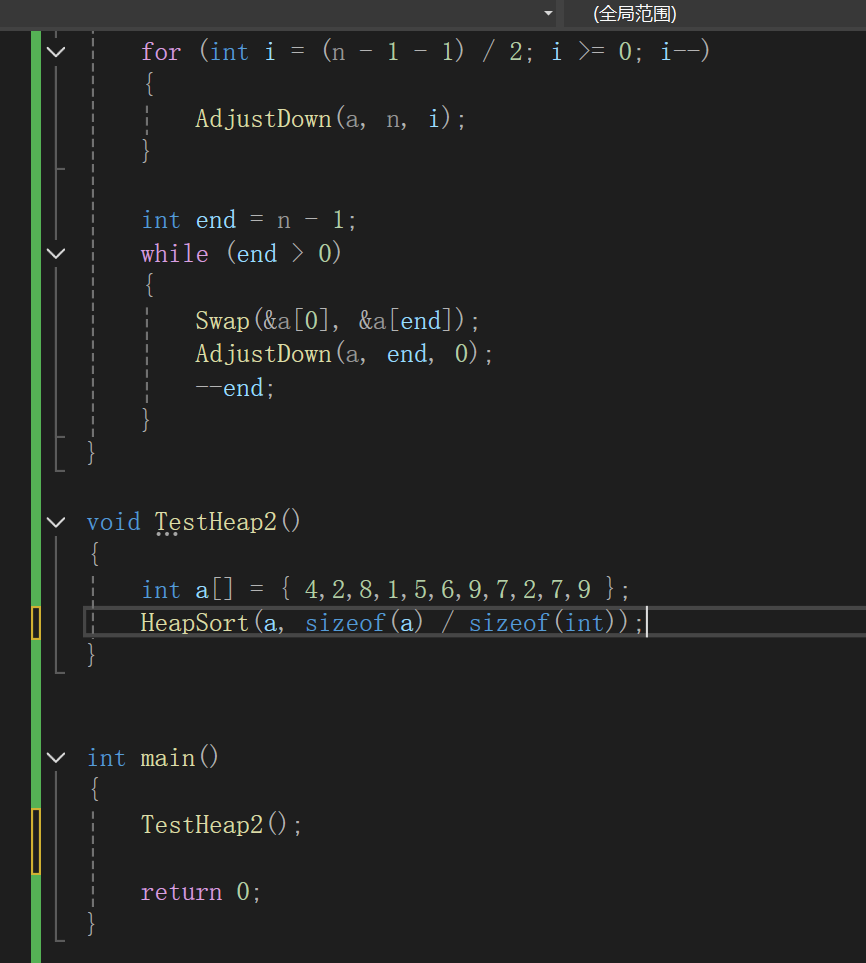
3.2测试2(堆排序函数 HeapSort)
c
//小堆
void HeapSort(int* a, int n)
{

	for (int i = (n - 1 - 1) / 2; i >= 0; i--)
	{
		AdjustDown(a, n, i);
	}

	int end = n - 1;
	while (end > 0)
	{
		Swap(&a[0], &a[end]);
		AdjustDown(a, end, 0);
		--end;
	}
}-
功能:对数组 a 进行堆排序(原地排序)。
-
建堆部分:采用向下调整建堆,从最后一个非叶子节点开始((n-1-1)/2 即 n/2 - 1),直到根。时间复杂度 O(n)。
-
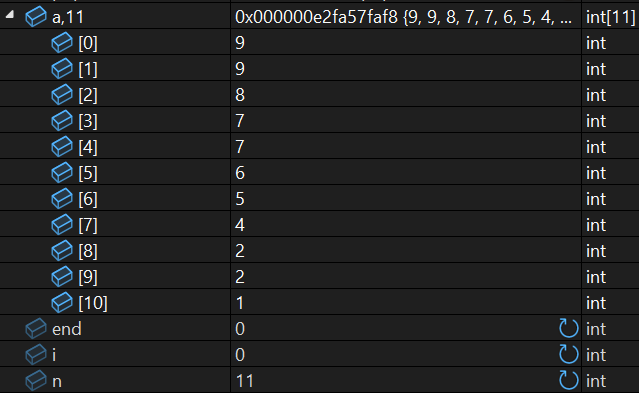
排序部分:while (end > 0) 循环,每次将堆顶(当前最小值)与下标 end 的元素交换,然后对前 end 个元素重新向下调整,end 减1。最终数组变为降序(因为最小值依次放到了末尾)。
-
或者在这里我们话可以去向上调整,不过这样效率可能会比较慢,如下:
c
void HeapSort(int* a, int n)
{
	 /*降序,建小堆
	 升序,建大堆*/
	for (int i = 1; i < n; i++)
	{
		AdjustUp(a, i);
	}
	int end = n - 1;
	while (end > 0)
	{
		Swap(&a[0], &a[end]);
		AdjustDown(a, end, 0);
		--end;
	}
}

void TestHeap2()
{
	int a[] = { 4,2,8,1,5,6,9,7,2,7,9 };
	HeapSort(a, sizeof(a) / sizeof(int));
}


int main()
{
	TestHeap2();

	return 0;
}
代码流程分析:
-
建堆:for (int i = 1; i < n; i++) AdjustUp(a, i);
从第二个元素开始逐个向上调整,使整个数组成为一个小堆(因为 AdjustUp 使用 < 比较)。
-
排序:while (end > 0) { Swap(&a0, &aend); AdjustDown(a, end, 0); end--; }
每次将堆顶(当前最小值)交换到末尾,然后对前 end 个元素向下调整,重复直到全部有序。
由于是小堆,最终数组是降序(从大到小)。
-
向上调整建堆(时间复杂度 O(n log n))
-
向下调整建堆(时间复杂度 O(n))
我们可以再画图举个例子:
c
数组:[4, 2, 8, 1, 5]对应完全二叉树(下标从0开始):
c
        4(0)
       /    \
     2(1)    8(2)
    /   \
  1(3)  5(4)
一、向上调整建小堆
我们从 i=1 到 i=4 依次调用 AdjustUp。
- i = 1(元素 2)
-
当前节点:下标1,值2,父节点下标0,值4。
-
因为 2 < 4,交换。交换后数组:2, 4, 8, 1, 5
树结构:
c
        2(0)
       /    \
     4(1)    8(2)
    /   \
1(3) 5(4)- i = 2(元素 8)
-
当前节点:下标2,值8,父节点下标0,值2。
-
8 < 2?否,不交换。
数组不变:2, 4, 8, 1, 5
树同上。
- i = 3(元素 1)
-
当前节点:下标3,值1,父节点下标1,值4。
-
1 < 4,交换 → 2, 1, 8, 4, 5
-
新位置下标1,值1,父节点下标0,值2。1 < 2,交换 → 1, 2, 8, 4, 5
-
新位置下标0,已是根,停止。
数组:1, 2, 8, 4, 5
树:
c
        1(0)
       /    \
     2(1)    8(2)
    /   \
4(3) 5(4)- i = 4(元素 5)
-
当前节点:下标4,值5,父节点下标1,值2。
-
5 < 2?否,不交换。
最终建堆完成:1, 2, 8, 4, 5(小堆)。
循环降序就不继续写了