
🔥小叶-duck:个人主页
❄️个人专栏:《Data-Structure-Learning》《C++入门到进阶&自我学习过程记录》
《算法题讲解指南》--优选算法
《算法题讲解指南》--递归、搜索与回溯算法
《算法题讲解指南》--动态规划算法
✨未择之路,不须回头
已择之路,纵是荆棘遍野,亦作花海遨游
目录
[一、map 核心原理:键值对与红黑树底层](#一、map 核心原理:键值对与红黑树底层)
[1、什么是 map?](#1、什么是 map?)
[二、 map 基础操作:构造、遍历与增删查改](#二、 map 基础操作:构造、遍历与增删查改)
[4.1 查找:find 与 count](#4.1 查找:find 与 count)
[5、核心特性:operator \[\] 的多功能性](#5、核心特性:operator [] 的多功能性)
[三. map 与 multimap 的差异](#三. map 与 multimap 的差异)
[四、map 实战:LeetCode 经典案例](#四、map 实战:LeetCode 经典案例)
前言
在 C++ STL 容器中,map 是兼具 "高效查找" 与 "键值映射" 能力的关联式容器,底层基于红黑树实现,支持 O(log N) 级别的增删查改操作,且会按键值(Key)自动排序。本文将从 map 的核心概念切入,结合实操代码,详细讲解其构造、增删查改、迭代器遍历等基础操作,对比 map 与 multimap 的差异,帮你彻底掌握 map 的使用。
一、map 核心原理:键值对与红黑树底层
1、什么是 map?
map 是一种 "键值对(Key-Value)" 容器,每个元素包含一个 不可修改的键 (Key) 和一个 可修改的值(Value),底层通过红黑树(平衡二叉搜索树)组织数据,因此具备两个核心特性:
- 键唯一:相同的 Key 无法重复插入;
- 自动排序:遍历 map 时(走的中序遍历),元素会按 Key 的升序(默认用 less<Key> 比较)排列。
map的参考文档 :map - C++ Reference
2、关键类型定义
map 的模板参数与内部类型需重点理解,直接影响使用方式:
cpp
// map 模板定义
template <class Key,          // 键的类型(Key,typedef 为 key_type)
          class T,            // 值的类型(Value,typedef 为 mapped_type)
          class Compare = less<Key>,  // 键的比较方式(默认升序)
          class Alloc = allocator<pair<const Key, T>>  // 空间配置器
          > class map;

// 核心内部类型
typedef pair<const Key, T> value_type;  // 红黑树节点存储的键值对(Key 不可改)
typedef Key key_type;                   // 键的类型
typedef T mapped_type; // 值的类型- value_type:map 存储的是 pair<const Key, T> 类型(这个非常重要,后面会反复进行讲解),其中 Key 被 const 修饰,意味着不能通过迭代器修改 Key (会破坏红黑树结构),但可以修改 T(Value);
- Compare:默认用 less<Key> 实现升序,若需降序,可传入 greater<Key>(如 map<int, int, greater<int>>)
pair 类型介绍:
map 底层的红黑树节点中的数据,使用 pair<Key,T> 存储键值对数据。
cpp
typedef pair<const Key, T> value_type;
template <class T1, class T2>
struct pair
{
	typedef T1 first_type;
	typedef T2 second_type;
	T1 first;
	T2 second;

	pair() : first(T1()), second(T2())
	{
	}

	pair(const T1& a, const T2& b) : first(a), second(b)
	{
	}

	template<class U, class V>
	pair(const pair<U, V>& pr) : first(pr.first), second(pr.second)
	{
	}
};

template <class T1, class T2>
inline pair<T1, T2> make_pair(T1 x, T2 y)
{
	return (pair<T1, T2>(x, y));
}
//make_pair这个函数模板可以帮助我们节省代码量来构造map
//简单来讲就是通过调用这个函数模板返回的类型就是map一些接口需要的pair的类型
我们会发现 value_type 这个是由 pair<const Key, T> typedef 而来的,而 pair 里面两个模板参数分别就是 Key(键) 和 T(值Value),所以我们可以理解为是将 map 中的 Key(键) 和 T(值Value) 通过类模板 pair 再进行了一次封装,之所以要这样是因为后面讲解的接口中有些需要传的类型是 pair 类型,所以在这里对 pair 的结构先进行讲解,而且 pair 会在后面的讲解中频繁地使用。
二、 map 基础操作:构造、遍历与增删查改
结合具体的代码示例,分模块讲解 map 的常用操作,注释会补充关键细节。
1、构造与初始化
set 的构造常见相关接口:
cpp
// empty (1) ⽆参默认构造
explicit map (const key_compare& comp = key_compare(),
 const allocator_type& alloc = allocator_type());
// range (2) 迭代器区间构造
template <class InputIterator>
 map (InputIterator first, InputIterator last,
 const key_compare& comp = key_compare(),
 const allocator_type& = allocator_type());
// copy (3) 拷⻉构造
map (const map& x);
// initializer list (5) initializer 列表构造
map (initializer_list<value_type> il,
 const key_compare& comp = key_compare(),
 const allocator_type& alloc = allocator_type());

// 迭代器是⼀个双向迭代器
iterator -> a bidirectional iterator to const value_type
// 正向迭代器
iterator begin();
iterator end();
// 反向迭代器
reverse_iterator rbegin();
reverse_iterator rend();
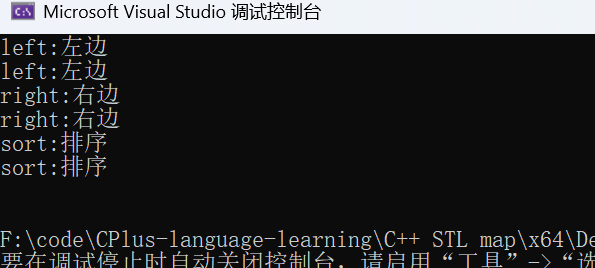
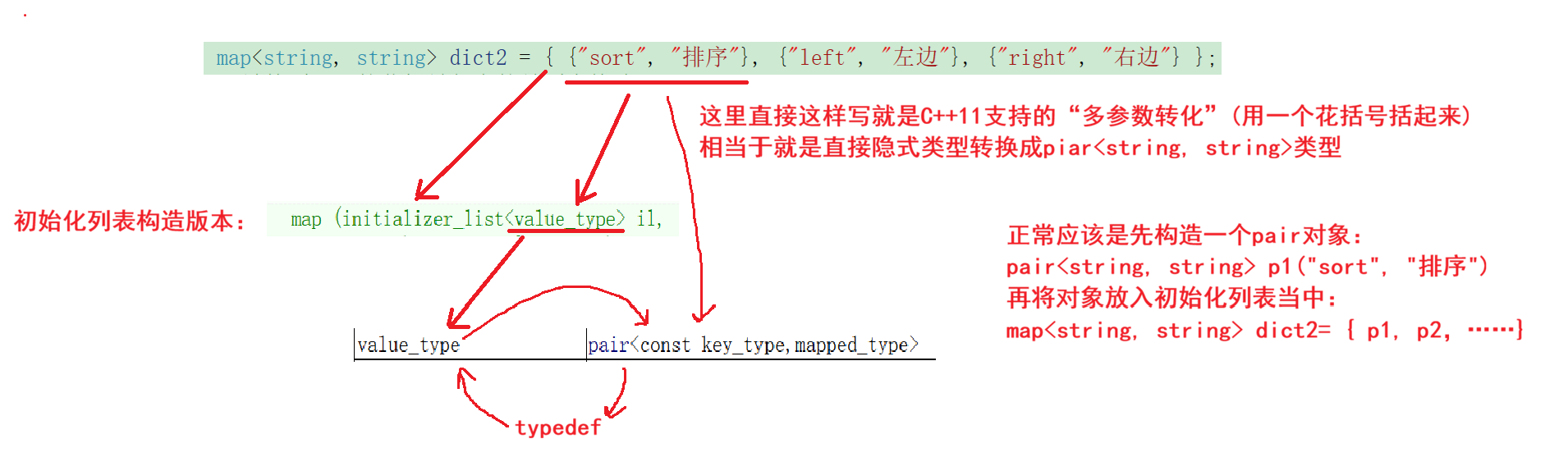
map 支持多种构造方式,包括默认构造、迭代器区间构造、初始化列表构造等,实际开发中初始化列表构造 最常用**(注意看下面代码的注释)**:
cpp
#include <iostream>
#include <string>
#include <map>
using namespace std;

//map构造与初始化
void test_map1()
{
    // 1. 默认构造(空 map)
    map<string, string> dict1;

    // 2. 初始化列表构造(C++11支持,比较推荐)
    map<string, string> dict2 = { {"sort", "排序"}, {"left", "左边"}, {"right", "右边"} };
    //最外面一层的花括号代表的是列表构造
    //而里面的每个花括号其实就是类型转换中的:多参数转化(C++11支持),通过一个花括号的形式将多个参数放在一起
    //{"sort", "排序"}等本质就是"多参数转化"隐式类型转换成 pair<string, string> 类型

    // 3. 迭代器区间构造(从其他 map 或容器拷贝)
    map<string, string> dict3(dict2.begin(), dict2.end());

    // 4. 拷贝构造
    map<string, string> dict4(dict3);

    //构造测试打印
    auto it = dict2.begin();
    while (it != dict2.end())
    {
        //cout << *it << endl;//error
        //因为迭代器it解引用获取的是里面的数据,而里面包含有两个值(Key、Value)
        //而 pair 并没有重载流插入cin和流提取cout,C++又不能同时返回两个值,所以会报错

        cout << (*it).first << ":" << (*it).second << endl; //所以我们需要手动通过.来访问first和second两个成员的值

        cout << it->first << ":" << it->second << endl;
        //pair不仅重载了*,也重载了->,所以当不对迭代器进行解引用时,
        //我们也可以通过调用operator->来访问first和second,上面是简化版本,实际展开为:
        //cout << it.operator->()->first << ":" << it.operator->()->second << endl;
        it++;
    }
    cout << endl;
}

int main()
{
	test_map1();
	return 0;
}
2、迭代器遍历
map 的迭代器是双向迭代器 ,仅支持 ++/-- 操作而不能使用 +/-操作,遍历方式包括 "迭代器循环""范围 for":
cpp
//迭代器遍历
void test_map2()
{
    map<string, string> dict1 = { {"sort", "排序"}, {"left", "左边"}, {"right", "右边"} };

    // 方式1:普通迭代器遍历(支持修改 Value)
    auto it = dict1.begin();
    while (it != dict1.end())
    {
        cout << it->first << ":" << it->second << endl;
        // 尝试修改 Key(编译报错!Key 是 const 修饰的,不可修改)
        //it->first = "new_left"; //error

        // 修改 Value(合法)
        if (it->first == "left")
        {
            it->second = "左边(修改后)";
        }
        ++it;
    }
    cout << endl;

    // 方式2:范围 for 遍历(传引用可减少拷贝次数优化效率,const 保护不被修改)
    for (const auto& e : dict1)
    {
        // e 是 pair<const string, string> 类型(重点)
        cout << e.first << ":" << e.second << endl;
    }
    cout << endl;
}核心细节:map 的 iterator 和 const_iterator 都不能修改 Key,但 iterator 可以修改 Value;若只需读取,可优先用 const auto& 传引用,减少拷贝开销优化效率。
3、插入操作(insert)
map 的 insert 接口用于插入键值对,返回 pair<iterator, bool>,其中:
- iterator:指向插入成功的新节点,或已存在的相同 Key 节点;
- bool:true 表示插入成功;false 表示 Key 已存在,插入失败。
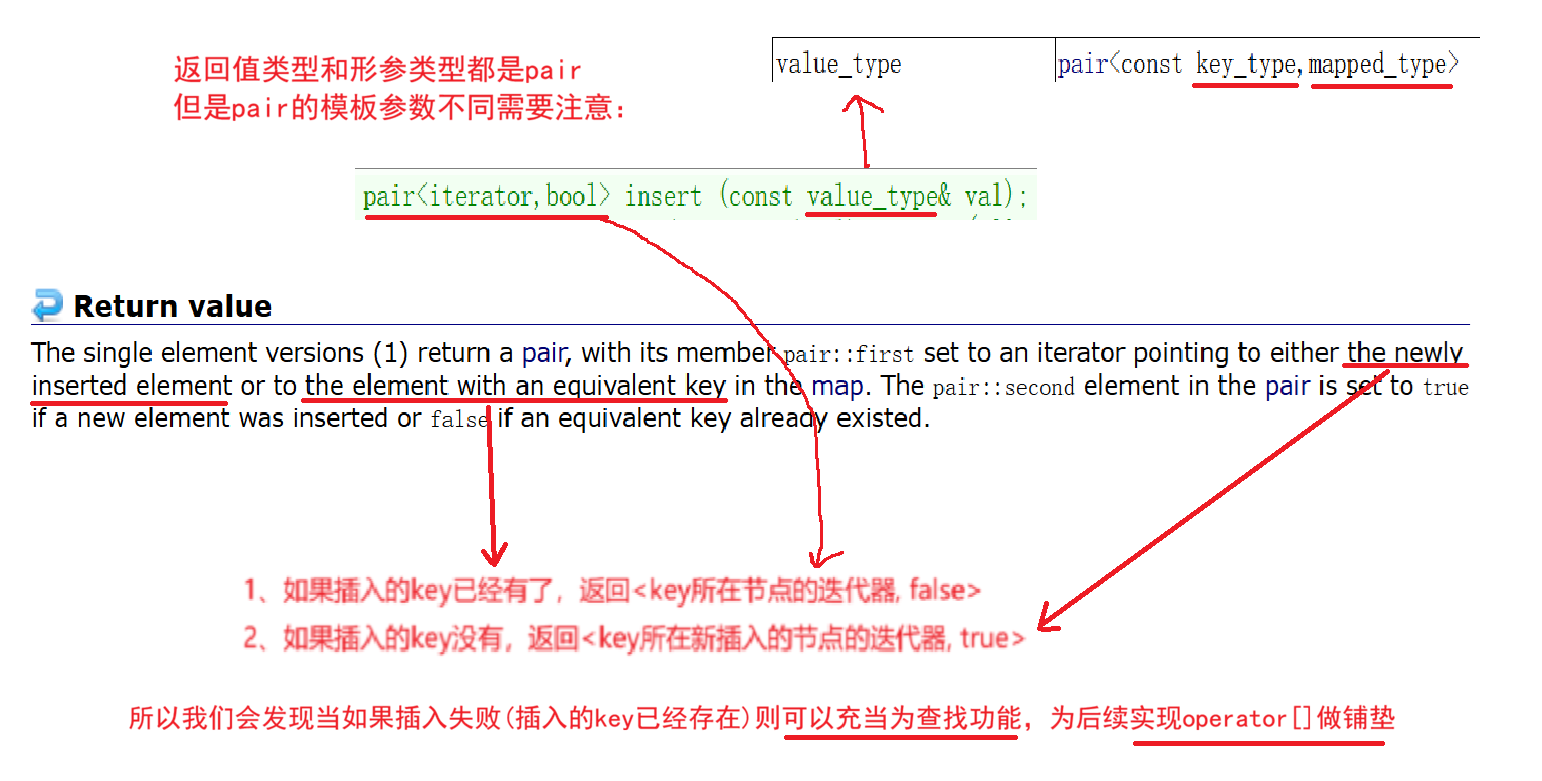
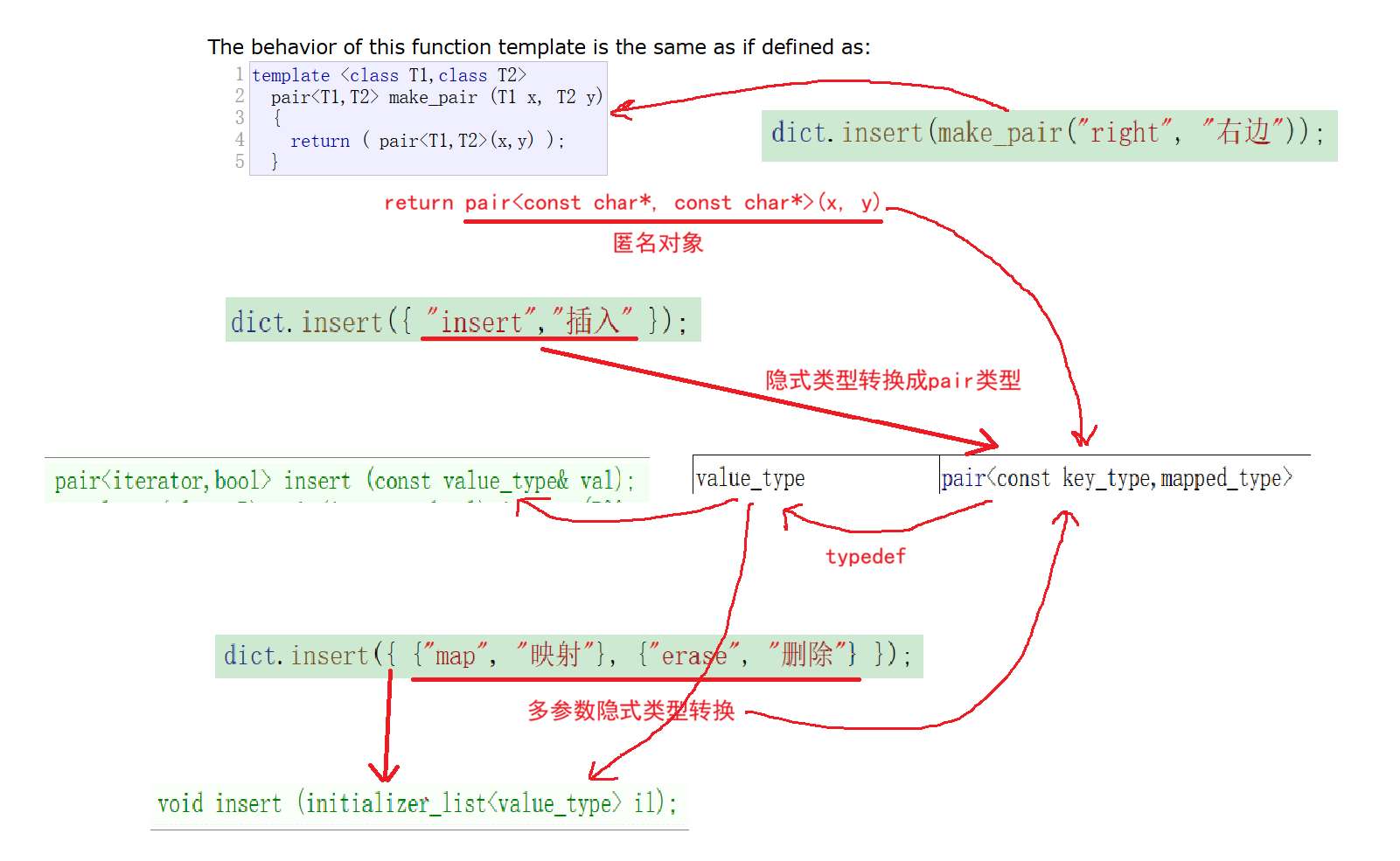
insert 支持多种插入形式,实际开发中推荐 "初始化列表" 和 "make_pair" ,以及多参数隐式类型转换:
cpp
//插入操作(insert)
void test_map3()
{
    map<string, string> dict;
    //方式1:插入 pair 对象(C++98 风格,较繁琐)
    pair<string, string> kv1("sort", "排序");
    dict.insert(kv1);

    // 方式2:插入匿名 pair 对象(略简洁)
    dict.insert(pair<string, string>("left", "左边"));

    // 方式3:用 make_pair 生成 pair(推荐,无需显式写类型)
    dict.insert(make_pair("right", "右边"));

    // 方法4:初始化列表插入(单参数隐式类型转换)
    dict.insert({ "insert","插入" });
    // 批量插入多个键值对:用多参数的隐式类型转换(C++11支持)
    dict.insert({ {"map", "映射"}, {"erase", "删除"} });

    // 插入重复 Key(返回的pair第二个成员(bool)为false,不修改原数据)
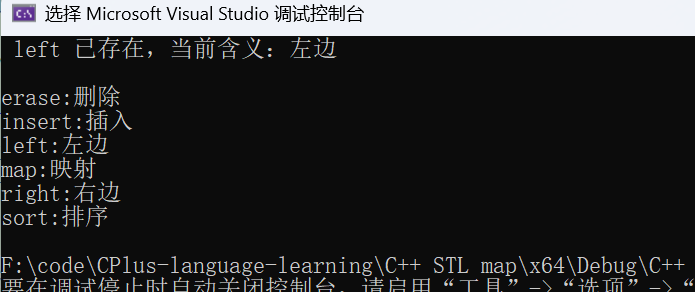
    auto ret = dict.insert({ "left", "左边(重复插入)" });
    if (!ret.second)
    {
        cout << " left 已存在,当前含义:" << ret.first->second << endl;
    }

    // 输出结果
    for (const auto& e : dict)
    {
        cout << e.first << ":" << e.second << endl;
    }
}

int main()
{
    test_map3();
    return 0;
}
4、查找与删除(find/erase)
4.1 查找:find 与 count
- find(Key):查找指定 Key,返回指向该 Key 的迭代器;若不存在,返回 end()(时间复杂度:O(log N) 效率);
- count(Key):返回 Key 的出现次数(map 中 Key 唯一,故返回 0 或 1,可间接用于查找)。
cpp
//查找与删除(find/erase)
void test_map4()
{
    map<string, string> dict = { {"sort", "排序"}, {"left", "左边"}, {"right", "右边"} };

    // 1. 查找单词并且进行删除
    string x;
    cin >> x;
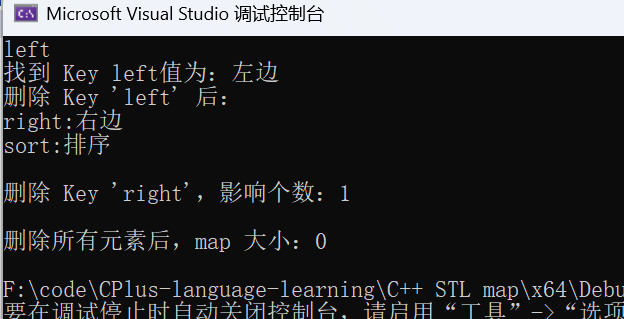
    auto pos = dict.find(x); //iterator find (const key_type& k);
    if (pos != dict.end())
    {
        cout << "找到 Key " << x << "值为:" << pos->second << endl;
        //删除迭代器指向的节点
        dict.erase(pos); //此时迭代器pos失效,无法访问
        cout << "删除 Key 'left' 后:" << endl;
        for (const auto& e : dict)
        {
            cout << e.first << ":" << e.second << endl;
        }
    }
    else
    {
        cout << "没有找到 Key " << x << endl;
    }
    cout << endl;

    // 2. 直接删除指定 Key(返回删除的个数,map 中 0 或 1)
    size_t del_cnt = dict.erase("right"); //size_type erase(const key_type & k);
    cout << "删除 Key 'right',影响个数:" << del_cnt << endl;
    cout << endl;

    // 3. 删除迭代器区间(删除所有元素)
    dict.erase(dict.begin(), dict.end()); //void erase (iterator first, iterator last);
    cout << "删除所有元素后,map 大小:" << dict.size() << endl;
}

int main()
{
    test_map4();
    return 0;
}
5、核心特性:operator \[\] 的多功能性
map 的 operator\[\] 是最灵活的接口,兼具 "插入、查找、修改" 三种功能,其内部实现依赖前面所讲解的 insert,核心逻辑如下:
cpp
// operator[] 内部伪代码,便于理解方括号的执行逻辑
mapped_type& operator[](const key_type& k)
{
    // 插入 {k, mapped_type()}(默认构造的 Value,如 int 为 0,string 为空)
    pair<iterator, bool> ret = insert({ k, mapped_type() });
    // 返回 Value 的引用(无论插入成功与否,都指向 Key 对应的 Value)
    return ret.first->second;
}
在前面讲解 insert 接口时我们就提到了这个接口当插入失败时可以充当查找功能 ,就是为这里实现 operator 做铺垫的:
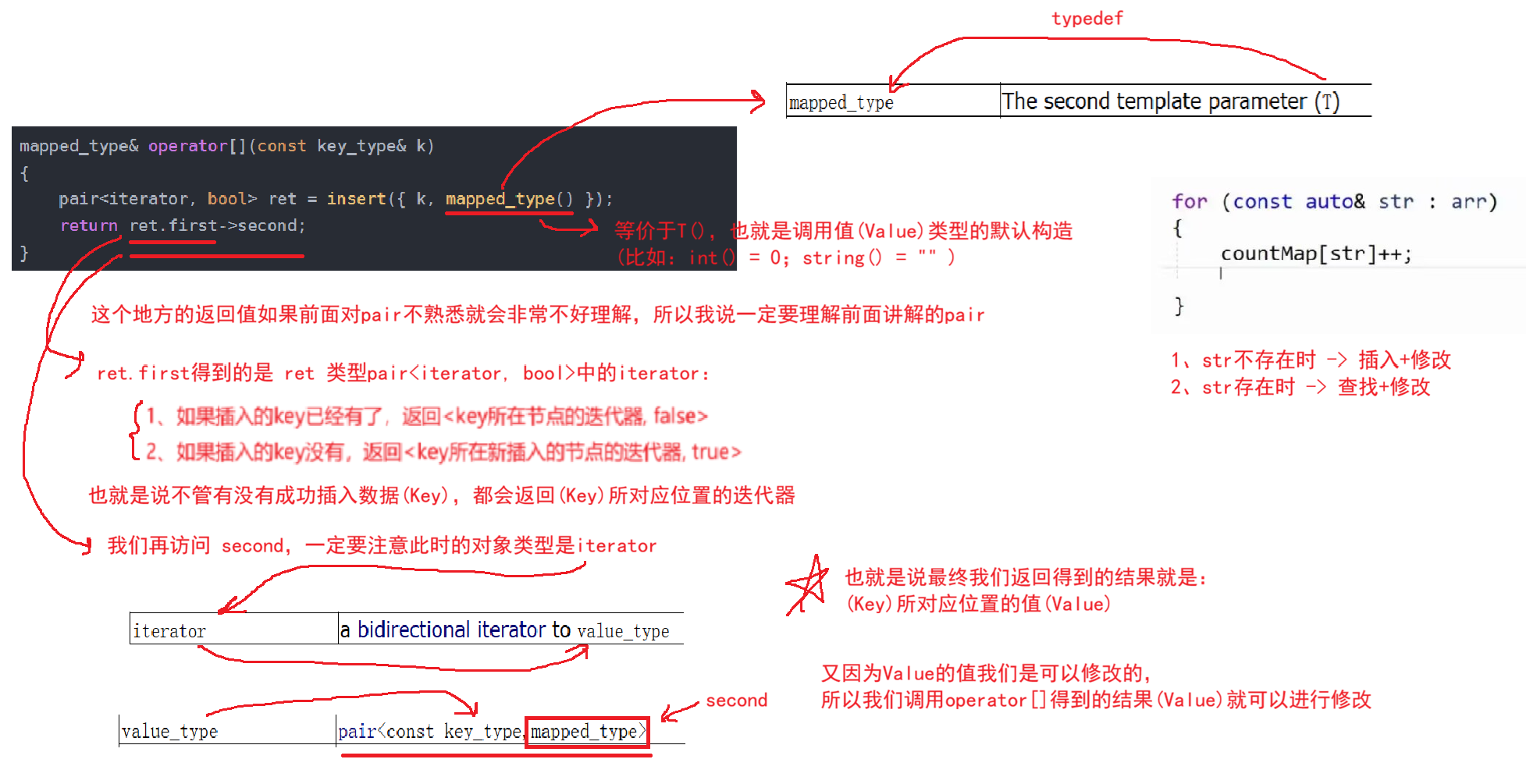
基于此实现,operator\[\] 就可以灵活应对不同场景:
cpp
//核心特性:operator []
void test_map5()
{
    map<string, int> countMap;  // 统计每种水果出现次数
    string arr[] = { "苹果", "西瓜", "苹果", "西瓜", "苹果", "香蕉" };

    ////方法一(不使用operator[]):
    ////先判断该水果是否存在于map中(find()),如果存在则Value++;如果不存在则insert
    //for (auto e : arr)
    //{
    //    auto it = countMap.find(e);
    //    if (it != countMap.end())//说明存在
    //    {
    //        it->second++;
    //    }
    //    else//说明不存在
    //    {
    //        countMap.insert({e, 1});
    //    }
    //}//这样写我们就会发现代码是比较多的,那能不能优化呢?是可以的,就是利用operator []

    //方法二:(使用operator[],同时进行插入、查找和修改操作)
    for (auto fruit : arr)
    {
        countMap[fruit]++;
        // 若 fruit 不存在:先插入 { fruit, int() },返回插入位置的Value引用( 调用的默认构造int()=0 ),++ 后变为 1;
        // 若 fruit 已存在:则不会执行插入操作,并且查找到fruit存在位置,返回存在位置 Value 引用,++ 后次数增加;
    }

    //测试打印结果
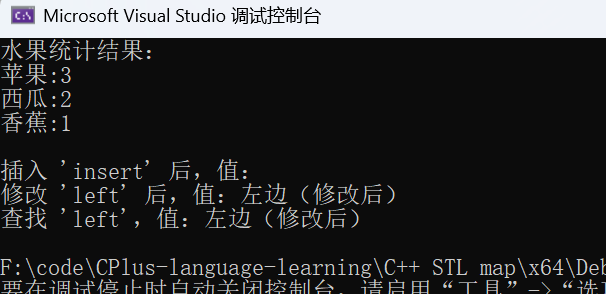
    cout << "水果统计结果:" << endl;
    for (const auto& e : countMap)
    {
        cout << e.first << ":" << e.second << endl;
    }
    cout << endl;

    // 场景2:只插入数据(Key 不存在时,插入默认 Value)
    map<string, string> dict;
    dict["insert"];  // 插入 { "insert", string() }(string 默认空)
    cout << "插入 'insert' 后,值:" << dict["insert"] << endl;

    // 场景3:插入 + 修改(Key 不存在时插入,存在时修改)
    dict["left"] = "左边";  // 插入 { "left", string() },同时将返回的结果 "" 修改为 "左边"
    dict["left"] = "左边(修改后)";  // Key已经存在,查找后返回结果"左边",再修改为 "左边(修改后)"
    cout << "修改 'left' 后,值:" << dict["left"] << endl;

    // 场景4:纯粹查找(Key 存在时,返回 Value 引用)
    cout << "查找 'left',值:" << dict["left"] << endl;
    //一定要注意的是:用operator[]用于查找时,要保证Key在map中一定是已经存在的,否则就会出问题
    //因为不管Key在不在map中,operator[]后都一定会使其存在于map中,就体现不出查找的功能
}

int main()
{
    test_map5();
    return 0;
}
三. map 与 multimap 的差异
multimap 是 map 的 "兄弟容器",底层同样基于红黑树,但核心差异是 支持 Key 冗余(相同 Key 可重复插入),由此导致接口和使用场景不同:
| 特性 | map | multimap |
|---|---|---|
| Key 唯一性 | 唯一(重复插入失败) | 不唯一(支持重复 Key) |
| operator\[\] | 支持(插入 / 查找 / 修改) | 不支持(Key 冗余,无法确定修改哪个) |
| find(Key) | 返回唯一 Key 的迭代器 | 返回中序遍历的第一个 Key 迭代器 |
| count(Key) | 返回 0 或 1 | 返回 Key 的实际出现次数 |
| erase(Key) | 删除唯一 Key(返回 0 或 1) | 删除所有相同 Key(返回删除个数) |
cpp
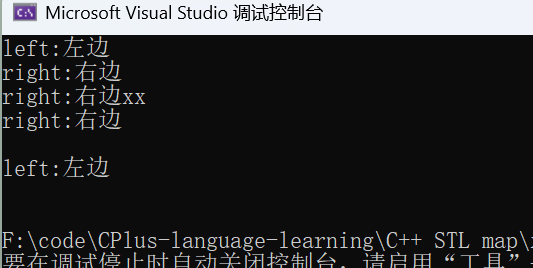
void test_multimap()
{
    //multimap没有[]
    multimap<string, string> dict;
    dict.insert({ "right", "右边" });
    dict.insert({ "left", "左边" });
    dict.insert({ "right", "右边xx" });
    dict.insert({ "right", "右边" });


    for (const auto& e : dict)
    {
        cout << e.first << ":" << e.second << endl;
    }
    cout << endl;

    dict.erase("right"); //删除所有的right(返回删除个数)
    for (const auto& e : dict)
    {
        cout << e.first << ":" << e.second << endl;
    }
    cout << endl;
}

int main()
{
    test_multimap();
    return 0;
}
四、map 实战:LeetCode 经典案例
map 的核心价值在于 "高效键值映射" 和 "自动排序",在算法题中可简化复杂逻辑,以下是两个典型案例:
1、随机链表的复制
题目链接
在数据结构初阶阶段,为了控制随机指针 ,我们将拷贝结点链接在原节点的后面 解决,后面拷贝节点还得解下来链接,非常麻烦。
这里我们直接让**{原结点, 拷贝结点} 建立映射关系放到 map 中** ,通过 operator\[\] 访问原结点就能返回相对于的拷贝结点,控制随机指针会非常简单方便,这里体现了 map 在解决⼀些问题时的价值,完全是降维打击。
C++算法代码:
cpp
class Solution {
public:
    Node* copyRandomList(Node* head)
    {
        map<Node*, Node*> Node_Copy_Map;
        //步骤一:先拷贝一个链表
        Node* copyhead = NULL;
        Node* copypail = NULL;
        Node* cur = head;
        while(cur)
        {
            if(copypail == NULL)
            {
                copyhead = copypail = new Node(cur->val);
            }
            else
            {
                copypail->next = new Node(cur->val);
                copypail = copypail->next;
            }

            //步骤二;在拷贝过程中将原节点和拷贝节点通过map进行联系
            Node_Copy_Map[cur] = copypail;
            cur = cur->next;
        }

        //步骤三:处理random
        //通过Node_Copy_Map[cur->random]就能获取到对应cur->random的copy结点位置
        cur = head;
        copypail = copyhead;
        while(cur)
        {
            if(cur->random == nullptr)
            {
                copypail->random = nullptr;
            }
            else
            {
                copypail->random = Node_Copy_Map[cur->random];
            }
            cur = cur->next;
            copypail = copypail->next;
        }
        return copyhead;
    }
};
2、前k个高频单词
题目链接
本题目我们利用 map 统计出次数以后,返回的答案应该按单词出现频率由高到低排序(需要手动实现仿函数),但还有一个特殊要求,如果不同的单词有相同出现频率,按字典顺序排序(这是这道题比较麻烦的地方,以下有两种解决思路)。
C++算法代码:
解决思路1:
用排序找前k个单词,因为 map 中已经对 key 单词排序过(按照字母的大小顺序),也就意味着遍历 map 时,次数相同的单词,字典序小的在前面,字典序大的在后面。那么我们将数据放到vector 中用一个稳定的排序就可以实现上面特殊要求,但是sort 底层是快排 ,是不稳定的 ,所以我们要用 stable_sort,他是稳定的。
cpp
class Solution {
public:
    struct Compare
    {
        bool operator()(const pair<string, int>& kv1, const pair<string, int>& kv2)
        {
            return kv1.second > kv2.second;
        }
    };
    vector<string> topKFrequent(vector<string>& words, int k)
{
        map<string,int> CountMap;
        for(int i = 0; i < words.size(); i++)
        {
            CountMap[words[i]]++;
        }

        vector<pair<string,int>> v(CountMap.begin(),CountMap.end());
        //sort(v.begin(),v.end(),Compare());
        // 得稳定排序
        stable_sort(v.begin(),v.end(),Compare());

        vector<string> ret;
        for(size_t i=0;i<k;i++)
        {
            ret.push_back(v[i].first);
        }
        return ret;
    }
};
解决思路2:(两种方法,两种容器)
将 map 统计出的次数的数据放到 vector 中排序,或者放到 priority_queue 中来选出前k个。利用仿函数强行控制次数相等的,字典序小的在前面。
方案一:vector:
cpp
class Solution {
public:
    //手动实现排序的仿函数,因为默认的排序方式不是我们想要的
    struct Compare
    {
        bool operator()(const pair<string, int>& kv1, const pair<string, int>& kv2)
        {
            return kv1.second > kv2.second || kv1.second == kv2.second && kv1.first < kv2.first;
        }
        //保证次数高的单词排在前面的同时也保证了当次数相同时按照字母小的单词在前面
    };

    vector<string> topKFrequent(vector<string>& words, int k)
    {
        vector<string> ret;
        map<string, int> CountMap;
        for(int i = 0; i < words.size(); i++)
        {
            CountMap[words[i]]++;
        }
        //此时map就将单词按照字母从小到大的顺序将出现次数统计出来了

        //通过创建一个类型为pair的vector进行排序
        //因为map的迭代器是双向迭代器,而sort需要随机迭代器才能使用
        vector<pair<string, int>> p(CountMap.begin(), CountMap.end());
        sort(p.begin(), p.end(), Compare());
        //因为sort底层是快排,即使map是按照字母从小到大的顺序存放次数,sort也会打乱,所以实现仿函数时也要考虑

        for(int i = 0; i < k; i++)
        {
            ret.push_back(p[i].first);
        }
        return ret;
    }
};方案二:优先级队列:
cpp
class Solution {
public:
    struct Compare
    {
        // 次数多的在前面,次数相等的时候,字典序小的在前面
        bool operator()(const pair<string, int>& x, const pair<string, int>& y)
        {
            // 要注意优先级队列底层是反的,大堆要实现小于比较,所以这里次数相等,想要字典序小的在前面要比较字典序大的为真
            return x.second < y.second || (x.second == y.second && x.first > y.first);
        }
    };

    vector<string> topKFrequent(vector<string>& words, int k)
    {
        map<string,int> CountMap;
        for(auto& e:words)
        {
            CountMap[e]++;
        }

        priority_queue<pair<string,int>,vector<pair<string,int>>,Compare> q(CountMap.begin(),CountMap.end());

        vector<string> ret;
        for(size_t i=0;i<k;i++)
        {
            ret.push_back(q.top().first);
            q.pop();
        }
        return ret;
    }
};
结束语
到此,C++ STL 中的 map 容器我们就讲解完了。**map系列容器是 C++ STL 中 "键值映射" 场景的核心工具,map的键唯一、multimap的键冗余特性,底层红黑树更是保障了 O (log N) 的高效操作。从operator\[\]的多功能统计,到算法题中简化复杂逻辑的实战价值,它既降低了开发复杂度,又兼顾了性能与易用性。**希望对大家学习C++能有所收获!
C++参考文档:
https://legacy.cplusplus.com/reference/
https://zh.cppreference.com/w/cpp
https://en.cppreference.com/w/