目录
[一、Hugging Face](#一、Hugging Face)
一、Hugging Face
Hugging Face 是一家以开源AI工具闻名的公司,通过其平台和生态系统,简化了从模型使用到项目落地的全流程。
-
核心起点 :凭借 Transformers库 降低了BERT、GPT等预训练模型的使用门槛。
-
当前定位 :已发展为全面的 AI 开发生态系统。
-
支持领域:覆盖自然语言处理、计算机视觉、语音处理及多模态任务。
Hugging Face生态系统主要由Hugging Face Hub和工具链Libraries构成,其中Libraries:
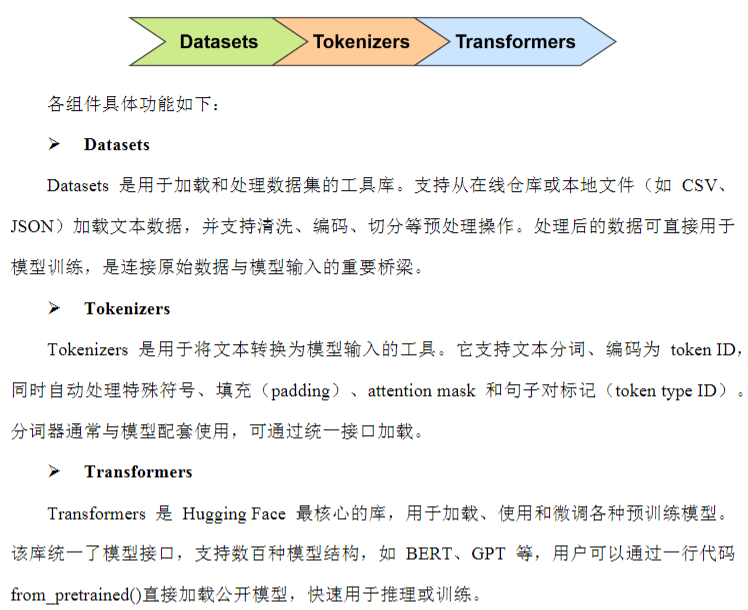
1、模型加载
1.1、AutoModel类
transformers就是hugging face上提供的开源库,可以使用AutoModel的from_pretrained方法来加
载里面的模型。

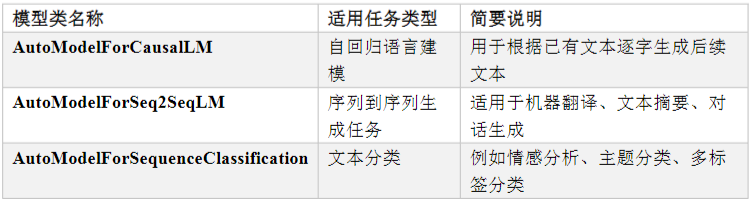
1.2、AutoModelForXXX类
AutoModelForXXX,这些类在模型主干的基础上,自动添加了适配任务的输出层(通常称为"任务
头"或TaskHead),使模型能够直接用于分类、命名实体识别、问答等标准NLP任务的训练与推
理,无需手动修改结构。

2、模型输入输出
各模型forward方法的定义,可查看Transformers库的API文档
3、Tokenizer
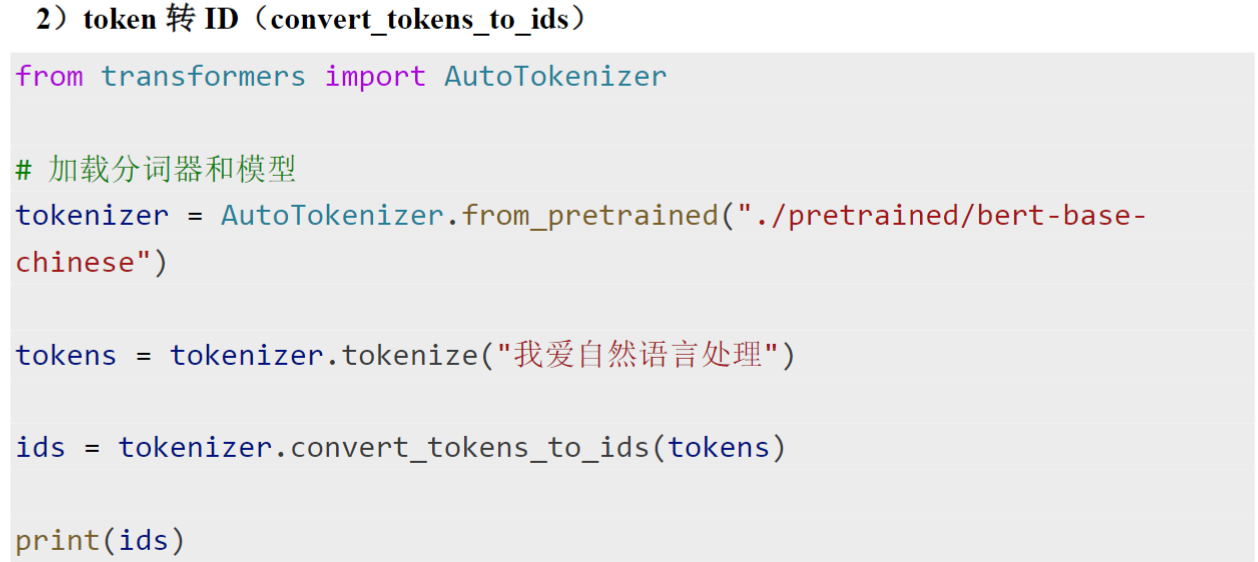
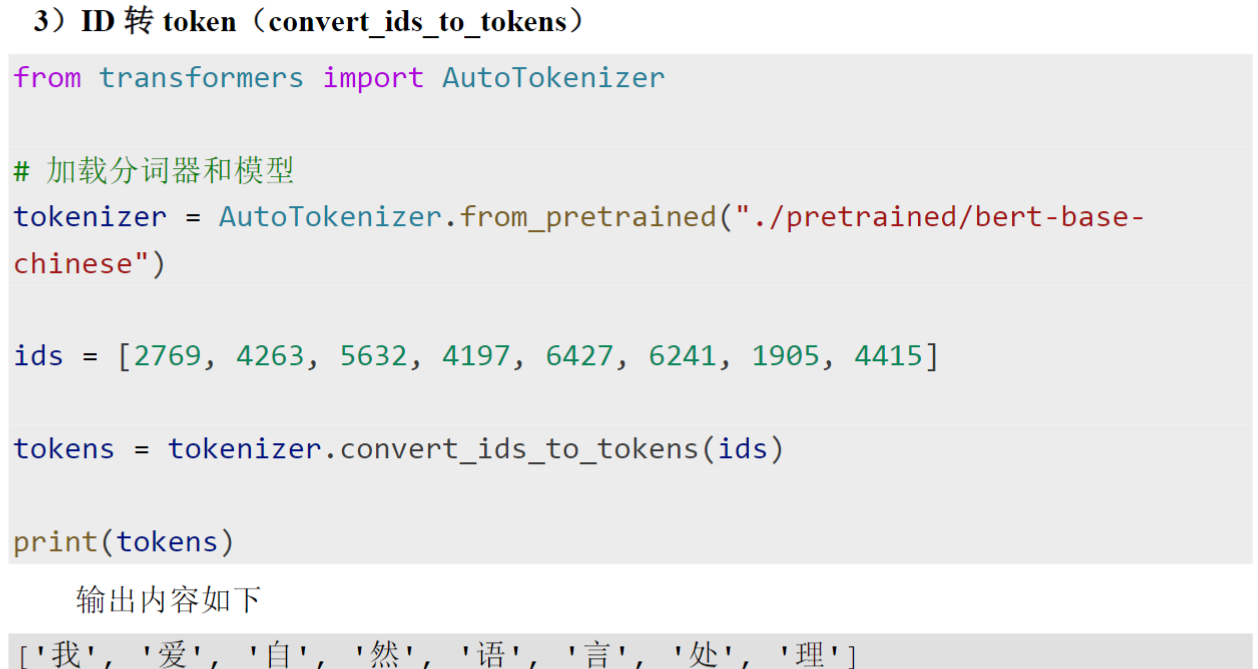
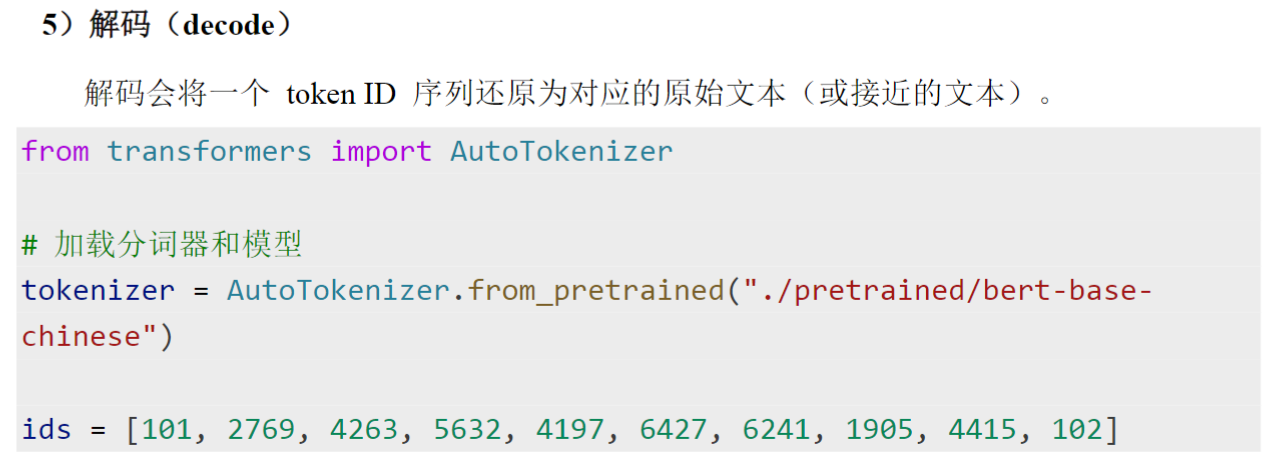
Hugging Face 的 Transformers 库中,每个预训练模型都配有专属的 Tokenizer,其核心作用是将原始文本转换为模型可读的格式化输入(如 input_ids、attention_mask)。
它集成了文本到张量的全流程处理,主要包括:
-
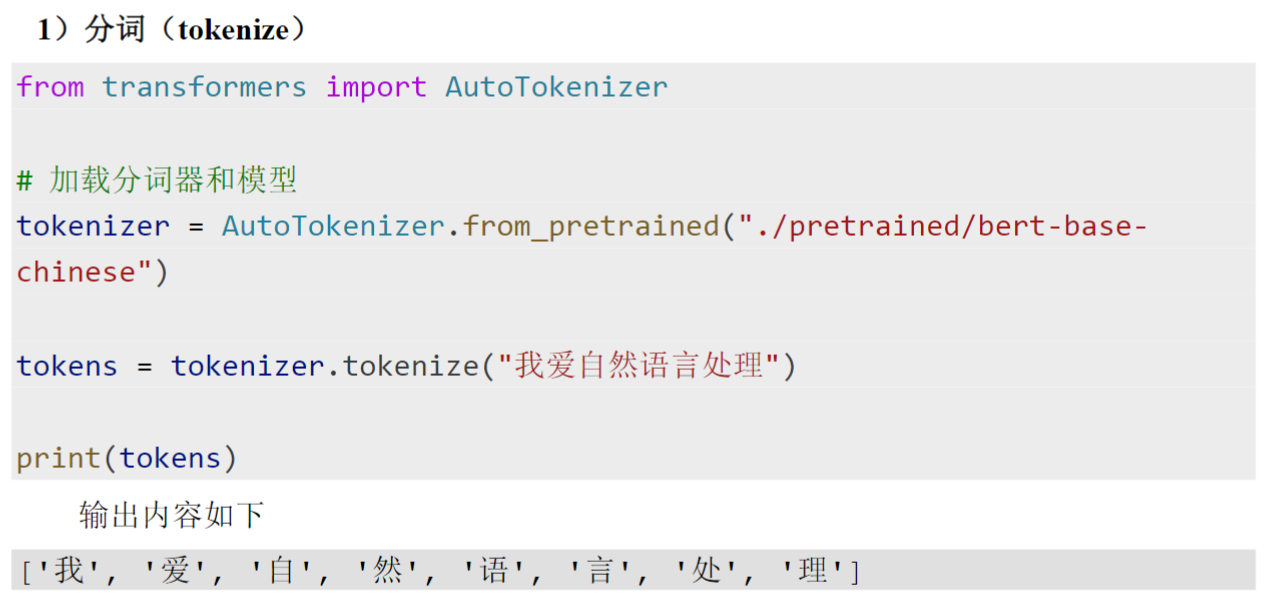
子词切分:将文本拆分为子词单元。
-
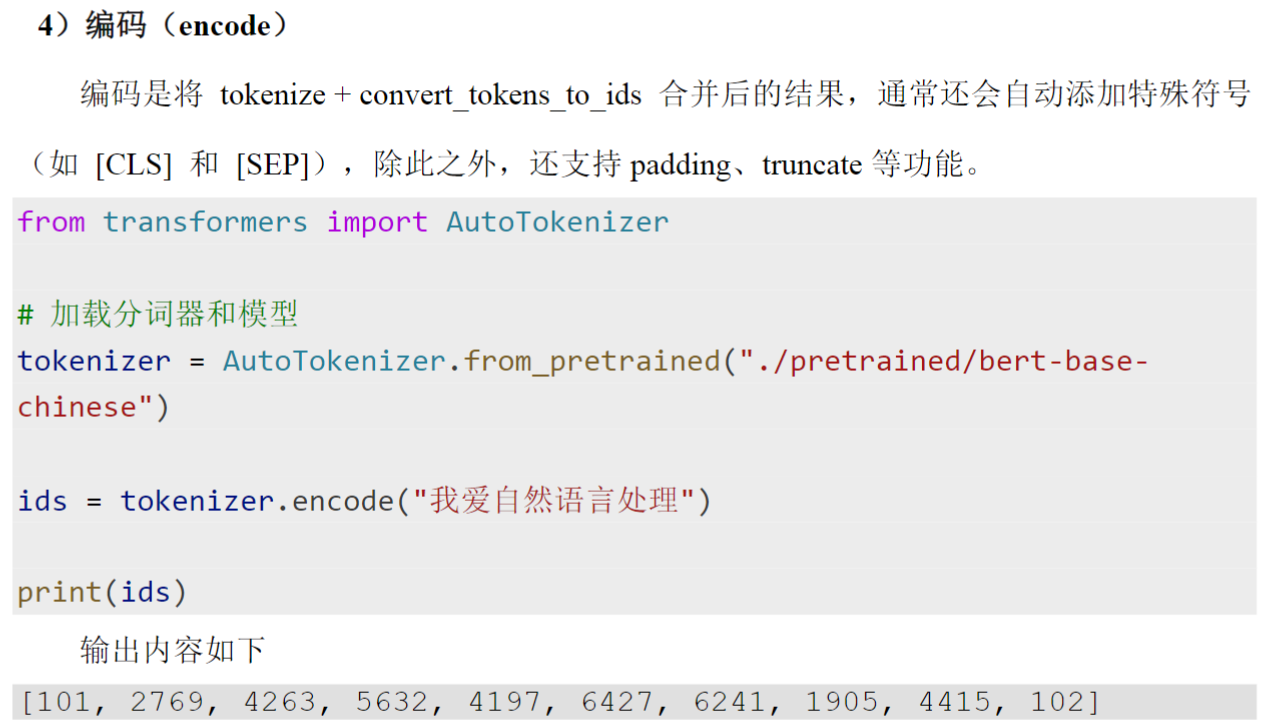
编码映射:将子词转换为对应的整数 ID。
-
添加特殊标记 :自动插入
[CLS]、[SEP]等符号。 -
截断与补齐:统一序列长度以构建批量输入。
-
生成辅助字段:创建 attention_mask 等模型所需的附加输入。
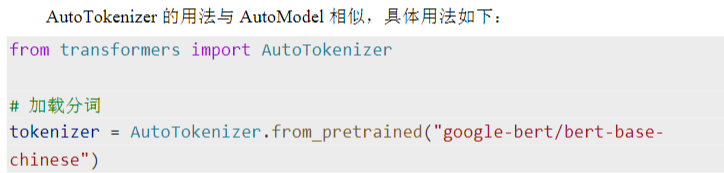
1.1、加载Tokenizer
1.2、使用Tokenizer
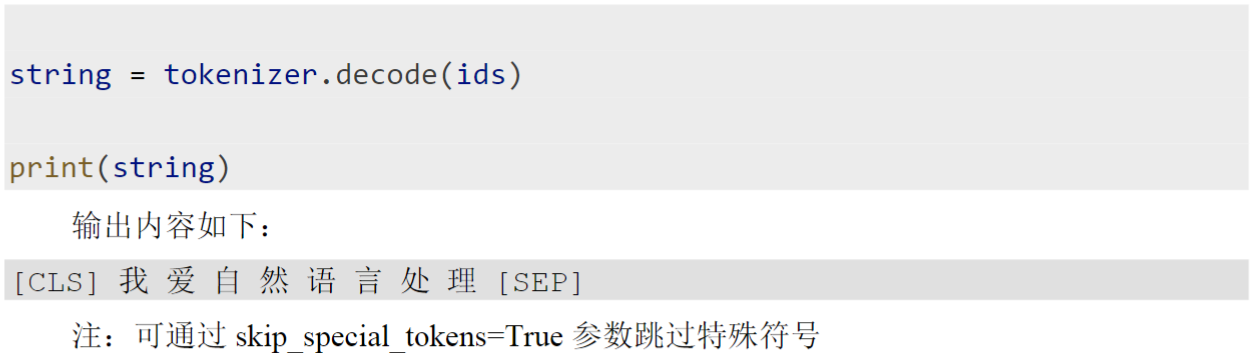
(6)tokenizer()方法(即__call__)
python
text = "我爱自然语言处理"
tokenizer = AutoTokenizer.from_pretrained("google-bert/bert-base-chinese")
inputs = tokenizer(text,padding = 'max_length',max_length=20,return_tensors='pt')
print(inputs)

{'input_ids': tensor([[ 101, 2769, 4263, 5632, 4197, 6427, 6241, 1905, 4415,  102,    0,    0,
            0,    0,    0,    0,    0,    0,    0,    0]]), 'token_type_ids': tensor([[0, 0, 0, 0, 0, 0, 0, 0, 0, 0, 0, 0, 0, 0, 0, 0, 0, 0, 0, 0]]), 'attention_mask': tensor([[1, 1, 1, 1, 1, 1, 1, 1, 1, 1, 0, 0, 0, 0, 0, 0, 0, 0, 0, 0]])}
python
texts = ['我爱打篮球','我们一起成长','我爱自然语言处理']
inputs = tokenizer(texts,
                   return_tensors='pt',
                   padding = 'max_length',
                   max_length = 10,
                   truncation=True)
print(inputs)

{'input_ids': tensor([[ 101, 2769, 4263, 2802, 5074, 4413,  102,    0,    0,    0],
        [ 101, 2769,  812,  671, 6629, 2768, 7270,  102,    0,    0],
        [ 101, 2769, 4263, 5632, 4197, 6427, 6241, 1905, 4415,  102]]), 'token_type_ids': tensor([[0, 0, 0, 0, 0, 0, 0, 0, 0, 0],
        [0, 0, 0, 0, 0, 0, 0, 0, 0, 0],
        [0, 0, 0, 0, 0, 0, 0, 0, 0, 0]]), 'attention_mask': tensor([[1, 1, 1, 1, 1, 1, 1, 0, 0, 0],
        [1, 1, 1, 1, 1, 1, 1, 1, 0, 0],
        [1, 1, 1, 1, 1, 1, 1, 1, 1, 1]])}
1.3、配合模型使用
python
texts = ['我爱打篮球','我们一起成长','我爱自然语言处理']
model_name = "google-bert/bert-base-chinese"
model = AutoModel.from_pretrained(model_name)
tokenizer = AutoTokenizer.from_pretrained(model_name)
inputs = tokenizer(
    texts,
    padding = True,
    return_tensors='pt'
)
print(inputs)
with torch.no_grad():
    outputs = model(
        # input_ids = inputs['input_ids'],
        # token_type_ids = inputs['token_type_ids'],
        # attention_mask = inputs['attention_mask']
        **inputs
    )
print(outputs)
4、Datasets
Datasets是Hugging Face推出的轻量级数据处理库,专注于NLP任务,简化模型训练中的数据加载与预处理。其核心优势包括:
-
加载灵活:支持本地文件(如CSV、JSON)与在线公开数据集;
-
结构直观:采用类似表格的结构,每条样本由多个字段组成;
-
集成高效:与Hugging Face模块(如tokenizer)无缝协作,快速构建模型输入;
-
功能实用:提供.map()批量处理、字段筛选、数据集划分(如train_test_split)等常用功能。
1.1、加载数据集
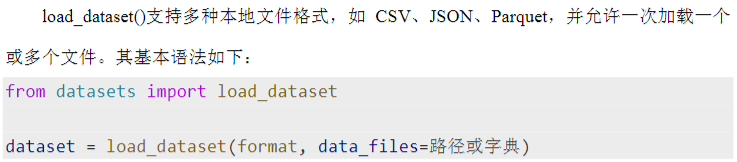
python
from datasets import load_dataset
file_path_train = "review_analysis_gru/data/processed/train.jsonl"
file_path_test = "review_analysis_gru/data/processed/test.jsonl"
dataset_dict = load_dataset(
     'json',
    data_files = {'test': file_path_test,
                  "train": file_path_train
                  },
)
print(dataset_dict)

DatasetDict({
    test: Dataset({
        features: ['label', 'review'],
        num_rows: 12555
    })
    train: Dataset({
        features: ['label', 'review'],
        num_rows: 50218
    })
})
1.2、删除列

1.3、过滤行

1.4、划分数据集
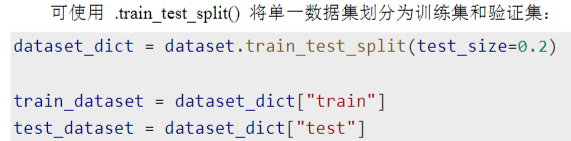
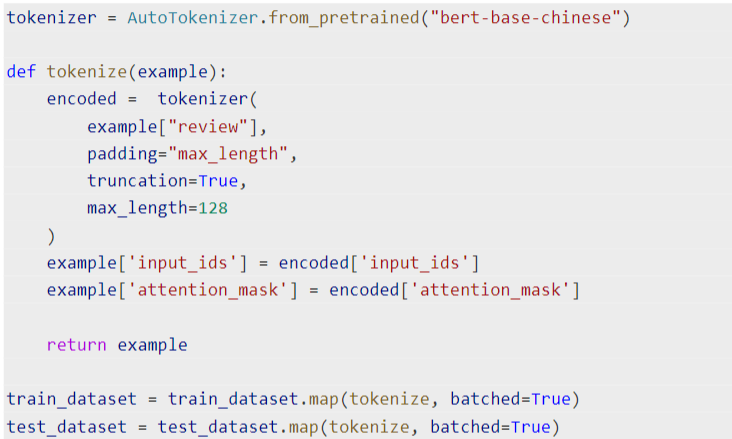
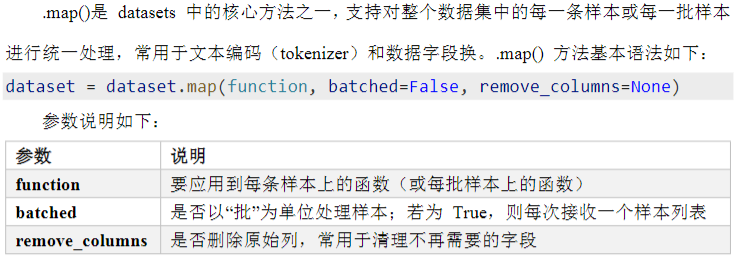
1.5、编码数据
其中function函数要自己写
1.6、保存数据集

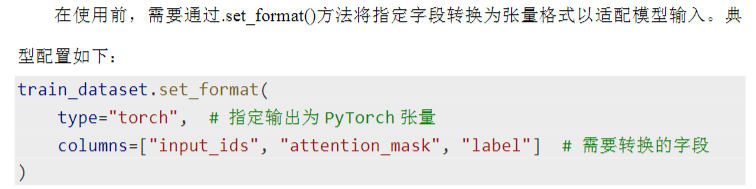
1.7、集成Dataloader
5、预训练模型案例
config
python
from pathlib import Path # 路径定义

# 定义项目根目录
ROOT_DIR = Path(__file__).parent.parent
# 数据目录
RAW_DATA_DIR = ROOT_DIR / "data" / "raw"
PROCESSED_DATA_DIR = ROOT_DIR / "data" / "processed"
# 模型目录
MODEL_DIR = ROOT_DIR / "models"
LOG_DIR = ROOT_DIR / "logs"
PRE_TRAINED_DIR = ROOT_DIR / "pretrained"

RAW_DATA_FILE = "online_shopping_10_cats.csv"
BEST_MODEL = "best.model.pt"
BERT_MODEL = "bert-base-chinese"

SEQ_LEN = 128
BATCH_SIZE = 16
EMBEDDING_SIZE = 128
HIDDEN_SIZE = 256

LEARNING_RATE = 1e-5
EPOCHS = 10
preprocess
python
from config import *
from datasets import load_dataset, ClassLabel  # 加载数据集
from transformers import AutoTokenizer


def preprocess(text):
    print("--------开始数据预处理--------")
    dataset = load_dataset('csv', data_files = str(RAW_DATA_DIR/RAW_DATA_FILE))['train']
    # print(dataset)

    # 去掉cat列,数据过滤
    dataset = dataset.remove_columns(['cat'])
    dataset = dataset.filter(lambda x : x['review'] is not None)
    # print(dataset)

    dataset = dataset.cast_column('label',ClassLabel(names = ['n','p']))
    dataset_dict = dataset.train_test_split(test_size=0.2,stratify_by_column = 'label')
    print(dataset_dict)

    tokenizer = AutoTokenizer.from_pretrained(PRE_TRAINED_DIR/BERT_MODEL)

    def batch_encode(example):
        inputs = tokenizer(
            example['review'],
            padding = 'max_length',
            max_length = 128,
            truncation = True
        )
        inputs['labels'] = example['label']
        return inputs

    dataset_dict = dataset_dict.map(batch_encode,batched = True,remove_columns = ['label','review'])

    dataset_dict.save_to_disk(PROCESSED_DATA_DIR)

    print("--------数据预处理完成--------")
if __name__ == '__main__':
    preprocess(())
dataset
python
import torch
from torch.utils.data import DataLoader
from config import *
from datasets import load_from_disk

def get_dataloader(train = True):
    path = str(PROCESSED_DATA_DIR / ('train' if train else 'test'))
    dataset = load_from_disk(path)
    dataset.set_format(type='torch')
    dataloader = DataLoader(dataset,batch_size=BATCH_SIZE,shuffle=True)
    return dataloader

if __name__ == "__main__":
    train_dataloader = get_dataloader(train = True)
    test_dataloader = get_dataloader(train = False)

    for batch in train_dataloader:
        for k,v in batch.items():
            print(k,'→',v.shape)
        break

input_ids → torch.Size([64, 128])
token_type_ids → torch.Size([64, 128])
attention_mask → torch.Size([64, 128])
labels → torch.Size([64])
model
python
import torch
import torch.nn as nn
from transformers import AutoModel

from config import *

class ReviewAnalysisModel(nn.Module):
    def __init__(self):
        super().__init__()
        self.bert = AutoModel.from_pretrained(PRE_TRAINED_DIR/BERT_MODEL)
        self.linear = nn.Linear(in_features=self.bert.config.hidden_size,out_features=1)
    def forward(self,input_ids,attention_mask,token_type_ids):
        output = self.bert(input_ids,attention_mask,token_type_ids)
        # 提取output中cls对应的输出隐状态
        cls_hidden_state = output.pooler_output

        result = self.linear(cls_hidden_state).squeeze(-1)

        return result

if __name__ == "__main__":
    model = ReviewAnalysisModel()
    print(model)

ReviewAnalysisModel(
  (bert): BertModel(
    (embeddings): BertEmbeddings(
      (word_embeddings): Embedding(21128, 768, padding_idx=0)
      (position_embeddings): Embedding(512, 768)
      (token_type_embeddings): Embedding(2, 768)
      (LayerNorm): LayerNorm((768,), eps=1e-12, elementwise_affine=True)
      (dropout): Dropout(p=0.1, inplace=False)
    )
    (encoder): BertEncoder(
      (layer): ModuleList(
        (0-11): 12 x BertLayer(
          (attention): BertAttention(
            (self): BertSelfAttention(
              (query): Linear(in_features=768, out_features=768, bias=True)
              (key): Linear(in_features=768, out_features=768, bias=True)
              (value): Linear(in_features=768, out_features=768, bias=True)
              (dropout): Dropout(p=0.1, inplace=False)
            )
            (output): BertSelfOutput(
              (dense): Linear(in_features=768, out_features=768, bias=True)
              (LayerNorm): LayerNorm((768,), eps=1e-12, elementwise_affine=True)
              (dropout): Dropout(p=0.1, inplace=False)
            )
          )
          (intermediate): BertIntermediate(
            (dense): Linear(in_features=768, out_features=3072, bias=True)
            (intermediate_act_fn): GELUActivation()
          )
          (output): BertOutput(
            (dense): Linear(in_features=3072, out_features=768, bias=True)
            (LayerNorm): LayerNorm((768,), eps=1e-12, elementwise_affine=True)
            (dropout): Dropout(p=0.1, inplace=False)
          )
        )
      )
    )
    (pooler): BertPooler(
      (dense): Linear(in_features=768, out_features=768, bias=True)
      (activation): Tanh()
    )
  )
  (linear): Linear(in_features=768, out_features=1, bias=True)
)
train
python
import torch
from torch import nn, optim
from config import *
from dataset import get_dataloader
from model import ReviewAnalysisModel
from tqdm import tqdm
from torch.utils.tensorboard import SummaryWriter # 日志写入器
import time # 时间库


# 定义训练引擎函数,训练一个epoch,返回平均损失
def train_one_epoch(model, train_loader, loss,optimizer,device):
    model.train()

    total_loss = 0
    for batch in tqdm(train_loader,desc='训练:'):
        inputs = {k:v.to(device) for k,v in batch.items()}
        targets = inputs.pop('labels').to(dtype = torch.float)
        outputs = model(**inputs)
        loss_value = loss(outputs, targets)
        loss_value.backward()
        optimizer.step()
        optimizer.zero_grad()

        total_loss += loss_value.item()
    return total_loss / len(train_loader)

def train():
    device = torch.device("cuda" if torch.cuda.is_available() else "cpu")
    train_loader = get_dataloader(train = True)

    model = ReviewAnalysisModel().to(device)

    # with open(MODEL_DIR/VOCAB_FILE,'r',encoding='utf-8') as f:
    #     vocab_list = [token.strip() for token in f.readlines()]
    #
    # model = InputMethodModel(vocab_size = len(vocab_list)).to(device)

    loss = nn.BCEWithLogitsLoss()
    optimizer = optim.Adam(model.parameters(),lr = LEARNING_RATE)

    writer = SummaryWriter(log_dir=LOG_DIR / time.strftime("%Y-%m-%d_%H-%M-%S"))

    min_loss = float('inf')
    for epoch in range(EPOCHS):
        print('='*10,f'EPOCH:{epoch+1}','='*10)
        this_loss = train_one_epoch(model, train_loader, loss,optimizer,device)
        print("本轮训练损失:",this_loss)

        writer.add_scalar('loss',this_loss,epoch+1)

        if this_loss < min_loss:
            min_loss = this_loss
            torch.save(model.state_dict(),MODEL_DIR/BEST_MODEL)
            print('模型保存成功!')

    writer.close()

if __name__ == '__main__':
    train()
predict
python
import torch
from config import *
from model import ReviewAnalysisModel
from transformers import AutoTokenizer

def predict_batch(model,input):
    model.eval()
    with torch.no_grad():
        output = model(**input)
    batch_results = torch.sigmoid(output)
    return batch_results.tolist() # 转换成列表返回

# def predict(text,model,id2word,word2id,k,device):
#     tokens = jieba.cut(text)
#     ids = [word2id.get(token, word2id.get(UNK_TOKEN)) for token in tokens]
def predict(text, model, tokenizer, device):

    inputs = tokenizer(
        text,
        padding = 'max_length',
        truncation = True,
        max_length=SEQ_LEN,
        return_tensors = 'pt'
    )
    inputs = {k:v.to(device) for k,v in inputs.items()}

    result = predict_batch(model,inputs)
    return result[0]

def run_predict():
    device = torch.device('cuda' if torch.cuda.is_available() else 'cpu')

    tokenizer = AutoTokenizer.from_pretrained(PRE_TRAINED_DIR/BERT_MODEL)
    # with open(MODEL_DIR/VOCAB_FILE,'r',encoding='utf-8') as f:
    #     vocab_list = [token.strip() for token in f.readlines()]
    # id2word = {id:word for id,word in enumerate(vocab_list)}
    # word2id = {word:id for id,word in enumerate(vocab_list)}
    print("词表加载成功!")


    model = ReviewAnalysisModel().to(device)
    # model = InputMethodModel(vocab_size = len(id2word)).to(device)
    model.load_state_dict(torch.load(MODEL_DIR/BEST_MODEL))
    print("模型加载成功!")

    print('欢迎使用文本情感分析模型!输入q或者quit退出...')

    while True: # 核心,一个死循环
        user_input = input('> ')
        # 判断如果是q或quit直接退出
        if user_input.strip() in['q','quit']:
            print('欢迎下次再来!')
            break
        # 判断如果是空白,提示信息后继续循环
        if user_input.strip()  == '':
            print('请输入有效内容!')
            continue
        result = predict(user_input, model, tokenizer, device)
        if result > 0.5:
            print(f"正向评价(置信度:{result})")
        else:
            print(f"负向评价(置信度{1 - result})")


if __name__ == '__main__':
    # text = "我们公司"
    # top5_tokens = predict(text)
    # print(top5_tokens)
    run_predict()
evaluate
python
import torch
from config import *
from tqdm import tqdm
from model import ReviewAnalysisModel
from dataset import get_dataloader
from predict import predict_batch


# 验证逻辑,返回评价指标
def evaluate(model, dataloader, device):
    correct_count = 0
    total_count = 0

    with torch.no_grad():
        for batch in tqdm(dataloader,desc = '评估:'):
            labels = batch.pop('labels').tolist()
            inputs = {k:v.to(device) for k,v in batch.items()}
            # 前向传播,得到预测概率
            batch_results = predict_batch(model, inputs)
            for target,result in zip(labels,batch_results):
                total_count += 1
                # 判断预测概率是否大于0.5
                result = 1 if result > 0.5 else 0
                if result == target:
                    correct_count += 1

    return correct_count/total_count

# 评估主流程
def run_evaluate():
    device = torch.device('cuda' if torch.cuda.is_available() else 'cpu')


    model = ReviewAnalysisModel().to(device)
    model.load_state_dict(torch.load(MODEL_DIR/BEST_MODEL))
    print("模型加载成功!")

    test_dataloader = get_dataloader(train = False)

    acc = evaluate(model, test_dataloader, device)

    print("评估结果:")
    print('准确率:', acc)

if __name__ == '__main__':
    run_evaluate()
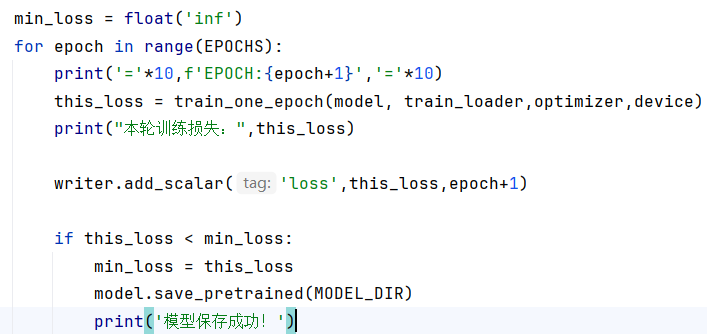
6、带任务头的模型实现
模型直接保存到目录文件下,然后模型加载直接去找目录
model = AutoModelForSequenceClassification.from_pretrained(MODEL_DIR).to(device)day12 10