1.
cpp
/**
 * Definition for a binary tree node.
 * struct TreeNode {
 *     int val;
 *     TreeNode *left;
 *     TreeNode *right;
 *     TreeNode() : val(0), left(nullptr), right(nullptr) {}
 *     TreeNode(int x) : val(x), left(nullptr), right(nullptr) {}
 *     TreeNode(int x, TreeNode *left, TreeNode *right) : val(x), left(left), right(right) {}
 * };
 */
class Solution {
private:
    // 中序遍历辅助函数
    void inorder(TreeNode* node, vector<int>& result) {
        if (node == nullptr) {
            return;
        }

        // 1. 先遍历左子树
        inorder(node->left, result);

        // 2. 再访问根节点
        result.push_back(node->val);

        // 3. 最后遍历右子树
        inorder(node->right, result);
    }

public:
    vector<int> inorderTraversal(TreeNode* root) {
        vector<int> result;
        inorder(root, result);
        return result;
    }
};
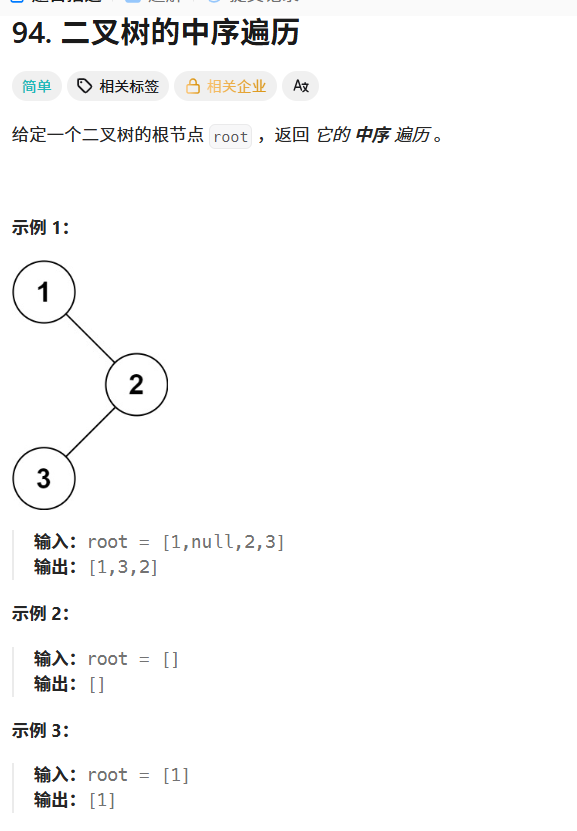
二叉树中序遍历详解(递归写法,一篇搞懂)
这道题是二叉树的入门基础题,但非常重要,因为它几乎是所有树题的"模板起点"。
一、中序遍历是什么
中序遍历的顺序只有一句话:
左子树 → 根节点 → 右子树
也就是:
Left -> Root -> Right二、代码在做什么
代码是标准递归写法
核心函数:
void inorder(TreeNode* node, vector<int>& result)作用就是:
把以 node 为根的整棵树,按照中序顺序存进 result
三、递归的三步逻辑
inorder(node->left, result);
result.push_back(node->val);
inorder(node->right, result);
这三行代码可以理解为:
-
先处理左子树
-
再处理当前节点
-
最后处理右子树
这就是中序遍历的本质。
四、递归终止条件
if (node == nullptr) return;当节点为空时,直接返回
这是所有树递归的"标配"。
五、举个例子理解
比如这棵树:
    2
   / \
  1   3
执行顺序是:
1 -> 2 -> 3因为:
-
先走到最左(1)
-
再回到根(2)
-
最后右边(3)
六、为什么中序很重要
在二叉搜索树(BST)中,中序遍历是有序的
例如:
BST → 中序遍历 = 升序数组这就是很多题的核心性质,比如:
-
验证 BST
-
转换有序数组
-
第 k 小元素
七、时间和空间复杂度
时间复杂度:
O(n),每个节点访问一次
空间复杂度:
O(h),递归栈深度(最坏 O(n),平均 O(log n))
八、非递归写法(进阶)
面试常考:用栈模拟递归
cpp
vector<int> inorderTraversal(TreeNode* root) {
    vector<int> res;
    stack<TreeNode*> st;
    TreeNode* cur = root;

    while (cur || !st.empty()) {
        while (cur) {
            st.push(cur);
            cur = cur->left;
        }
        cur = st.top(); st.pop();
        res.push_back(cur->val);
        cur = cur->right;
    }
    return res;
}
九、一句话总结
中序遍历就是:一路向左到底 → 访问 → 转向右边
2.
cpp
/**
 * Definition for a binary tree node.
 * struct TreeNode {
 *     int val;
 *     TreeNode *left;
 *     TreeNode *right;
 *     TreeNode() : val(0), left(nullptr), right(nullptr) {}
 *     TreeNode(int x) : val(x), left(nullptr), right(nullptr) {}
 *     TreeNode(int x, TreeNode *left, TreeNode *right) : val(x), left(left), right(right) {}
 * };
 */
class Solution {
public:
    int maxDepth(TreeNode* root) {
        if (root == nullptr) {
            return 0;
        }
        int leftDepth = maxDepth(root->left);
        int rightDepth = maxDepth(root->right);
        return max(leftDepth, rightDepth) + 1;
    }
};
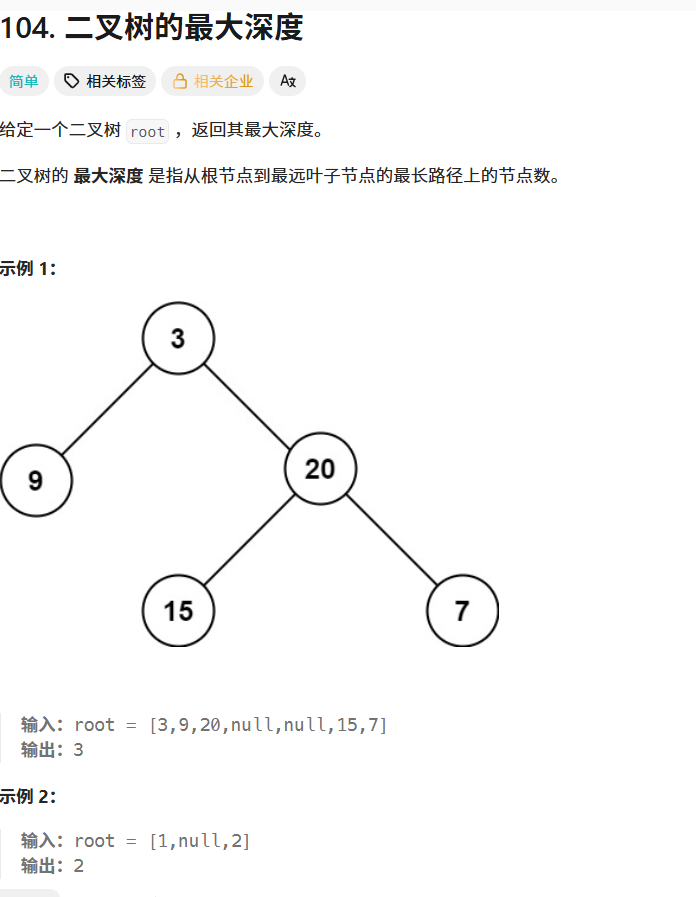
二叉树最大深度详解(递归写法,一步看懂)
这道题是二叉树中最经典的递归入门题之一,本质就是一句话:
一棵树的深度 = 左子树深度 和 右子树深度 的最大值 + 1
一、题目本质
给你一棵二叉树,求从根节点到最远叶子节点的最长路径长度。
也就是:
有多少层
二、代码在做什么
cpp
int maxDepth(TreeNode* root) {
    if (root == nullptr) {
        return 0;
    }
    int leftDepth = maxDepth(root->left);
    int rightDepth = maxDepth(root->right);
    return max(leftDepth, rightDepth) + 1;
}
这段代码其实就干了三件事:
三、递归三步拆解
1. 终止条件
if (root == nullptr) return 0;空节点深度是 0
2. 分解子问题
int leftDepth = maxDepth(root->left);
int rightDepth = maxDepth(root->right);
分别去计算左子树和右子树的深度
3. 合并结果
return max(leftDepth, rightDepth) + 1;当前节点的深度 = 子树最大深度 + 自己这一层
四、举个例子
      3
     / \
    9  20
       / \
      15  7
计算过程:
-
叶子节点 9、15、7 → 深度 = 1
-
节点 20 → max(1,1) + 1 = 2
-
根节点 3 → max(1,2) + 1 = 3
最终答案:
3五、递归本质理解(非常重要)
这题的核心思想是:
把大问题拆成子问题,让子树帮你算
你不用关心整棵树,只需要相信:
-
左子树会返回它的最大深度
-
右子树会返回它的最大深度
你只需要做一件事:
取最大 +1
六、时间和空间复杂度
时间复杂度:
O(n),每个节点访问一次
空间复杂度:
O(h),递归深度(树高)
-
平衡树:O(log n)
-
极端链状树:O(n)
七、另一种写法(层序遍历 BFS)
也可以用队列一层一层算:
cpp
int maxDepth(TreeNode* root) {
    if (!root) return 0;

    queue<TreeNode*> q;
    q.push(root);
    int depth = 0;

    while (!q.empty()) {
        int size = q.size();
        depth++;

        for (int i = 0; i < size; i++) {
            TreeNode* node = q.front(); q.pop();
            if (node->left) q.push(node->left);
            if (node->right) q.push(node->right);
        }
    }
    return depth;
}
每一层循环一次,depth++
八、一句话总结
树的高度问题 = 递归取左右子树最大值 + 1