文章目录
- 拓扑排序
- [1. 课程表(LC207)](#1. 课程表(LC207))
- [2. 课程表II(LC210)](#2. 课程表II(LC210))
- [3. 火星词典(LCR114)](#3. 火星词典(LCR114))
拓扑排序
借助队列,一次BFS即可
- 初始化,把所有AOV网中入度为0的点加入到队列中
- 当队列不为空时:
- 拿出队头元素放到结果中
- 删除与该节点相连的边
- 判断:与删除边相连的节点是否入度变成0,如果入度为0,加入到队列中
建图:
- 用
List<List<Integer>或者Map<Integer,List<Integer>>实现领接表 - 利用数组
int[] in = new int[n]存储每个节点的入度
1. 课程表(LC207)
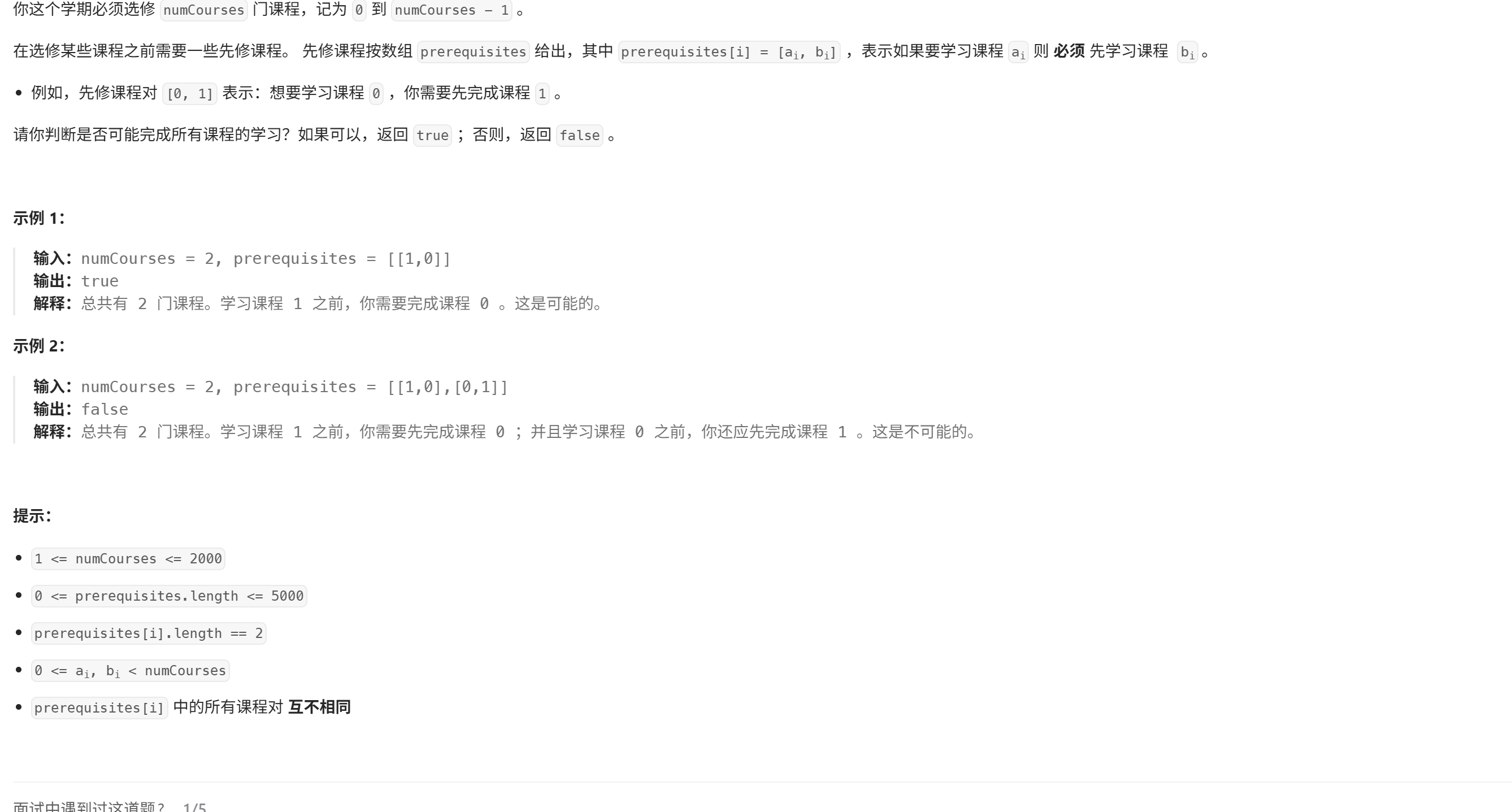
题目描述
代码实现
java
class Solution {
    public boolean canFinish(int numCourses, int[][] prerequisites) {
        Queue<Integer> queue = new LinkedList<>();
        //统计入度
        int[] in = new int[numCourses];
        //邻接表存图
        Map<Integer,List<Integer>> edge = new HashMap<>();

        //建图
        for(int i =0;i<prerequisites.length;i++){
            //b->a
            int a = prerequisites[i][0];
            int b = prerequisites[i][1];
            if(!edge.containsKey(b))
                edge.put(b,new ArrayList<>());
            edge.get(b).add(a);
            in[a]++;
        }

        //拓扑排序
        //1.把入度为0 的点加入到队列中
        for(int i = 0;i<numCourses;i++){
            if(in[i]==0)
                queue.offer(i);
        }
        //bfs
        while(!queue.isEmpty()){
            int t = queue.poll();
            //遍历当前点所连接的下一个节点,让它们入度-1
            for(int a : edge.getOrDefault(t,new ArrayList<>())){
                in[a]--;
                if(in[a]==0)
                    queue.offer(a);
            }
        }

        //判断是否有环
        for(int a :in){
            if(a!=0)
                return false;
        }
        return true;
    }
}
2. 课程表II(LC210)
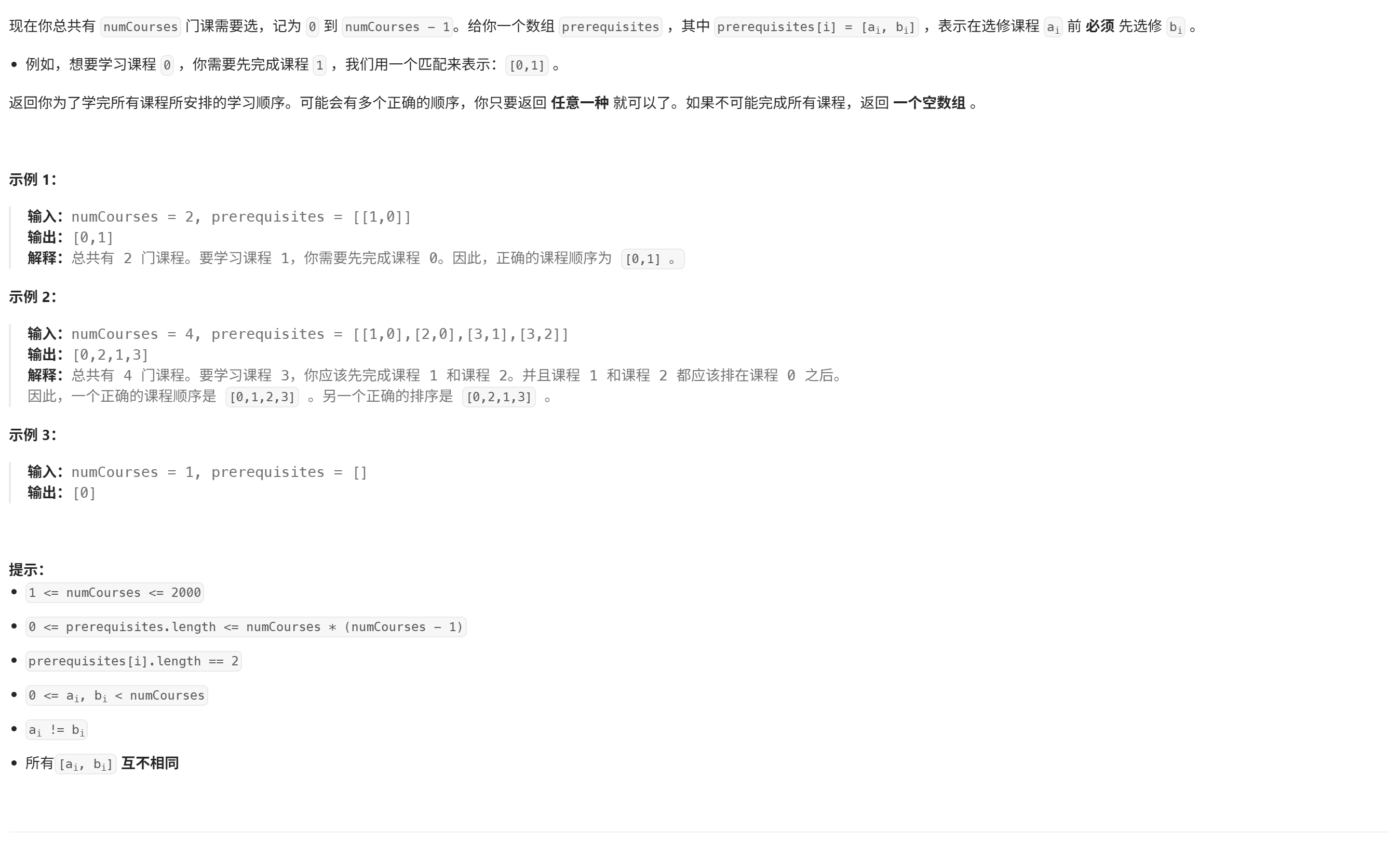
题目描述
解题思路
在出队时统计拓扑排序
代码实现
java
class Solution {
    public int[] findOrder(int numCourses, int[][] prerequisites) {
        int index = 0;
        int[] ret = new int[numCourses];
        Queue<Integer> queue = new LinkedList<>();
        Map<Integer,List<Integer>> map = new HashMap<>();
        int[] in = new int[numCourses];

        //建图
        for(int i = 0;i<prerequisites.length;i++){
            int a = prerequisites[i][0];
            int b = prerequisites[i][1];
            if(!map.containsKey(b))
                map.put(b,new ArrayList());
            map.get(b).add(a);
            in[a]++;
        }

        //拓扑排序
        for (int i = 0; i < numCourses; i++) {
            if (in[i] == 0) {
                queue.offer(i);
            }
        }

        //bfs
        while(!queue.isEmpty()){
            int t = queue.poll();
            ret[index++]=t;
            for(int a : map.getOrDefault(t,new ArrayList<>())){
                in[a]--;
                if(in[a]==0)
                    queue.offer(a);
            }
        }

        if(index==numCourses)
            return ret;
        return new int[0];
    }
}
3. 火星词典(LCR114)
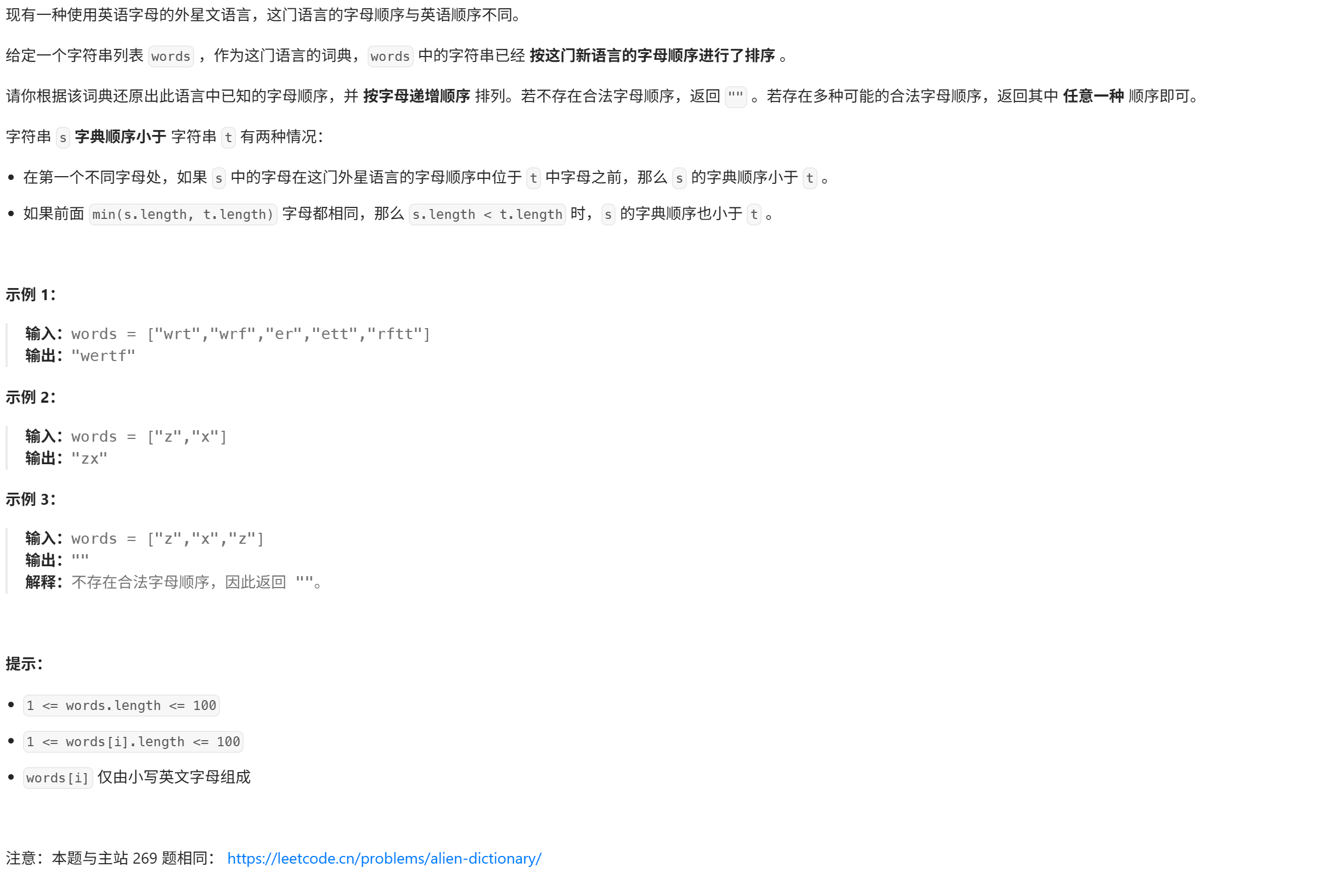
题目描述
解题思路
-
收集信息:两层for循环,统计所有的字母组合。
-
拓扑排序:
- 建图:利用
Map<Charater , Set<Character>>存放边的信息。不直接用List,而是要换成Set,防止重复的信息干扰 - 统计入度信息:
Map<Character,Integer>,数组可以自动初始化为0,而哈希表必须手动初始化所有的节点入度为0
- 建图:利用
-
判断字典序:一个指针分别遍历两个字符串,当指针遇到不同字符时,前面的字符比后面的字典序小。如果遇到类似
abc,ab这种前长后短的字符串,可以直接判定为无效。
代码实现
java
class Solution {
    public String alienOrder(String[] words) {
        HashMap<Character,HashSet<Character>> edges = new HashMap<>();
        HashMap<Character,Integer> in = new HashMap<>();
        StringBuilder ret = new StringBuilder();

        //初始化哈希表入度,把所有字符的入度都置为0
        for(String s:words){
            for(int i = 0;i<s.length();i++)
                in.put(s.charAt(i),0);
        }

        //收集信息
        for(int i = 0;i<words.length;i++){
            for(int j = i+1;j<words.length;j++){
                String a = words[i];
                String b = words[j];

                int index = 0;
                while(index<a.length() && index<b.length() && a.charAt(index) == b.charAt(index))
                    index++;

                //a包含b且a比b长,非法
                if(index<a.length() && index==b.length())
                    return "";

                //字母不同,判断字典序
                if(index<a.length() && index<b.length()){
                    char ch1 = a.charAt(index);
                    char ch2 = b.charAt(index);
                    //ch1 < ch2

                    if(!edges.containsKey(ch1))
                        edges.put(ch1,new HashSet<Character>());

                    if(!edges.get(ch1).contains(ch2)){
                        edges.get(ch1).add(ch2);
                        in.put(ch2,in.get(ch2)+1);
                    }
                }
            }
        }
        //  拓扑排序
        Queue<Character> queue = new LinkedList<>();
        //把所有入度为0的节点放入队列中
        for(char ch :in.keySet()){
            if(in.get(ch)==0)
                queue.offer(ch);
        }

        while(!queue.isEmpty()){
            char top = queue.poll();
            ret.append(top);

            for(char ch:edges.getOrDefault(top,new HashSet<>())){
                in.put(ch,in.get(ch)-1);
                if(in.get(ch)==0)
                    queue.offer(ch);
            }
        }
        for(char ch :in.keySet()){
            if(in.get(ch)!=0)
                return "";
        }
        return ret.toString();
    }
}