从源码深入理解LinkedList
- LinkedList的整体架构
- LinkedList的核心数据结构
- LinkedList的核心成员变量
- LinkedList的构造器
- LinkedList的常用方法:源码解读
-
- 添加方法
-
- [头插法:addFirst(E e)](#头插法:addFirst(E e))
- [尾插法:add(E e) / addLast(E e)](#尾插法:add(E e) / addLast(E e))
- [指定位置插入:add(int index, E element)](#指定位置插入:add(int index, E element))
- [添加集合:boolean addAll(Collection<? extends E> c) -](#添加集合:boolean addAll(Collection<? extends E> c) -)
- 删除方法
-
- [删除指定位置:E remove(int index)](#删除指定位置:E remove(int index))
- [删除第一次出现的对象:boolean remove(Object o)](#删除第一次出现的对象:boolean remove(Object o))
- 查找方法
-
- [获取元素:E get(int index)](#获取元素:E get(int index))
- [返回第一个匹配的下标: int indexOf(Object o)](#返回第一个匹配的下标: int indexOf(Object o))
- [返回最后一个匹配的下标:int lastIndexOf(Object o)](#返回最后一个匹配的下标:int lastIndexOf(Object o))
- 修改与清理方法
-
- [修改元素: E set(int index, E element)](#修改元素: E set(int index, E element))
- [清空链表: void clear()](#清空链表: void clear())
- [是否包含: boolean contains(Object o)](#是否包含: boolean contains(Object o))
- [截取方法:List<E> subList(int fromIndex, int toIndex)](#截取方法:List
subList(int fromIndex, int toIndex)) - [队列操作: offer(E e) / poll() / peek()](#队列操作: offer(E e) / poll() / peek())
- [LinkedList vs ArrayList](#LinkedList vs ArrayList)
- LinkedList的遍历
-
- [1)普通 for 循环](#1)普通 for 循环)
- [2)增强 for 循环 / Iterator](#2)增强 for 循环 / Iterator)
-
- a)基本遍历(正向)
- b)从指定位置开始遍历
- c)反向遍历
- d)遍历时添加元素
- e)遍历时修改元素
- [f) 遍历时删除元素](#f) 遍历时删除元素)
- 笔试面试题
LinkedList的整体架构
LinkedList的继承与实现关系如下:
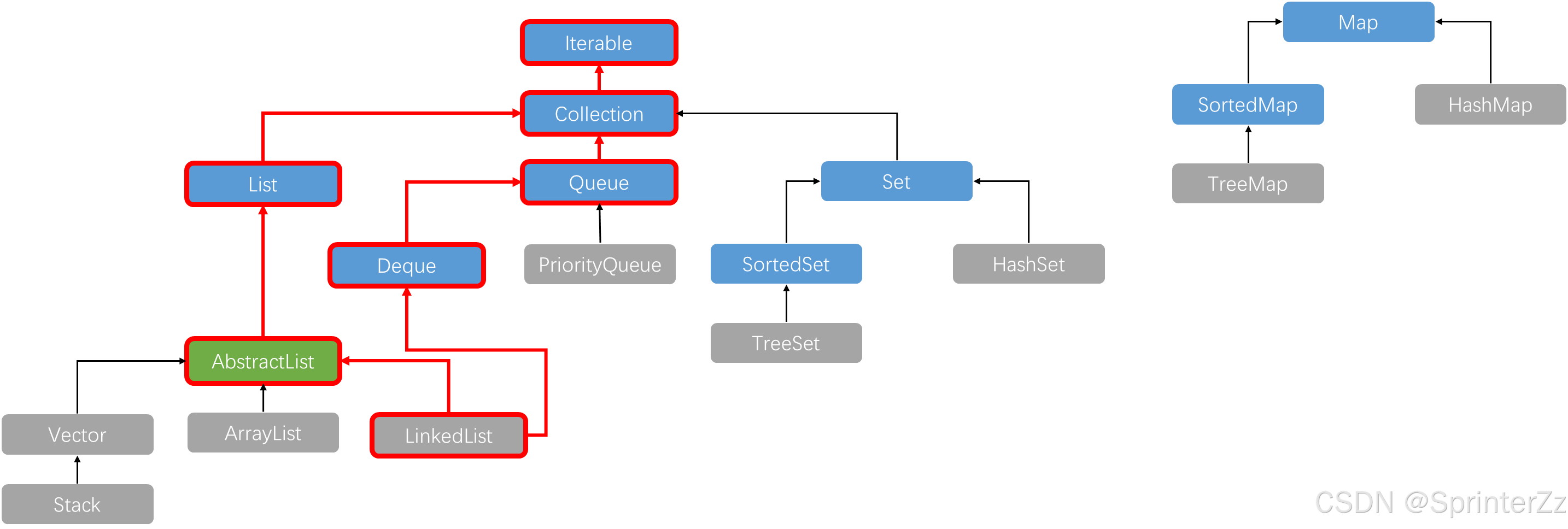
java
public class LinkedList<E>
    extends AbstractSequentialList<E>
    implements List<E>, Deque<E>, Cloneable, java.io.Serializable
从继承结构可以看出:
- AbstractSequentialList:提供顺序访问的骨架实现
- List接口:提供列表的基本操作
- Deque接口:支持双端队列操作(这是LinkedList的特色)
- Cloneable:支持克隆
- Serializable:支持序列化
LinkedList的核心数据结构
LinkedList的底层是一个双向链表,其节点定义如下:
java
private static class Node<E> {
    E item;          // 节点存储的元素
    Node<E> next;    // 指向下一个节点
    Node<E> prev;    // 指向上一个节点

    Node(Node<E> prev, E element, Node<E> next) {
        this.item = element;
        this.next = next;
        this.prev = prev;
    }
}
每个节点都持有对前驱和后继节点的引用。
LinkedList的核心成员变量
java
// 链表长度(节点个数)
transient int size = 0;

// 指向第一个节点
transient Node<E> first;

// 指向最后一个节点
transient Node<E> last;- 这三个成员变量都用
transient修饰,意味着它们不会参与默认序列化 - LinkedList重写了
writeObject和readObject方法来手动实现序列化,只序列化实际存储的元素,而不序列化链表结构
LinkedList的构造器
无参构造
java
// 构造一个空链表
public LinkedList() {
}
传入一个已有的集合
java
// 通过已有集合构造
public LinkedList(Collection<? extends E> c) {
    this();
    addAll(c);
}
创建 LinkedList 对象
java
// 方式1:使用父接口引用
List<Integer> LinkedList1 = new LinkedList<>();

// 方式2:使用具体实现类引用
LinkedList<Integer> LinkedList2 = new LinkedList<>();| 特性 | List LinkedList1 | LinkedList LinkedList2 |
|---|---|---|
| 变量类型 | List接口 | LinkedList类 |
| 可调用的方法 | 只有List接口定义的方法 | LinkedList类的所有公开方法 |
使用 List 接口引用(方式1)
java
List<Integer> LinkedList1 = new LinkedList<>();
LinkedList1.add(1);        // ✅ List接口方法
LinkedList1.add(2);
LinkedList1.get(0);        // ✅ List接口方法

// ❌ 无法调用LinkedList特有方法
LinkedList1.addFirst(0);   // 编译错误!List接口没有addFirst
LinkedList1.addLast(3); // 编译错误!- 只需要使用 List 的标准操作(add, remove, get, set 等)
- 希望保持代码灵活性(未来可以切换为 ArrayList)
使用 LinkedList 类引用(方式2)
java
LinkedList<Integer> LinkedList2 = new LinkedList<>();
LinkedList2.add(1);         // ✅ 继承自List
LinkedList2.addFirst(0);    // ✅ LinkedList特有方法
LinkedList2.addLast(3);     // ✅ LinkedList特有方法
LinkedList2.peek();         // ✅ 队列方法
LinkedList2.poll(); // ✅ 队列方法-
需要使用 LinkedList 特有方法(addFirst, addLast, peek, poll 等)
-
明确利用双端队列特性
java// 作为双端队列使用 LinkedList<Integer> queue = new LinkedList<>(); queue.addFirst(1); queue.addLast(2);
LinkedList的常用方法:源码解读
添加方法
头插法:addFirst(E e)
java
public void addFirst(E e) {
    linkFirst(e);
}

private void linkFirst(E e) {
    final Node<E> f = first;
    final Node<E> newNode = new Node<>(null, e, f);
    first = newNode;
    if (f == null)  // 原链表为空
        last = newNode;
    else
        f.prev = newNode;
    size++;
    modCount++;
}
尾插法:add(E e) / addLast(E e)
java
public boolean add(E e) {
    linkLast(e);
    return true;
}

public void addLast(E e) {
    linkLast(e);
}

void linkLast(E e) {
    final Node<E> l = last;
    final Node<E> newNode = new Node<>(l, e, null);
    last = newNode;
    if (l == null)  // 原链表为空
        first = newNode;
    else
        l.next = newNode;
    size++;
    modCount++;
}
指定位置插入:add(int index, E element)
java
public void add(int index, E element) {
    checkPositionIndex(index);  // 检查索引合法性

    if (index == size)
        linkLast(element);       // 尾部插入
    else
        linkBefore(element, node(index));  // 中间插入
}

// 获取指定位置的节点
Node<E> node(int index) {
    // 关键优化:判断index靠近哪一端
    if (index < (size >> 1)) {  // 靠近头部,从头开始找
        Node<E> x = first;
        for (int i = 0; i < index; i++)
            x = x.next;
        return x;
    } else {                     // 靠近尾部,从尾开始找
        Node<E> x = last;
        for (int i = size - 1; i > index; i--)
            x = x.prev;
        return x;
    }
}

// 在指定节点之前插入
void linkBefore(E e, Node<E> succ) {
    final Node<E> pred = succ.prev;
    final Node<E> newNode = new Node<>(pred, e, succ);
    succ.prev = newNode;
    if (pred == null)
        first = newNode;
    else
        pred.next = newNode;
    size++;
    modCount++;
}
关键点 :node(int index)方法利用双向链表的特性,通过比较index与size/2的大小来决定是从头遍历还是从尾遍历,这是LinkedList查询操作的核心优化。
添加集合:boolean addAll(Collection<? extends E> c) -
java
public boolean addAll(Collection<? extends E> c) {
    return addAll(size, c);  // 从尾部开始添加
}

public boolean addAll(int index, Collection<? extends E> c) {
    checkPositionIndex(index);

    Object[] a = c.toArray();     // 将集合转为数组
    int numNew = a.length;
    if (numNew == 0)
        return false;

    // 找到插入位置的前驱和后继节点
    Node<E> pred, succ;
    if (index == size) {           // 尾插
        succ = null;
        pred = last;
    } else {                       // 中间插
        succ = node(index);        // 找到index位置的节点
        pred = succ.prev;
    }

    // 批量添加节点
    for (Object o : a) {
        @SuppressWarnings("unchecked") E e = (E) o;
        Node<E> newNode = new Node<>(pred, e, null);
        if (pred == null)
            first = newNode;
        else
            pred.next = newNode;
        pred = newNode;
    }

    // 连接后继部分
    if (succ == null) {
        last = pred;               // 尾插,更新last
    } else {
        pred.next = succ;
        succ.prev = pred;
    }

    size += numNew;
    modCount++;
    return true;
}
删除方法
删除指定位置:E remove(int index)
java
public E remove(int index) {
    checkElementIndex(index);        // 检查 0 ≤ index < size
    return unlink(node(index));      // 找到节点并删除
}

// 核心删除逻辑
E unlink(Node<E> x) {
    final E element = x.item;
    final Node<E> next = x.next;     // 后继节点
    final Node<E> prev = x.prev;     // 前驱节点

    // 处理前驱指针
    if (prev == null) {              // x是头节点
        first = next;                // 头节点指向next
    } else {
        prev.next = next;            // 前驱的next指向后继
        x.prev = null;               // 断开引用,帮助GC
    }

    // 处理后继指针
    if (next == null) {              // x是尾节点
        last = prev;                 // 尾节点指向prev
    } else {
        next.prev = prev;            // 后继的prev指向前驱
        x.next = null;               // 断开引用,帮助GC
    }

    x.item = null;                   // 清空元素,帮助GC
    size--;
    modCount++;
    return element;
}
删除第一次出现的对象:boolean remove(Object o)
java
public boolean remove(Object o) {
    if (o == null) {                    // 删除null
        for (Node<E> x = first; x != null; x = x.next) {
            if (x.item == null) {
                unlink(x);
                return true;
            }
        }
    } else {                            // 删除非null对象
        for (Node<E> x = first; x != null; x = x.next) {
            if (o.equals(x.item)) {
                unlink(x);
                return true;
            }
        }
    }
    return false;
}特点:需要遍历链表找到第一个匹配的元素,时间复杂度 O(n)。
查找方法
获取元素:E get(int index)
java
public E get(int index) {
    checkElementIndex(index);
    return node(index).item;    // 先定位节点,再取值
}
返回第一个匹配的下标: int indexOf(Object o)
java
public int indexOf(Object o) {
    int index = 0;
    if (o == null) {
        for (Node<E> x = first; x != null; x = x.next) {
            if (x.item == null)
                return index;
            index++;
        }
    } else {
        for (Node<E> x = first; x != null; x = x.next) {
            if (o.equals(x.item))
                return index;
            index++;
        }
    }
    return -1;
}
返回最后一个匹配的下标:int lastIndexOf(Object o)
java
public int lastIndexOf(Object o) {
    int index = size;
    if (o == null) {
        for (Node<E> x = last; x != null; x = x.prev) {  // 从尾向前遍历
            index--;
            if (x.item == null)
                return index;
        }
    } else {
        for (Node<E> x = last; x != null; x = x.prev) {  // 从尾向前遍历
            index--;
            if (o.equals(x.item))
                return index;
        }
    }
    return -1;
}
注意 :lastIndexOf 是从尾部向前遍历,这样找到的第一个就是最后一个匹配项。
修改与清理方法
修改元素: E set(int index, E element)
java
public E set(int index, E element) {
    checkElementIndex(index);
    Node<E> x = node(index);      // 先定位节点
    E oldVal = x.item;
    x.item = element;             // 直接替换item值
    return oldVal;
}
清空链表: void clear()
java
public void clear() {
    // 逐个断开所有节点引用,帮助GC回收
    for (Node<E> x = first; x != null; ) {
        Node<E> next = x.next;
        x.item = null;
        x.next = null;
        x.prev = null;
        x = next;
    }
    first = last = null;   // 头尾置空
    size = 0;
    modCount++;
}
是否包含: boolean contains(Object o)
java
public boolean contains(Object o) {
    return indexOf(o) != -1;   // 复用indexOf方法
}
截取方法:List subList(int fromIndex, int toIndex)
java
// LinkedList本身没有实现subList,继承自AbstractList
public List<E> subList(int fromIndex, int toIndex) {
    return (this instanceof RandomAccess ?
            new RandomAccessSubList<>(this, fromIndex, toIndex) :
            new SubList<>(this, fromIndex, toIndex));
}
重要提醒 :subList 返回的是原列表的视图,对子列表的修改会影响原列表!
java
LinkedList<String> list = new LinkedList<>();
list.addAll(Arrays.asList("A", "B", "C", "D"));
List<String> sub = list.subList(1, 3);  // [B, C]

sub.set(0, "X");        // 修改子列表
System.out.println(list); // [A, X, C, D] 原列表也被修改!
队列操作: offer(E e) / poll() / peek()
java
// 入队(尾部)
public boolean offer(E e) {
    return add(e);
}

// 出队(头部)
public E poll() {
    final Node<E> f = first;
    return (f == null) ? null : unlinkFirst(f);
}

// 查看队首元素
public E peek() {
    final Node<E> f = first;
    return (f == null) ? null : f.item;
}
LinkedList vs ArrayList
时间复杂度对比
| 操作 | ArrayList | LinkedList |
|---|---|---|
| get(index) | O(1) | O(n) |
| add(尾部) | O(1) 均摊 | O(1) |
| add(index) | O(n) | O(n) * |
| remove(index) | O(n) | O(n) * |
| remove(头部) | O(n) | O(1) |
| addFirst | O(n) | O(1) |
*注:LinkedList的中间插入/删除虽然定位到index需要O(n)时间,但插入/删除操作本身是O(1);ArrayList则是移位操作O(n)。
我来从源码角度深入解读 LinkedList 的各种遍历方法,以及它们的底层实现原理和适用场景。
LinkedList的遍历
1)普通 for 循环
java
// 这种方式性能最差!
for (int i = 0; i < linkedList2.size(); i++) {
    System.out.print(linkedList2.get(i) + " ");
}源码分析:
java
// 每次调用 get(i) 都会执行 node(i) 方法
public E get(int index) {
    checkElementIndex(index);
    return node(index).item;  // 每次都要从头/尾遍历
}

Node<E> node(int index) {
    // 每次调用都要遍历 O(n)
    if (index < (size >> 1)) {
        Node<E> x = first;
        for (int i = 0; i < index; i++)
            x = x.next;
        return x;
    } else {
        // ...
    }
}
2)增强 for 循环 / Iterator
java
// 方式1:增强for(底层也是Iterator)
for (Integer num : linkedList2) {
    System.out.print(num + " ");
}

// 方式2:显式使用Iterator
Iterator<Integer> it = linkedList2.iterator();
while (it.hasNext()) {
    System.out.print(it.next() + " ");
}
Iterator 源码分析:
java
// LinkedList 的 iterator() 方法
public Iterator<E> iterator() {
    return listIterator();  // 返回 ListIterator
}

// ListIterator 的实现(LinkedList内部类)
private class ListItr implements ListIterator<E> {
    private Node<E> lastReturned = null;
    private Node<E> next;           // 下一个要返回的节点
    private int nextIndex;          // 下一个节点的索引
    private int expectedModCount = modCount;

    // 构造器
    ListItr(int index) {
        next = (index == size) ? null : node(index);
        nextIndex = index;
    }

    public boolean hasNext() {
        return nextIndex < size;
    }

    public E next() {
        checkForComodification();
        if (!hasNext())
            throw new NoSuchElementException();

        lastReturned = next;
        next = next.next;        // 移动指针 O(1)
        nextIndex++;
        return lastReturned.item;
    }
}时间复杂度:O(n) - 只需遍历一次
a)基本遍历(正向)
java
ListIterator<Integer> lit = linkedList2.listIterator();
while (lit.hasNext()) {
    System.out.print(lit.next() + " ");
}
b)从指定位置开始遍历
java
// 从倒数第二个元素开始正向遍历
ListIterator<Integer> lit2 = linkedList2.listIterator(linkedList2.size() - 2);
while (lit2.hasNext()) {
    System.out.print(lit2.next() + " ");
}源码分析:
java
// ListIterator 构造器
ListItr(int index) {
    next = (index == size) ? null : node(index);  // 直接定位到index位置
    nextIndex = index;
}
// 时间复杂度:O(n) 定位一次,后续遍历O(1) per element
c)反向遍历
java
// 技巧:从末尾开始,使用 previous() 反向遍历
ListIterator<Integer> lit2 = linkedList2.listIterator(linkedList2.size());
while (lit2.hasPrevious()) {  // 注意是 hasPrevious
    System.out.print(lit2.previous() + " ");
}
previous() 源码:
java
public E previous() {
    checkForComodification();
    if (!hasPrevious())
        throw new NoSuchElementException();

    lastReturned = next = (next == null) ? last : next.prev;  // 移动前驱指针
    nextIndex--;
    return lastReturned.item;
}

public boolean hasPrevious() {
    return nextIndex > 0;
}
d)遍历时添加元素
java
ListIterator<Integer> lit = list.listIterator();
while (lit.hasNext()) {
    Integer num = lit.next();
    if (num == 3) {
        lit.add(99);  // 在3后面插入99
    }
}
// 原列表:[1,2,3,4,5] → [1,2,3,99,4,5]
e)遍历时修改元素
java
ListIterator<Integer> lit = list.listIterator();
while (lit.hasNext()) {
    Integer num = lit.next();
    if (num == 3) {
        lit.set(100);  // 将3改为100
    }
}
// 原列表:[1,2,3,4,5] → [1,2,100,4,5]
f) 遍历时删除元素
java
ListIterator<Integer> lit = list.listIterator();
while (lit.hasNext()) {
    Integer num = lit.next();
    if (num == 3) {
        lit.remove();  // 删除3
    }
}
// 原列表:[1,2,3,4,5] → [1,2,4,5]| 遍历方式 | 时间复杂度 | 推荐程度 | 适用场景 |
|---|---|---|---|
| 普通for + get(index) | O(n²) | ❌ 不推荐 | 无 |
| 增强for | O(n) | ✅ 推荐 | 只读遍历 |
| Iterator | O(n) | ✅ 推荐 | 需要删除元素 |
| ListIterator | O(n) | ✅ 推荐 | 需要双向遍历/修改/添加 |
笔试面试题
陷阱1:在遍历时直接修改列表
java
// ❌ 错误:会抛出 ConcurrentModificationException
for (Integer num : list) {
    if (num == 3) {
        list.remove(num);  // 直接修改原列表
    }
}

// ✅ 正确:使用 Iterator
Iterator<Integer> it = list.iterator();
while (it.hasNext()) {
    if (it.next() == 3) {
        it.remove();  // 安全删除
    }
}