C++11
目录
[5.2.泛左值(generalized value)](#5.2.泛左值(generalized value))
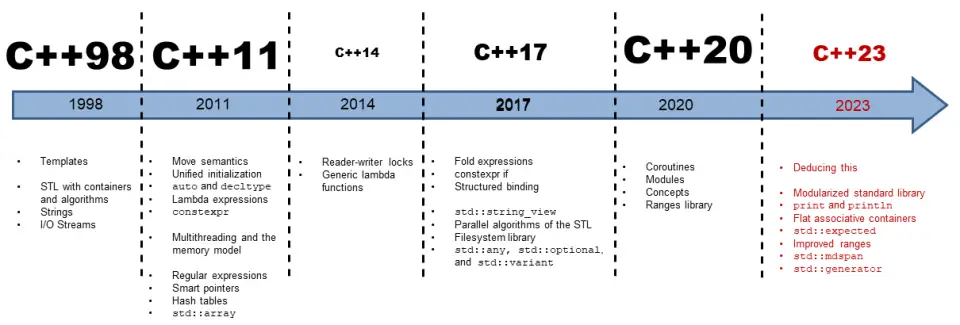
一、C++11的发展历史
C++的第二个重要版本
是从C++98开始的最重要更新
二、列表初始化
2.1.C++98中的{}
用于数组 、结构体的初始化
cpp
struct Point
{
	int _x;
	int _y;
};

int main()
{
	int array1[] = { 1, 2, 3, 4, 5 };
	int array2[5] = { 0 };
	Point p = { 1, 2 };
	return 0;
}
2.2.C++11中的{}
用于一切对象的初始化
(注:{}初始化也叫做列表初始化)
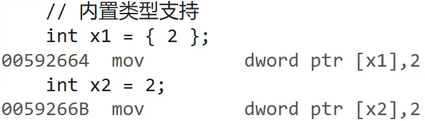
支持内置类型 ,自定义类型(类型转换,产生临时对象,优化为直接构造)
(注:{}初始化时,可以省略掉=)
cpp
#define _CRT_SECURE_NO_WARNINGS 1
#include <iostream>
using namespace std;
#include <vector>

struct Point
{
	int _x;
	int _y;
};
class Date
{
public:
	Date(int year = 1, int month = 1, int day = 1)
		:_year(year)
		,_month(month)
		,_day(day)
	{
		cout << "Date(int year, int month, int day)" << endl;
	}
	Date(const Date& d)
		:_year(d._year)
		,_month(d._month)
		,_day(d._day)
	{
		cout << "Date(const Date& d)" << endl;
	}
private:
	int _year;
	int _month;
	int _day;
};

int main()
{
	//内置类型
	int x1 = { 2 };
	//自定义类型
	//本质:
	//用{2025, 1, 1}构造一个Date临时对象
	//临时对象再去拷贝构造d1
	//编译器优化后变成{2025, 1, 1}直接构造初始化
	Date d1 = { 2025, 1, 1 };

	//d2是{2024, 7, 25}构造的临时对象
	//临时对象具有常性,需要const修饰
	const Date& d2 = { 2024, 7, 25 };

	//C++98支持单参数时类型转换
	//也可以不用{}
	Date d3 = { 2025 };//C++11
	Date d4 = 2025;//C++98

	//可以省略掉=
	Point p1{ 1, 2 };
	int x2{ 2 };
	Date d6{ 2024, 7, 25 };
	const Date & d7{ 2024, 7, 25 };

	//不支持,只有{}初始化,才能省略=
	//Date d8 2025;

	vector<Date> v;
	v.push_back(d1);
	v.push_back(Date(2025, 1, 1));

	//比起有名对象和匿名对象传参
	//这里{}更有性价比
	v.push_back({ 2025, 1, 1 });

	return 0;
}
三、C++中的std::initializer_list
对于对象容器的初始化,用列表初始化不太方便
(比如:vector对象,用N个值去构造初始化,需要实现多个构造函数)
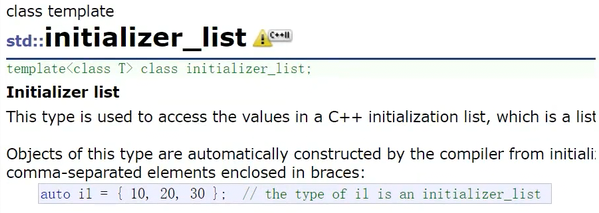
可以用std::initializer_list进行初始化

cpp
vector<int> v1 = { 1,2,3,4,5 };
vector<int> v2 = { 1,2,3,4,5,1,1,1,1,1 };
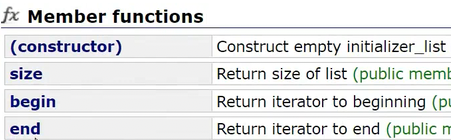
3.1.std::initializer_list的类
**本质:**底层开一个数组,将数据拷贝,内部有两个指针分别指向数组的开始和结束
(注:std::initializer_list支持迭代器遍历)
cpp
template<class T>
class vector {
public:
    typedef T* iterator;
    vector(initializer_list<T> l)
    {
        for (auto e : l)
        push_back(e)
    }
private:
    iterator _start = nullptr;
    iterator _finish = nullptr;
    iterator _endofstorage = nullptr;
};
3.2.std::initializer_list的使用
cpp
#define _CRT_SECURE_NO_WARNINGS 1
#include<iostream>
#include<vector>
#include<string>
#include<map>
using namespace std;

int main()
{
	std::initializer_list<int> mylist = { 10, 20, 30 };
	cout << sizeof(mylist) << endl;
	//begin和end返回的值initializer_list对象中存的两个指针
	//这两个指针的值跟i的地址跟接近,说明数组存在栈上
	int i = 0;
	cout << mylist.begin() << endl;
	cout << mylist.end() << endl;
	cout << &i << endl;

	//直接构造,将实参传给形参,调用initialize_list
	vector<int> v1({ 1,2,3,4,5 });
	//构造临时对象+临时对象拷贝构造给v2+优化为直接构造
	vector<int> v2 = { 1,2,3,4,5 };
	//构造临时对象,临时对象具有常性,需要用const修饰
	const vector<int>& v3 = { 1,2,3,4,5 };
    // initializer_list版本的赋值支持
	v1 = { 10,20,30,40,50 };
	//pair对象的{}初始化和map的initializer_list构造结合到一起使用
	map<string, string> dict = { {"sort", "排序"}, {"string", "字符串"} };

	return 0;
}
四、右值引用和移动语义
4.1.左值和右值
**左值(lvalue):**left value / locate value(可取地址的对象)
数据的表达式(变量名 、解引用的指针)
具有持久状态,存储在内存中
可以出现在赋值符号的左边,也可以出现在右边,左值可以取地址
(注:定义时const修饰符后的左值,不能赋值,但可以取地址)
cpp
#include<iostream>
using namespace std;

int main()
{
	//左值:可以取地址
	//以下的p、b、c、*p、s、s[0]就是常见的左值
	int* p = new int(0);
	int b = 1;
	const int c = b;
	*p = 10;
	string s("111111");
	s[0] = 'x';

	return 0;
}
**右值(rvalue):**right value / read value(不可寻址的对象)
数据的表达式(字面值常量 、存储在寄存器中的变量 、表达式求值过程中创建的临时对象)
可以出现在赋值符号的右边,但是不能出现在左边,右值不可以取地址
cpp
#include<iostream>
using namespace std;

int main()
{
	// 右值:不能取地址
	double x = 1.1, y = 2.2;
	//10、x + y、fmin(x, y)、string("11111")都是常见的右值
	10;
	x + y;
	fmin(x, y);
	string("11111");

	return 0;
}
4.2.左值引用和右值引用
**左值引用:**Type & r1 = x
**右值引用:**Type && rr1 = y
无论是左值引用还是右值引用,都是给对象取别名
左值引用给左值取别名
cpp
#include<iostream>
using namespace std;

int main()
{
	int* p = new int(0);
	int b = 1;
	const int c = b;
	*p = 10;
	string s("111111");
	s[0] = 'x';

	//左值引用给左值取别名
	int& r1 = b;
	int*& r2 = p;
	int& r3 = *p;
	string& r4 = s;
	char& r5 = s[0];

	return 0;
}
右值引用给move**(左值)取别名**
cpp
#include<iostream>
using namespace std;

int main()
{
	int* p = new int(0);
	int b = 1;
	const int c = b;
	*p = 10;
	string s("111111");
	s[0] = 'x';

	//右值引用不能直接引用左值
	//右值引用可以引用:move(左值)
	int&& rrx1 = move(b);
	int*&& rrx2 = move(p);
	int&& rrx3 = move(*p);
	string && rrx4 = move(s);
	//move的底层是强制类型转换:string && rrx5 = (string&&)s;

	return 0;
}
**注:**move是一个函数模板,内部进行强制类型转换,涉及引用折叠

右值引用给右值取别名
cpp
#include<iostream>
using namespace std;

int main()
{
	double x = 1.1, y = 2.2;

	//右值引用给右值取别名
	int&& rr1 = 10;
	double&& rr2 = x + y;
	double&& rr3 = fmin(x, y);
	string && rr4 = string("11111");

	return 0;
}const左值引用给右值取别名
cpp
#include<iostream>
using namespace std;

int main()
{
	double x = 1.1, y = 2.2;

	//左值引用不能直接引用右值
	//const左值引用可以引用右值
	const int& rx1 = 10;
	const double& rx2 = x + y;
	const double& rx3 = fmin(x, y);
	const string & rx4 = string("11111");

	return 0;
}
**引用本身是左值:**左值引用的属性是左值,右值引用的属性也是左值
cpp
#include<iostream>
using namespace std;

int main()
{
	//rr1的属性是左值
	int&& rr1 = 10;
	//左值可以被左值引用绑定
	int& r6 = rr1;
	//不能再被右值引用绑定
	//int&& rrx6 = rr1;
	//除非使用move(左值)
	int&& rrx6 = move(rr1);

	return 0;
}
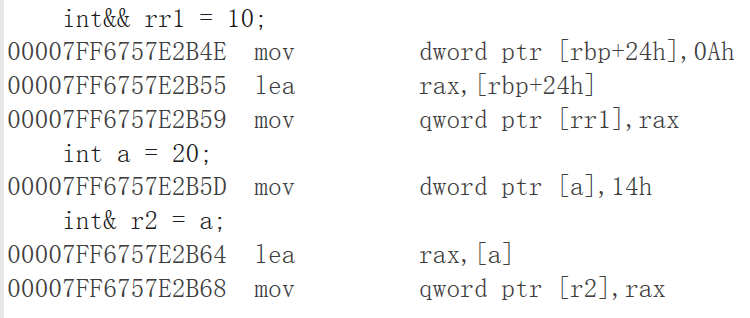
**语法层面:**左值引用与右值引用都是取别名,不开空间
**汇编层面:**左值引用与右值引用的底层都是用指针实现
cpp
#include<iostream>
using namespace std;

int main()
{
	int&& rr1 = 10;
	int a = 20;
	int& r2 = a;

	return 0;
}
4.3.引用延长生命周期
右值引用: 为临时对象、匿名对象延长生命周期(读写)
const左值引用: 为临时对象、匿名对象延长生命周期(只读)
cpp
#include<iostream>
using namespace std;

int main()
{
	std::string s1 = "Test";
	//右值引用不能绑定左值
	//std::string&& r1 = s1;

	//const左值引用:延长s1+s2返回的临时对象string的生命周期,与r2相同
	const std::string & r2 = s1 + s1;
	//不能对const的引用修改
	//r2 += "Test";

	//右值引用:延长s1+s2返回的临时对象string的生命周期,与r3相同
	std::string && r3 = s1 + s1;
	//能对非const的引用修改
	r3 += "Test";

	std::cout << r3 << '\n';
	return 0;
}
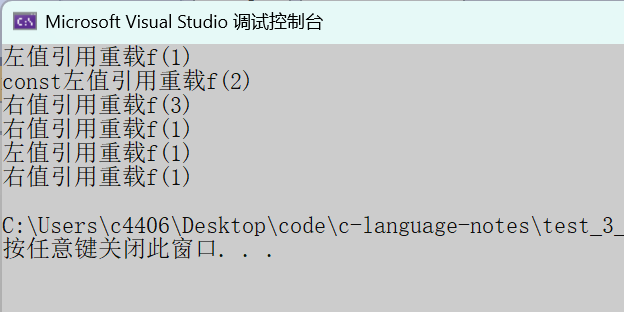
4.4.左值和右值的参数匹配
**C++98:**使用const左值引用作为函数形参,实参既可以传左值也可以传右值
**C++11:**分别重载左值引用,const左值引用,右值引用作为函数形参
- 实参为左值 ,匹配左值引用
- 实参为const左值 ,匹配const左值引用
- 实参为右值 ,匹配右值引用
cpp
#include<iostream>
using namespace std;

void f(int& x)
{
	std::cout << "左值引用重载f(" << x << ")\n";
}

void f(const int& x)
{
	std::cout << "const左值引用重载f(" << x << ")\n";
}

void f(int&& x)
{
	std::cout << "右值引用重载f(" << x << ")\n";
}

int main()
{
	int i = 1;
	const int ci = 2;
	//调用f(int&)
	f(i);
	//调用f(const int&)
	f(ci);
	//调用f(int&&)
	f(3);//如果没有 f(int&&)重载则会调用f(const int&)
	//调用f(int&&)
	f(std::move(i));

	//右值引用变量在用于表达式时是左值
	int&& x = 1;
	//调用f(int& x)
	f(x);
	//调用f(int&& x)
	f(std::move(x));
	return 0;
}
4.5.左值引用的使用场景
左值引用的优点
- 左值引用传函数形参,避免传值传参发生拷贝
- 左值引用传返回值,避免产生临时对象时拷贝
- 左值引用传返回值,可以修改实参和返回对象
左值引用的问题
当返回的对象为局部对象时,函数结束后这个对象被析构,造成野引用
无论是左值引用还是右值引用都无法解决这个问题,只能使用传值返回
cpp
#include<iostream>
using namespace std;
#include <vector>

class Solution
{
public:
    //传值返回没有问题
	string addStrings(string num1, string num2)
    //左值引用返回会失败
    string& addStrings(string num1, string num2)
    //右值引用返回会报错
    string&& addStrings(string num1, string num2)
	{
		string str;
		int end1 = num1.size() - 1, end2 = num2.size() - 1;
		int next = 0;
		while (end1 >= 0 || end2 >= 0)
		{
			int val1 = end1 >= 0 ? num1[end1--] - '0' : 0;
			int val2 = end2 >= 0 ? num2[end2--] - '0' : 0;
			int ret = val1 + val2 + next;
			next = ret / 10;
			ret = ret % 10;
			str += ('0' + ret);
		}
		if (next == 1)
		{
			str += '1';
		}
		reverse(str.begin(), str.end());
		return str;
        //即使右值引用使用move(左值)也会失败:return move(str)
	}
};

int main()
{
	string ret = Solution().addStrings("11111111111111111", "22222222222222");
	cout << ret << endl;
	return 0;
}
4.6.移动构造和移动赋值
**移动构造:**一种构造函数,与拷贝构造类似
**要求:**第一个参数是该类类型的引用(右值引用),额外的参数必须要有缺省值
**移动赋值:**一种赋值运算符重载,与拷贝赋值函数类似,构成函数重载
**要求:**第一个参数是该类类型的引用(右值引用)
只有像string/vector这样的深拷贝的类,或者包含深拷贝成员变量的类
移动构造和移动赋值才有意义,本质是窃取引用的右值对象的资源
而非像拷贝构造与拷贝赋值去拷贝资源,从而提高效率
cpp
#define _CRT_SECURE_NO_WARNINGS 1
#include<iostream>
#include<assert.h>
#include<string.h>
#include<algorithm>
using namespace std;

namespace bit
{
	class string
	{
	public:
		typedef char* iterator;
		typedef const char* const_iterator;

		iterator begin()
		{
			return _str;
		}

		iterator end()
		{
			return _str + _size;
		}

		const_iterator begin() const
		{
			return _str;
		}

		const_iterator end() const
		{
			return _str + _size;
		}

		string(const char* str = "")
			:_size(strlen(str))
			, _capacity(_size)
		{
			cout << "string(char* str)-构造" << endl;
			_str = new char[_capacity + 1];
			strcpy(_str, str);
		}

		void swap(string& s)
		{
			::swap(_str, s._str);
			::swap(_size, s._size);
			::swap(_capacity, s._capacity);
		}

		//拷贝构造(左值)
		string(const string& s)
			:_str(nullptr)
		{
			cout << "string(const string& s) -- 拷贝构造" << endl;
			reserve(s._capacity);
			for (auto ch : s)
			{
				push_back(ch);
			}
		}

		//移动构造(右值)
		string(string&& s)
		{
			cout << "string(string&& s) -- 移动构造" << endl;
			//交换:掠夺资源(右值引用的属性为左值)
			swap(s);
		}

		string& operator=(const string& s)
		{
			cout << "string& operator=(const string& s) -- 拷贝赋值" << endl;
			if (this != &s)
			{
				_str[0] = '\0';
				_size = 0;
				reserve(s._capacity);
				for (auto ch : s)
				{
					push_back(ch);
				}
			}

			return *this;
		}

		//移动赋值
		string& operator=(string&& s)
		{
			cout << "string& operator=(string&& s) -- 移动赋值" << endl;
			swap(s);
			return *this;
		}

		~string()
		{
			cout << "~string() -- 析构" << endl;
			delete[] _str;
			_str = nullptr;
		}

		char& operator[](size_t pos)
		{
			assert(pos < _size);
			return _str[pos];
		}

		void reserve(size_t n)
		{
			if (n > _capacity)
			{
				char* tmp = new char[n + 1];
				if (_str)
				{
					strcpy(tmp, _str);
					delete[] _str;
				}
				_str = tmp;
				_capacity = n;
			}
		}

		void push_back(char ch)
		{
			if (_size >= _capacity)
			{
				size_t newcapacity = _capacity == 0 ? 4 : _capacity * 2;
				reserve(newcapacity);
			}
			_str[_size] = ch;
			++_size;
			_str[_size] = '\0';
		}

		string& operator+=(char ch)
		{
			push_back(ch);
			return *this;
		}

		const char* c_str() const
		{
			return _str;
		}

		size_t size() const
		{
			return _size;
		}
	private:
		char* _str = nullptr;
		size_t _size = 0;
		size_t _capacity = 0;
	};
}

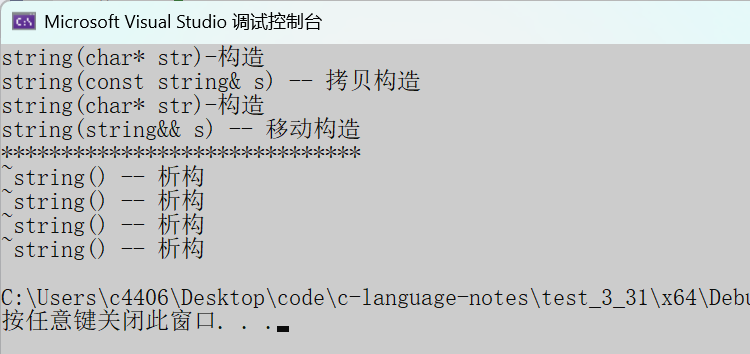
int main()
{
	//直接构造
	bit::string s1("xxxxx");
	//拷贝构造
	bit::string s2 = s1;
	//构造+移动构造,优化后直接构造
	bit::string s3 = bit::string("yyyyy");
	//移动构造
	bit::string s4 = move(s1);
	cout << "******************************" << endl;
	return 0;
}
4.7.右值对象构造
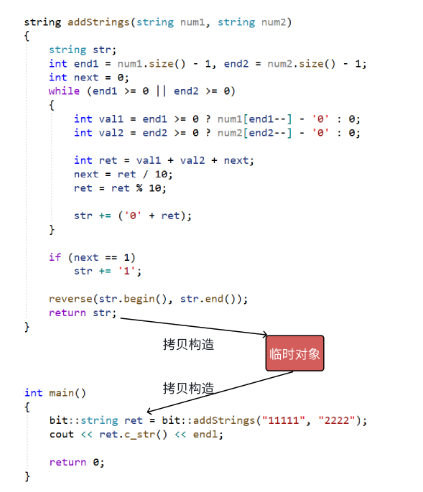
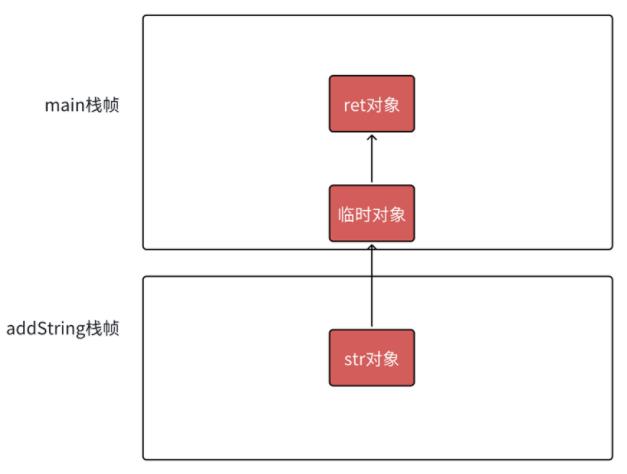
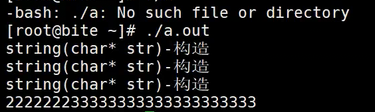
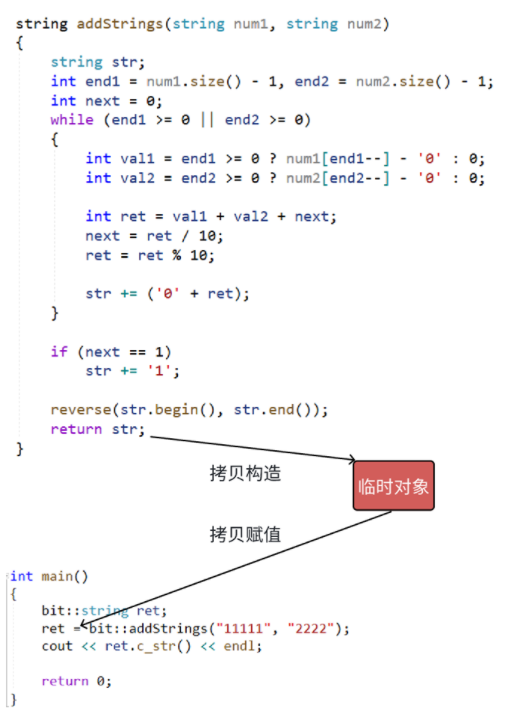
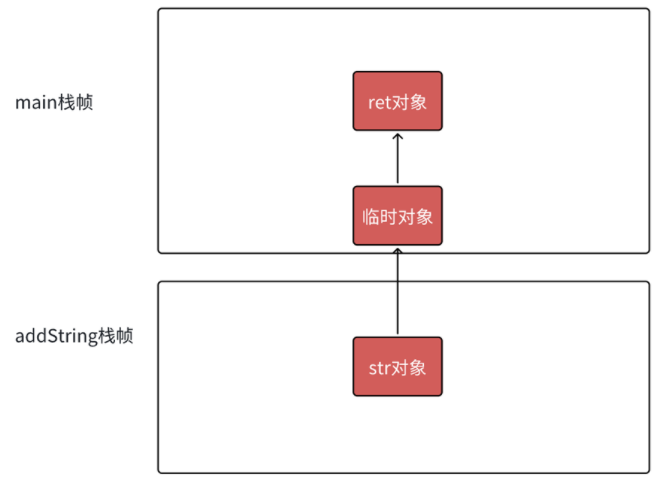
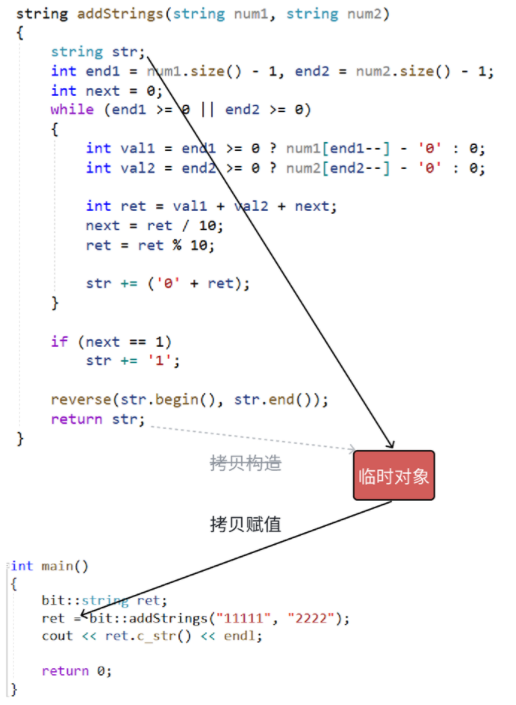
**场景1:**只有拷贝构造,没有移动构造
vs2019 debug环境
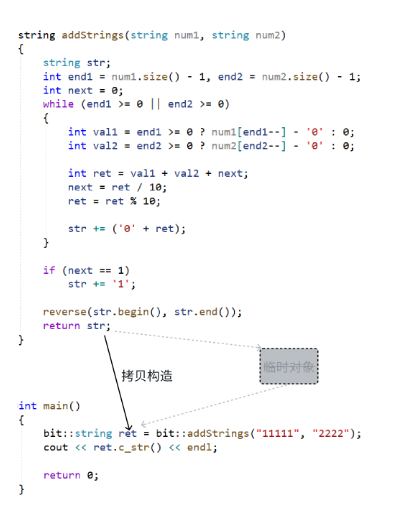
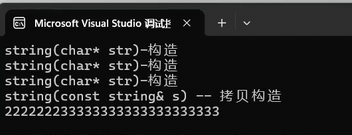
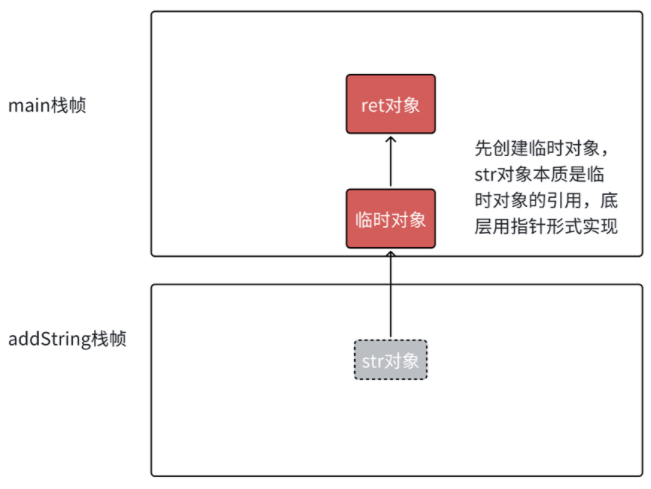
**左边:**无优化,两次拷贝构造
**右边:**编译器优化,合二为一变为一次拷贝构造
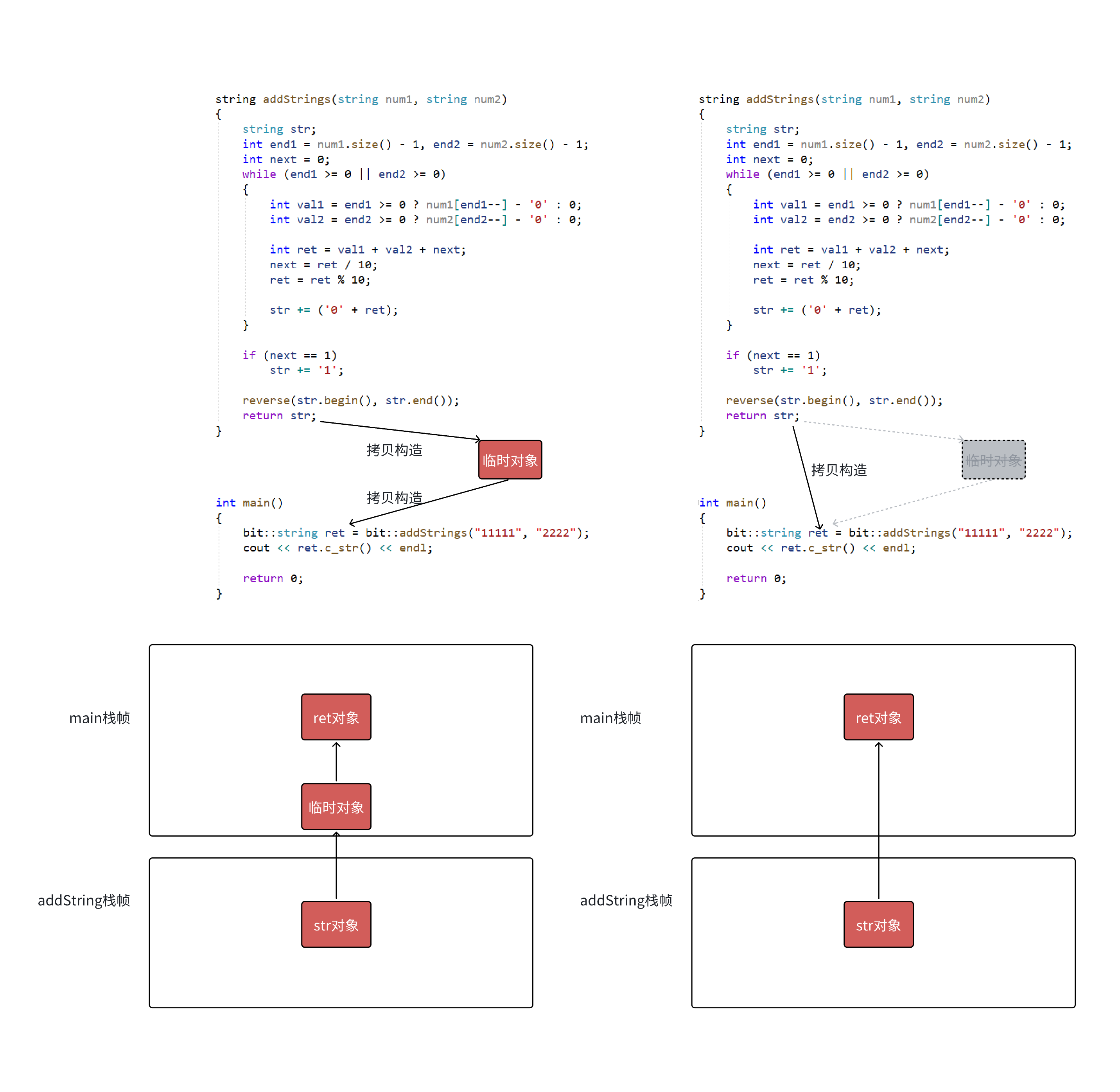
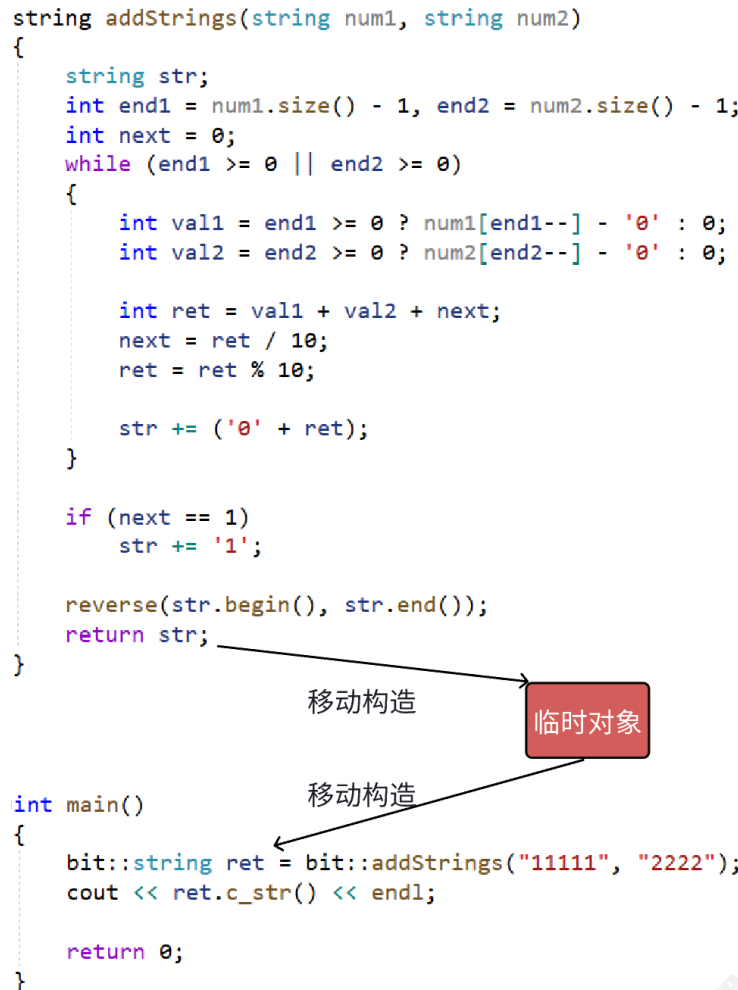
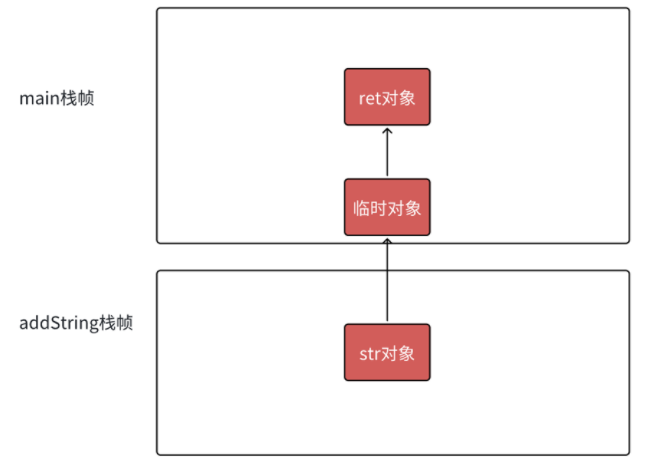
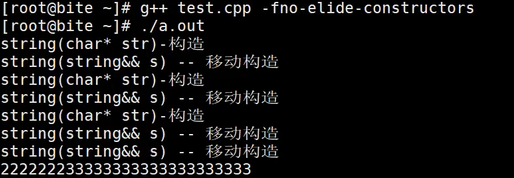
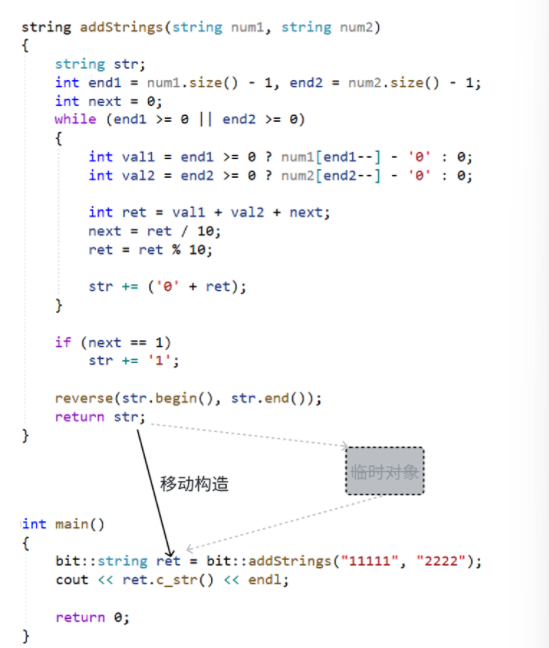
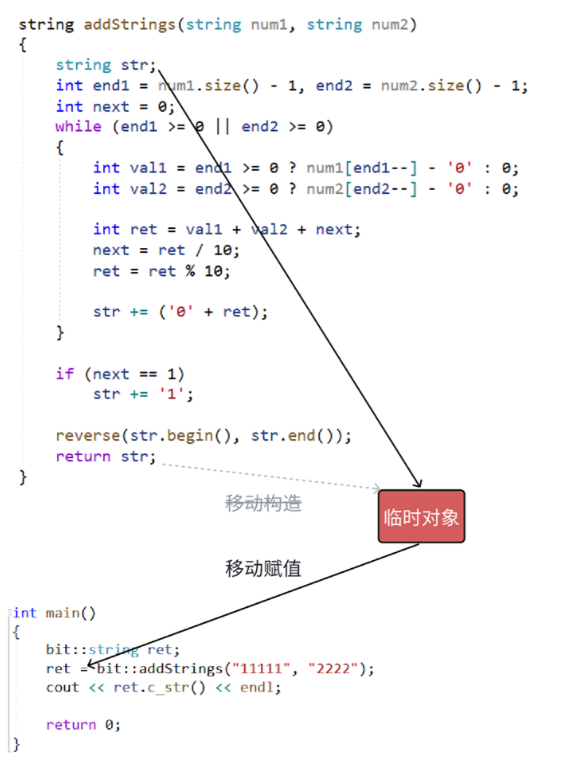
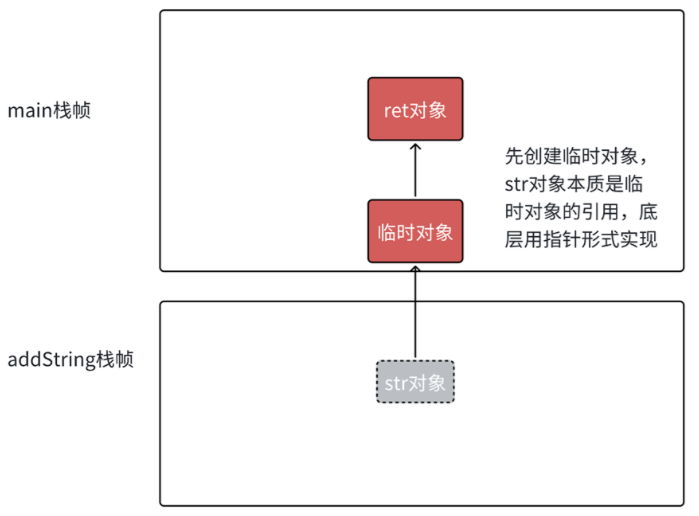
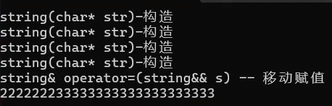
**场景2:**既有拷贝构造,又有移动构造
vs2019 debug环境
**左边:**无优化,两次移动构造
右边: 编译器优化,合二为一变为一次移动构造
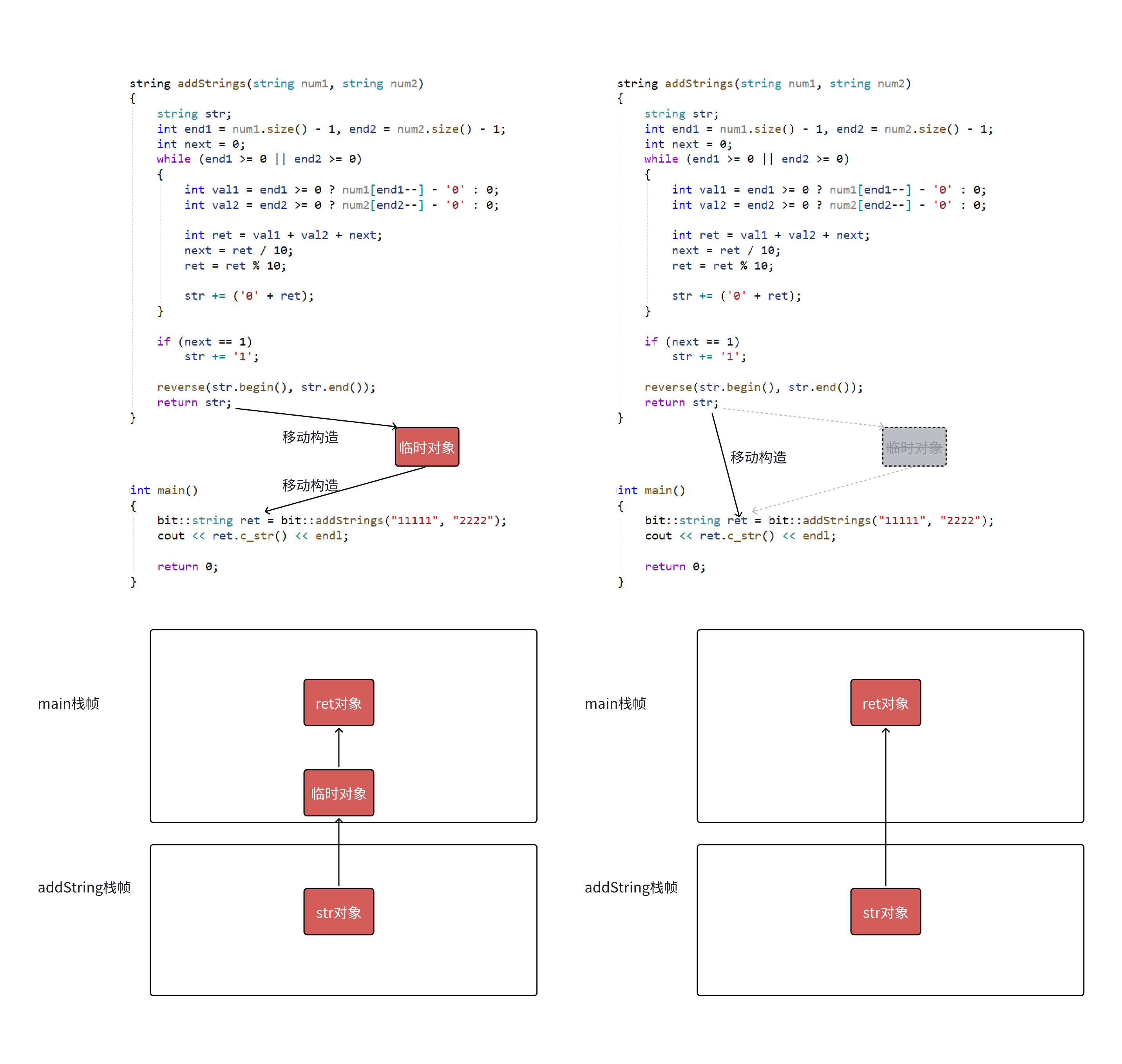
vs2019 release 和 vs2022 debug/release环境
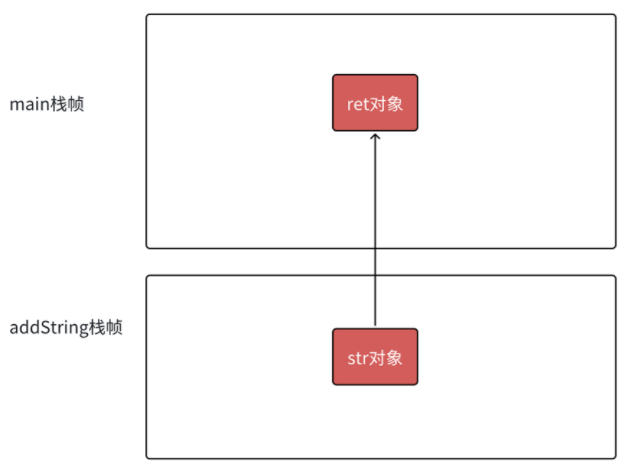
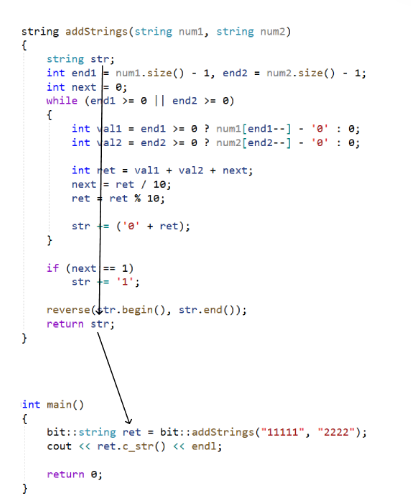
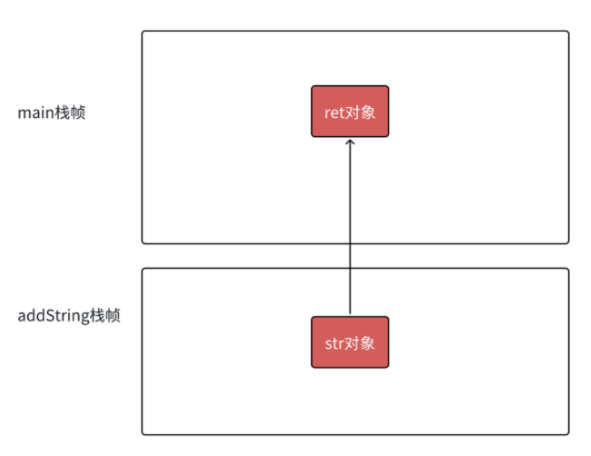
将str对象的构造,str拷贝构造临时对象,临时对象拷贝构造ret对象,合三为一,变为直接构造
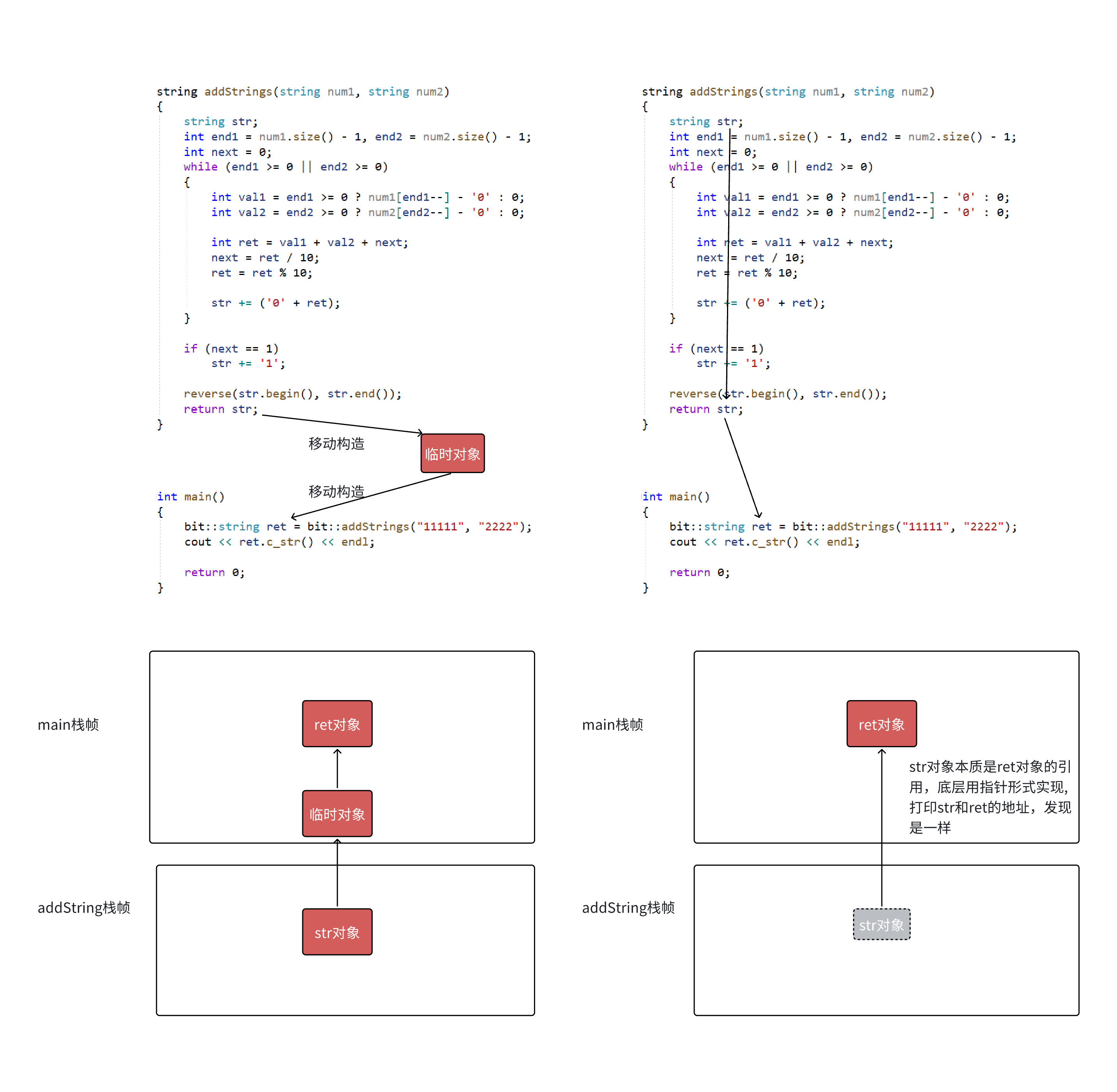
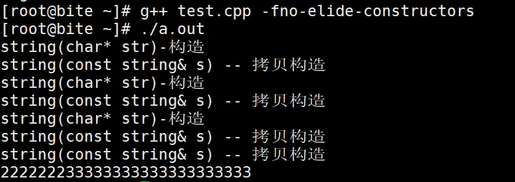
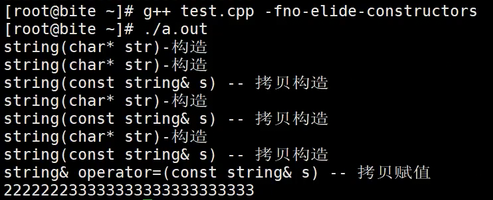
linux g++环境
编译时用g++ test.cpp -fno-elide-construtors关闭优化
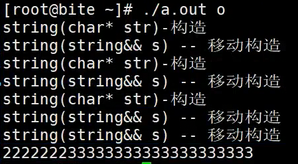
**左值引用与右值引用的目的:**减少拷贝,提高效率
(注:左值引用还可以修改参数或者返回值,方便使用)
左值引用的局限性
部分函数返回场景,只能传值返回,不能左值引用返回
当前函数的局部对象,出了当前函数的作用域,生命周期结束后销毁
不能用左值引用返回,只能传值返回
cpp
#define _CRT_SECURE_NO_WARNINGS 1
#include <iostream>
using namespace std;
#include <vector>

class Solution
{
public:
	//这里的传值返回拷贝代价太大
	vector<vector<int>> generate(int numRows)
	{
		vector<vector<int>> vv(numRows);
		for (int i = 0; i < numRows; ++i)
		{
			vv[i].resize(i + 1, 1);
		}
		for (int i = 2; i < numRows; ++i)
		{
			for (int j = 1; j < i; ++j)
			{
				vv[i][j] = vv[i - 1][j] + vv[i - 1][j - 1];
			}
		}
		return vv;
	}
};

int main()
{
	vector<vector<int>> ret = Solution().generate(100);
	return 0;
}
**解决方案1:**不用返回值,用输出型参数解决(牺牲可读性)
cpp
#define _CRT_SECURE_NO_WARNINGS 1
#include <iostream>
using namespace std;
#include <vector>

class Solution
{
public:
	void generate(int numRows, vector<vector<int>>& vv)
	{
		vector<vector<int>> vv(numRows);
		for (int i = 0; i < numRows; ++i)
		{
			vv[i].resize(i + 1, 1);
		}
		for (int i = 2; i < numRows; ++i)
		{
			for (int j = 1; j < i; ++j)
			{
				vv[i][j] = vv[i - 1][j] + vv[i - 1][j - 1];
			}
		}
	}
};

int main()
{
	vector<vector<int>> ret;
	Solution().generate(100,ret);
	return 0;
}
**解决方案2:**编译器的优化(非标准,不同的编译器优化可能不同)
**解决方案3:**新标准,新语法处理(右值引用和移动语义)
C++98:拷贝构造
无优化
一代优化
二代优化
C++98:拷贝构造+拷贝赋值
无优化
一代优化
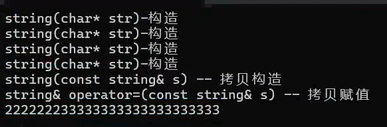
二代优化
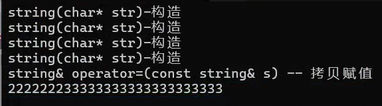
C++11:移动构造
无优化
一代优化
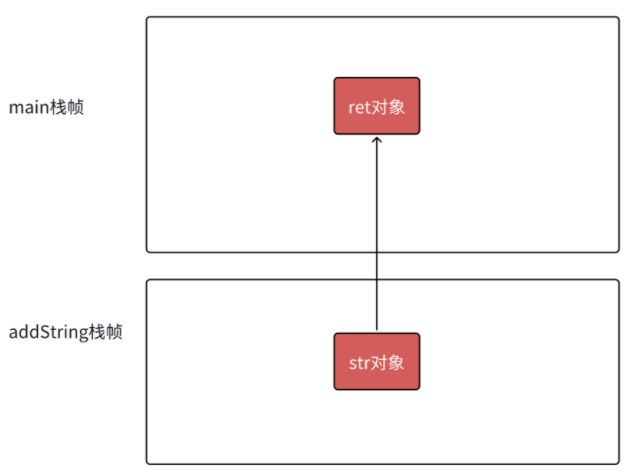
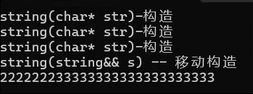
二代优化
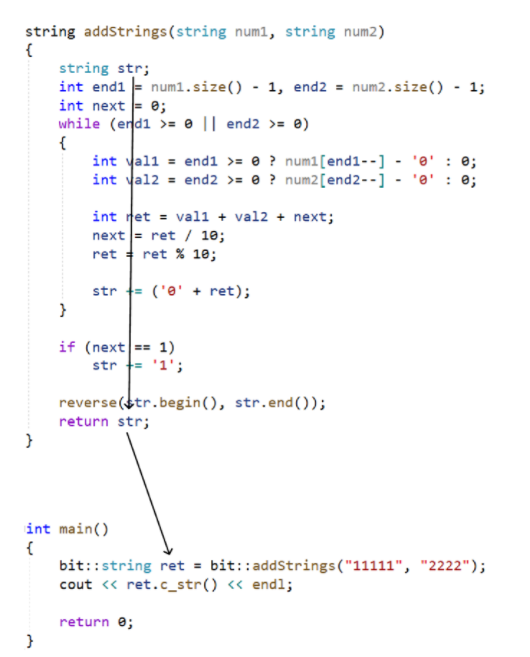
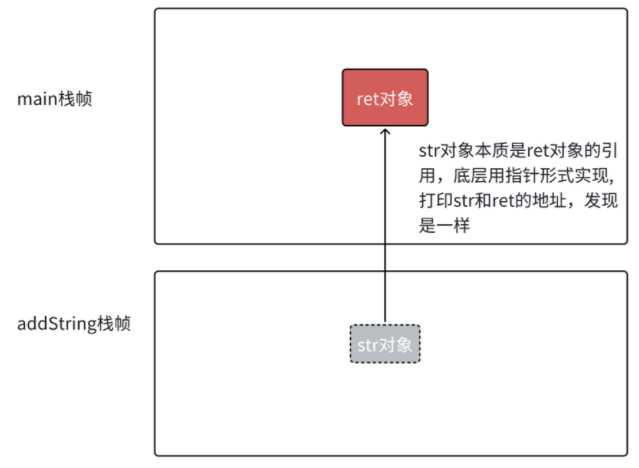
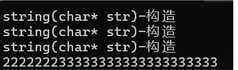
C++11:移动构造+移动赋值
无优化
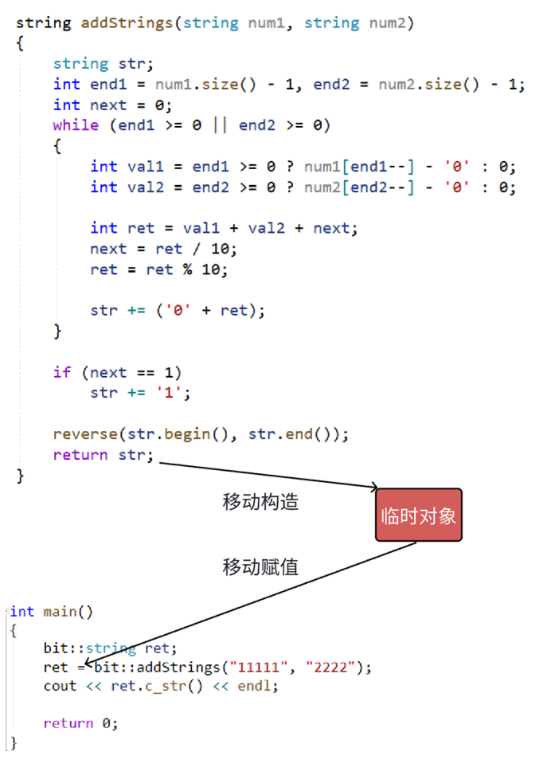
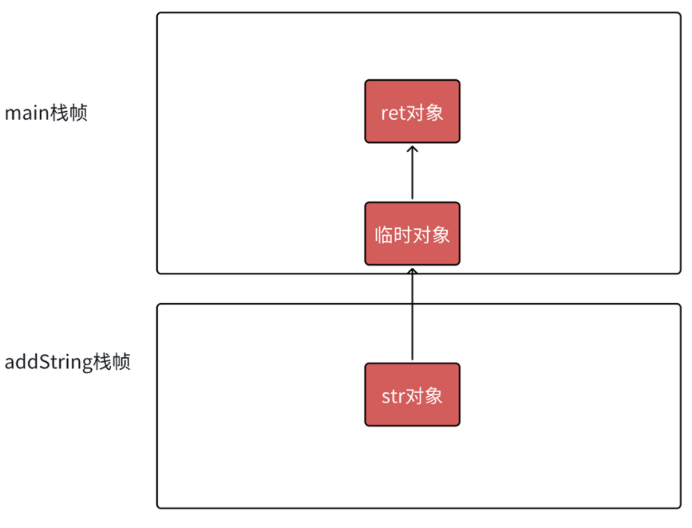
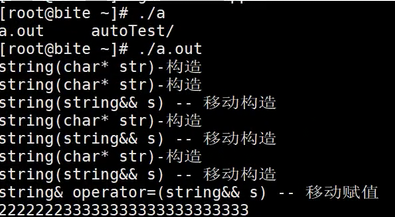
一代优化
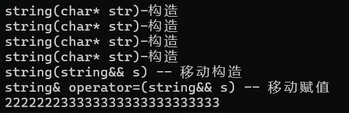
二代优化
4.8.移动构造和移动赋值的意义
深拷贝的自定义类型
如:vector、string
实现移动构造和移动赋值有很大价值
浅拷贝的自定义类型
如:Date、pair<int,int>
不需要实现移动构造和移动赋值
五、类型分类
C++11后,对类型进行进一步划分
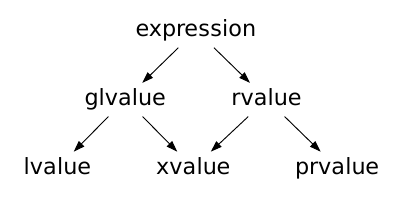
5.1.右值(rvalue)
纯右值(pure value)+ 将亡值(expiring value)
5.2.泛左值(generalized value)
左值(lvalue)+ 将亡值(expiring value)
5.3.纯右值(prvalue)
字面值常量、求值结果相当于字面值、不具名的临时对象
(比如:42、true、nullptr、str.substr(1,2)、str1 + str2传值返回函数调用、整型a、b、a+b、a++)
5.4.将亡值(xvalue)
返回右值引用的函数的调用表达式、转换为右值引用的转换函数的调用表达式
(比如:move(x)、static_cast<X&&>(x))
- 有名字的就是泛左值(glvalue)
- 有名字的、不能被move的是左值(lvalue)
- 有名字的、可以被move的是将亡值(xvalue)
- 无名字的、可以被move的是纯右值(prvalue)
六、引用折叠
6.1.引用折叠的规则
**C++11中无法定义引用的引用:**int& && r = i(直接报错)
使用模板或者typedef中的类型操作就可以构成引用的引用
cpp
int main()
{
	typedef int& lref;
	typedef int&& rref;

	int n = 0;
	lref& r1 = n;  //r1 的类型是 int&
	lref&& r2 = n; //r2 的类型是 int&
	rref& r3 = n;  //r3 的类型是 int&
	rref&& r4 = 1; //r4 的类型是 int&&

    return 0;
}- 左值引用 + 左值引用/右值引用 == 左值引用
- 右值引用 + 右值引用 == 右值引用
6.2.函数模板参数为左值引用
cpp
// 由于引用折叠限定,f1实例化以后总是一个左值引⽤
template<class T>
void f1(T& x)
{}

int main()
{
	//没有折叠->实例化为void f1(int& x)
	f1<int>(n);
	f1<int>(0);//报错

	//折叠->实例化为void f1(int& x)
	f1<int&>(n);
	f1<int&>(0);//报错

	//折叠->实例化为void f1(int& x)
	f1<int&&>(n);
	f1<int&&>(0);//报错

	//折叠->实例化为void f1(const int& x)
	f1<const int&>(n);
	f1<const int&>(0);

	//折叠->实例化为void f1(const int& x)
	f1<const int&&>(n);
	f1<const int&&>(0);

    return 0;
}
6.3.函数模板参数为右值引用
传递左值时,就是左值引用
传递右值时,就是右值引用
又称为万能引用
cpp
// 由于引用折叠限定,f2实例化后可以是左值引用,也可以是右值引用
template<class T>
void f2(T&& x)
{}

int main()
{
	//没有折叠->实例化为void f2(int&& x)
	f2<int>(n);//报错
	f2<int>(0);

	//折叠->实例化为void f2(int& x)
	f2<int&>(n);
	f2<int&>(0);//报错

	//折叠->实例化为void f2(int&& x)
	f2<int&&>(n);//报错
	f2<int&&>(0);

	return 0;
}
在Function(T&& t) 函数模板中
- 假设实参为int右值、模板参数T推导为int
- 假设实参为int左值、模板参数T推导为int&
结合引用折叠
- 实参是左值、实例化左值引用版本形参的Function
- 实参是右值、实例化右值引用版本形参的Function
cpp
template <class T>
void Function(T && t)
{
	int a = 0;
	T x = a;
	//x++;
	cout << &a << endl;
	cout << &x << endl << endl;
}

int main()
{
	//10是右值 -> 推导出T为int -> 模板实例化为void Function(int&& t)
	Function(10);//右值

	int a;
	//a是左值 -> 推导出T为int& -> 引用折叠 -> 模板实例化为void Function(int& t)
	Function(a);//左值

	//std::move(a)是右值 -> 推导出T为int -> 模板实例化为void Function(int&& t)
	Function(std::move(a));//右值

	const int b = 8;
	//a是左值 -> 推导出T为const int& -> 引用折叠 -> 模板实例化为void Function(const int&t)
	//所以Function内部会编译报错,x不能++
	Function(b);//const左值

	//std::move(b)右值 -> 推导出T为const int -> 模板实例化为void Function(const int&&t)
	//所以Function内部会编译报错,x不能++
	Function(std::move(b));//const右值
	return 0;
}
6.4.完美转发
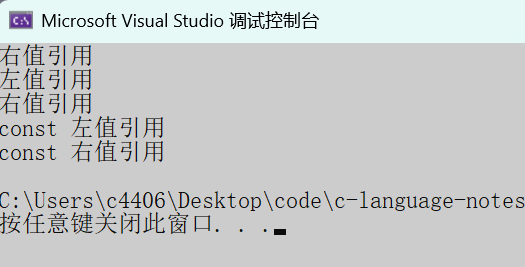
**完美转发:**一个类模板,保证值类别与类型相一致
cpp
template <class _Ty>
_Ty&& forward(remove_reference_t<_Ty>& _Arg) noexcept
{
	return static_cast<_Ty&&>(_Arg);
}
右值引用类型的变量,属性(值类别)为左值
当再去使用形参t作为实参去调用函数时,使用的是左值引用
所以决定调用哪个函数的并非实参的类型而是实参的值类别
cpp
void Fun(int& x)
{
	cout << "左值引用" << endl;
}

void Fun(const int& x)
{
	cout << "const 左值引用" << endl;
}

void Fun(int&& x)
{
    cout << "右值引用" << endl;
}

void Fun(const int&& x)
{
	cout << "const 右值引用" << endl;
}

template<class T>
void Function(T&& t)
{
	Fun(t);
}

int main()
{
	//10是右值 -> 推导出T为int -> 模板实例化为void Function(int&& t)
	Function(10);//右值

	int a;
	// a是左值 -> 推导出T为int& -> 引用折叠 -> 模板实例化为void Function(int& t)
	Function(a);//左值
	// std::move(a)是右值 -> 推导出T为int -> 模板实例化为void Function(int&& t)
	Function(std::move(a));//右值

	const int b = 8;
	// a是左值 -> 推导出T为const int& -> 引用折叠 -> 模板实例化为void Function(const int&t)
	Function(b); // const 左值
	// std::move(b)右值 -> 推导出T为const int -> 模板实例化为void Function(const int&&t)
	Function(std::move(b));//const 右值

	return 0;
}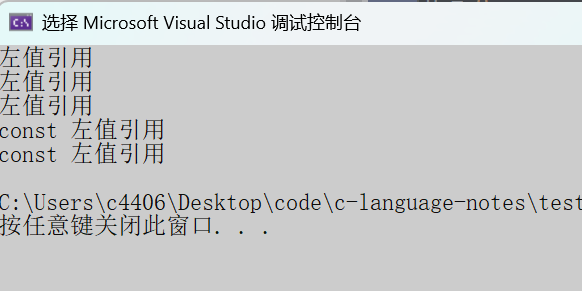
**注:**该段程序全为左值引用或者const 左值引用,使用完美转发就可以避免这种情况
cpp
void Fun(int& x)
{
	cout << "左值引用" << endl;
}

void Fun(const int& x)
{
	cout << "const 左值引用" << endl;
}

void Fun(int&& x)
{ cout << "右值引用" << endl;
}

void Fun(const int&& x)
{
	cout << "const 右值引用" << endl;
}

template<class T>
void Function(T&& t)
{
	Fun(forward<T>(t));
}

int main()
{
	//10是右值 -> 推导出T为int -> 模板实例化为void Function(int&& t)
	Function(10);//右值

	int a;
	// a是左值 -> 推导出T为int& -> 引用折叠 -> 模板实例化为void Function(int& t)
	Function(a);//左值
	// std::move(a)是右值 -> 推导出T为int -> 模板实例化为void Function(int&& t)
	Function(std::move(a));//右值

	const int b = 8;
	// a是左值 -> 推导出T为const int& -> 引用折叠 -> 模板实例化为void Function(const int&t)
	Function(b); // const 左值
	// std::move(b)右值 -> 推导出T为const int -> 模板实例化为void Function(const int&&t)
	Function(std::move(b));//const 右值

	return 0;
}
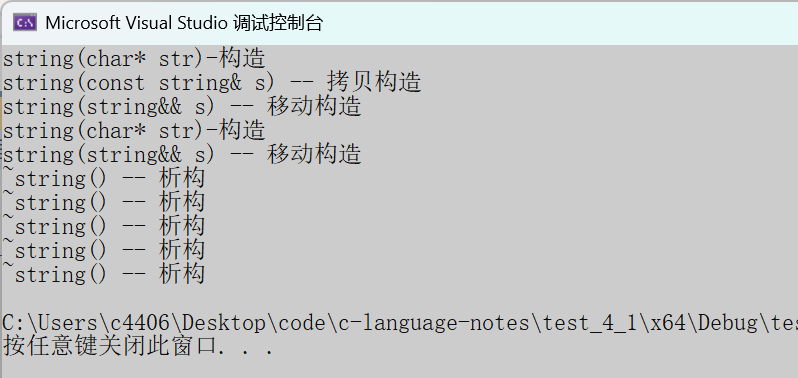
push_back右值引用的使用场景
cpp
#define _CRT_SECURE_NO_WARNINGS 1
#include <iostream>
using namespace std;
#include <assert.h>
#include <string.h>
#include <list>
#include <algorithm>

namespace bit
{
	class string
	{
	public:
		typedef char* iterator;
		typedef const char* const_iterator;

		iterator begin()
		{
			return _str;
		}

		iterator end()
		{
			return _str + _size;
		}

		const_iterator begin() const
		{
			return _str;
		}

		const_iterator end() const
		{
			return _str + _size;
		}

		string(const char* str = "")
			:_size(strlen(str))
			, _capacity(_size)
		{
			cout << "string(char* str)-构造" << endl;
			_str = new char[_capacity + 1];
			strcpy(_str, str);
		}

		void swap(string& s)
		{
			::swap(_str, s._str);
			::swap(_size, s._size);
			::swap(_capacity, s._capacity);
		}

		//拷贝构造(左值)
		string(const string& s)
			:_str(nullptr)
		{
			cout << "string(const string& s) -- 拷贝构造" << endl;
			reserve(s._capacity);
			for (auto ch : s)
			{
				push_back(ch);
			}
		}

		//移动构造(右值)
		string(string&& s)
		{
			cout << "string(string&& s) -- 移动构造" << endl;
			//交换:掠夺资源(右值引用的属性为左值)
			swap(s);
		}

		string& operator=(const string& s)
		{
			cout << "string& operator=(const string& s) -- 拷贝赋值" << endl;
			if (this != &s)
			{
				_str[0] = '\0';
				_size = 0;
				reserve(s._capacity);
				for (auto ch : s)
				{
					push_back(ch);
				}
			}

			return *this;
		}

		//移动赋值
		string& operator=(string&& s)
		{
			cout << "string& operator=(string&& s) -- 移动赋值" << endl;
			swap(s);
			return *this;
		}

		~string()
		{
			cout << "~string() -- 析构" << endl;
			delete[] _str;
			_str = nullptr;
		}

		char& operator[](size_t pos)
		{
			assert(pos < _size);
			return _str[pos];
		}

		void reserve(size_t n)
		{
			if (n > _capacity)
			{
				char* tmp = new char[n + 1];
				if (_str)
				{
					strcpy(tmp, _str);
					delete[] _str;
				}
				_str = tmp;
				_capacity = n;
			}
		}

		void push_back(char ch)
		{
			if (_size >= _capacity)
			{
				size_t newcapacity = _capacity == 0 ? 4 : _capacity * 2;
				reserve(newcapacity);
			}
			_str[_size] = ch;
			++_size;
			_str[_size] = '\0';
		}

		string& operator+=(char ch)
		{
			push_back(ch);
			return *this;
		}

		const char* c_str() const
		{
			return _str;
		}

		size_t size() const
		{
			return _size;
		}
	private:
		char* _str = nullptr;
		size_t _size = 0;
		size_t _capacity = 0;
	};
}

int main()
{
	bit::string s1("1111111");//构造
	list<bit::string> lt;
	lt.push_back(s1);//拷贝构造
	lt.push_back(move(s1));//移动构造
    lt.push_back("2222222");//构造+移动构造
	return 0;
}
万能引用+完美转发的使用场景
list.h
cpp
#pragma once
namespace bit
{
	template < class T>
	struct ListNode
	{
		ListNode<T>*_next;
		ListNode<T>*_prev;
		T _data;

		ListNode() = default;
		template<class X>
		ListNode(X&& data = T())
			:_next(nullptr)
			,_prev(nullptr)
			,_data(forward<X>(data))
		{}
	};

	template <class T, class Ref, class Ptr>
	struct ListIterator
	{
		typedef ListNode<T> Node;
		typedef ListIterator<T, Ref, Ptr> Self;
		Node * _node;

		ListIterator(Node * node)
			:_node(node)
		{}

		Self & operator++()
		{
			_node = _node->_next;
			return *this;
		}

		Ref operator*()
		{
			return _node->_data;
		}

		bool operator!=(const Self& it)
		{
			return _node != it._node;
		}
	};

	template < class T>
	class list
	{
		typedef ListNode<T> Node;
	public:
		typedef ListIterator<T, T&, T*> iterator;
		typedef ListIterator<T, const T&, const T*> const_iterator;

		iterator begin()
		{
			return iterator(_head->_next);
		}

		iterator end()
		{
			return iterator(_head);
		}

		void empty_init()
		{
			_head = new Node();
			_head->_next = _head;
			_head->_prev = _head;
		}

		list()
		{
			empty_init();
		}

		template<class X>
		void push_back(X&& x)
		{
			insert(end(), forward<X>(x));
		}

		template<class X>
		iterator insert(iterator pos, X&& x)
		{
			Node * cur = pos._node;
			Node * newnode = new Node(forward<X>(x));
			Node * prev = cur->_prev;

			prev->_next = newnode;
			newnode->_prev = prev;
			newnode->_next = cur;
			cur->_prev = newnode;

			return iterator(newnode);
		}
	private:
		Node * _head;
	};
}
test.c
cpp
#define _CRT_SECURE_NO_WARNINGS 1
#include <iostream>
using namespace std;
#include <assert.h>
#include <string.h>
#include <list>
#include <algorithm>
#include "List.h"

namespace bit
{
	class string
	{
	public:
		typedef char* iterator;
		typedef const char* const_iterator;

		iterator begin()
		{
			return _str;
		}

		iterator end()
		{
			return _str + _size;
		}

		const_iterator begin() const
		{
			return _str;
		}

		const_iterator end() const
		{
			return _str + _size;
		}

		string(const char* str = "")
			:_size(strlen(str))
			, _capacity(_size)
		{
			cout << "string(char* str)-构造" << endl;
			_str = new char[_capacity + 1];
			strcpy(_str, str);
		}

		void swap(string& s)
		{
			::swap(_str, s._str);
			::swap(_size, s._size);
			::swap(_capacity, s._capacity);
		}

		//拷贝构造(左值)
		string(const string& s)
			:_str(nullptr)
		{
			cout << "string(const string& s) -- 拷贝构造" << endl;
			reserve(s._capacity);
			for (auto ch : s)
			{
				push_back(ch);
			}
		}

		//移动构造(右值)
		string(string&& s)
		{
			cout << "string(string&& s) -- 移动构造" << endl;
			//交换:掠夺资源(右值引用的属性为左值)
			swap(s);
		}

		string& operator=(const string& s)
		{
			cout << "string& operator=(const string& s) -- 拷贝赋值" << endl;
			if (this != &s)
			{
				_str[0] = '\0';
				_size = 0;
				reserve(s._capacity);
				for (auto ch : s)
				{
					push_back(ch);
				}
			}

			return *this;
		}

		//移动赋值
		string& operator=(string&& s)
		{
			cout << "string& operator=(string&& s) -- 移动赋值" << endl;
			swap(s);
			return *this;
		}

		~string()
		{
			cout << "~string() -- 析构" << endl;
			delete[] _str;
			_str = nullptr;
		}

		char& operator[](size_t pos)
		{
			assert(pos < _size);
			return _str[pos];
		}

		void reserve(size_t n)
		{
			if (n > _capacity)
			{
				char* tmp = new char[n + 1];
				if (_str)
				{
					strcpy(tmp, _str);
					delete[] _str;
				}
				_str = tmp;
				_capacity = n;
			}
		}

		void push_back(char ch)
		{
			if (_size >= _capacity)
			{
				size_t newcapacity = _capacity == 0 ? 4 : _capacity * 2;
				reserve(newcapacity);
			}
			_str[_size] = ch;
			++_size;
			_str[_size] = '\0';
		}

		string& operator+=(char ch)
		{
			push_back(ch);
			return *this;
		}

		const char* c_str() const
		{
			return _str;
		}

		size_t size() const
		{
			return _size;
		}
	private:
		char* _str = nullptr;
		size_t _size = 0;
		size_t _capacity = 0;
	};
}

int main()
{
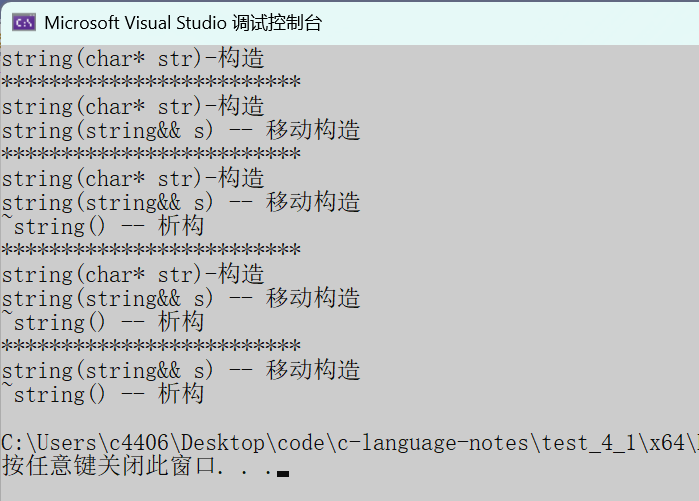
	bit::list<bit::string> lt;
	cout << "*************************" << endl;

	bit::string s1("111111111111111111111");
	lt.push_back(s1);
	cout << "*************************" << endl;

	lt.push_back(bit::string("22222222222222222222222222222"));
	cout << "*************************" << endl;

	lt.push_back("3333333333333333333333333333");
	cout << "*************************" << endl;

	lt.push_back(move(s1));

	return 0;
}
七、可变模板参数
7.1.基本语法及原理
C++11支持可变数量参数的函数模板和类模板
参数类型可变,参数个数可变
可变数目的参数被称为参数包
**模板参数包:**零个或者多个模板参数
**函数参数包:**零个或者多个函数参数
cpp
template<class ...Args> void Func(Args... args) {}//传值
template<class ...Args> void Func(Args&... args) {}//左值引用
template<class ...Args> void Func(Args&&... args) {}//万能引用
**省略号:**指出模板参数或者函数参数的标识一个包
在模板参数列表中
class ...或者typename ...,指出接下来的参数表示零个或者多个类型列表
在函数参数列表中
类型名... ,指出接下表示零个或者多个形参对象列表
(注:函数参数包可以用左值引用或万能引用表示)
**原理:**与模板类似,去实例化对应类型和多个参数
**sizeof...():**计算计算参数包中参数的个数
cpp
#define _CRT_SECURE_NO_WARNINGS 1
#include <iostream>
using namespace std;
#include <string>

//0 ~ N个参数
template <class ...Args>
void Print(Args&&... args)
{
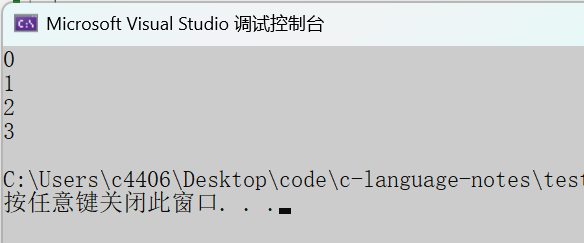
	cout << sizeof...(args) << endl;
}

int main()
{
	double x = 2.2;
	Print();//包里有0个参数
	Print(1);//包里有1个参数
	Print(1, string("xxxxx")); // 包里有2个参数
	Print(1.1, string("xxxxx"), x); // 包里有3个参数
	return 0;
}
没有可变模板参数的情况
cpp
// 原理1:编译本质这里会结合引⽤折叠规则实例化出以下四个函数
void Print();
void Print(int&& arg1);
void Print(int&& arg1, string&& arg2);
void Print(double&& arg1, string&& arg2, double& arg3);

// 原理2:更本质去看没有可变参数模板,我们实现出这样的多个函数模板才能支持
void Print();
template <class T1>
void Print(T1&& arg1);
template <class T1, class T2>
void Print(T1&& arg1, T2&& arg2);
template <class T1, class T2, class T3>
void Print(T1&& arg1, T2&& arg2, T3&& arg3);
// ...

//可变参数模板是类型泛化基础上叠加数量变化,让泛型编程更灵活
总结:
- **模板:**一个函数模板实例化出多个不同类型参数的函数
- **可变参数模板:**一个可变参数函数模板实例化出多个不同参数个数的模板
7.2.包扩展
解析出参数包的内容,只有在编译时才能扩展
cpp
template <class ...Args>
void Print(Args... args)
{
	//可变参数模板编译时解析
	//下面是运行获取和解析,所以不支持使用
	cout << sizeof...(args) << endl;
	for (size_t i = 0; i < sizeof...(args); i++)
	{
		cout << args[i] << " ";
	}
}
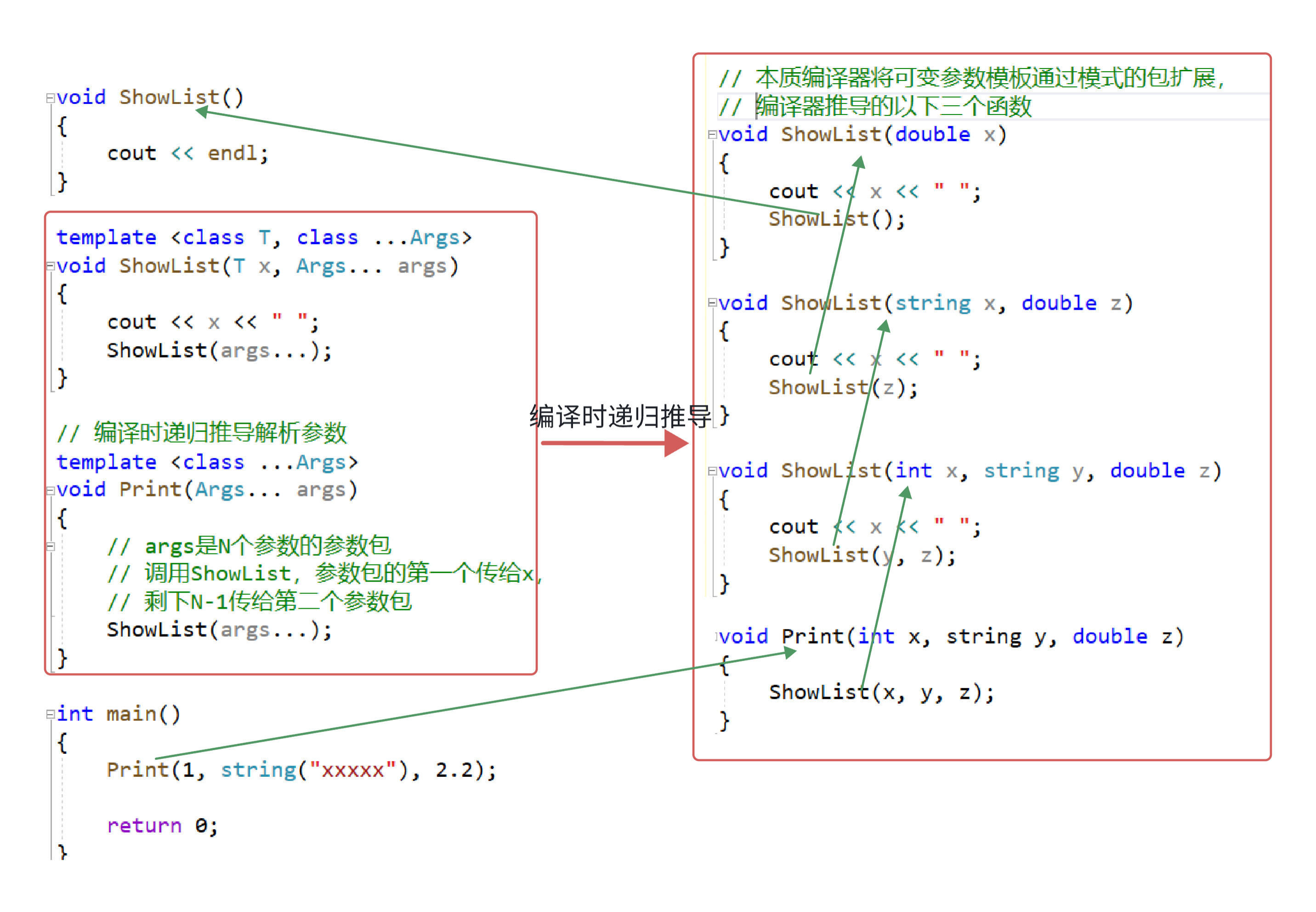
**扩展方法1:**编译时递归
cpp
#define _CRT_SECURE_NO_WARNINGS 1
#include <iostream>
using namespace std;

void ShowList()
{
	cout << endl;
}

template<class T, class ...Args>
void ShowList(T&& x, Args&&... args)
{
	cout << x << " ";
	ShowList(args...);
}

template <class ...Args>
void Print(Args&&... args)
{
	ShowList(args...);
}

int main()
{
	double x = 2.2;
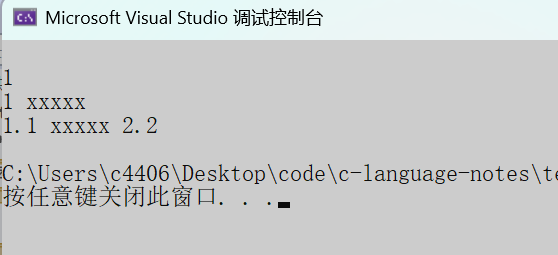
	Print();//包里有0个参数
	Print(1);//包里有1个参数
	Print(1, string("xxxxx")); // 包里有2个参数
	Print(1.1, string("xxxxx"), x); // 包里有3个参数
	return 0;
}
**扩展方法2:**函数传参
cpp
#define _CRT_SECURE_NO_WARNINGS 1
#include <iostream>
using namespace std;

template <class T>
const T & GetArg(const T & x)
{
	cout << x << " ";
	return x;
}

template <class ...Args>
void Arguments(Args... args)
{}

template <class ...Args>
void Print(Args... args)
{
	//GetArg必须返回获得到的对象
	//才能组成参数包给Arguments
	Arguments(GetArg(args)...);
}

//本质可以理解为编译器编译时包的扩展模式
//将上面的函数模板扩展实例化为下面的函数
//void Print(int x, string y, double z)
//{
// Arguments(GetArg(x), GetArg(y), GetArg(z));
//}

int main()
{
	Print(1, string("xxxxx"), 2.2);
	return 0;
}
7.3.emplace接口
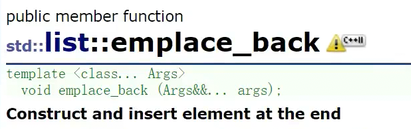
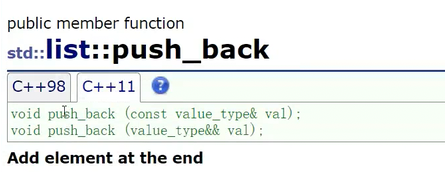
cpp
#define _CRT_SECURE_NO_WARNINGS 1
#include <iostream>
using namespace std;
#include "assert.h"
#include <list>

namespace bit
{
	class string
	{
	public:
		typedef char* iterator;
		typedef const char* const_iterator;

		iterator begin()
		{
			return _str;
		}

		iterator end()
		{
			return _str + _size;
		}

		const_iterator begin() const
		{
			return _str;
		}

		const_iterator end() const
		{
			return _str + _size;
		}

		string(const char* str = "")
			:_size(strlen(str))
			, _capacity(_size)
		{
			cout << "string(char* str)-构造" << endl;
			_str = new char[_capacity + 1];
			strcpy(_str, str);
		}

		void swap(string& s)
		{
			::swap(_str, s._str);
			::swap(_size, s._size);
			::swap(_capacity, s._capacity);
		}

		//拷贝构造(左值)
		string(const string& s)
			:_str(nullptr)
		{
			cout << "string(const string& s) -- 拷贝构造" << endl;
			reserve(s._capacity);
			for (auto ch : s)
			{
				push_back(ch);
			}
		}

		//移动构造(右值)
		string(string&& s)
		{
			cout << "string(string&& s) -- 移动构造" << endl;
			//交换:掠夺资源(右值引用的属性为左值)
			swap(s);
		}

		string& operator=(const string& s)
		{
			cout << "string& operator=(const string& s) -- 拷贝赋值" << endl;
			if (this != &s)
			{
				_str[0] = '\0';
				_size = 0;
				reserve(s._capacity);
				for (auto ch : s)
				{
					push_back(ch);
				}
			}

			return *this;
		}

		//移动赋值
		string& operator=(string&& s)
		{
			cout << "string& operator=(string&& s) -- 移动赋值" << endl;
			swap(s);
			return *this;
		}

		~string()
		{
			cout << "~string() -- 析构" << endl;
			delete[] _str;
			_str = nullptr;
		}

		char& operator[](size_t pos)
		{
			assert(pos < _size);
			return _str[pos];
		}

		void reserve(size_t n)
		{
			if (n > _capacity)
			{
				char* tmp = new char[n + 1];
				if (_str)
				{
					strcpy(tmp, _str);
					delete[] _str;
				}
				_str = tmp;
				_capacity = n;
			}
		}

		void push_back(char ch)
		{
			if (_size >= _capacity)
			{
				size_t newcapacity = _capacity == 0 ? 4 : _capacity * 2;
				reserve(newcapacity);
			}
			_str[_size] = ch;
			++_size;
			_str[_size] = '\0';
		}

		string& operator+=(char ch)
		{
			push_back(ch);
			return *this;
		}

		const char* c_str() const
		{
			return _str;
		}

		size_t size() const
		{
			return _size;
		}
	private:
		char* _str = nullptr;
		size_t _size = 0;
		size_t _capacity = 0;
	};
}

//emplace_back总体而言是更高效
//推荐使用emplace系列替代insert和push系列
int main()
{
	list<bit::string> lt;
	bit::string s1("111111111111");
	bit::string s2("111111111111");

	//传左值,跟push_back一样,拷贝构造
	lt.emplace_back(s1);
	cout << "*********************************" << endl;
	lt.push_back(s2);
	cout << "*********************************" << endl;

	//右值,跟push_back一样,移动构造
	lt.emplace_back(move(s1));
	cout << "*********************************" << endl;
	lt.push_back(move(s2));
	cout << "*********************************" << endl;

	//直接把构造string参数包往下传
	//直接用string参数包构造string
	//这里的效果是push_back做不到的
	lt.emplace_back("111111111111");
	cout << "*********************************" << endl;
	lt.push_back("111111111111");//直接传参,隐式类型转换
	cout << "*********************************" << endl;

	list<pair<bit::string, int>> lt1;
	//跟push_back一样
	//构造pair + 拷贝/移动构造pair到list的节点中data上
	pair<bit::string, int> kv("苹果", 1);
	lt1.emplace_back(kv);
	cout << "*********************************" << endl;
	lt1.push_back(kv);
	cout << "*********************************" << endl;

	//跟push_back一样
	lt1.emplace_back(move(kv));
	cout << "*********************************" << endl;
	lt1.push_back(move(kv));
	cout << "*********************************" << endl;

	//直接把构造pair参数包往下传
	//直接用pair参数包构造pair
	//这里的效果是push_back做不到的
	lt1.emplace_back("苹果", 1);//传参数包,直接构造
	cout << "*********************************" << endl;
	lt1.push_back({ "苹果", 1 });//隐式类型转换,构造临时对象+移动构造
	cout << "*********************************" << endl;
	return 0;
}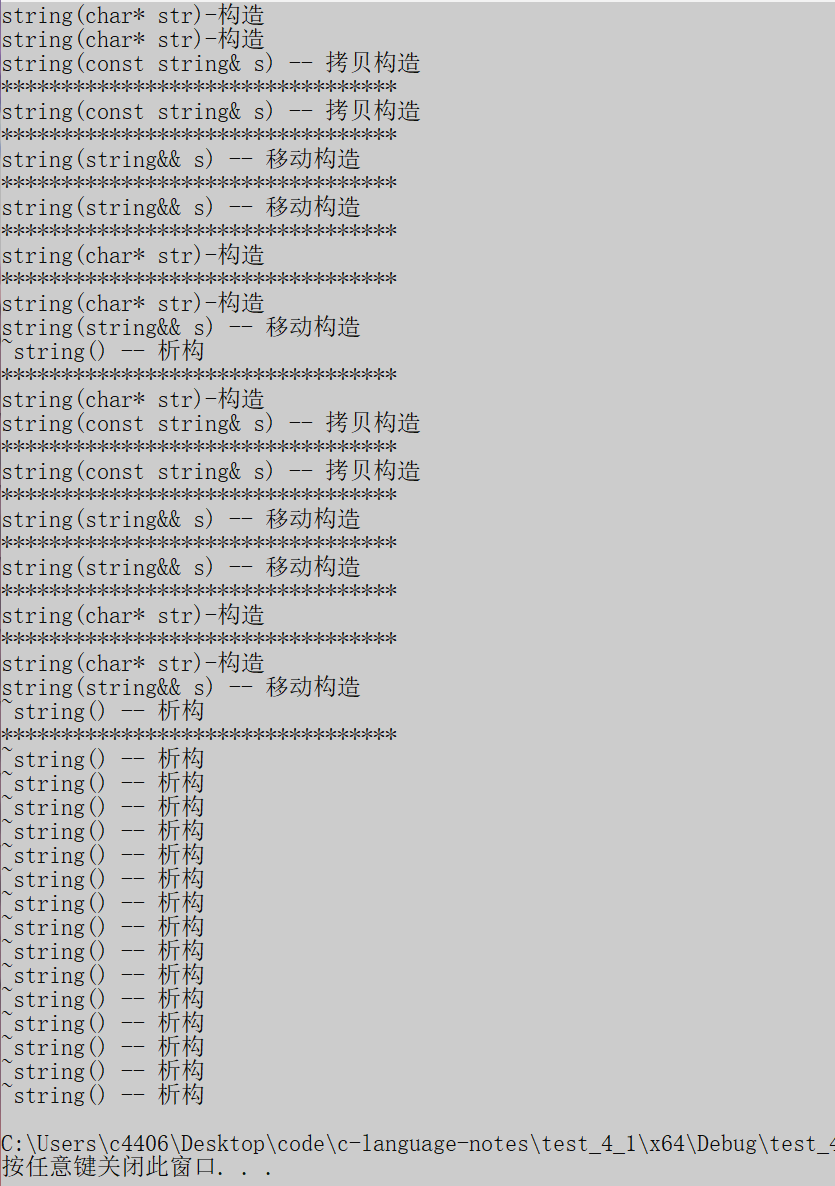
总结:
emplace系列兼任push系列和insert系列的功能
部分场景下emplace 可以直接构造
push、insert 是构造+移动构造/拷贝构造
cpp
template < class... Args>
void emplace_back(Args&&... args)
{
	insert(end(), std::forward<Args>(args)...);
}

// 原理:本质编译器根据可变参数模板⽣成对应参数的函数
/*void emplace_back(string& s)
{
	insert(end(), std::forward<string>(s));
}

void emplace_back(string&& s)
{
	insert(end(), std::forward<string>(s));
}

void emplace_back(const char* s)
{
	insert(end(), std::forward<const char*>(s));
}
*/
八、新的类功能
8.1.默认的移动构造与移动赋值
C++11之前的类中,有6个默认成员函数
构造函数、析构函数、拷贝构造、赋值重载、取地址重载、const取地址重载
不写时,编译器会生成一个默认的函数
C++11之后的类中,新增了两个默认成员函数
移动构造函数、移动赋值运算符重载
如果没有实现析构函数、拷贝构造、赋值重载、移动构造中的任意一个
编译器就会自动生成一个默认移动构造函数
内置类型成员:执行逐成员按字节拷贝
自定义类型成员:如果实现移动构造、就调用移动构造,如果没有、就调用拷贝构造
(注:默认移动赋值与移动构造完全类似)
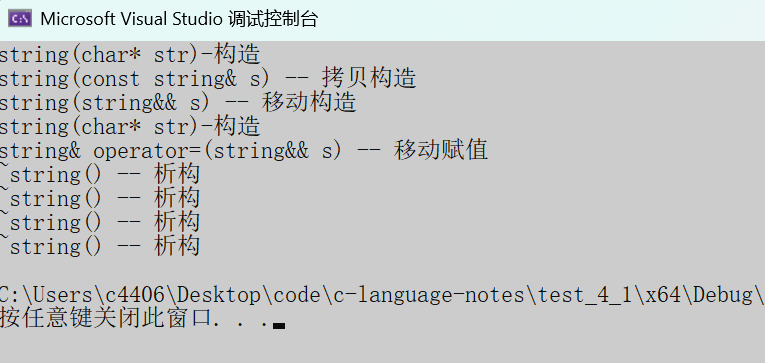
如果提供了移动构造或者移动赋值,编译器不会自动提供拷贝构造和拷贝赋值
cpp
#define _CRT_SECURE_NO_WARNINGS 1
#include <iostream>
using namespace std;
#include "assert.h"

namespace bit
{
	class string
	{
	public:
		typedef char* iterator;
		typedef const char* const_iterator;

		iterator begin()
		{
			return _str;
		}

		iterator end()
		{
			return _str + _size;
		}

		const_iterator begin() const
		{
			return _str;
		}

		const_iterator end() const
		{
			return _str + _size;
		}

		string(const char* str = "")
			:_size(strlen(str))
			, _capacity(_size)
		{
			cout << "string(char* str)-构造" << endl;
			_str = new char[_capacity + 1];
			strcpy(_str, str);
		}

		void swap(string& s)
		{
			::swap(_str, s._str);
			::swap(_size, s._size);
			::swap(_capacity, s._capacity);
		}

		//拷贝构造(左值)
		string(const string& s)
		{
			cout << "string(const string& s) -- 拷贝构造" << endl;
			reserve(s._capacity);
			for (auto ch : s)
			{
				push_back(ch);
			}
		}

		//移动构造(右值)
		string(string&& s)
		{
			cout << "string(string&& s) -- 移动构造" << endl;
			//交换:掠夺资源(右值引用的属性为左值)
			swap(s);
		}

		string& operator=(const string& s)
		{
			cout << "string& operator=(const string& s) -- 拷贝赋值" << endl;
			if (this != &s)
			{
				_str[0] = '\0';
				_size = 0;
				reserve(s._capacity);
				for (auto ch : s)
				{
					push_back(ch);
				}
			}

			return *this;
		}

		//移动赋值
		string& operator=(string&& s)
		{
			cout << "string& operator=(string&& s) -- 移动赋值" << endl;
			swap(s);
			return *this;
		}

		~string()
		{
			cout << "~string() -- 析构" << endl;
			delete[] _str;
			_str = nullptr;
		}

		char& operator[](size_t pos)
		{
			assert(pos < _size);
			return _str[pos];
		}

		void reserve(size_t n)
		{
			if (n > _capacity)
			{
				char* tmp = new char[n + 1];
				if (_str)
				{
					strcpy(tmp, _str);
					delete[] _str;
				}
				_str = tmp;
				_capacity = n;
			}
		}

		void push_back(char ch)
		{
			if (_size >= _capacity)
			{
				size_t newcapacity = _capacity == 0 ? 4 : _capacity * 2;
				reserve(newcapacity);
			}
			_str[_size] = ch;
			++_size;
			_str[_size] = '\0';
		}

		string& operator+=(char ch)
		{
			push_back(ch);
			return *this;
		}

		const char* c_str() const
		{
			return _str;
		}

		size_t size() const
		{
			return _size;
		}
	private:
		char* _str = new char('/0');
		size_t _size = 0;
		size_t _capacity = 0;
	};
}

class Person
{
public:
	Person(const char* name = "", int age = 0)
		:_name(name)
		, _age(age)
	{}

	/*Person(const Person& p)
	:_name(p._name)
	,_age(p._age)
	{}

	Person& operator=(const Person& p)
	{
		if(this != &p)
		{
		_name = p._name;
		_age = p._age;
		}
		return *this;
	}

	~Person()
	{}*/

private:
	bit::string _name;
	int _age;
};

int main()
{
	Person s1;
	Person s2 = s1;
	Person s3 = std::move(s1);
	Person s4;
	s4 = std::move(s2);
	return 0;
}
8.2.声明时给缺省值
成员变量声明是给缺省值是给初始化列表使用的
如果没有显示在初始化列表初始化
就会在初始化列表时用这个缺省值
8.3.default和delete
**default关键字:**控制要使用的默认函数
提供拷贝构造后就不会生成移动构造,使用default关键字显示指定移动构造生成
**delete关键字:**限制某些默认函数的生成
在函数声明加=delete,指示编译器不生成对应函数的默认版本
cpp
class Person
{
public:
	Person(const char* name = "", int age = 0)
		:_name(name)
		, _age(age)
	{}

	Person(const Person& p)
		:_name(p._name)
		, _age(p._age)
	{}

	Person(Person&& p) = default;

	//Person(const Person& p) = delete;

private:
	bit::string _name;
	int _age;
};
int main()
{
	Person s1;
	Person s2 = s1;
	Person s3 = std::move(s1);
	return 0;
}
8.4.final与override
**final关键字:**修饰类,让该类无法被继承;修饰虚函数,让该虚函数无法重写
**override关键字:**放在派生类中重写的虚函数后面,虚函数重写时报错
九、STL中的变化
9.1.新的容器
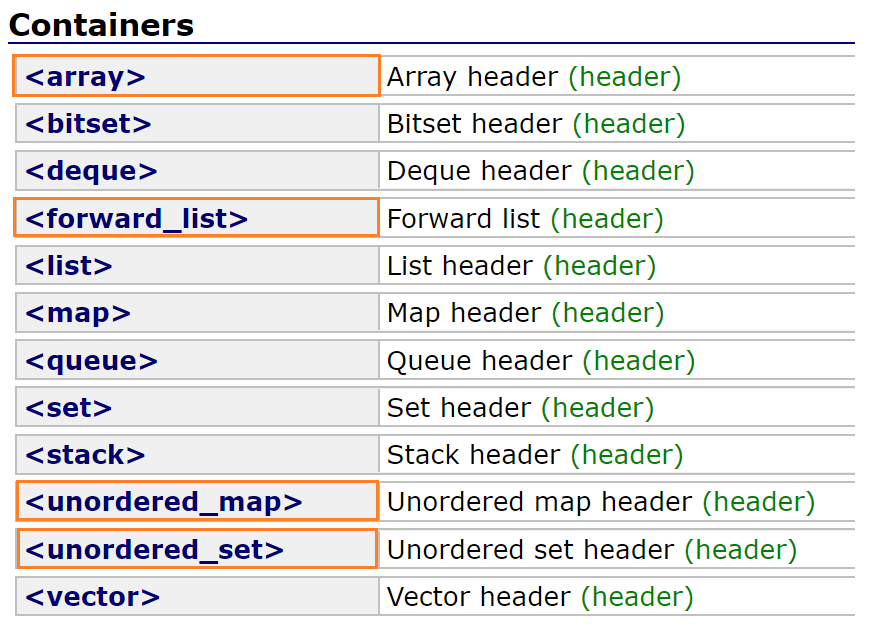
9.2.新的接口
右值引用、移动语义相关的push/insert/emplace系列的接口
移动构造、移动赋值
initializer_list版本的构造
容器的范围for遍历
十、lambda
10.1.lambda表达式语法
本质: 匿名函数对象
**特点:**可以定义在函数内部
在语法使用层中没有类型,一般用auto或者模板参数定义的对象去接收lambda对象
格式:capture-list (parameters) -> return type {function body}
**capture-list:**捕捉列表
**(parameters):**参数列表
如果不需要传参,可以同()一起省略
**-> return type:**返回值类型
在返回值类型明确的情况下,可以省略,由编译器对返回类型进行推导
**{function body}:**函数体
函数体为空不能省略
示例1:
cpp
#define _CRT_SECURE_NO_WARNINGS 1
#include <iostream>
using namespace std;

int main()
{
	//一个简单的lambda表达式
	//[]:捕捉列表
	//(int x, int y):参数列表
	//->int:返回类型
	//{return x + y; }:函数体
	auto add1 = [](int x, int y)->int {return x + y; };
	cout << add1(1, 2) << endl;

	return 0;
}
示例2:
cpp
#define _CRT_SECURE_NO_WARNINGS 1
#include <iostream>
using namespace std;

int main()
{
	//捕捉为空也不能省略
	//参数为空可以省略
	//返回值可以省略,可以通过返回对象自动推导
	//函数题不能省略
	auto func1 = [] {cout << "hello bit" << endl; return 0; };

	func1();

	return 0;
}
示例3:
cpp
#define _CRT_SECURE_NO_WARNINGS 1
#include <iostream>
using namespace std;

int main()
{
	int a = 0, b = 1;
	auto swap1 = [](int& x, int& y)
	{
		int tmp = x;
		x = y;
		y = tmp;
	};

	swap1(a, b);
	cout << a << ":" << b << endl;

	return 0;
}
10.2.lambda的应用
仿函数
cpp
#define _CRT_SECURE_NO_WARNINGS 1
#include <iostream>
using namespace std;
#include <vector>
#include <algorithm>

struct Goods
{
	string _name;  //名字
	double _price; //价格
	int _evaluate; //评价
	// ...
	Goods(const char* str, double price, int evaluate)
		:_name(str)
		,_price(price)
		,_evaluate(evaluate)
	{}
};

struct ComparePriceLess
{
	bool operator()(const Goods& gl, const Goods& gr)
	{
		return gl._price < gr._price;
	}
};

struct ComparePriceGreater
{
	bool operator()(const Goods& gl, const Goods& gr)
	{
		return gl._price > gr._price;
	}
};

int main()
{
	vector<Goods> v = { { "苹果", 2.1, 5 }, { "香蕉", 3, 4 }, { "橙子", 2.2, 3}, { "菠萝", 1.5, 4 } };
	sort(v.begin(), v.end(), ComparePriceLess());
	sort(v.begin(), v.end(), ComparePriceGreater());
	return 0;
}
lambda
cpp
#define _CRT_SECURE_NO_WARNINGS 1
#include <iostream>
using namespace std;
#include <vector>
#include <algorithm>

struct Goods
{
	string _name;  //名字
	double _price; //价格
	int _evaluate; //评价
	// ...
	Goods(const char* str, double price, int evaluate)
		:_name(str)
		,_price(price)
		,_evaluate(evaluate)
	{}
};

int main()
{
	vector<Goods> v = { { "苹果", 2.1, 5 }, { "香蕉", 3, 4 }, { "橙子", 2.2, 3}, { "菠萝", 1.5, 4 } };
	//价格升序
	sort(v.begin(), v.end(), [](const Goods& g1, const Goods& g2) {
		return g1._price < g2._price;
		});
	//价格降序
	sort(v.begin(), v.end(), [](const Goods& g1, const Goods& g2) {
		return g1._price > g2._price;
		});
	//评价升序
	sort(v.begin(), v.end(), [](const Goods& g1, const Goods& g2) {
		return g1._evaluate < g2._evaluate;
		});
	//评价降序
	sort(v.begin(), v.end(), [](const Goods& g1, const Goods& g2) {
		return g1._evaluate > g2._evaluate;
		});
	return 0;
}
10.3.捕捉列表
lambda表达式默认只能用lambda函数体 和参数列表中的变量
如果想要使用外层作用域中的变量,就需要进行捕捉
显示传值捕捉和传引用捕捉
写法:x,y,\&z
cpp
#define _CRT_SECURE_NO_WARNINGS 1
#include <iostream>
using namespace std;

//全局域的变量可以直接使用
//不需要捕捉
int y = 0;

//全局域也可以写lambda表达式
auto func2 = []()
{
	y++;
};

int main()
{
	//只能用当前lambda所在局部域和全局域(向上查找)
	int a = 0, b = 1, c = 2, d = 3;
	auto func1 = [&a, &b](int x)
	{
		//值捕捉的变量无法修改
		a++;
		//引用捕捉的变量可以修改
		b++;
		int ret = a + b + x + y;
		return x;
	};
	cout << func1(1) << endl;
	func2();
	return 0;
}
隐式捕捉
- 在捕捉列表写一个=表示隐式值捕捉
- 在捕捉列表写一个&表示隐式引用捕捉
用到谁,捕捉谁
cpp
#define _CRT_SECURE_NO_WARNINGS 1
#include <iostream>
using namespace std;

int main()
{
	int a = 1, b = 2, c = 3,d = 4;

	auto func2 = [=]
	{
		int ret = a + b + c;
		return ret;
	};
	cout << func2() << endl;

	auto func3 = [&]
	{
		a++;
		c++;
		d++;
	};
	func3();
	cout << a << " " << b << " " << c << " " << d << endl;
	return 0;
}
混合捕捉
cpp
#define _CRT_SECURE_NO_WARNINGS 1
#include <iostream>
using namespace std;

int main()
{
	int a = 0, b = 1, c = 2, d = 3;
	auto func4 = [&, a, b]
	{
		//a++;
		//b++;
		c++;
		d++;
		return a + b + c + d;
	};
	func4();
	cout << a << " " << b << " " << c << " " << d << endl;

	auto func5 = [=, &a, &b]
	{
		a++;
		b++;
		//c++;
		//d++;
		return a + b + c + d;
	};
	func5();
	cout << a << " " << b << " " << c << " " << d << endl;
	return 0;
}在参数列表后加mutable可以消除传值调用时变量的const属性
让传值调用的变量可以在函数体内被修改但出函数后还是原值
cpp
#define _CRT_SECURE_NO_WARNINGS 1
#include <iostream>
using namespace std;

int main()
{
	int a = 1, b = 2, c = 3,d = 4;
	auto func7 = [=]()mutable
	{
		a++;
		b++;
		c++;
		d++;
		return a + b + c + d;
	};
	cout << func7() << endl;
	cout << a << " " << b << " " << c << " " << d << endl;
	return 0;
}
10.4.lambda原理
和范围for类似,编译后, 从汇编指令层的角度来看
- 范围for的底层是迭代器
- lambda的底层是仿函数对象
写了一个lambda表达式后,编译器会生成一个对应的仿函数类
lambda参数、返回类型、函数体,就是仿函数operator()的参数、返回类型、函数体
lambda的捕捉列表就是仿函数类的成员变量
cpp
#define _CRT_SECURE_NO_WARNINGS 1
#include <iostream>
using namespace std;

class Rate
{
public:
	Rate(double rate)
		: _rate(rate)
	{}

	//仿函数
	double operator()(double money, int year)
	{
		return money * _rate * year;
	}

private:
	double _rate;
};

int main()
{
	double rate = 0.49;

	// lambda
	auto r2 = [rate](double money, int year)
	{
		return money * rate * year;
	};

	// 函数对象
	Rate r1(rate);
	r1(10000, 2);
	r2(10000, 2);

	auto func1 = []
	{
		cout << "hello world" << endl;
	};

	func1();

	return 0;
}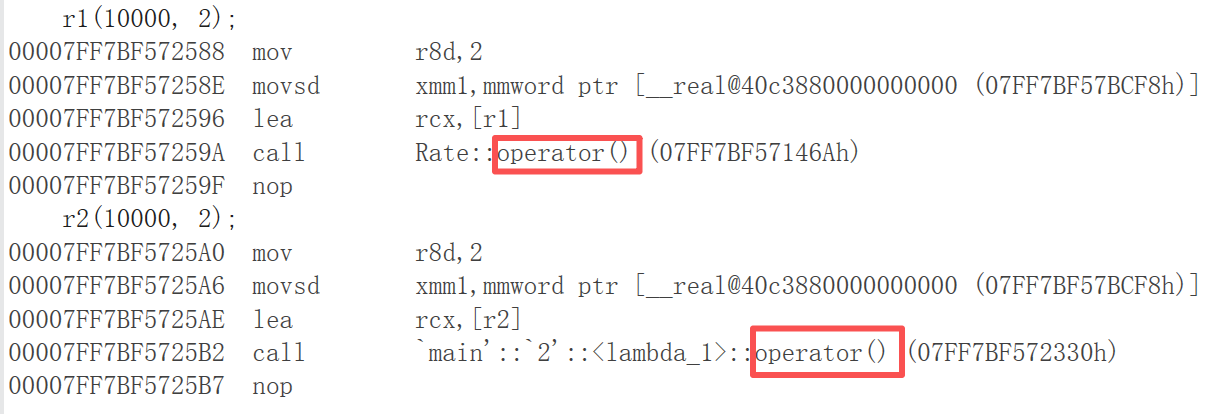
注:<lambda_1>这个类型名称的规则是编译器自己定制的,保证不同的lambda不冲突
十一、包装器
11.1.function
cpp
template <class T>
class function; // undefined

template <class Ret, class... Args>
class function<Ret(Args...)>;
**std::function:**是一个类模板、也是一个包装器
实例化的对象可以包装存储其他可调用对象
比如:函数指针、仿函数、lambda、bind表达式
cpp
#define _CRT_SECURE_NO_WARNINGS 1
#include <iostream>
using namespace std;
#include<functional>

int f(int a, int b)
{
	return a + b;
}

struct Functor
{
public:
	int operator() (int a, int b)
	{
		return a + b;
	}
};

class Plus
{
public:
	Plus(int n = 10)
		:_n(n)
	{
	}
	static int plusi(int a, int b)
	{
		return a + b;
	}
	double plusd(double a, double b)
	{
		return (a + b) * _n;
	}
private:
	int _n;
};

int main()
{
	//包装各种可调用对象
	function<int(int, int)> f1 = f;
	function<int(int, int)> f2 = Functor();
	function<int(int, int)> f3 = [](int a, int b) { return a + b; };

	cout << f1(1, 1) << endl;
	cout << f2(1, 1) << endl;
	cout << f3(1, 1) << endl;

    return 0;
}
试题:逆波兰表达式求解
题目内容:
给你一个字符串数组 tokens
表示一个根据逆波兰表示法表示的算术表达式
请你计算该表达式,返回一个表示表达式值的整数
示例:
输入:tokens = "2","1","+","3","\*"
输出:9
解释:该算式转化为常见的中缀算术表达式为:((2 + 1) * 3) = 9
注意:
有效的算符为 '+'、'-'、'*' 和 '/'
每个操作数(运算对象)都可以是一个整数或者另一个表达式
两个整数之间的除法总是向零截断
表达式中不含除零运算
输入是一个根据逆波兰表示法表示的算术表达式
答案及所有中间计算结果可以用32位整数表示
传统方式
cpp
class Solution
{
public:
    int evalRPN(vector<string>& tokens)
    {
        stack<int> st;
        for (auto& str : tokens)
        {
            if (str == "+" || str == "-" || str == "*" || str == "/")
            {
                int right = st.top();
                st.pop();
                int left = st.top();
                st.pop();

                switch (str[0])
                {
                    case '+':
                    st.push(left + right);
                    break;
                    case '-':
                    st.push(left - right);
                    break;
                    case '*':
                    st.push(left * right);
                    break;
                    case '/':
                    st.push(left / right);
                    break;
                }
            }
            else
            {
                st.push(stoi(str));
            }
        }
        return st.top();
    }
};
function作为map的映射可调用对象的类型
cpp
class Solution
{
public:
    int evalRPN(vector<string>& tokens)
    {
        stack<int> st;
        map<string, function<int(int, int)>> opFuncMap =
        {
        {"+", [](int x, int y) {return x + y; }},
        {"-", [](int x, int y) {return x - y; }},
        {"*", [](int x, int y) {return x * y; }},
        {"/", [](int x, int y) {return x / y; }}
        };

        for (auto& str : tokens)
        {
            if (opFuncMap.count(str))
            {
                int right = st.top();
                st.pop();
                int left = st.top();
                st.pop();
                int ret = opFuncMap[str](left, right);
                st.push(ret);
            }
            else
            {
                st.push(stoi(str));
            }
        }
        return st.top();
    }
};
包装静态成员函数与普通成员函数
cpp
#define _CRT_SECURE_NO_WARNINGS 1
#include <iostream>
using namespace std;
#include<functional>

int f(int a, int b)
{
	return a + b;
}
struct Functor
{
public:
	int operator() (int a, int b)
	{
		return a + b;
	}
};
class Plus
{
public:
	Plus(int n = 10)
		:_n(n)
	{
	}
	static int plusi(int a, int b)
	{
		return a + b;
	}
	double plusd(double a, double b)
	{
		return (a + b) * _n;
	}
private:
	int _n;
};

int main()
{
	//包装静态成员函数
	//成员函数要指定类域并且前面加&才能获取地址
	function<int(int, int)> f4 = &Plus::plusi;
	cout << f4(1, 1) << endl;

	//包装普通成员函数
	//普通成员函数还有一个隐含的this指针参数
	//所以绑定时传对象或者对象的指针过去都可以
	function<double(Plus*, double, double)> f5 = &Plus::plusd;
	Plus pd;
	cout << f5(&pd, 1.1, 1.1) << endl;

	function<double(Plus, double, double)> f6 = &Plus::plusd;
	cout << f6(pd, 1.1, 1.1) << endl;
	cout << f6(pd, 1.1, 1.1) << endl;

	function<double(Plus&&, double, double)> f7 = &Plus::plusd;
	cout << f7(move(pd), 1.1, 1.1) << endl;
	cout << f7(Plus(), 1.1, 1.1) << endl;

	return 0;
}- 普通函数调用:(*Fptr)(1,2);
- 成员函数调用:(obj.*Fptr)(1,2);
11.2.bind
cpp
simple(1)
template <class Fn, class... Args>
/* unspecified */ bind (Fn&& fn, Args&&... args);
with return type (2)
template <class Ret, class Fn, class... Args>
/* unspecified */ bind (Fn&& fn, Args&&... args);
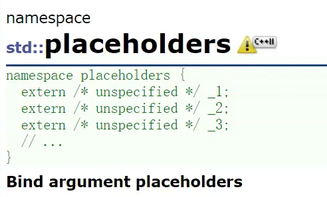
**bind绑定:**是一个函数模板,也是一个可调用对象的包装器、可以看作函数适配器
**作用:**调整参数个数和参数顺序
cpp
#define _CRT_SECURE_NO_WARNINGS 1
#include <iostream>
using namespace std;
#include<functional>

using placeholders::_1;
using placeholders::_2;
using placeholders::_3;

int Sub(int a, int b)
{
	return (a - b) * 10;
}

int SubX(int a, int b, int c)
{
	return (a - b - c) * 10;
}

class Plus
{
public:
	static int plusi(int a, int b)
	{
		return a + b;
	}
	double plusd(double a, double b)
	{
		return a + b;
	}
};

int main()
{
    // bind本质:返回的一个仿函数对象

	//调整参数顺序(不常用)
	//_1代表第一个实参
	//_2代表第二个实参
	//...
	auto sub1 = bind(Sub, _1, _2);
	cout << sub1(10, 5) << endl;//50

    auto sub2 = bind(Sub, _2, _1);
    cout << sub2(10, 5) << endl;//-50

    // 调整参数个数 (常⽤)
    auto sub3 = bind(Sub, 100, _1);
    cout << sub3(5) << endl;

    auto sub4 = bind(Sub, _1, 100);
    cout << sub4(5) << endl;

    // 分别绑死第1、2、3个参数
    auto sub5 = bind(SubX, 100, _1, _2);
    cout << sub5(5, 1) << endl;

    auto sub6 = bind(SubX, _1, 100, _2);
    cout << sub6(5, 1) << endl;

    auto sub7 = bind(SubX, _1, _2, 100);
    cout << sub7(5, 1) << endl;

    // 用于绑死一些固定参数
    // 成员函数对象进行绑死,就不需要每次都传递了
    function<double(Plus&&, double, double)> f6 = &Plus::plusd;
    Plus pd;
    cout << f6(move(pd), 1.1, 1.1) << endl;
    cout << f6(Plus(), 1.1, 1.1) << endl;

    function<double(double, double)> f7 = bind(&Plus::plusd, Plus(), _1, _2);
    cout << f7(1.1, 1.1) << endl;

    return 0;
}
**示例:**计算复利
cpp
#define _CRT_SECURE_NO_WARNINGS 1
#include <iostream>
using namespace std;
#include<functional>

using placeholders::_1;

int main()
{
	// 计算复利的lambda
    // 复利前一年的利息变成第二年的本金
    // (10000 * 0.02 + 10000) * 0.02 + 10000 * 0.02 + 10000
    // 参数:利率 本金 年限
	auto func1 = [](double rate, double money, int year)->double
	{
		double ret = money;
		for (int i = 0; i < year; i++)
		{
			ret += ret * rate;
		}

		return ret - money;
	};

	// 绑死一些参数,实现出持不同年华利率,不同金额和不同年份计算出复利的结算利息
	function<double(double)> func3_1_5 = bind(func1, 0.015, _1, 3);
	function<double(double)> func5_1_5 = bind(func1, 0.015, _1, 5);
	function<double(double)> func10_2_5 = bind(func1, 0.025, _1, 10);
	function<double(double)> func20_3_5 = bind(func1, 0.035, _1, 30);

	cout << func3_1_5(1000000) << endl;
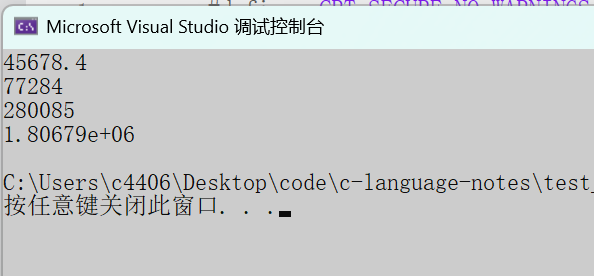
	cout << func5_1_5(1000000) << endl;
	cout << func10_2_5(1000000) << endl;
	cout << func20_3_5(1000000) << endl;

	return 0;
}