
大家好!今天给大家讲解倒装句的,是我Hello,Mr Crab。这句话本身就是一个倒装句。倒装句简单来说,就是把句子中的谓语成分(或者部分谓语)移到主语的前面,这样做通常是为了强调、平衡句子结构,或者符合某些特定的语法规则。接下来我将给大家讲解英语中的倒装句。
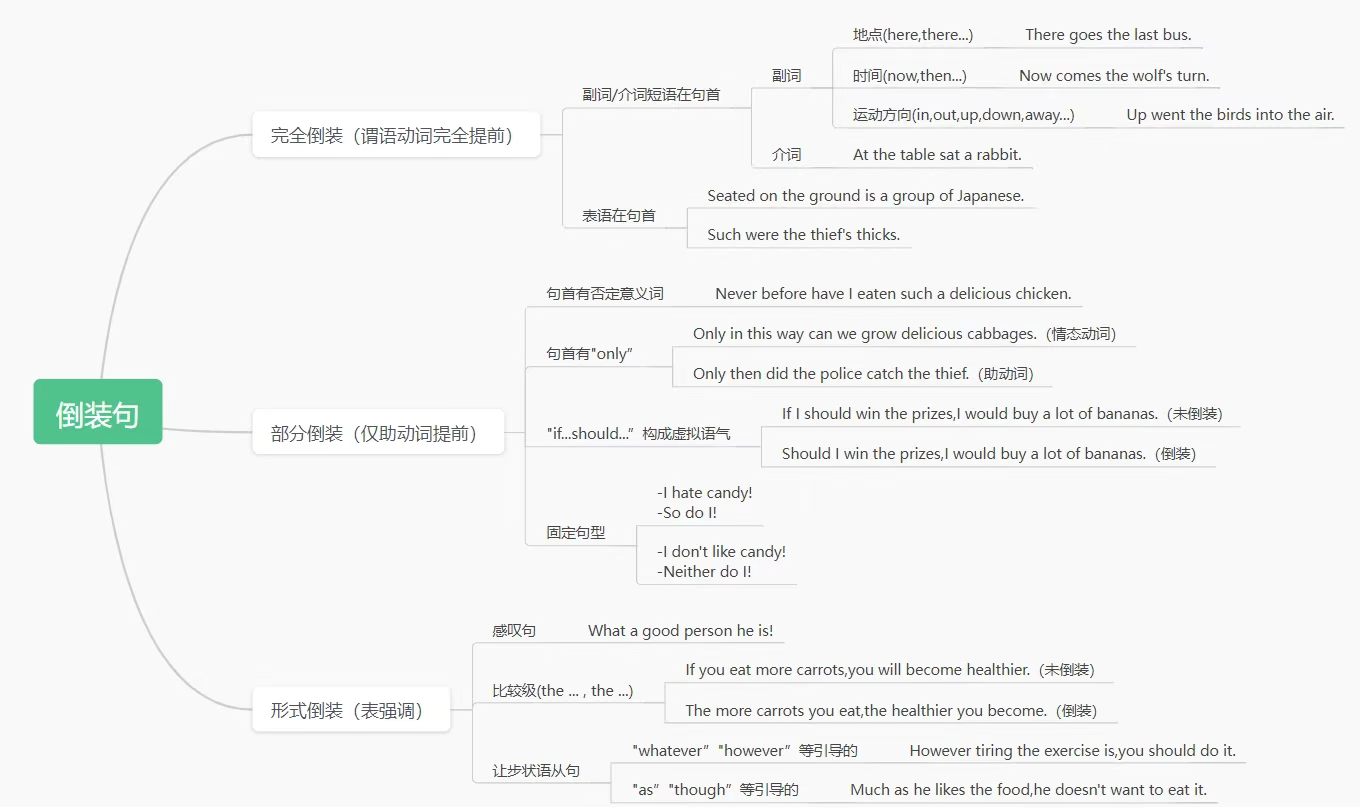
倒装句类型
倒装句定义
正常语序:主语****谓语(动词)****其它成分
倒装句语序:****谓语(动词)****主语其它成分
倒装句:谓语动词放到主语之前
倒装句分类
完全倒装:谓语动词放到主语之前
部分倒装:只有助动词放到主语之前
形式倒装:仅将强调内容提至句首,谓语动词不提前
完全倒装
句子在进行倒装时是有一定前提的,并不是随心所欲想倒装就可以倒装,对于完全倒装而言出现以下几种情况时我们才会把谓语动词置于主语之前进行倒装。
方位副词在句首
当句子以表示方位、方向的副词(如 here, there, up, down, in, out, away, off)或拟声词(如bang, crack)开头,且谓语是表示位置移动或存在的不及物动词(如 be, come, go, run, rush, fly, fall, lie, stand, sit)时,常用完全倒装。
句子结构:方位副词/拟声词 + 谓语(动词) + 主语(名词)
例句:
Here comes the bus.(公交车来了。)
There goes the bell.(铃声响了。)
Up went the arrow into the air.(箭嗖的一声射向天空。)
Away flew the bird.(鸟飞走了。)
例外 :**如果主语是人称代词,则不需要倒装!**
句子结构:方位副词 + 主语(代词)+ 谓语动词。
Here we go.(我们出发吧。)
Away he went.(他走了。)
Down it fell.(它掉了下来。)
地点状语在句首
当句首是表示地点、位置的介词短语(如 in the room, on the hill, at the foot of the mountain, from the valley),且谓语动词是 be, stand, lie, sit, exist, live, remain 等表示"存在、位于、静止"的动词时,常用完全倒装来生动地呈现场景。
句子结构:地点状语 + 谓语动词 + 主语(名词)
例句:
On the hill stands an ancient temple.(山上矗立着一座古庙)
In the corner of the room sits a quiet girl.(房间的角落里坐着一个安静的女孩)
From the valley came a strange sound.(从山谷传来一个奇怪的声音)
At the foot of the mountain lies a small village.(山脚下躺着一个小村庄)
表语提前
为了强调主语的状态,可以将作表语的成分(形容词、过去分词、现在分词、介词短语)提前至句首,后面跟上be动词和主语。
句子结构:表语 + be动词 + 主语(名词)
例句:
Gone are the days when we played together.(我们一起玩耍的日子一去不复返)
- 形容词作表语
Seated on the ground were a group of students.(坐在地上的是一群学生)
- 过去分词作表语
Lying on the bed was an old man.(躺在床上的是一位老人)
- 现在分词作表语
Among the guests was the famous scientist.(在宾客之中是那位著名的科学家)- 介词短语作表语
Such,So强调
当 "such" 或 "so...that..." 结构中的 "such" 或 "so + 形容词" 部分提到句首以示强调时,主句常用完全倒装。
句子结构:Such/So + 形容词 + be动词 + 主语 + that
例句:
Such a good girl is she that everyone wants to stay with her.(她是如此好的一个女孩,以至于每个人都想和她待在一起)
正常语序:She is such a good girl that everyone wants to stay with her.
So frightened was he that he could not move.(他吓得动弹不得)
正常语序:He was so frightened that he could not move.
直接引语后注明讲话人
在叙事中,当直接引语在前,"某人说" 的结构在后,且主语是名词时,常用完全倒装。如果主语是代词,或谓语带有宾语、状语,则通常不倒装。
句子结构:"直接引语," + 谓语动词(said, asked等)+ 主语(名词)
例句:
"Help!" shouted the boy.("救命!"男孩喊道。)
"I don't know," replied Mary.("我不知道,"玛丽回答。)
不倒装的情况 :
"Help!" he shouted.(主语是代词,不倒装)
"I don't know," Mary replied quietly.(谓语带有状语,通常不倒装)
完全倒装总结
|------------|----------------------------------------|--------------------------------------|--------------------------------------------------------------|
| 情况 | 引导词(句子开头的成分) | 谓语动词的特点 | 例句 |
| 方位副词/拟声词 | Here, There, Up, Away, Bang | 表示运动/存在的不及物动词 | Here comes the bus |
| 地点状语 | 介词短语 (in, on, at...) | be, stand, lie, sit 等表示存在的动词 | In the room was a piano |
| 表语提前 | 形容词/过去分词/现在分词/介词短语(seated on,standing) | be动词 | Seated on the Ground is a group of janpanese |
| Such/So强调 | Such / So + 形容词 | be动词 | So frightened was he that he could not move |
| 直接引语后注明讲话人 | 直接引语 | said, asked, shouted | "Yes," answered the child. |
部分倒装
部分倒装则指的是将谓语的一部分(通常是助动词、情态动词或系动词be)提到主语之前,而主要动词(实义动词)仍保留在主语之后。其基本结构是:
特定引导词/结构 + 助动词/情态动词/be动词 + 主语 + 其他成分
常见的助动词
否定词或半否定词置于句首时
当句子以具有否定或限制意义的副词、短语或从句开头,且这些词修饰整个句子 (作状语)时,主句必须进行部分倒装。
1. 否定副词开头
Never, Rarely, Seldom, Little, Hardly, Scarcely
Never have I seen such a spectacular performance. 我从未看过如此精彩的演出)
Seldom does he go to bed before midnight. (他很少在午夜前睡觉)
2. 含"no"的短语开头
At no time, In no way, By no means, Under no circumstances, On no account (表示"绝不)
例句:
Under no circumstances should you disclose the password. (在任何情况下你都不应泄露密码。)
By no means is he an expert in this field.(他绝不是这个领域的专家)
3. "Not" 开头的结构
Not only... (but also)...("Not only"引导的分句要倒装, "but also"引导的不倒装)
Not until + 时间 (从句/短语)...(主句倒装)
Not a single word/Nothing/Nobody 等 作状语置于句首
例句:
Not only did he finishthe work, (but) he also helped others. (他不仅完成了自己的工作,还帮助了别人。)
Not until yesterday did I realizethe truth. (直到昨天我才意识到真相)
Not until the teacher came in did the students become quiet. (直到老师进来,学生们才安静下来。)
Not a single mistake did he make in the exam. (他考试中一个错误都没犯)
4. 固定搭配
Hardly/Scarcely... when... (一...就...)
No sooner... than... (一...就...)
例句:
Hardly had I sat down whenthe phone rang. (我刚坐下,电话就响了)
No sooner had he arrived than he started complaining. (他一到就开始抱怨)
"Only" 修饰状语并置于句首时
当"only"强调一个状语 (副词、介词短语或状语从句)并将其置于句首时,主句需要部分倒装。
例句:
Only then did I understand what he meant. (只有到那时,我才明白他的意思。 - 强调副词"then")
Only in this way can we solve the problem. (只有用这种方法,我们才能解决问题。 - 强调介词短语"in this way")
Only when you lose something do yourealize its value. (只有当你失去某物时,你才会意识到它的价值。 - 强调状语从句"when...")
注意 :如果"only"修饰的是主语 ,则不需要倒装!
Only John knows the answer. (只有约翰知道答案。 "only"修饰主语"John")
"So... that..." 和 "Such... that..." 结构
为了强调程度,可以将"So + 形容词/副词"或"Such + 名词"提到句首,此时主句需部分倒装。
例句:
So fast did he runthat we couldn't catch up. (他跑得太快了,我们追不上。)
在虚拟条件句中省略"if"
虚拟语气中的一种特殊倒装。如果条件从句中包含 were, had, should,可以省略"if",并将这三个词提至句首,构成部分倒装。
例句:
****Were I you (= If I were you),****I would accept the job. (如果我是你,我会接受这份工作。)
Had you arrivedearlier (= If you had arrived earlier), you would have met her. (如果你早到一点,就能见到她了)
Should it rain tomorrow (= If it should rain tomorrow), the match will be postponed. (万一下雨,比赛将被推迟)
在"as/though"引导的让步状语从句中
在正式或文学性文体中,用"as"或"though"表示"尽管"时,常将表语、状语或动词原形提前,从句本身主谓部分倒装。
例句:
Try as you might, you won't succeed****.****(尽管你努力尝试,也不会成功。- 动词原形提前)
Young as/though he is, he is very responsible****.****(尽管他年轻,但很有责任心。- 形容词提前)
Much as I admire him, I don't agree with him on this.(尽管我很钦佩他,但在这点上我不同意他。-副词提前)
附和与比较(So/either/neither)
这属于比较常见的口语和书面语用法。当我们需要对某个事件表示附和的时候,经常会说,So am I(我也是)。
例句:
You are a fan, and so am I. (你是粉丝,我也是)
He didn't like the movie, and neither/nor did I. (他不喜欢那部电影,我也不喜欢)
祝愿(May)
在一些祝福语句中,我们会将情态动词放到句子开头处,比如May,
例句:
May you succeed! (祝你成功!)
Long live the king! (国王万岁!)
部分倒装总结
|-----------|----------------------------------------|-----------------------------------------------|
| 情况 | 引导词(句子开头的成分) | 例句 |
| 否定词置于句首 | Rarely,Scarcely,Never little,Not until | Never have I felt so excited. |
| Only + 状语 | Only then, Only by Only in this way.. | Only in this wat can we succeed |
| 程度强调 | So... that..., Such... that. | So fast did he run that we couldn't catch up. |
| 虚拟省略if | Were, Had, Should | Were he here, he would help. |
| 让步从句 | as/though | Farner as he is, he knows a lot |
| 附和/比较 | so/neither/nor | I'm tired. -- So am I. |
| 祝愿 | May,Long Live | May all your dreams come true! |
形式倒装
If you eat more apples, you will become healthier.(主谓 you will 顺序正常)
The more apples you eat,the healthier you will be.(主谓 you eat 顺序正常,但相比上一个,把比较级短语提前了)
严格的意义上来说,这种形式的句子还算不上倒装句(按照我们前边的定义,倒装句的顺序是谓主),但是有些教材认为这种强调前置的形式也属于形式倒装范畴。
感叹句
句子结构:引导词(what,how)+形容词、副词或名词短语+主语+谓语
例句:
What a good person he is!
How beautiful the sceneary is!
The more 比较级
句子结构:The+比较级...,The+比较级...
例句:
The more apples you eat,the healthier you will be.
让步状语从句
这种形式倒装通常出现在引导词为 **however、whatever、as、though**的从句中。
句子结构:将形容词或副词或表语提到句首,从句主谓保持正常顺序。
例句:
However引导:
However tiring the exercise is, you should do it.
As/Though引导:
Much as he likes the food, he doesn't want to eat it.
总结

以上便是本文所有内容,如果对你有用,还请一键三连支持一下!