Chapter 1 Getting Started with Deep Learning Using Pytorch
In this chapter, we will cover the following different parts of AI:
- AI itself and its origination
- Machine learning in the real world
- Applications of deep learning
- Why deep learning now
- Deep learning framework: Pytorch
- Artificial Intelligence
There are several definitions of AI floating around the web, my favorite being the automation of intellectual tasks normally performed by humans.
- Machine Learning
Machine learning systems look at tons of data and come up with rules to predict outcomes for unseen data:
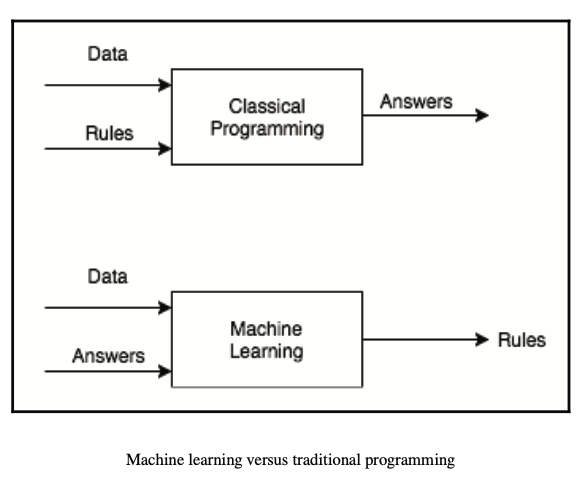
Most ML algorithms perform well on structured data. An important factor for any ML algorithm is feature engineer, while it needs a lot of time to get the features for ML algorithms.
Features engineering is challenging as they suffer from high dimensionality, such as an image of size 224 224 * 3 (height * width * channels). To store this image in computer memory, our matrix will contain 224 * 224 * 3 = 150,528 dimensions for a single image. Fortunately, a special branch of machine learning called deep learning allows you to handle these problems using modern techniques and hardware.
- Examples of Machine Learning in Real Life
The following are some cool products that are powered by machine learning:
- Google Photos uses a specific form of machine learning called deep learning for grouping photos.
- Recommendation systems, where are a family of ML algorithms, are used for recommending movies, music, and products by major companies such as Netflix, Amazon, and iTunes.
- Deep Learning
Traditional ML algorithms use handwritten features for extractions to train algorithms, while DL algorithms use techniques of modern tools to extract features in an automatic fashion.
The use of DL has grown tremendously in the last few years with the rise of GPU, big data, cloud platform of its services, and frameworks such as Torch, TensorFlow, Caffe, and PyTorch.
- Applications of Deep Learning
Some popular applications that were made possible using DL are as the following:
- Image classification for human-readable
- Speech recognition for human-specified
- Machine translation/Language translation for hight-rating accuracy
Autonomous cars - Siri, Google Voice, and Alexa evolves in recent years
- Cancer detection/prediction
- Why Deep Learning Now
Some of the reasons are as the following:
- Hardware availability
- Data and algorithms
- Deep Learning frameworks
- Deep Learning Framework: PyTorch
PyTorch can be used for building deep neural networks. As PyTorch was primarily built for research, it is not recommended for production usage in certain scenarios where the latency is not adaptably along with the hardware.
- Summary
In this chapter, we explored:
- Artificial intelligence
- Machine learning
- Deep learning
- Applications powered of above three
- Deep Learning becomes more popular
- A simple introduction of PyTorch
Chapter 2 Building Blocks of Neural Networks
In this chapter, we will build our first Hello World program in neural networks by covering the following topics:
- Installing PyTorch
- Implementing our first neural network
- Splitting the neural network into functional blocks
- Walking through each fundamental block covering tensors, variables, autogrades, gradients, and optimizers
- Loading data using PyTorch
- Installing PyTorch
Pytorch is available as a PyTorch package and you can use conda to build it. The recommended approach for this book is to use the Anaconda Python3 distribution. To install Anaconda, please refer to the web page https://mirrors.tuna.tsinghua.edu.cn/anaconda/archive/. It is strongly recommend you use Jupyter Notebook for the examples of this book to experiment interactively. If you have Anaconda installed, then you can proceed with the following steps for PyTorch installation.
For GPU-based installation:
python
conda install pytorch torchvision -c soumith(to be continued)