引言
在上一篇文章中,我们介绍了虚函数的基本概念和规则。今天,我们将深入到底层,探究运行时多态的实现原理------虚函数表(vtable) 和虚函数指针(vptr),以及与之密切相关的静态联编与动态联编。
理解这些底层机制,不仅能帮你写出更高效的多态代码,更是面试中经常考察的重点。
第一部分:静态联编与动态联编
一、什么是联编?
联编(Binding)是指计算机程序自身彼此关联的过程,也就是将函数调用与函数实现代码连接在一起的过程。根据发生时机,分为静态联编和动态联编。
cpp
#include <iostream>
using namespace std;

// 静态联编示例:函数重载
void print(int x) { cout << "int: " << x << endl; }
void print(double x) { cout << "double: " << x << endl; }

// 动态联编示例:虚函数
class Animal {
public:
    virtual void speak() { cout << "动物叫" << endl; }
};

class Dog : public Animal {
public:
    void speak() override { cout << "汪汪" << endl; }
};

int main() {
    // 静态联编:编译时就能确定调用哪个函数
    print(10);    // 编译时确定调用 print(int)
    print(3.14);  // 编译时确定调用 print(double)

    // 动态联编:运行时才能确定调用哪个函数
    Animal* p = new Dog();
    p->speak();   // 运行时确定调用 Dog::speak()

    delete p;
    return 0;
}
二、静态联编 vs 动态联编
| 特性 | 静态联编 | 动态联编 |
|---|---|---|
| 发生时机 | 编译阶段 | 运行阶段 |
| 别名 | 早期联编、静态多态 | 晚期联编、动态多态 |
| 实现方式 | 函数重载、模板 | 虚函数、继承 |
| 执行效率 | 高(直接调用) | 低(通过虚表间接调用) |
| 灵活性 | 低 | 高 |
| 判断依据 | 指针/引用的静态类型 | 指针/引用指向的实际对象类型 |
cpp
class Base {
public:
    void normal() { cout << "Base::normal" << endl; }
    virtual void dynamic() { cout << "Base::dynamic" << endl; }
};

class Derived : public Base {
public:
    void normal() { cout << "Derived::normal" << endl; }
    void dynamic() override { cout << "Derived::dynamic" << endl; }
};

int main() {
    Derived d;
    Base* p = &d;

    p->normal();   // 静态联编:输出 Base::normal
    p->dynamic();  // 动态联编:输出 Derived::dynamic

    return 0;
}
第二部分:运行时多态的底层原理
一、虚函数表(vtable)和虚函数指针(vptr)
当类中声明了虚函数时,编译器会为该类生成一个虚函数表(vtable) ,并在每个对象中添加一个虚函数指针(vptr) ,指向该类的虚函数表。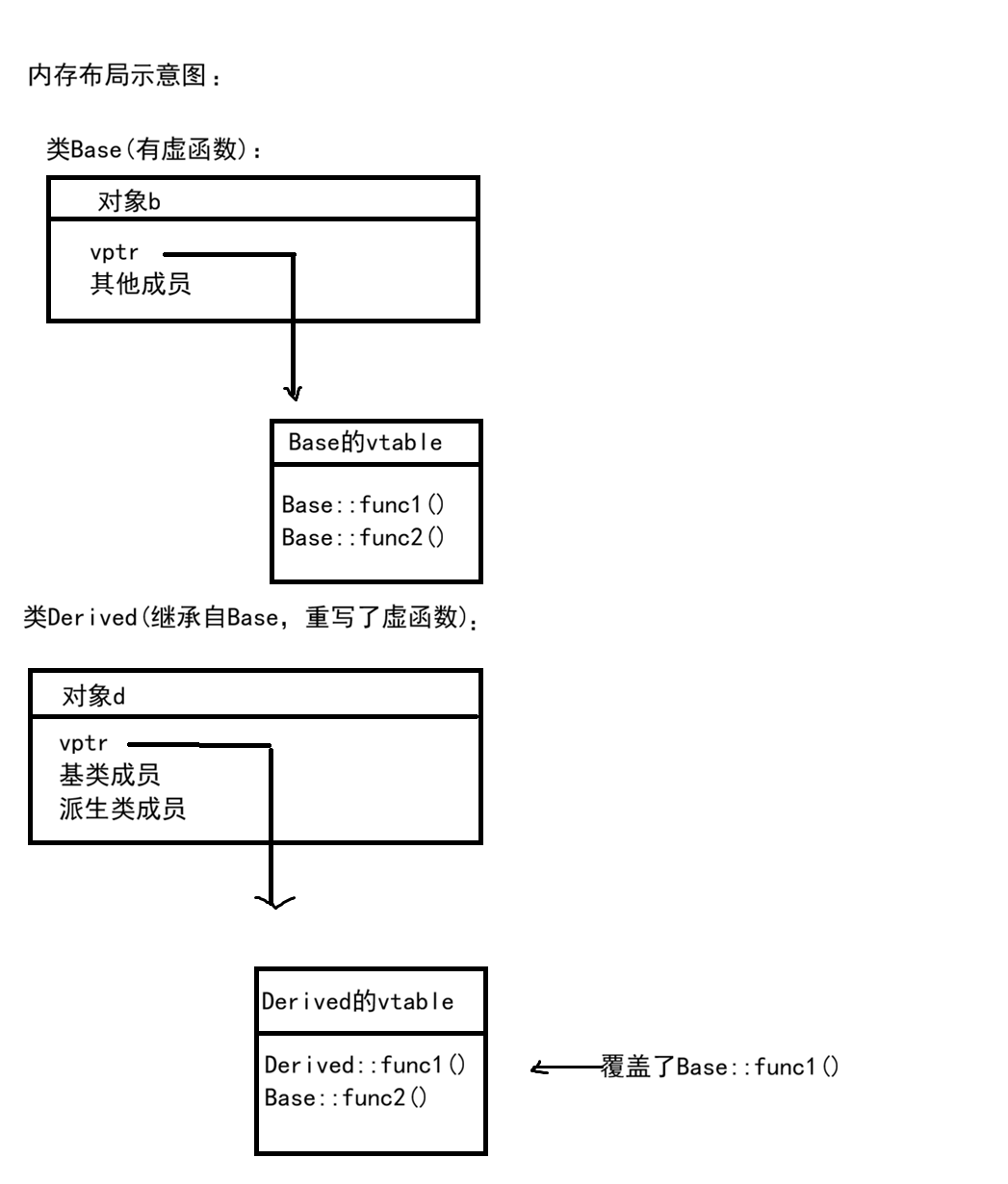
二、代码验证
cpp
#include <iostream>
using namespace std;

class Base {
public:
    virtual void func1() { cout << "Base::func1" << endl; }
    virtual void func2() { cout << "Base::func2" << endl; }
    void normal() { cout << "Base::normal" << endl; }
};

class Derived : public Base {
public:
    void func1() override { cout << "Derived::func1" << endl; }
    virtual void func3() { cout << "Derived::func3" << endl; }
};

int main() {
    Base b;
    Derived d;

    // 查看对象大小(虚函数指针占用8字节(64位)或4字节(32位))
    cout << "sizeof(Base): " << sizeof(Base) << endl;     // 8(vptr)
    cout << "sizeof(Derived): " << sizeof(Derived) << endl; // 8(vptr)

    // 通过指针调用,体现动态联编
    Base* p = &d;
    p->func1();  // 输出 Derived::func1
    p->func2();  // 输出 Base::func2

    return 0;
}
三、动态联编的完整执行流程
cpp
class Grand {
public:
    virtual void speak() { cout << "Grand" << endl; }
};

class Parent : public Grand {
public:
    void speak() override { cout << "Parent" << endl; }
};

class Child : public Parent {
public:
    void speak() override { cout << "Child" << endl; }
};

int main() {
    Child c;
    Grand* p1 = &c;
    Parent* p2 = &c;

    p1->speak();  // 输出 Child
    p2->speak();  // 输出 Child

    // 执行流程:
    // 1. 通过指针 p1 找到对象 c
    // 2. 从对象 c 中读取 vptr
    // 3. 通过 vptr 找到 Child 类的 vtable
    // 4. 从 vtable 中找到 speak() 的地址
    // 5. 调用 Child::speak()

    return 0;
}
第三部分:虚析构函数
一、为什么需要虚析构函数?
当通过基类指针删除派生类对象时,如果析构函数不是虚函数,只会调用基类的析构函数,导致派生类的资源未被释放,造成内存泄漏。
cpp
#include <iostream>
#include <cstring>
using namespace std;

// 错误示例:析构函数非虚
class BaseWrong {
public:
    ~BaseWrong() { cout << "BaseWrong 析构" << endl; }
};

class DerivedWrong : public BaseWrong {
private:
    char* buffer;
public:
    DerivedWrong() {
        buffer = new char[100];
        cout << "DerivedWrong 分配内存" << endl;
    }
    ~DerivedWrong() {
        delete[] buffer;
        cout << "DerivedWrong 释放内存" << endl;
    }
};

// 正确示例:析构函数为虚
class BaseCorrect {
public:
    virtual ~BaseCorrect() { cout << "BaseCorrect 析构" << endl; }
};

class DerivedCorrect : public BaseCorrect {
private:
    char* buffer;
public:
    DerivedCorrect() {
        buffer = new char[100];
        cout << "DerivedCorrect 分配内存" << endl;
    }
    ~DerivedCorrect() override {
        delete[] buffer;
        cout << "DerivedCorrect 释放内存" << endl;
    }
};

int main() {
    cout << "=== 错误示例:内存泄漏 ===" << endl;
    BaseWrong* p1 = new DerivedWrong();
    delete p1;  // 只调用 BaseWrong 析构,DerivedWrong 的 buffer 泄漏!

    cout << "\n=== 正确示例:正确释放 ===" << endl;
    BaseCorrect* p2 = new DerivedCorrect();
    delete p2;  // 先调用 DerivedCorrect 析构,再调用 BaseCorrect 析构

    return 0;
}
二、虚析构函数的规则
cpp
class Base {
public:
    // 规则1:只要类会被继承,析构函数就应该声明为虚函数
    virtual ~Base() = default;

    // 规则2:纯虚析构函数(需要提供函数体)
    // virtual ~Base() = 0;
};
// Base::~Base() {}  // 纯虚析构函数必须在类外提供实现

class Derived : public Base {
public:
    ~Derived() override = default;
};

// 规则3:基类析构函数为虚,派生类析构函数自动成为虚函数(即使不加override)
第四部分:纯虚函数与抽象类
一、纯虚函数的定义
纯虚函数是在基类中声明但没有实现的虚函数,语法是在函数声明后加 = 0。含有纯虚函数的类称为抽象类,不能实例化对象。
cpp
#include <iostream>
using namespace std;

// 抽象类:形状
class Shape {
public:
    // 纯虚函数
    virtual double getArea() const = 0;
    virtual double getPerimeter() const = 0;
    virtual void draw() const = 0;

    // 抽象类可以有普通成员函数
    void info() const {
        cout << "这是一个形状" << endl;
    }

    // 抽象类可以有成员变量
    string color;

    // 抽象类可以有构造函数和析构函数
    Shape() : color("red") {}
    virtual ~Shape() {}
};

// 具体类:圆形
class Circle : public Shape {
private:
    double radius;

public:
    Circle(double r) : radius(r) {}

    double getArea() const override {
        return 3.14159 * radius * radius;
    }

    double getPerimeter() const override {
        return 2 * 3.14159 * radius;
    }

    void draw() const override {
        cout << "绘制一个半径为 " << radius << " 的圆" << endl;
    }
};

// 具体类:矩形
class Rectangle : public Shape {
private:
    double width, height;

public:
    Rectangle(double w, double h) : width(w), height(h) {}

    double getArea() const override {
        return width * height;
    }

    double getPerimeter() const override {
        return 2 * (width + height);
    }

    void draw() const override {
        cout << "绘制一个 " << width << "x" << height << " 的矩形" << endl;
    }
};

int main() {
    // Shape s;  // 错误!不能实例化抽象类

    Circle c(5);
    Rectangle r(4, 6);

    Shape* shapes[] = {&c, &r};

    for (Shape* s : shapes) {
        s->draw();
        cout << "面积: " << s->getArea() << endl;
        cout << "周长: " << s->getPerimeter() << endl;
        cout << "颜色: " << s->color << endl;
    }

    return 0;
}
二、抽象类的特点
cpp
// 1. 抽象类不能实例化对象
// Shape s;  // 错误

// 2. 抽象类可以定义指针和引用
Shape* p;           // 正确
Shape& r = c;       // 正确

// 3. 派生类必须实现所有纯虚函数,否则仍是抽象类
class Triangle : public Shape {
    // 没有实现 getArea() 等,Triangle 仍是抽象类
};

// 4. 抽象类可以有构造函数和析构函数
// 5. 抽象类可以有成员变量和普通成员函数
// 6. 抽象类可以作为接口使用
三、纯虚析构函数
纯虚析构函数比较特殊:它需要被声明为纯虚,但必须提供函数体。
cpp
class Interface {
public:
    virtual ~Interface() = 0;  // 纯虚析构函数声明
};

// 必须提供实现
Interface::~Interface() {
    cout << "Interface 析构" << endl;
}

class Impl : public Interface {
public:
    ~Impl() override {
        cout << "Impl 析构" << endl;
    }
};

int main() {
    Interface* p = new Impl();
    delete p;  // 先调用 Impl 析构,再调用 Interface 析构
    return 0;
}
第五部分:联编相关面试题
面试题1:静态联编与动态联编的判断
cpp
class A {
public:
    virtual void f() { cout << "A::f" << endl; }
    void g() { cout << "A::g" << endl; }
};

class B : public A {
public:
    void f() override { cout << "B::f" << endl; }
    void g() { cout << "B::g" << endl; }
};

int main() {
    B b;
    A* p = &b;

    p->f();  // 动态联编 → B::f
    p->g();  // 静态联编 → A::g

    return 0;
}
面试题2:构造函数和析构函数中的虚函数
cpp
class Base {
public:
    Base() { func(); }
    virtual void func() { cout << "Base::func" << endl; }
    ~Base() { func(); }
};

class Derived : public Base {
public:
    virtual void func() override { cout << "Derived::func" << endl; }
};

int main() {
    Derived d;
    // 输出:
    // Base::func   (构造时,Derived 部分还未构造,虚表指向 Base)
    // Base::func   (析构时,Derived 部分已析构,虚表已恢复为 Base)
    return 0;
}
重要结论: 构造函数和析构函数中调用虚函数,不会发生动态联编,而是调用当前类自己的版本。
面试题3:虚函数表的存在位置
cpp
class NoVirtual {
    int x;
public:
    void func() {}
};

class HasVirtual {
    int x;
public:
    virtual void func() {}
};

int main() {
    cout << "sizeof(NoVirtual): " << sizeof(NoVirtual) << endl;  // 4
    cout << "sizeof(HasVirtual): " << sizeof(HasVirtual) << endl; // 16(64位:vptr 8 + int 4 + 对齐4)
    return 0;
}
面试题4:多重继承的虚函数表
cpp
class Base1 {
public:
    virtual void f1() { cout << "Base1::f1" << endl; }
};

class Base2 {
public:
    virtual void f2() { cout << "Base2::f2" << endl; }
};

class Derived : public Base1, public Base2 {
public:
    void f1() override { cout << "Derived::f1" << endl; }
    void f2() override { cout << "Derived::f2" << endl; }
};

int main() {
    Derived d;
    Base1* p1 = &d;
    Base2* p2 = &d;

    p1->f1();  // Derived::f1
    p2->f2();  // Derived::f2

    // 多重继承的对象有多个 vptr
    cout << "sizeof(Derived): " << sizeof(Derived) << endl;  // 16(两个 vptr)

    return 0;
}
面试题5:切片问题与多态
cpp
class Base {
public:
    virtual void show() { cout << "Base" << endl; }
};

class Derived : public Base {
public:
    void show() override { cout << "Derived" << endl; }
};

void printByValue(Base b) {
    b.show();  // 切片发生,总是输出 Base
}

void printByPointer(Base* b) {
    b->show();  // 多态,输出实际类型
}

int main() {
    Derived d;

    printByValue(d);      // 输出 Base(切片)
    printByPointer(&d);   // 输出 Derived

    // 切片:将派生类对象赋值给基类对象时,派生类部分被切掉
    Base b = d;
    b.show();  // Base

    return 0;
}
面试题6:纯虚函数可以有实现
cpp
class Base {
public:
    virtual void func() = 0;
};

// 纯虚函数可以有实现(但很少这样用)
void Base::func() {
    cout << "Base::func 默认实现" << endl;
}

class Derived : public Base {
public:
    void func() override {
        Base::func();  // 调用基类的实现
        cout << "Derived::func" << endl;
    }
};

int main() {
    Derived d;
    d.func();
    // 输出:
    // Base::func 默认实现
    // Derived::func
    return 0;
}
面试题7:final 关键字对多态的影响
cpp
class Base {
public:
    virtual void func1() { cout << "Base::func1" << endl; }
    virtual void func2() final { cout << "Base::func2" << endl; }  // final:禁止重写
};

class Derived : public Base {
public:
    void func1() override { cout << "Derived::func1" << endl; }
    // void func2() override { }  // 错误!func2 被 final 禁止重写
};

class Final final : public Base {  // final:禁止继承
};

// class Test : public Final { };  // 错误!Final 不能被继承

int main() {
    Derived d;
    Base* p = &d;
    p->func1();  // Derived::func1(多态仍然有效)
    p->func2();  // Base::func2(无法重写)
    return 0;
}
第六部分:完整示例------图形系统
cpp
#include <iostream>
#include <vector>
#include <cmath>
using namespace std;

// 抽象基类
class Shape {
protected:
    string color;

public:
    Shape(const string& c = "red") : color(c) {}

    // 纯虚函数
    virtual double getArea() const = 0;
    virtual double getPerimeter() const = 0;
    virtual void draw() const = 0;

    // 普通成员函数
    string getColor() const { return color; }
    void setColor(const string& c) { color = c; }

    // 虚析构函数(重要!)
    virtual ~Shape() {
        cout << "Shape 析构" << endl;
    }
};

// 圆形
class Circle : public Shape {
private:
    double radius;

public:
    Circle(double r, const string& c = "red") : Shape(c), radius(r) {}

    double getArea() const override {
        return M_PI * radius * radius;
    }

    double getPerimeter() const override {
        return 2 * M_PI * radius;
    }

    void draw() const override {
        cout << "画一个 " << color << " 的圆,半径=" << radius << endl;
    }

    ~Circle() {
        cout << "Circle 析构" << endl;
    }
};

// 矩形
class Rectangle : public Shape {
private:
    double width, height;

public:
    Rectangle(double w, double h, const string& c = "red")
        : Shape(c), width(w), height(h) {}

    double getArea() const override {
        return width * height;
    }

    double getPerimeter() const override {
        return 2 * (width + height);
    }

    void draw() const override {
        cout << "画一个 " << color << " 的矩形,"
             << width << "x" << height << endl;
    }

    ~Rectangle() {
        cout << "Rectangle 析构" << endl;
    }
};

// 三角形
class Triangle : public Shape {
private:
    double a, b, c;

public:
    Triangle(double a, double b, double c, const string& col = "red")
        : Shape(col), a(a), b(b), c(c) {}

    double getArea() const override {
        double s = (a + b + c) / 2;
        return sqrt(s * (s - a) * (s - b) * (s - c));
    }

    double getPerimeter() const override {
        return a + b + c;
    }

    void draw() const override {
        cout << "画一个 " << color << " 的三角形,边长="
             << a << "," << b << "," << c << endl;
    }

    ~Triangle() {
        cout << "Triangle 析构" << endl;
    }
};

// 图形管理器
class ShapeManager {
private:
    vector<Shape*> shapes;

public:
    void add(Shape* s) {
        shapes.push_back(s);
    }

    void drawAll() const {
        for (Shape* s : shapes) {
            s->draw();
        }
    }

    double getTotalArea() const {
        double total = 0;
        for (Shape* s : shapes) {
            total += s->getArea();
        }
        return total;
    }

    ~ShapeManager() {
        for (Shape* s : shapes) {
            delete s;  // 虚析构函数确保正确释放
        }
    }
};

int main() {
    ShapeManager manager;

    manager.add(new Circle(5, "blue"));
    manager.add(new Rectangle(4, 6, "green"));
    manager.add(new Triangle(3, 4, 5, "yellow"));

    cout << "=== 绘制所有图形 ===" << endl;
    manager.drawAll();

    cout << "\n=== 总面积 ===" << endl;
    cout << "总面积: " << manager.getTotalArea() << endl;

    // 多态数组
    cout << "\n=== 多态演示 ===" << endl;
    Shape* shapes[] = {
        new Circle(3),
        new Rectangle(2, 3),
        new Triangle(6, 8, 10)
    };

    for (Shape* s : shapes) {
        cout << "面积: " << s->getArea() << ", ";
        s->draw();
    }

    for (Shape* s : shapes) {
        delete s;
    }

    return 0;
}
总结
一、核心概念对比
| 概念 | 静态联编 | 动态联编 |
|---|---|---|
| 发生时机 | 编译时 | 运行时 |
| 实现方式 | 函数重载、模板 | 虚函数、继承 |
| 效率 | 高 | 稍低 |
| 灵活性 | 低 | 高 |
| 概念 | 虚函数 | 纯虚函数 |
|---|---|---|
| 声明 | virtual void func() |
virtual void func() = 0 |
| 是否有实现 | 必须有 | 可选(通常没有) |
| 类是否可实例化 | 可以 | 不可以(抽象类) |
| 派生类要求 | 可选重写 | 必须重写(否则仍是抽象类) |
二、运行时多态要点
-
虚函数表(vtable):每个有虚函数的类都有一个虚函数表
-
虚函数指针(vptr):每个对象都有一个vptr指向所属类的vtable
-
动态联编条件:
-
通过指针或引用调用
-
函数是虚函数
-
指针/引用指向派生类对象
-
-
虚析构函数:基类析构函数必须是虚函数,否则内存泄漏
-
抽象类:至少有一个纯虚函数,不能实例化
三、面试题总结
| 考点 | 关键点 |
|---|---|
| 构造/析构中的虚函数 | 不会动态联编,调用当前类版本 |
| 切片问题 | 值传递会丢失派生类信息 |
| 多重继承 | 多个vptr |
| final关键字 | 禁止重写或禁止继承 |
| 纯虚函数可以有实现 | 很少用,但语法允许 |
运行时多态是C++面向对象编程的核心特性之一。理解虚函数表(vtable)和虚函数指针(vptr)的底层原理,能够帮助你:
-
理解多态的开销:虚函数调用有额外的间接寻址开销
-
避免常见陷阱:构造/析构函数中调用虚函数、切片问题
-
正确设计接口:纯虚函数作为接口、虚析构函数防止内存泄漏