LLM 具有强大的推理能力,它能够根据训练数据和输入的 Prompt 生成文本。但是它无法获取实时数据(比如今天的天气),也无法执行具体操作(比如发邮件)。
问题在于现有的程序只能通过结构化的函数调用,例如:
js
function toolCall(param: ToolParam): ToolResult;所以 LLM 需要将用户的自然语言需求转换为结构化的函数调用,才能与其它程序交互。
Function Calling 是一种 LLM 调用 Tool 的机制。当 LLM 识别用户需求需要调用 Tool 时,它会生成结构化的函数调用指令,然后由 Agent 执行指定函数并将结果反馈给 LLM,最后 LLM 基于结果进行下一步操作。
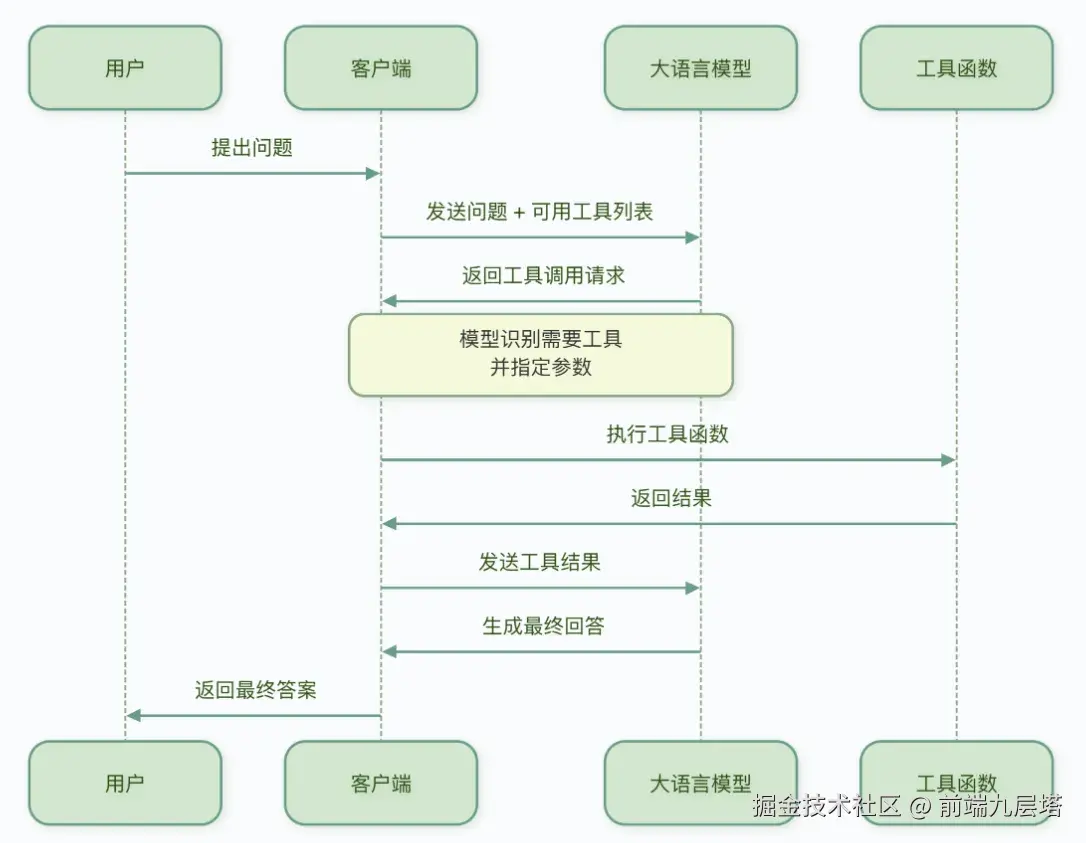
LLM生成结构化的函数调用指令:
js
{
  "id": "chatcmpl-abc123",
  "choices": [
    {
      "index": 0,
      "message": {
        "role": "assistant",
        "tool_calls": [
          {
            "id": "call_abc123",
            "type": "function",
            "function": {
              "name": "get_weather",
              "arguments": "{"city": "北京", "date": "today"}"
            }
          }
        ]
      },
      "finish_reason": "tool_calls"
    }
  ]
}
Agent解析函数调用指令,根据 function.name 找到对应的函数,解析 function.arguments 获取参数,然后执行调用。
js
// 1. 解析LLM返回的函数调用指令
const toolCall = response.choices[0].message.tool_calls[0];
const functionName = toolCall.function.name;
const functionArgs = JSON.parse(toolCall.function.arguments);

// 2. 根据工具名称找到对应的函数
const tools = {
    get_weather: ({city, date}) => {
        // 调用天气查询API
        return {
            "temperature": 22,
            "condition": "晴天",
            "humidity": 45
        };
    },
};
// 3. 执行工具调用
const result = tools[functionName](functionArgs);