Day 10 编程实战:Boosting(AdaBoost & GBDT)金融预测
实战目标
- 理解 AdaBoost 和 GBDT 的核心原理
- 使用 AdaBoostClassifier 进行涨跌预测
- 使用 GradientBoostingClassifier 进行涨跌预测
- 对比 Boosting 与随机森林的性能
- 学习 GBDT 的超参数调优
1. 导入必要的库
python
import numpy as np
import pandas as pd
import matplotlib.pyplot as plt
import seaborn as sns
import time
from pathlib import Path
from sklearn.ensemble import (
    AdaBoostClassifier, GradientBoostingClassifier,
    RandomForestClassifier
)
from sklearn.tree import DecisionTreeClassifier
from sklearn.model_selection import train_test_split, TimeSeriesSplit, GridSearchCV, cross_val_score
from sklearn.metrics import (
    accuracy_score, precision_score, recall_score, f1_score,
    roc_auc_score, roc_curve, classification_report, confusion_matrix
)
from sklearn.preprocessing import StandardScaler
import warnings
warnings.filterwarnings('ignore')

# 启用LaTeX渲染(如果系统安装了LaTeX)
plt.rcParams['text.usetex'] = False  # 设为False避免LaTeX依赖
# 设置中文显示
plt.rcParams['font.sans-serif'] = ['SimHei', 'Microsoft YaHei', 'DejaVu Sans']
plt.rcParams['axes.unicode_minus'] = False
2. 生成金融数据
python
def generate_financial_data(ts_code):
    """生成金融数据"""

    data_path = Path(r"E:\AppData\quant_trade\klines\kline2014-2024")
    kline_file = data_path / f"{ts_code}.csv"

    df = pd.read_csv(kline_file, usecols=["trade_date", "close", "vol"],
                     parse_dates=["trade_date"])\
            .rename(columns={"vol": "volume"})\
            .sort_values(by=["trade_date"])\
            .reset_index(drop=True)

    df['return'] = df['close'].pct_change()

    # 技术指标
    # RSI
    delta = df['return'].fillna(0)
    gain = delta.where(delta > 0, 0).rolling(14).mean()
    loss = -delta.where(delta < 0, 0).rolling(14).mean()
    rs = gain / (loss + 1e-10)
    df['rsi'] = 100 - (100 / (1 + rs))

    # MACD
    ema12 = df['close'].ewm(span=12, adjust=False).mean()
    ema26 = df['close'].ewm(span=26, adjust=False).mean()
    df['macd'] = ema12 - ema26
    df['macd_signal'] = df['macd'].ewm(span=9, adjust=False).mean()

    # 均线比率
    df['ma5'] = df['close'].rolling(5).mean()
    df['ma20'] = df['close'].rolling(20).mean()
    df['ma_ratio'] = df['ma5'] / df['ma20'] - 1

    # 波动率
    df['volatility'] = df['return'].rolling(20).std()

    # 成交量比率
    df['volume_ratio'] = df['volume'] / df['volume'].rolling(10).mean()

    # 动量指标
    for lag in [1, 2, 3, 5, 10]:
        df[f'momentum_{lag}'] = df['return'].shift(lag).fillna(0)

    # 目标变量:次日是否上涨
    df['target'] = (df['return'].shift(-1) > 0).astype(int)

    # 删除缺失值
    df = df.dropna()

    return df

# 生成数据
ts_code = '600519.SH'
df = generate_financial_data(ts_code)
print(f"数据形状: {df.shape}")

# 特征选择
feature_cols = ['rsi', 'macd', 'macd_signal', 'ma_ratio', 'volatility',
                'volume_ratio', 'momentum_1', 'momentum_2', 'momentum_3',
                'momentum_5', 'momentum_10']
X = df[feature_cols]
y = df['target']

print(f"特征数量: {len(feature_cols)}")
print(f"样本数量: {len(X)}")
print(f"目标分布: \n{y.value_counts(normalize=True)}")

# 按时间划分
split_idx = int(len(X) * 0.7)
X_train = X[:split_idx]
X_test = X[split_idx:]
y_train = y[:split_idx]
y_test = y[split_idx:]

print(f"\n训练集: {len(X_train)} 样本")
print(f"测试集: {len(X_test)} 样本")数据形状: (2452, 18)
特征数量: 11
样本数量: 2452
目标分布:
target
1 0.505302
0 0.494698
Name: proportion, dtype: float64
训练集: 1716 样本
测试集: 736 样本3. AdaBoost 算法详解与实现
3.1 手动实现 AdaBoost
python
class AdaBoostManual:
    """手动实现 AdaBoost(演示原理)"""

    def __init__(self, n_estimators=50, learning_rate=1.0):
        self.n_estimators = n_estimators
        self.learning_rate = learning_rate
        self.models = []
        self.model_weights = []

    def fit(self, X, y):
        """
        这里标签 y 是 -1 和 +1
        """
        n_samples = len(X)
        # 初始化样本权重
        weights = np.ones(n_samples) / n_samples

        for t in range(self.n_estimators):
            # 训练弱学习器(决策树桩)
            stump = DecisionTreeClassifier(max_depth=1, random_state=t)
            stump.fit(X, y, sample_weight=weights)

            # 预测
            y_pred = stump.predict(X)

            # 计算加权误差率
            error = np.sum(weights * (y_pred != y)) / np.sum(weights)

            # 计算模型权重
            alpha = 0.5 * np.log((1 - error) / (error + 1e-10))
            alpha = alpha * self.learning_rate

            # 更新样本权重
            ## sklearn 的决策树输出通常是 0 和 1。
            ## AdaBoost 的数学公式要求标签是 -1 和 +1。
            ## 这行代码把预测结果从 [0, 1] 映射到了 [-1, +1]。
            weights = weights * np.exp(-alpha * y * (2 * y_pred - 1))
            weights = weights / np.sum(weights)  # 归一化

            # 保存模型
            self.models.append(stump)
            self.model_weights.append(alpha)

            # 打印进度
            if (t + 1) % 10 == 0:
                print(f"迭代 {t+1}/{self.n_estimators}, 误差率: {error:.4f}, α: {alpha:.4f}")

        return self

    def predict(self, X):
        # 加权投票
        pred_sum = np.zeros(len(X))
        for alpha, model in zip(self.model_weights, self.models):
            pred_sum += alpha * (2 * model.predict(X) - 1)
        return (pred_sum > 0).astype(int)

# 测试手动实现
print("="*60)
print("手动实现 AdaBoost 测试")
print("="*60)
X_sample = X_train[:1000]
y_sample = y_train[:1000]

ada_manual = AdaBoostManual(n_estimators=30)
ada_manual.fit(X_sample, 2 * y_sample -1)
y_pred_manual = ada_manual.predict(X_test)

print(f"\n手动实现 AdaBoost 测试集准确率: {accuracy_score(y_test, y_pred_manual):.4f}")============================================================
手动实现 AdaBoost 测试
============================================================
迭代 10/30, 误差率: 0.4233, α: 0.1546
迭代 20/30, 误差率: 0.4693, α: 0.0614
迭代 30/30, 误差率: 0.4921, α: 0.0158
手动实现 AdaBoost 测试集准确率: 0.48103.2 使用 sklearn 的 AdaBoost
python
print("="*60)
print("sklearn AdaBoost 训练")
print("="*60)

# 基础 AdaBoost(决策树桩)
ada_base = AdaBoostClassifier(
    n_estimators=100,
    learning_rate=1.0,
    random_state=42
)

start_time = time.time()
ada_base.fit(X_train, y_train)
ada_time = time.time() - start_time

# 预测
y_pred_ada = ada_base.predict(X_test)
y_proba_ada = ada_base.predict_proba(X_test)[:, 1]

print(f"训练时间: {ada_time:.2f}秒")
print(f"测试集准确率: {accuracy_score(y_test, y_pred_ada):.4f}")
print(f"AUC: {roc_auc_score(y_test, y_proba_ada):.4f}")

# 不同基学习器
print("\n使用浅层决策树作为基学习器:")
ada_tree = AdaBoostClassifier(
    estimator=DecisionTreeClassifier(max_depth=3),
    n_estimators=100,
    learning_rate=0.5,
    random_state=42
)
ada_tree.fit(X_train, y_train)
y_pred_ada_tree = ada_tree.predict(X_test)
y_proba_ada_tree = ada_tree.predict_proba(X_test)[:, 1]

print(f"测试集准确率: {accuracy_score(y_test, y_pred_ada_tree):.4f}")
print(f"AUC: {roc_auc_score(y_test, y_proba_ada_tree):.4f}")============================================================
sklearn AdaBoost 训练
============================================================
训练时间: 0.59秒
测试集准确率: 0.5027
AUC: 0.5114
使用浅层决策树作为基学习器:
测试集准确率: 0.4986
AUC: 0.50393.3 AdaBoost 参数影响分析
python
def analyze_adaboost_params(X_train, y_train, X_test, y_test):
    """分析 AdaBoost 的 n_estimators 和 learning_rate 影响"""

    n_range = [10, 20, 50, 100, 200, 300]
    lr_range = [0.1, 0.5, 1.0, 1.5, 2.0]

    results = []

    for n in n_range:
        for lr in lr_range:
            ada = AdaBoostClassifier(n_estimators=n, learning_rate=lr, random_state=42)
            ada.fit(X_train, y_train)
            y_pred = ada.predict(X_test)
            acc = accuracy_score(y_test, y_pred)
            results.append({'n_estimators': n, 'learning_rate': lr, 'accuracy': acc})

    results_df = pd.DataFrame(results)

    # 创建热力图
    pivot_table = results_df.pivot(index='n_estimators', columns='learning_rate', values='accuracy')

    plt.figure(figsize=(10, 6))
    sns.heatmap(pivot_table, annot=True, fmt='.4f', cmap='RdYlGn', center=0.5)
    plt.title('AdaBoost 参数热力图(测试集准确率)')
    plt.xlabel('学习率 (learning_rate)')
    plt.ylabel('树数量 (n_estimators)')
    plt.tight_layout()
    plt.show()

    # 最佳参数
    best_row = results_df.loc[results_df['accuracy'].idxmax()]
    print(f"最佳参数: n_estimators={int(best_row['n_estimators'])}, learning_rate={best_row['learning_rate']}")
    print(f"最佳准确率: {best_row['accuracy']:.4f}")

    return best_row

# 分析 AdaBoost 参数(使用子集加速)
print("分析 AdaBoost 参数影响...")
X_sample = X_train[:2000]
y_sample = y_train[:2000]
best_ada_params = analyze_adaboost_params(X_sample, y_sample, X_test, y_test)分析 AdaBoost 参数影响...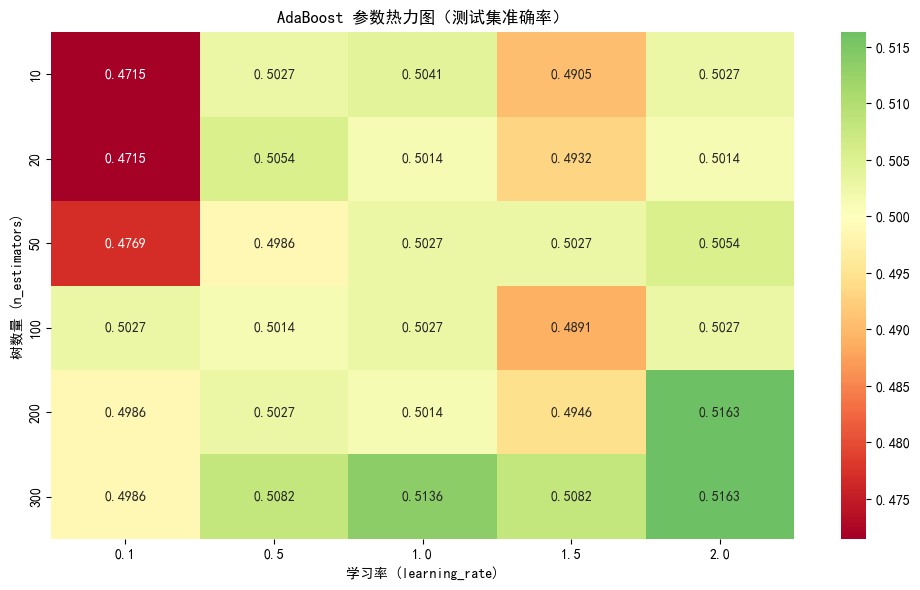
最佳参数: n_estimators=200, learning_rate=2.0
最佳准确率: 0.5163
4. GBDT 算法详解与实现
4.1 梯度提升分类器基础
python
print("="*60)
print("GradientBoostingClassifier 训练")
print("="*60)

# 基础 GBDT
gbdt_base = GradientBoostingClassifier(
    n_estimators=100,
    learning_rate=0.1,
    max_depth=3,
    random_state=42
)

start_time = time.time()
gbdt_base.fit(X_train, y_train)
gbdt_time = time.time() - start_time

# 预测
y_pred_gbdt = gbdt_base.predict(X_test)
y_proba_gbdt = gbdt_base.predict_proba(X_test)[:, 1]

print(f"训练时间: {gbdt_time:.2f}秒")
print(f"测试集准确率: {accuracy_score(y_test, y_pred_gbdt):.4f}")
print(f"精确率: {precision_score(y_test, y_pred_gbdt):.4f}")
print(f"召回率: {recall_score(y_test, y_pred_gbdt):.4f}")
print(f"F1: {f1_score(y_test, y_pred_gbdt):.4f}")
print(f"AUC: {roc_auc_score(y_test, y_proba_gbdt):.4f}")

# 特征重要性
feature_importance_gbdt = pd.DataFrame({
    'feature': feature_cols,
    'importance': gbdt_base.feature_importances_
}).sort_values('importance', ascending=False)

print("\n特征重要性(Top 5):")
print(feature_importance_gbdt.head())============================================================
GradientBoostingClassifier 训练
============================================================
训练时间: 1.06秒
测试集准确率: 0.4918
精确率: 0.4737
召回率: 0.7003
F1: 0.5651
AUC: 0.5038
特征重要性(Top 5):
feature importance
8 momentum_3 0.130215
5 volume_ratio 0.116798
7 momentum_2 0.104701
4 volatility 0.104672
10 momentum_10 0.1038054.2 不同损失函数对比
python
def compare_gbdt_loss_functions(X_train, y_train, X_test, y_test):
    """对比不同损失函数的性能"""

    # 旧版本损失函数 deviance 改为 log_loss,
    loss_functions = ['log_loss', 'exponential']
    results = []

    for loss in loss_functions:
        gbdt = GradientBoostingClassifier(
            n_estimators=100,
            learning_rate=0.1,
            max_depth=3,
            loss=loss,
            random_state=42
        )
        gbdt.fit(X_train, y_train)

        y_pred = gbdt.predict(X_test)
        y_proba = gbdt.predict_proba(X_test)[:, 1]

        results.append({
            'loss': loss,
            'accuracy': accuracy_score(y_test, y_pred),
            'precision': precision_score(y_test, y_pred),
            'recall': recall_score(y_test, y_pred),
            'f1': f1_score(y_test, y_pred),
            'auc': roc_auc_score(y_test, y_proba)
        })

    results_df = pd.DataFrame(results)
    print("\n不同损失函数性能对比:")
    print(results_df.to_string(index=False))

    return results_df

compare_gbdt_loss_functions(X_train, y_train, X_test, y_test)不同损失函数性能对比:
loss accuracy precision recall f1 auc
log_loss 0.491848 0.473684 0.700288 0.565116 0.503812
exponential 0.480978 0.464066 0.651297 0.541966 0.4964404.3 学习率与树数量的关系
python
def analyze_lr_vs_trees(X_train, y_train, X_test, y_test):
    """分析学习率和树数量的关系"""

    learning_rates = [0.01, 0.05, 0.1, 0.2, 0.3]
    n_estimators_list = [50, 100, 200, 300]

    results = []

    for lr in learning_rates:
        for n in n_estimators_list:
            gbdt = GradientBoostingClassifier(
                n_estimators=n,
                learning_rate=lr,
                max_depth=3,
                random_state=42
            )
            gbdt.fit(X_train, y_train)
            y_proba = gbdt.predict_proba(X_test)[:, 1]
            auc = roc_auc_score(y_test, y_proba)
            results.append({
                'learning_rate': lr,
                'n_estimators': n,
                'auc': auc
            })

    results_df = pd.DataFrame(results)

    # 绘图
    plt.figure(figsize=(10, 6))
    for lr in learning_rates:
        subset = results_df[results_df['learning_rate'] == lr]
        plt.plot(subset['n_estimators'], subset['auc'], 'o-', label=f'lr={lr}', linewidth=2)

    plt.xlabel('树数量 (n_estimators)')
    plt.ylabel('AUC')
    plt.title('学习率与树数量对GBDT性能的影响')
    plt.legend()
    plt.grid(True, alpha=0.3)
    plt.show()

    # 最佳组合
    best = results_df.loc[results_df['auc'].idxmax()]
    print(f"最佳组合: learning_rate={best['learning_rate']}, n_estimators={best['n_estimators']}")
    print(f"最佳AUC: {best['auc']:.4f}")

    return best

analyze_lr_vs_trees(X_train, y_train, X_test, y_test)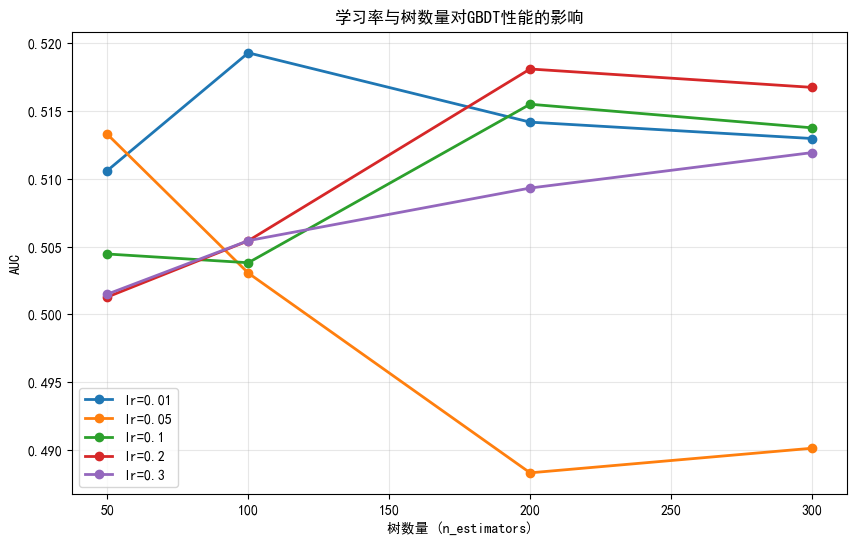
最佳组合: learning_rate=0.01, n_estimators=100.0
最佳AUC: 0.5193
learning_rate      0.010000
n_estimators     100.000000
auc                0.519302
Name: 1, dtype: float64
5. GBDT 超参数调优
5.1 网格搜索
python
def grid_search_gbdt(X_train, y_train, X_test, y_test):
    """GBDT 网格搜索"""

    # 定义参数网格
    param_grid = {
        'n_estimators': [100, 200],
        'max_depth': [3, 4, 5],
        'min_samples_split': [2, 5, 10],
        'learning_rate': [0.05, 0.1]
    }

    # 时间序列交叉验证
    tscv = TimeSeriesSplit(n_splits=3)

    gbdt = GradientBoostingClassifier(random_state=42)

    grid_search = GridSearchCV(
        gbdt, param_grid,
        cv=tscv,
        scoring='roc_auc',
        n_jobs=-1,
        verbose=1
    )

    print("开始网格搜索...")
    start_time = time.time()
    grid_search.fit(X_train, y_train)
    elapsed = time.time() - start_time

    print(f"\n搜索完成,耗时: {elapsed:.2f}秒")
    print(f"最佳参数: {grid_search.best_params_}")
    print(f"最佳CV AUC: {grid_search.best_score_:.4f}")

    # 测试集评估
    y_pred = grid_search.predict(X_test)
    y_proba = grid_search.predict_proba(X_test)[:, 1]

    print(f"\n测试集准确率: {accuracy_score(y_test, y_pred):.4f}")
    print(f"测试集AUC: {roc_auc_score(y_test, y_proba):.4f}")

    return grid_search.best_estimator_

# 执行网格搜索(使用子集加速)
print("GBDT 超参数调优...")
X_sample = X_train[:2000]
y_sample = y_train[:2000]
best_gbdt = grid_search_gbdt(X_sample, y_sample, X_test, y_test)GBDT 超参数调优...
开始网格搜索...
Fitting 3 folds for each of 36 candidates, totalling 108 fits
搜索完成,耗时: 38.98秒
最佳参数: {'learning_rate': 0.05, 'max_depth': 5, 'min_samples_split': 10, 'n_estimators': 200}
最佳CV AUC: 0.5195
测试集准确率: 0.4918
测试集AUC: 0.51085.2 早停(Early Stopping)
python
def early_stopping_demo(X_train, y_train, X_test, y_test):
    """演示早停机制"""

    # 划分验证集
    split_idx = int(len(X_train) * 0.8)
    X_train_sub = X_train[:split_idx]
    y_train_sub = y_train[:split_idx]
    X_val = X_train[split_idx:]
    y_val = y_train[split_idx:]

    # 训练不同树数量的模型
    n_estimators_list = range(10, 310, 20)
    train_scores = []
    val_scores = []

    for n in n_estimators_list:
        gbdt = GradientBoostingClassifier(
            n_estimators=n,
            learning_rate=0.1,
            max_depth=3,
            random_state=42
        )
        gbdt.fit(X_train_sub, y_train_sub)

        train_scores.append(roc_auc_score(y_train_sub, gbdt.predict_proba(X_train_sub)[:, 1]))
        val_scores.append(roc_auc_score(y_val, gbdt.predict_proba(X_val)[:, 1]))

    # 绘图
    plt.figure(figsize=(10, 6))
    plt.plot(n_estimators_list, train_scores, 'b-o', label='训练集', linewidth=2)
    plt.plot(n_estimators_list, val_scores, 'r-s', label='验证集', linewidth=2)
    plt.xlabel('树数量 (n_estimators)')
    plt.ylabel('AUC')
    plt.title('早停原理:验证集AUC先升后降')
    plt.legend()
    plt.grid(True, alpha=0.3)

    # 标记最佳点
    best_idx = np.argmax(val_scores)
    best_n = n_estimators_list[best_idx]
    plt.axvline(x=best_n, color='green', linestyle='--', label=f'最佳树数量={best_n}')
    plt.legend()
    plt.show()

    print(f"最佳树数量: {best_n}")
    print(f"训练集AUC: {train_scores[best_idx]:.4f}")
    print(f"验证集AUC: {val_scores[best_idx]:.4f}")

early_stopping_demo(X_train, y_train, X_test, y_test)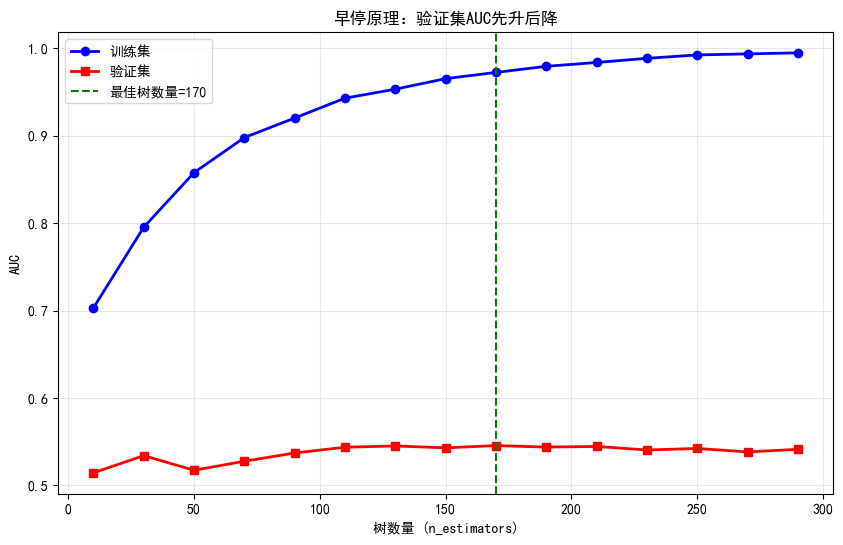
最佳树数量: 170
训练集AUC: 0.9723
验证集AUC: 0.5456
6. 模型综合对比
6.1 训练所有模型
python
print("="*70)
print("模型综合对比")
print("="*70)

# 随机森林
rf = RandomForestClassifier(n_estimators=100, max_depth=10, random_state=42, n_jobs=-1)
rf.fit(X_train, y_train)
rf_pred = rf.predict(X_test)
rf_proba = rf.predict_proba(X_test)[:, 1]

# AdaBoost
ada = AdaBoostClassifier(n_estimators=100, learning_rate=1.0, random_state=42)
ada.fit(X_train, y_train)
ada_pred = ada.predict(X_test)
ada_proba = ada.predict_proba(X_test)[:, 1]

# GBDT
gbdt = GradientBoostingClassifier(n_estimators=100, learning_rate=0.1, max_depth=3, random_state=42)
gbdt.fit(X_train, y_train)
gbdt_pred = gbdt.predict(X_test)
gbdt_proba = gbdt.predict_proba(X_test)[:, 1]

# 收集结果
models = {
    '随机森林': (rf_pred, rf_proba),
    'AdaBoost': (ada_pred, ada_proba),
    'GBDT': (gbdt_pred, gbdt_proba)
}

results = []
for name, (pred, proba) in models.items():
    results.append({
        '模型': name,
        '准确率': accuracy_score(y_test, pred),
        '精确率': precision_score(y_test, pred),
        '召回率': recall_score(y_test, pred),
        'F1': f1_score(y_test, pred),
        'AUC': roc_auc_score(y_test, proba)
    })

results_df = pd.DataFrame(results)
print("\n性能对比:")
print(results_df.to_string(index=False))======================================================================
模型综合对比
======================================================================
性能对比:
模型 准确率 精确率 召回率 F1 AUC
随机森林 0.502717 0.481973 0.731988 0.581236 0.500100
AdaBoost 0.502717 0.483536 0.804035 0.603896 0.511353
GBDT 0.491848 0.473684 0.700288 0.565116 0.5038126.2 ROC曲线对比
python
plt.figure(figsize=(12, 8))

colors = {'随机森林': 'blue', 'AdaBoost': 'green', 'GBDT': 'red'}
for name, (_, proba) in models.items():
    fpr, tpr, _ = roc_curve(y_test, proba)
    auc = roc_auc_score(y_test, proba)
    plt.plot(fpr, tpr, color=colors[name], linewidth=2,
             label=f'{name} (AUC={auc:.4f})')

plt.plot([0, 1], [0, 1], 'k--', linewidth=1, label='随机分类器')
plt.xlabel('假阳性率 (FPR)')
plt.ylabel('真阳性率 (TPR)')
plt.title('Boosting vs 随机森林 ROC曲线对比')
plt.legend(loc='lower right')
plt.grid(True, alpha=0.3)
plt.show()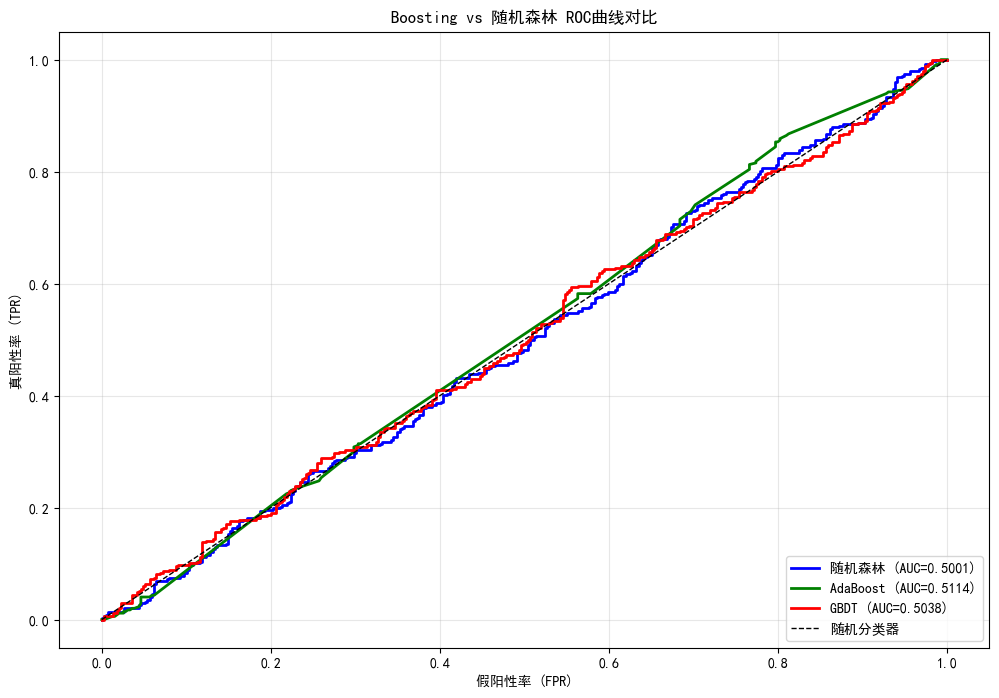
6.3 混淆矩阵对比
python
fig, axes = plt.subplots(1, 3, figsize=(15, 4))

for idx, (name, (pred, _)) in enumerate(models.items()):
    cm = confusion_matrix(y_test, pred)
    sns.heatmap(cm, annot=True, fmt='d', cmap='Blues', ax=axes[idx],
                xticklabels=['下跌', '上涨'], yticklabels=['下跌', '上涨'])
    axes[idx].set_title(f'{name}\n准确率: {accuracy_score(y_test, pred):.4f}')
    axes[idx].set_xlabel('预测')
    axes[idx].set_ylabel('真实')

plt.tight_layout()
plt.show()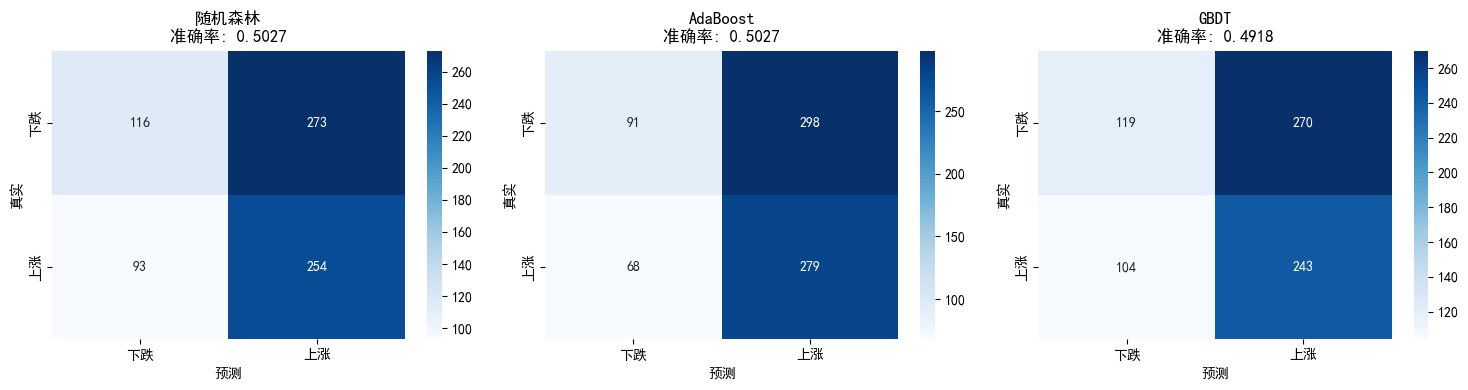
7. GBDT 特征重要性分析
7.1 特征重要性可视化
python
# 获取特征重要性
importances_gbdt = gbdt.feature_importances_
importance_df = pd.DataFrame({
    'feature': feature_cols,
    'importance': importances_gbdt
}).sort_values('importance', ascending=True)

plt.figure(figsize=(10, 6))
plt.barh(importance_df['feature'], importance_df['importance'])
plt.xlabel('重要性')
plt.title('GBDT 特征重要性')
for i, (_, row) in enumerate(importance_df.iterrows()):
    plt.text(row['importance'] + 0.002, i, f"{row['importance']:.4f}", va='center')
plt.grid(True, alpha=0.3)
plt.tight_layout()
plt.show()

print("特征重要性排序:")
print(importance_df.sort_values('importance', ascending=False).to_string(index=False))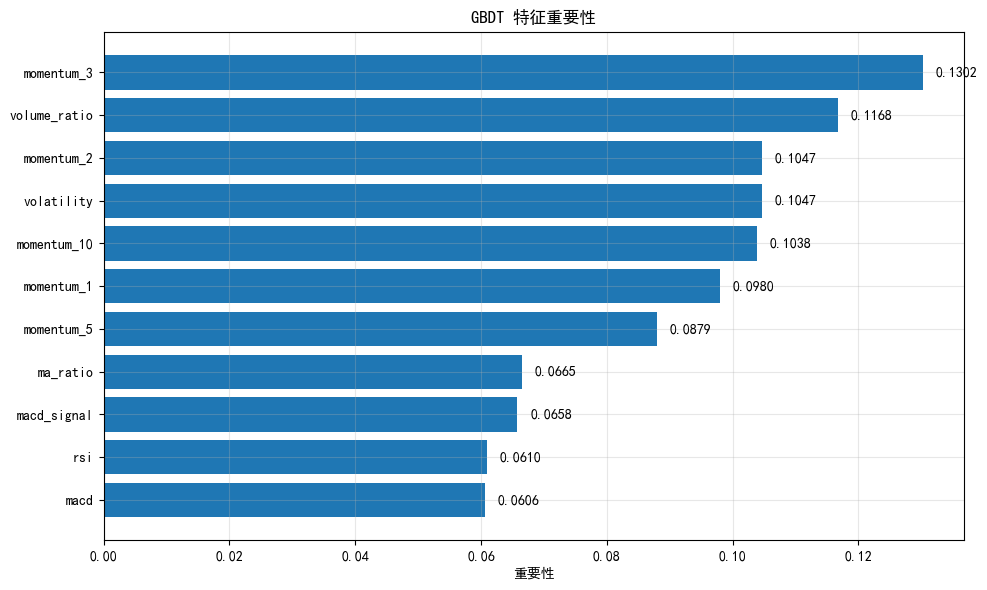
特征重要性排序:
     feature  importance
  momentum_3    0.130215
volume_ratio    0.116798
  momentum_2    0.104701
  volatility    0.104672
 momentum_10    0.103805
  momentum_1    0.097966
  momentum_5    0.087941
    ma_ratio    0.066498
 macd_signal    0.065796
         rsi    0.061013
        macd    0.060596
7.2 累积重要性曲线
python
# 累积重要性
sorted_importance = importance_df.sort_values('importance', ascending=False)['importance'].values
cumulative_importance = np.cumsum(sorted_importance)

plt.figure(figsize=(10, 6))
plt.plot(range(1, len(cumulative_importance) + 1), cumulative_importance, 'bo-', linewidth=2)
plt.axhline(y=0.9, color='r', linestyle='--', label='90% 阈值')
plt.axhline(y=0.95, color='g', linestyle='--', label='95% 阈值')
plt.xlabel('特征数量')
plt.ylabel('累积重要性')
plt.title('GBDT 累积特征重要性')
plt.legend()
plt.grid(True, alpha=0.3)

# 找到达到90%的特征数量
n_90 = np.argmax(cumulative_importance >= 0.9) + 1
n_95 = np.argmax(cumulative_importance >= 0.95) + 1
plt.axvline(x=n_90, color='r', linestyle=':', alpha=0.5)
plt.axvline(x=n_95, color='g', linestyle=':', alpha=0.5)
plt.text(n_90, 0.5, f'{n_90}个特征达90%', rotation=90)
plt.text(n_95, 0.5, f'{n_95}个特征达95%', rotation=90)

plt.show()

print(f"前 {n_90} 个特征贡献了 90% 的重要性")
print(f"前 {n_95} 个特征贡献了 95% 的重要性")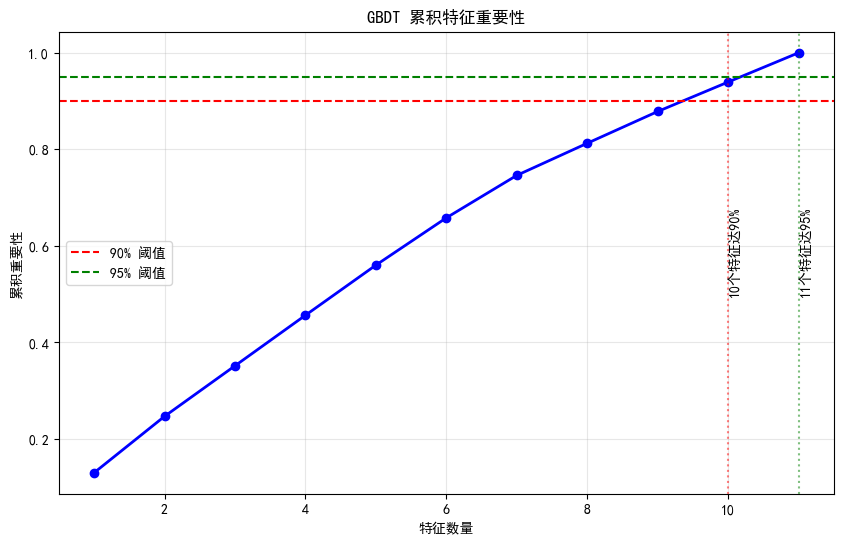
前 10 个特征贡献了 90% 的重要性
前 11 个特征贡献了 95% 的重要性
8. 学习曲线分析
GBDT 学习曲线
python
def plot_gbdt_learning_curve(X_train, y_train, X_val, y_val, max_estimators=300):
    """绘制GBDT的学习曲线"""

    train_scores = []
    val_scores = []
    n_list = range(10, max_estimators + 10, 20)

    for n in n_list:
        gbdt = GradientBoostingClassifier(
            n_estimators=n,
            learning_rate=0.1,
            max_depth=3,
            random_state=42
        )
        gbdt.fit(X_train, y_train)

        train_scores.append(roc_auc_score(y_train, gbdt.predict_proba(X_train)[:, 1]))
        val_scores.append(roc_auc_score(y_val, gbdt.predict_proba(X_val)[:, 1]))

    plt.figure(figsize=(10, 6))
    plt.plot(n_list, train_scores, 'b-o', label='训练集', linewidth=2)
    plt.plot(n_list, val_scores, 'r-s', label='验证集', linewidth=2)
    plt.xlabel('树数量 (n_estimators)')
    plt.ylabel('AUC')
    plt.title('GBDT 学习曲线')
    plt.legend()
    plt.grid(True, alpha=0.3)

    # 标记最佳点
    best_idx = np.argmax(val_scores)
    best_n = n_list[best_idx]
    plt.axvline(x=best_n, color='green', linestyle='--', label=f'最佳={best_n}')
    plt.legend()
    plt.show()

    print(f"最佳树数量: {best_n}")
    print(f"训练集AUC: {train_scores[best_idx]:.4f}")
    print(f"验证集AUC: {val_scores[best_idx]:.4f}")
    print(f"过拟合差距: {train_scores[best_idx] - val_scores[best_idx]:.4f}")

# 划分验证集
split_val = int(len(X_train) * 0.8)
X_train_sub = X_train[:split_val]
y_train_sub = y_train[:split_val]
X_val = X_train[split_val:]
y_val = y_train[split_val:]

plot_gbdt_learning_curve(X_train_sub, y_train_sub, X_val, y_val)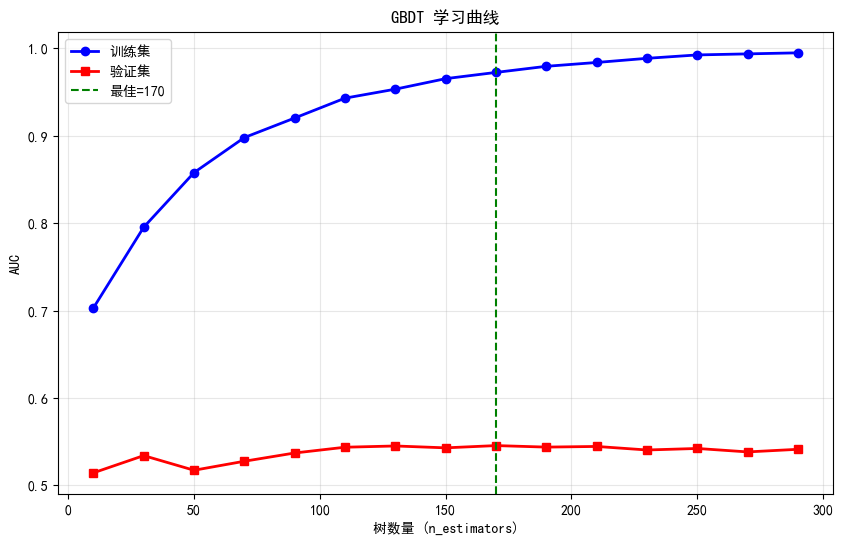
最佳树数量: 170
训练集AUC: 0.9723
验证集AUC: 0.5456
过拟合差距: 0.4266
9. Boosting vs Bagging 深入对比
偏差-方差分解
python
def bias_variance_analysis(X_train, y_train, X_test, y_test, n_experiments=10):
    """分析模型的偏差和方差"""

    models = {
        '随机森林': RandomForestClassifier(n_estimators=100, max_depth=10, random_state=None),
        'GBDT': GradientBoostingClassifier(n_estimators=100, learning_rate=0.1, max_depth=3, random_state=None)
    }

    results = {}

    for name, model in models.items():
        predictions = []

        for seed in range(n_experiments):
            np.random.seed(seed)
            model.set_params(random_state=seed)

            # 使用不同的训练子集
            indices = np.random.choice(len(X_train), len(X_train), replace=True)
            X_sample = X_train.iloc[indices]
            y_sample = y_train.iloc[indices]

            model.fit(X_sample, y_sample)
            pred = model.predict(X_test)
            predictions.append(pred)

        predictions = np.array(predictions)

        # 计算偏差和方差
        mean_pred = np.mean(predictions, axis=0)
        bias = np.mean(mean_pred != y_test)
        variance = np.mean(np.var(predictions, axis=0))

        results[name] = {'bias': bias, 'variance': variance}

    return pd.DataFrame(results).T

# 偏差-方差分析(使用子集加速)
print("偏差-方差分析(10次实验)...")
X_sample_analysis = X_train[:1000]
y_sample_analysis = y_train[:1000]
bias_var_df = bias_variance_analysis(X_sample_analysis, y_sample_analysis, X_test, y_test)

print("\n偏差-方差分析结果:")
print(bias_var_df)

# 可视化
fig, axes = plt.subplots(1, 2, figsize=(12, 5))

axes[0].bar(bias_var_df.index, bias_var_df['bias'])
axes[0].set_ylabel('偏差')
axes[0].set_title('模型偏差对比(越低越好)')
axes[0].grid(True, alpha=0.3)

axes[1].bar(bias_var_df.index, bias_var_df['variance'])
axes[1].set_ylabel('方差')
axes[1].set_title('模型方差对比(越低越好)')
axes[1].grid(True, alpha=0.3)

plt.tight_layout()
plt.show()

print("\n解读:")
print("- 随机森林: 方差较低(Bagging优势),偏差可能略高")
print("- GBDT: 偏差较低(Boosting优势),方差可能较高")
print("- 理想模型: 低偏差 + 低方差(需要平衡)")偏差-方差分析(10次实验)...
偏差-方差分析结果:
bias variance
随机森林 0.877717 0.137622
GBDT 0.938859 0.170421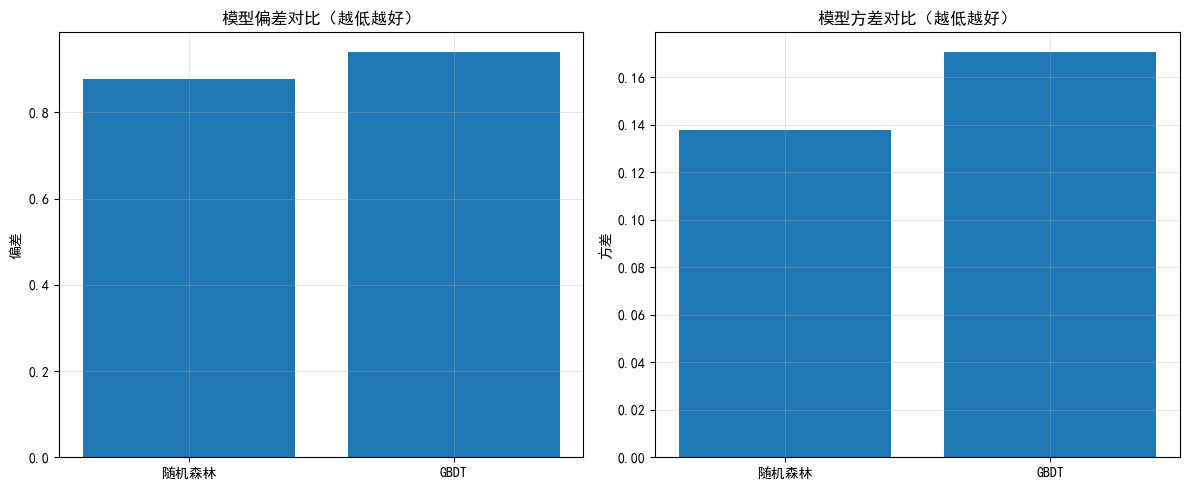
解读:
- 随机森林: 方差较低(Bagging优势),偏差可能略高
- GBDT: 偏差较低(Boosting优势),方差可能较高
- 理想模型: 低偏差 + 低方差(需要平衡)
10. 今日总结
text
================================================================================
                        Day 10 学习总结
================================================================================-
Boosting 核心概念:
- 串行训练,关注错误样本
- 加权组合弱学习器
- 降低偏差,可能增加方差
-
AdaBoost:
- 调整样本权重和模型权重
- 指数损失函数
- 对异常值敏感
-
GBDT:
- 函数空间梯度下降
- 拟合负梯度(伪残差)
- 支持多种损失函数
-
超参数要点:
- learning_rate × n_estimators ≈ 常数
- 小学习率 + 多棵树通常更好
- 使用早停防止过拟合
-
模型对比:
- 随机森林: 方差低,对异常值鲁棒
- AdaBoost: 简单高效,但敏感
- GBDT: 精度高,需要调参
-
量化应用建议:
- 先用随机森林作为基准
- 如需更高精度,尝试GBDT
- 注意防止时间序列过拟合
- 使用时间序列交叉验证
-
扩展作业
- 作业1:实现自定义的GBDT损失函数
- 作业2:使用早停训练GBDT,找到最佳树数量
- 作业3:在实际股票数据上对比AdaBoost、GBDT和XGBoost
- 作业4:分析GBDT的预测概率是否校准(使用校准曲线)
-
量化思考
- Boosting模型通常比随机森林精度更高
- 但更容易过拟合,需要更谨慎的验证
- 学习率是关键参数,建议从0.05开始
- 时间序列数据建议使用TimeSeriesSplit验证