线程池是一种"池化"技术(类似内存池、连接池),它预先创建一组线程,然后不断从任务队列中取出任务并执行。这样做的好处是:
-
避免频繁创建/销毁线程的开销(线程创建和销毁涉及系统调用,成本较高)。
-
控制并发线程数量,防止因线程过多导致内存耗尽或调度过载。
-
任务解耦:生产者(提交任务的模块)和消费者(工作线程)通过队列通信,提高响应速度。
一、前置依赖模块
为了专注线程池逻辑,我们先回顾会用到的几个封装类:
1. Thread 线程封装
#ifndef _THREAD_H_
#define _THREAD_H_

#include <iostream>
#include <string>
#include <pthread.h>
#include <cstdio>
#include <cstring>
#include <functional>
#include "Log.hpp"
using namespace LogModule;

namespace ThreadModlue
{
    static uint32_t number = 1; // bug

    class Thread
    {
        using func_t = std::function<void()>; // 暂时这样写,完全够了
    private:
        void EnableDetach()
        {
            _isdetach = true;
        }
        void EnableRunning()
        {
            _isrunning = true;
        }
        static void *Routine(void *args) // 属于类内的成员函数,默认包含this指针!
        {
            Thread *self = static_cast<Thread *>(args);
            self->EnableRunning();
            if (self->_isdetach)
                self->Detach();
            pthread_setname_np(self->_tid, self->_name.c_str());
            self->_func(); // 回调处理

            return nullptr;
        }
        // bug
    public:
        Thread(func_t func)
            : _tid(0),
              _isdetach(false),
              _isrunning(false),
              res(nullptr),
              _func(func)
        {
            _name = "thread-" + std::to_string(number++);
        }
        void Detach()
        {
            if (_isdetach)
                return;
            if (_isrunning)
                pthread_detach(_tid);
            EnableDetach();
        }
        std::string Name()
        {
            return _name;
        }

        bool Start()
        {
            if (_isrunning)
                return false;
            int n = pthread_create(&_tid, nullptr, Routine, this);
            if (n != 0)
            {
                return false;
            }
            else
            {
                return true;
            }
        }
        bool Stop()
        {
            if (_isrunning)
            {
                int n = pthread_cancel(_tid);
                if (n != 0)
                {
                    return false;
                }
                else
                {
                    _isrunning = false;
                    return true;
                }
            }
            return false;
        }
        void Join()
        {
            if (_isdetach)
            {
                return;
            }
            int n = pthread_join(_tid, &res);
            if (n != 0)
            {
                LOG(LogLevel::DEBUG) << "join线程失败";
            }
            else
            {
                LOG(LogLevel::DEBUG) << "join线程成功";
            }
        }
        ~Thread()
        {
        }

    private:
        pthread_t _tid;
        std::string _name;
        bool _isdetach;
        bool _isrunning;
        void *res;
        func_t _func;
    };
}

#endif
关键点:线程的执行体是
_func,在 Start 中通过 pthread_create 调用一个静态函数,再调用 _func。
2. 互斥锁封装
#pragma once

#include <iostream>
#include <pthread.h>

namespace MutexModule
{
    class Mutex
    {
    public:
        Mutex()
        {
            pthread_mutex_init(&_mutex, nullptr);
        }
        void Lock()
        {
            int n = pthread_mutex_lock(&_mutex);
            (void)n;
        }
        void Unlock()
        {
            int n = pthread_mutex_unlock(&_mutex);
            (void)n;
        }
        ~Mutex()
        {
            pthread_mutex_destroy(&_mutex);
        }
        pthread_mutex_t *Get()
        {
            return &_mutex;
        }
    private:
        pthread_mutex_t _mutex;
    };

    class LockGuard
    {
    public:
        LockGuard(Mutex &mutex) : _mutex(mutex)
        {
            _mutex.Lock();
        };
        ~LockGuard()
        {
            _mutex.Unlock();
        };

    private:
        Mutex &_mutex;
    };
}
3. 条件变量封装(Cond.hpp)
#pragma once

#include <iostream>
#include <pthread.h>
#include "Mutex.hpp"

using namespace MutexModule;

namespace CondModule
{
    class Cond
    {
    public:
        Cond()
        {
            pthread_cond_init(&_cond, nullptr);
        }
        void Wait(Mutex &mutex)
        {
            int n = pthread_cond_wait(&_cond, mutex.Get());
            (void)n;
        }
        void Signal()
        {
            // 唤醒在条件变量下等待的一个线程
            int n = pthread_cond_signal(&_cond);
            (void)n;
        }
        void Broadcast()
        {
            // 唤醒所有在条件变量下等待的线程
            int n = pthread_cond_broadcast(&_cond);
            (void)n;
        }
        ~Cond()
        {
            pthread_cond_destroy(&_cond);
        }
    private:
        pthread_cond_t _cond;
    };
};
4. 日志系统(Log.hpp)
#ifndef __LOG_HPP__
#define __LOG_HPP__

#include <iostream>
#include <filesystem> //c++17
#include <fstream>
#include <string>
#include <cstdio>
#include <memory>
#include <unistd.h>
#include <ctime>
#include <sstream>
#include "Mutex.hpp"

using namespace MutexModule;

namespace LogModule
{
    const std::string gsep = "\r\n";
    // 策略模式 -- C++多态特性
    //  2.刷新策略 a:显示器打印 b:向指定的文件写入
    //  刷新策略基类
    class LogStrategy
    {
    public:
        ~LogStrategy() = default;
        virtual void SyncLog(const std::string &message) = 0;

    private:
    };

    // 显示器打印日志的策略:子类
    class ConsoleLogStrategy : public LogStrategy
    {
    public:
        ConsoleLogStrategy()
        {
        }
        void SyncLog(const std::string &message) override
        {
            LockGuard lockguard(_mutex);
            std::cout << message << gsep;
        }
        ~ConsoleLogStrategy()
        {
        }

    private:
        Mutex _mutex; // 显示器也是临界资源,保证输出线程安全
    };

    // 文件打印日志的策略 : 子类
    const std::string defaultPath = "./log";
    const std::string defaultfile = "log.log";
    class FileLogStrategy : public LogStrategy
    {
    public:
        FileLogStrategy(const std::string &path = defaultPath, const std::string &file = defaultfile)
            : _path(path),
              _file(file)
        {
            LockGuard lockguard(_mutex);
            if (std::filesystem::exists(_path))
            {
                return;
            }
            try
            {
                std::filesystem::create_directories(_path);
            }
            catch (const std::filesystem::filesystem_error &e)
            {
                std::cerr << e.what() << "\n";
            }
        }
        void SyncLog(const std::string &message) override
        {
            LockGuard lockguard(_mutex);
            std::string filename = _path + (_path.back() == '/' ? "" : "/") + _file;
            //"./log/" + "my.log"
            std::ofstream out(filename, std::ios::app); // 以追加写入的方式打开
            if (!out.is_open())
            {
                return;
            }
            out << message << gsep;
            out.close();
        }

        ~FileLogStrategy()
        {
        }

    private:
        std::string _path; // 日志文件所在的路径
        std::string _file; // 日志文件本身

        Mutex _mutex;
    };

    // 形成一条完整的日志&&根据上面的策略,选择不同的刷新方式

    // 1.形成日志等级
    enum class LogLevel
    {
        DEBUG,
        INFO,
        WARNING,
        ERROR,
        FATAL
    };
    std::string Level2Str(LogLevel level)
    {
        switch (level)
        {
        case LogLevel::DEBUG:
            return "DEBUG";
        case LogLevel::INFO:
            return "INFO";
        case LogLevel::WARNING:
            return "WARNING";
        case LogLevel::ERROR:
            return "ERROR";
        case LogLevel::FATAL:
            return "FATAL";
        default:
            return "UNKNOWN";
        }
    }
    std::string GetTimeStamp()
    {
        time_t curr = time(nullptr);
        struct tm curr_tm;
        localtime_r(&curr, &curr_tm);
        char timebuffer[128];
        snprintf(timebuffer, sizeof(timebuffer), "%4d-%02d-%02d %02d:%02d:%02d",
                 curr_tm.tm_year+1900,
                 curr_tm.tm_mon+1,
                 curr_tm.tm_mday,
                 curr_tm.tm_hour,
                 curr_tm.tm_min,
                 curr_tm.tm_sec);
        return timebuffer;
    }

    // 1.形成日志 && 2.根据不同的策略,完成刷新
    class Logger
    {
    public:
        Logger()
        {
            EnableConsoleLogStrategy();
        }
        void EnableFileLogStrategy()
        {
            _fflush_strategy = std::make_unique<FileLogStrategy>();
        }
        void EnableConsoleLogStrategy()
        {
            _fflush_strategy = std::make_unique<ConsoleLogStrategy>();
        }

        // 内部类  表示的是未来的一条日志
        class LogMessage
        {
        public:
            LogMessage(LogLevel &level, std::string &src_name, int line_number, Logger &logger)
                : _curr_time(GetTimeStamp()),
                  _level(level),
                  _pid(getpid()),
                  _src_name(src_name),
                  _line_number(line_number),
                  _logger(logger)
            {
                // 日志左边部分,合并起来
                std::stringstream ss;
                ss << "[" << _curr_time << "]"
                   << "[" << Level2Str(_level) << "]"
                   << "[" << _pid << "]"
                   << "[" << _src_name << "]"
                   << "[" << _line_number << "]"
                   << "- ";
                _loginfo = ss.str();
            };

            // LogMessage() << "hello world" << "xxxx" << 3.14 << 1234;
            // 需要支持重载
            template <typename T>
            LogMessage &operator<<(const T &info)
            {
                // 日志右边部分,可变的
                std::stringstream ss;
                ss << info;
                _loginfo += ss.str();
                return *this;
            }

            ~LogMessage()
            {
                if (_logger._fflush_strategy)
                {
                    _logger._fflush_strategy->SyncLog(_loginfo);
                }
            };

        private:
            std::string _curr_time;
            LogLevel _level;
            pid_t _pid;
            std::string _src_name;
            int _line_number;
            std::string _loginfo; // 合并完成之后,一条完整的信息
            Logger &_logger;
        };
        // 这里故意写成返回临时对象
        LogMessage operator()(LogLevel level, std::string name, int line)
        {
            return LogMessage(level, name, line, *this);
        }
        ~Logger() {}

    private:
        std::unique_ptr<LogStrategy> _fflush_strategy;
    };

    // 全局日志对象
    Logger logger;

// 使用宏,简化用户操作,获取文件名和行号
#define LOG(level) logger(level, __FILE__, __LINE__)
#define Enable_Console_Log_Stratege() logger.EnableConsoleLogStrategy();
#define Enable_File_Log_Stratege() logger.EnableFileLogStrategy();
}

#endif
5.Makefile
threadpool:Main.cc
	g++ -o $@ $^ -std=c++17 -lpthread
.PHONY:clean
clean:
	rm -f threadpool
二、线程池
2.1 ThreadPool.hpp
#pragma once
#include <iostream>
#include <string>
#include "Log.hpp"
#include <vector>
#include <queue>
#include "Cond.hpp"
#include " Thread.hpp"

namespace ThreadPoolModule
{
    using namespace ThreadModlue;
    using namespace LogModule;
    using namespace CondModule;
    using namespace MutexModule;

    static const int gnum = 4;
    template <typename T>
    class ThreadPool
    {
    private:
        void WakeUpAllThread()
        {
            LockGuard localguard(_mutex);
            if (_sleepernum)
                _cond.Broadcast();
            LOG(LogLevel::INFO) << "唤醒所有的休眠的线程";
        }
        void WakeUpOne()
        {
            _cond.Signal();
            LOG(LogLevel::INFO) << "唤醒一个的休眠的线程";
        }

    public:
        ThreadPool(int num = gnum) : _num(num), _isrunning(false), _sleepernum(0)
        {
            for (int i = 0; i < num; i++)
            {
                _threads.emplace_back(
                    [this]()
                    {
                        HandlerTask();
                    });
            }
        }

        void Start()
        {
            if (_isrunning)
                return; // 如果线程已经启动了,返回
            _isrunning = true;
            for (auto &thread : _threads)
            {
                thread.Start();
                LOG(LogLevel::INFO) << "create new thread success: " << thread.Name();
            }
        }
        void Stop()
        {
            if (!_isrunning)
                return;
            _isrunning = false;

            // 唤醒所有线程
            WakeUpAllThread();
        }
        void Join()
        {
            for (auto &thread : _threads)
            {
                thread.Join();
            }
        }
        void HandlerTask()
        {
            char name[128];
            pthread_getname_np(pthread_self(), name, sizeof(name));
            while (true)
            {
                T t;
                {
                    LockGuard lockguard(_mutex);
                    // 1.a.队列是否为空  b.线程池没有退出
                    while (_taskq.empty() && _isrunning)
                    {
                        _sleepernum++;
                        _cond.Wait(_mutex);
                        _sleepernum--;
                    }

                    // 2.内部的线程被唤醒
                    if (!_isrunning && _taskq.empty())
                    {
                        LOG(LogLevel::INFO) << name << "退出了,线程池退出&&任务队列为空";
                        break;
                    }

                    // 一定有任务
                    t = _taskq.front(); // 从q中获取任务,任务已经是线程私有的了
                    _taskq.pop();
                }
                t(); // 处理任务,需要在临界区内部处理吗?
            }
        }
        bool Enqueue(const T &in)
        {
            if (_isrunning)
            {
                LockGuard lockguard(_mutex);
                _taskq.push(in);
                if (_threads.size() - _sleepernum == 0)
                    WakeUpOne();
                return true;
            }
            return false;
        }
        ~ThreadPool() {};

    private:
        std::vector<Thread> _threads;
        int _num; // 线程池中,线程的个数
        std::queue<T> _taskq;
        Cond _cond;
        Mutex _mutex;

        bool _isrunning;
        int _sleepernum;
    };
}
2.2 Task.hpp
#pragma once

#include <iostream>
#include <unistd.h>
#include <functional>
#include "Log.hpp"

using task_t = std::function<void()>;

using namespace LogModule;
void Download()
{
    LOG(LogLevel::DEBUG) << "我是一个下载任务...";
}
2.3 Main.cc
#include "Log.hpp"
#include "ThreadPool.hpp"
#include <memory>
#include "Task.hpp"

using namespace LogModule;
using namespace ThreadPoolModule;

int main()
{
    Enable_Console_Log_Stratege();
    ThreadPool<task_t> *tp = new ThreadPool<task_t>();
    tp->Start();
    int count = 10;

    while(count)
    {
        tp->Enqueue(Download);
        sleep(1);
        count--;
    }

    tp->Stop();
    tp->Join();
}
2.4 常见问题解析
1. 模板参数 T
ThreadPool是一个模板类,T代表任务类型。通常我们使用std::function<void()>作为任务类型,这样任何可调用对象(函数指针、lambda、std::bind结果等)都可以作为任务包装。
2. 工作线程的主循环 HandlerTask
       void HandlerTask()
        {
            char name[128];
            pthread_getname_np(pthread_self(), name, sizeof(name));
            while (true)
            {
                T t;
                {
                    LockGuard lockguard(_mutex);
                    // 1.a.队列是否为空  b.线程池没有退出
                    while (_taskq.empty() && _isrunning)
                    {
                        _sleepernum++;
                        _cond.Wait(_mutex);
                        _sleepernum--;
                    }

                    // 2.内部的线程被唤醒
                    if (!_isrunning && _taskq.empty())
                    {
                        LOG(LogLevel::INFO) << name << "退出了,线程池退出&&任务队列为空";
                        break;
                    }

                    // 一定有任务
                    t = _taskq.front(); // 从q中获取任务,任务已经是线程私有的了
                    _taskq.pop();
                }
                t(); // 处理任务,需要在临界区内部处理吗?
            }
}线程池中工作线程的核心循环 ,它的作用是:不断从任务队列中取出任务并执行,如果队列为空就休眠等待,当线程池要退出时能正确终止。
为什么要用 while 而不是 if?
-
条件变量可能被伪唤醒 (spurious wakeup),或者被
NotifyAll唤醒时队列仍然为空(比如另一个线程抢先取走了任务)。 -
while循环确保被唤醒后重新检查条件,只有队列非空或线程池停止时才退出循环。
_sleepernum 的作用 :
-
记录当前有多少线程因为队列空而处于休眠等待状态。
-
在
Enqueue时,如果_sleepernum > 0,可以只唤醒一个线程(_cond.Notify())来取任务,避免唤醒所有线程造成"惊群效应"。这是一种性能优化。
_cond.Wait(_mutex) 的原子操作 :
-
进入
Wait后,会自动释放_mutex锁,然后当前线程挂起。 -
当被
Notify或NotifyAll唤醒后,会重新竞争_mutex锁,获得锁后才从Wait返回。 -
因此,从
Wait返回时,线程已经再次持有锁 ,可以安全地访问共享的_taskq。
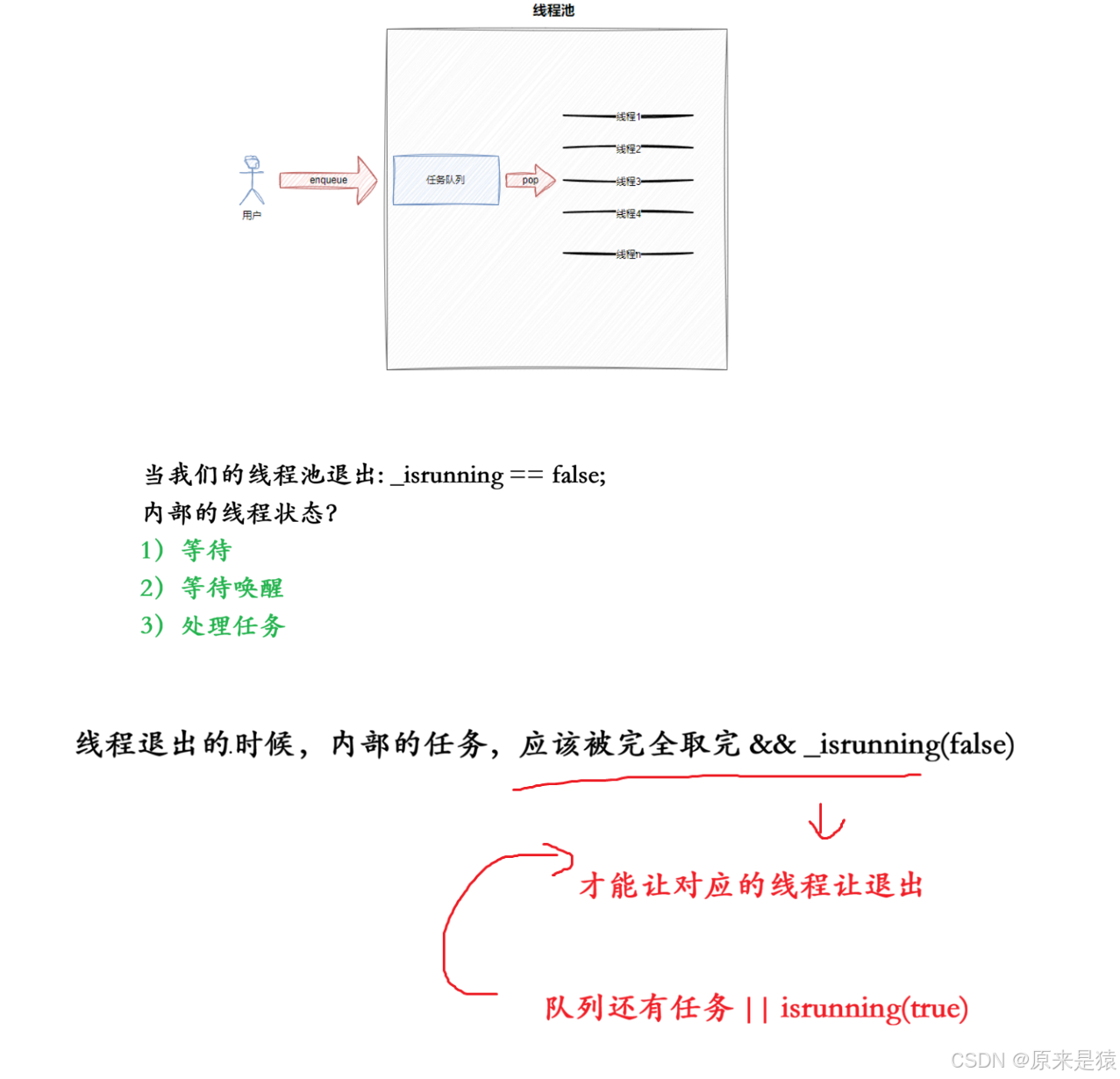
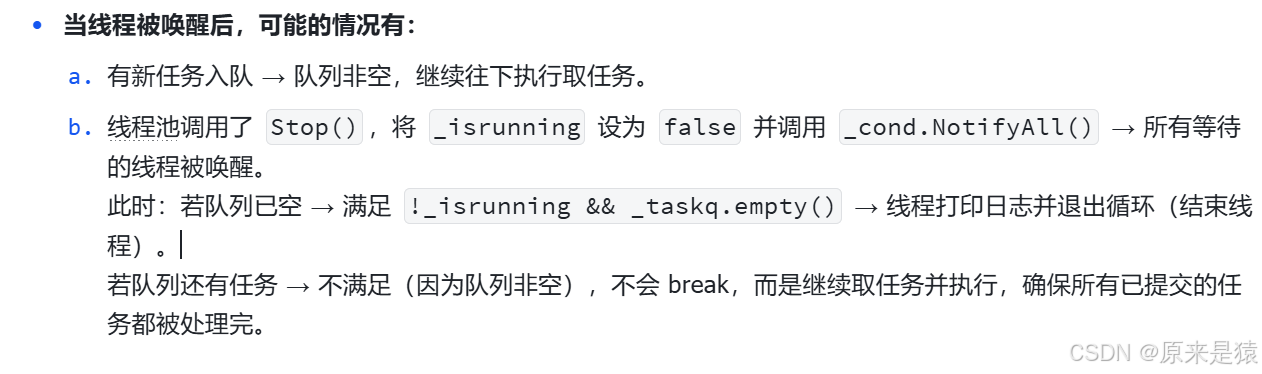
3. 检查退出条件
if (!_isrunning && _taskq.empty())
{
    LOG(LogLevel::INFO) << name << "退出了,线程池退出&&任务队列为空";
    break;
}
4. 执行任务(无锁)
t(); // 处理任务,在临界区外执行
为什么要在临界区外执行任务?
-
任务执行可能耗时很长(比如处理复杂计算或 I/O)。如果在锁内执行,其他工作线程无法访问任务队列,导致并发度下降。
-
先取出任务并释放锁,让其他线程可以同时取任务或入队,提高吞吐量。
5. 完整循环的三种退出路径
| 情况 | 条件 | 行为 |
|---|---|---|
| 正常处理任务 | 队列非空 | 取任务,执行,继续循环 |
| 队列空且线程池运行中 | _taskq.empty() && _isrunning |
进入 Wait 休眠,直到被唤醒 |
| 线程池停止且队列空 | !_isrunning && _taskq.empty() |
break 退出循环,线程结束 |