背景
JEP 395: Records 中提到 JDK 16 正式支持记录类( Record Classes)。那么记录类在 class 文件中长什么样子呢?让我们一起来探索吧。
要点
- 规范构造函数( canonical constructor)
- 如果我们在记录类中没有定义构造函数,那么记录类中会出现隐式的 canonical constructor
- 对每个 Record Component 而言
- 记录类中会有一个与之对应的 private, final, 非 static 字段
- 记录类中会有一个与之对应的被称为 accessor method 的方法
正文
例子
我从 JEP 395: Records 里找了个例子 ⬇️ (略有改动)
java
public record Point(int x, int y) {
}
我们将上述代码保存为 Point.java。下方的命令可以编译 Point.java (请注意,所使用的 javac 版本应当高于或者等于 16)
bash
javac Point.java编译后,会得到 Point.class 文件。使用如下命令可以查看 Point.class 的内容
bash
javap -p Point这个命令在我电脑上运行的结果如下 ⬇️
text
Compiled from "Point.java"
public final class Point extends java.lang.Record {
  private final int x;
  private final int y;
  public Point(int, int);
  public final java.lang.String toString();
  public final int hashCode();
  public final boolean equals(java.lang.Object);
  public int x();
  public int y();
}
我画了对应的类图 ⬇️
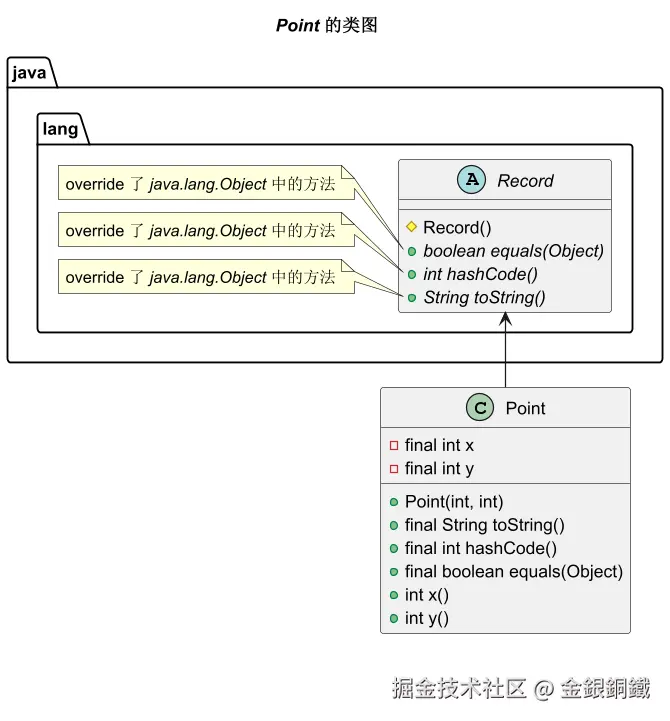
在反编译的结果中,我们看到了
- Point 的构造函数
- x 字段和 y 字段
- x() 方法和 y() 方法
但是我们在 Point.java 中 并没有 显式定义这些内容,那么它们是从哪里来的呢?
规范构造函数(Canonical Constructor)
如果我们在记录类没有显式定义构造函数,那么记录类中会出现隐式的 canonical constructor。 8.10.4. Record Constructor Declarations 提到了相关细节 ⬇️
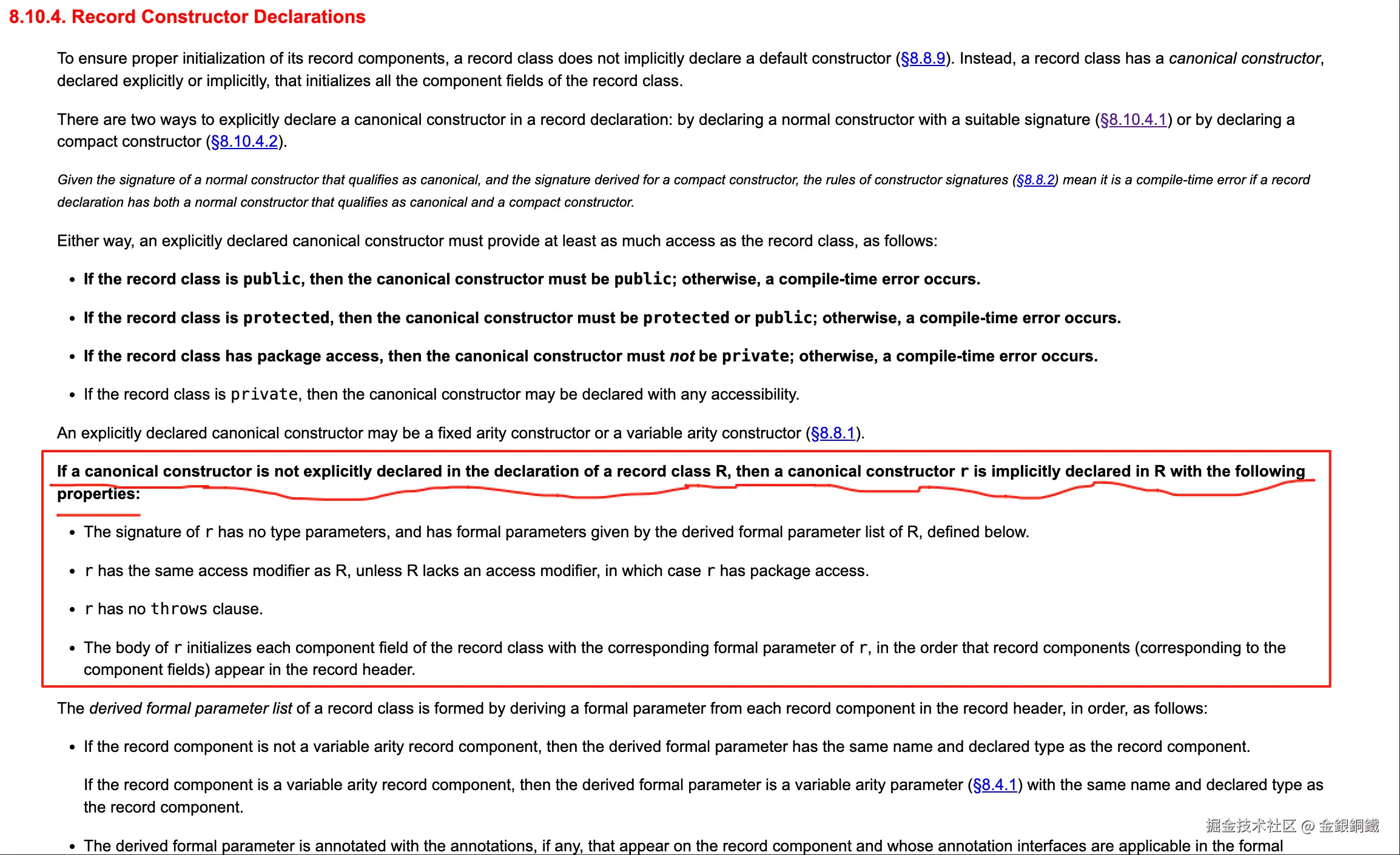
可以用如下命令查看 Point.class 的详细内容
bash
javap -v -p Point完整的结果比较长,其中和构造函数相关的部分如下
text
  public Point(int, int);
    descriptor: (II)V
    flags: (0x0001) ACC_PUBLIC
    Code:
      stack=2, locals=3, args_size=3
         0: aload_0
         1: invokespecial #1                  // Method java/lang/Record."<init>":()V
         4: aload_0
         5: iload_1
         6: putfield      #7                  // Field x:I
         9: aload_0
        10: iload_2
        11: putfield      #13                 // Field y:I
        14: return
      LineNumberTable:
        line 1: 0
    MethodParameters:
      Name                           Flags
      x
      y
我们可以手动对其进行反编译 ⬇️
java
// 以下内容是我手动反编译的结果,仅供参考
public Record(int x, int y) {
    super();
    this.x = x;
    this.y = y;
}
Record Components
在 8.10. Record Classes 中提到了 Record Components ⬇️ (重要的部分我用绿色框和绿色箭头标了出来)
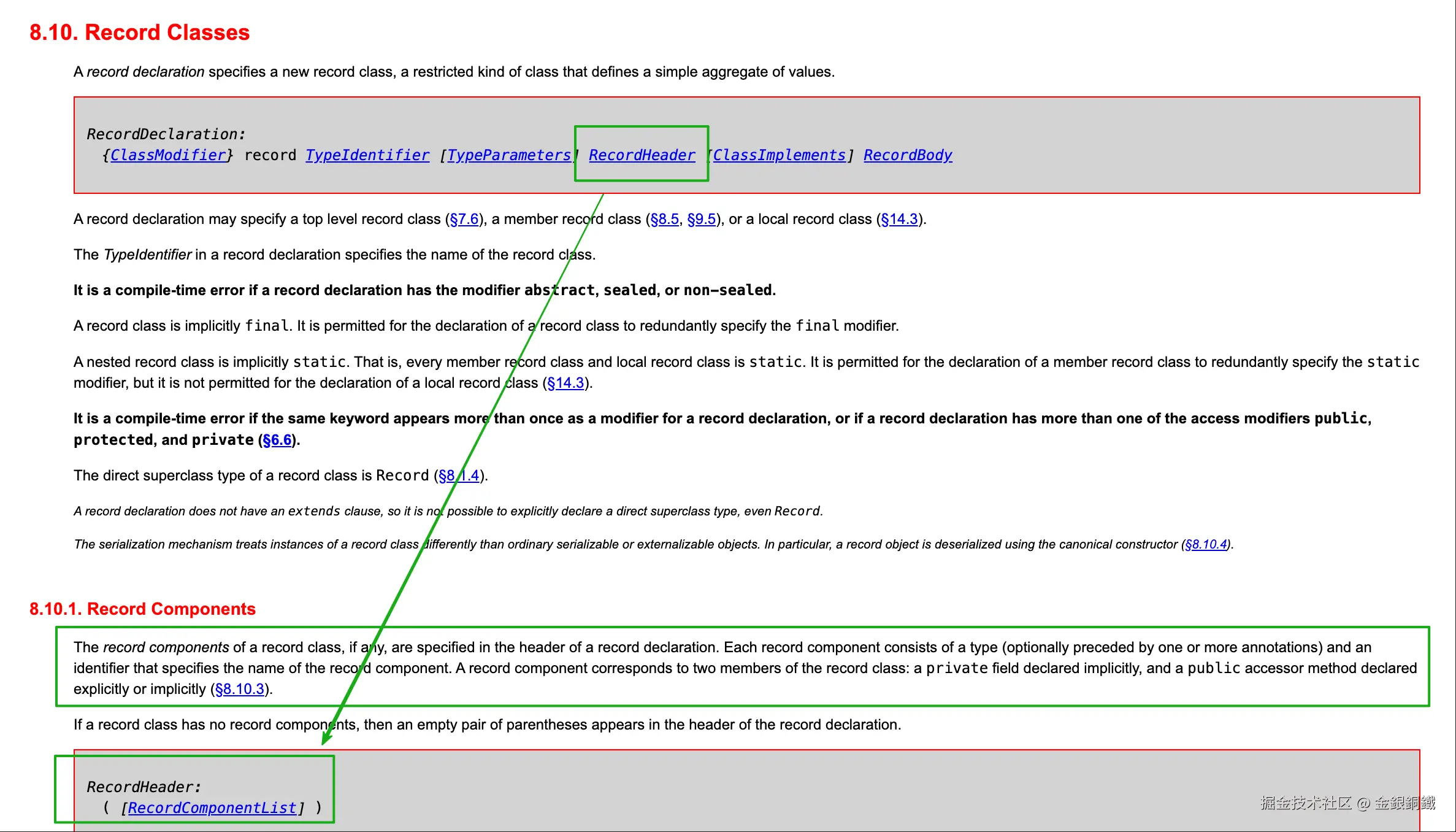
对 Point 这个记录类而言,以下两者都是它的 Record Component
- int x
- int y
8.10.3. Record Members 提到了如下内容 ⬇️ (重要的部分我用绿色框标了出来)
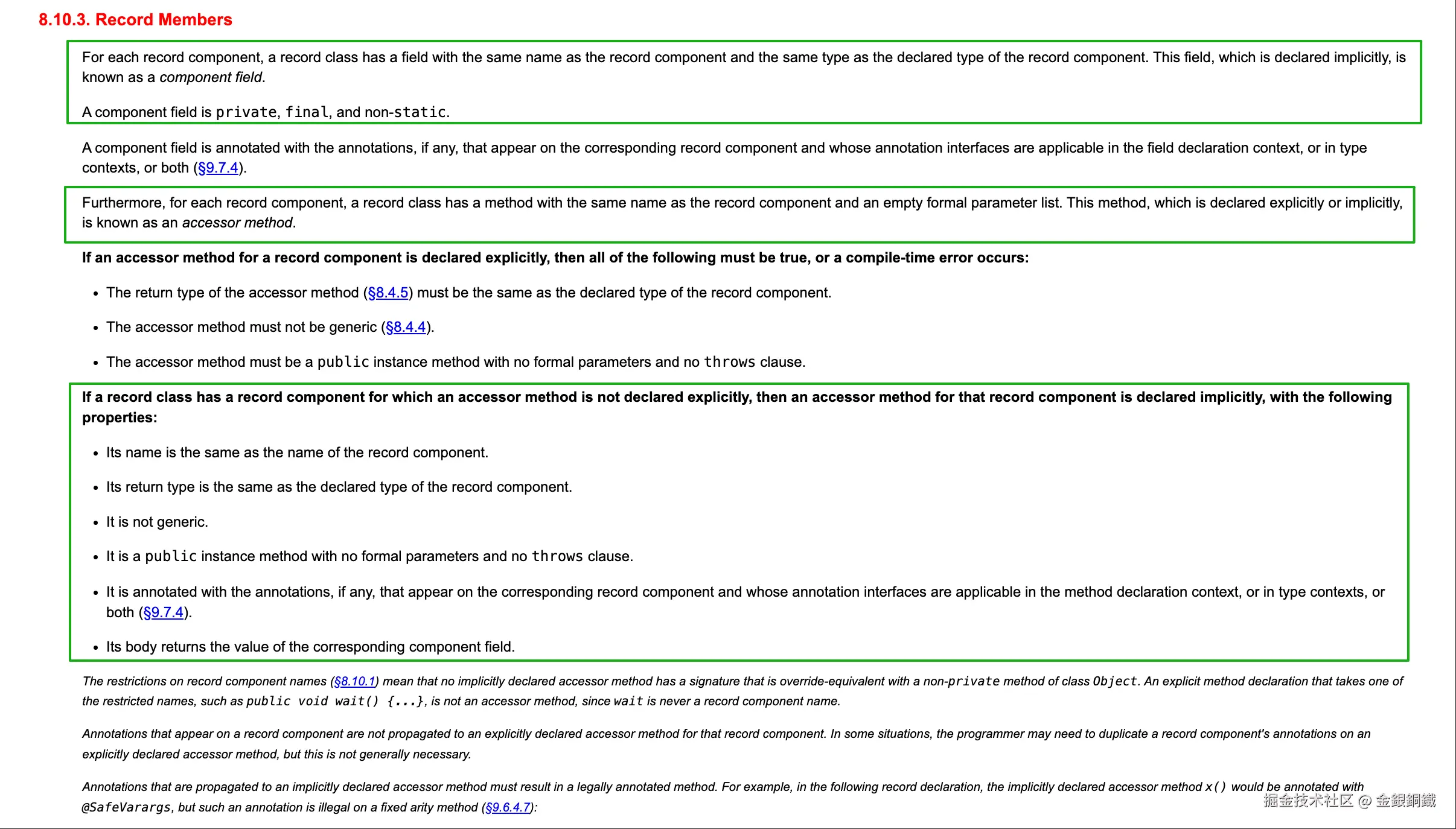
对每个 Record Component 而言,
- 记录类中会有一个与之对应的 private, final, 非 static 字段
- 记录类中会有一个与之对应的被称为 accessor method 的方法
我们可以用如下的命令查看 Point.class 的详细内容
bash
javap -v -p Point完整的结果比较长,其中和 Record Components 相关的部分如下
text
  private final int x;
    descriptor: I
    flags: (0x0012) ACC_PRIVATE, ACC_FINAL

  private final int y;
    descriptor: I
    flags: (0x0012) ACC_PRIVATE, ACC_FINAL

  public int x();
    descriptor: ()I
    flags: (0x0001) ACC_PUBLIC
    Code:
      stack=1, locals=1, args_size=1
         0: aload_0
         1: getfield      #7                  // Field x:I
         4: ireturn
      LineNumberTable:
        line 1: 0

  public int y();
    descriptor: ()I
    flags: (0x0001) ACC_PUBLIC
    Code:
      stack=1, locals=1, args_size=1
         0: aload_0
         1: getfield      #13                 // Field y:I
         4: ireturn
      LineNumberTable:
        line 1: 0
我们可以手动对其进行反编译 ⬇️
java
// 以下内容是我手动反编译的结果,仅供参考
private final int x;
private final int y;

public int x() {
    return this.x;
}

public int y() {
    return this.y;
}
参考资料
其他
画 Point 的类图所用到的代码
puml
@startuml
'https://plantuml.com/class-diagram

@startuml

title <i>Point</i> 的类图
caption \n\n
' caption 的内容只是为了防止掘金平台生成的水印遮盖图中的文字

abstract java.lang.Record
class Point
java.lang.Record <-- Point

abstract java.lang.Record {
    # Record()
    + {abstract} boolean equals(Object)
    + {abstract} int hashCode()
    + {abstract} String toString()
}

class Point {
  - final int x
  - final int y
  + Point(int, int)
  + final String toString()
  + final int hashCode()
  + final boolean equals(Object)
  + int x()
  + int y()
}

note left of java.lang.Record::equals
override 了 <i>java.lang.Object</i> 中的方法
end note

note left of java.lang.Record::hashCode
override 了 <i>java.lang.Object</i> 中的方法
end note

note left of java.lang.Record::toString
override 了 <i>java.lang.Object</i> 中的方法
end note

@enduml