前言
核心价值主张:用一根线,让传感器数据更精准、更可靠、更经济。SENT协议正成为汽车电子领域替代模拟和PWM信号,实现传感器数字化通信的首选方案。
随着汽车电动化、智能化浪潮的推进,车载传感器数量呈指数级增长,对数据传输的精度、实时性和可靠性提出了前所未有的要求。传统的模拟电压信号易受干扰,PWM信号的精度和诊断能力有限,而复杂的CAN/LIN总线网络则带来了高昂的成本和布线负担。在此背景下,SENT协议应运而生,为汽车传感器与电子控制单元(ECU)之间的点对点通信提供了最优解决方案。
技术原理剖析:SENT协议如何实现"以时传数"
SENT协议的核心设计哲学在于将信息编码在时间维度而非电压幅度。这种"以时传数"的机制,使其在严苛的汽车电磁环境中展现出卓越的抗干扰能力和高精度特性。
其核心技术架构围绕以下四个关键机制构建:
-
时间编码:协议的基本数据单元为"半字节"(Nibble,4位)。每个Nibble的值(0-15)通过测量两个下降沿之间的时间差来编码。具体公式为:脉冲宽度 = (N + 1) × Tick。其中"+1"机制确保了即使传输值为0,脉冲也有最小宽度,增强了信号的鲁棒性。
-
自同步时钟校准:每帧数据以固定56个Tick时长的同步脉冲开始。接收端ECU通过精确测量该同步脉冲的实际物理时间,动态反推出传感器端的Tick周期。这一机制实现了无外部时钟线的动态校准,有效补偿了因温度、电压变化引起的时钟漂移。
-
结构化帧传输:一个完整的SENT帧由同步脉冲、状态/通信字、最多6个数据字、CRC校验字和可选的暂停脉冲组成。状态字可携带传感器故障标志或慢速通道数据起始位,数据字则承载核心的传感信息,支持双12位通道传输,CRC校验保障了数据的完整性。
-
硬件极简主义:发送端(传感器)通常仅需一个精准定时器和一个GPIO引脚,无需专用通信控制器或PHY芯片。接收端(ECU)也仅需一个带输入捕获功能的定时器。这种设计将协议复杂性从遍布车辆的传感器节点转移到了集中的ECU,显著降低了系统整体成本。
核心优势对比:为什么选择SENT而非传统方案?
为清晰展示SENT协议的全面优势,我们将其与模拟信号、PWM信号及CAN/LIN总线在传感器应用场景下进行多维度对比。
|---------------|---------------------------------|------------------|------------------------|-------------------|
| 对比维度 | SENT 协议 | 模拟信号 | PWM 信号 | CAN/LIN |
| 传输精度 | 高 (非线性误差**<0.1%****)** | 低 (易受干扰) | 中 (精度受限) | 高 |
| 抗干扰能力 | 强 (时间编码) | 弱 | 中等 | 强 |
| 系统成本 | 低 (单线三线制) | 低 | 低 | 中高 (需收发器) |
| 诊断功能 | 强 **(****CRC+**状态字) | 几乎无 | 弱 | 强 |
| 实时性 | 高 (微秒级延迟) | 高 | 高 | 中 |
| 布线复杂度 | 极简 (3根线) | 简 | 简 | 复杂 |
通过对比可见,SENT协议在精度、抗扰、成本、诊断和实时性五个关键维度上取得了最佳平衡,尤其适合对成本敏感且要求高可靠性的汽车传感器应用。
关键增强:SPC功能与协议演进
基础SENT协议为单向通信,为满足更复杂的系统需求,SENT SPC应运而生。SPC通过在数据帧的暂停脉冲期间插入主触发脉冲,实现了有限的双向通信和单线多传感器管理。
SPC功能允许ECU通过发送不同宽度的MTP来"寻址"总线上的特定传感器,从而按需获取数据,可将总线负载降低30%。这使其在需要初始化配置、在线诊断或优先调度关键传感器的场景中价值巨大。
全景应用:SENT协议赋能现代汽车
SENT 协议已深度渗透到现代汽车的各个核心系统,从传统动力总成到新兴的智能驾驶领域,成为连接物理世界与数字控制的关键桥梁。
-
动力总成系统:曲轴 / 凸轮轴位置传感器、涡轮增压压力传感器、变速箱速度传感器
-
底盘与安全系统:轮速传感器( ABS )、加速度传感器、横摆角速度传感器( ESC )
-
车身电子与新能源:电子油门位置传感器、电池管理系统( BMS )、能量回收系统
-
智能驾驶:线控转向、线控制动、自动驾驶传感器网络
知从科技木牛配置工具对SENT协议的支持
6. 1 木 牛配置工具简介
知从科技木牛配置工具是一款专为汽车电子嵌入式软件开发设计的可视化配置工具,深度集成于知从科技基础软件( ZC.MuNiu )生态体系中。该工具基于 AUTOSAR 架构设计理念,为 ECU 软件开发提供图形化的配置界面,大幅降低开发门槛,提升开发效率。
木牛配置工具支持多种车载通信协议的配置与代码生成,包括 CAN/CANFD 、 LIN 、 FlexRay 以及 SENT 协议。通过可视化的参数配置界面,开发人员可以快速完成协议栈的参数设置、信号映射、诊断配置等复杂工作,自动生成符合标准的配置文件和底层代码,实现 " 零代码 " 或 " 低代码 " 的协议栈开发。
6.2 SENT 协议配置功能详解
- 完整的 SENT 协议栈支持:木牛配置工具完整支持 SAE J2716 标准定义的 SENT 协议,包括基础 SENT 和 SPC ( Short PWM Code )增强模式,满足不同应用场景的通信需求。
-
可视化参数配置:通过直观的图形界面配置 Tick 时间、同步脉冲参数、数据帧格式( Nibble 数量)、 CRC 校验方式等关键参数,避免手动配置的错误。
-
多通道管理:支持同时配置和管理多个 SENT 通道,每个通道可独立设置参数,适用于复杂 ECU 中连接多个传感器的应用场景。
-
信号映射与解析:提供可视化的信号映射工具,将 SENT 帧中的数据 Nibble 映射到应用层信号,自动完成数据解析和物理值转换配置。
-
诊断与错误处理配置:内置完善的诊断功能配置,包括 CRC 错误检测、同步脉冲异常检测、时钟漂移监控等,支持用户自定义错误处理策略。
-
代码自动生成:基于配置自动生成符合 AUTOSAR 标准的 SENT 驱动代码和配置文件,无缝集成到 MCAL 层,减少 90% 以上的手动编码工作。
6.3 配置界面展示
下图展示了知从科技木牛配置工具的 SENT 协议配置界面,用户可以通过图形化界面轻松完成协议参数配置:
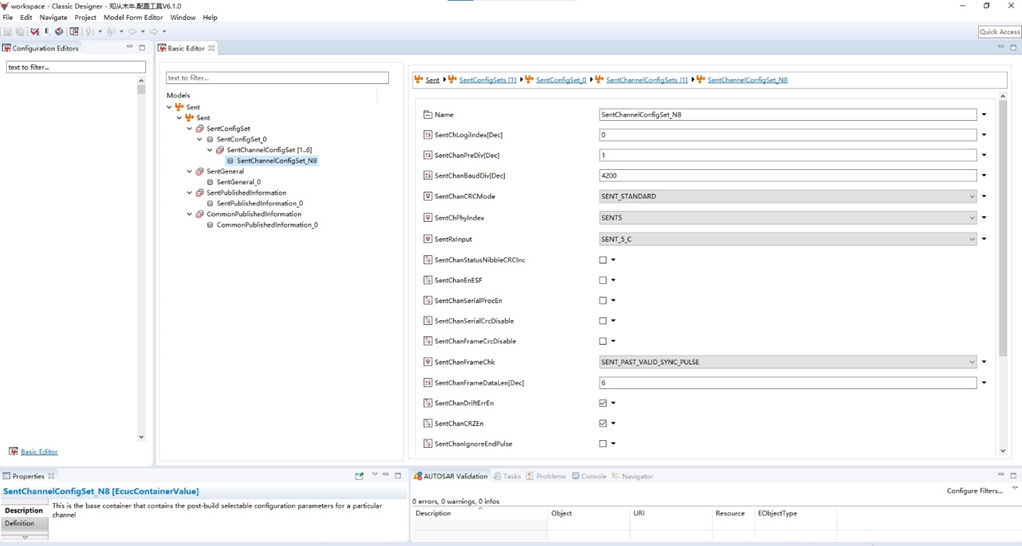
知从科技木牛配置工具 SENT 协议配置界面截图
6.4 典型配置流程
-
通道启用与命名:在配置界面选择 SENT 模块,启用所需通道并设置通道名称
-
Tick 时间配置:根据传感器规格设置 Tick 时间(通常 3-10μs )
-
帧格式配置:选择数据 Nibble 数量( 1-6 个)、是否使用暂停脉冲
-
SPC 模式配置(可选):如需双向通信,启用 SPC 模式并配置 MTP 参数
-
信号映射:将 SENT 数据 Nibble 映射到应用层信号变量
-
诊断配置:启用 CRC 校验、同步脉冲监控等诊断功能
-
代码生成:一键生成配置文件和驱动代码,集成到项目中
结语:拥抱SENT,智驭未来
在汽车电子向着更智能、更集成、更可靠方向发展的今天, SENT 协议在精度、可靠性、成本这个传统的不可能三角中,找到了一个优雅的平衡点。它并非意在取代复杂的 CAN 或 FlexRay 网络,而是作为其关键补充,在点对点、高精度、高可靠的传感器通信场景中,提供了无可替代的最优解。
对于汽车电子工程师而言,掌握并应用 SENT 协议,意味着能为产品赋予更高的性能、更强的鲁棒性和更优的成本结构。而对于希望在项目中快速落地 SENT 协议的开发者,知从科技木牛配置工具提供了全方位的技术支持。
知从科技木牛配置工具核心优势
-
开箱即用:完整的 SENT 协议栈支持,无需从零开发,缩短项目周期 50% 以上
-
可视化配置:直观的图形界面,大幅降低协议配置复杂度,减少人为错误
-
AUTOSAR 兼容:生成符合 AUTOSAR 标准的代码和配置,无缝集成主流 AutoSAR 工具链
-
一站式服务:从配置到代码生成、从调试到验证,提供全流程技术支持
-
持续更新:紧跟 SAE 标准演进,持续更新协议支持,保障技术领先性
-
本土化支持:国内专业团队提供及时的技术支持和服务响应
Introduction
Core Value Proposition: With a single wire, make sensor data more accurate, more reliable, and more cost-effective. The SENT protocol is becoming the preferred solution in the automotive electronics field to replace analog and PWM signals, enabling digital communication for sensors.
With the advancement of automotive electrification and intelligentization, the number of onboard sensors has grown exponentially, placing unprecedented demands on data transmission accuracy, real-time performance, and reliability. Traditional analog voltage signals are susceptible to interference, PWM signals have limited accuracy and diagnostic capabilities, and complex CAN/LIN bus networks bring high costs and wiring burdens. In this context, the SENT protocol emerged as the optimal solution for point-to-point communication between automotive sensors and Electronic Control Units (ECUs).
Technical Principles Analysis: How SENT Protocol Achieves "Data Transmission Through Time"
The core design philosophy of the SENT protocol lies in encoding information in the time dimension rather than voltage amplitude. This "data transmission through time" mechanism enables it to demonstrate excellent anti-interference capabilities and high-precision characteristics in harsh automotive electromagnetic environments.
Its core technical architecture is built around the following four key mechanisms:
-
Time Encoding: The basic data unit of the protocol is the "Nibble" (4 bits). Each Nibble value (0-15) is encoded by measuring the time difference between two falling edges. The specific formula is: Pulse Width = (N + 1) × Tick. The "+1" mechanism ensures that even when transmitting a value of 0, the pulse has a minimum width, enhancing signal robustness.
-
Self-Synchronizing Clock Calibration: Each data frame begins with a synchronization pulse of fixed 56 Tick duration. The receiving ECU dynamically calculates the sensor-side Tick period by precisely measuring the actual physical time of this synchronization pulse. This mechanism achieves dynamic calibration without external clock lines, effectively compensating for clock drift caused by temperature and voltage variations.
-
Structured Frame Transmission: A complete SENT frame consists of a synchronization pulse, status/communication nibble, up to 6 data nibbles, CRC checksum nibble, and optional pause pulse. The status nibble can carry sensor fault flags or slow channel data start bits, while data nibbles carry core sensor information, supporting dual 12-bit channel transmission. CRC checksum ensures data integrity.
-
Hardware Minimalism: The transmitting end (sensor) typically requires only a precision timer and a GPIO pin, without needing dedicated communication controllers or PHY chips. The receiving end (ECU) also requires only a timer with input capture functionality. This design transfers protocol complexity from numerous sensor nodes distributed throughout the vehicle to the centralized ECU, significantly reducing overall system costs.
Core Advantages Comparison: Why Choose SENT Over Traditional Solutions?
To clearly demonstrate the comprehensive advantages of the SENT protocol, we compare it with analog signals, PWM signals, and CAN/LIN buses in sensor application scenarios across multiple dimensions.
|-------------------------------|----------------------------------------|-----------------------------------|-----------------------------------|--------------------------------------------|
| Omparison Dimension | SENT Protocol | Analog Signal | PWM Signal | CAN/LIN |
| Transmission Accuracy | High (Non-linear error <0.1%) | (Susceptible to interference) | Medium (Limited accuracy) | High |
| Antiinterference | Strong (Time encoding) | Weak | Medium | Strong |
| System Cost | Low (Single-wire/3-wire) | Low | Low | Medium-High (Requires transceiver) |
| Diagnostic Function | Strong (CRC+Status nibble) | Almost none | Weak | Strong |
| Real-time Performance | High (Microsecond-level delay) | High | High | Medium |
| Wiring Complexity | Minimal (3 wires) | Simple | Simple | Complex |
Through comparison, it is evident that the SENT protocol achieves the optimal balance across five key dimensions: accuracy, anti-interference capability, cost, diagnostics, and real-time performance. It is particularly suitable for automotive sensor applications that are cost-sensitive and require high reliability.
Key Enhancement: SPC Functionality and Protocol Evolution
The basic SENT protocol is unidirectional. To meet more complex system requirements, SENT SPC (Short PWM Code) was developed. SPC achieves limited bidirectional communication and single-wire multi-sensor management by inserting Master Trigger Pulses (MTP) during the pause pulse period of data frames.
The SPC functionality allows the ECU to "address" specific sensors on the bus by sending MTPs of different widths, thereby obtaining data on demand and reducing bus load by up to 30%. This makes it extremely valuable in scenarios requiring initialization configuration, online diagnostics, or priority scheduling of critical sensors.
Panoramic Applications: SENT Protocol Empowering Modern Automobiles
The SENT protocol has deeply penetrated various core systems of modern automobiles, from traditional powertrains to emerging intelligent driving fields, becoming a crucial bridge connecting the physical world with digital control.
-
Powertrain Systems: Crankshaft/camshaft position sensors, turbocharger pressure sensors, transmission speed sensors
-
Chassis and Safety Systems: Wheel speed sensors (ABS), acceleration sensors, yaw rate sensors (ESC)
-
Body Electronics and New Energy: Electronic throttle position sensors, Battery Management Systems (BMS), energy recovery systems
-
Intelligent Driving: Steer-by-wire, brake-by-wire, autonomous driving sensor networks
ZC.MuNiu Configuration Tool Support for SENT Protocol
6.1 Introduction to MuNiu Configuration Tool
The ZC.MuNiu Configuration Tool is a visual configuration tool specifically designed for automotive electronics embedded software development, deeply integrated into the ZC.MuNiu software ecosystem. Based on AUTOSAR architecture design concepts, it provides a graphical configuration interface for ECU software development, significantly lowering the development threshold and improving development efficiency.
The MuNiu Configuration Tool supports configuration and code generation for various in-vehicle communication protocols, including CAN/CANFD, LIN, FlexRay, and SENT protocols. Through a visual parameter configuration interface, developers can quickly complete complex tasks such as protocol stack parameter settings, signal mapping, and diagnostic configuration, automatically generating standard-compliant configuration files and low-level code, achieving "zero-code" or "low-code" protocol stack development.
6.2 Detailed SENT Protocol Configuration Functions
-
Complete SENT Protocol Stack Support: The MuNiu Configuration Tool fully supports the SENT protocol as defined by the SAE J2716 standard, including both basic SENT and SPC (Short PWM Code) enhanced modes, meeting communication requirements for different application scenarios.
-
Visual Parameter Configuration: Configure key parameters such as Tick time, synchronization pulse parameters, data frame format (number of Nibbles), and CRC checksum methods through an intuitive graphical interface, avoiding manual configuration errors.
-
Multi-Channel Management: Supports simultaneous configuration and management of multiple SENT channels, with each channel independently configurable, suitable for application scenarios in complex ECUs connecting multiple sensors.
-
Signal Mapping and Parsing: Provides visual signal mapping tools to map data Nibbles in SENT frames to application-layer signals, automatically completing data parsing and physical value conversion configuration.
-
Diagnostic and Error Handling Configuration: Built-in comprehensive diagnostic function configuration, including CRC error detection, synchronization pulse anomaly detection, clock drift monitoring, etc., supporting user-defined error handling strategies.
-
Automatic Code Generation: Automatically generates AUTOSAR-standard-compliant SENT driver code and configuration files based on configuration, seamlessly integrating into the MCAL layer, reducing manual coding work by over 90%.
6.3 Configuration Interface Display
The following figure shows the SENT protocol configuration interface of the ZC.MuNiu Configuration Tool, where users can easily complete protocol parameter configuration through a graphical interface:
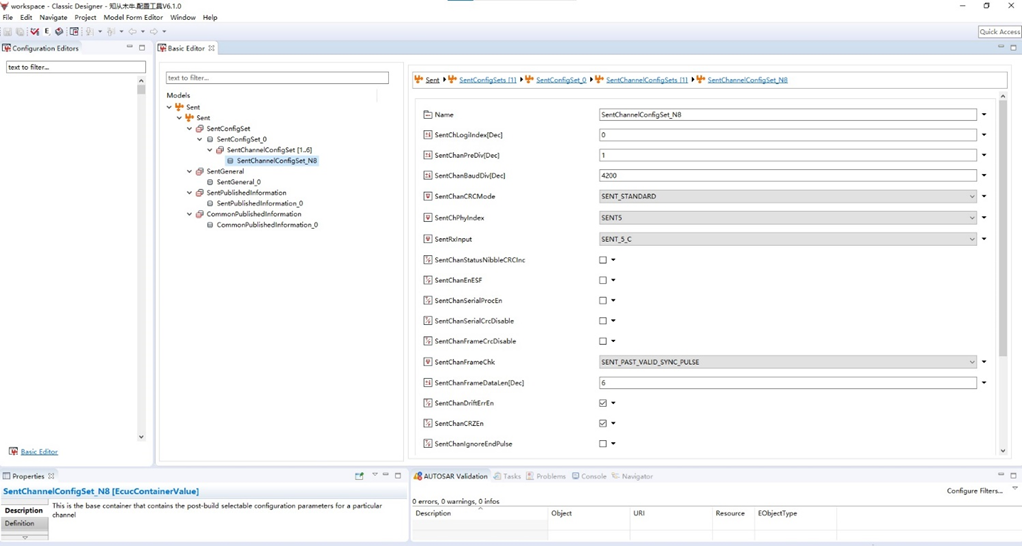
Screenshot of ZC.MuNiu Configuration Tool SENT Protocol Configuration Interface
6.4 Typical Configuration Workflow
-
Channel Enable and Naming: Select the SENT module in the configuration interface, enable the required channels, and set channel names.
-
Tick Time Configuration: Set Tick time according to sensor specifications (typically 3-10μs).
-
Frame Format Configuration: Select the number of data Nibbles (1-6) and whether to use pause pulses.
-
SPC Mode Configuration (Optional): If bidirectional communication is required, enable SPC mode and configure MTP parameters.
-
Signal Mapping: Map SENT data Nibbles to application-layer signal variables.
-
Diagnostic Configuration: Enable diagnostic functions such as CRC checksum and synchronization pulse monitoring.
-
Code Generation: One-click generation of configuration files and driver code for integration into the project.
Conclusion: Embrace SENT, Drive the Future with Intelligence
As automotive electronics evolves toward greater intelligence, integration, and reliability today, the SENT protocol has found an elegant balance point in the traditional "impossible triangle" of accuracy, reliability, and cost. It is not intended to replace complex CAN or FlexRay networks, but rather serves as a crucial complement, providing an irreplaceable optimal solution for point-to-point, high-precision, high-reliability sensor communication scenarios.
For automotive electronics engineers, mastering and applying the SENT protocol means endowing products with higher performance, stronger robustness, and better cost structures. For developers seeking to rapidly implement the SENT protocol in their projects, the ZC.MuNiu Configuration Tool provides comprehensive technical support.
Core Advantages of ZC.MuNiu Configuration Tool
-
Ready to Use: Complete SENT protocol stack support, no need to develop from scratch, reducing project cycle by over 50%.
-
Visual Configuration: Intuitive graphical interface, significantly reducing protocol configuration complexity and human errors.
-
AUTOSAR Compatible: Generates AUTOSAR-standard-compliant code and configuration, seamlessly integrating with mainstream AUTOSAR toolchains.
-
One-Stop Service: From configuration to code generation, from debugging to verification, providing full-process technical support.
-
Continuous Updates: Following SAE standard evolution, continuously updating protocol support to ensure technological leadership.
-
Localized Support: Domestic professional teams provide timely technical support and service response.
------The End------
点击进入知从官网 https://www.shzckj.cn/
