写在前面:本笔记为个人学习各平台C语言系列课程所作,仅供交流学习,不得作他用。
1. 字符型多次读入/getchar函数
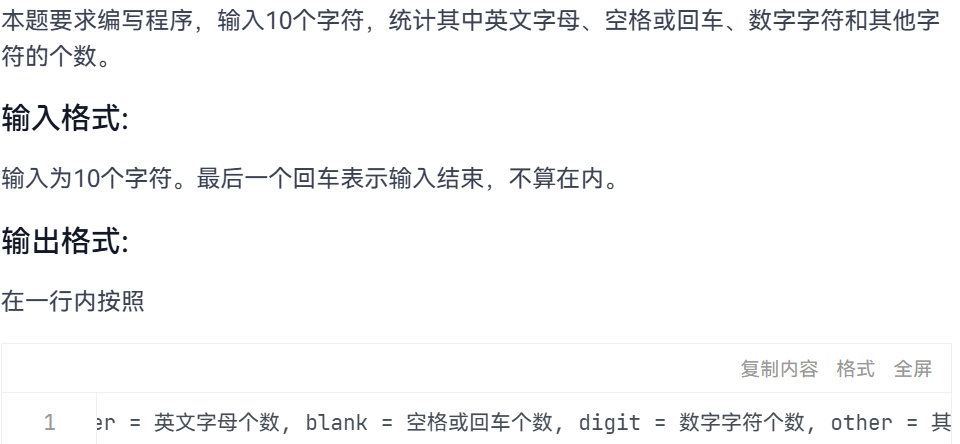
cpp
#include <stdio.h>

int main() {
    char c;
    int letter = 0, blank = 0, digit = 0, other = 0;
    int count = 0;
    while (count < 10) {
        c = getchar();
        if (c == '\n') {
            blank++;
            count++;
            continue;
        }
        count++;// 正常字符,计数+1
        if ((c >= 'a' && c <= 'z') || (c >= 'A' && c <= 'Z')) {letter++;}
        else if (c == ' ') {blank++;}
        else if (c >= '0' && c <= '9') {digit++;}
        else {other++;}
    }
    printf("letter = %d, blank = %d, digit = %d, other = %d", letter, blank, digit, other);
    return 0;
}
(1)getchar函数一次读入一个字符。即使你在终端里输入很多个字符,他一次也只能读第一个然后跳出。所以需要实现多个输入,需要准备循环。
(2)scanf对空格和回车敏感,当类似的字符需要作为可被读取到的输入时,用getchar。
(3)**回车/r,ASCII码13,作用是让光标回到当前行最左边,不向下移动;换行/n,ASCII码10,作用是让光标向下移动,不回到最左边。**只是现在电脑的回车键是连用两个功能的。
(4)在windows系统下,终端处换行系统会读到/r和/n。在linux和MAC系统下,换行只会读到/n。但是用getchar去读字符时,/r/n会被合并为/n,所以只会读到换行/n。
2. 百分数输出(整数不精确)
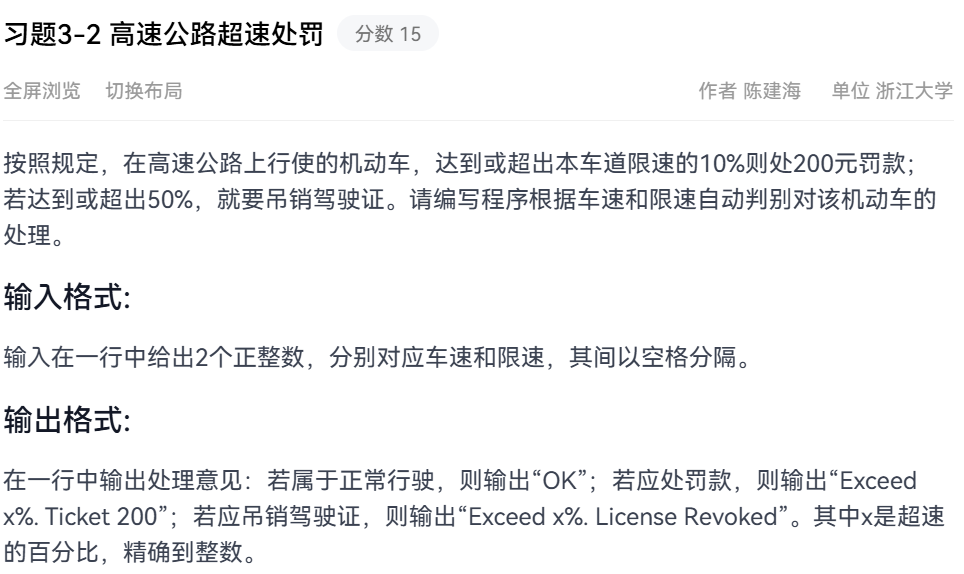
这道题我原来写的代码是这样的:
cpp
#include <stdio.h>
int main(){
    int v1=0;int v2=0;
    scanf("%d %d",&v1,&v2);
    if(1.0*v1<v2*1.1){printf("OK");}
    else if(1.0*v1>=1.1*v2 && v1<v2*1.5){printf("Exceed %d%. Ticket 200",(int)1.0*v1/v2);}
    else{printf("Exceed %d%. License Revoked",(int)1.0*v1/v2);}
    return 0;
}
这样在输入110和100时会进入第一个判断分支,原因是计算机内部整数不精确,用浮点数计算时第一个分支成立了。为解决这一问题,全部*10改用整数计算:
cpp
#include <stdio.h>

int main() {
    int v1 = 0, v2 = 0;
    scanf("%d %d", &v1, &v2);

    // 全部用整数运算,避免浮点数误差
    if (v1 * 10 < v2 * 11) {
        printf("OK");
    } else if (v1 * 10 < v2 * 15) {
        // 计算超速百分比
        int percent = (v1 - v2) * 100 / v2;
        printf("Exceed %d%%. Ticket 200", percent);
    } else {
        int percent = (v1 - v2) * 100 / v2;
        printf("Exceed %d%%. License Revoked", percent);
    }
    return 0;
}
而且在printf里打%时,要连续输入两个%%。
3. 分硬币(想的比较复杂的一道题)
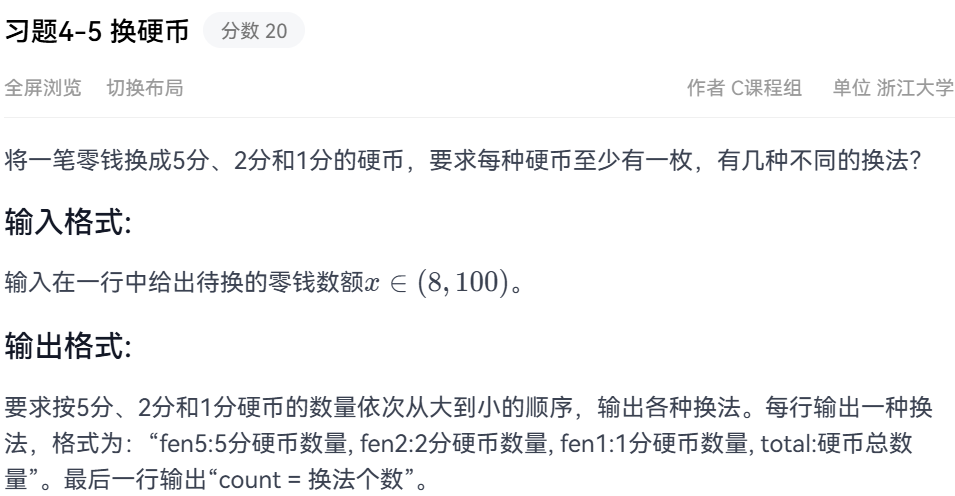
cpp
#include <stdio.h>
int main(){
    int n;int f;int t;int o;int c=0;
    scanf("%d",&n);
    f=n/5;
    while(f>=1){
        t=(n-5*f)/2;o=n-5*f-2*t;
        while(t>=1){
            if(o>=1){printf("fen5:%d, fen2:%d, fen1:%d, total:%d\n",f,t,o,f+t+o);c++;}
            if(t==1){break;}
            t--;o=o+2;
        }
        f--;
    }
    printf("count = %d",c);
    return 0;
}
4. 字符加密(注意" "和' '的区别)
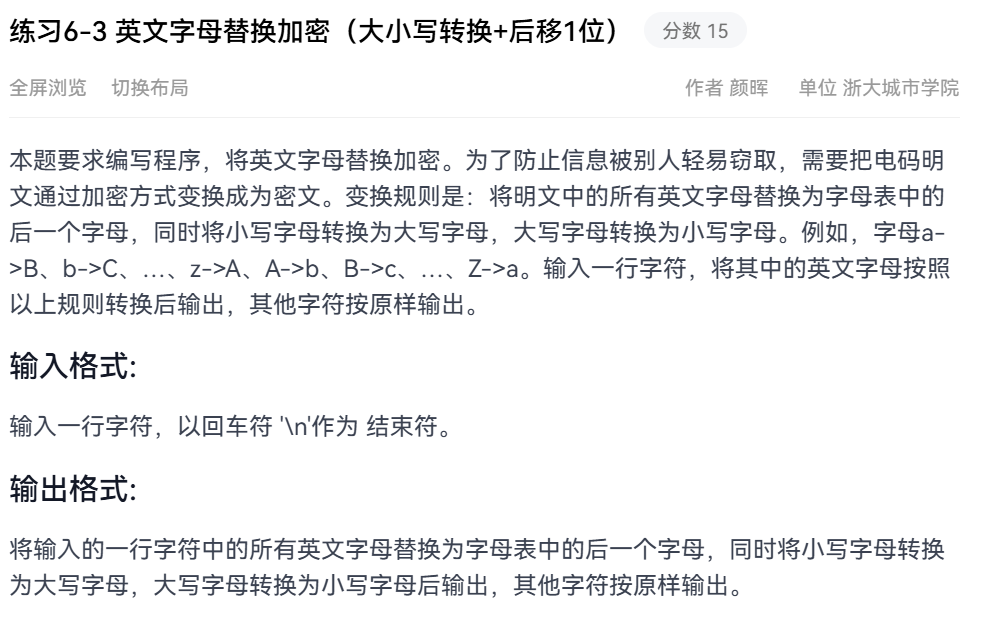
cpp
#include <stdio.h>
int main(){
    char a;
    a=getchar();
    while(a!='\n'){
        if(a>='a' && a<'z'){printf("%c",a+'A'-'a'+'B'-'A');}
        else if(a=='z'){printf("A");}
        else if(a=='Z'){printf("a");}
        else if(a>='A' && a<'Z'){printf("%c",a+'a'-'A'+'b'-'a');}
        else{printf("%c",a);}
        a=getchar();
    }
    return 0;
}printf()里,输出要用双引号""。表达字符的加减或者比较运算时,得用单引号''。
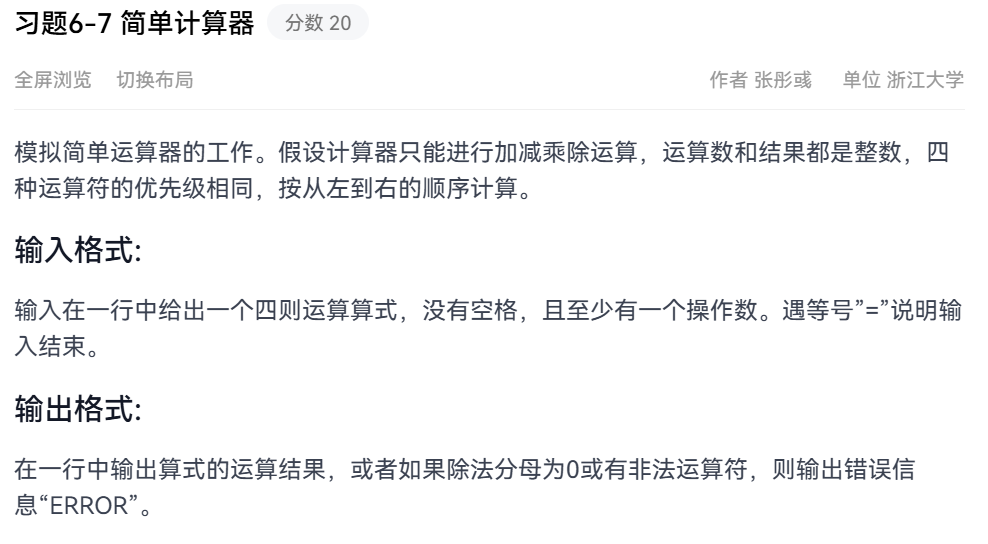
5. 简单计算器(字符操作)
cpp
#include <stdio.h>

int main() {
    int result = 0;int num = 0;char op = 0;char c;int error = 0;

    // 1. 读取第一个操作数
    while ((c = getchar()) != '+' && c != '-' && c != '*' && c != '/' && c != '=') {
        if(c >= '0' && c <= '9') {num = num * 10 + (c - '0');}
        else{error = 1;break;}
    }
    if (error) {printf("ERROR");return 0;}
    if (c == '=') {printf("%d", num);return 0;} // 只有一个数的情况

    result = num;op = c;num = 0;//到此,c读到一个操作符并传给了op

    // 2. 循环处理后续运算符和操作数
    while ((c = getchar()) != '=') {
        if (c >= '0' && c <= '9') {num = num * 10 + (c - '0');}
        else if (c == '+' || c == '-' || c == '*' || c == '/') {
            // 先计算上一步的结果
            switch (op) {
                case '+': result += num; break;
                case '-': result -= num; break;
                case '*': result *= num; break;
                case '/':
                    if (num == 0) {error = 1;break;}
                    result /= num;break;
                default: error = 1; break;
            }
            if (error) break;
            // 更新运算符,重置临时数
            op = c;num = 0;
        }
        else {error = 1;break;}
    }

    // 3. 处理最后一次运算(读到=时,还没算上一次的运算符)
    if (!error) {
        switch (op) {
            case '+': result += num; break;
            case '-': result -= num; break;
            case '*': result *= num; break;
            case '/':
                if (num == 0) {error = 1;}
                else {result /= num;}
                break;
            default: error = 1; break;
        }
    }

    // 4. 输出结果
    if (error) {printf("ERROR");}
    else {printf("%d", result);}

    return 0;
}
(1)如何实现字符拼接,使用string库。
cpp
#include <stdio.h>
#include <string.h>  // 必须加!strcat 在这个头文件里

int main() {
    // 注意:str1 必须足够大!能装下拼接后的所有字符
    char str1[100] = "hello";
    char str2[] = " world";

    strcat(str1, str2);  // 把 str2 拼到 str1 后面

    printf("%s", str1);  // 输出:hello world
    return 0;
}
(2)这道题主要是比较复杂,第一步操作后,c已经读到了第一个操作符并传给了op。第二步开始读第二个操作数,读到第二个操作符时停止,计算上一步运算,然后重置参数计算。同时要注意error。
6. 泰勒函数求余弦(最后一项)
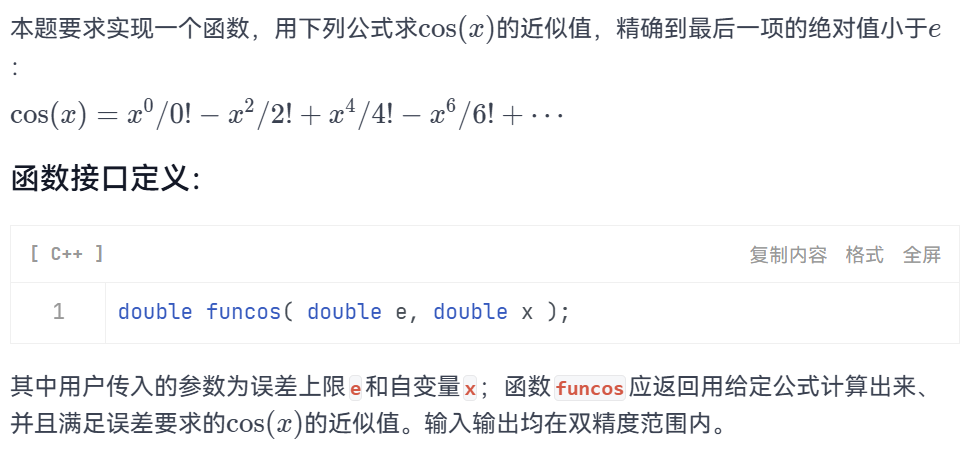
注意描述!这里说的是最后一项绝对值小于e,这小于e的一项也是要加进去的!!!
cpp
double funcos(double e, double x)
{
    double sum = 1.0;    // 第一项 1 先放进去
    double term = 1.0;   // 存当前项
    int n = 1;           // 计数

    // 核心:当前项 >= e 才继续算下一项并累加
    while (fabs(term) >= e)
    {
        // 递推计算下一项
        term = term * (-x * x) / ((2*n - 1) * (2*n));
        sum = sum + term;
        n++;
    }

    return sum;
}