文章目录
- [UICollectionView 瀑布流布局](#UICollectionView 瀑布流布局)
-
- 整体思路
- 声明属性
- 核心方法:prepareLayout
-
- [为什么初始值是 sectionInset.top](#为什么初始值是 sectionInset.top)
- [item 宽度计算](#item 宽度计算)
- [item 的 x 坐标计算](#item 的 x 坐标计算)
- [item 的 y 坐标计算](#item 的 y 坐标计算)
- 找最矮列:findSmallestColumn
- 返回内容大小:collectionViewContentSize
- 返回可见区域的布局属性:layoutAttributesForElementsInRect:
- [根据 indexPath 返回单个属性:layoutAttributesForItemAtIndexPath:](#根据 indexPath 返回单个属性:layoutAttributesForItemAtIndexPath:)
- 响应尺寸变化:shouldInvalidateLayoutForBoundsChange:
- 方法调用顺序总结
- 完整代码如下:
UICollectionView 瀑布流布局
UICollectionViewLayout 是 UICollectionView 的布局引擎,通过继承它可以实现任意自定义布局。瀑布流(Waterfall Layout)就是其中最经典的一种------每列高度不同,item 从高度最小的列开始填充,像瀑布一样自然流下。
整体思路
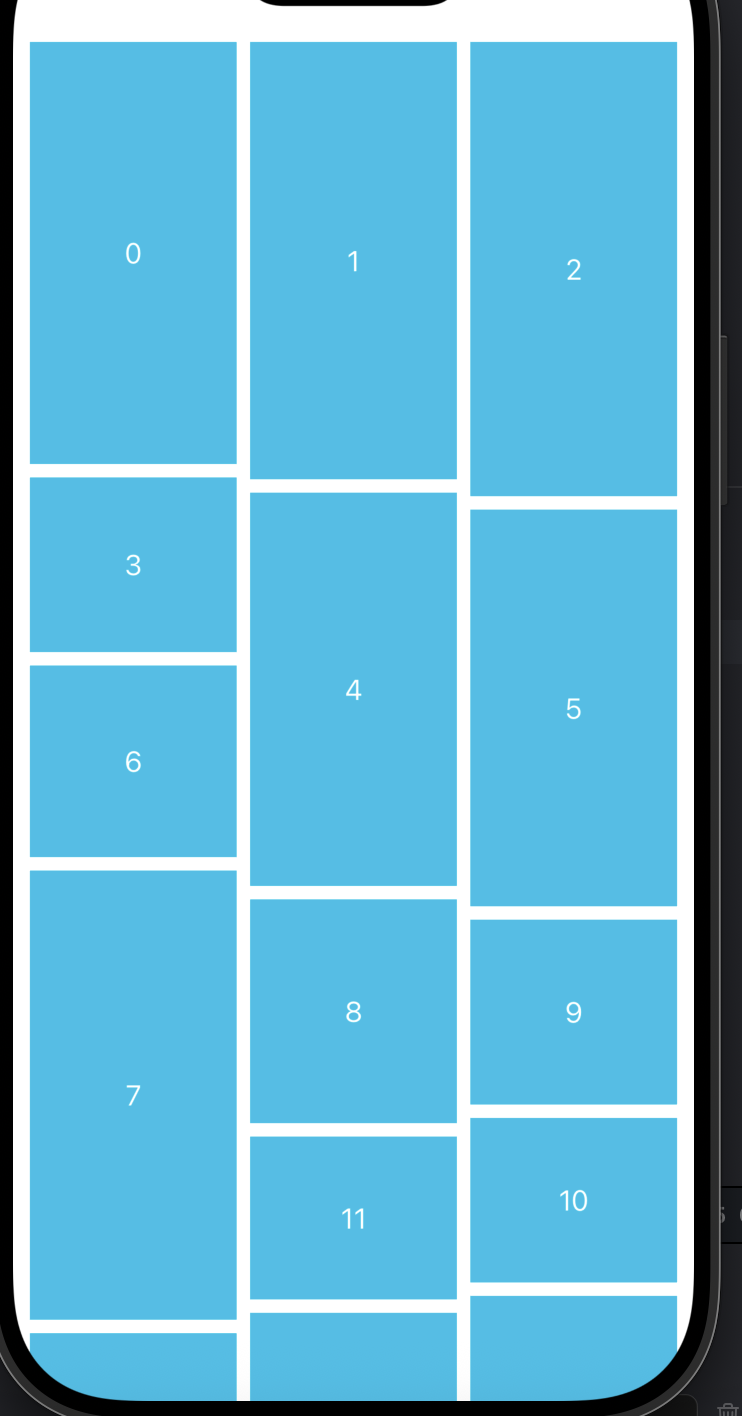
瀑布流布局的核心逻辑只有一句话:哪列最矮,就往哪列放。
实现步骤如下:
- 在
prepareLayout中提前计算所有 item 的位置和大小,缓存起来 - 在
layoutAttributesForElementsInRect:中返回当前可见区域内的 item 属性 - 在
collectionViewContentSize中告诉系统内容总共有多高
声明属性
objc
// WaterfallLayout.h

@interface WaterfallLayout : UICollectionViewLayout

@property (nonatomic, assign) NSInteger columnCount;    // 列数
@property (nonatomic, assign) CGFloat columnSpacing;    // 列间距
@property (nonatomic, assign) CGFloat rowSpacing;       // 行间距
@property (nonatomic, assign) UIEdgeInsets sectionInset; // 四周内边距

@end
objc
// WaterfallLayout.m

@interface WaterfallLayout ()

@property (nonatomic, strong) NSMutableArray<UICollectionViewLayoutAttributes *> *attributesArray; // 缓存所有 item 的布局属性
@property (nonatomic, strong) NSMutableArray<NSNumber *> *columnHeights; // 记录每列当前的累计高度
@property (nonatomic, assign) CGFloat contentHeight; // 内容总高度

@end
attributesArray用来缓存所有 item 的布局属性(位置、大小),避免每次都重新计算columnHeights记录每一列当前"长"到哪里了,是找最矮列的依据contentHeight是整个内容区域的总高度,决定 collectionView 能滚多远
sectionInset 是 UIEdgeInsets 结构体,包含四个属性:
| 属性 | 含义 |
|---|---|
top |
上内边距 |
left |
左内边距 |
bottom |
下内边距 |
right |
右内边距 |
核心方法:prepareLayout
prepareLayout 是整个布局的"总指挥",在布局开始前被系统调用一次,负责把所有 item 的位置和大小提前算好、存起来。
objc
- (void)prepareLayout {
    [super prepareLayout];

    UICollectionView *cv = self.collectionView;

    // 初始化每列高度,初始值为上内边距
    self.columnHeights = [NSMutableArray array];
    for (NSInteger i = 0; i < self.columnCount; i++) {
        [self.columnHeights addObject:@(self.sectionInset.top)];
    }

    self.attributesArray = [NSMutableArray array];

    // 计算 item 宽度
    CGFloat totalWidth = CGRectGetWidth(cv.bounds);
    CGFloat availableWidth = totalWidth - self.sectionInset.left - self.sectionInset.right;
    CGFloat itemWidth = (availableWidth - (self.columnCount - 1) * self.columnSpacing) / self.columnCount;

    // 遍历所有 item,计算每个 item 的 frame
    NSInteger itemCount = [cv numberOfItemsInSection:0];
    for (NSInteger i = 0; i < itemCount; i++) {
        NSIndexPath *indexPath = [NSIndexPath indexPathForItem:i inSection:0];

        // 找到最矮的列
        NSInteger targetColumn = [self findSmallestColumn];

        // 取出该列的当前高度
        CGFloat columnY = [self.columnHeights[targetColumn] floatValue];

        // 计算 item 的 y 坐标(非空列需要加行间距)
        CGFloat y = columnY;
        if (columnY > self.sectionInset.top) {
            y += self.rowSpacing;
        }

        // 计算 item 的 x 坐标
        CGFloat x = self.sectionInset.left + targetColumn * (itemWidth + self.columnSpacing);

        // 向数据源询问 item 高度(需要自定义代理协议)
        CGFloat itemHeight = [self.delegate waterfallLayout:self heightForItemAtIndexPath:indexPath itemWidth:itemWidth];

        // 创建布局属性,设置 frame
        UICollectionViewLayoutAttributes *attr = [UICollectionViewLayoutAttributes layoutAttributesForCellWithIndexPath:indexPath];
        attr.frame = CGRectMake(x, y, itemWidth, itemHeight);
        [self.attributesArray addObject:attr];

        // 更新该列的累计高度
        self.columnHeights[targetColumn] = @(y + itemHeight);
    }

    //  计算内容总高度 = 最高列的高度 + 底部内边距
    CGFloat maxColumnHeight = [[self.columnHeights valueForKeyPath:@"@max.floatValue"] floatValue];
    self.contentHeight = maxColumnHeight + self.sectionInset.bottom;
}
为什么初始值是 sectionInset.top
每列从顶部开始放置第一个 item,第一个 item 的 y 坐标就是 sectionInset.top(上内边距),所以初始化时每列高度都设为 sectionInset.top。
item 宽度计算
objc
totalWidth        = collectionView 的总宽度
availableWidth    = totalWidth - 左内边距 - 右内边距
itemWidth         = (availableWidth - 列间距总和) / 列数
列间距总和 = (columnCount - 1) * columnSpacing,因为 3 列之间只有 2 个间隔。
举例:totalWidth = 400,左右内边距各 10,3 列,列间距 10
availableWidth = 400 - 10 - 10 = 380
itemWidth = (380 - 2 × 10) / 3 = 360 / 3 = 120
验证:3 × 120 + 2 × 10 = 380
注意:左右内边距 ≠ 列间距。
sectionInset.left/right是内容区域与 collectionView 边界之间的空白columnSpacing是列与列之间的空白
item 的 x 坐标计算
objc
CGFloat x = self.sectionInset.left + targetColumn * (itemWidth + self.columnSpacing);第 0 列:x = 左内边距
第 1 列:x = 左内边距 + 1 × (列宽 + 列间距)
第 2 列:x = 左内边距 + 2 × (列宽 + 列间距)
以此类推,每列的 x 坐标都是固定的。
item 的 y 坐标计算
objc
CGFloat columnY = [self.columnHeights[targetColumn] floatValue];

CGFloat y = columnY;
if (columnY > self.sectionInset.top) {
    y += self.rowSpacing;
}
columnY 就是该列当前的累计高度,也就是这列最后一个 item 的底部在哪里
如果 columnY > sectionInset.top,说明该列已经有 item 了,下一个 item 需要在此基础上加行间距
如果 columnY == sectionInset.top,说明该列还是空的,直接从 sectionInset.top 开始放,不需要加行间距
找最矮列:findSmallestColumn
objc
- (NSInteger)findSmallestColumn {
    NSInteger targetColumn = 0;
    CGFloat minHeight = [self.columnHeights[0] floatValue];

    for (NSInteger i = 1; i < self.columnCount; i++) {
        CGFloat height = [self.columnHeights[i] floatValue];
        if (height < minHeight) {
            minHeight = height;
            targetColumn = i;
        }
    }
    return targetColumn;
}
遍历 columnHeights,找到高度最小的列的索引,把下一个 item 放到那里,这就是瀑布流"哪里矮往哪里放"的核心逻辑
返回内容大小:collectionViewContentSize
objc
- (CGSize)collectionViewContentSize {
    return CGSizeMake(CGRectGetWidth(self.collectionView.bounds), self.contentHeight);
}
这个方法告诉 UICollectionView(本质上是 UIScrollView)"我的内容有多大",系统根据这个值来决定可以滚动多远。
- 宽度 = collectionView 自身的宽度 → 水平方向不可滚动
- 高度 =
contentHeight(在 prepareLayout 中计算好的)→ 垂直方向按内容高度滚动
为什么不是自动决定的?
使用系统自带的
UICollectionViewFlowLayout时,它内部已经帮你计算好了,不需要手动写。但使用自定义 Layout 时,系统不知道你的排列规则,必须由你亲自告诉它内容有多大。如果不实现,默认返回CGSizeZero,collectionView 无法滚动,甚至不会显示任何 cell。
返回可见区域的布局属性:layoutAttributesForElementsInRect:
objc
- (NSArray<UICollectionViewLayoutAttributes *> *)layoutAttributesForElementsInRect:(CGRect)rect {
    NSMutableArray *result = [NSMutableArray array];
    for (UICollectionViewLayoutAttributes *attr in self.attributesArray) {
        if (CGRectIntersectsRect(rect, attr.frame)) {
            [result addObject:attr];
        }
    }
    return result;
}
系统在滚动时会不断调用这个方法,传入当前可见区域的 rect,问你"这个范围内有哪些 item 需要显示?"
CGRectIntersectsRect(rect, attr.frame) 判断某个 item 的 frame 是否与可见区域有交集,有交集才加入结果数组返回给系统。
这样做的好处是:不管有多少个 item,每次只返回屏幕上看得见的那十几个,系统只渲染这些,滚动流畅不卡顿。
如果不判断直接返回所有 attributes,功能上也能显示,但性能极差------每次滚动系统都要处理全部 item,数量一多就会明显掉帧。
根据 indexPath 返回单个属性:layoutAttributesForItemAtIndexPath:
objc
- (UICollectionViewLayoutAttributes *)layoutAttributesForItemAtIndexPath:(NSIndexPath *)indexPath {
    for (UICollectionViewLayoutAttributes *attr in self.attributesArray) {
        if ([attr.indexPath isEqual:indexPath]) {
            return attr;
        }
    }
    return nil;
}
系统在某些情况下(比如插入、删除 item 时)会直接通过 indexPath 查询某个 item 的属性,这个方法负责从缓存数组中找到对应的结果返回。
objc// 在 prepareLayout 中 self.attributesDict[indexPath] = attr; // 查找时直接返回 return self.attributesDict[indexPath];
响应尺寸变化:shouldInvalidateLayoutForBoundsChange:
objc
- (BOOL)shouldInvalidateLayoutForBoundsChange:(CGRect)newBounds {
    CGRect oldBounds = self.collectionView.bounds;
    if (CGSizeEqualToSize(oldBounds.size, newBounds.size)) {
        return NO;
    }
    return YES;
}
这是系统提供的可重写方法,用来控制当 collectionView 的 bounds 变化时,是否需要重新计算布局。
CGSizeEqualToSize 会比较两个 CGSize 的 width 和 height 是否都相等。
- 滚动时 :bounds 的 origin 变化,但 size 不变 → 返回
NO,不重新计算,滚动流畅 - 旋转屏幕时 :宽度发生变化,size 不同 → 返回
YES,重新计算所有 item 的位置和宽度
系统默认实现返回
NO,即 bounds 改变不会自动触发重新布局。瀑布流中 item 宽度依赖 collectionView 宽度,所以旋转屏幕后必须重算,需要重写这个方法。
方法调用顺序总结
prepareLayout                           // 提前算好所有 item 的位置
        ↓
collectionViewContentSize               // 告诉系统内容总高度
        ↓
layoutAttributesForElementsInRect:      // 滚动时返回当前可见区域的 item 属性
        ↓
layoutAttributesForItemAtIndexPath:     // 按需查询某个 item 的属性
完整代码如下:
objc
//
//  WaterfallLayout.h
//

#import <UIKit/UIKit.h>

@class WaterfallLayout;

@protocol WaterfallLayoutDelegate <NSObject>
- (CGFloat)waterfallLayout:(WaterfallLayout *)layout
    heightForItemAtIndexPath:(NSIndexPath *)indexPath
                  itemWidth:(CGFloat)itemWidth;
@end

@interface WaterfallLayout : UICollectionViewLayout

@property (nonatomic, weak) id<WaterfallLayoutDelegate> delegate;
@property (nonatomic, assign) NSInteger columnCount;
@property (nonatomic, assign) CGFloat columnSpacing;
@property (nonatomic, assign) CGFloat rowSpacing;
@property (nonatomic, assign) UIEdgeInsets sectionInset;

@end
objc
//
//  WaterfallLayout.m
//

#import "WaterfallLayout.h"

@interface WaterfallLayout ()
@property (nonatomic, strong) NSMutableArray<UICollectionViewLayoutAttributes *> *attributesArray;
@property (nonatomic, strong) NSMutableArray<NSNumber *> *columnHeights;
@property (nonatomic, assign) CGFloat contentHeight;
@end

@implementation WaterfallLayout

- (void)prepareLayout {
    [super prepareLayout];

    UICollectionView *cv = self.collectionView;

    self.columnHeights = [NSMutableArray array];
    for (NSInteger i = 0; i < self.columnCount; i++) {
        [self.columnHeights addObject:@(self.sectionInset.top)];
    }

    self.attributesArray = [NSMutableArray array];

    CGFloat totalWidth = CGRectGetWidth(cv.bounds);
    CGFloat availableWidth = totalWidth - self.sectionInset.left - self.sectionInset.right;
    CGFloat itemWidth = (availableWidth - (self.columnCount - 1) * self.columnSpacing) / self.columnCount;

    NSInteger itemCount = [cv numberOfItemsInSection:0];
    for (NSInteger i = 0; i < itemCount; i++) {
        NSIndexPath *indexPath = [NSIndexPath indexPathForItem:i inSection:0];

        NSInteger targetColumn = [self findSmallestColumn];
        CGFloat columnY = [self.columnHeights[targetColumn] floatValue];

        CGFloat y = columnY;
        if (columnY > self.sectionInset.top) {
            y += self.rowSpacing;
        }

        CGFloat x = self.sectionInset.left + targetColumn * (itemWidth + self.columnSpacing);
        CGFloat itemHeight = [self.delegate waterfallLayout:self heightForItemAtIndexPath:indexPath itemWidth:itemWidth];

        UICollectionViewLayoutAttributes *attr = [UICollectionViewLayoutAttributes layoutAttributesForCellWithIndexPath:indexPath];
        attr.frame = CGRectMake(x, y, itemWidth, itemHeight);
        [self.attributesArray addObject:attr];

        self.columnHeights[targetColumn] = @(y + itemHeight);
    }

    CGFloat maxColumnHeight = [[self.columnHeights valueForKeyPath:@"@max.floatValue"] floatValue];
    self.contentHeight = maxColumnHeight + self.sectionInset.bottom;
}

- (NSInteger)findSmallestColumn {
    NSInteger targetColumn = 0;
    CGFloat minHeight = [self.columnHeights[0] floatValue];
    for (NSInteger i = 1; i < self.columnCount; i++) {
        CGFloat height = [self.columnHeights[i] floatValue];
        if (height < minHeight) {
            minHeight = height;
            targetColumn = i;
        }
    }
    return targetColumn;
}

- (CGSize)collectionViewContentSize {
    return CGSizeMake(CGRectGetWidth(self.collectionView.bounds), self.contentHeight);
}

- (NSArray<UICollectionViewLayoutAttributes *> *)layoutAttributesForElementsInRect:(CGRect)rect {
    NSMutableArray *result = [NSMutableArray array];
    for (UICollectionViewLayoutAttributes *attr in self.attributesArray) {
        if (CGRectIntersectsRect(rect, attr.frame)) {
            [result addObject:attr];
        }
    }
    return result;
}

- (UICollectionViewLayoutAttributes *)layoutAttributesForItemAtIndexPath:(NSIndexPath *)indexPath {
    for (UICollectionViewLayoutAttributes *attr in self.attributesArray) {
        if ([attr.indexPath isEqual:indexPath]) {
            return attr;
        }
    }
    return nil;
}

- (BOOL)shouldInvalidateLayoutForBoundsChange:(CGRect)newBounds {
    CGRect oldBounds = self.collectionView.bounds;
    if (CGSizeEqualToSize(oldBounds.size, newBounds.size)) {
        return NO;
    }
    return YES;
}

@end
效果如下: