HarmonyOS AI 应用开发实战:英语口语情景对话系统
本文基于 HarmonyOS + ArkTS 的 Model-Service-Page 架构,详细解析英语口语情景对话 AI 应用的完整开发流程,涵盖语言学习痛点、架构设计、提示词工程、核心实现、性能优化等全链路技术要点。
一、项目背景与需求分析
1.1 英语口语学习的痛点
英语口语能力是全球化时代最重要的技能之一,然而也是大多数英语学习者最薄弱的环节。根据中国英语能力等级量表的调查数据显示,超过 70% 的中国英语学习者的口语能力远低于阅读和写作能力。
英语口语学习面临的核心痛点包括:
- 缺乏真实语境:传统的课堂学习缺乏真实的语言交流场景,学习内容与实际应用脱节
- 练习机会有限:缺少与母语者或高水平学习者的对话练习机会
- 反馈不足:口语练习后缺乏及时的纠正和反馈,错误表达固化
- 场景覆盖不全:日常学习涉及的场景有限,难以覆盖职场、商务、旅行等多场景需求
- 心理障碍:害怕犯错、缺乏自信,导致不敢开口说英语
1.2 产品功能定位
本应用旨在利用 AI 大语言模型的能力,为英语学习者提供沉浸式的口语情景对话练习体验。核心功能包括:
- 情景对话生成:根据用户指定的场景(如商务会议、餐厅点餐、机场值机等),生成多轮情景对话
- 关键词汇学习:提取对话中的关键词汇和短语,附带中文释义
- 发音技巧指导:针对对话中的难点发音提供发音技巧建议
- 难度自适应:根据用户指定的难度等级(初级、中级、高级)调整对话复杂度
1.3 技术选型
| 维度 | 方案 | 说明 |
|---|---|---|
| 平台 | HarmonyOS NEXT | 国产操作系统,教育场景 |
| 语言 | ArkTS | 静态类型,声明式 UI |
| 框架 | ArkUI | 响应式布局 |
| 架构 | Model-Service-Page | 三层分离 |
| AI | 大语言模型 | 情景对话生成 |
二、技术架构设计
2.1 架构总览
┌──────────────────────────────────────────────────────────────┐
│                        Page 层                                │
│  ┌───────────────────────────────────────────────────────┐   │
│  │  DialogPage                                           │   │
│  │  ├── 输入:场景、难度等级、目标岗位                     │   │
│  │  ├── 按钮:AI 生成                                     │   │
│  │  └── 结果:对话内容、关键词汇、发音技巧                  │   │
│  └───────────────────────────────────────────────────────┘   │
├──────────────────────────────────────────────────────────────┤
│                      Service 层                               │
│  ┌───────────────────────────────────────────────────────┐   │
│  │  DialogService                                         │   │
│  │  ├── Prompt 构建(场景 + 难度 + 角色)                  │   │
│  │  ├── AI API 调用                                       │   │
│  │  ├── 响应解析与数据映射                                 │   │
│  │  └── 降级策略                                          │   │
│  └───────────────────────────────────────────────────────┘   │
├──────────────────────────────────────────────────────────────┤
│                      Model 层                                 │
│  ┌───────────────────────────────────────────────────────┐   │
│  │  DialogData                                           │   │
│  │  ├── scene: string(场景)                             │   │
│  │  ├── level: string(难度等级)                         │   │
│  │  ├── role: string(目标岗位)                          │   │
│  │  ├── dialogue: Record<string, string>[](对话内容)    │   │
│  │  ├── key_vocab: Record<string, string>[](关键词汇)    │   │
│  │  └── pronunciation_tips: string[](发音技巧)          │   │
│  └───────────────────────────────────────────────────────┘   │
└──────────────────────────────────────────────────────────────┘
2.2 Model 层:数据模型设计
typescript
export class DialogData {
  scene: string = ''
  level: string = ''
  role: string = ''
  dialogue: Record<string, string>[] = []
  key_vocab: Record<string, string>[] = []
  pronunciation_tips: string[] = []

  constructor() {
    this.scene = ''
    this.level = ''
    this.role = ''
    this.dialogue = []
    this.key_vocab = []
    this.pronunciation_tips = []
  }
}字段设计分析:
| 字段 | 类型 | 说明 |
|---|---|---|
scene |
string | 对话场景描述 |
level |
string | 难度等级(初级/中级/高级) |
role |
string | 目标岗位或角色 |
dialogue |
Record<string, string>\[\] | 多轮对话内容,每个元素包含说话人和对话内容 |
key_vocab |
Record<string, string>\[\] | 关键词汇,每个元素包含单词和释义 |
pronunciation_tips |
string\[\] | 发音技巧建议列表 |
Record<string, string>\[\] 的使用 :dialogue 使用 Record 数组,每个元素包含 speaker(说话人)和 text(对话内容)两个键,天然适合多轮对话的展示。key_vocab 同样使用 Record 数组,包含 word(单词)和 meaning(释义)两个键。
2.3 Service 层:业务逻辑设计
typescript
import { DialogData } from './英语口语情景对话Model'

export class DialogService {
  private model: DialogData

  constructor() {
    this.model = new DialogData()
  }

  generateData(input: Record<string, Object>): DialogData {
    let result: DialogData = new DialogData()
    let scene: string = input['scene'] as string
    let level: string = input['level'] as string
    let role: string = input['role'] as string

    let prompt: string = this.buildPrompt(scene, level, role)
    let response: string = this.callAI(prompt)
    result = this.parseResponse(response, result)

    return result
  }

  private buildPrompt(scene: string, level: string, role: string): string {
    return `你是一位英语口语教学专家,擅长设计情景对话...
场景:${scene}
难度等级:${level}
目标岗位:${role}
请输出 JSON 格式的对话内容...`
  }
}
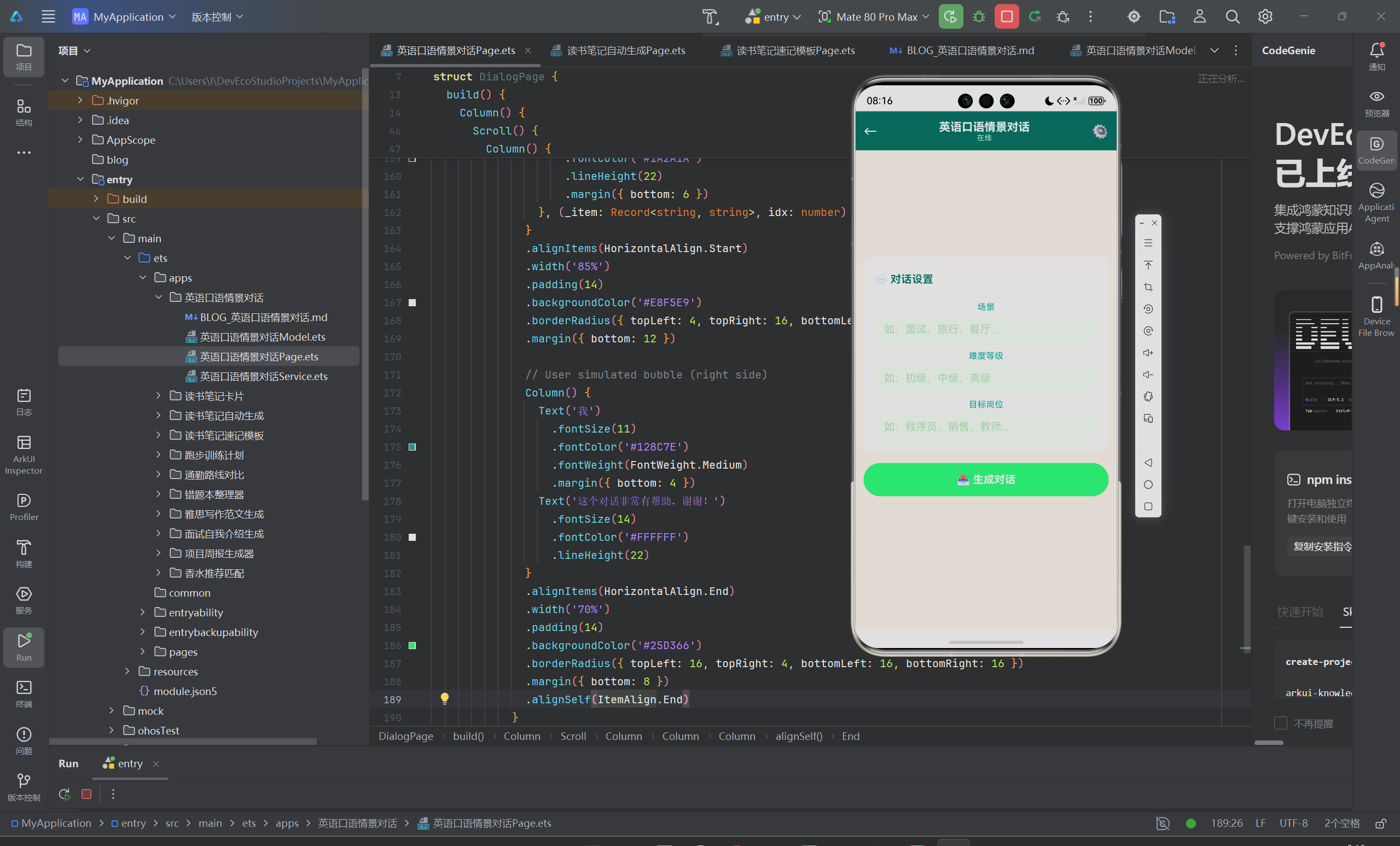
2.4 Page 层:UI 组件设计
typescript
@Entry
@Component
struct DialogPage {
  @State inputData: Record<string, Object> = {}
  @State resultData: DialogData | null = null
  @State showResult: boolean = false
  private service: DialogService = new DialogService()

  build() {
    Column() {
      Row() {
        Text('← 返回').onClick(() => { router.back() })
        Blank()
        Text('英语口语情景对话')
        Blank()
        Text('')
      }
      Scroll() {
        Column() {
          Text('场景')
          TextInput({ placeholder: '请输入场景' })
            .onChange((val: string) => { this.inputData['scene'] = val })
          Text('难度等级')
          TextInput({ placeholder: '请输入难度等级' })
            .onChange((val: string) => { this.inputData['level'] = val })
          Text('目标岗位')
          TextInput({ placeholder: '请输入目标岗位' })
            .onChange((val: string) => { this.inputData['role'] = val })
          Button('AI 生成').onClick(() => {
            this.resultData = this.service.generateData(this.inputData)
            this.showResult = true
          })
          if (this.showResult && this.resultData !== null) {
            Text('生成结果')
            Text('英语对话')
          }
        }
      }
    }
  }
}
三、AI 提示词工程原理
3.1 情景对话提示词设计
3.1.1 角色设定
你是一位英语口语教学专家,拥有 TESOL 国际英语教师资格认证,擅长根据学习者的水平设计真实、自然、有教育意义的情景对话。你精通英语语音学、语用学和跨文化交际。3.1.2 难度分级策略
难度等级:{level}

各等级要求:
- 初级:使用简单句式和基础词汇,语速建议慢速,对话轮次5-6轮
- 中级:使用复合句和常用短语,语速正常,对话轮次8-10轮
- 高级:使用复杂句式和地道表达,语速自然,对话轮次10-12轮
3.1.3 场景和角色注入
对话场景:{scene}
目标岗位/角色:{role}

请确保对话内容贴合该场景的实际沟通需求,角色语言符合其身份特征。
3.2 完整 Prompt 示例
typescript
buildPrompt(scene: string, level: string, role: string): string {
  return `你是一位英语口语教学专家,擅长设计情景对话。

请为以下场景生成英语情景对话:

对话场景:${scene}
难度等级:${level}
目标岗位:${role}

请严格按照以下 JSON 格式输出:

{
  "dialogue": [
    {"speaker": "A", "text": "说话人A的对话内容"},
    {"speaker": "B", "text": "说话人B的对话内容"},
    {"speaker": "A", "text": "说话人A的下一句对话内容"}
  ],
  "key_vocab": [
    {"word": "关键词1", "meaning": "中文释义"},
    {"word": "关键词2", "meaning": "中文释义"}
  ],
  "pronunciation_tips": [
    "发音技巧1:针对某个单词的发音指导",
    "发音技巧2:针对某个句子的连读/弱读指导"
  ]
}

要求:
1. 对话内容要真实、自然,符合实际场景
2. 根据难度等级调整句式和词汇复杂度
3. 关键词汇至少5个,包含单词和中文释义
4. 发音技巧至少3条,针对对话中的难点发音
5. 对话轮次根据难度等级确定:初级5-6轮,中级8-10轮,高级10-12轮`
}
3.3 响应解析
typescript
parseResponse(response: string, result: DialogData): DialogData {
  try {
    let parsed: Object = JSON.parse(response)
    if (Array.isArray(parsed['dialogue'])) {
      result.dialogue = parsed['dialogue'] as Record<string, string>[]
    }
    if (Array.isArray(parsed['key_vocab'])) {
      result.key_vocab = parsed['key_vocab'] as Record<string, string>[]
    }
    if (Array.isArray(parsed['pronunciation_tips'])) {
      result.pronunciation_tips = parsed['pronunciation_tips'] as string[]
    }
  } catch (e) {
    result.pronunciation_tips = ['AI 服务暂时不可用,请稍后重试']
  }
  return result
}
四、核心功能实现详解
4.1 输入区域实现
typescript
Text('场景')
  .fontSize(14)
  .fontWeight(FontWeight.Bold)
  .fontColor($r('app.color.text_primary'))
  .margin({ top: 12, bottom: 4 })
TextInput({ placeholder: '请输入场景' })
  .fontSize(14)
  .height(44)
  .backgroundColor('#FFFFFF')
  .borderRadius(8)
  .padding({ left: 12, right: 12 })
  .onChange((val: string) => { this.inputData['scene'] = val })

Text('难度等级')
  .fontSize(14)
  .fontWeight(FontWeight.Bold)
  .fontColor($r('app.color.text_primary'))
  .margin({ top: 12, bottom: 4 })
TextInput({ placeholder: '请输入难度等级' })
  .fontSize(14)
  .height(44)
  .backgroundColor('#FFFFFF')
  .borderRadius(8)
  .padding({ left: 12, right: 12 })
  .onChange((val: string) => { this.inputData['level'] = val })

Text('目标岗位')
  .fontSize(14)
  .fontWeight(FontWeight.Bold)
  .fontColor($r('app.color.text_primary'))
  .margin({ top: 12, bottom: 4 })
TextInput({ placeholder: '请输入目标岗位' })
  .fontSize(14)
  .height(44)
  .backgroundColor('#FFFFFF')
  .borderRadius(8)
  .padding({ left: 12, right: 12 })
  .onChange((val: string) => { this.inputData['role'] = val })
4.2 结果展示区域
typescript
if (this.showResult && this.resultData !== null) {
  // 对话内容 - 使用气泡样式
  Text('情景对话')
    .fontSize(16)
    .fontWeight(FontWeight.Bold)
    .margin({ top: 16, bottom: 8 })

  ForEach(this.resultData.dialogue, (turn: Record<string, string>, index: number) => {
    Row() {
      if (turn['speaker'] === 'A') {
        Text(turn['speaker'])
          .fontSize(12)
          .fontColor('#3B82F6')
          .fontWeight(FontWeight.Bold)
          .margin({ right: 8 })
        Text(turn['text'])
          .fontSize(14)
          .fontColor($r('app.color.text_primary'))
          .backgroundColor('#E8F0FE')
          .padding(10)
          .borderRadius(8)
          .maxLines(10)
        Blank()
      } else {
        Blank()
        Text(turn['text'])
          .fontSize(14)
          .fontColor($r('app.color.text_primary'))
          .backgroundColor('#F0FDF4')
          .padding(10)
          .borderRadius(8)
          .maxLines(10)
        Text(turn['speaker'])
          .fontSize(12)
          .fontColor('#22C55E')
          .fontWeight(FontWeight.Bold)
          .margin({ left: 8 })
      }
    }
    .width('100%')
    .margin({ bottom: 8 })
  }, (turn: Record<string, string>, index: number) => index.toString())

  // 关键词汇
  Text('关键词汇')
    .fontSize(16)
    .fontWeight(FontWeight.Bold)
    .margin({ top: 16, bottom: 8 })

  ForEach(this.resultData.key_vocab, (vocab: Record<string, string>, index: number) => {
    Row() {
      Text(vocab['word'])
        .fontSize(14)
        .fontWeight(FontWeight.Bold)
        .fontColor('#3B82F6')
        .margin({ right: 12 })
      Text(vocab['meaning'])
        .fontSize(14)
        .fontColor($r('app.color.text_secondary'))
      Blank()
    }
    .width('100%')
    .backgroundColor('#FFFFFF')
    .padding(10)
    .borderRadius(8)
    .margin({ bottom: 6 })
  }, (vocab: Record<string, string>, index: number) => index.toString())

  // 发音技巧
  Text('发音技巧')
    .fontSize(16)
    .fontWeight(FontWeight.Bold)
    .margin({ top: 16, bottom: 8 })

  ForEach(this.resultData.pronunciation_tips, (tip: string, index: number) => {
    Row() {
      Circle()
        .width(6)
        .height(6)
        .fill('#F59E0B')
        .margin({ right: 8 })
      Text(tip)
        .fontSize(14)
        .fontColor($r('app.color.text_primary'))
    }
    .width('100%')
    .margin({ bottom: 6 })
  }, (tip: string, index: number) => index.toString())
}
4.3 完整数据流
用户输入:场景 = "商务会议自我介绍", 难度等级 = "中级", 目标岗位 = "产品经理"
    ↓
inputData = { scene: "商务会议自我介绍", level: "中级", role: "产品经理" }
    ↓
点击 "AI 生成"
    ↓
service.generateData(inputData)
    ↓
构建 Prompt → 调用 AI → 解析响应
    ↓
返回 DialogData 实例
    ↓
resultData 更新 → showResult = true
    ↓
UI 渲染:对话气泡、关键词汇列表、发音技巧
五、用户体验优化
5.1 页面布局
┌──────────────────────────────────┐
│ ← 返回    英语口语情景对话         │
├──────────────────────────────────┤
│  输入信息                         │
│  ┌──────────────────────┐       │
│  │ 场景                  │       │
│  │ [商务会议自我介绍]    │       │
│  │ 难度等级              │       │
│  │ [中级]                │       │
│  │ 目标岗位              │       │
│  │ [产品经理]            │       │
│  └──────────────────────┘       │
│  ┌──────────────────────┐       │
│  │     AI 生成            │       │
│  └──────────────────────┘       │
│  情景对话                         │
│  ┌──┐  ┌────────────────┐      │
│  │A │  │ 对话内容...     │      │
│  └──┘  └────────────────┘      │
│  ┌────────────────┐  ┌──┐     │
│  │ 对话内容...     │  │B │     │
│  └────────────────┘  └──┘     │
│  关键词汇                         │
│  ┌──────────────────────┐       │
│  │ collaborate  合作    │       │
│  │ strategy     策略    │       │
│  └──────────────────────┘       │
│  发音技巧                         │
│  • 注意 strategy 中的 /str/...   │
└──────────────────────────────────┘
5.2 交互优化
5.2.1 对话气泡设计
说话人 A 的对话左对齐(蓝色背景),说话人 B 的对话右对齐(绿色背景),模拟真实聊天软件的对话界面,提供沉浸式阅读体验。
5.2.2 颜色编码
- 蓝色:说话人 A 和关键词
- 绿色:说话人 B
- 橙色:发音技巧标记
5.3 资源管理
typescript
.fontColor($r('app.color.text_primary'))
.fontColor($r('app.color.text_secondary'))
.backgroundColor('#F8FAFC')
.backgroundColor('#FFFFFF')
.backgroundColor('#E8F0FE')  // 说话人A背景
.backgroundColor('#F0FDF4')  // 说话人B背景
六、性能优化与最佳实践
6.1 ArkTS 约束适配
6.1.1 Record 数组遍历
typescript
// 正确:遍历 Record 数组
ForEach(this.resultData.dialogue, (turn: Record<string, string>, index: number) => {
  Text(turn['speaker'])
  Text(turn['text'])
}, (turn: Record<string, string>, index: number) => index.toString())
6.1.2 条件渲染与样式
typescript
// 正确:根据条件渲染不同样式
if (turn['speaker'] === 'A') {
  // 左对齐,蓝色背景
} else {
  // 右对齐,绿色背景
}
6.2 性能优化
6.2.1 条件渲染
typescript
if (this.showResult && this.resultData !== null) {
  // 结果渲染
}
6.2.2 ForEach 列表优化
typescript
// 使用稳定的 key 生成函数
ForEach(items, item => { /* ... */ }, (item, index) => index.toString())
6.3 错误处理
typescript
generateData(input: Record<string, Object>): DialogData {
  try {
    if (!input['scene'] || !input['level']) {
      throw new Error('场景和难度等级为必填')
    }
    return this.parseResponse(this.callAI(this.buildPrompt(...)), new DialogData())
  } catch (e) {
    let result: DialogData = new DialogData()
    result.pronunciation_tips = ['请确保场景和难度等级已填写']
    return result
  }
}
6.4 代码组织
英语口语情景对话/
├── 英语口语情景对话Model.ets     # 数据模型
├── 英语口语情景对话Service.ets    # 业务逻辑
└── 英语口语情景对话Page.ets      # 页面组件
七、总结与展望
7.1 项目成果
- 实现了基于 AI 的英语口语情景对话生成
- 对话气泡 UI 设计提供沉浸式阅读体验
- 包含关键词汇和发音技巧,辅助学习
- 难度分级满足不同水平学习者的需求
7.2 技术经验
- 对话气泡 UI 设计提升口语学习体验
- Record 数组适合存储多轮对话数据
- 难度分级提示词设计需要精确的等级描述
7.3 未来展望
- 接入语音合成(TTS),实现对话朗读功能
- 支持语音识别,用户可以跟读并得到评分
- 扩展更多真实场景,覆盖商务、旅游、留学等
本文通过英语口语情景对话 AI 应用的完整开发实践,详细阐述了 HarmonyOS + ArkTS + AI 的技术栈应用。从对话气泡 UI 设计到难度分级提示词工程,全面展示了鸿蒙平台上智慧语言学习工具开发的全流程。