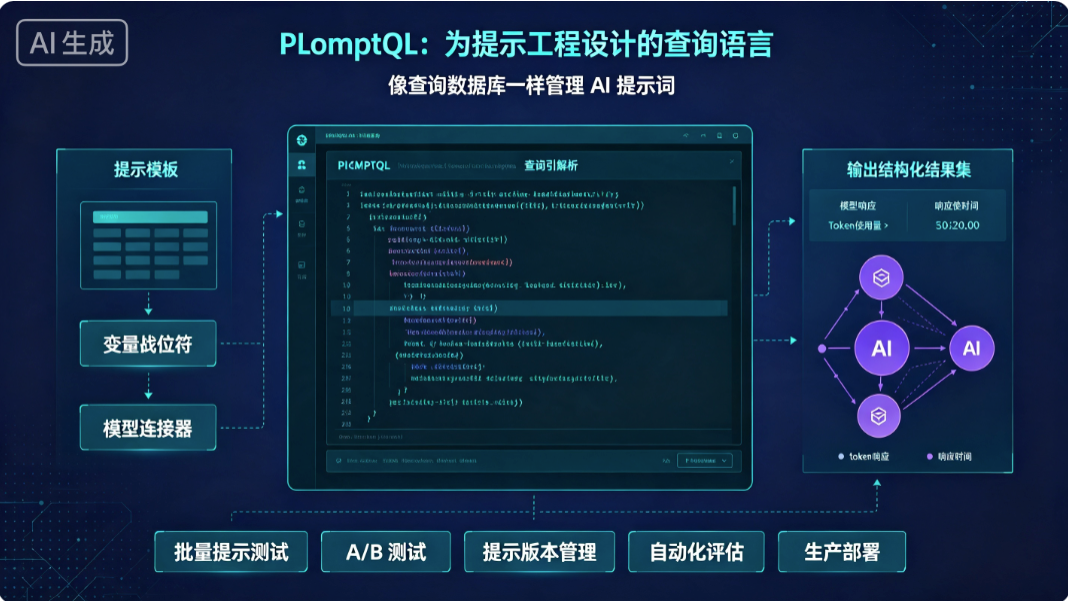
① PromptQL 核心概念与应用场景解析
什么是 PromptQL?
PromptQL(Prompt Query Language)是一种专门为 AI 提示工程设计的查询语言。它借鉴了 SQL 的语法结构,但将操作对象从数据库表变成了 AI 模型和提示模板,让开发者能够以结构化、可编程的方式构建、管理和优化提示词。
核心概念
- 提示模板(Prompt Template) :包含变量占位符的文本模板,如
"请用{style}风格总结以下内容:{content}" - 模型连接器(Model Connector):连接不同 AI 模型(如 OpenAI GPT、Claude、本地模型)的接口
- 查询引擎(Query Engine):解析 PromptQL 语句并执行提示优化的核心组件
- 结果集(Result Set):查询执行后返回的结构化数据,包含模型响应、token 使用量、响应时间等元数据
应用场景
- 批量提示测试:同时测试同一提示在不同模型或参数下的效果
- A/B 测试优化:系统化对比不同提示版本的性能
- 提示版本管理:像管理代码一样管理提示词的迭代历史
- 自动化评估:编写评估查询来自动评分模型响应质量
- 生产环境部署:将优化后的提示模板集成到应用程序中
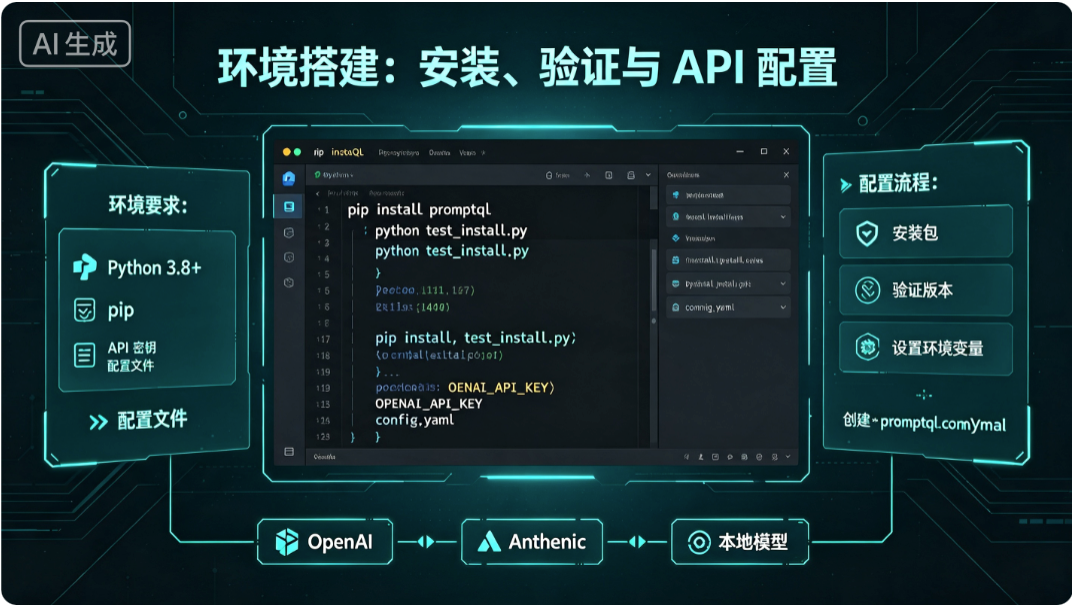
② 开发环境搭建与依赖安装步骤
环境要求
- Python 3.8 或更高版本
- pip 包管理器
- 可选的 AI 模型 API 密钥(OpenAI、Anthropic 等)
安装 PromptQL
bash
# 使用 pip 安装最新版本
pip install promptql

# 或者安装开发版本
pip install git+https://github.com/promptql/promptql.git

# 安装包含所有可选依赖的版本
pip install "promptql[all]"
验证安装
python
# 创建 test_install.py 文件
import promptql

print(f"PromptQL 版本: {promptql.__version__}")
print("安装成功!")
运行验证:
bash
python test_install.py配置 API 密钥
python
# 在代码中配置(不推荐硬编码)
import os
os.environ["OPENAI_API_KEY"] = "your-openai-api-key"
os.environ["ANTHROPIC_API_KEY"] = "your-anthropic-api-key"

# 或者使用配置文件
# 创建 ~/.promptql/config.yaml
# api_keys:
#   openai: your-openai-api-key
#   anthropic: your-anthropic-api-key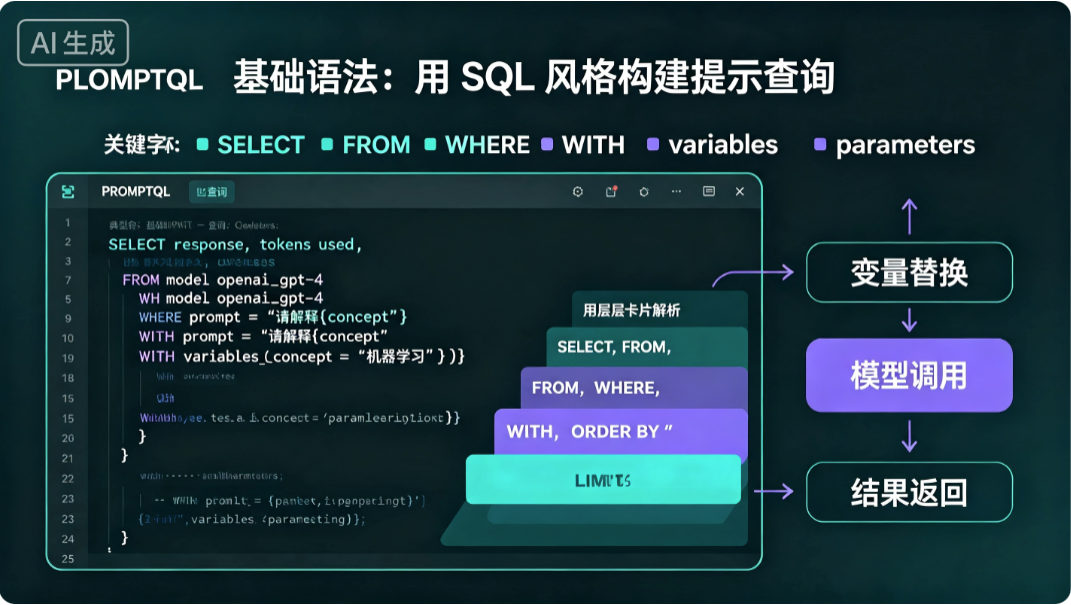
③ 基础语法结构与查询语句编写
基本查询结构
PromptQL 查询语句的基本结构类似于 SQL:
sql
SELECT response, tokens_used
FROM model.openai.gpt-4
WHERE prompt = '请用简洁的语言解释{concept}'
  AND parameters.temperature = 0.7
  AND parameters.max_tokens = 500
WITH variables(concept = '机器学习')
LIMIT 1;
关键子句解析
1. SELECT 子句
指定要返回的字段:
sql
-- 返回完整响应
SELECT *

-- 返回特定字段
SELECT response, tokens_used, response_time

-- 使用聚合函数
SELECT AVG(response_length), COUNT(*) as total_queries
2. FROM 子句
指定使用的模型:
sql
-- 使用特定模型
FROM model.openai.gpt-4

-- 使用模型别名
FROM model.anthropic.claude-3-opus AS claude

-- 多模型查询
FROM model.openai.gpt-4, model.anthropic.claude-3-sonnet
3. WHERE 子句
筛选条件:
sql
WHERE prompt = '固定提示词'
WHERE prompt_template = 'templates/classification.prompt'
WHERE parameters.temperature BETWEEN 0.3 AND 0.9
WHERE model_name IN ('gpt-4', 'claude-3-opus')
4. WITH 子句
定义变量和参数:
sql
WITH variables(
  topic = '人工智能',
  style = '技术博客',
  length = '简短'
),
parameters(
  temperature = 0.7,
  max_tokens = 1000
)
完整示例
sql
-- 基础查询示例
SELECT response, tokens_used, model_name
FROM model.openai.gpt-4
WHERE prompt = '请将以下英文翻译成中文:{text}'
  AND parameters.temperature = 0.5
WITH variables(text = 'Hello, world! This is a PromptQL tutorial.')
ORDER BY tokens_used ASC
LIMIT 3;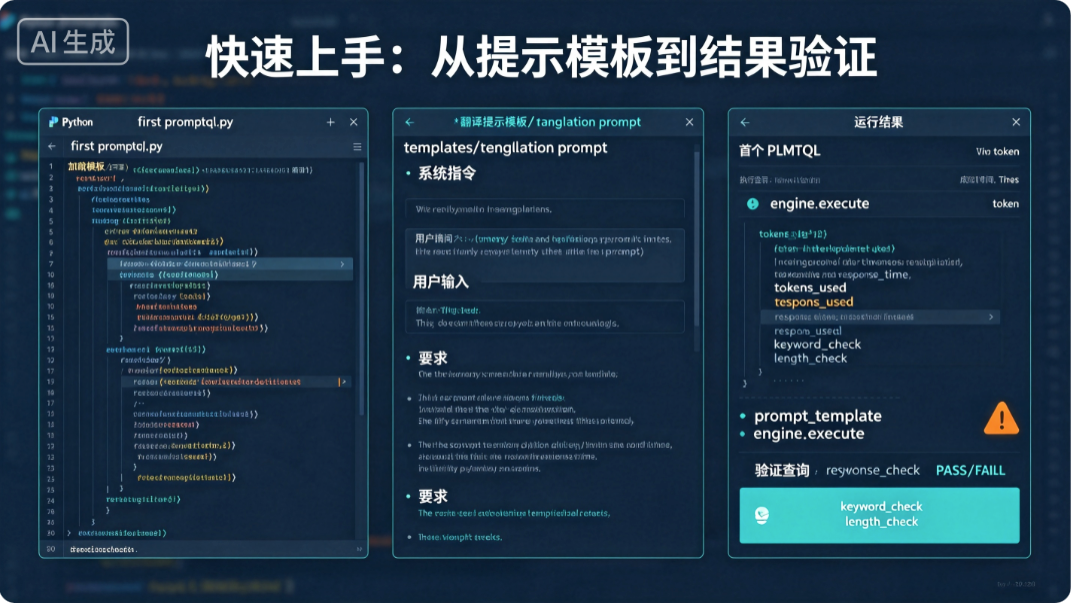
④ 首个 PromptQL 程序运行与结果验证
创建第一个提示模板
python
# 创建 templates/translation.prompt
"""
[系统指令]
你是一位专业的翻译专家,擅长技术文档翻译。

[用户输入]
请将以下{source_language}文本翻译成{target_language}:
{text}

[要求]
1. 保持技术术语准确
2. 符合目标语言表达习惯
3. 保留原文格式和标点
"""
编写 Python 程序
python
# first_promptql.py
from promptql import PromptQL
import os

# 设置 API 密钥
os.environ["OPENAI_API_KEY"] = "your-api-key-here"

# 初始化 PromptQL 引擎
engine = PromptQL()

# 定义查询语句
query = """
SELECT response, tokens_used, response_time
FROM model.openai.gpt-3.5-turbo
WHERE prompt_template = 'templates/translation.prompt'
  AND parameters.temperature = 0.3
WITH variables(
  source_language = '英语',
  target_language = '中文',
  text = 'PromptQL is a query language designed specifically for prompt engineering. It allows developers to structure, manage, and optimize prompts in a programmable way.'
)
LIMIT 1;
"""

# 执行查询
try:
    results = engine.execute(query)

    # 处理结果
    for result in results:
        print("=" * 50)
        print("翻译结果:")
        print(result['response'])
        print(f"\n使用 Token 数:{result['tokens_used']}")
        print(f"响应时间:{result['response_time']:.2f}秒")
        print("=" * 50)

except Exception as e:
    print(f"查询执行失败:{e}")
运行与验证
bash
# 运行程序
python first_promptql.py

# 预期输出示例
==================================================
翻译结果:
PromptQL 是一种专门为提示工程设计的查询语言。它允许开发者以可编程的方式构建、管理和优化提示词。

使用 Token 数:78
响应时间:1.23秒
==================================================
结果验证方法
- 人工检查:阅读翻译结果,确保准确性和流畅性
- 自动验证:添加验证查询
sql
-- 验证查询:检查翻译是否包含关键词
SELECT
  CASE
    WHEN response LIKE '%查询语言%' THEN 'PASS'
    ELSE 'FAIL'
  END as keyword_check,
  CASE
    WHEN LENGTH(response) > 20 THEN 'PASS'
    ELSE 'FAIL'
  END as length_check
FROM model.openai.gpt-3.5-turbo
WHERE prompt = '请验证以下翻译是否准确:{translation}'
WITH variables(translation = '上一步的翻译结果');
⑤ 复杂条件过滤与数据聚合操作
多条件过滤
sql
-- 组合多个条件
SELECT response, model_name, parameters.temperature
FROM model.openai.gpt-4, model.anthropic.claude-3-sonnet
WHERE prompt_template = 'templates/summarization.prompt'
  AND parameters.temperature BETWEEN 0.3 AND 0.8
  AND parameters.max_tokens >= 500
  AND parameters.max_tokens <= 2000
  AND created_at >= '2024-01-01'
WITH variables(
  text = '长文本内容...',
  summary_length = 'medium'
)
ORDER BY parameters.temperature ASC, tokens_used DESC;
数据聚合操作
sql
-- 统计不同模型的平均表现
SELECT
  model_name,
  COUNT(*) as query_count,
  AVG(tokens_used) as avg_tokens,
  AVG(response_time) as avg_response_time,
  MIN(response_time) as min_response_time,
  MAX(response_time) as max_response_time
FROM model.openai.gpt-3.5-turbo,
     model.openai.gpt-4,
     model.anthropic.claude-3-sonnet
WHERE prompt_template = 'templates/qa.prompt'
  AND created_at >= DATE_SUB(NOW(), INTERVAL 7 DAY)
GROUP BY model_name
HAVING query_count > 10
ORDER BY avg_response_time ASC;
子查询与嵌套查询
sql
-- 使用子查询筛选
SELECT response, model_name, tokens_used
FROM (
  SELECT *
  FROM model.openai.gpt-4
  WHERE prompt LIKE '%机器学习%'
    AND tokens_used < 1000
) as filtered_results
WHERE response LIKE '%算法%'
  AND LENGTH(response) > 100;

-- 嵌套查询示例:找出最优温度参数
SELECT
  parameters.temperature,
  AVG(rating) as avg_rating,
  COUNT(*) as sample_size
FROM (
  SELECT
    response,
    parameters.temperature,
    CASE
      WHEN response LIKE '%准确%' AND response LIKE '%完整%' THEN 5
      WHEN response LIKE '%准确%' THEN 4
      WHEN response LIKE '%基本正确%' THEN 3
      ELSE 2
    END as rating
  FROM model.openai.gpt-3.5-turbo
  WHERE prompt = '请解释{concept}'
  WITH variables(concept = '神经网络')
) as rated_responses
GROUP BY parameters.temperature
HAVING sample_size >= 5
ORDER BY avg_rating DESC
LIMIT 3;
连接查询(多提示对比)
sql
-- 比较不同提示模板的效果
SELECT
  a.template_name as template_a,
  b.template_name as template_b,
  a.response as response_a,
  b.response as response_b,
  ABS(LENGTH(a.response) - LENGTH(b.response)) as length_diff
FROM (
  SELECT 'template_v1' as template_name, response
  FROM model.openai.gpt-4
  WHERE prompt_template = 'templates/version1.prompt'
    AND parameters.temperature = 0.7
  WITH variables(topic = '人工智能伦理')
) a
JOIN (
  SELECT 'template_v2' as template_name, response
  FROM model.openai.gpt-4
  WHERE prompt_template = 'templates/version2.prompt'
    AND parameters.temperature = 0.7
  WITH variables(topic = '人工智能伦理')
) b ON 1=1;
⑥ 自定义函数扩展与模块化调用
创建自定义函数
python
# custom_functions.py
from promptql.decorators import ql_function
import re
from typing import List, Dict

@ql_function(name="extract_keywords")
def extract_keywords(text: str, max_keywords: int = 5) -> List[str]:
    """
    从文本中提取关键词
    """
    # 简单的关键词提取逻辑(实际应用中可以使用更复杂的NLP库)
    words = re.findall(r'\b\w{4,}\b', text.lower())
    word_count = {}

    for word in words:
        if word not in ['this', 'that', 'with', 'from', 'have']:
            word_count[word] = word_count.get(word, 0) + 1

    sorted_words = sorted(word_count.items(), key=lambda x: x[1], reverse=True)
    return [word for word, count in sorted_words[:max_keywords]]

@ql_function(name="calculate_readability")
def calculate_readability(text: str) -> Dict[str, float]:
    """
    计算文本可读性分数
    """
    sentences = re.split(r'[.!?]+', text)
    words = text.split()

    if len(sentences) == 0 or len(words) == 0:
        return {"score": 0, "avg_sentence_length": 0}

    avg_sentence_length = len(words) / len(sentences)

    # 简单的可读性分数计算
    readability_score = max(0, min(100, 100 - (avg_sentence_length - 10) * 2))

    return {
        "score": round(readability_score, 2),
        "avg_sentence_length": round(avg_sentence_length, 2)
    }
在查询中使用自定义函数
sql
-- 使用自定义函数处理响应
SELECT
  response,
  extract_keywords(response, 3) as top_keywords,
  calculate_readability(response).score as readability_score,
  calculate_readability(response).avg_sentence_length as avg_sentence_len
FROM model.openai.gpt-4
WHERE prompt = '请写一篇关于{technology}的简短介绍'
WITH variables(technology = '区块链技术')
LIMIT 1;
模块化提示模板
yaml
# 模块化模板配置 templates/modular_config.yaml
modules:
  system_prompt: |
    你是一位{expert_role},擅长{expertise_area}。
    请以{style}风格回答用户问题。

  format_instructions: |
    请按照以下格式回复:
    1. 核心观点
    2. 关键要点(3-5条)
    3. 实际应用建议

  quality_checks: |
    回答必须满足:
    - 准确性:基于事实和数据
    - 实用性:提供可操作建议
    - 清晰性:语言简洁明了
sql
-- 使用模块化模板
SELECT response
FROM model.openai.gpt-4
WHERE prompt = '
{system_prompt}

{format_instructions}

{quality_checks}

用户问题:{question}
'
WITH variables(
  expert_role = '技术架构师',
  expertise_area = '系统设计和性能优化',
  style = '专业且易懂',
  question = '如何设计一个高可用的微服务架构?'
);
创建可复用查询模板
sql
-- 保存为 templates/analysis_query.sql
-- 分析查询模板
SELECT
  model_name,
  DATE(created_at) as query_date,
  COUNT(*) as daily_queries,
  AVG(tokens_used) as avg_tokens,
  AVG(response_time) as avg_response_time,
  SUM(CASE WHEN response LIKE '%{success_keyword}%' THEN 1 ELSE 0 END) as success_count
FROM {model_table}
WHERE created_at >= '{start_date}'
  AND created_at <= '{end_date}'
  AND prompt_template LIKE '%{template_pattern}%'
GROUP BY model_name, DATE(created_at)
ORDER BY query_date DESC, daily_queries DESC;
⑦ 常见语法报错分析与快速修复
1. 语法错误:缺少引号或括号
sql
-- 错误示例
SELECT response
FROM model.openai.gpt-4
WHERE prompt = 请解释机器学习  -- 缺少引号

-- 正确写法
SELECT response
FROM model.openai.gpt-4
WHERE prompt = '请解释机器学习'
2. 错误:未定义的变量
sql
-- 错误示例
SELECT response
FROM model.openai.gpt-4
WHERE prompt = '请解释{topic}'  -- topic 变量未在 WITH 子句中定义

-- 正确写法
SELECT response
FROM model.openai.gpt-4
WHERE prompt = '请解释{topic}'
WITH variables(topic = '深度学习')
3. 错误:模型不存在或不可用
sql
-- 错误示例
SELECT response
FROM model.openai.gpt-5  -- GPT-5 不存在

-- 解决方案
-- 1. 检查模型名称拼写
-- 2. 确认 API 密钥有权限访问该模型
-- 3. 查看可用模型列表:
SHOW MODELS;
4. 错误:参数范围无效
sql
-- 错误示例
SELECT response
FROM model.openai.gpt-4
WHERE parameters.temperature = 2.0  -- temperature 应在 0-2 之间

-- 正确写法
SELECT response
FROM model.openai.gpt-4
WHERE parameters.temperature = 0.7
5. 调试技巧
python
# 启用详细日志
import logging
logging.basicConfig(level=logging.DEBUG)

# 使用验证模式
from promptql import PromptQL
engine = PromptQL(validate_queries=True)

# 逐步执行复杂查询
try:
    # 先测试简单查询
    test_query = """
    SELECT 'test' as result
    FROM model.openai.gpt-3.5-turbo
    LIMIT 1;
    """
    results = engine.execute(test_query)
    print("基础连接测试通过")

    # 逐步添加复杂度
    complex_query = """
    -- 分步构建复杂查询
    """

except Exception as e:
    print(f"错误类型:{type(e).__name__}")
    print(f"错误信息:{str(e)}")
    print(f"错误位置:{e.__traceback__.tb_lineno if hasattr(e, '__traceback__') else '未知'}")
6. 性能问题排查
sql
-- 查询执行缓慢时使用 EXPLAIN
EXPLAIN
SELECT response
FROM model.openai.gpt-4
WHERE prompt LIKE '%{keyword}%'
WITH variables(keyword = '人工智能');

-- 结果示例:
-- | Step | Operation | Estimated Cost | Notes |
-- |------|-----------|----------------|-------|
-- | 1    | Parse Query | 10ms | 语法解析 |
-- | 2    | Resolve Variables | 5ms | 变量替换 |
-- | 3    | Model A