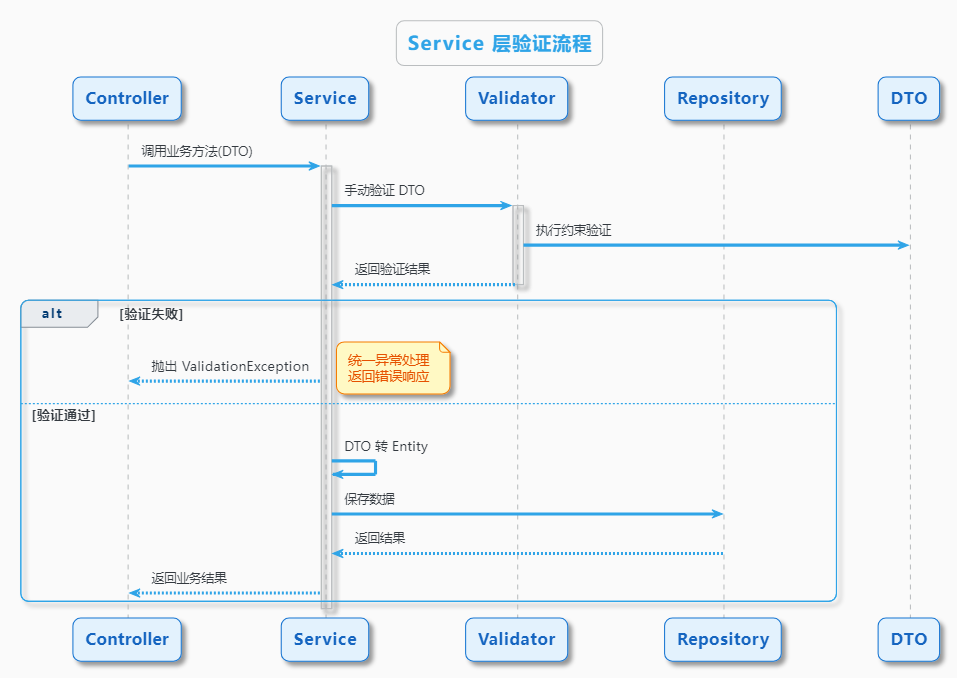
1 Service 层验证架构
2 使用 @Validated 注解(方法级验证)
java
// Service 接口
public interface OrderService {
    Order createOrder(OrderDTO orderDTO);
    Order updateOrder(Long id, OrderDTO orderDTO);
}

// Service 实现类
@Service
@Validated  // ⚠️ 类级别注解:开启方法参数验证
@Slf4j
public class OrderServiceImpl implements OrderService {

    @Autowired
    private OrderRepository orderRepository;

    @Autowired
    private ProductService productService;

    /**
     * 创建订单 - 使用 @Valid 自动验证
     */
    @Override
    public Order createOrder(@Valid OrderDTO orderDTO) {
        log.info("创建订单: {}", orderDTO);

        // 验证通过后执行业务逻辑

        // 1. 检查商品库存
        for (OrderItemDTO item : orderDTO.getItems()) {
            if (!productService.checkStock(item.getProductId(), item.getQuantity())) {
                throw new BusinessException("商品库存不足");
            }
        }

        // 2. 计算总价
        BigDecimal totalAmount = calculateTotal(orderDTO);

        // 3. 创建订单
        Order order = new Order();
        order.setCustomerId(orderDTO.getCustomerId());
        order.setTotalAmount(totalAmount);
        order.setStatus(OrderStatus.PENDING);

        // 4. 保存订单
        return orderRepository.save(order);
    }

    /**
     * 更新订单 - 使用分组验证
     */
    @Override
    public Order updateOrder(@PathVariable Long id,
                            @Validated(ValidationGroups.Update.class) OrderDTO orderDTO) {
        Order order = orderRepository.findById(id)
            .orElseThrow(() -> new BusinessException("订单不存在"));

        // 只允许更新特定状态的订单
        if (order.getStatus() != OrderStatus.PENDING) {
            throw new BusinessException("订单状态不允许修改");
        }

        // 更新订单信息
        order.setRemark(orderDTO.getRemark());
        return orderRepository.save(order);
    }

    private BigDecimal calculateTotal(OrderDTO orderDTO) {
        return orderDTO.getItems().stream()
            .map(item -> {
                Product product = productService.getById(item.getProductId());
                return product.getPrice().multiply(new BigDecimal(item.getQuantity()));
            })
            .reduce(BigDecimal.ZERO, BigDecimal::add);
    }
}

// DTO 定义
@Data
public class OrderDTO {

    @NotNull(groups = ValidationGroups.Update.class, message = "订单ID不能为空")
    private Long id;

    @NotNull(message = "客户ID不能为空")
    private Long customerId;

    @Valid
    @NotEmpty(message = "订单项不能为空")
    @Size(max = 100, message = "订单项不能超过100个")
    private List<OrderItemDTO> items;

    @Size(max = 500, message = "备注长度不能超过500字符")
    private String remark;

    @NotNull(message = "收货地址不能为空")
    @Valid
    private AddressDTO address;
}

@Data
public class OrderItemDTO {

    @NotNull(message = "商品ID不能为空")
    private Long productId;

    @NotNull(message = "数量不能为空")
    @Min(value = 1, message = "数量至少为1")
    @Max(value = 999, message = "数量不能超过999")
    private Integer quantity;
}
3 手动调用 Validator(编程式验证)
java
// Service 实现类 - 手动验证方式
@Service
@Slf4j
public class ProductServiceImpl implements ProductService {

    @Autowired
    private Validator validator;  // ⚠️ 注入 javax.validation.Validator

    @Autowired
    private ProductRepository productRepository;

    /**
     * 批量导入商品 - 逐个验证
     */
    public BatchImportResult batchImport(List<ProductDTO> productDTOs) {
        List<Product> successProducts = new ArrayList<>();
        List<String> errors = new ArrayList<>();

        // 逐个验证
        for (int i = 0; i < productDTOs.size(); i++) {
            ProductDTO dto = productDTOs.get(i);

            // 手动验证
            Set<ConstraintViolation<ProductDTO>> violations = validator.validate(dto);

            if (!violations.isEmpty()) {
                // 收集错误信息
                String errorMsg = String.format("第%d行: %s", i + 1,
                    violations.stream()
                        .map(ConstraintViolation::getMessage)
                        .collect(Collectors.joining(", ")));
                errors.add(errorMsg);
                log.error("商品验证失败: {}", errorMsg);
            } else {
                // 验证通过,转换为实体
                Product product = convertToEntity(dto);
                successProducts.add(product);
            }
        }

        // 如果有错误,返回批量导入结果
        if (!errors.isEmpty()) {
            log.warn("批量导入完成,成功: {}, 失败: {}", successProducts.size(), errors.size());
            return BatchImportResult.builder()
                .successCount(successProducts.size())
                .failCount(errors.size())
                .errors(errors)
                .build();
        }

        // 保存所有商品
        productRepository.saveAll(successProducts);
        return BatchImportResult.success(successProducts.size());
    }

    /**
     * 条件验证 - 根据不同条件使用不同验证组
     */
    public Product createOrUpdate(ProductDTO dto, boolean isUpdate) {
        Set<ConstraintViolation<ProductDTO>> violations;

        if (isUpdate) {
            // 更新时验证(需要ID)
            violations = validator.validate(dto, ValidationGroups.Update.class);
        } else {
            // 创建时验证(不需要ID)
            violations = validator.validate(dto, ValidationGroups.Create.class);
        }

        if (!violations.isEmpty()) {
            String errorMsg = violations.stream()
                .map(v -> v.getPropertyPath() + ": " + v.getMessage())
                .collect(Collectors.joining(", "));
            throw new ValidationException(errorMsg);
        }

        // 执行业务逻辑
        return isUpdate ? updateProduct(dto) : createProduct(dto);
    }

    /**
     * 验证单个属性
     */
    public void validateAndUpdatePrice(Long productId, BigDecimal newPrice) {
        ProductDTO dto = new ProductDTO();
        dto.setPrice(newPrice);

        // 只验证 price 属性
        Set<ConstraintViolation<ProductDTO>> violations =
            validator.validateProperty(dto, "price");

        if (!violations.isEmpty()) {
            throw new ValidationException(
                violations.iterator().next().getMessage()
            );
        }

        // 更新价格
        Product product = productRepository.findById(productId)
            .orElseThrow(() -> new BusinessException("商品不存在"));
        product.setPrice(newPrice);
        productRepository.save(product);
    }

    /**
     * 验证属性值(无需创建对象实例)
     */
    public boolean isValidProductName(String name) {
        Set<ConstraintViolation<ProductDTO>> violations =
            validator.validateValue(ProductDTO.class, "name", name);
        return violations.isEmpty();
    }

    private Product convertToEntity(ProductDTO dto) {
        Product product = new Product();
        product.setName(dto.getName());
        product.setPrice(dto.getPrice());
        product.setStock(dto.getStock());
        return product;
    }

    private Product createProduct(ProductDTO dto) {
        // 创建逻辑
        return null;
    }

    private Product updateProduct(ProductDTO dto) {
        // 更新逻辑
        return null;
    }
}

@Data
@Builder
class BatchImportResult {
    private int successCount;
    private int failCount;
    private List<String> errors;

    public static BatchImportResult success(int count) {
        return BatchImportResult.builder()
            .successCount(count)
            .failCount(0)
            .errors(Collections.emptyList())
            .build();
    }
}
4 封装验证工具类
java
/**
 * 验证工具类 - 简化验证操作
 */
@Component
@Slf4j
public class ValidationHelper {

    @Autowired
    private Validator validator;

    /**
     * 验证对象,失败抛出异常
     */
    public <T> void validateOrThrow(T object, Class<?>... groups) {
        Set<ConstraintViolation<T>> violations = validator.validate(object, groups);
        if (!violations.isEmpty()) {
            String errorMsg = formatViolations(violations);
            log.error("验证失败: {}", errorMsg);
            throw new ValidationException(errorMsg);
        }
    }

    /**
     * 验证对象,返回结果
     */
    public <T> ValidationResult validate(T object, Class<?>... groups) {
        Set<ConstraintViolation<T>> violations = validator.validate(object, groups);
        return new ValidationResult(violations);
    }

    /**
     * 验证属性,失败抛出异常
     */
    public <T> void validatePropertyOrThrow(T object, String property, Class<?>... groups) {
        Set<ConstraintViolation<T>> violations =
            validator.validateProperty(object, property, groups);
        if (!violations.isEmpty()) {
            throw new ValidationException(
                property + ": " + violations.iterator().next().getMessage()
            );
        }
    }

    /**
     * 验证值(无需对象实例)
     */
    public <T> boolean isValidValue(Class<T> beanType, String property, Object value, Class<?>... groups) {
        Set<ConstraintViolation<T>> violations =
            validator.validateValue(beanType, property, value, groups);
        return violations.isEmpty();
    }

    /**
     * 批量验证集合
     */
    public <T> List<ValidationResult> validateList(List<T> list, Class<?>... groups) {
        return list.stream()
            .map(item -> validate(item, groups))
            .collect(Collectors.toList());
    }

    /**
     * 格式化验证错误
     */
    private <T> String formatViolations(Set<ConstraintViolation<T>> violations) {
        return violations.stream()
            .map(v -> v.getPropertyPath() + ": " + v.getMessage())
            .collect(Collectors.joining("; "));
    }

    /**
     * 验证结果封装类
     */
    @Getter
    public static class ValidationResult {
        private final boolean valid;
        private final Map<String, String> errors;
        private final List<String> errorMessages;

        public ValidationResult(Set<? extends ConstraintViolation<?>> violations) {
            this.valid = violations.isEmpty();
            this.errors = violations.stream()
                .collect(Collectors.toMap(
                    v -> v.getPropertyPath().toString(),
                    ConstraintViolation::getMessage,
                    (v1, v2) -> v1 + "; " + v2,
                    LinkedHashMap::new
                ));
            this.errorMessages = new ArrayList<>(errors.values());
        }

        public void throwIfInvalid() {
            if (!valid) {
                throw new ValidationException(String.join("; ", errorMessages));
            }
        }

        public String getFirstError() {
            return errorMessages.isEmpty() ? null : errorMessages.get(0);
        }
    }
}

// 使用工具类
@Service
public class UserService {

    @Autowired
    private ValidationHelper validationHelper;

    public void createUser(UserDTO userDTO) {
        // 方式1:验证失败抛出异常
        validationHelper.validateOrThrow(userDTO);

        // 方式2:获取验证结果
        ValidationHelper.ValidationResult result = validationHelper.validate(userDTO);
        if (!result.isValid()) {
            log.error("用户数据验证失败: {}", result.getErrors());
            throw new ValidationException(result.getFirstError());
        }

        // 业务逻辑
    }
}
5 Service 层验证注意事项
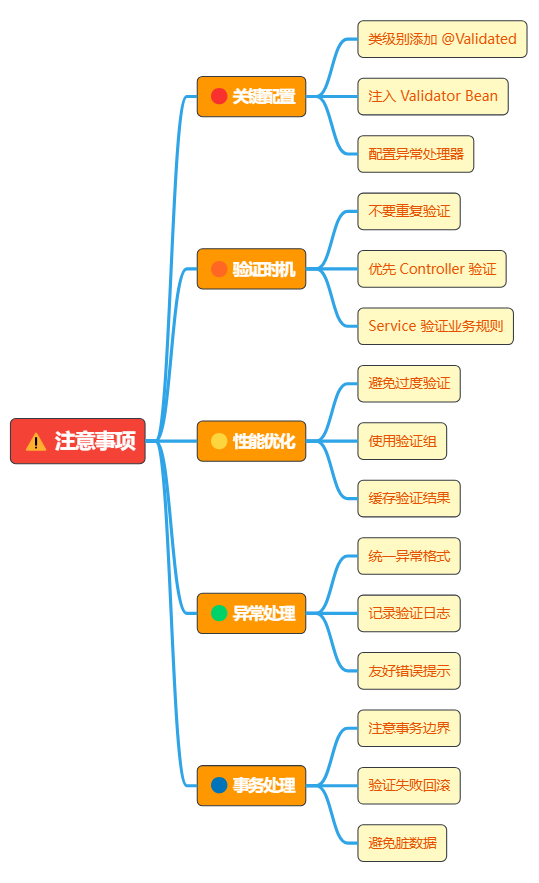
详细说明:
- 🔴** 关键配置**
java
// ✅ 正确:类级别添加 @Validated
@Service
@Validated
public class UserService {
    public void create(@Valid UserDTO dto) { }
}

// ❌ 错误:忘记类级别注解
@Service  // 缺少 @Validated
public class UserService {
    public void create(@Valid UserDTO dto) { }  // 不会触发验证
}- 🟠** 验证时机**
java
// ✅ 推荐:Controller 验证格式,Service 验证业务
@RestController
public class UserController {
    @PostMapping
    public ResponseEntity<?> create(@Valid @RequestBody UserDTO dto) {
        // 格式验证已完成
        return ResponseEntity.ok(userService.create(dto));
    }
}

@Service
public class UserService {
    public User create(UserDTO dto) {
        // 只需验证业务规则
        if (userRepository.existsByUsername(dto.getUsername())) {
            throw new BusinessException("用户名已存在");
        }
        return userRepository.save(convert(dto));
    }
}- 🟡** 性能优化**
java
// ✅ 使用验证组按需验证
@Service
@Validated
public class ProductService {
    // 快速验证:只验证基本字段
    public void quickUpdate(@Validated(BasicValidation.class) ProductDTO dto) {
        productRepository.updatePrice(dto.getId(), dto.getPrice());
    }

    // 完整验证:验证所有字段
    public void fullUpdate(@Validated(FullValidation.class) ProductDTO dto) {
        // 完整更新逻辑
    }
}- 🟢** 异常处理**
java
// ✅ Service 层统一处理验证异常
@RestControllerAdvice
public class GlobalExceptionHandler {

    @ExceptionHandler(ConstraintViolationException.class)
    public ResponseEntity<?> handleConstraintViolation(ConstraintViolationException ex) {
        Map<String, String> errors = ex.getConstraintViolations().stream()
            .collect(Collectors.toMap(
                v -> v.getPropertyPath().toString(),
                ConstraintViolation::getMessage
            ));
        return ResponseEntity.badRequest().body(errors);
    }
}- 🔵** 事务处理**
java
// ⚠️ 注意:验证应在事务外进行
@Service
public class OrderService {

    @Autowired
    private Validator validator;

    @Transactional
    public Order createOrder(OrderDTO orderDTO) {
        // ❌ 错误:在事务内验证(验证失败导致无用事务)
        validator.validate(orderDTO);

        return orderRepository.save(convert(orderDTO));
    }

    // ✅ 正确:验证在事务外
    public Order createOrderCorrect(OrderDTO orderDTO) {
        // 先验证
        Set<ConstraintViolation<OrderDTO>> violations = validator.validate(orderDTO);
        if (!violations.isEmpty()) {
            throw new ValidationException("验证失败");
        }

        // 再开启事务保存
        return saveOrder(orderDTO);
    }

    @Transactional
    private Order saveOrder(OrderDTO orderDTO) {
        return orderRepository.save(convert(orderDTO));
    }
}
6 Service 层验证对比总结
| 特性 | @Validated 注解 | 手动 Validator | 推荐场景 |
|---|---|---|---|
| 使用方式 | 声明式(注解) | 编程式(代码) | - |
| 灵活性 | ⭐⭐ | ⭐⭐⭐⭐⭐ | 手动更灵活 |
| 代码量 | 少 | 较多 | 简单用注解 |
| 验证时机 | 方法调用时 | 手动控制 | 复杂用手动 |
| 分组支持 | ✅ | ✅ | 都支持 |
| 条件验证 | ❌ | ✅ | 手动 |
| 批量验证 | ❌ | ✅ | 手动 |
| 适用场景 | 标准业务方法 | 批量、条件、复杂验证 | 按需选择 |
💡** 最佳实践建议**:
- Controller 层 :使用
@Valid验证请求参数格式 - Service 层 :使用
@Validated或手动Validator验证业务规则 - 优先使用 @Validated:代码简洁,适合大多数场景
- 复杂场景用手动验证:批量导入、条件验证、部分属性验证
- 封装工具类:简化手动验证操作,提高代码复用性
7 @Validated/@Valid 不生效的常见情况
- 缺少 @Validated 注解
- Service 层方法参数使用 @Valid/@Validated,但类上未加 @Validated,Spring 不会自动触发方法参数校验。
- 方法不是 public 或未被 Spring 管理
- 只有 public 方法且被 Spring 容器管理的 Bean 才会触发 AOP 校验,private/protected 方法或 new 出来的对象不会生效。
- 参数未加 @Valid/@Validated
- 方法参数未加 @Valid/@Validated 注解时,不会自动校验。
- DTO 未加约束注解
- DTO 字段未加 @NotNull、@Size 等约束注解,校验不会生效。
- 嵌套对象未加 @Valid
- DTO 中嵌套对象未加 @Valid 注解,嵌套校验不会生效。
- 未配置异常处理器
- 校验异常未被捕获,导致异常未能正确返回前端。
- 直接调用本类方法(this.xxx)
- Spring 的 AOP 只对代理对象生效,直接调用本类方法不会触发校验。
- 未使用 SpringMVC 参数绑定
- Controller 层未用 @RequestBody/@ModelAttribute 等参数绑定,@Valid 不会自动生效。
示例:本类方法调用不生效
java
@Service
@Validated
public class UserService {
    public void create(@Valid UserDTO dto) { ... }

    public void batchCreate(List<UserDTO> list) {
        // ❌ 直接调用本类方法,不会触发参数校验
        list.forEach(this::create);
    }
}
解决方法:通过代理调用
java
@Autowired
private UserService userServiceProxy;

public void batchCreate(List<UserDTO> list) {
    // ✅ 通过代理对象调用,触发参数校验
    list.forEach(userServiceProxy::create);
}