题目
给你一个正整数 n,表示一个 n x n 的城市,同时给定一个二维数组 buildings,其中 buildingsi = x, y 表示位于坐标 x, y 的一个 唯一 建筑。
如果一个建筑在四个方向(左、右、上、下)中每个方向上都至少存在一个建筑,则称该建筑 被覆盖 。
返回 被覆盖 的建筑数量。
示例
示例 1:
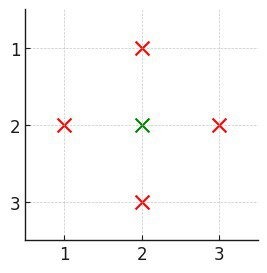
输入: n = 3, buildings = \[1,2,2,2,3,2,2,1,2,3]
输出: 1
解释: 只有建筑2,2 被覆盖,因为它在每个方向上都至少存在一个建筑:
上方 (1,2)
下方 (3,2)
左方 (2,1)
右方(2,3)
因此,被覆盖的建筑数量是 1。
示例 2:
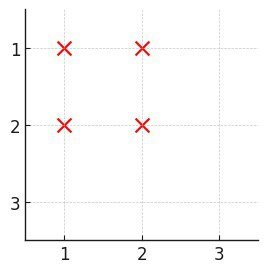
输入: n = 3, buildings = \[1,1,1,2,2,1,2,2]
输出: 0
解释:
没有任何一个建筑在每个方向上都有至少一个建筑。
示例 3:
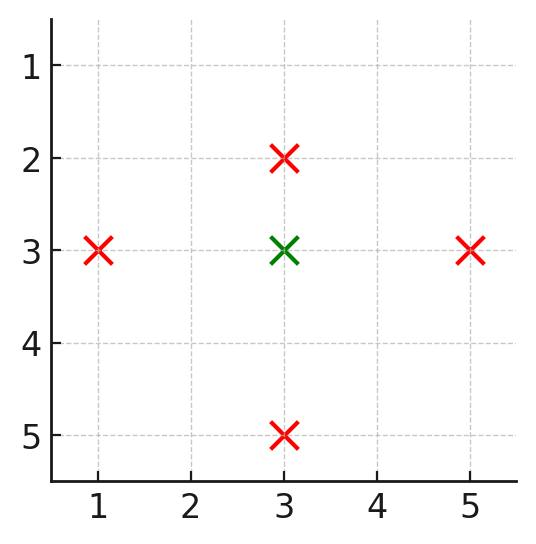
输入: n = 5, buildings = \[1,3,3,2,3,3,3,5,5,3]
输出: 1
解释: 只有建筑3,3 被覆盖,因为它在每个方向上至少存在一个建筑:
上方 (1,3)
下方 (5,3)
左方 (3,2)
右方(3,5)
因此,被覆盖的建筑数量是 1。
提示:
2 <= n <= 105
1 <= buildings.length <= 105
buildingsi = x, y
1 <= x, y <= n
buildings 中所有坐标均 唯一 。
思路:
定义两个横纵方向的哈希数组,分别计算两个方向每个坐标的最大值和最小值,如果buildingi在该范围内,则该建筑被覆盖
例如对于坐标
{1,3},{3,2},{3,3},{3,5},{5,3}
初始化mapRow为
{0,Integer.MAX_VALUE,Integer.MIN_VALUE} //表示第0行的最小值和最大值
{1,Integer.MAX_VALUE,Integer.MIN_VALUE}
{2,Integer.MAX_VALUE,Integer.MIN_VALUE}
{3,Integer.MAX_VALUE,Integer.MIN_VALUE}
{4,Integer.MAX_VALUE,Integer.MIN_VALUE}
{5,Integer.MAX_VALUE,Integer.MIN_VALUE}
初始化mapCol为
{0,Integer.MAX_VALUE,Integer.MIN_VALUE} //表示第0列的最小值和最大值
{1,Integer.MAX_VALUE,Integer.MIN_VALUE}
{2,Integer.MAX_VALUE,Integer.MIN_VALUE}
{3,Integer.MAX_VALUE,Integer.MIN_VALUE}
{4,Integer.MAX_VALUE,Integer.MIN_VALUE}
{5,Integer.MAX_VALUE,Integer.MIN_VALUE}
对于数字{1,3}修改mapRow为
{0,Integer.MAX_VALUE,Integer.MIN_VALUE} //表示第0行的最小值和最大值
{1,Integer.MAX_VALUE,Integer.MIN_VALUE}
{2,Integer.MAX_VALUE,Integer.MIN_VALUE}
{3,1,1}. //表示第3行的最小值和最大值分别是(1,1)
{4,Integer.MAX_VALUE,Integer.MIN_VALUE}
{5,Integer.MAX_VALUE,Integer.MIN_VALUE}
修改mapCol为
{0,Integer.MAX_VALUE,Integer.MIN_VALUE} //表示第0行的最小值和最大值
{1,3,3} //表示第1列的最小值和最大值分别是(3,3)
{2,Integer.MAX_VALUE,Integer.MIN_VALUE}
{3,Integer.MAX_VALUE,Integer.MIN_VALUE}.
{4,Integer.MAX_VALUE,Integer.MIN_VALUE}
{5,Integer.MAX_VALUE,Integer.MIN_VALUE}
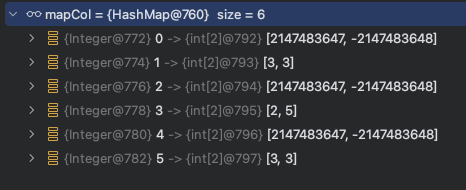
最后的mapRow为
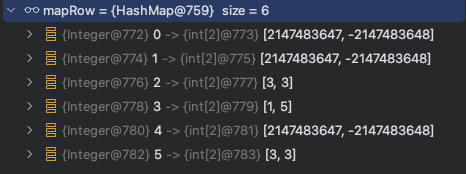
最后的mapCol为
代码
java
    public static int countCoveredBuildings(int n, int[][] buildings) {
        HashMap<Integer, int[]> mapRow = new HashMap<>();//第i行的最大值和最小值
        HashMap<Integer, int[]> mapCol = new HashMap<>();//第i列的最大值和最小值
        for(int i = 0; i < n + 1;i++){
            mapRow.put(i, new int[]{Integer.MAX_VALUE,Integer.MIN_VALUE});
            mapCol.put(i, new int[]{Integer.MAX_VALUE,Integer.MIN_VALUE});
        }
        int result = 0;
        for(int[] building : buildings){
            if(building[0]>mapRow.get(building[1])[1])
                mapRow.put(building[1],new int[]{mapRow.get(building[1])[0],building[0]});
            if(building[0]<mapRow.get(building[1])[0])
                mapRow.put(building[1],new int[]{building[0],mapRow.get(building[1])[1]});
            if(building[1]>mapCol.get(building[0])[1])
                mapCol.put(building[0],new int[]{mapCol.get(building[0])[0],building[1]});
            if(building[1]<mapCol.get(building[0])[0])
                mapCol.put(building[0],new int[]{building[1],mapCol.get(building[0])[1]});
        }
        for(int[] building : buildings){
            if(building[0] < mapRow.get(building[1])[1] && building[0] > mapRow.get(building[1])[0] && building[1] < mapCol.get(building[0])[1] && building[1] > mapCol.get(building[0])[0]){
                result += 1;
            }
        }
        return result;
    }