前言
无人机高空俯拍视角下,目标物体(如行人、车辆等)在图像中呈现极高的空间密度和显著的重叠现象。特别是在小目标聚集区域,边界框之间的遮挡与重叠严重干扰了特征提取的准确性。飞行过程中遭遇的光照强度变化以及运动模糊会显著降低图像质量。因此提出了一种专为无人机设计的LAM-YOLO。提出了光遮挡注意力机制,用于增强不同光照条件下的小目标可见能力,集成了Involution模块以改善特征层之间的交互。其次,采用改进的SIB-IoU作为回归损失函数,以加速模型收敛并提高定位精度。最后,实现了一种新颖的检测策略,通过引入两个辅助检测头来识别更小规模的目标。
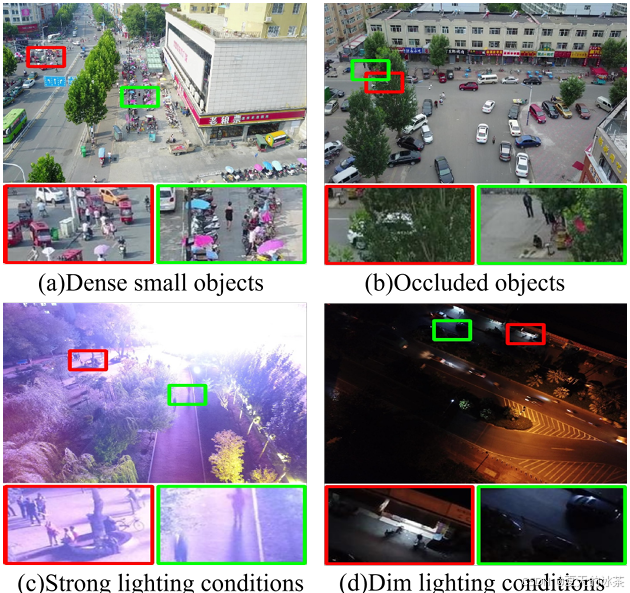
论文地址:2411.00485
注:此论文未开源代码,文中的代码均为复现。
我创建了一个用于存储小目标检测的复现仓库,欢迎start:Auorui/tiny-target-detection
网络整体结构
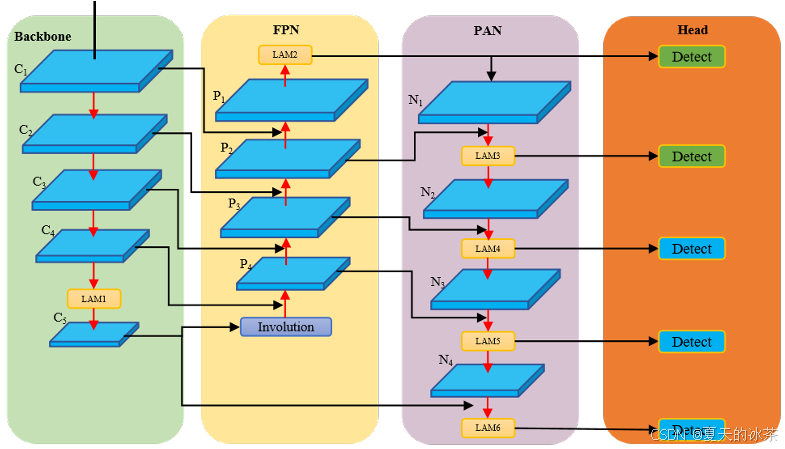
整体的结构还是按照YOLOv8改进的,光照-遮挡注意力模块(LAM)被分别插入到骨干网络的末端以及Neck部分的瓶颈层之后,该模块结合了通道注意力和自注意力机制,以增强模块的光照认知能力。
受Involution卷积机制的启发,在骨干网络和颈部之间加入了卷积块,以增强和共享通道信息,减少特征金字塔网络(FPN)初始阶段的信息损失。最后,引入了两个辅助检测头,分辨率为160×160和320×320,以提高对小目标的检测能力。
我觉得这里面唯一的问题就是检测头太多了,按理来说要增加小目标的准确性,加P2而不用P1,因为P1会导致模型参数量显著增加,计算复杂度急剧上升,同时容易引入过多噪声和背景干扰,反而降低检测性能。P2特征图具有适中的分辨率和语义信息,既能保留足够的细节用于小目标检测,又避免了P1层过高的空间冗余。
但还是考虑到实验的实际性,这里我们按照原文复现。
光照遮挡注意力模块LAM
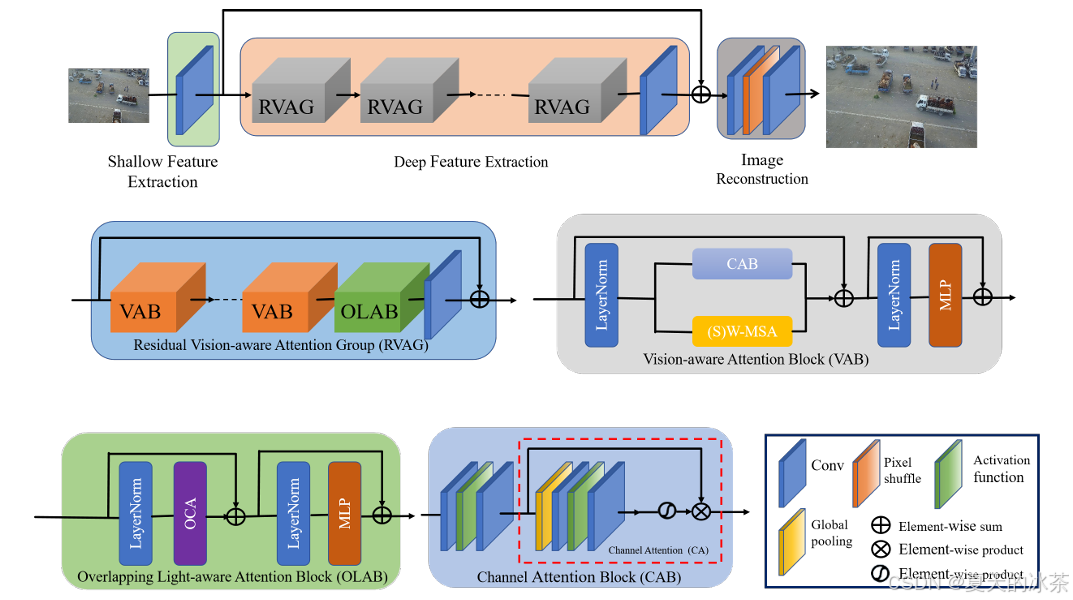
LAM的整体架构由三部分组成:浅层特征提取、深层特征提取和图像重建。
输入低分辨率特征,通过卷积层提取浅层特征,然后再使用一系列残差混合注意力组合RHAG与3×3卷积层Hconv(·)进行深层特征提取,最后通过重建模块重构高分辨率结果。
如上图所示,每个RHAG包含多个混合注意力块(HAB)、重叠交叉注意力块(OCAB)以及带残差连接的3×3卷积层。对于重建模块,采用像素打乱方法对融合特征进行上采样。
这篇文章写作有很大的问题,图文匹配不上对应的,还有很多的简称没用写,我猜测这个是预印本的问题,这里我还是按照图示一个一个来构建。
视觉感知注意力模块VAB
CAB就是本身就是一个通道注意力机制,这个简直是司空见惯了,它这里在通道注意力前面还有一个卷积+激活函数+卷积的一个组合,注意力机制里面是带有两个卷积层的,所以与ultralytics里面实现的有所不同,具体实现如下所示:
python
import torch
import torch.nn as nn
import torch.nn.functional as F
from ultralytics.nn.modules.conv import ChannelAttention

class CAB(nn.Module):
    def __init__(self, dim):
        super(CAB, self).__init__()
        self.conv_block = nn.Sequential(
            nn.Conv2d(dim, dim, 3, padding=1, bias=True),
            nn.SiLU(),
            nn.Conv2d(dim, dim, 3, padding=1, bias=True),
        )
        self.avg_pool = nn.AdaptiveAvgPool2d(1)
        self.ca = nn.Sequential(
            nn.Conv2d(dim, dim // 8, 1, padding=0, bias=True),
            nn.ReLU(inplace=True),
            nn.Conv2d(dim // 8, dim, 1, padding=0, bias=True),
            nn.Sigmoid()
        )

    def forward(self, x):
        x = self.conv_block(x)
        y = self.avg_pool(x)
        y = self.ca(y)
        return x * y

if __name__ == "__main__":
    dim = 64
    batch_size = 4
    height, width = 32, 32
    input_tensor = torch.randn(batch_size, dim, height, width)
    cab = CAB(dim=dim)
    print(f"输入形状: {input_tensor.shape}")
    output_tensor = cab(input_tensor)
    print(f"输出形状: {output_tensor.shape}")
(S)W-MSA这个模块没有在原文和图注中出现过,我猜测应该是Shifted Window Attention,不过一般应该简称是SW-MSA的才对,这个部分我们就直接采用官方的代替,但这里面有完全没用提到是如何去进行分为两分支的,写到这里我已经想放弃了。。。
python
import torch
import torch.nn as nn
import torch.nn.functional as F
from ultralytics.nn.modules import LayerNorm2d, ChannelAttention
from torchvision.models.swin_transformer import ShiftedWindowAttention, ShiftedWindowAttentionV2


class VAB(nn.Module):
    def __init__(self, dim, window_size=7, shift_size=0, num_heads=8, mlp_ratio=4.0):
        super(VAB, self).__init__()
        if isinstance(window_size, int):
            window_size = [window_size, window_size]
        if isinstance(shift_size, int):
            shift_size = [shift_size, shift_size]
        self.layer_norm1 = LayerNorm2d(dim)
        self.layer_norm2 = LayerNorm2d(dim)
        self.cab = CAB(dim)
        self.sw_msa = ShiftedWindowAttention(
            dim=dim,
            window_size=window_size,
            shift_size=shift_size,
            num_heads=num_heads
        )   # or use ShiftedWindowAttentionV2
        hidden_dim = int(dim * mlp_ratio)
        self.mlp = nn.Sequential(
            nn.Conv2d(dim, hidden_dim, 1),
            nn.GELU(),
            nn.Conv2d(hidden_dim, dim, 1)
        )

    def forward(self, x):
        identity = x
        x_norm = self.layer_norm1(x)
        print(x_norm.shape)
        # 左侧分支:SW-MSA(需要(B, H, W, C)格式)
        # 从(B, C, H, W)转换为(B, H, W, C)
        x_for_sw_msa = x_norm.permute(0, 2, 3, 1)  # (B, H, W, C)
        x_left = self.sw_msa(x_for_sw_msa)  # (B, H, W, C)
        x_left = x_left.permute(0, 3, 1, 2)
        # 右侧分支:CAB
        x_right = self.cab(x)
        x_out = x_left + x_right + identity
        identity2 = x_out
        x = self.layer_norm2(x_out)
        x_out = self.mlp(x) + identity2
return x我从这篇文章里面看到了关于这里面的图:即插即用系列 | 2024 SOTA LAM-YOLO : 无人机小目标检测模型_lam-yolo: drones-based small object detection on l-CSDN博客
它左右的分支应该就是相加才对。
这里面的OLAB模块有面有一个OCA注意力,我找了一下,这个应该指的是Overlapping Cross Attention,然后大家猜猜我找到了什么东西,如下图这是SwinIR的工作图:
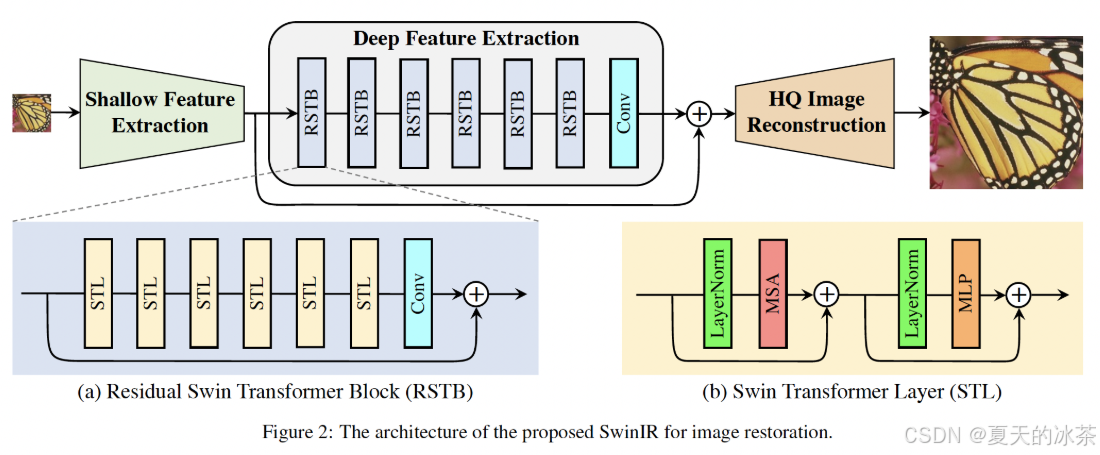
下面是关于HAT的工作图,但却是延续了SwinIR的基本结构,将RSTB升级成RHAG,内部的STL也对应升级成HAB,并且在每个Block中加入了一个OCAB。
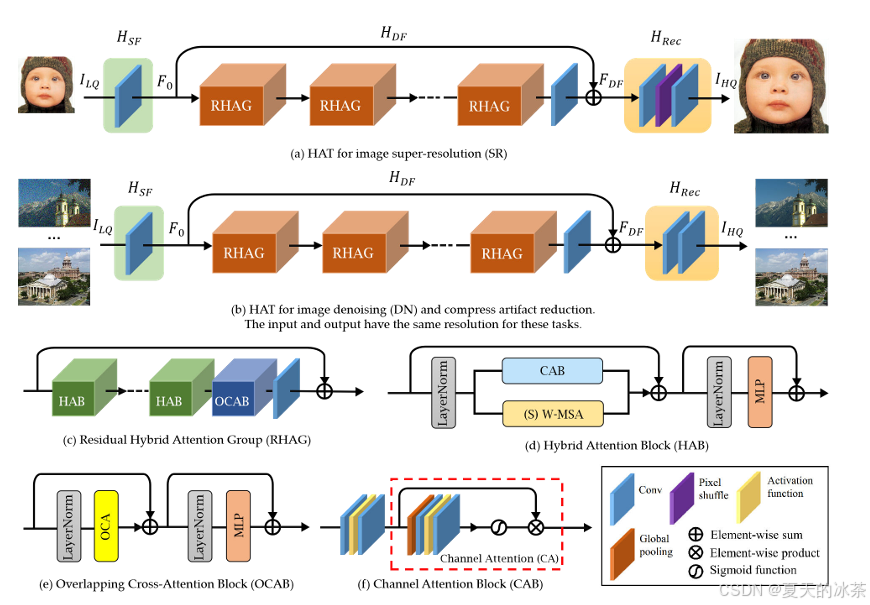
我的天呐,只能说还是太权威了,CVPR2023年的一篇文章图像复原的文章,我改吧改吧弄到目标检测里面整个四区,完全没毛病啊。这篇文章的仓库是:HAT/hat/archs/hat_arch.py at main · XPixelGroup/HAT
现在我也明白了为什么会出现论文名字和模块名不相符的问题,原来是搬过来还没改啊。
好,上面的我也不动就留着,我们现在从这篇CVPR的文章里面去找线索,首先是关于CAB模块:
python
class ChannelAttention(nn.Module):
    """Channel attention used in RCAN.
    Args:
        num_feat (int): Channel number of intermediate features.
        squeeze_factor (int): Channel squeeze factor. Default: 16.
    """

    def __init__(self, num_feat, squeeze_factor=16):
        super(ChannelAttention, self).__init__()
        self.attention = nn.Sequential(
            nn.AdaptiveAvgPool2d(1),
            nn.Conv2d(num_feat, num_feat // squeeze_factor, 1, padding=0),
            nn.ReLU(inplace=True),
            nn.Conv2d(num_feat // squeeze_factor, num_feat, 1, padding=0),
            nn.Sigmoid())

    def forward(self, x):
        y = self.attention(x)
        return x * y


class CAB(nn.Module):

    def __init__(self, num_feat, compress_ratio=3, squeeze_factor=30):
        super(CAB, self).__init__()

        self.cab = nn.Sequential(
            nn.Conv2d(num_feat, num_feat // compress_ratio, 3, 1, 1),
            nn.GELU(),
            nn.Conv2d(num_feat // compress_ratio, num_feat, 3, 1, 1),
            ChannelAttention(num_feat, squeeze_factor)
            )

    def forward(self, x):
        return self.cab(x)
基本与我的想法一致,只是因为我想到是采用ultralytics,或许用的是SiLU激活函数。
原本的HAB->VAB:
python
import math
import torch
import torch.nn as nn
import torch.utils.checkpoint as checkpoint
from einops import rearrange
from ultralytics.nn.extra_modules import to_2tuple
from timm.layers import trunc_normal_


def drop_path(x, drop_prob: float = 0., training: bool = False):
    """Drop paths (Stochastic Depth) per sample (when applied in main path of residual blocks).

    From: https://github.com/rwightman/pytorch-image-models/blob/master/timm/models/layers/drop.py
    """
    if drop_prob == 0. or not training:
        return x
    keep_prob = 1 - drop_prob
    shape = (x.shape[0], ) + (1, ) * (x.ndim - 1)  # work with diff dim tensors, not just 2D ConvNets
    random_tensor = keep_prob + torch.rand(shape, dtype=x.dtype, device=x.device)
    random_tensor.floor_()  # binarize
    output = x.div(keep_prob) * random_tensor
    return output


class DropPath(nn.Module):
    """Drop paths (Stochastic Depth) per sample  (when applied in main path of residual blocks).

    From: https://github.com/rwightman/pytorch-image-models/blob/master/timm/models/layers/drop.py
    """

    def __init__(self, drop_prob=None):
        super(DropPath, self).__init__()
        self.drop_prob = drop_prob

    def forward(self, x):
        return drop_path(x, self.drop_prob, self.training)


class ChannelAttention(nn.Module):
    """Channel attention used in RCAN.
    Args:
        num_feat (int): Channel number of intermediate features.
        squeeze_factor (int): Channel squeeze factor. Default: 16.
    """

    def __init__(self, num_feat, squeeze_factor=16):
        super(ChannelAttention, self).__init__()
        self.attention = nn.Sequential(
            nn.AdaptiveAvgPool2d(1),
            nn.Conv2d(num_feat, num_feat // squeeze_factor, 1, padding=0),
            nn.ReLU(inplace=True),
            nn.Conv2d(num_feat // squeeze_factor, num_feat, 1, padding=0),
            nn.Sigmoid())

    def forward(self, x):
        y = self.attention(x)
        return x * y


class CAB(nn.Module):

    def __init__(self, num_feat, compress_ratio=3, squeeze_factor=30):
        super(CAB, self).__init__()

        self.cab = nn.Sequential(
            nn.Conv2d(num_feat, num_feat // compress_ratio, 3, 1, 1),
            nn.GELU(),
            nn.Conv2d(num_feat // compress_ratio, num_feat, 3, 1, 1),
            ChannelAttention(num_feat, squeeze_factor)
            )

    def forward(self, x):
        return self.cab(x)


class Mlp(nn.Module):

    def __init__(self, in_features, hidden_features=None, out_features=None, act_layer=nn.GELU, drop=0.):
        super().__init__()
        out_features = out_features or in_features
        hidden_features = hidden_features or in_features
        self.fc1 = nn.Linear(in_features, hidden_features)
        self.act = act_layer()
        self.fc2 = nn.Linear(hidden_features, out_features)
        self.drop = nn.Dropout(drop)

    def forward(self, x):
        x = self.fc1(x)
        x = self.act(x)
        x = self.drop(x)
        x = self.fc2(x)
        x = self.drop(x)
        return x


def window_partition(x, window_size):
    """
    Args:
        x: (b, h, w, c)
        window_size (int): window size

    Returns:
        windows: (num_windows*b, window_size, window_size, c)
    """
    b, h, w, c = x.shape
    x = x.view(b, h // window_size, window_size, w // window_size, window_size, c)
    windows = x.permute(0, 1, 3, 2, 4, 5).contiguous().view(-1, window_size, window_size, c)
    return windows


def window_reverse(windows, window_size, h, w):
    """
    Args:
        windows: (num_windows*b, window_size, window_size, c)
        window_size (int): Window size
        h (int): Height of image
        w (int): Width of image

    Returns:
        x: (b, h, w, c)
    """
    b = int(windows.shape[0] / (h * w / window_size / window_size))
    x = windows.view(b, h // window_size, w // window_size, window_size, window_size, -1)
    x = x.permute(0, 1, 3, 2, 4, 5).contiguous().view(b, h, w, -1)
    return x


class WindowAttention(nn.Module):
    r""" Window based multi-head self attention (W-MSA) module with relative position bias.
    It supports both of shifted and non-shifted window.

    Args:
        dim (int): Number of input channels.
        window_size (tuple[int]): The height and width of the window.
        num_heads (int): Number of attention heads.
        qkv_bias (bool, optional):  If True, add a learnable bias to query, key, value. Default: True
        qk_scale (float | None, optional): Override default qk scale of head_dim ** -0.5 if set
        attn_drop (float, optional): Dropout ratio of attention weight. Default: 0.0
        proj_drop (float, optional): Dropout ratio of output. Default: 0.0
    """

    def __init__(self, dim, window_size, num_heads, qkv_bias=True, qk_scale=None, attn_drop=0., proj_drop=0.):

        super().__init__()
        self.dim = dim
        self.window_size = window_size  # Wh, Ww
        self.num_heads = num_heads
        head_dim = dim // num_heads
        self.scale = qk_scale or head_dim**-0.5

        # define a parameter table of relative position bias
        self.relative_position_bias_table = nn.Parameter(
            torch.zeros((2 * window_size[0] - 1) * (2 * window_size[1] - 1), num_heads))  # 2*Wh-1 * 2*Ww-1, nH

        self.qkv = nn.Linear(dim, dim * 3, bias=qkv_bias)
        self.attn_drop = nn.Dropout(attn_drop)
        self.proj = nn.Linear(dim, dim)

        self.proj_drop = nn.Dropout(proj_drop)

        trunc_normal_(self.relative_position_bias_table, std=.02)
        self.softmax = nn.Softmax(dim=-1)

    def forward(self, x, rpi, mask=None):
        """
        Args:
            x: input features with shape of (num_windows*b, n, c)
            mask: (0/-inf) mask with shape of (num_windows, Wh*Ww, Wh*Ww) or None
        """
        b_, n, c = x.shape
        qkv = self.qkv(x).reshape(b_, n, 3, self.num_heads, c // self.num_heads).permute(2, 0, 3, 1, 4)
        q, k, v = qkv[0], qkv[1], qkv[2]  # make torchscript happy (cannot use tensor as tuple)

        q = q * self.scale
        attn = (q @ k.transpose(-2, -1))

        relative_position_bias = self.relative_position_bias_table[rpi.view(-1)].view(
            self.window_size[0] * self.window_size[1], self.window_size[0] * self.window_size[1], -1)  # Wh*Ww,Wh*Ww,nH
        relative_position_bias = relative_position_bias.permute(2, 0, 1).contiguous()  # nH, Wh*Ww, Wh*Ww
        attn = attn + relative_position_bias.unsqueeze(0)

        if mask is not None:
            nw = mask.shape[0]
            attn = attn.view(b_ // nw, nw, self.num_heads, n, n) + mask.unsqueeze(1).unsqueeze(0)
            attn = attn.view(-1, self.num_heads, n, n)
            attn = self.softmax(attn)
        else:
            attn = self.softmax(attn)

        attn = self.attn_drop(attn)

        x = (attn @ v).transpose(1, 2).reshape(b_, n, c)
        x = self.proj(x)
        x = self.proj_drop(x)
        return x


class HAB(nn.Module):
    r""" Hybrid Attention Block.

    Args:
        dim (int): Number of input channels.
        input_resolution (tuple[int]): Input resolution.
        num_heads (int): Number of attention heads.
        window_size (int): Window size.
        shift_size (int): Shift size for SW-MSA.
        mlp_ratio (float): Ratio of mlp hidden dim to embedding dim.
        qkv_bias (bool, optional): If True, add a learnable bias to query, key, value. Default: True
        qk_scale (float | None, optional): Override default qk scale of head_dim ** -0.5 if set.
        drop (float, optional): Dropout rate. Default: 0.0
        attn_drop (float, optional): Attention dropout rate. Default: 0.0
        drop_path (float, optional): Stochastic depth rate. Default: 0.0
        act_layer (nn.Module, optional): Activation layer. Default: nn.GELU
        norm_layer (nn.Module, optional): Normalization layer.  Default: nn.LayerNorm
    """

    def __init__(self,
                 dim,
                 input_resolution,
                 num_heads,
                 window_size=7,
                 shift_size=0,
                 compress_ratio=3,
                 squeeze_factor=30,
                 conv_scale=0.01,
                 mlp_ratio=4.,
                 qkv_bias=True,
                 qk_scale=None,
                 drop=0.,
                 attn_drop=0.,
                 drop_path=0.,
                 act_layer=nn.GELU,
                 norm_layer=nn.LayerNorm):
        super().__init__()
        self.dim = dim
        self.input_resolution = input_resolution
        self.num_heads = num_heads
        self.window_size = window_size
        self.shift_size = shift_size
        self.mlp_ratio = mlp_ratio
        if min(self.input_resolution) <= self.window_size:
            # if window size is larger than input resolution, we don't partition windows
            self.shift_size = 0
            self.window_size = min(self.input_resolution)
        assert 0 <= self.shift_size < self.window_size, 'shift_size must in 0-window_size'

        self.norm1 = norm_layer(dim)
        self.attn = WindowAttention(
            dim,
            window_size=to_2tuple(self.window_size),
            num_heads=num_heads,
            qkv_bias=qkv_bias,
            qk_scale=qk_scale,
            attn_drop=attn_drop,
            proj_drop=drop)

        self.conv_scale = conv_scale
        self.conv_block = CAB(num_feat=dim, compress_ratio=compress_ratio, squeeze_factor=squeeze_factor)

        self.drop_path = DropPath(drop_path) if drop_path > 0. else nn.Identity()
        self.norm2 = norm_layer(dim)
        mlp_hidden_dim = int(dim * mlp_ratio)
        self.mlp = Mlp(in_features=dim, hidden_features=mlp_hidden_dim, act_layer=act_layer, drop=drop)

    def forward(self, x, x_size, rpi_sa, attn_mask):
        h, w = x_size
        b, _, c = x.shape
        # assert seq_len == h * w, "input feature has wrong size"

        shortcut = x
        x = self.norm1(x)
        x = x.view(b, h, w, c)

        # Conv_X
        conv_x = self.conv_block(x.permute(0, 3, 1, 2))
        conv_x = conv_x.permute(0, 2, 3, 1).contiguous().view(b, h * w, c)

        # cyclic shift
        if self.shift_size > 0:
            shifted_x = torch.roll(x, shifts=(-self.shift_size, -self.shift_size), dims=(1, 2))
            attn_mask = attn_mask
        else:
            shifted_x = x
            attn_mask = None

        # partition windows
        x_windows = window_partition(shifted_x, self.window_size)  # nw*b, window_size, window_size, c
        x_windows = x_windows.view(-1, self.window_size * self.window_size, c)  # nw*b, window_size*window_size, c

        # W-MSA/SW-MSA (to be compatible for testing on images whose shapes are the multiple of window size
        attn_windows = self.attn(x_windows, rpi=rpi_sa, mask=attn_mask)

        # merge windows
        attn_windows = attn_windows.view(-1, self.window_size, self.window_size, c)
        shifted_x = window_reverse(attn_windows, self.window_size, h, w)  # b h' w' c

        # reverse cyclic shift
        if self.shift_size > 0:
            attn_x = torch.roll(shifted_x, shifts=(self.shift_size, self.shift_size), dims=(1, 2))
        else:
            attn_x = shifted_x
        attn_x = attn_x.view(b, h * w, c)

        # FFN
        x = shortcut + self.drop_path(attn_x) + conv_x * self.conv_scale
        x = x + self.drop_path(self.mlp(self.norm2(x)))

        return x
与我本身的实现也差不多是一致的,只是我为了图方便从torchvision里面导入的。
这里稍微简化一下其结构:
python
class LAM(HAT):
    def __init__(self, embed_dim):
        super(LAM, self).__init__(
            embed_dim=embed_dim,
            in_chans=embed_dim,
            depths=(2, ),
            num_heads=(4, )
        )
Involution卷积模块
出自这一篇文章:arxiv.org/pdf/2103.06255
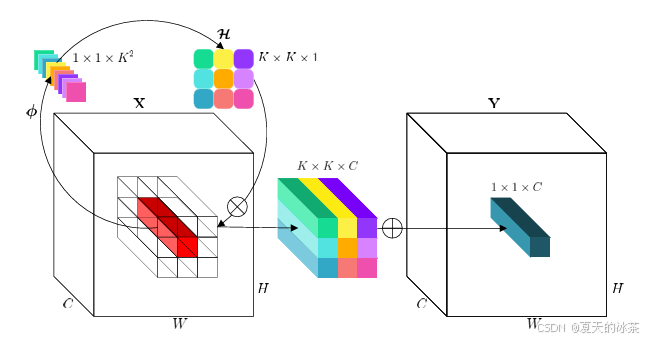
此为原图图示,是一篇CVPR2021年的一篇文章,lam-yolo里面绘制的和这个差不多,我想作者应该不会就这样投出去,大概率是在图上面重修修改了一下,我这里也不纠结了,只希望下次找一篇好的文章来看。
python
class involution(nn.Module):

    def __init__(self,
                 channels,
                 kernel_size,
                 stride):
        super(involution, self).__init__()
        self.kernel_size = kernel_size
        self.stride = stride
        self.channels = channels
        reduction_ratio = 4
        self.group_channels = 16
        self.groups = self.channels // self.group_channels
        self.conv1 = ConvNormAct(
            in_channels=channels,
            out_channels=channels // reduction_ratio,
            kernel_size=1)
        self.conv2 = ConvNormAct(
            in_channels=channels // reduction_ratio,
            out_channels=kernel_size**2 * self.groups,
            kernel_size=1,
            stride=1)
        if stride > 1:
            self.avgpool = nn.AvgPool2d(stride, stride)
        self.unfold = nn.Unfold(kernel_size, 1, (kernel_size-1)//2, stride)

    def forward(self, x):
        weight = self.conv2(self.conv1(x if self.stride == 1 else self.avgpool(x)))
        b, c, h, w = weight.shape
        weight = weight.view(b, self.groups, self.kernel_size**2, h, w).unsqueeze(2)
        out = self.unfold(x).view(b, self.groups, self.group_channels, self.kernel_size**2, h, w)
        out = (weight * out).sum(dim=3).view(b, self.channels, h, w)
        return out
消融实验
关于它这里的损失函数就不研究,以后有空闲再专门研究一下这些损失函数。
配置文件如下所示:
python
# Ultralytics 🚀 AGPL-3.0 License - https://ultralytics.com/license

# Ultralytics YOLOv8 object detection model with P3/8 - P5/32 outputs
# Model docs: https://docs.ultralytics.com/models/yolov8
# Task docs: https://docs.ultralytics.com/tasks/detect

# Parameters
nc: 80 # number of classes
scales: # model compound scaling constants, i.e. 'model=yolov8n.yaml' will call yolov8.yaml with scale 'n'
  # [depth, width, max_channels]
  n: [0.33, 0.25, 1024] # YOLOv8n summary: 129 layers, 3157200 parameters, 3157184 gradients, 8.9 GFLOPS
  s: [0.33, 0.50, 1024] # YOLOv8s summary: 129 layers, 11166560 parameters, 11166544 gradients, 28.8 GFLOPS
  m: [0.67, 0.75, 768] # YOLOv8m summary: 169 layers, 25902640 parameters, 25902624 gradients, 79.3 GFLOPS
  l: [1.00, 1.00, 512] # YOLOv8l summary: 209 layers, 43691520 parameters, 43691504 gradients, 165.7 GFLOPS
  x: [1.00, 1.25, 512] # YOLOv8x summary: 209 layers, 68229648 parameters, 68229632 gradients, 258.5 GFLOPS

# YOLOv8.0n backbone
backbone:
  # input -> 640×640×3
  # [from, repeats, module, args]
  - [-1, 1, Conv, [64, 3, 2]] # 0-P1/2  C1         320×320×64
  - [-1, 1, Conv, [128, 3, 2]] # 1-P2/4            160×160×128
  - [-1, 3, C2f, [128, True]]  #        C2         160×160×128
  - [-1, 1, Conv, [256, 3, 2]] # 3-P3/8            80×80×256
  - [-1, 6, C2f, [256, True]]  #        C3         80×80×256
  - [-1, 1, Conv, [512, 3, 2]] # 5-P4/16           40×40×512
  - [-1, 6, C2f, [512, True]]  #        C4         40×40×512
  - [-1, 1, LAM, [512]] # 7 LAM 1 between C4 and C5 (使用默认参数)
  - [-1, 1, Conv, [1024, 3, 2]] # 8-P5/32          20×20×1024
  - [-1, 3, C2f, [1024, True]]  #                  20×20×1024
  - [-1, 1, SPPF, [1024, 5]] # 10        C5        20×20×1024

# YOLOv8.0n head
head:
  # FPN 路径(自顶向下)
  - [-1, 1, involution, [1024, 7, 1]] # 11
  # 上采样 P5 -> P4
  - [-1, 1, nn.Upsample, [None, 2, "nearest"]] #   40×40×1024
  # 连接 P4 和上采样后的 P5
  - [[-1, 6], 1, Concat, [1]] # cat backbone P4 (注意索引还是为6,不是与LAM层相拼接)
  # 融合特征
  - [-1, 3, C2f, [512]] # 14                       40×40×512

  # 上采样 P4 -> P3
  - [-1, 1, nn.Upsample, [None, 2, "nearest"]] # 15   80×80×512
  # 连接 P3 和上采样后的 P4
  - [[-1, 4], 1, Concat, [1]] # 16 cat backbone P3
  # 融合特征 (P3/8-small)
  - [-1, 3, C2f, [256]] # 17 (P3/8-small)          80×80×256

  # 上采样 P3 -> P2
  - [-1, 1, nn.Upsample, [None, 2, "nearest"]] # 18   160×160×256
  # 连接 P2 和上采样后的 P3
  - [[-1, 2], 1, Concat, [1]] # 19 cat backbone P3
  # 融合特征 (P3/8-small)
  - [-1, 3, C2f, [128]] # 20 (P3/8-small)          160×160×128

  # 上采样 P2 -> P1
  - [-1, 1, nn.Upsample, [None, 2, "nearest"]] # 21   320×320×128
  # 连接 P2 和上采样后的 P3
  - [[-1, 0], 1, Concat, [1]] # 22 cat backbone P3
  # 融合特征 (P3/8-small)
  - [-1, 3, C2f, [64]] # 23 (P3/8-small)          320×320×64

  - [-1, 1, LAM, [64]] # 24 LAM 2 after FPN

  # PAN 路径(自底向上)
  # 下采样 P1 -> P2
  - [-1, 1, Conv, [64, 3, 2]]
  - [[-1, 20], 1, Concat, [1]]
  - [-1, 3, C2f, [128]]
  - [-1, 1, LAM, [128]] # 28 LAM after P2 downsampling

  # 下采样 P2 -> P3
  - [-1, 1, Conv, [128, 3, 2]]
  - [[-1, 17], 1, Concat, [1]]
  - [-1, 3, C2f, [256]]
  - [-1, 1, LAM, [256]] # 32 LAM after P3 downsampling

  # 下采样 P3 -> P4
  - [-1, 1, Conv, [256, 3, 2]]
  - [[-1, 14], 1, Concat, [1]]
  - [-1, 3, C2f, [512]]
  - [-1, 1, LAM, [512]] # 36 LAM after P4 downsampling

  # 下采样 P4 -> P5
  - [-1, 1, Conv, [512, 3, 2]]
  - [[-1, 10], 1, Concat, [1]] # with C5
  - [-1, 3, C2f, [1024]]
  - [-1, 1, LAM, [1024]] # 40 LAM after P5 downsampling

  # 检测头
  - [[24, 28, 32, 36, 40], 1, Detect, [nc]] # Detect(P1, P3, P4, P5)
精度 (P): 0.717
召回率 (R): 0.108
mAP50 (IoU=0.5时的平均精度): 0.126
mAP50-95 (IoU=0.5到0.95的平均精度): 0.0559