普通队列和优先级队列的小区别:
主要在于取队头元素:
queue
cpp
queue<int> q;
q.push(10);
q.push(20);
cout << q.front();   // 输出 10
priority_queue
cpp
priority_queue<int> pq;
pq.push(5);
pq.push(1);
pq.push(9);
cout << pq.top();    // 默认输出最大值 9
例题:
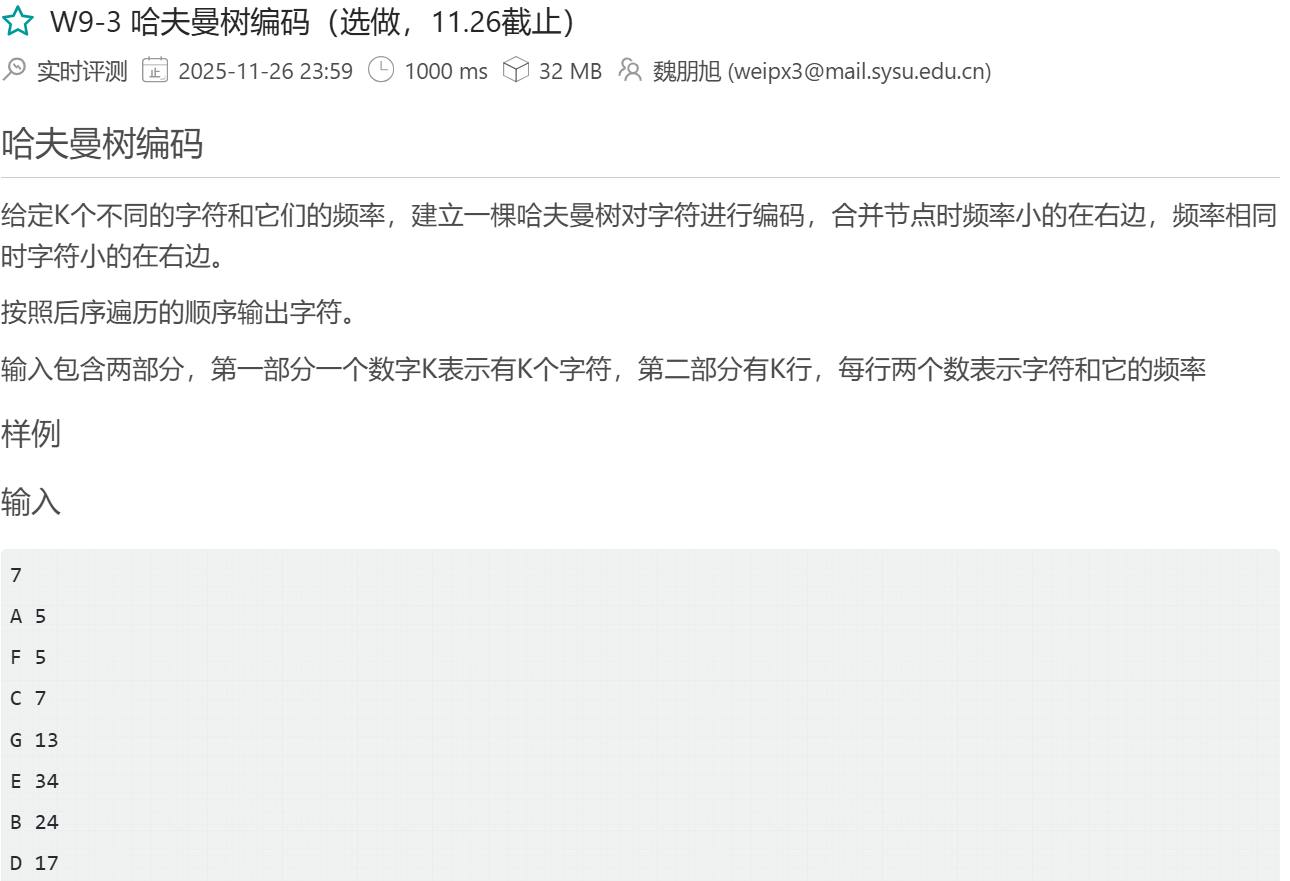
W9-3 哈夫曼树编码
cpp
#include <iostream>
#include <queue>
#include <vector>
using namespace std;

struct Node {
    char c;
    int val;
    Node* left;
    Node* right;
    Node(int v = 0, char ch = '{') : val(v), c(ch), left(nullptr), right(nullptr) {}
};

// 比较器:用于最小堆
struct cmp {
    bool operator()(Node* a, Node* b) const {
        if (a->val != b->val) return a->val > b->val;
        return a->c > b->c; // 频率相等时字符小的优先
    }
};

// 后序遍历输出叶子字符
void postOrder(Node* root) {
    if (!root) return;
    postOrder(root->left);
    postOrder(root->right);
    if (root->c != '{')  // 只输出叶子节点
        cout << root->c << endl;
}

int main() {
    int n;
    cin >> n;
    priority_queue<Node*, vector<Node*>, cmp> pq;

    for (int i = 0; i < n; i++) {
        char ch;
        int f;
        cin >> ch >> f;
        pq.push(new Node(f, ch));
    }

    while(pq.size()>1){
        Node* a=pq.top();
        pq.pop();
        Node* b=pq.top();
        pq.pop();
        Node* parent=new Node(a->val+b->val);
        parent->left=b;
        parent->right=a;
        pq.push(parent);
    }
    Node* root=pq.top();
    postOrder(root);
    return 0;
}
注意里面的模板函数的写法,写在结构体里面,用operator声明
cpp
// 比较器:用于最小堆
struct cmp {
    bool operator()(Node* a, Node* b) const {
        if (a->val != b->val) return a->val > b->val;
        return a->c > b->c; // 频率相等时字符小的优先
    }
};
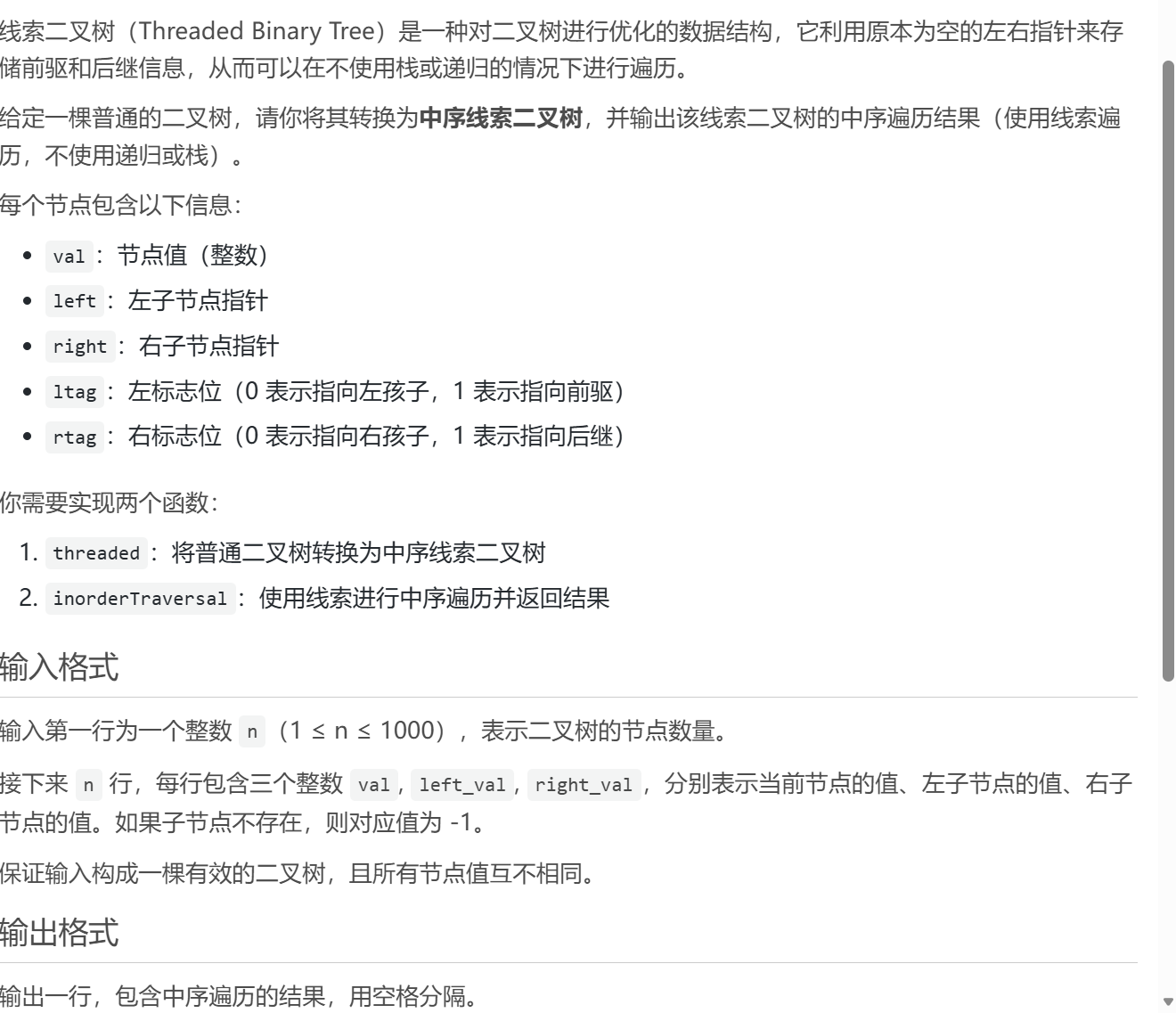
W8-4 中序遍历的线索化以及如何遍历
cpp
ThreadedTreeNode* Solution::threaded(ThreadedTreeNode* root){
    if(!root) return nullptr;

    // 中序遍历存序列
    stack<ThreadedTreeNode*> st;
    vector<ThreadedTreeNode*> order;
    ThreadedTreeNode* cur = root;

    while (cur || !st.empty()) {
        while (cur) {
            st.push(cur);
            cur = cur->left;
        }
        cur = st.top(); st.pop();
        order.push_back(cur);
        cur = cur->right;
    }

    // 构建线索
    for (int i = 0; i < order.size(); ++i) {
        ThreadedTreeNode* node = order[i];

        // 原来有左孩子 => ltag = 0
        if (node->left)
            node->ltag = 0;
        else {
            node->ltag = 1;
            node->left = (i == 0 ? nullptr : order[i - 1]);
        }

        // 原来有右孩子 => rtag = 0
        if (node->right)
            node->rtag = 0;
        else {
            node->rtag = 1;
            node->right = (i == order.size() - 1 ? nullptr : order[i + 1]);
        }
    }

    return root;
}


vector<int> Solution::inorderTraversal(ThreadedTreeNode* root){
    vector<int> ans;
    if(!root) return ans;

    ThreadedTreeNode* cur = root;

    // 1. 找最左节点
    while (cur->ltag == 0)
        cur = cur->left;

    // 2. 遍历
    while (cur) {
        ans.push_back(cur->val);

        // 如果有中序后继(线索)
        if (cur->rtag == 1) {
            cur = cur->right;
        }
        // 否则进入右子树,再找最左
        else {
            cur = cur->right;
            while (cur && cur->ltag == 0)
                cur = cur->left;
        }
    }

    return ans;
}
Q1-6 非递归实现汉诺塔
有文章指出,汉诺塔就是重复以下两步:
第一步: 将最小圆盘移动到下一个杆上;
第二步: 对剩下两个杆的顶上元素 进行判断,把较小 的那个圆盘移动到较大的那个圆盘上(如果有空杆则移在空杆上)。
cpp
#include<iostream>
#include<stack>
using namespace std;

char s[4] = { '0','A','B','C' };
stack<int>a[4];

void move(int now, int next) {
	a[next].push(a[now].top());
	/*printf("%d from %c to %c\n", a[now].top(), s[now], s[next]);*/
	printf("%c -> %c\n",  s[now], s[next]);
	a[now].pop();
}

int main() {
	int n, count = 0;
	cin >> n;
	for (int i = 0; i < n; i++) {
		a[1].push(n - i);
	}
	//n为奇数的话就改
	if (n % 2 == 1) {
		s[2] = 'C';
		s[3] = 'B';
	}

	while (1) {
		int next;
		//第一步:将圆盘移动到下一个杆上
		//虽然是循环三次,但是只会移动一个玩意
		for (int i = 0; i <= 3; i++) {
			if (!a[i].empty()) {
				if (a[i].top() == 1) {
					if (i == 3)next = 1;
					else next = i + 1;
					move(i, next);
					break;
				}
			}
		}

		//判断是否完成
		if (a[2].size() == n || a[3].size() == n) {
			break;
		}

		//第二步:对顶上的元素进行判断,将较小圆盘移动到较大的那个圆盘上
		int other1, other2;
		switch (next) {
		case 1: { other1 = 2; other2 = 3; break; }
		case 2: { other1 = 3; other2 = 1; break; }
		case 3: { other1 = 1; other2 = 2; break; }
		}

		if (a[other1].empty()) {
			move(other2, other1);
		}
		else if (a[other2].empty()) {
			move(other1, other2);
		}
		else {
			if (a[other1].top() < a[other2].top() ){
				move(other1, other2);
			}
			else move(other2, other1);
		}
	}
}
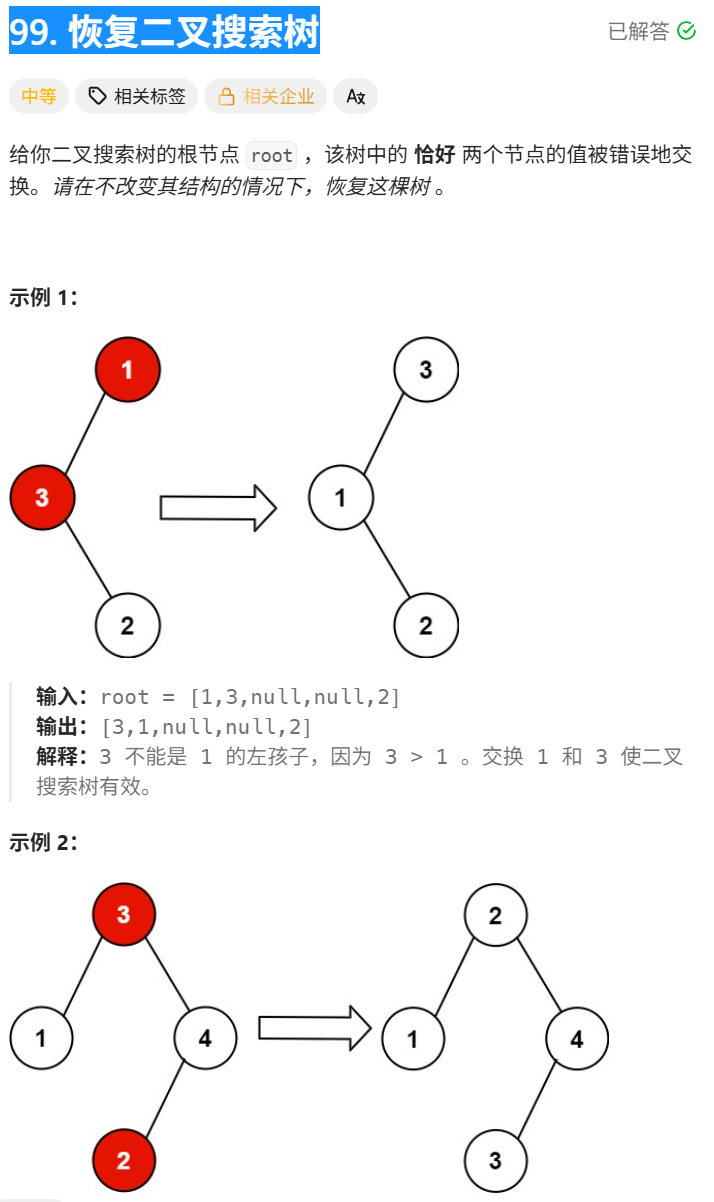
leecode99恢复二叉搜索树(逆序)
99. 恢复二叉搜索树 https://leetcode.cn/problems/recover-binary-search-tree/
cpp
/**
 * Definition for a binary tree node.
 * struct TreeNode {
 *     int val;
 *     TreeNode *left;
 *     TreeNode *right;
 *     TreeNode() : val(0), left(nullptr), right(nullptr) {}
 *     TreeNode(int x) : val(x), left(nullptr), right(nullptr) {}
 *     TreeNode(int x, TreeNode *left, TreeNode *right) : val(x), left(left), right(right) {}
 * };
 */
class Solution {
public:

    //其实只需要找逆序对
    TreeNode* pre=nullptr,*first=nullptr,*second=nullptr;
    void inorder(TreeNode* root){
        if(!root)return;

        inorder(root->left);
        if(pre&&pre->val>root->val){
            if(!first){
                first=pre;
            }
            // 无论第几次逆序,second 都指向当前的 root
            second = root;
        }
        pre=root;
        inorder(root->right);
    }

    void recoverTree(TreeNode* root) {
        vector<TreeNode*>order;
        inorder(root);
        // int tmp=first->val;
        // first->val=second->val;
        // second->val=tmp;
        swap(first->val,second->val);
    }
};
逆序检查逻辑必须是下面这一版:
if (pre && pre->val > root->val) { if (!first) first = pre; second = root; // 每次逆序都赋值 }
这里的关键思想:
-
first:在第一次逆序时记录
-
second :每次逆序都记录,最终停在最后一次逆序的
cur
这样:
相邻交换(1 次逆序)
prev=3, cur=2 first = 3 second = 2
不相邻交换(2 次逆序)
prev=5, cur=3 → first = 5, second = 3 prev=4, cur=2 → second = 2(覆盖)
总结 ------ 你的代码为什么不行?
-
你在第二次逆序后就
return,导致相邻交换时永远找不到 second -
正确解法是:first 在第一次逆序赋值;second 在每次逆序赋值
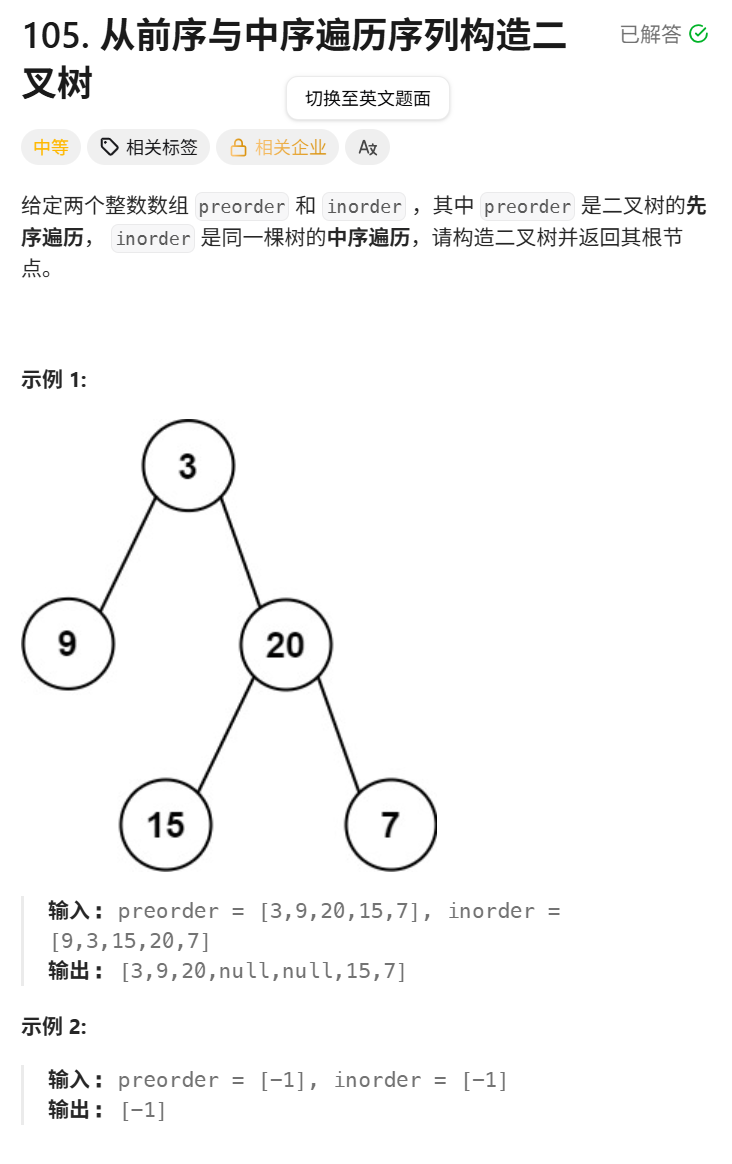
leetcode105根据前序和中序遍历构建二叉树
cpp
/**
 * Definition for a binary tree node.
 * struct TreeNode {
 *     int val;
 *     TreeNode *left;
 *     TreeNode *right;
 *     TreeNode() : val(0), left(nullptr), right(nullptr) {}
 *     TreeNode(int x) : val(x), left(nullptr), right(nullptr) {}
 *     TreeNode(int x, TreeNode *left, TreeNode *right) : val(x), left(left), right(right) {}
 * };
 */
class Solution {
public:
    TreeNode* build(const vector<int>&preorder,const vector<int>&inorder,int start1,int end1,int start2,int end2){
        if(start2>end2||start1>end1)return nullptr;
        TreeNode* newone=new TreeNode(preorder[start1]);
        int index=start2;
        for(int i=start2;i<=end2;i++){
            if(inorder[i]==preorder[start1]){
                index=i;
                break;
            }
        }
        int leftsize=index-start2;
        newone->left=build(preorder,inorder,start1+1,start1+leftsize,start2,index-1);
        newone->right=build(preorder,inorder,start1+leftsize+1,end1,index+1,end2);
        return newone;
    }

    TreeNode* buildTree(vector<int>& preorder, vector<int>& inorder) {
        TreeNode* root=nullptr;
        root=build(preorder,inorder,0,inorder.size()-1,0,inorder.size()-1);
        return root;
    }
};
注意一下:前序的边界end1是与左/右节点的个数有关的,不要漏掉了
合法的出栈顺序(没错又来了)
cpp
#include <iostream>
#include <stack>
#include <vector>
using namespace std;

int main() {
    int n;
    cin >> n;

    vector<int> A(n), B(n);
    for (int i = 0; i < n; ++i) cin >> A[i];
    for (int i = 0; i < n; ++i) cin >> B[i];

    stack<int> st;
    int j = 0;  // pointer in A

    for (int i = 0; i < n; ++i) {
        int target = B[i];

        // push until stack top == target
        while ((st.empty() || st.top() != target) && j < n) {
            st.push(A[j]);
            j++;
        }

        // can't match target
        if (st.top() != target) {
            cout << "False";
            return 0;
        }

        st.pop();
    }

    cout << "True";
    return 0;
}
W10-8 二叉搜索树的路径长度

cpp
#include<iostream>
#include<vector>
using namespace std;

struct treeNode{
    int val;
    treeNode* lchild;
    treeNode* rchild;
    treeNode():val(0),lchild(NULL),rchild(NULL){}
};

void insert(treeNode*& root, int x){
    if(!root){
        treeNode* newone=new treeNode();
        newone->val=x;
        root=newone;
        return;
    }
    if(root->val>x)insert(root->lchild,x);
    else insert(root->rchild,x);
    return;
}

void deletel(treeNode* root){
    if(!root)return;
    deletel(root->lchild);
    deletel(root->rchild);
    delete root;
}

vector<int>path;
bool flag=false;
// void dfs(treeNode* root,const int &m,int now){
//     if(now==m){
//         flag=true;
//         for(int i=0;i<path.size();i++){
//             if(i==path.size()-1){
//                 cout<<path[i]<<endl;
//                 break;
//             }
//             cout<<path[i]<<"->";
//         }
//     }
//     if(!root)return;

//     //选与不选
//     int val=root->val;
//     path.push_back(val);
//     dfs(root->lchild,m,now+val);
//     path.pop_back();
//     dfs(root->rchild,m,now+val);
// }

void dfs(treeNode* root, int m, int now){
    if(!root) return;

    path.push_back(root->val);
    now += root->val;

    bool leaf = (!root->lchild && !root->rchild);

    // root-to-leaf 才能输出
    if(leaf && now == m){
        flag = true;
        for(int i=0;i<path.size();i++){
            cout << path[i];
            if(i + 1 < path.size()) cout << "->";
        }
        cout << "\n";
    }

    dfs(root->lchild, m, now);
    dfs(root->rchild, m, now);

    path.pop_back();
}


int main(){
    int n,m;
    while(cin>>n>>m){

        //cin>>n>>m;
        path.clear();
        vector<int>vec(n);
        treeNode* root=nullptr;
        for(int i=0;i<n;i++){
            cin>>vec[i];
            insert(root,vec[i]);
        }
        dfs(root,m,0);
        deletel(root);
        if(!flag)cout<<"NULL"<<endl;
        flag=false;
        //cout<<1111<<endl;
    }
}
dfs搜索天然就是字典序的所以不用管
有一个易错点就是void insert(treeNode*& root, int x),这里传入的是root的引用,因为第一步从空节点开始创建的时候是直接修改的root本身,但是如果没有引用,那么这时候传入的就是一个临时变量,对临时变量进行修改没有任何作用,会导致后面main函数里面的root一直为空
还有一个易错也是实力问题,先不管细节部分,看两个dfs并进行对比,为什么两个dfs一个插入path前先判断是否now==m,一个插入后判断会有区别呢
核心结论:push 前判断是错误的,本质是判断位置完全错了,而非回溯问题,核心是输出时机不符合 "root-to-leaf" 的题目要求。
错误写法的核心问题
错误写法的判断逻辑顺序为:先判断 if (now == m) print(path);,再判断 if (!root) return;,后续才执行 path.push_back(root->val);、递归和 path.pop_back();。
当递归到空节点时,此时 now == 28,path = {13, 7, 3, 5},由于判断写在 root 检查之前,空节点会触发输出。根本错误是把判断写在「访问节点之前」,导致空孩子也会触发路径判断,而非在目标的叶子节点上判断。
关键疑问解答:为何输出正确序列仍算错?
虽然错误写法输出了正确的节点序列 {13,7,3,5},但输出时机是在访问空节点时,而非在叶子节点本身。题目要求的是 "root-to-leaf" 的路径,不是 "root-to-null" 的路径,这是两种完全不同的时机。
正确时机是站在叶子节点(root!=nullptr && root->lchild==nullptr && root->rchild==nullptr)时判断;错误时机是递归到叶子节点的 null 左子树或 null 右子树时判断,相当于 "离开叶子节点后" 才判断,根本没在叶子节点本身进行检测,破坏了 DFS 对树结构的语义。
举例说明差异
以简单叶子节点 5(左右子树均为 null)为例:
- 理应检测的场景:在节点 5(非空)时,判断是否完成 "root-to-leaf" 路径。
- 错误写法检测的场景:在节点 5 的左空孩子和右空孩子处判断,完全偏离了题目要求的判断对象。
错误写法影响全局的原因
输出时机错误后,不是在叶子处返回打印,而是在空节点打印,这会让 DFS 的控制逻辑混乱。尤其是在逻辑复杂的场景中,会导致重复输出、多打印、错序等问题。整个判断条件变成了 "走到 null 就判断一次",完全背离了 "root-to-leaf" 的语义,即使偶然打印出正确路径序列,也只是 "值对了",逻辑上完全错误。
正确逻辑的要求
正确的逻辑必须是先执行 path.push_back(root->val); 和 now += root->val;,再判断该节点是否为叶子节点且 now == m,若是则打印路径;之后再递归遍历左子树和右子树,最后执行 path.pop_back()。
这样才能保证判断在 "节点本身" 发生,路径中包含当前节点,sum 计算包含当前节点,只在叶子节点判断,DFS 遍历顺序正确,输出顺序也自然符合字典序要求
(此题等待重做)W10-4 最大对称子二叉树
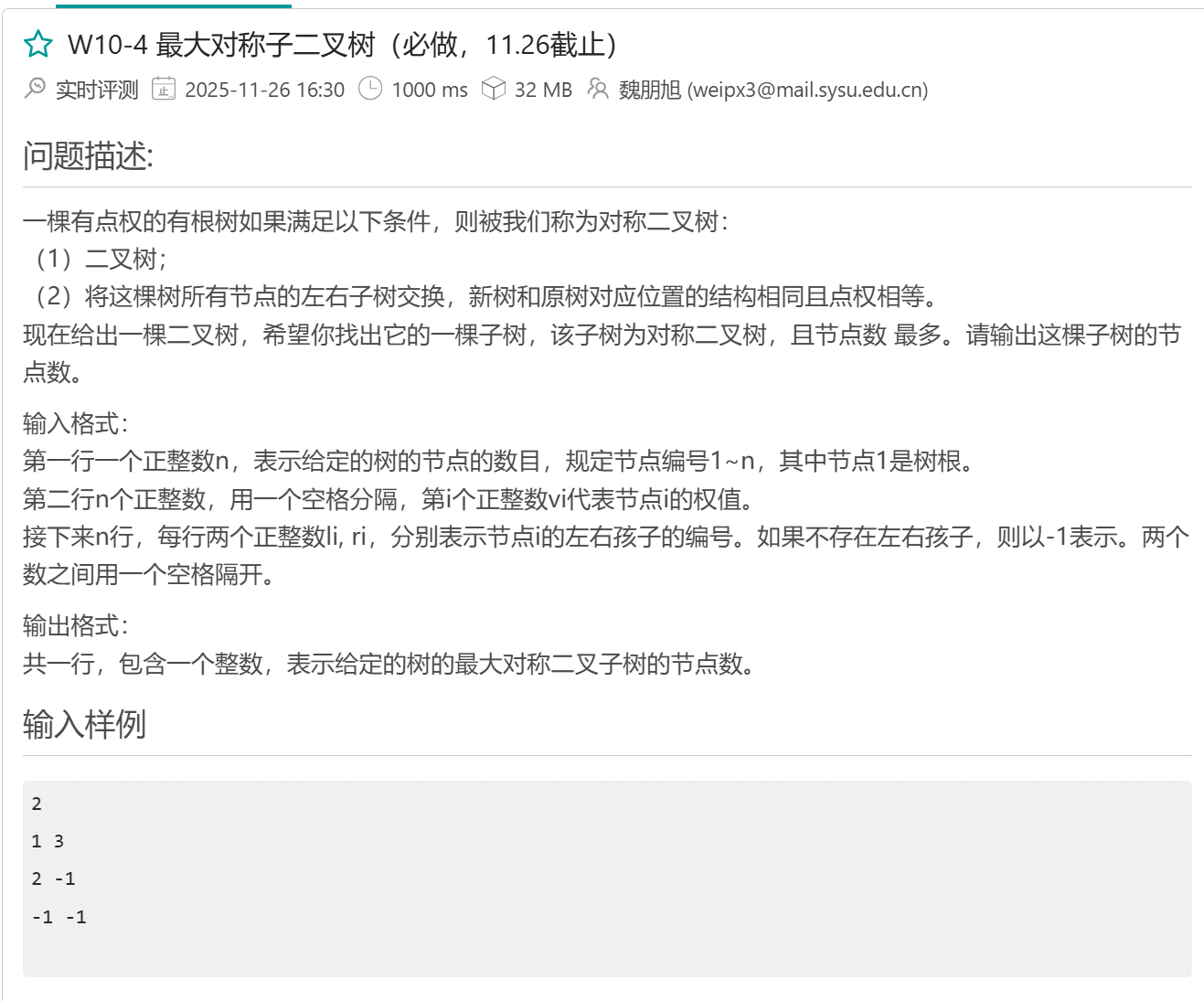
cpp
#include<iostream>
#include<vector>
#include<queue>
using namespace std;

vector<int> weight;
vector<pair<int,int>> child;

int n;
int ans=1;

// 判断两棵子树是否镜像,并返回镜像节点数
int mirror_size(int a, int b) {
    if (a == -1 && b == -1) return 0;
    if (a == -1 || b == -1) return -1e9; // 不可能对称
    if (weight[a] != weight[b]) return -1e9;

    int left_part  = mirror_size(child[a].first,  child[b].second);
    int right_part = mirror_size(child[a].second, child[b].first);

    if (left_part < 0 || right_part < 0) return -1e9;

    return left_part + right_part + 2; // 包含 a 和 b
}

void dfs(int u) {
    if (u == -1) return;
    int L = child[u].first;
    int R = child[u].second;

    int res = mirror_size(L, R);
    if (res >= 0) ans = max(ans, res + 1); // 加上根节点

    dfs(L);
    dfs(R);
}

// //返回最多的节点个数
// int dfs(int now){
//     if(now==-1)return 0;
//     int left=dfs(child[now].first);
//     int right=dfs(child[now].second);
//     if()
//     if(weight[child[now].first]==weight[child[now].second])
// }


int main() {
    cin >> n;
    weight.resize(n+1);
    child.resize(n+1);

    for (int i = 1; i <= n; i++) {
        cin >> weight[i];
    }
    for (int i = 1; i <= n; i++) {
        int l, r;
        cin >> l >> r;
        child[i] = {l, r};
    }

    dfs(1);
    cout << ans << endl;
}
W10-5 四叉树的实现(恶心了点)
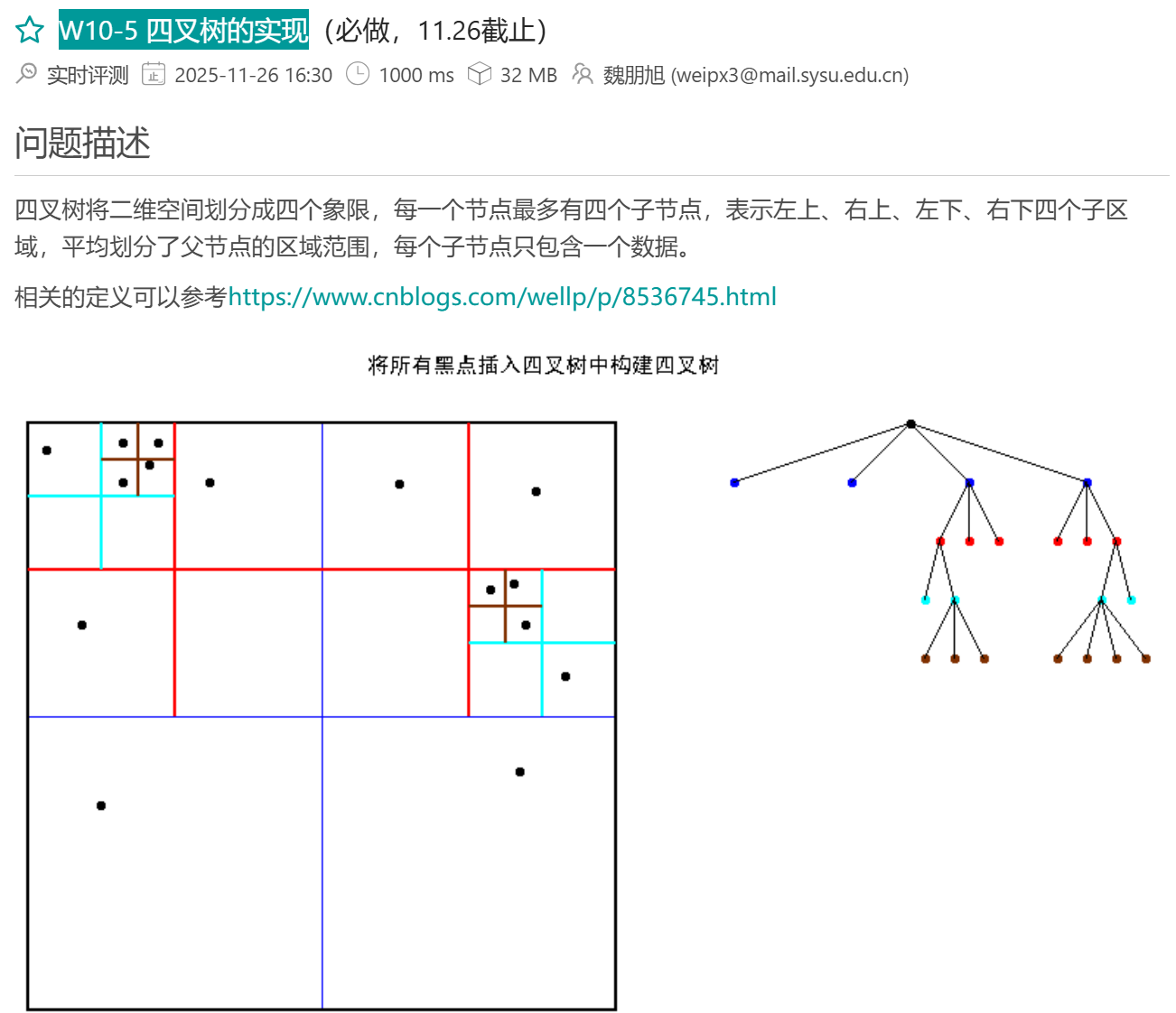
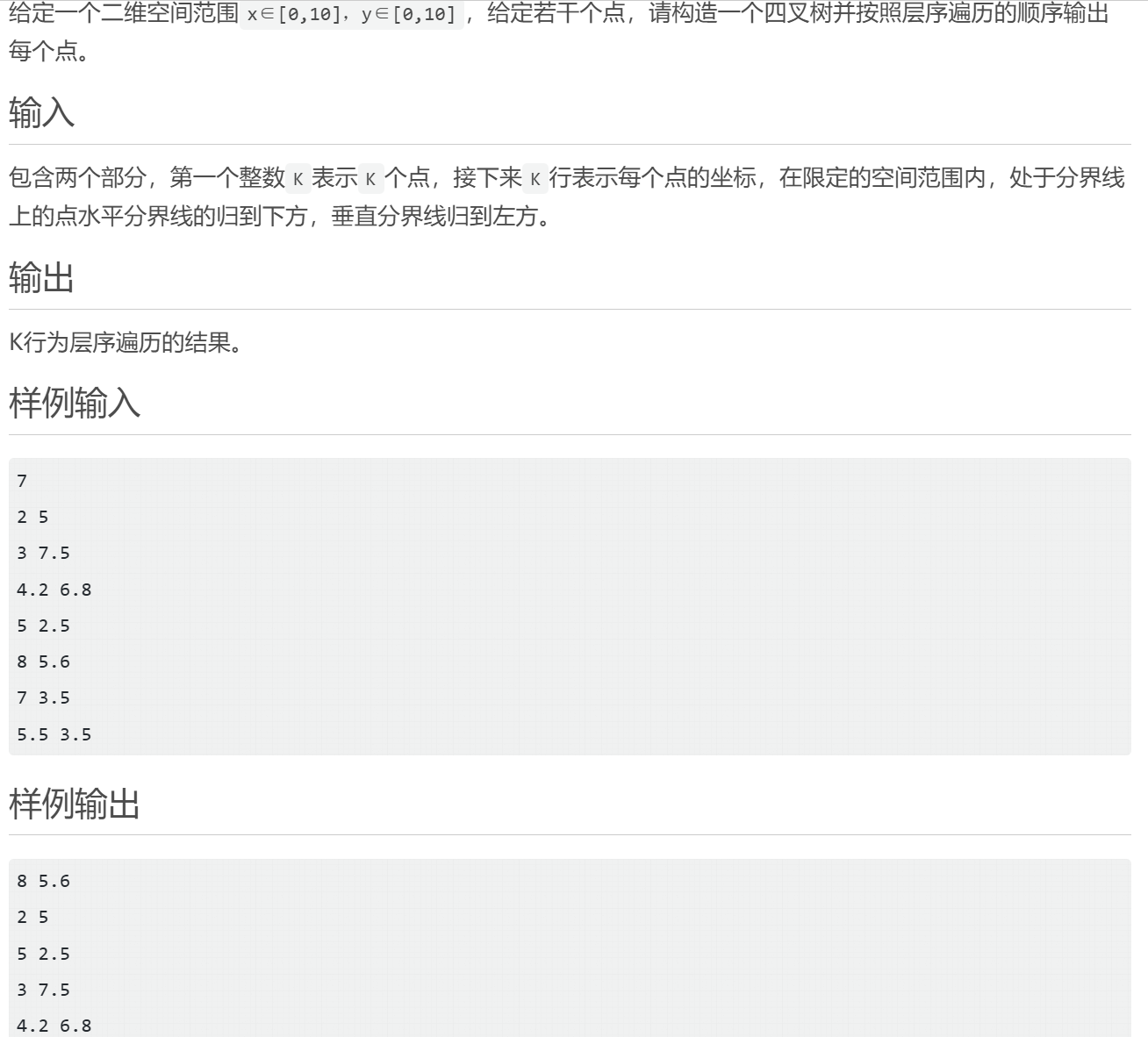
cpp
#include<iostream>
#include<vector>
#include<queue>
#include<algorithm>
using namespace std;

// struct node{
//     pair<double,double> site;
//     bool flag;
//     node* quark1;
//     node* quark2;
//     node* quark3;
//     node* quark4;
//     node(pair<double,double> site,bool flag=false):site(site),flag(flag),quark1(nullptr),quark2(nullptr),quark3(nullptr),quark4(nullptr){}
// };

struct QuadNode {
    bool hasPoint;      // 是否有点
    double x, y;        // 点坐标
    QuadNode* child[4]; // 四象限

    QuadNode() : hasPoint(false), x(0), y(0) {
        for (int i = 0; i < 4; i++) child[i] = nullptr;
    }
};

int iswhich(pair<double,double>site,pair<double,double> mid){
    if(site.first<=mid.first&&site.second>mid.second)return 0;
    else if(site.first>mid.first&&site.second>mid.second)return 1;
    else if(site.first<=mid.first&&site.second<=mid.second)return 2;
    else return 3;
}


// //传入中点和长度
// void insert(QuadNode*& root,pair<double,double>site,pair<double,double> mid,double len){
//     if(!root){
//         QuadNode* newnode=new QuadNode();
//         newnode->hasPoint=true;
//         newnode->x=site.first;
//         newnode->y=site.second;
//         root=newnode;
//         return;
//     }

//     if(root->hasPoint){
//         pair<double,double> old = {root->x, root->y};
//         root->hasPoint = false; // 自己不再存点

//         // 插入原来的点
//         insert(root, old, {5,5},10);
//     }

//     // if(root->hasPoint){
//     //     pair<double,double> old = {root->x, root->y};
//     //     root->hasPoint = false;

//     //     insert(root, old, {5,5}, 10); // 下放旧点
//     //     insert(root, site, {5,5}, 10); // 🔥 继续处理当前点(必要)
//     //     return;
//     // }


//     //判断象限
//     int order=iswhich(site,mid);
//     //构造下一次的坐标
//     double nx,ny,nlen;
//     nlen=len/2;
//     if(order==0){
//         nx=mid.first-nlen;
//         ny=mid.second+nlen;
//     }
//     else if(order==1){
//         nx=mid.first+nlen;
//         ny=mid.second+nlen;
//     }
//     else if(order==2){
//         nx=mid.first-nlen;
//         ny=mid.second-nlen;
//     }
//     else{
//         nx=mid.first+nlen;
//         ny=mid.second-nlen;
//     }

//     insert(root->child[order],{site.first,site.second},{nx,ny},nlen);
// }


void insert(QuadNode*& root, pair<double,double> site, pair<double,double> mid, double len){
    if(!root){
        root = new QuadNode();
        root->hasPoint = true;
        root->x = site.first;
        root->y = site.second;
        return;
    }

    if(root->hasPoint){
        pair<double,double> old = {root->x, root->y};
        root->hasPoint = false;

        // 计算旧点属于哪个象限
        int oldOrder = iswhich(old, mid);
        double nlen = len / 2;
        double nx = mid.first  + ((oldOrder == 1 || oldOrder == 3) ? nlen : -nlen);
        double ny = mid.second + ((oldOrder == 0 || oldOrder == 1) ? nlen : -nlen);

        // 下放旧点到子象限
        insert(root->child[oldOrder], old, {nx, ny}, nlen);

        // 继续处理当前点
        int order = iswhich(site, mid);
        nx = mid.first  + ((order == 1 || order == 3) ? nlen : -nlen);
        ny = mid.second + ((order == 0 || order == 1) ? nlen : -nlen);
        insert(root->child[order], site, {nx, ny}, nlen);
        return;
    }

    // 当前节点为空或已经分裂,继续递归
    int order = iswhich(site, mid);
    double nlen = len / 2;
    double nx = mid.first  + ((order == 1 || order == 3) ? nlen : -nlen);
    double ny = mid.second + ((order == 0 || order == 1) ? nlen : -nlen);

    insert(root->child[order], site, {nx, ny}, nlen);
}


int main(){
    int k;
    cin>>k;
    vector<pair<double,double>>site(k);
    QuadNode* root=nullptr;
    for(int i=0;i<k;i++){
        cin>>site[i].first>>site[i].second;
        insert(root,{site[i].first,site[i].second},{5,5},10);
    }

    queue<QuadNode*>dq;
    dq.push(root);
    while(!dq.empty()){
        QuadNode* cur=dq.front();
        dq.pop();
        if(cur->hasPoint){
            cout<<cur->x<<" "<<cur->y<<endl;
        }
        else{
            for(int i=0;i<4;i++){
                if(cur->child[i]){
                    dq.push(cur->child[i]);
                }
            }
        }
    }
    return 0;
}
第一个犯的错,如果该节点下有孩子节点,那么这个节点必须变为空,同时该节点的坐标转移到他的孩子里面
第二个犯的错,在第一种情况下,写转移的时候不能直接硬编码{5,5},会导致死循环无限递归
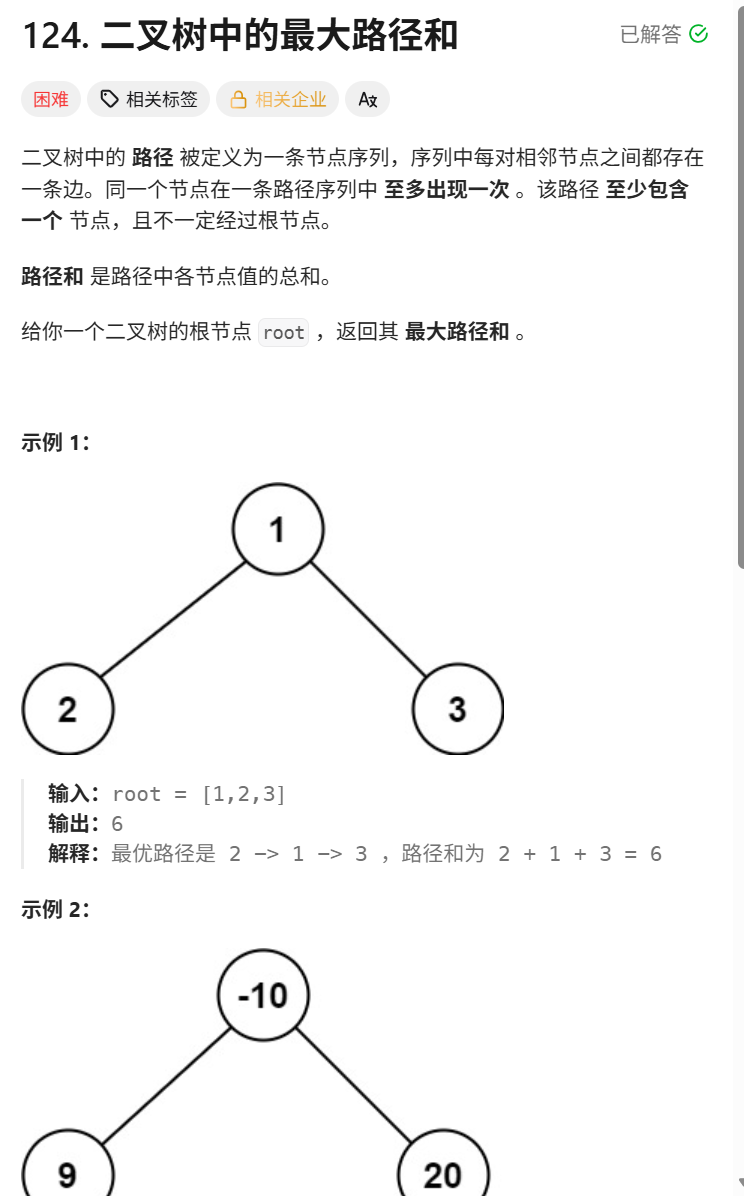
树形dp------leetcode三典例
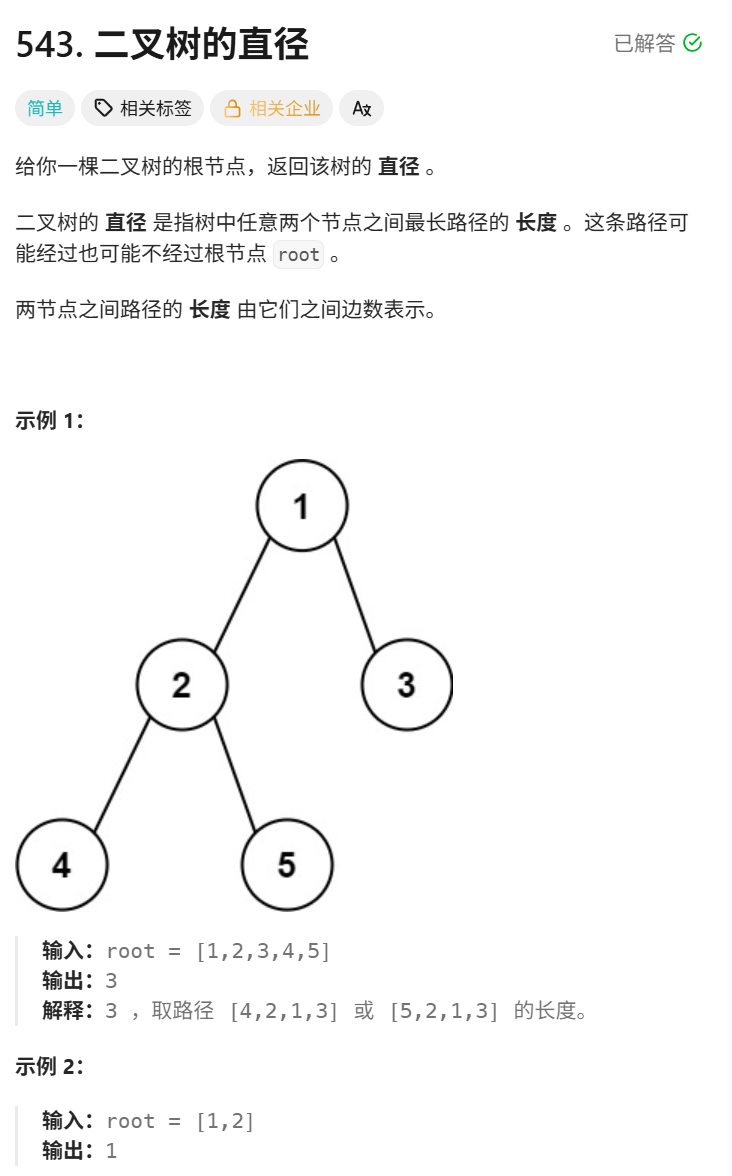
cpp
/**
 * Definition for a binary tree node.
 * struct TreeNode {
 *     int val;
 *     TreeNode *left;
 *     TreeNode *right;
 *     TreeNode() : val(0), left(nullptr), right(nullptr) {}
 *     TreeNode(int x) : val(x), left(nullptr), right(nullptr) {}
 *     TreeNode(int x, TreeNode *left, TreeNode *right) : val(x), left(left), right(right) {}
 * };
 */
class Solution {
public:
int ans=0;

    int dfs(TreeNode* root){
        if(!root)return -1;
        int l=dfs(root->left);
        int r=dfs(root->right);
        ans=max(ans,l+r+2);
        return max(l+1,r+1);
    }

    int diameterOfBinaryTree(TreeNode* root) {
        dfs(root);
        return ans;
    }
};
cpp
/**
 * Definition for a binary tree node.
 * struct TreeNode {
 *     int val;
 *     TreeNode *left;
 *     TreeNode *right;
 *     TreeNode() : val(0), left(nullptr), right(nullptr) {}
 *     TreeNode(int x) : val(x), left(nullptr), right(nullptr) {}
 *     TreeNode(int x, TreeNode *left, TreeNode *right) : val(x), left(left), right(right) {}
 * };
 */
class Solution {
public:
    int ans=-0x3f;
    int dfs(TreeNode* root){
        if(!root)return 0;
        int l=dfs(root->left);
        int r=dfs(root->right);
        if(l<0&&r<0){
            ans=max(ans,root->val);
            return root->val;
        }
        else if(l<0){
            ans=max(ans,root->val+r);
            return root->val+r;
        }
        else if(r<0){
            ans=max(ans,root->val+l);
            return root->val+l;
        }
        else{
            ans=max(ans,root->val+l+r);
            return max(l,r)+root->val;
        }
    }

    int maxPathSum(TreeNode* root) {
        ans=-0x3f;
        dfs(root);
        return ans;
    }
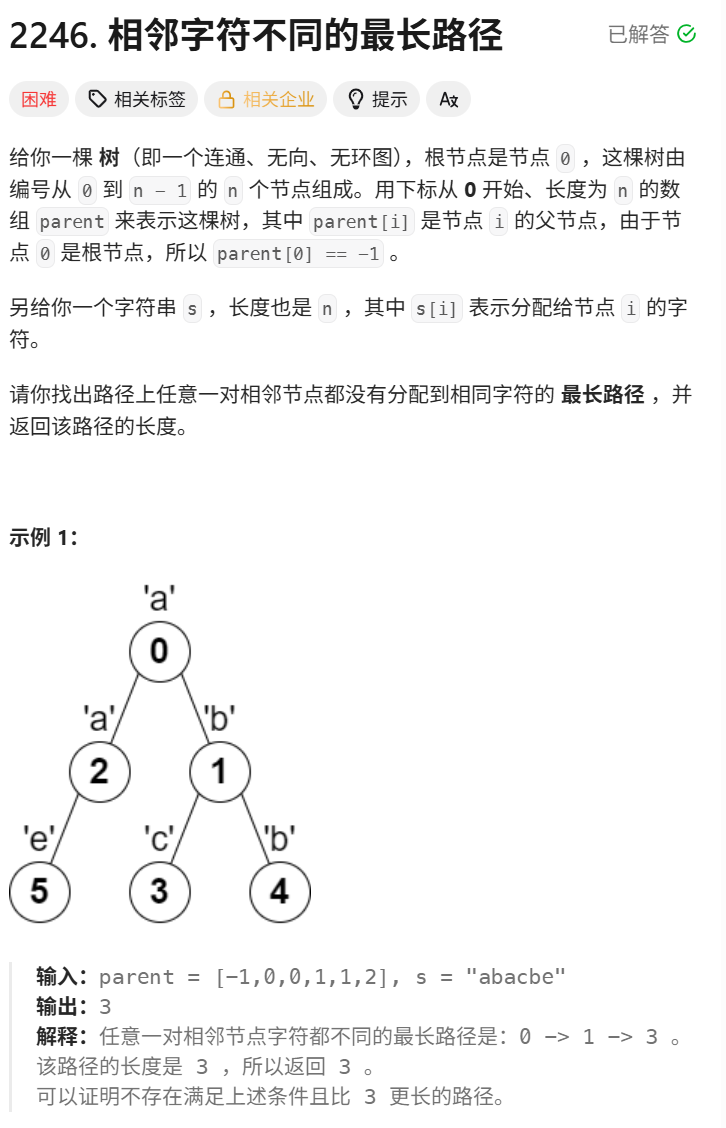
};
cpp
class Solution {
public:
    int n=0;
    vector<vector<int>>child;
    int ans=0;
    string ss;

    int dfs(int number,char last){
        int max1=0,max2=0;
        char word=ss[number];
        int child_num=child[number].size();
        // if(child_num>2){
        //     deque<int>dq;
        //     for(int i=0;i<child_num;i++){
        //         int tmp=dfs(child[number][i],word);
        //         if(dq.size()==0)dq.push_back(tmp);
        //         else if(dq.size()==1){
        //             if(tmp<dq.front())dq.push_back(tmp);
        //             else dq.push_front(tmp);
        //         }
        //         else{
        //             if(tmp>dq.front()){
        //                 dq.push_front(tmp);
        //                 dq.pop_back();
        //             }
        //             else if(tmp>dq.back()){
        //                 dq.pop_back();
        //                 dq.push_back(tmp);
        //             }
        //             else continue;
        //         }
        //     }
        //     // if(dq.size()>=1)max1=dq.front();
        //     // if(dq.size()>=2)max2=dq.back();
        // }
        // else if(child_num==2){
        //     max1=dfs(child[number][0],word);
        //     max2=dfs(child[number][1],word);
        // }
        // else if(child_num==1){
        //     max1=dfs(child[number][0],word);
        // }

        // 遍历所有子节点,保留其中 top2 最大的
        for (int i = 0; i < child_num; i++){
            int son = child[number][i];
            int tmp = dfs(son, word);

            // 如果字符相同,则不能接下去,强制置 0
            if (ss[son] == word) tmp = 0;

            // 维护 top2:max1 >= max2
            if (tmp > max1){
                max2 = max1;
                max1 = tmp;
            } else if (tmp > max2){
                max2 = tmp;
            }
        }

        ans=max(ans,1+max1+max2);
        if(last==' '||last!=word){
            return max(max1,max2)+1;
        }
        else return 0;
    }


    int longestPath(vector<int>& parent, string s) {
        ss=s;
        n=s.length();
        child.resize(n);
        for(int i=0;i<n;i++){
            if(parent[i]==-1)continue;
            child[parent[i]].push_back(i);
        }

        dfs(0,' ');
        return ans;
    }
};
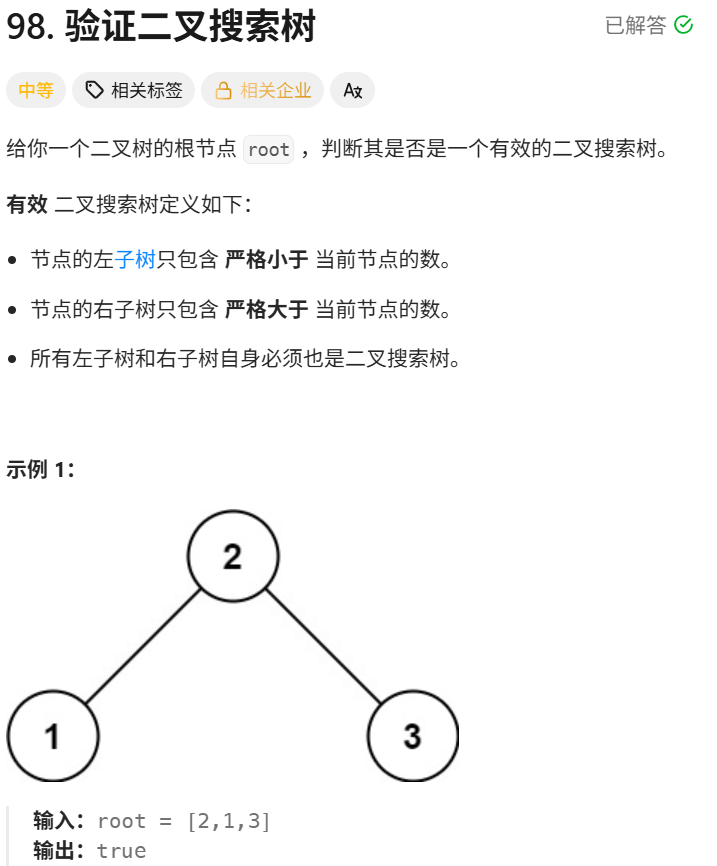
(经典用法,尤其是pre)leetcode98验证二叉搜索树
cpp
// /**
//  * Definition for a binary tree node.
//  * struct TreeNode {
//  *     int val;
//  *     TreeNode *left;
//  *     TreeNode *right;
//  *     TreeNode() : val(0), left(nullptr), right(nullptr) {}
//  *     TreeNode(int x) : val(x), left(nullptr), right(nullptr) {}
//  *     TreeNode(int x, TreeNode *left, TreeNode *right) : val(x), left(left), right(right) {}
//  * };
//  */
// class Solution {
// public:
//     // bool isv(TreeNode* p,int& pre){
//     //     //if(!p)return true;
//     //     if(p){
//     //         int cur=p->val;
//     //         bool isp1 = isv(p->left,pre);
//     //         if(pre>=cur)return false;
//     //         pre=p->val;
//     //         cout<<pre<<endl;
//     //         bool isp2 = isv(p->right,pre);
//     //         return isp1&&isp2;
//     //     }
//     //     else return true;
//     // }
//     // bool isValidBST(TreeNode* root) {
//     //     if(!root)return true;
//     //     int pre;
//     //     cout << pre;
//     //     return isv(root,pre);
//     // }
// public:
//     bool isValidBST(TreeNode* root, long long left = LLONG_MIN, long long right = LLONG_MAX) {
//         if (root == nullptr) {
//             return true;
//         }
//         long long x = root->val;
//         return left < x && x < right &&
//                isValidBST(root->left, left, x) &&
//                isValidBST(root->right, x, right);
//     }
// };
class Solution {
    long long pre = LLONG_MIN;
public:
    bool isValidBST(TreeNode* root) {
        if(root==nullptr)return true;

        if(!isValidBST(root->left))return false;

        if(root->val<=pre)return false;

        pre=root->val;
        if(!isValidBST(root->right))return false;
        return true;
    }
};
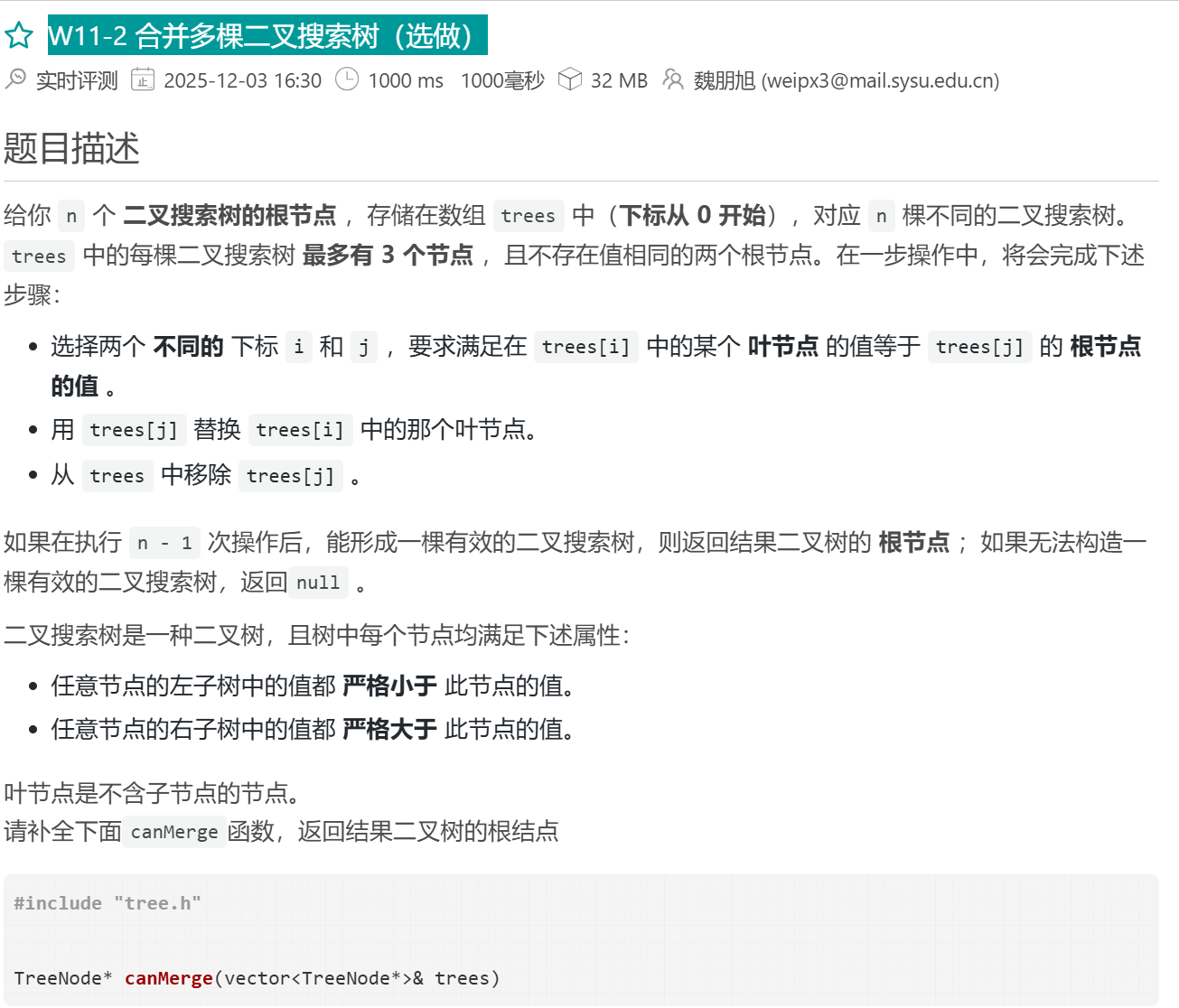
W11-2 合并多棵二叉搜索树(选做,很精彩)
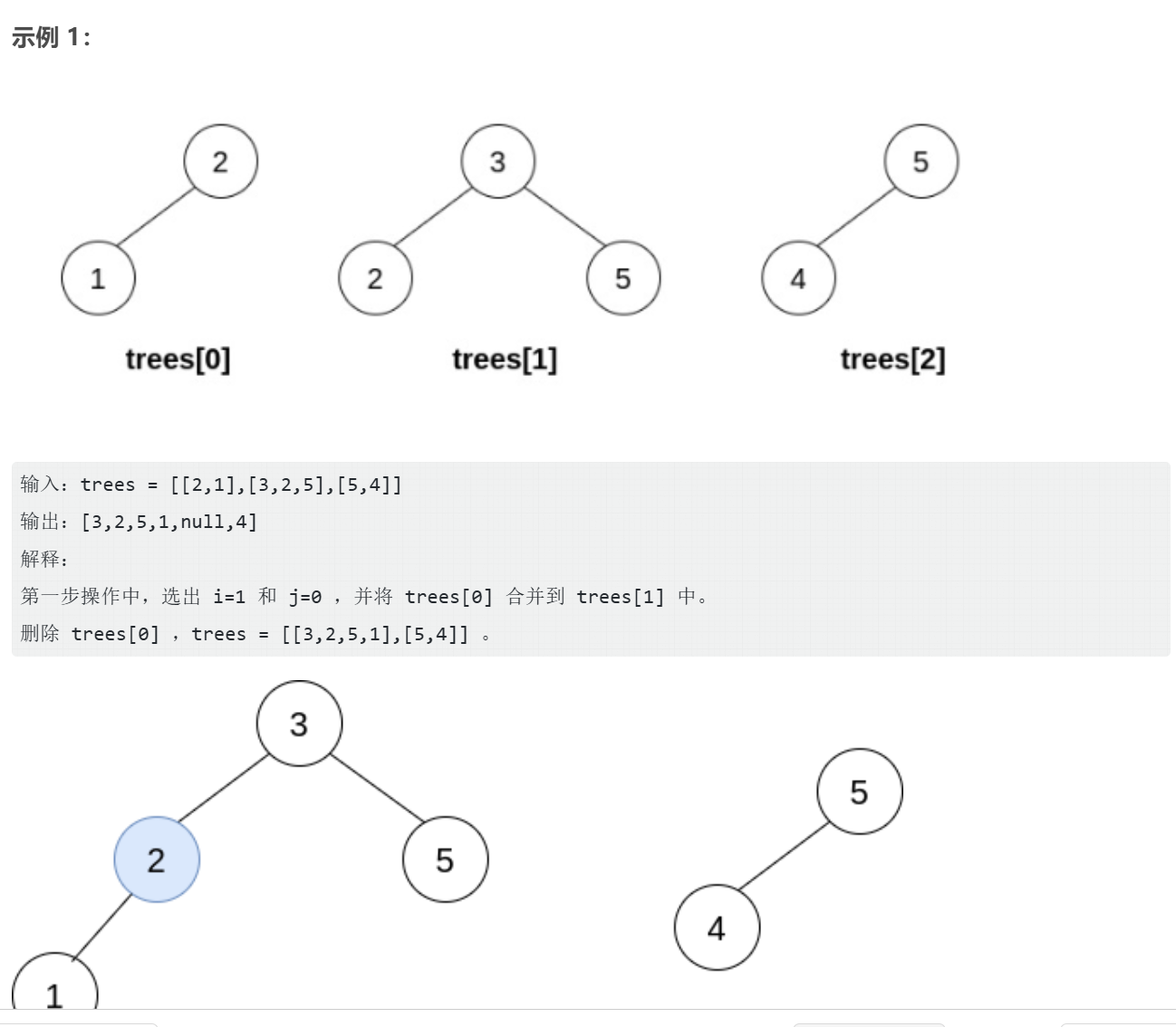
cpp
#include <bits/stdc++.h>
using namespace std;

struct TreeNode {
    int val;
    TreeNode *left, *right;
    TreeNode(int x): val(x), left(nullptr), right(nullptr) {}
};

class Solution {
public:
    unordered_map<int, TreeNode*> mp; // 根值 → 树
    unordered_set<int> leaves;        // 所有叶子值
    int used = 0;                     // 被合并的树数量

    // 检查 BST(中序递增)
    long long pre = LLONG_MIN;
    bool checkBST(TreeNode* root){
        if(!root) return true;
        if(!checkBST(root->left)) return false;
        if(root->val <= pre) return false;
        pre = root->val;
        return checkBST(root->right);
    }

    // DFS 合并
    TreeNode* merge(TreeNode* root){
        if(!root) return nullptr;

        // 左孩子
        if(root->left && mp.count(root->left->val)){
            used++;
            root->left = mp[root->left->val];
            merge(root->left);
        }

        // 右孩子
        if(root->right && mp.count(root->right->val)){
            used++;
            root->right = mp[root->right->val];
            merge(root->right);
        }

        return root;
    }

    TreeNode* canMerge(vector<TreeNode*>& trees) {
        mp.clear();
        leaves.clear();
        used = 0;

        // 记录根
        for(auto t : trees){
            mp[t->val] = t;
            if(t->left) leaves.insert(t->left->val);
            if(t->right) leaves.insert(t->right->val);
        }

        // 寻找大根
        TreeNode* root = nullptr;
        for(auto t : trees){
            if(!leaves.count(t->val)){ // 不是别人的叶子
                if(root) return nullptr; // 多个大根
                root = t;
            }
        }
        if(!root) return nullptr;

        // 合并
        merge(root);

        // 必须合并所有其他树
        if(used != trees.size() - 1) return nullptr;

        // 最后检查是否为合法 BST
        pre = LLONG_MIN;
        if(!checkBST(root)) return nullptr;

        return root;
    }
};
✔ 关键 1:找唯一的"大根"(最关键)
所有树的根值都在:
rootValues = {每棵树的根节点值} leafValues = {所有树的叶子节点值}
大根是:
rootValues - leafValues = 唯一没有作为叶子出现过的根值
如果没有 → impossible
如果有多个 → impossible
✔ 关键 2:做"按需合并"
我们 DFS 大根,每当遇到一个叶子节点的值 X:
如果 X 也是某棵树的根值 → 合并那棵树
如果 X 不是某棵树的根值 → 保持为空叶子
✔ 关键 3:最终检查是不是合法 BST
用中序遍历检查是否递增。
(图论)leetcode-207课程表
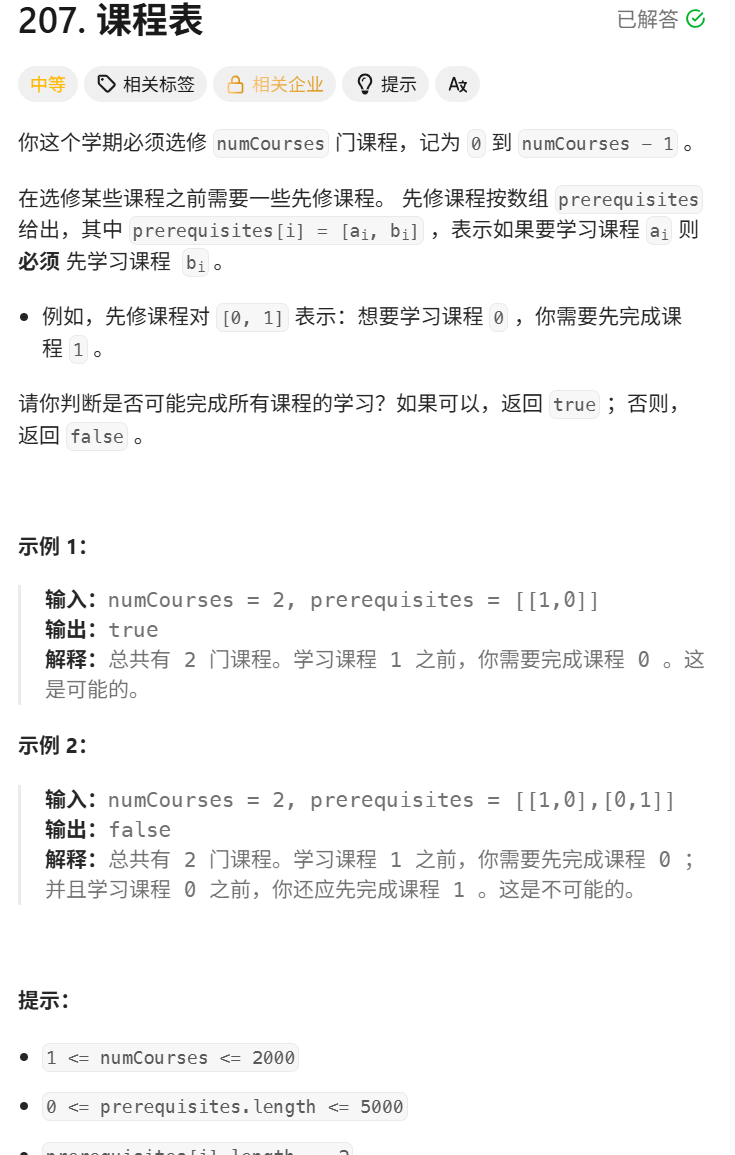
dfs
cpp
class Solution {
public:
    vector<vector<int>> g;
    vector<int> vis;

    bool dfs(int u) {
        if (vis[u] == 1) return false; // 找到环
        if (vis[u] == 2) return true;  // 已经确定无环

        vis[u] = 1; // 标记正在访问

        for (int v : g[u]) {
            if (!dfs(v)) return false;
        }

        vis[u] = 2; // 访问结束
        return true;
    }

    bool canFinish(int numCourses, vector<vector<int>>& prerequisites) {
        g.assign(numCourses, {});
        vis.assign(numCourses, 0);

        for (auto &p : prerequisites) {
            g[p[1]].push_back(p[0]);
        }

        for (int i = 0; i < numCourses; i++) {
            if (!dfs(i)) return false;
        }

        return true;
    }
};
法二(bfs)
cpp
class Solution {
public:
    bool canFinish(int numCourses, vector<vector<int>>& prerequisites) {
        vector<vector<int>> g(numCourses);
        vector<int> indegree(numCourses, 0);

        // 建图 + 入度
        for (auto &p : prerequisites) {
            int a = p[0], b = p[1];
            g[b].push_back(a);  // b -> a (先学b才能学a)
            indegree[a]++;
        }

        queue<int> q;

        // 入度为 0 的课程先入队
        for (int i = 0; i < numCourses; i++) {
            if (indegree[i] == 0) {
                q.push(i);
            }
        }

        int learned = 0;

        while (!q.empty()) {
            int u = q.front(); q.pop();
            learned++;

            for (int v : g[u]) {
                if (--indegree[v] == 0) {
                    q.push(v);
                }
            }
        }

        return learned == numCourses;
    }
};
用bfs写题时候vis数组应该在什么时候标注?(leetcode841)
理解:应该在入队的时候就立马标记,不要等到进入下一个循环才标记,否则虽然不会错,但是会导致一些地方是重复入队的,很浪费时间
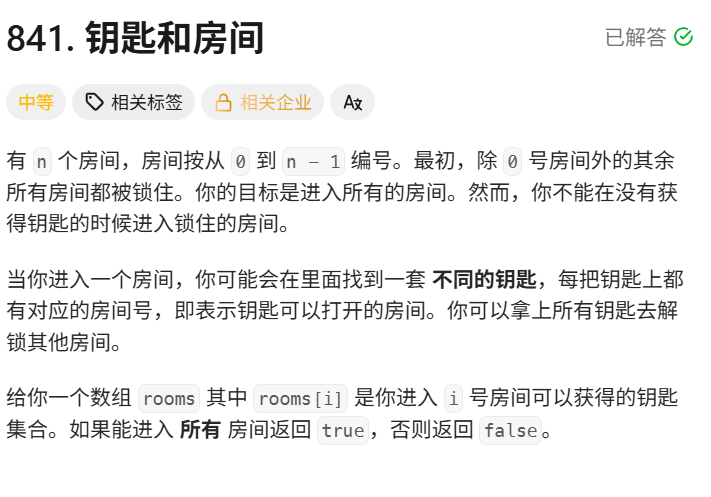
cpp
// class Solution {
// public:
//     vector<bool>vis;
//     bool canVisitAllRooms(vector<vector<int>>& rooms) {
//         int n=rooms.size();
//         vis.resize(n);
//         queue<int>q;
//         q.push(0);
//         while(!q.empty()){
//             int cur=q.front();q.pop();
//             vis[cur]=true;
//             for(auto p:rooms[cur]){
//                 if(!vis[p]){
//                     q.push(p);
//                 }
//             }
//         }
//         for(int i=0;i<n;i++){
//             if(!vis[i])return false;
//         }
//         return true;
//     }
// };

class Solution {
public:
    bool canVisitAllRooms(vector<vector<int>>& rooms) {
        int n = rooms.size();
        vector<bool> vis(n, false);
        queue<int> q;

        q.push(0);
        vis[0] = true;   // ✅ 入队即标记

        while (!q.empty()) {
            int cur = q.front(); q.pop();
            for (int nxt : rooms[cur]) {
                if (!vis[nxt]) {
                    vis[nxt] = true;  // ✅ 立刻标记
                    q.push(nxt);
                }
            }
        }

        for (bool v : vis)
            if (!v) return false;
        return true;
    }
};
时间差距:


Dijkstra算法求最短路径------leetcode743
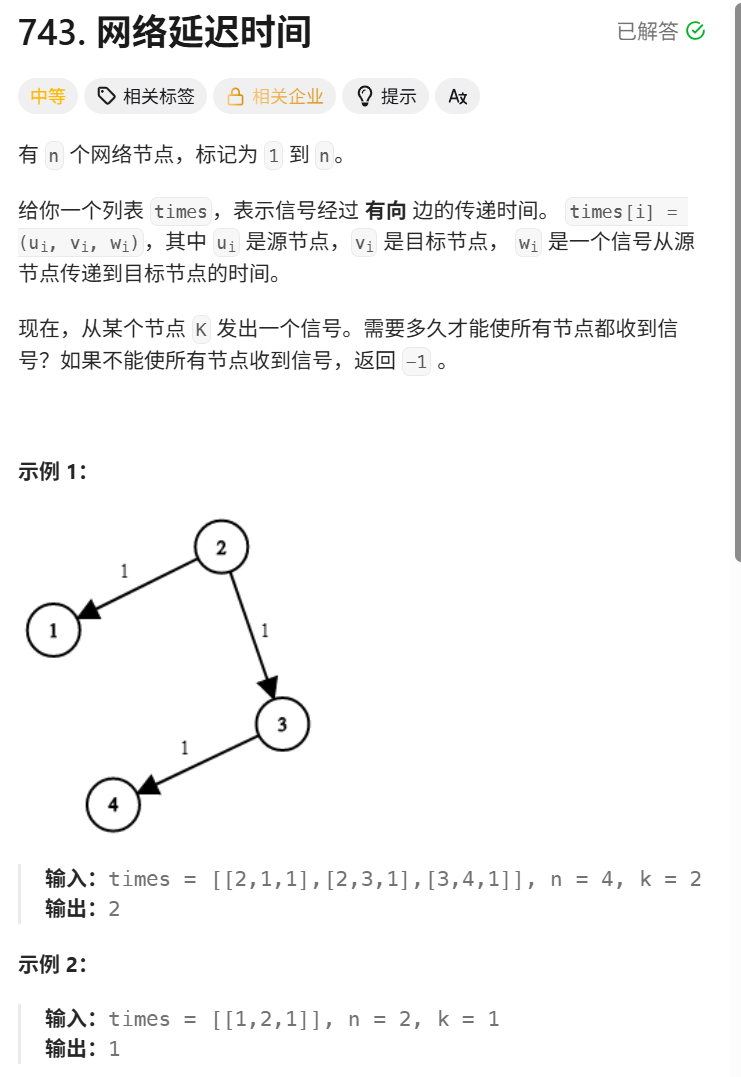
cpp
class Solution {
public:
int networkDelayTime(vector<vector<int>>& times, int n, int k) {
    vector<vector<int>> g(n+1, vector<int>(n+1, -1));
    for (auto &t : times) {
        g[t[0]][t[1]] = t[2];
    }

    vector<int> dist(n+1, INT_MAX);
    vector<bool> vis(n+1, false);

    dist[k] = 0;

    for (int step = 1; step <= n; step++) {
        int u = -1;
        int mind = INT_MAX;

        // ✅ 正确:从所有未访问节点里选最小
        for (int i = 1; i <= n; i++) {
            if (!vis[i] && dist[i] < mind) {
                mind = dist[i];
                u = i;
            }
        }

        if (u == -1) break; // 剩下的都不可达

        vis[u] = true;

        // ✅ 松弛 u 的所有出边
        for (int v = 1; v <= n; v++) {
            if (g[u][v] != -1 && !vis[v]) {
                dist[v] = min(dist[v], dist[u] + g[u][v]);
            }
        }
    }

    int ans = 0;
    for (int i = 1; i <= n; i++) {
        if (dist[i] == INT_MAX) return -1;
        ans = max(ans, dist[i]);
    }
    return ans;
}

    // int networkDelayTime(vector<vector<int>>& times, int n, int k) {
    //     vector<vector<int>>g(n+1,vector<int>(n+1,-1));
    //     for(int i=0;i<times.size();i++){
    //         int u,v,w;
    //         u=times[i][0],v=times[i][1],w=times[i][2];
    //         g[u][v]=w;
    //     }
    //     vector<bool>vis(n+1,false);
    //     vector<int>mindist(n+1,INT_MAX);
    //     queue<int>q;
    //     q.push(k);
    //     vis[k]=true;
    //     mindist[k]=0;
    //     int count=0;
    //     while(!q.empty()){
    //         count++;
    //         int cur=q.front();q.pop();
    //         int minval=INT_MAX,minindex=-1;
    //         for(int i=1;i<=n;i++){
    //             if(g[cur][i]!=-1&&!vis[i]){
    //                 mindist[i]=min(mindist[i],g[cur][i]+mindist[cur]);
    //                 if(mindist[i]<minval){
    //                     minval=mindist[i];
    //                     minindex=i;
    //                 }
    //             }
    //         }
    //         if(minindex!=-1){
    //             vis[minindex]=true;
    //             q.push(minindex);
    //         }
    //         else break;
    //     }
    //     cout<<count<<endl;
    //     int timess=0;
    //     for(int i=1;i<=n;i++){
    //         cout<<mindist[i]<<endl;
    //         if(mindist[i]==INT_MAX)return -1;
    //         timess=max(timess,mindist[i]);
    //     }
    //     return timess;
    // }
};
优先队列的方法:
cpp
class Solution {
public:
    int networkDelayTime(vector<vector<int>>& times, int n, int k) {
    // ---------- 1. 建图:邻接表 ----------
    // g[u] 中存的是:从 u 出发的所有边 (v, w)
    vector<vector<pair<int,int>>> g(n + 1);
    for (auto &t : times) {
        // t = {起点, 终点, 权值}
        g[t[0]].push_back({t[1], t[2]});
    }

    // ---------- 2. dist 数组 ----------
    // dist[i] 表示:从起点 k 到 i 的当前最短距离
    // 初始都设为无穷大,表示"暂时不可达"
    vector<int> dist(n + 1, INT_MAX);

    // ---------- 3. 优先队列(小根堆) ----------
    // pq 中存的是 {当前路径长度, 节点编号}
    // 使用 greater<> 后,dist 最小的元素会优先弹出
    priority_queue<pair<int,int>,
                   vector<pair<int,int>>,
                   greater<pair<int,int>>> pq;

    // 起点到自身距离为 0
    dist[k] = 0;
    pq.push({0, k});  // 先把起点放进去

    // ---------- 4. Dijkstra 主循环 ----------
    // 只要还有"候选的最短路径",就继续
    while (!pq.empty()) {

        // 取出当前距离最小的节点
        // d:当前从 k 到 u 的路径长度
        auto [d, u] = pq.top();
        pq.pop();

        // 如果这条路径已经不是最短的(过期状态),直接跳过
        // 因为 dist[u] 可能在之后被更新成了更小的值
        if (d > dist[u]) continue;

        // ---------- 5. 松弛操作 ----------
        // 遍历从 u 出发的所有边
        for (auto [v, w] : g[u]) {
            // 判断:从 k -> u -> v 是否比之前的路径更短
            if (dist[v] > dist[u] + w) {

                // 如果更短,就更新最短距离
                dist[v] = dist[u] + w;

                // 把更新后的状态放入优先队列
                // 注意:这里不立刻确定 v,只是"候选"
                pq.push({dist[v], v});
            }
        }
    }

    // ---------- 6. 统计答案 ----------
    int ans = 0;
    for (int i = 1; i <= n; i++) {

        // 如果有节点始终不可达,返回 -1
        if (dist[i] == INT_MAX) return -1;

        // 网络延迟时间是最慢的那个节点
        ans = max(ans, dist[i]);
    }

    return ans;
}
};
W13-4邮递员送信(朴素Dijkstra和堆优化Dijkstra)
cpp
#include<iostream>
#include<vector>
#include<queue>
#include<climits>
#include<algorithm>
using namespace std;
int n;
vector<vector<pair<int,int>>>a;
vector<vector<pair<int,int>>>b;

// struct cmp{
//     bool operator()(const pair<int,int>&x,const pair<int,int>&y){
//         return x.second>y.second;
//     }
// };

long long function(vector<vector<pair<int,int>>>&a){
    vector<int>dist(n+1,INT_MAX/2);
    vector<bool>final(n+1,false);
    dist[1]=0;
    for(int i=0;i<n;i++){
        int u=-1;
        int mindist=INT_MAX/2;
        for(int j=1;j<=n;j++){
            if(dist[j]<mindist&&final[j]==false){
                mindist=dist[j];
                u=j;
            }
        }
        if(u==-1)break;
        final[u]=true;
        for(auto p:a[u]){
            if(p.second+dist[u]<dist[p.first]){
                dist[p.first]=p.second+dist[u];
            }
        }
    }
    long long sum=0;
    for(int i=1;i<=n;i++)sum+=dist[i];
    return sum;
}

int main(){
    int m;
    cin>>n>>m;
    a.resize(n+1);
    b.resize(n+1);
    for(int i=1;i<=m;i++){
        int u,v,w;
        cin>>u>>v>>w;
        a[u].push_back({v,w});
        b[v].push_back({u,w});
    }
    long long sum=function(a)+function(b);
    cout<<sum;
}
cpp
#include<iostream>
#include<vector>
#include<queue>
#include<climits>
#include<algorithm>
using namespace std;
int n;
vector<vector<pair<int,int>>>a;
vector<vector<pair<int,int>>>b;

struct cmp{
    bool operator()(const pair<int,int>&x,const pair<int,int>&y){
        return x.second>y.second;
    }
};

int function(vector<vector<pair<int,int>>>&a){
    priority_queue<pair<int,int>,vector<pair<int,int>>,cmp>pq;
    vector<bool>final(n+1,false);
    vector<int>dist(n+1,INT_MAX/2);
    dist[1]=0;
    pq.push({1,0});
    while(!pq.empty()){
        int u=pq.top().first;
        //int w=pq.top().second;
        pq.pop();
        if(final[u])continue;
        final[u]=true;
        for(auto p:a[u]){
            if(final[p.first]==false){
                dist[p.first]=min(dist[p.first],p.second+dist[u]);
                pq.push({p.first,dist[p.first]});
            }
        }
    }
    long long sum=0;
    for(int i=1;i<=n;i++)sum+=dist[i];
    return sum;
}

int main(){
    int m;
    cin>>n>>m;
    a.resize(n+1);
    b.resize(n+1);
    for(int i=1;i<=m;i++){
        int u,v,w;
        cin>>u>>v>>w;
        a[u].push_back({v,w});
        b[v].push_back({u,w});
    }
    long long sum=function(a)+function(b);
    cout<<sum;
}
总结一下:Dijkstra算法思想和做这个题的综合思路
节点1到所有各个节点的最短距离
稀疏图用pair邻接矩阵
稠密图用矩阵就行
然后大体都是设置一个final标志位来判断是否已经是最短距离
然后每次遍历的逻辑是先找到一个最短的并且还没有final标记的节点
把final标记设置为true
之后松弛与这个结点直接接触的其他节点
标准拓扑dp:w14-5并行课程
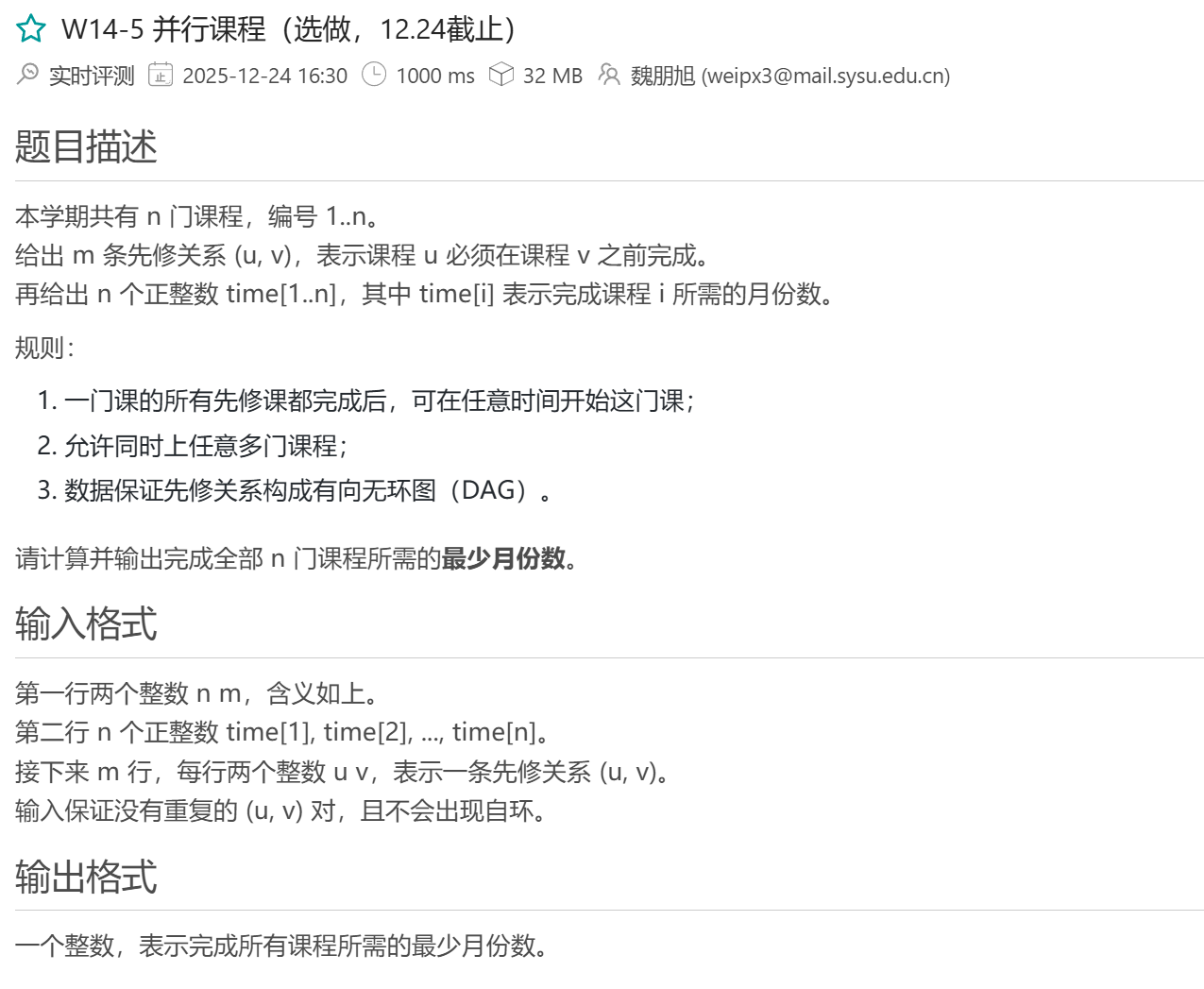
cpp
#include<iostream>
#include<vector>
#include<queue>
#include<climits>
#include<algorithm>
using namespace std;

int main(){
    int n,m;
    cin>>n>>m;
    vector<int>time(n+1);
    vector<vector<int>>g(n+1);
    vector<int>indeg(n+1,0);
    for(int i=1;i<=n;i++){
        cin>>time[i];
    }
    for(int i=0;i<m;i++){
        int u,v;
        cin>>u>>v;
        g[u].push_back(v);
        indeg[v]++;
    }
    vector<int>spendtime(n+1);
    queue<int>fuck;
    for(int i=1;i<=n;i++){
        if(indeg[i]==0){
            fuck.push(i);
        }
        spendtime[i]=time[i];
    }
    int sum=0;
    while(!fuck.empty()){
            int cur=fuck.front();
            sum=max(sum,spendtime[cur]);
            //cout<<time[cur]<<" "<<spendtime[cur]<<endl;
            fuck.pop();
            for(auto p:g[cur]){
                spendtime[p]=max(spendtime[p],time[p]+spendtime[cur]);

                indeg[p]--;
                if(indeg[p]==0)fuck.push(p);
            }
        }
    cout<<sum;
}