以下是详细内容
html
<!DOCTYPE html>
<html lang="zh-CN">
<head>
<meta charset="UTF-8">
<meta name="viewport" content="width=device-width, initial-scale=1.0">
<title>C/C++不是对汇编的简单封装</title>
<style>
* {
margin: 0;
padding: 0;
box-sizing: border-box;
}
body {
font-family: -apple-system, BlinkMacSystemFont, 'Segoe UI', 'PingFang SC', 'Microsoft YaHei', sans-serif;
font-size: 12px;
line-height: 1.4;
color: #333;
background: #f5f5f5;
overflow-x: hidden;
}
.container {
max-width: 100%;
min-height: 100vh;
position: relative;
}
.page {
width: 100%;
min-height: 100vh;
padding: 12px;
display: none;
animation: fadeIn 0.3s ease-in-out;
background: white;
overflow-y: auto;
}
.page.active {
display: block;
}
@keyframes fadeIn {
from { opacity: 0; transform: translateX(20px); }
to { opacity: 1; transform: translateX(0); }
}
h1 {
font-size: 16px;
font-weight: bold;
margin-bottom: 12px;
color: #1a1a1a;
border-bottom: 2px solid #4CAF50;
padding-bottom: 6px;
}
h2 {
font-size: 14px;
font-weight: bold;
margin: 10px 0 6px;
color: #2c3e50;
}
h3 {
font-size: 13px;
font-weight: 600;
margin: 8px 0 5px;
color: #34495e;
}
p {
margin-bottom: 6px;
text-align: justify;
}
ul, ol {
margin: 6px 0;
padding-left: 18px;
}
li {
margin-bottom: 4px;
}
.highlight {
background: #fff3cd;
padding: 1px 3px;
border-radius: 2px;
}
.code-block {
background: #f8f9fa;
border: 1px solid #e9ecef;
border-radius: 3px;
padding: 6px;
margin: 6px 0;
font-family: 'Consolas', 'Monaco', monospace;
font-size: 11px;
overflow-x: auto;
}
.flow-diagram {
background: #e8f5e9;
border: 1px solid #c8e6c9;
border-radius: 3px;
padding: 8px;
margin: 8px 0;
font-size: 11px;
}
.navigation {
position: fixed;
bottom: 8px;
left: 50%;
transform: translateX(-50%);
display: flex;
gap: 6px;
background: rgba(255, 255, 255, 0.95);
padding: 6px;
border-radius: 20px;
box-shadow: 0 2px 10px rgba(0,0,0,0.1);
z-index: 1000;
}
.nav-btn {
padding: 5px 10px;
background: #4CAF50;
color: white;
border: none;
border-radius: 15px;
cursor: pointer;
font-size: 11px;
transition: all 0.3s;
}
.nav-btn:hover {
background: #45a049;
transform: scale(1.05);
}
.nav-btn:disabled {
background: #ccc;
cursor: not-allowed;
transform: scale(1);
}
.page-indicator {
display: flex;
align-items: center;
gap: 4px;
font-size: 10px;
color: #666;
}
.dot {
width: 6px;
height: 6px;
border-radius: 50%;
background: #ddd;
transition: all 0.3s;
}
.dot.active {
background: #4CAF50;
transform: scale(1.3);
}
.key-point {
border-left: 3px solid #4CAF50;
padding-left: 8px;
margin: 8px 0;
}
.comparison-table {
width: 100%;
border-collapse: collapse;
margin: 8px 0;
font-size: 11px;
}
.comparison-table th,
.comparison-table td {
border: 1px solid #ddd;
padding: 4px;
text-align: left;
}
.comparison-table th {
background: #f2f2f2;
font-weight: bold;
}
</style>
</head>
<body>
<div class="container">
<!-- 第1页:总体概述 -->
<div class="page active" id="page1">
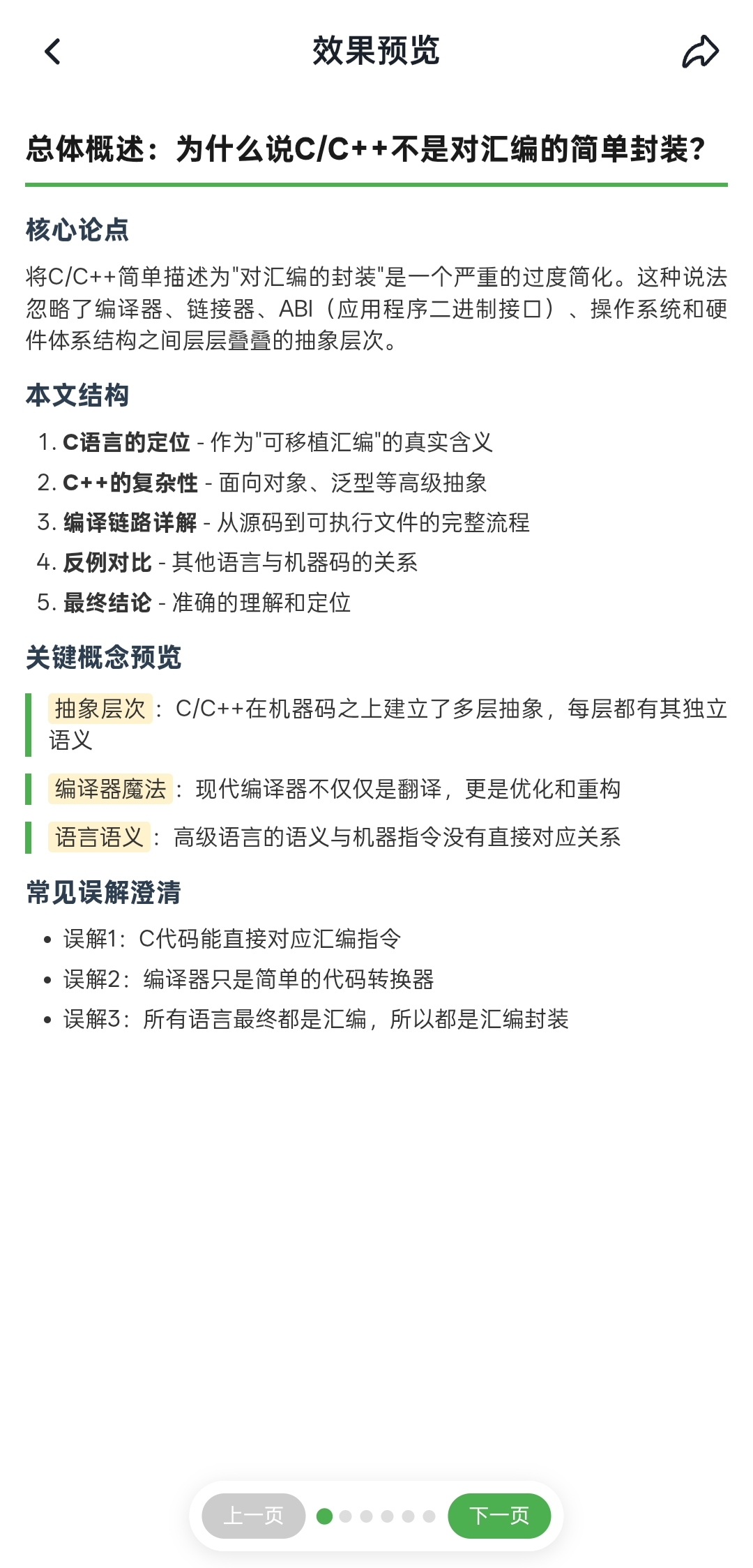
<h1>总体概述:为什么说C/C++不是对汇编的简单封装?</h1>
<h2>核心论点</h2>
<p>将C/C++简单描述为"对汇编的封装"是一个严重的过度简化。这种说法忽略了编译器、链接器、ABI(应用程序二进制接口)、操作系统和硬件体系结构之间层层叠叠的抽象层次。</p>
<h2>本文结构</h2>
<ol>
<li><strong>C语言的定位</strong> - 作为"可移植汇编"的真实含义</li>
<li><strong>C++的复杂性</strong> - 面向对象、泛型等高级抽象</li>
<li><strong>编译链路详解</strong> - 从源码到可执行文件的完整流程</li>
<li><strong>反例对比</strong> - 其他语言与机器码的关系</li>
<li><strong>最终结论</strong> - 准确的理解和定位</li>
</ol>
<h2>关键概念预览</h2>
<div class="key-point">
<p><span class="highlight">抽象层次</span>:C/C++在机器码之上建立了多层抽象,每层都有其独立语义</p>
</div>
<div class="key-point">
<p><span class="highlight">编译器魔法</span>:现代编译器不仅仅是翻译,更是优化和重构</p>
</div>
<div class="key-point">
<p><span class="highlight">语言语义</span>:高级语言的语义与机器指令没有直接对应关系</p>
</div>
<h2>常见误解澄清</h2>
<ul>
<li>误解1:C代码能直接对应汇编指令</li>
<li>误解2:编译器只是简单的代码转换器</li>
<li>误解3:所有语言最终都是汇编,所以都是汇编封装</li>
</ul>
</div>
<!-- 第2页:C语言详细说明 -->
<div class="page" id="page2">
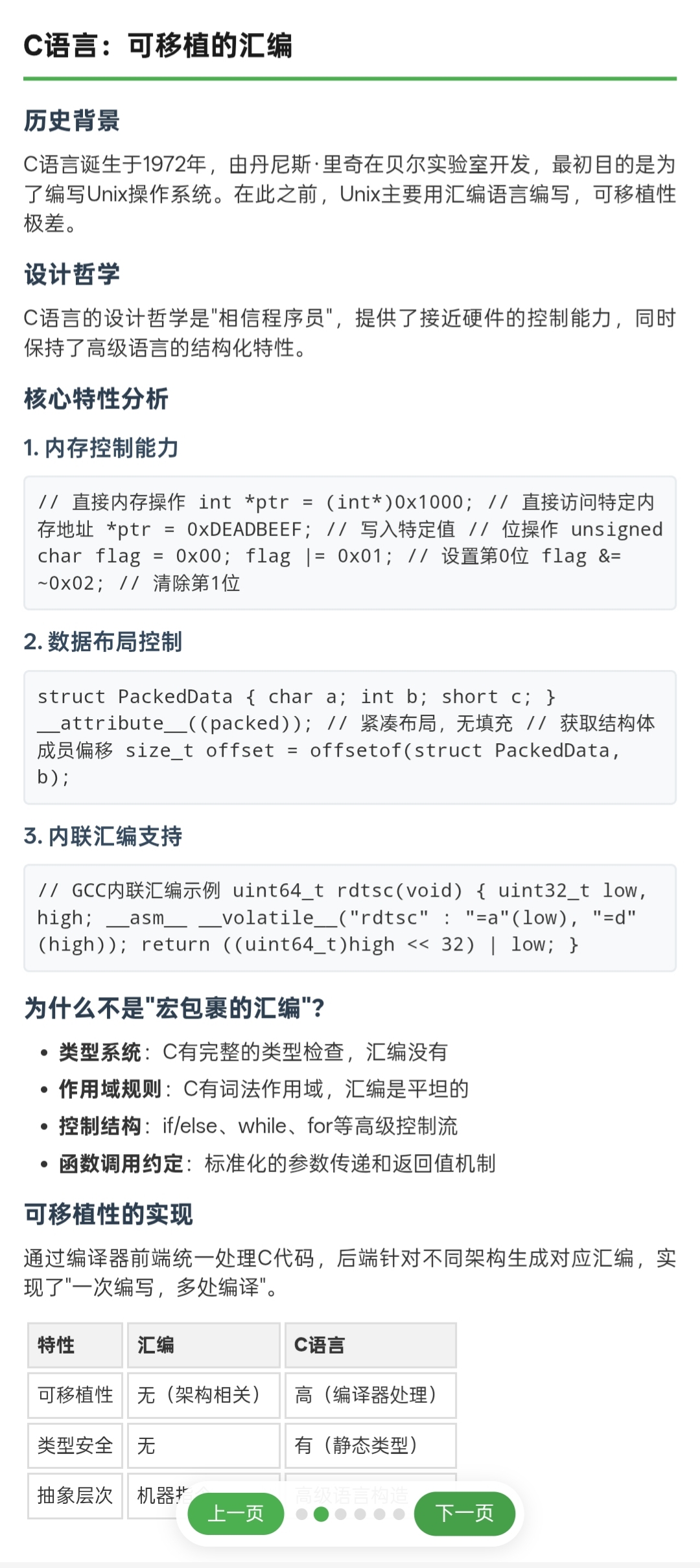
<h1>C语言:可移植的汇编</h1>
<h2>历史背景</h2>
<p>C语言诞生于1972年,由丹尼斯·里奇在贝尔实验室开发,最初目的是为了编写Unix操作系统。在此之前,Unix主要用汇编语言编写,可移植性极差。</p>
<h2>设计哲学</h2>
<p>C语言的设计哲学是"相信程序员",提供了接近硬件的控制能力,同时保持了高级语言的结构化特性。</p>
<h2>核心特性分析</h2>
<h3>1. 内存控制能力</h3>
<div class="code-block">
// 直接内存操作
int *ptr = (int*)0x1000; // 直接访问特定内存地址
*ptr = 0xDEADBEEF; // 写入特定值
// 位操作
unsigned char flag = 0x00;
flag |= 0x01; // 设置第0位
flag &= ~0x02; // 清除第1位
</div>
<h3>2. 数据布局控制</h3>
<div class="code-block">
struct PackedData {
char a;
int b;
short c;
} __attribute__((packed)); // 紧凑布局,无填充
// 获取结构体成员偏移
size_t offset = offsetof(struct PackedData, b);
</div>
<h3>3. 内联汇编支持</h3>
<div class="code-block">
// GCC内联汇编示例
uint64_t rdtsc(void) {
uint32_t low, high;
__asm__ __volatile__("rdtsc" : "=a"(low), "=d"(high));
return ((uint64_t)high << 32) | low;
}
</div>
<h2>为什么不是"宏包裹的汇编"?</h2>
<ul>
<li><strong>类型系统</strong>:C有完整的类型检查,汇编没有</li>
<li><strong>作用域规则</strong>:C有词法作用域,汇编是平坦的</li>
<li><strong>控制结构</strong>:if/else、while、for等高级控制流</li>
<li><strong>函数调用约定</strong>:标准化的参数传递和返回值机制</li>
</ul>
<h2>可移植性的实现</h2>
<p>通过编译器前端统一处理C代码,后端针对不同架构生成对应汇编,实现了"一次编写,多处编译"。</p>
<div class="comparison-table">
<table>
<tr>
<th>特性</th>
<th>汇编</th>
<th>C语言</th>
</tr>
<tr>
<td>可移植性</td>
<td>无(架构相关)</td>
<td>高(编译器处理)</td>
</tr>
<tr>
<td>类型安全</td>
<td>无</td>
<td>有(静态类型)</td>
</tr>
<tr>
<td>抽象层次</td>
<td>机器指令</td>
<td>高级语言构造</td>
</tr>
</table>
</div>
</div>
<!-- 第3页:C++详细说明 -->
<div class="page" id="page3">
<h1>C++:多重抽象的复杂系统</h1>
<h2>从C到C++的飞跃</h2>
<p>C++在C的基础上引入了面向对象编程、泛型编程、异常处理、RTTI(运行时类型信息)等高级特性,这些特性在汇编层面完全没有对应概念。</p>
<h2>面向对象机制</h2>
<h3>1. 虚函数表(vtable)</h3>
<div class="code-block">
class Shape {
public:
virtual void draw() = 0;
virtual ~Shape() {}
};
class Circle : public Shape {
public:
void draw() override { /* 绘制圆形 */ }
};
// 编译器生成的内部结构(概念性)
struct Shape_vtable {
void (*draw)(Shape*);
void (*destructor)(Shape*);
};
struct Shape {
Shape_vtable* vptr;
};
</div>
<h3>2. 多重继承的内存布局</h3>
<div class="code-block">
class A { int a; };
class B { int b; };
class C : public A, public B { int c; };
// 内存布局可能包含多个vptr指针
// 需要指针调整(this pointer adjustment)
</div>
<h2>模板元编程</h2>
<div class="code-block">
// 编译期计算斐波那契数列
template<int N>
struct Fibonacci {
static const int value = Fibonacci<N-1>::value + Fibonacci<N-2>::value;
};
template<>
struct Fibonacci<0> { static const int value = 0; };
template<>
struct Fibonacci<1> { static const int value = 1; };
// 在编译期就计算完成,运行时只是常量
int main() {
int x = Fibonacci<10>::value; // 编译期已计算为55
}
</div>
<h2>异常处理机制</h2>
<p>C++异常处理需要在编译时生成额外的元数据:</p>
<ul>
<li>展开表(unwind tables)</li>
<li>Landing pads</li>
<li>类型信息(typeinfo)</li>
</ul>
<div class="code-block">
try {
risky_operation();
} catch (const std::exception& e) {
// 需要类型匹配和栈展开
handle_error(e);
}
// 生成的汇编包含:
// 1. try块边界标记
// 2. 异常类型信息
// 3. 清理代码(析构函数调用)
// 4. 栈展开逻辑
</div>
<h2>STL的复杂性</h2>
<div class="code-block">
std::vector<int> v = {1, 2, 3};
// 背后的复杂机制:
// 1. 模板实例化
// 2. 内存分配器(allocator)
// 3. 迭代器实现
// 4. 异常安全保证
// 5. RAII资源管理
// 6. 移动语义优化
</div>
<h2>名字修饰(Name Mangling)</h2>
<div class="code-block">
// C++源码
namespace NS {
class MyClass {
void foo(int);
};
}
// 编译后的符号名(GCC)
// _ZN2NS7MyClass3fooEi
</div>
<h2>编译器优化示例</h2>
<div class="code-block">
// 原始C++代码
int sum = 0;
for (int i = 0; i < 100; ++i) {
sum += i * 2;
}
// 优化后的汇编可能变成:
// mov eax, 9900 // 直接计算结果
// 因为编译器在编译期就计算了 2 * (0+1+...+99)
</div>
</div>
<!-- 第4页:编译链路详解 -->
<div class="page" id="page4">
<h1>编译链路:从源码到可执行文件</h1>
<h2>完整编译流程</h2>
<div class="flow-diagram">
源文件(.cpp) → 预处理器 → 编译器前端 → 中间表示(IR) → 优化器 → 编译器后端 → 汇编代码(.s) → 汇编器 → 目标文件(.o) → 链接器 → 可执行文件
</div>
<h2>1. 预处理阶段</h2>
<ul>
<li>处理#include指令</li>
<li>宏展开</li>
<li>条件编译(#ifdef/#ifndef)</li>
<li>删除注释</li>
</ul>
<h2>2. 编译器前端</h2>
<h3>词法分析</h3>
<p>将源代码转换为token流:</p>
<div class="code-block">
int x = 42;
// Tokens: INT, IDENTIFIER, EQUAL, NUMBER, SEMICOLON
</div>
<h3>语法分析</h3>
<p>构建抽象语法树(AST):</p>
<div class="code-block">
// if (x > 0) return x;
// AST结构:
// IfStatement
// ├── Condition: BinaryOp(>, x, 0)
// └── Then: ReturnStatement(x)
</div>
<h3>语义分析</h3>
<ul>
<li>类型检查</li>
<li>作用域解析</li>
<li>重载决议</li>
<li>模板实例化</li>
</ul>
<h2>3. 中间表示(IR)</h2>
<p>现代编译器使用IR作为优化桥梁:</p>
<div class="code-block">
// LLVM IR示例
define i32 @add(i32 %a, i32 %b) {
entry:
%sum = add i32 %a, %b
ret i32 %sum
}
</div>
<h2>4. 优化器</h2>
<h3>常见优化技术</h3>
<ul>
<li><strong>常量折叠</strong>:编译期计算常量表达式</li>
<li><strong>死代码消除</strong>:删除不可达代码</li>
<li><strong>循环展开</strong>:减少循环开销</li>
<li><strong>内联函数</strong>:消除函数调用开销</li>
<li><strong>向量化</strong>:使用SIMD指令</li>
</ul>
<div class="code-block">
// 优化前
for (int i = 0; i < 4; ++i) {
a[i] = b[i] + c[i];
}
// 向量化优化后(伪汇编)
// movdqa xmm0, [b]
// paddd xmm0, [c]
// movdqa [a], xmm0
</div>
<h2>5. 编译器后端</h2>
<h3>指令选择</h3>
<p>将IR映射到目标机器指令:</p>
<div class="code-block">
// IR: %result = add i32 %a, %b
// x86: add eax, ebx
// ARM: add r0, r0, r1
</div>
<h3>寄存器分配</h3>
<p>将虚拟寄存器映射到物理寄存器,需要处理寄存器溢出。</p>
<h3>指令调度</h3>
<p>重排指令以避免流水线停顿,提高指令级并行。</p>
<h2>6. 汇编器和链接器</h2>
<h3>汇编器工作</h3>
<ul>
<li>将汇编代码转换为机器码</li>
<li>生成符号表</li>
<li>生成重定位信息</li>
</ul>
<h3>链接器工作</h3>
<ul>
<li>符号解析</li>
<li>地址重定位</li>
<li>库链接</li>
<li>生成最终可执行文件</li>
</ul>
<h2>优化对代码的改变</h2>
<p>经过优化后,生成的汇编可能与原始代码逻辑完全不同:</p>
<div class="code-block">
// 原始代码
int factorial(int n) {
if (n <= 1) return 1;
return n * factorial(n - 1);
}
// 尾递归优化后可能变成循环
// 或者对于常量参数直接计算结果
</div>
</div>
<!-- 第5页:反例对比 -->
<div class="page" id="page5">
<h1>反例对比:其他语言与机器码</h1>
<h2>Python的例子</h2>
<p>Python的CPython实现最终也生成机器码,但没人说"Python是对汇编的封装":</p>
<h3>Python的执行模型</h3>
<div class="code-block">
# Python源码
def add(a, b):
return a + b
# 字节码(通过dis模块查看)
# 0 LOAD_FAST 0 (a)
# 2 LOAD_FAST 1 (b)
# 4 BINARY_ADD
# 6 RETURN_VALUE
</div>
<p>Python通过解释器执行字节码,解释器本身是编译的C代码。这里有多层抽象:Python代码 → 字节码 → 解释器 → 机器码。</p>
<h2>Java的例子</h2>
<h3>JVM执行模型</h3>
<div class="flow-diagram">
Java源码 → Java编译器 → 字节码(.class) → JVM解释器/JIT编译器 → 机器码
</div>
<ul>
<li><strong>解释执行</strong>:JVM逐条解释字节码</li>
<li><strong>JIT编译</strong>:热点代码动态编译为机器码</li>
<li><strong>GC管理</strong>:自动内存管理,程序员无需关心</li>
</ul>
<h2>JavaScript的例子</h2>
<p>V8引擎的执行流程:</p>
<ol>
<li>解析器生成AST</li>
<li>Ignition解释器执行字节码</li>
<li>TurboFan编译热点代码为优化机器码</li>
<li>去优化:当假设失效时回退到解释执行</li>
</ol>
<h2>对比分析</h2>
<div class="comparison-table">
<table>
<tr>
<th>语言</th>
<th>执行方式</th>
<th>抽象层次</th>
<th>是否"汇编封装"</th>
</tr>
<tr>
<td>C</td>
<td>静态编译</td>
<td>低(接近硬件)</td>
<td>部分正确但不准确</td>
</tr>
<tr>
<td>C++</td>
<td>静态编译</td>
<td>中(多层抽象)</td>
<td>不准确</td>
</tr>
<tr>
<td>Java</td>
<td>JVM</td>
<td>高(虚拟机抽象)</td>
<td>明显不是</td>
</tr>
<tr>
<td>Python</td>
<td>解释器</td>
<td>极高(动态语言)</td>
<td>明显不是</td>
</tr>
</table>
</div>
<h2>关键区别</h2>
<h3>1. 语义距离</h3>
<ul>
<li><strong>语义接近度</strong>:语言构造与机器概念的对应程度</li>
<li><strong>抽象层级</strong>:需要跨越多少抽象层才能到达机器码</li>
</ul>
<h3>2. 运行时支持</h3>
<ul>
<li><strong>GC</strong>:自动垃圾回收</li>
<li><strong>反射</strong>:运行时类型检查</li>
<li><strong>动态加载</strong>:运行时代码生成</li>
</ul>
<h3>3. 编译时vs运行时</h3>
<ul>
<li><strong>静态语言</strong>:大部分工作在编译时完成</li>
<li><strong>动态语言</strong>:大量工作在运行时进行</li>
</ul>
<h2>判断标准</h2>
<p>判断一门语言是否是"汇编封装"应该考虑:</p>
<ol>
<li>语言语义是否直接映射到机器概念</li>
<li>是否需要运行时系统支持</li>
<li>编译器是否进行深度优化和转换</li>
<li>是否有复杂的内存管理机制</li>
</ol>
</div>
<!-- 第6页:总结 -->
<div class="page" id="page6">
<h1>总结:准确理解C/C++与汇编的关系</h1>
<h2>核心结论</h2>
<div class="key-point">
<p><strong>C语言</strong>:可以看作"可移植的、结构化的高级汇编",提供了接近硬件的控制能力,但仍然是一门独立的高级语言。</p>
</div>
<div class="key-point">
<p><strong>C++语言</strong>:在C之上构建了大量与机器无关的抽象层,包括面向对象、泛型编程、异常处理等,离汇编更远。</p>
</div>
<div class="key-point">
<p><strong>编译过程</strong>:现代编译器不是简单的翻译器,而是复杂的优化系统,可能完全改变代码的结构和逻辑。</p>
</div>
<h2>为什么"封装汇编"的说法不准确?</h2>
<ol>
<li><strong>忽略抽象层次</strong>:C/C++建立了多层抽象,每层都有独立语义</li>
<li><strong>简化编译器作用</strong>:编译器进行深度优化,不是一对一映射</li>
<li><strong>混淆实现与定义</strong>:语言语义不等于最终机器码</li>
<li><strong>缺乏历史视角</strong>:不了解语言设计的历史背景和目标</li>
</ol>
<h2>更准确的描述</h2>
<h3>对于C语言:</h3>
<ul>
<li>"系统编程语言"</li>
<li>"可移植的汇编"</li>
<li>"结构化的低级语言"</li>
<li>"Unix的母语"</li>
</ul>
<h3>对于C++语言:</h3>
<ul>
<li>"多范式系统编程语言"</li>
<li>"带类的C"</li>
<li>"零开销抽象的语言"</li>
<li>"现代系统编程的瑞士军刀"</li>
</ul>
<h2>实践意义</h2>
<h3>1. 理解性能优化</h3>
<p>正确理解编译过程有助于写出性能更好的代码,知道哪些优化编译器会做,哪些需要手动干预。</p>
<h3>2. 调试和问题定位</h3>
<p>了解抽象层次有助于在不同层级调试问题,从应用层到汇编层。</p>
<h3>3. 语言选择</h3>
<p>根据项目需求选择合适的语言,理解每种语言的抽象层次和适用场景。</p>
<h2>未来展望</h2>
<ul>
<li><strong>Rust</strong>:提供C++级别的性能,但增加内存安全保证</li>
<li><strong>WebAssembly</strong>:新的编译目标,介于高级语言和机器码之间</li>
<li><strong>量子计算</strong>:全新的计算模型,需要新的抽象层次</li>
</ul>
<h2>最终思考</h2>
<p>编程语言的设计是在<span class="highlight">抽象能力</span>和<span class="highlight">控制精度</span>之间的权衡。C/C++在这个谱系中偏向控制精度,但仍然提供了重要的抽象。将它们简单称为"汇编封装"既不尊重语言设计的复杂性,也无助于理解现代软件系统的构建。</p>
<div class="flow-diagram">
<strong>抽象谱系:</strong><br>
机器码 ← 汇编 ← C ← C++ ← Java/Python ← 领域特定语言
</div>
</div>
</div>
<!-- 导航控制 -->
<div class="navigation">
<button class="nav-btn" id="prevBtn" onclick="changePage(-1)">上一页</button>
<div class="page-indicator">
<span class="dot active" data-page="1"></span>
<span class="dot" data-page="2"></span>
<span class="dot" data-page="3"></span>
<span class="dot" data-page="4"></span>
<span class="dot" data-page="5"></span>
<span class="dot" data-page="6"></span>
</div>
<button class="nav-btn" id="nextBtn" onclick="changePage(1)">下一页</button>
</div>
<script>
let currentPage = 1;
const totalPages = 6;
function showPage(pageNum) {
// 隐藏所有页面
document.querySelectorAll('.page').forEach(page => {
page.classList.remove('active');
});
// 显示当前页面
document.getElementById(`page${pageNum}`).classList.add('active');
// 更新导航按钮状态
document.getElementById('prevBtn').disabled = pageNum === 1;
document.getElementById('nextBtn').disabled = pageNum === totalPages;
// 更新页面指示器
document.querySelectorAll('.dot').forEach(dot => {
dot.classList.remove('active');
if (parseInt(dot.dataset.page) === pageNum) {
dot.classList.add('active');
}
});
currentPage = pageNum;
}
function changePage(direction) {
const newPage = currentPage + direction;
if (newPage >= 1 && newPage <= totalPages) {
showPage(newPage);
}
}
// 触摸滑动支持
let touchStartX = 0;
let touchEndX = 0;
document.addEventListener('touchstart', e => {
touchStartX = e.changedTouches[0].screenX;
});
document.addEventListener('touchend', e => {
touchEndX = e.changedTouches[0].screenX;
handleSwipe();
});
function handleSwipe() {
const swipeThreshold = 50;
const diff = touchStartX - touchEndX;
if (Math.abs(diff) > swipeThreshold) {
if (diff > 0) {
// 向左滑动,下一页
changePage(1);
} else {
// 向右滑动,上一页
changePage(-1);
}
}
}
// 键盘导航
document.addEventListener('keydown', e => {
if (e.key === 'ArrowLeft') {
changePage(-1);
} else if (e.key === 'ArrowRight') {
changePage(1);
}
});
// 点击页面指示器跳转
document.querySelectorAll('.dot').forEach(dot => {
dot.addEventListener('click', () => {
showPage(parseInt(dot.dataset.page));
});
});
</script>
</body>
</html>