前言
这个感觉竞赛里也用不到,随便学学吧()
一、原理
1.内容
(1)核心
没有左子树的节点只到达一次,有左子树的节点会到达两次,其中用左子树最右节点的右指针状态来标记第几次到达。
(2)过程
首先,开始时cur在头节点,cur为空时整个过程停止。
若cur没有左孩子,就向右移动。
若cur有左孩子,就去找cur左子树的最右节点mostRight。若mostRight的右指针为空,那么就让其指向cur,然后cur向左移动。若mostRight右指针指向cur,就让其指向空,然后cur向右移动。
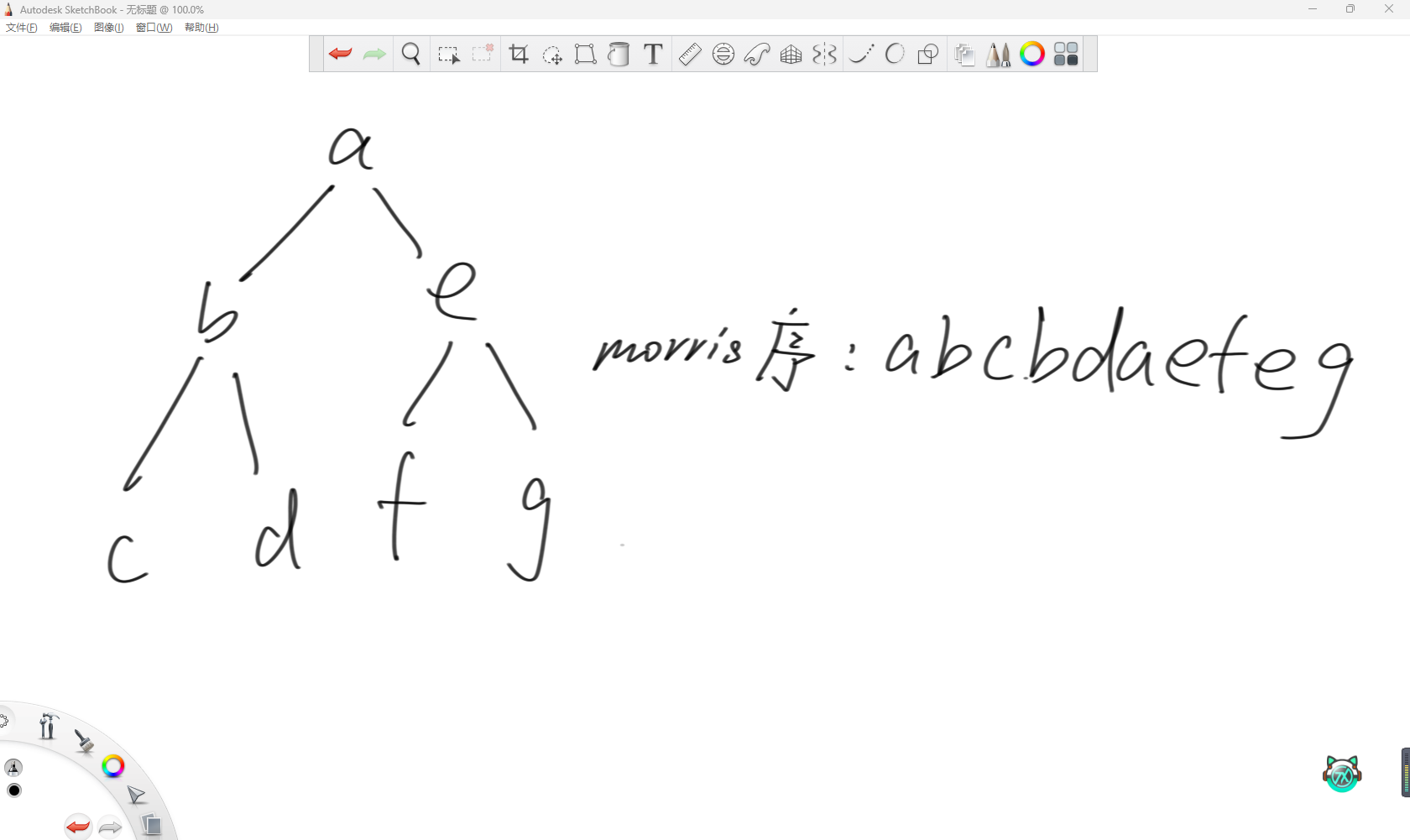
首先cur肯定先来到a节点。之后,因为a节点有左孩子,那么就去a节点左子树的最右节点,所以就是d节点。因为此时d节点的右指针为空,所以让其指向a节点,然后cur来到b节点。
之后,因为b节点有左孩子,所以还是去找左子树的最右节点,那么就是c节点。同样因为此时c节点右指针为空,所以让其指向b节点,然后cur来到c节点。
当cur来到c节点时,因为没有左孩子,那么就向右移动,所以cur回到b节点。此时再去找左子树的最右节点,可以发现c节点的右指针指向自己,所以c节点的右指针指向空,然后cur往右去d节点。
之后因为没有左孩子,所以往右回到a节点,同样去找左子树的最右节点,发现d节点的右指针指回来了,所以将其指为空,cur往右来到e节点。
之后就是把f节点的右指针指向e,然后来到f,之后回到e,把f的右指针指回空,然后去g,完成遍历。观察整个过程,不难发现时间复杂度就是O(n)的,空间复杂度O(1)。
2.二叉树的前序遍历
cpp
class Solution {
public:
    vector<int> preorderTraversal(TreeNode* root) {

        vector<int>ans;

        return morrisPreorder(root,ans);
    }

    vector<int>morrisPreorder(TreeNode* head,vector<int>&ans)
    {
        TreeNode* cur=head;
        TreeNode* mostRight=NULL;

        while(cur!=NULL)
        {
            mostRight=cur->left;

            //cur有左树
            if(mostRight!=NULL)
            {
                while(mostRight->right!=NULL&&mostRight->right!=cur)
                {
                    mostRight=mostRight->right;
                }

                //最右节点右指针为空 -> 第一次到达
                if(mostRight->right==NULL)
                {
                    ans.push_back(cur->val);

                    mostRight->right=cur;
                    cur=cur->left;
                    continue;
                }
                //右指针为cur -> 第二次到达
                else
                {
                    mostRight->right=NULL;
                }
            }
            //没左树 -> 直接收集
            else
            {
                ans.push_back(cur->val);
            }

            cur=cur->right;
        }

        return ans;
    }

    //Morris遍历模板
    void morris(TreeNode* head)
    {
        TreeNode* cur=head;
        TreeNode* mostRight=NULL;

        while(cur!=NULL)
        {
            mostRight=cur->left;

            //cur有左树
            if(mostRight!=NULL)
            {
                while(mostRight->right!=NULL&&mostRight->right!=cur)
                {
                    mostRight=mostRight->right;
                }

                //最右节点右指针为空
                if(mostRight->right==NULL)
                {
                    mostRight->right=cur;
                    cur=cur->left;
                    continue;
                }
                //右指针为cur
                else
                {
                    mostRight->right=NULL;
                }
            }

            cur=cur->right;
        }
    }
};
先序遍历就是在morris遍历的过程中,只在第一次来到时打印该节点,第二次来到时不打印。而观察morris遍历的特点,当最右节点的右指针是cur,那么就说明此时是第二次来到这个节点,所以就不打印。
3.二叉树的中序遍历
cpp
class Solution {
public:
    vector<int> inorderTraversal(TreeNode* root) {

        vector<int>ans;

        return morrisInorder(root,ans);
    }

    vector<int>morrisInorder(TreeNode* head,vector<int>&ans)
    {
        TreeNode* cur=head;
        TreeNode* mostRight=NULL;

        while(cur!=NULL)
        {
            mostRight=cur->left;

            //cur有左树
            if(mostRight!=NULL)
            {
                while(mostRight->right!=NULL&&mostRight->right!=cur)
                {
                    mostRight=mostRight->right;
                }

                //最右节点右指针为空 -> 第一次到达
                if(mostRight->right==NULL)
                {
                    mostRight->right=cur;
                    cur=cur->left;
                    continue;
                }
                //右指针为cur -> 第二次到达
                else
                {
                    ans.push_back(cur->val);

                    mostRight->right=NULL;
                }
            }
            //没左树 -> 直接收集
            else
            {
                ans.push_back(cur->val);
            }

            cur=cur->right;
        }

        return ans;
    }
};
中序遍历就是在morris遍历的过程中,若只来一次,那么就直接打印,否则就在第二次来的时候再打印。根据morris遍历,有左子树的节点会来两遍,所以如果没有就直接打印,有的话就在最右节点右指针指向自己时输出。
4.二叉树的后序遍历
cpp
class Solution {
public:
    vector<int> postorderTraversal(TreeNode* root) {

        vector<int>ans;

        return morrisPostorder(root,ans);
    }

    vector<int> morrisPostorder(TreeNode* head,vector<int>&ans)
    {
        TreeNode* cur=head;
        TreeNode* mostRight=NULL;

        while(cur!=NULL)
        {
            mostRight=cur->left;

            //cur有左树
            if(mostRight!=NULL)
            {
                while(mostRight->right!=NULL&&mostRight->right!=cur)
                {
                    mostRight=mostRight->right;
                }

                //最右节点右指针为空
                if(mostRight->right==NULL)
                {
                    mostRight->right=cur;
                    cur=cur->left;
                    continue;
                }
                //右指针为cur -> 第二次到达
                else
                {
                    mostRight->right=NULL;

                    collect(cur->left,ans);
                }
            }

            cur=cur->right;
        }

        collect(head,ans);

        return ans;
    }

    void collect(TreeNode* head,vector<int>&ans)
    {
        TreeNode* tail=reverse(head);
        TreeNode* cur=tail;
        while(cur!=NULL)
        {
            ans.push_back(cur->val);
            cur=cur->right;
        }
        reverse(tail);
    }

    //类似单链表的反转
    TreeNode* reverse(TreeNode* cur)
    {
        TreeNode* pre=NULL;
        TreeNode* next=NULL;

        while(cur!=NULL)
        {
            next=cur->right;
            cur->right=pre;
            pre=cur;
            cur=next;
        }

        return pre;
    }
};
后序遍历就是在morris遍历时,在第二次到达某个节点时,去逆序收集该节点左树的右边界,最后逆序收集整棵树的右边界。对于逆序操作,就类似于单链表的反转,记得最后需要反转回去。
5.Morris遍历的局限性
很容易就能看出,局限性就是每个节点来到的次数比较少。因为morris遍历每个点最多来两次,而dfs每个点会来三次,所以一些需要dfs整合信息的情况morris就不适用了.
二、应用
1.验证二叉搜索树
cpp
class Solution {
public:
    bool isValidBST(TreeNode* root) {
        TreeNode* cur=root;
        TreeNode* mostRight=NULL;

        TreeNode* pre=NULL;
        bool ans=true;

        while(cur!=NULL)
        {
            mostRight=cur->left;

            //cur有左树
            if(mostRight!=NULL)
            {
                while(mostRight->right!=NULL&&mostRight->right!=cur)
                {
                    mostRight=mostRight->right;
                }

                //最右节点右指针为空
                if(mostRight->right==NULL)
                {
                    mostRight->right=cur;
                    cur=cur->left;
                    continue;
                }
                //右指针为cur
                else
                {
                    mostRight->right=NULL;
                }
            }

            //中序遍历值单调递增就是BST
            //不能直接返回!要把树改回来!
            if(pre!=NULL&&pre->val>=cur->val)
            {
                ans=false;
            }

            pre=cur;
            cur=cur->right;
        }

        return ans;
    }
};
因为中序遍历时值单调递增就是BST,所以直接中序遍历即可。所以多用一个pre变量记录上一个位置,然后每次比较即可。注意这里不能直接返回,需要都把那么改过的右指针改回来,最后再返回。
2.二叉树的最小深度
太逆天了......
cpp
class Solution {
public:
    int minDepth(TreeNode* head) {

        if(head==NULL)
        {
            return 0;
        }

        TreeNode* cur=head;
        TreeNode* mostRight=NULL;

        //morris遍历中,上个节点所在的层数
        int preLevel=0;

        //树的右边界长度
        int rightLen=0;

        int ans=1e9;
        while(cur!=NULL)
        {
            mostRight=cur->left;

            //cur有左树
            if(mostRight!=NULL)
            {
                rightLen=1;
                while(mostRight->right!=NULL&&mostRight->right!=cur)
                {
                    rightLen++;
                    mostRight=mostRight->right;
                }

                //最右节点右指针为空 -> 第一次来
                if(mostRight->right==NULL)
                {
                    preLevel++;
                    mostRight->right=cur;
                    cur=cur->left;
                    continue;
                }
                //右指针为cur -> 第二次来
                else
                {
                    //是叶节点
                    if(mostRight->left==NULL)
                    {
                        ans=min(ans,preLevel);
                    }

                    //当前层数为左树最右节点层数减去左树右边界长度
                    preLevel-=rightLen;
                    mostRight->right=NULL;
                }
            }
            //没有左树 -> 必然从上方来的
            else
            {
                preLevel++;
            }

            cur=cur->right;
        }

        //整棵树的最右节点
        rightLen=1;
        cur=head;
        while(cur->right!=NULL)
        {
            rightLen++;
            cur=cur->right;
        }

        //是叶节点
        if(cur->left==NULL)
        {
            ans=min(ans,rightLen);
        }

        return ans;
    }
};
考虑再多设置两个变量,preLevel表示上一个节点所在的层数,rightLen为树右边界的长度,所以在找最右节点时可以求得rightLen。之后,若是第一次来,因为之后cur要左移,所以preLevel直接加一。而如果是第二次来,那么如果此时的最右节点是叶节点,那么就可以直接统计ans了。否则,当前的层数就是左树最右节点的层数减去这个最右边界的长度。另外,如果压根没有左树,那么必然是从上方节点来的,所以preLevel直接加一即可。
注意,当遍历结束后,整棵树的最右节点是没有被统计过的,所以需要额外特判一下。
3.二叉树的最近公共祖先
cpp
class Solution {
public:
    TreeNode* lowestCommonAncestor(TreeNode* head, TreeNode* o1, TreeNode* o2) {

        //特判是否其中一个是另一个的lca
        if(preOrder(o1->left,o1,o2)!=NULL||preOrder(o1->right,o1,o2)!=NULL)
        {
            return o1;
        }
        if(preOrder(o2->left,o1,o2)!=NULL||preOrder(o2->right,o1,o2)!=NULL)
        {
            return o2;
        }

        //先序遍历中,谁先被找到谁在左
        TreeNode* lleft=preOrder(head,o1,o2);

        TreeNode* cur=head;
        TreeNode* mostRight=NULL;
        TreeNode* ans=NULL;
        while(cur!=NULL)
        {
            mostRight=cur->left;

            //cur有左树
            if(mostRight!=NULL)
            {
                while(mostRight->right!=NULL&&mostRight->right!=cur)
                {
                    mostRight=mostRight->right;
                }

                //最右节点右指针为空
                if(mostRight->right==NULL)
                {
                    mostRight->right=cur;
                    cur=cur->left;
                    continue;
                }
                //右指针为cur
                else
                {
                    mostRight->right=NULL;

                    if(ans==NULL)
                    {
                        //lleft在左树右边界上
                        if(rightCheck(cur->left,lleft))
                        {
                            //看lleft的右树里是否有另一个
                            if(preOrder(lleft->right,o1,o2)!=NULL)
                            {
                                ans=lleft;
                            }
                            lleft=cur;
                        }
                    }
                }
            }

            cur=cur->right;
        }

        //额外检查最后一个lleft

        return ans!=NULL?ans:lleft;
    }

    //以head为头的树进行先序遍历,o1和o2谁先被找到就返回谁
    TreeNode* preOrder(TreeNode* head,TreeNode* o1,TreeNode* o2)
    {
        TreeNode* cur=head;
        TreeNode* mostRight=NULL;
        TreeNode* ans=NULL;

        while(cur!=NULL)
        {
            mostRight=cur->left;

            //cur有左树
            if(mostRight!=NULL)
            {
                while(mostRight->right!=NULL&&mostRight->right!=cur)
                {
                    mostRight=mostRight->right;
                }

                //最右节点右指针为空 -> 第一次到达
                if(mostRight->right==NULL)
                {
                    if(ans==NULL&&(cur==o1||cur==o2))
                    {
                        ans=cur;
                    }

                    mostRight->right=cur;
                    cur=cur->left;
                    continue;
                }
                //右指针为cur -> 第二次到达
                else
                {
                    mostRight->right=NULL;
                }
            }
            //没左树 -> 直接收集
            else
            {
                if(ans==NULL&&(cur==o1||cur==o2))
                {
                    ans=cur;
                }
            }

            cur=cur->right;
        }

        return ans;
    }

    bool rightCheck(TreeNode* head, TreeNode* target)
    {
        while(head!=NULL)
        {
            if(head==target)
            {
                return true;
            }
            head=head->right;
        }
        return false;
    }
};
感觉这个的思路和tarjan算法求lca很类似(?
首先,定义preOrder方法为从某个节点开始,o1和o2谁先被找到就返回谁,所以上来可以先特判两者是否其中一个是另一个的lca。之后,再从head开始preOrder一遍,那么此时谁先被找到谁就是左侧的节点left。
之后去跑morris遍历,当第二次来到当前节点时,去check看left是否在cur左树右边界上。如果在,那么就去看left的右树里是否有另一个。如果有,那么此时的left就是lca。否则就把left设置为当前节点cur。注意最后需要额外再考虑一下最后的left。
大体的原理就是因为已经找到left了,所以就只用查右树即可。
总结
了解一下就行了~