Dify数据库迁移,用到了 migrate_weaviate_collections.py 脚本。
这个脚本中做了哪些工作,才解决版本不兼容问题?
如何解决不兼容问题?
先来看看脚本中每个函数的详细说明,然后了解整体架构。了解脚本中的环境变量配置和解决方案步骤。最后再看执行日志会做哪些内容。
函数详解
-
identify_old_collections(client: weaviate.WeaviateClient) -> List[str]- 作用 :识别需要迁移的旧集合(即没有
vectorConfig的集合)。 - 实现 :
- 列出所有集合,检查是否以
Vector_index_开头。 - 如果集合的配置中没有
vectorConfig,则将其添加到需要迁移的集合列表中。
- 列出所有集合,检查是否以
- 作用 :识别需要迁移的旧集合(即没有
-
get_collection_schema(client: weaviate.WeaviateClient, collection_name: str) -> Dict[str, Any]- 作用:通过 REST API 获取指定集合的完整架构。
- 实现 :
- 发送 GET 请求到 Weaviate 的架构 API,返回集合的 JSON 架构。
-
create_new_collection(client: weaviate.WeaviateClient, old_name: str, schema: Dict[str, Any]) -> str- 作用:创建一个新的集合,使用更新后的架构。
- 实现 :
- 构建新的集合名称(在旧名称后加
_migrated)。 - 生成新的架构,确保包含正确的
vectorConfig。 - 通过 REST API 创建新集合,并返回新集合的名称。
- 构建新的集合名称(在旧名称后加
-
migrate_collection_data(client: weaviate.WeaviateClient, old_collection_name: str, new_collection_name: str) -> int- 作用:将数据从旧集合迁移到新集合,使用基于游标的分页方式。
- 实现 :
- 使用游标分页获取旧集合中的对象,并将其批量插入到新集合中。
- 返回迁移的对象总数。
-
verify_migration(client: weaviate.WeaviateClient, old_collection_name: str, new_collection_name: str)- 作用:验证迁移是否成功。
- 实现 :
- 查询旧集合和新集合中的对象数量,并进行比较。
- 输出验证结果。
-
replace_old_collection(client: weaviate.WeaviateClient, old_collection_name: str, new_collection_name: str)- 作用:用新的集合替换旧的集合。
- 实现 :
- 删除旧集合。
- 获取新集合的架构,并将其 class 名称更改为旧集合的名称。
- 创建一个新的集合(与旧集合同名),并复制数据。
- 删除临时的新集合。
-
migrate_all_collections()- 作用:整体迁移的主入口函数。
- 实现 :
- 关闭客户端连接。
整体架构
该脚本的整体架构如下:

环境变量配置
在进入具体解决方案步骤之前,先使用环境变量获取 Weaviate 的连接信息,包括 WEAVIATE_ENDPOINT、WEAVIATE_GRPC_ENDPOINT 和 WEAVIATE_API_KEY。
解决方案步骤
-
识别旧集合:
- 脚本首先使用
identify_old_collections函数识别所有需要迁移的旧集合。这些集合的特征是缺少vectorConfig,这是导致架构不兼容的主要原因。
- 脚本首先使用
-
获取旧集合架构:
- 对于每个识别出的旧集合,脚本通过
get_collection_schema函数获取其完整的架构信息。这一步确保在迁移过程中可以正确复制旧集合的属性。
- 对于每个识别出的旧集合,脚本通过
-
创建新集合:
- 使用
create_new_collection函数,脚本根据旧集合的架构创建新集合。在新集合中,脚本确保包含适当的vectorConfig设置,特别是引入了名为 "default" 的命名向量配置。这一变化是解决架构不兼容的关键。
- 使用
-
数据迁移:
- 通过
migrate_collection_data函数,脚本将数据从旧集合迁移到新集合。迁移使用基于游标的分页方式,以确保在处理大数据集时的效率和稳定性。这一步骤确保所有对象及其属性都被正确地迁移到新的架构中。
- 通过
-
验证迁移结果:
- 使用
verify_migration函数,脚本验证旧集合和新集合中的对象数量是否一致。如果数量匹配,说明迁移成功,这进一步确保了数据的完整性。
- 使用
-
替换旧集合:
- 在确认迁移成功后,脚本通过
replace_old_collection函数删除旧集合,并使用新集合的架构和数据替换旧集合。这一步骤确保系统在使用新架构时不会留下任何旧数据。
- 在确认迁移成功后,脚本通过
-
清理临时集合:
- 最后,脚本会删除临时创建的新集合,确保系统的整洁和一致性。
小结
通过以上步骤,该脚本有效地解决了 Weaviate 架构不兼容的问题,确保了数据的完整性和系统的稳定性。它不仅自动化了迁移过程,还通过验证和替换操作确保了整个迁移的成功。
脚本运行日志解读
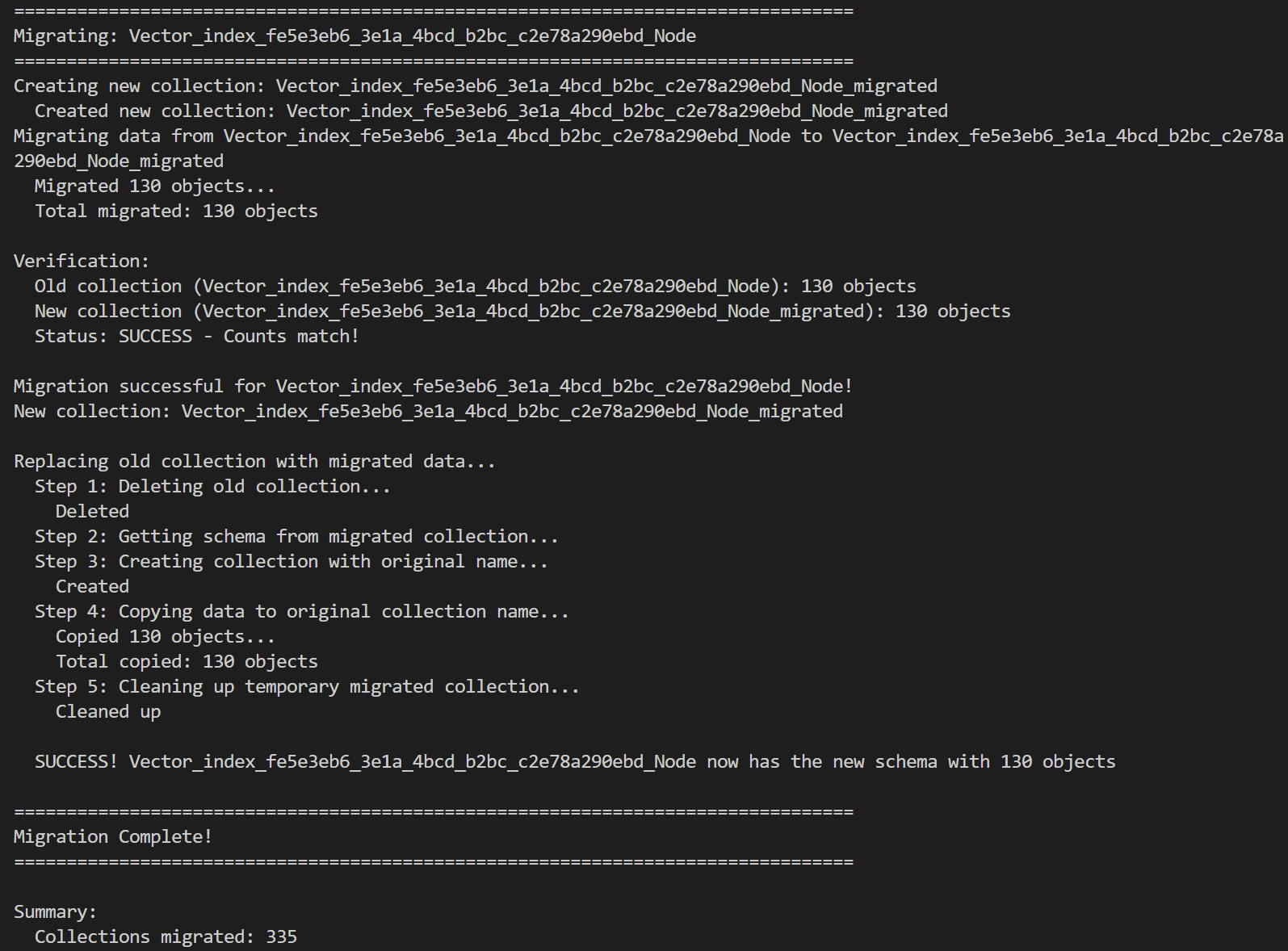
-
迁移开始:
- 日志显示正在迁移集合
Vector_index_fe5e3eb6_3e1a_4bcd_b2bc_c2e78a290ebd_Node。
- 日志显示正在迁移集合
-
创建新集合:
- 创建了一个新的集合
Vector_index_fe5e3eb6_3e1a_4bcd_b2bc_c2e78a290ebd_Node_migrated。 - 成功创建后,日志确认新集合已创建。
- 创建了一个新的集合
-
数据迁移:
- 从旧集合
Vector_index_fe5e3eb6_3e1a_4bcd_b2bc_c2e78a290ebd_Node向新集合迁移数据。 - 成功迁移了 130 个对象,并记录了迁移的总数。
- 从旧集合
-
验证迁移:
- 验证迁移结果:
- 旧集合中的对象数量为 130。
- 新集合中的对象数量也为 130。
- 由于数量匹配,确认迁移状态为成功。
- 验证迁移结果:
-
替换旧集合:
- 开始用迁移后的数据替换旧集合:
- 步骤 1:删除旧集合,成功删除。
- 步骤 2:从迁移后的集合获取架构。
- 步骤 3:使用原始名称创建新集合,成功创建。
- 步骤 4:将数据从迁移后的集合复制到新创建的集合中,成功复制 130 个对象。
- 步骤 5:清理临时迁移集合,成功清理。
- 开始用迁移后的数据替换旧集合:
-
迁移成功:
- 最终确认
Vector_index_fe5e3eb6_3e1a_4bcd_b2bc_c2e78a290ebd_Node现在拥有新的架构,并包含 130 个对象。
- 最终确认
日志的最后一行显示整个迁移过程已完成,共迁移了 335 个集合。整个过程包括创建新集合、迁移数据、验证、替换旧集合以及清理临时集合,所有步骤均成功执行。
附:迁移脚本
提供3个版本的迁移脚本,一个是Dify官方的,一个是个人git账户备份的,最后是无法科学上网的朋友,可以直接复制的。各取所需,能直接wget就wget。
Dify的Weaviate迁移脚本
备份的Weaviate迁移脚本
python
"""
Migration script to fix Weaviate schema incompatibility between 1.19.0 and 1.27.0+
This script:
- Identifies collections with old schema (no vectorConfig)
- Creates new collections with proper vectorConfig including "default" named vector
- Migrates data using cursor-based pagination (efficient for large datasets)
- Uses batch operations for fast inserts
- Preserves all object properties and vectors
Note:
- This is a community-edited version of the draft of the script presented by the Dify Team.
- This script is not officially supported by the Dify Team.
- The original source for this script can be found at https://github.com/langgenius/dify/issues/27291#issuecomment-3501003678.
- The changes made in this script are:
  - Retrieve Weaviate connection info from environment variables to make this script run in the Worker container.
  - Switch to cursor-based pagination in "replace_old_collection", since the migration could fail with large collections.
  - Fix an issue where both the old and new collections remained without being deleted after migrating an empty collection.
"""

import os
import weaviate
from weaviate.classes.config import Configure, VectorDistances
import sys
import time
from typing import List, Dict, Any

# Configuration
WEAVIATE_ENDPOINT = os.getenv("WEAVIATE_ENDPOINT", "http://weaviate:8080")
WEAVIATE_GRPC_ENDPOINT = os.getenv("WEAVIATE_GRPC_ENDPOINT", "grpc://weaviate:50051")
WEAVIATE_API_KEY = os.getenv("WEAVIATE_API_KEY", "WVF5YThaHlkYwhGUSmCRgsX3tD5ngdN8pkih")
BATCH_SIZE = 1000
WEAVIATE_HOST = WEAVIATE_ENDPOINT.split("//")[-1].split(":")[0]
WEAVIATE_PORT = int(WEAVIATE_ENDPOINT.split(":")[-1])
WEAVIATE_GRPC_PORT = int(WEAVIATE_GRPC_ENDPOINT.split(":")[-1])


def identify_old_collections(client: weaviate.WeaviateClient) -> List[str]:
    """Identify collections that need migration (those without vectorConfig)"""
    collections_to_migrate = []

    all_collections = client.collections.list_all()
    print(f"Found {len(all_collections)} total collections")

    for collection_name in all_collections.keys():
        # Only check Vector_index collections (Dify knowledge bases)
        if not collection_name.startswith("Vector_index_"):
            continue

        collection = client.collections.get(collection_name)
        config = collection.config.get()

        # Check if this collection has the old schema
        if config.vector_config is None:
            collections_to_migrate.append(collection_name)
            print(f"  - {collection_name}: OLD SCHEMA (needs migration)")
        else:
            print(f"  - {collection_name}: NEW SCHEMA (skip)")

    return collections_to_migrate


def get_collection_schema(
    client: weaviate.WeaviateClient, collection_name: str
) -> Dict[str, Any]:
    """Get the full schema of a collection via REST API"""
    import requests

    response = requests.get(
        f"http://{WEAVIATE_HOST}:{WEAVIATE_PORT}/v1/schema/{collection_name}",
        headers={"Authorization": f"Bearer {WEAVIATE_API_KEY}"},
    )

    if response.status_code == 200:
        return response.json()
    else:
        raise Exception(f"Failed to get schema: {response.text}")


def create_new_collection(
    client: weaviate.WeaviateClient, old_name: str, schema: Dict[str, Any]
) -> str:
    """Create a new collection with updated schema using REST API"""
    import requests

    # Generate new collection name
    new_name = f"{old_name}_migrated"

    print(f"Creating new collection: {new_name}")

    # Build new schema with proper vectorConfig
    # Note: When using vectorConfig (named vectors), we don't set class-level vectorizer
    new_schema = {
        "class": new_name,
        # This is the key: define vectorConfig with "default" named vector
        # Do NOT set class-level vectorizer when using vectorConfig
        "vectorConfig": {
            "default": {
                "vectorizer": {"none": {}},
                "vectorIndexType": "hnsw",
                "vectorIndexConfig": {
                    "distance": "cosine",
                    "ef": -1,
                    "efConstruction": 128,
                    "maxConnections": 32,
                },
            }
        },
        "properties": [],
    }

    # Copy properties from old schema
    if "properties" in schema:
        new_schema["properties"] = schema["properties"]

    # Create collection via REST API
    response = requests.post(
        f"{WEAVIATE_ENDPOINT}/v1/schema",
        json=new_schema,
        headers={"Authorization": f"Bearer {WEAVIATE_API_KEY}"},
    )

    if response.status_code not in [200, 201]:
        raise Exception(f"Failed to create collection: {response.text}")

    print(f"  Created new collection: {new_name}")
    return new_name


def migrate_collection_data(
    client: weaviate.WeaviateClient, old_collection_name: str, new_collection_name: str
) -> int:
    """Migrate data from old collection to new collection using cursor-based pagination"""

    old_collection = client.collections.get(old_collection_name)
    new_collection = client.collections.get(new_collection_name)

    total_migrated = 0
    cursor = None

    print(f"Migrating data from {old_collection_name} to {new_collection_name}")

    while True:
        # Fetch batch of objects using cursor-based pagination
        if cursor is None:
            # First batch
            response = old_collection.query.fetch_objects(
                limit=BATCH_SIZE, include_vector=True
            )
        else:
            # Subsequent batches using cursor
            response = old_collection.query.fetch_objects(
                limit=BATCH_SIZE, include_vector=True, after=cursor
            )

        objects = response.objects

        if not objects:
            break

        # Use batch insert for efficiency
        with new_collection.batch.dynamic() as batch:
            for obj in objects:
                # Prepare properties
                properties = obj.properties

                # Add object with vector
                batch.add_object(
                    properties=properties,
                    vector=(
                        obj.vector["default"]
                        if isinstance(obj.vector, dict)
                        else obj.vector
                    ),
                    uuid=obj.uuid,
                )

        total_migrated += len(objects)
        print(f"  Migrated {total_migrated} objects...")

        # Update cursor for next iteration
        if len(objects) < BATCH_SIZE:
            # Last batch
            break
        else:
            # Get the last object's UUID for cursor
            cursor = objects[-1].uuid

    print(f"  Total migrated: {total_migrated} objects")
    return total_migrated


def verify_migration(
    client: weaviate.WeaviateClient, old_collection_name: str, new_collection_name: str
):
    """Verify that the migration was successful"""

    old_collection = client.collections.get(old_collection_name)
    new_collection = client.collections.get(new_collection_name)

    # Count objects in both collections
    old_count_response = old_collection.query.fetch_objects(limit=1)
    new_count_response = new_collection.query.fetch_objects(limit=1)

    # Get aggregation for accurate counts
    old_agg = old_collection.aggregate.over_all(total_count=True)
    new_agg = new_collection.aggregate.over_all(total_count=True)

    old_count = old_agg.total_count
    new_count = new_agg.total_count

    print(f"\nVerification:")
    print(f"  Old collection ({old_collection_name}): {old_count} objects")
    print(f"  New collection ({new_collection_name}): {new_count} objects")

    if old_count == new_count:
        print(f"  Status: SUCCESS - Counts match!")
        return True
    else:
        print(f"  Status: WARNING - Counts don't match!")
        return False


def replace_old_collection(
    client: weaviate.WeaviateClient, old_collection_name: str, new_collection_name: str
):
    """Replace old collection with migrated one by recreating with original name"""
    import requests

    print(f"\nReplacing old collection with migrated data...")

    # Step 1: Delete old collection
    print(f"  Step 1: Deleting old collection...")
    response = requests.delete(
        f"{WEAVIATE_ENDPOINT}/v1/schema/{old_collection_name}",
        headers={"Authorization": f"Bearer {WEAVIATE_API_KEY}"},
    )
    if response.status_code != 200:
        print(f"    Warning: Could not delete old collection: {response.text}")
    else:
        print(f"    Deleted")

    # Step 2: Get schema from migrated collection
    print(f"  Step 2: Getting schema from migrated collection...")
    schema_response = requests.get(
        f"{WEAVIATE_ENDPOINT}/v1/schema/{new_collection_name}",
        headers={"Authorization": f"Bearer {WEAVIATE_API_KEY}"},
    )
    schema = schema_response.json()
    schema["class"] = old_collection_name

    # Step 3: Create collection with original name and new schema
    print(f"  Step 3: Creating collection with original name...")
    create_response = requests.post(
        f"{WEAVIATE_ENDPOINT}/v1/schema",
        json=schema,
        headers={"Authorization": f"Bearer {WEAVIATE_API_KEY}"},
    )
    if create_response.status_code not in [200, 201]:
        raise Exception(f"Failed to create collection: {create_response.text}")
    print(f"    Created")

    # Step 4: Copy data to collection with original name using cursor-based pagination
    print(f"  Step 4: Copying data to original collection name...")
    migrated_collection = client.collections.get(new_collection_name)
    new_collection = client.collections.get(old_collection_name)

    total_copied = 0
    cursor = None

    while True:
        # Fetch batch of objects using cursor-based pagination
        if cursor is None:
            # First batch
            response = migrated_collection.query.fetch_objects(
                include_vector=True, limit=BATCH_SIZE
            )
        else:
            # Subsequent batches using cursor
            response = migrated_collection.query.fetch_objects(
                include_vector=True, limit=BATCH_SIZE, after=cursor
            )

        objects = response.objects

        if not objects:
            break

        # Use batch insert for efficiency
        with new_collection.batch.dynamic() as batch:
            for obj in objects:
                batch.add_object(
                    properties=obj.properties, vector=obj.vector, uuid=obj.uuid
                )

        total_copied += len(objects)
        print(f"    Copied {total_copied} objects...")

        # Update cursor for next iteration
        if len(objects) < BATCH_SIZE:
            break
        else:
            cursor = objects[-1].uuid

    print(f"    Total copied: {total_copied} objects")

    # Step 5: Delete the temporary migrated collection
    print(f"  Step 5: Cleaning up temporary migrated collection...")
    response = requests.delete(
        f"{WEAVIATE_ENDPOINT}/v1/schema/{new_collection_name}",
        headers={"Authorization": f"Bearer {WEAVIATE_API_KEY}"},
    )
    if response.status_code == 200:
        print(f"    Cleaned up")

    print(
        f"\n  SUCCESS! {old_collection_name} now has the new schema with {total_copied} objects"
    )
    return True


def migrate_all_collections():
    """Main migration function"""

    print("=" * 80)
    print("Weaviate Collection Migration Script")
    print("Migrating from Weaviate 1.19.0 schema to 1.27.0+ schema")
    print("=" * 80)
    print()

    client = weaviate.connect_to_local(
        host=WEAVIATE_HOST,
        port=WEAVIATE_PORT,
        grpc_port=WEAVIATE_GRPC_PORT,
        auth_credentials=weaviate.auth.AuthApiKey(WEAVIATE_API_KEY),
    )

    try:
        # Step 1: Identify collections that need migration
        print("Step 1: Identifying collections that need migration...")
        collections_to_migrate = identify_old_collections(client)

        if not collections_to_migrate:
            print("\nNo collections need migration. All collections are up to date!")
            return

        print(f"\nFound {len(collections_to_migrate)} collections to migrate:")
        for col in collections_to_migrate:
            print(f"  - {col}")

        # Confirm before proceeding
        print("\nThis script will:")
        print("1. Create new collections with updated schema")
        print("2. Copy all data using efficient batch operations")
        print("3. Verify the migration")
        print("4. Optionally rename collections to activate the new ones")
        print()

        # Step 2: Migrate each collection
        for collection_name in collections_to_migrate:
            print("\n" + "=" * 80)
            print(f"Migrating: {collection_name}")
            print("=" * 80)

            try:
                # Get old schema
                schema = get_collection_schema(client, collection_name)

                # Create new collection
                new_collection_name = create_new_collection(
                    client, collection_name, schema
                )

                # Migrate data
                migrated_count = migrate_collection_data(
                    client, collection_name, new_collection_name
                )

                # Verify migration
                success = verify_migration(client, collection_name, new_collection_name)

                if success:
                    print(f"\nMigration successful for {collection_name}!")
                    print(f"New collection: {new_collection_name}")

                    # Automatically replace old collection with migrated one
                    try:
                        replace_old_collection(
                            client, collection_name, new_collection_name
                        )
                    except Exception as e:
                        print(
                            f"\nWarning: Could not automatically replace collection: {e}"
                        )
                        print(f"\nTo activate manually:")
                        print(f"1. Delete the old collection: {collection_name}")
                        print(f"2. Rename {new_collection_name} to {collection_name}")

            except Exception as e:
                print(f"\nError migrating {collection_name}: {e}")
                print(f"Skipping this collection and continuing...")
                continue

        print("\n" + "=" * 80)
        print("Migration Complete!")
        print("=" * 80)
        print("\nSummary:")
        print(f"  Collections migrated: {len(collections_to_migrate)}")

    finally:
        client.close()


if __name__ == "__main__":
    try:
        migrate_all_collections()
    except KeyboardInterrupt:
        print("\n\nMigration interrupted by user.")
        sys.exit(1)
    except Exception as e:
        print(f"\n\nFatal error: {e}")
        import traceback

        traceback.print_exc()
        sys.exit(1)