目录
- 前言
- [1 序列式容器和关联式容器](#1 序列式容器和关联式容器)
- [2 红黑树的修改](#2 红黑树的修改)
-
- [2.1 模板参数](#2.1 模板参数)
- [2.2 迭代器的实现](#2.2 迭代器的实现)
- [2.3 Insert 的修改](#2.3 Insert 的修改)
- [2.4 加入 Begin,End](#2.4 加入 Begin,End)
- [2.4 修改后的红黑树](#2.4 修改后的红黑树)
- [3 set 的模拟实现](#3 set 的模拟实现)
-
- [3.1 Begin,End,Insert](#3.1 Begin,End,Insert)
- [3.2 KeyofValue](#3.2 KeyofValue)
- [3.3 对值的限制](#3.3 对值的限制)
- [3.4 Set 的代码](#3.4 Set 的代码)
- [4 map 的模拟实现](#4 map 的模拟实现)
-
- [4.1 Begin,End,Insert](#4.1 Begin,End,Insert)
- [4.2 KeyofValue](#4.2 KeyofValue)
- [4.3 \[\] 重载](#4.3 [] 重载)
- [4.5 对值的限制](#4.5 对值的限制)
- [4.6 Map 的代码](#4.6 Map 的代码)
前言
STL 中,Map 和 Set 的底层实现使用到了红黑树,因此要模拟实现 Map 和 Set 的话,还需要模拟实现红黑树,关于红黑树的底层原理,可以参考这篇文章:
1 序列式容器和关联式容器
序列式容器 指逻辑结构 为线性结构 的容器,它内部存储的元素之间没有较强的关联性,互相进行交换以后不会破坏存储结构。在 STL 中,array(静态数组),vector(顺序表),forward_list(单链表),list(双向带头循环链表),deque(vector 和 list 的缝合) 都属于序列式容器
关联式容器 指逻辑结构 为非线性结构 的容器,它内部存储的元素之间有较强的关系,互相交换以后就会破坏原来的存储结构。在 STL 中,map/set(红黑树),unordered_map/unordered_set(哈希表)都属于关联式容器
2 红黑树的修改
2.1 模板参数
为了在 map 和 set 中封装红黑树,红黑树的模板参数中需要给定 K 和 T,其中 K 指用来比较的值的类型,也就是 Key 的类型,T 则指真正存储在结点中数据的类型,对于 set 来说,可能是 char,int 等类型,对于 map 来说则是 键值对 pair
在做值的比较时,set 存储的是值,所以 set 中的值可以直接用来比较 ,但是 map 存储的是键值对,需要取出 Key 对应的 Value 才可以进行比较,因此还需要给出模板参数 KeyofValue,它的作用是取出用作比较的值,是一个仿函数
cpp
template<class T>
struct RBTreeNode
{
	RBTreeNode(const T& kv)
		:_kv(kv)
		,_left(nullptr)
		,_right(nullptr)
		,_parent(nullptr)
	{}

	T _kv;
	RBTreeNode<T>* _left;
	RBTreeNode<T>* _right;
	RBTreeNode<T>* _parent;
	COLOR _color;
};

//K -- 用于比较的值的类型
//T -- 真正存储的值的类型
//KeyofValue -- 取出用作比较的值的仿函数类型
template<class K, class T, class KeyofValue>
class RBTree
{
	typedef RBTreeNode<T> Node;
public:
	//...
private:
	Node* _root = nullptr;
};
2.2 迭代器的实现
红黑树的迭代器是一个封装了指针的类,表面上是迭代器在进行着遍历,背地里实际上是指针在做遍历,在实现的时候,考虑到普通对象和 const 对象都需要进行调用,所以需要分普通迭代器 和 const 迭代器 ,为此迭代器类需要模板参数 Ref 和 Ptr,当普通对象调用时,Ref 就是普通的引用类型,Ptr 就是普通的指针类型,代表可以对结点中的 Value 进行修改,就是普通迭代器 ,当 const 对象调用时,Ref 就是 const 引用类型,Ptr 就是 const 指针,代表无法对结点中的 Value 进行修改,就是 const 迭代器
cpp
template<class T, class Ref, class Ptr>
class Iterator
{
	typedef Iterator<T, Ref, Ptr> Self; //代表迭代器自身
	typedef RBTreeNode<T> Node;
public:
	Iterator(Node* node, Node* root)
		:_node(node)
		,_root(root)
	{}

	Ref operator*()
	{
		return (*_node)._kv;
	}

	Ptr operator->()
	{
		return &(_node->_kv);
	}

	bool operator==(const Self& it)
	{
		return _node == it._node;
	}

	bool operator!=(const Self& it)
	{
		return _node != it._node;
	}

	private:
	Node* _node;
	Node* _root;
};

template<class K, class T, class KeyofValue>
class RBTree
{
	typedef RBTreeNode<T> Node;
	KeyofValue kov;
public:
	typedef Iterator<T, T&, T*> iterator; //普通迭代器
	typedef Iterator<T, const T&, const T*> const_iterator; //const迭代器
	//...
private:
	//...
	Node* _root = nullptr;
};
迭代器的 ++ 操作在实现时的思路为:
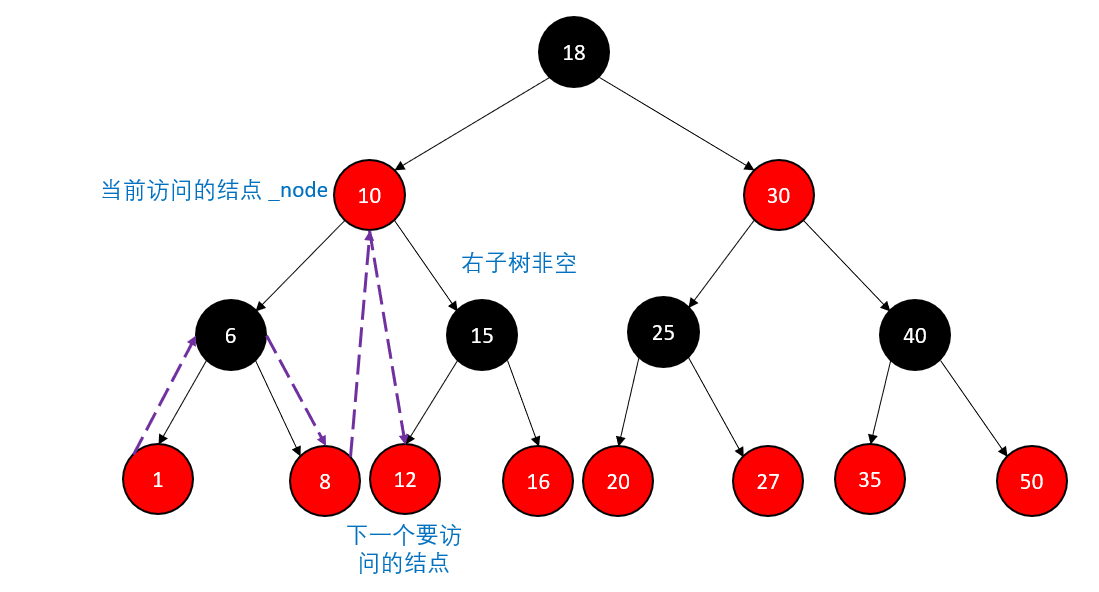
由于红黑树也是一种二叉搜索树(BST),所以中序遍历序列是有序的,因此按照中序遍历来设计,中序遍历为左子树 -- 根节点 -- 右子树的顺序
假设当前访问了根节点,那么接下来要访问的结点就是右子树了,对于右子树主要有两种情况:
右子树不为空,则接下来要访问的是右子树中最小的结点,也就是最左下角的结点
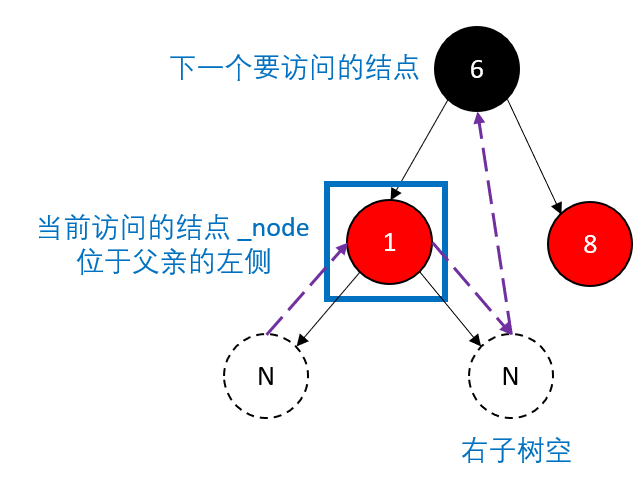
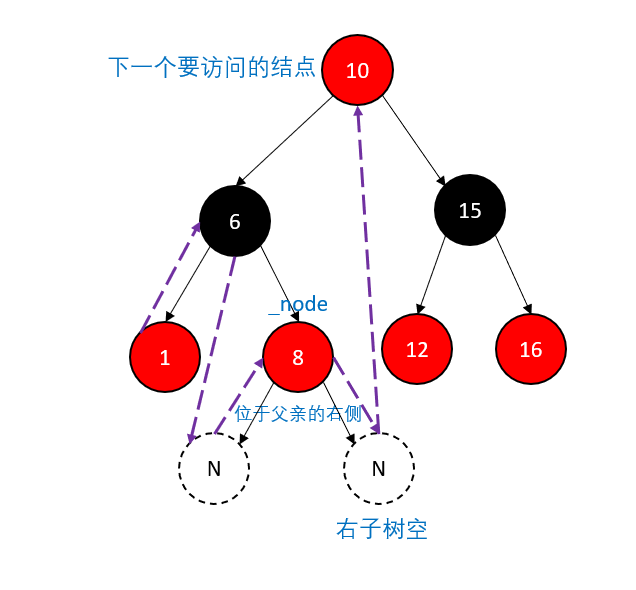
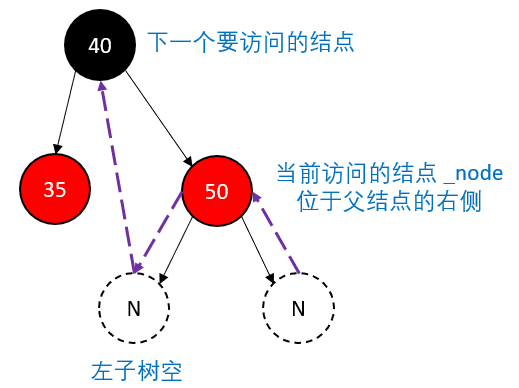
右子树为空,就说明当前这棵树访问完毕,则接下来访问的结点根据当前这棵树的位置有所不同:
如果当前这棵树是父结点的左孩子,那么根据 左 -- 根 -- 右,接下来要访问父结点
如果当前这棵树是父结点的右孩子,那么说明外层那一棵树访问完毕,接下来要访问祖父结点
迭代器的 - - 操作在实现时的思路为:
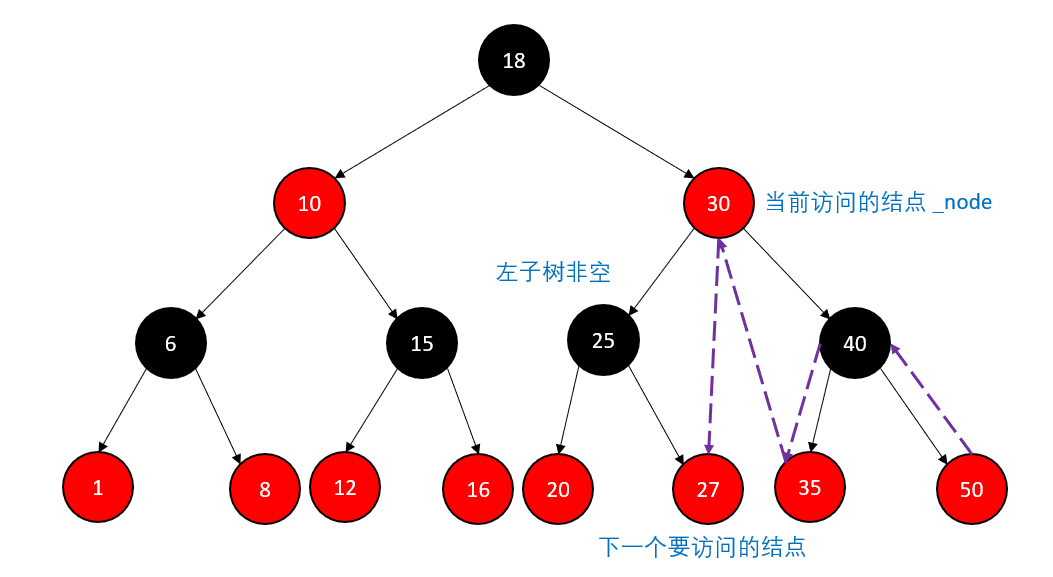
由于 -- 时进行反向遍历,因此需要按照反向的中序遍历设计,右子树 -- 根节点 -- 左子树
由于遍历红黑树到最后时,迭代器会指向空,所以 -- 在实现时,需要判断一下指针指向的是否为空结点
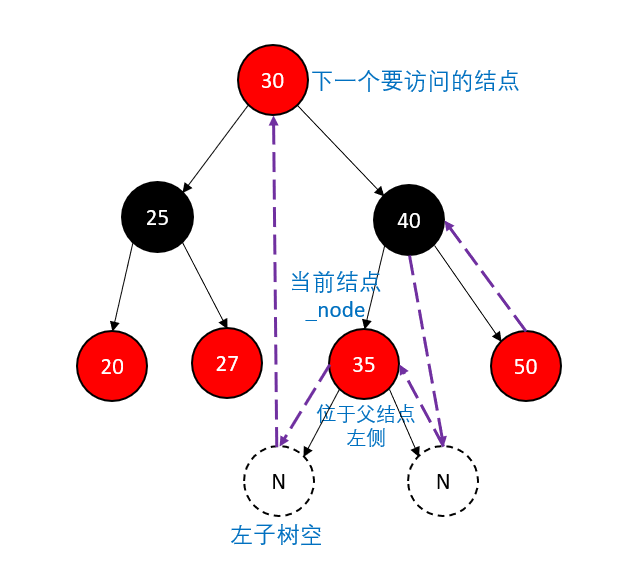
如果是空结点则需要先找到右子树中最大的结点,它是存在的最后一个结点,如果不是空结点,则假设当前访问的是根结点,接下来就要访问左子树了,对于左子树有两种情况:
左子树不为空,接下来要访问的是左子树中最大的结点,也就是左子树中最右下角的结点
左子树为空,就说明当前这棵树访问完了,接下来就要根据当前这棵树的位置来判断要访问的结点:当前这棵树是父结点的左孩子,则说明外层这棵树已经访问完,接下来要访问祖父结点
当前这棵树是父结点的右孩子,按照 右 -- 根 -- 左,接下来要访问根节点(父结点)
cpp
Self& operator++()
{
	//左 根 右
	if (_node->_right) //右子树存在,访问右子树最小结点
	{
		Node* cur = _node->_right;
		while (cur->_left)
		{
			cur = cur->_left;
		}
		_node = cur;
	}
	else //右子树不存在,当前树访问完
	{
		Node* cur = _node;
		Node* parent = cur->_parent;

		while (parent && cur == parent->_right) //当前的是右子树,要去访问祖先,是左子树访问父结点
		{
			cur = parent;
			parent = cur->_parent;
		}

		_node = parent;
	}

	return *this;
}

Self& operator--()
{
	//右 根 左
	if (!_node) //End为空,所以需要先找到最右下角结点
	{
		Node* cur = _root;
		while (cur->_right)
		{
			cur = cur->_right;
		}
		_node = cur;
	}
	else if (_node->_left) //左子树不为空,要访问左子树最大节点
	{
		Node* cur = _node->_left;
		while (cur->_right)
		{
			cur = cur->_right;
		}
		_node = cur;
	}
	else //左子树为空
	{
		Node* cur = _node;
		Node* parent = cur->_parent;

		while (parent && cur == parent->_left)
		{
			cur = parent;
			parent = cur->_parent;
		}

		_node = parent;
	}

	return *this;
}
2.3 Insert 的修改
由于库中的 map 和 set 的 Insert 返回了带有迭代器和布尔值的键值对,所以在这里要将红黑树的 Insert 的返回值修改为一个键值对,键值对中,布尔值说明插入的值是否重复,迭代器为指向保存了要插入的值的结点的迭代器
cpp
pair<iterator, bool> Insert(const T& kv)
{
	//空树,插入为根节点,黑色
	if (!_root)
	{
		_root = new Node(kv);
		_root->_color = BLACK;
		return { { _root, _root }, true };
	}

	//非空树
	Node* cur = _root;
	Node* parent = nullptr;

	//查询插入的位置
	while (cur)
	{
		if (kov(cur->_kv) < kov(kv))
		{
			parent = cur;
			cur = cur->_right;
		}
		else if (kov(cur->_kv) > kov(kv))
		{
			parent = cur;
			cur = cur->_left;
		}
		else
		{
			return { { cur, _root }, false };
		}
	}

	//插入结点
	cur = new Node(kv);
	cur->_color = RED;
	if (kov(cur->_kv) < kov(parent->_kv))
	{
		parent->_left = cur;
	}
	else if (kov(cur->_kv) > kov(parent->_kv))
	{
		parent->_right = cur;
	}
	cur->_parent = parent;
	Node* newNode = cur;

	while (parent && parent->_color == RED)
	{
		Node* grand = parent->_parent;
		Node* uncle = nullptr;

		if (parent == grand->_left)
		{
			uncle = grand->_right;
		}
		else if (parent == grand->_right)
		{
			uncle = grand->_left;
		}

		if (uncle && uncle->_color == RED) //叔为红,叔父爷换色
		{
			grand->_color = RED;
			parent->_color = BLACK;
			uncle->_color = BLACK;

			//继续向上更新
			cur = grand;
			parent = cur->_parent;
		}
		else if (!uncle || uncle->_color == BLACK) //叔不存在或为黑
		{
			if (parent == grand->_left && cur == parent->_left) //parent为grand的左,cur插入在parent的左子树中,右单旋+换色
			{
				RotateToRight(parent);
				parent->_color = BLACK;
				grand->_color = RED;
			}
			else if (parent == grand->_right && cur == parent->_right) //parent为grand的右,cur插入在parent的右子树中,左单旋+换色
			{
				RotateToLeft(parent);
				parent->_color = BLACK;
				grand->_color = RED;
			}
			else if (parent == grand->_left && cur == parent->_right) //左右双旋 + 换色
			{
				RotateToLeft(parent);
				RotateToRight(grand);
				cur->_color = BLACK;
				grand->_color = RED;
			}
			else if (parent == grand->_right && cur == parent->_left) //右左双旋 + 换色
			{
				RotateToRight(parent);
				RotateToLeft(grand);
				cur->_color = BLACK;
				grand->_color = RED;
			}

			break;
		}
	}

	_root->_color = BLACK;

	return { { newNode, _root }, true };
}
2.4 加入 Begin,End
Begin 中要返回的就是中序遍历的第一个结点,而中序遍历的第一个结点位于整棵树的最左下角,因此只需要使用指针一直向左下角遍历,直到左子树为空即可
cpp
iterator Begin()
{
	Node* cur = _root;
	while (cur && cur->_left)
	{
		cur = cur->_left;
	}

	return { cur, _root };
}

const_iterator Begin() const
{
	Node* cur = _root;
	while (cur && cur->_left)
	{
		cur = cur->_left;
	}

	return { cur, _root };
}
End 中要返回的是中序遍历的最后一个结点的下一个结点,而这个结点就是空结点,因此直接返回空指针即可
cpp
iterator End()
{
	return { nullptr, _root };
}

const_iterator End() const
{
	return { nullptr, _root };
}
2.4 修改后的红黑树
cpp
enum COLOR
{
	RED,
	BLACK
};

template<class T>
struct RBTreeNode
{
	RBTreeNode(const T& kv)
		:_kv(kv)
		,_left(nullptr)
		,_right(nullptr)
		,_parent(nullptr)
	{}

	T _kv;
	RBTreeNode<T>* _left;
	RBTreeNode<T>* _right;
	RBTreeNode<T>* _parent;
	COLOR _color;
};

template<class T, class Ref, class Ptr>
class Iterator
{
	typedef Iterator<T, Ref, Ptr> Self; //代表迭代器自身
	typedef RBTreeNode<T> Node;
public:
	Iterator(Node* node, Node* root)
		:_node(node)
		,_root(root)
	{}

	Ref operator*()
	{
		return (*_node)._kv;
	}

	Ptr operator->()
	{
		return &(_node->_kv);
	}

	bool operator==(const Self& it)
	{
		return _node == it._node;
	}

	bool operator!=(const Self& it)
	{
		return _node != it._node;
	}

	Self& operator++()
	{
		//左 根 右
		if (_node->_right) //右子树存在,访问右子树最小结点
		{
			Node* cur = _node->_right;
			while (cur->_left)
			{
				cur = cur->_left;
			}
			_node = cur;
		}
		else //右子树不存在,当前树访问完
		{
			Node* cur = _node;
			Node* parent = cur->_parent;

			while (parent && cur == parent->_right) //当前的是右子树,要去访问祖先,是左子树访问父结点
			{
				cur = parent;
				parent = cur->_parent;
			}

			_node = parent;
		}

		return *this;
	}

	Self& operator--()
	{
		//右 根 左
		if (!_node) //End为空,所以需要先找到最右下角结点
		{
			Node* cur = _root;
			while (cur->_right)
			{
				cur = cur->_right;
			}
			_node = cur;
		}
		else if (_node->_left) //左子树不为空,要访问左子树最大节点
		{
			Node* cur = _node->_left;
			while (cur->_right)
			{
				cur = cur->_right;
			}
			_node = cur;
		}
		else //左子树为空
		{
			Node* cur = _node;
			Node* parent = cur->_parent;

			while (parent && cur == parent->_left)
			{
				cur = parent;
				parent = cur->_parent;
			}

			_node = parent;
		}

		return *this;
	}
private:
	Node* _node;
	Node* _root;
};

template<class K, class T, class KeyofValue>
class RBTree
{
	typedef RBTreeNode<T> Node;
	KeyofValue kov;
public:
	typedef Iterator<T, T&, T*> iterator; //普通迭代器
	typedef Iterator<T, const T&, const T*> const_iterator; //const迭代器

	iterator Begin()
	{
		Node* cur = _root;
		while (cur && cur->_left)
		{
			cur = cur->_left;
		}

		return { cur, _root };
	}

	const_iterator Begin() const
	{
		Node* cur = _root;
		while (cur && cur->_left)
		{
			cur = cur->_left;
		}

		return { cur, _root };
	}

	iterator End()
	{
		return { nullptr, _root };
	}

	const_iterator End() const
	{
		return { nullptr, _root };
	}

	pair<iterator, bool> Insert(const T& kv)
	{
		//空树,插入为根节点,黑色
		if (!_root)
		{
			_root = new Node(kv);
			_root->_color = BLACK;
			return { { _root, _root }, true };
		}

		//非空树
		Node* cur = _root;
		Node* parent = nullptr;

		//查询插入的位置
		while (cur)
		{
			if (kov(cur->_kv) < kov(kv))
			{
				parent = cur;
				cur = cur->_right;
			}
			else if (kov(cur->_kv) > kov(kv))
			{
				parent = cur;
				cur = cur->_left;
			}
			else
			{
				return { { cur, _root }, false };
			}
		}

		//插入结点
		cur = new Node(kv);
		cur->_color = RED;
		if (kov(cur->_kv) < kov(parent->_kv))
		{
			parent->_left = cur;
		}
		else if (kov(cur->_kv) > kov(parent->_kv))
		{
			parent->_right = cur;
		}
		cur->_parent = parent;
		Node* newNode = cur;

		while (parent && parent->_color == RED)
		{
			Node* grand = parent->_parent;
			Node* uncle = nullptr;

			if (parent == grand->_left)
			{
				uncle = grand->_right;
			}
			else if (parent == grand->_right)
			{
				uncle = grand->_left;
			}

			if (uncle && uncle->_color == RED) //叔为红,叔父爷换色
			{
				grand->_color = RED;
				parent->_color = BLACK;
				uncle->_color = BLACK;

				//继续向上更新
				cur = grand;
				parent = cur->_parent;
			}
			else if (!uncle || uncle->_color == BLACK) //叔不存在或为黑
			{
				if (parent == grand->_left && cur == parent->_left) //parent为grand的左,cur插入在parent的左子树中,右单旋+换色
				{
					RotateToRight(parent);
					parent->_color = BLACK;
					grand->_color = RED;
				}
				else if (parent == grand->_right && cur == parent->_right) //parent为grand的右,cur插入在parent的右子树中,左单旋+换色
				{
					RotateToLeft(parent);
					parent->_color = BLACK;
					grand->_color = RED;
				}
				else if (parent == grand->_left && cur == parent->_right) //左右双旋 + 换色
				{
					RotateToLeft(parent);
					RotateToRight(grand);
					cur->_color = BLACK;
					grand->_color = RED;
				}
				else if (parent == grand->_right && cur == parent->_left) //右左双旋 + 换色
				{
					RotateToRight(parent);
					RotateToLeft(grand);
					cur->_color = BLACK;
					grand->_color = RED;
				}

				break;
			}
		}

		_root->_color = BLACK;

		return { { newNode, _root }, true };
	}
private:
	//右单旋
	void RotateToRight(Node* parent)
	{
		Node* subL = parent->_left;
		Node* subLR = subL->_right;
		Node* grandParent = parent->_parent;

		//更新子树
		subL->_right = parent;
		parent->_left = subLR;
		parent->_parent = subL;
		if (subLR)
			subLR->_parent = parent;

		if (parent == _root) //父结点是根节点,更新根节点
		{
			_root = subL;
			subL->_parent = nullptr;
		}
		else //如果父结点不是根节点,那么要更新组父结点
		{
			subL->_parent = grandParent;
			if (grandParent->_left == parent)
			{
				grandParent->_left = subL;
			}
			else if (grandParent->_right == parent)
			{
				grandParent->_right = subL;
			}
		}
	}

	//左单旋
	void RotateToLeft(Node* parent)
	{
		Node* subR = parent->_right;
		Node* subRL = subR->_left;
		Node* grandParent = parent->_parent;

		//更新子树
		subR->_left = parent;
		parent->_right = subRL;
		parent->_parent = subR;
		if (subRL)
			subRL->_parent = parent;

		if (parent == _root)  //父结点是根节点,更新根节点
		{
			_root = subR;
			subR->_parent = nullptr;
		}
		else  //如果父结点不是根节点,那么要更新组父结点
		{
			subR->_parent = grandParent;
			if (grandParent->_left == parent)
			{
				grandParent->_left = subR;
			}
			else if (grandParent->_right == parent)
			{
				grandParent->_right = subR;
			}
		}
	}

	Node* _root = nullptr;
};
3 set 的模拟实现
set 通过封装红黑树的方式来进行实现
3.1 Begin,End,Insert
由于红黑树中已经实现了 Begin,End,Insert 这些函数,所以在实现 Set 时直接复用即可
cpp
iterator Begin()
{
	return _tree.Begin();
}

const_iterator Begin() const
{
	return _tree.Begin();
}

iterator End()
{
	return _tree.End();
}

const_iterator End()
{
	return _tree.End();
}

pair<iterator, bool> Insert(const K& key)
{
	return _tree.Insert(key);
}
3.2 KeyofValue
对于 KeyofValue 仿函数,由于 set 中存储的值可以直接拿来作比较,所以在 KeyofValue 中直接返回传入的值即可
cpp
class KeyofValue
{
	K& operator()(const K& key)
	{
		return key;
	}
};
3.3 对值的限制
由于 set 不支持对存储的值进行修改,一旦进行修改,则结构就会被破坏,所以要给 set 中封装的红黑树的第二个模板参数加上 const
cpp
RBTree<K, const K, KeyofValue> _tree;3.4 Set 的代码
cpp
template<class K>
class set
{
	class KeyofValue
	{
		K& operator()(const K& key)
		{
			return key;
		}
	};
public:
	typedef typename RBTree<K, const K, KeyofValue>::iterator iterator;
	typedef typename RBTree<K, const K, KeyofValue>::const_iterator const_iterator;

	iterator Begin()
	{
		return _tree.Begin();
	}

	const_iterator Begin() const
	{
		return _tree.Begin();
	}

	iterator End()
	{
		return _tree.End();
	}

	const_iterator End()
	{
		return _tree.End();
	}

	pair<iterator, bool> Insert(const K& key)
	{
		return _tree.Insert(key);
	}
private:
	RBTree<K, const K, KeyofValue> _tree;
};
4 map 的模拟实现
map 通过封装红黑树的方式来进行实现
4.1 Begin,End,Insert
map 在实现 End,Begin,Insert 时,直接复用红黑树的即可
cpp
iterator Begin()
{
	return _tree.Begin();
}

const_iterator Begin() const
{
	return _tree.Begin();
}

iterator End()
{
	return _tree.End();
}

const_iterator End() const
{
	return _tree.End();
}

pair<iterator, bool> Insert(const pair<const K, V>& kv)
{
	return _tree.Insert(kv);
}
4.2 KeyofValue
对于 KeyofValue 仿函数,由于 map 存储的是键值对 pair,所以要取出它的 key 来进行比较,KeyofValue 中需要返回 pair 中的 key 值
cpp
class KeyofValue
{
	const K& operator()(const pair<const K, V>& kv)
	{
		return kv.first;
	}
};
4.3 \[\] 重载
库中 map 的 \[\] 重载既可以根据给入的 Key 来进行插入,也可以进行更新、查找,为了实现这个功能,需要复用红黑树的 Insert 函数,在外部传入 Key 后,通过 Insert 先来做查找,如果找到了值与 Key 相同的结点,就意味着不需要进行插入,直接返回 pair,如果没有找到则需要进行插入,插入完后仍然返回一个 pair,pair 内是该结点的迭代器和一个布尔类型的值,布尔值为 false 代表插入失败,已经有相同的值了,为 true 则表示插入成功,接下来再通过 pair 内的迭代器,取出结点中的 Value 并返回它的引用,这样就可以做到对 Value 进行修改
cpp
V& operator[](const K& key)
{
	pair<iterator, bool> ret = Insert({ key, V() });
	//ret.first.operator->()->second
	return ret.first->second;
}
4.5 对值的限制
在 map 中,pair 内存储了 Key/Value 的键值对,其中 Key 是不允许修改的,修改后就会破坏结构,所以需要给 map 中封装的红黑树的第二个模板参数 pair 内的 Key 加上 const
4.6 Map 的代码
cpp
template<class K, class V>
class map
{
	class KeyofValue
	{
		const K& operator()(const pair<const K, V>& kv)
		{
			return kv.first;
		}
	};
public:
	typedef typename RBTree<K, pair<const K, V>, KeyofValue>::iterator iterator;
	typedef typename RBTree<K, pair<const K, V>, KeyofValue>::const_iterator const_iterator;

	iterator Begin()
	{
		return _tree.Begin();
	}

	const_iterator Begin() const
	{
		return _tree.Begin();
	}

	iterator End()
	{
		return _tree.End();
	}

	const_iterator End() const
	{
		return _tree.End();
	}

	pair<iterator, bool> Insert(const pair<const K, V>& kv)
	{
		return _tree.Insert(kv);
	}

	V& operator[](const K& key)
	{
		pair<iterator, bool> ret = Insert({ key, V() });
		//ret.first.operator->()
		return ret.first->second;
	}
private:
	RBTree<K, pair<const K, V>, KeyofValue> _tree;
};