一、Route控制器架构总览
1. 什么是Route控制器?
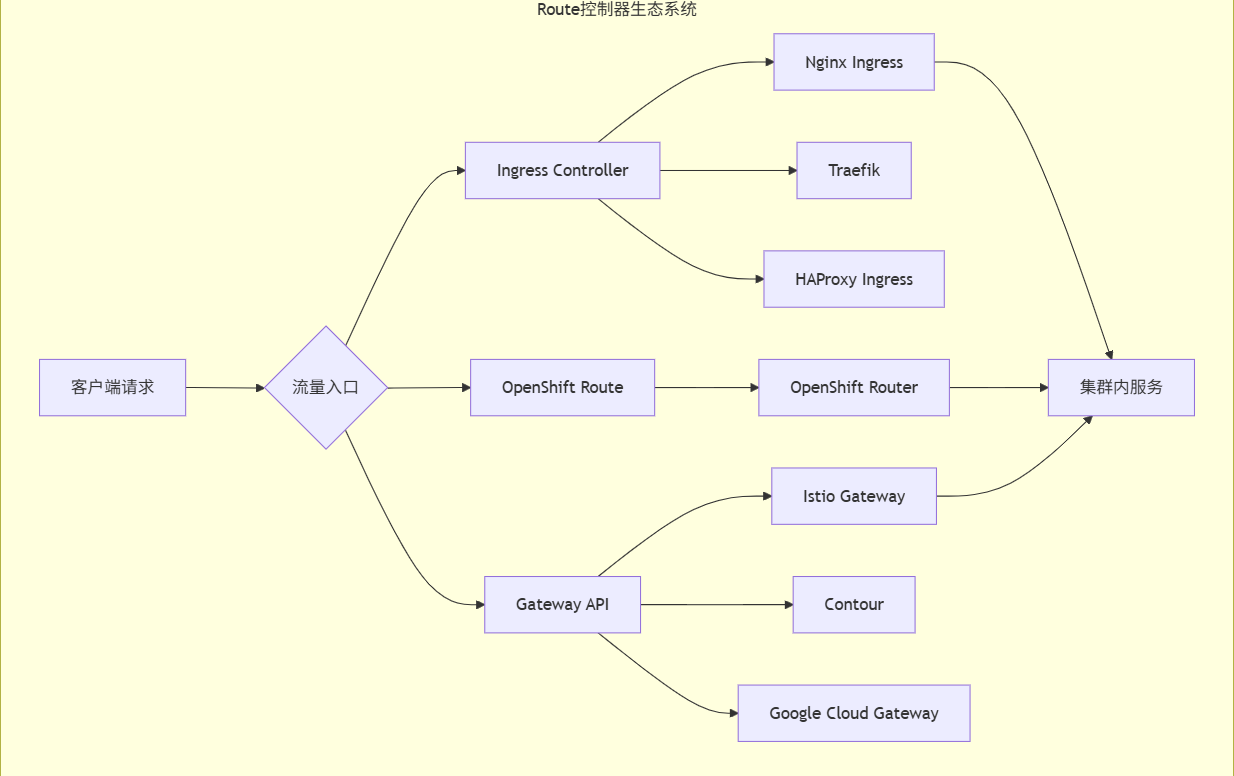
在Kubernetes生态中,Route控制器 通常指代实现外部流量路由到集群内部服务的组件。它主要包含两种实现:
-
Ingress Controller:Kubernetes原生解决方案
-
OpenShift Route:Red Hat OpenShift扩展实现
-
Gateway API Controllers:新一代标准
二、Ingress Controller深度解析
1. Ingress Controller架构原理
// Ingress Controller核心架构
type IngressController struct {
    // 1. 监听器
    kubernetesClient clientset.Interface
    informerFactory  informers.SharedInformerFactory
    ingressInformer  cache.SharedIndexInformer
    serviceInformer  cache.SharedIndexInformer
    endpointInformer cache.SharedIndexInformer

    // 2. 队列系统
    workqueue        workqueue.RateLimitingInterface

    // 3. 配置生成器
    configGenerator  ConfigGenerator

    // 4. 代理管理器
    proxyManager     ProxyManager

    // 5. 状态同步器
    statusSyncer     StatusSyncer
}
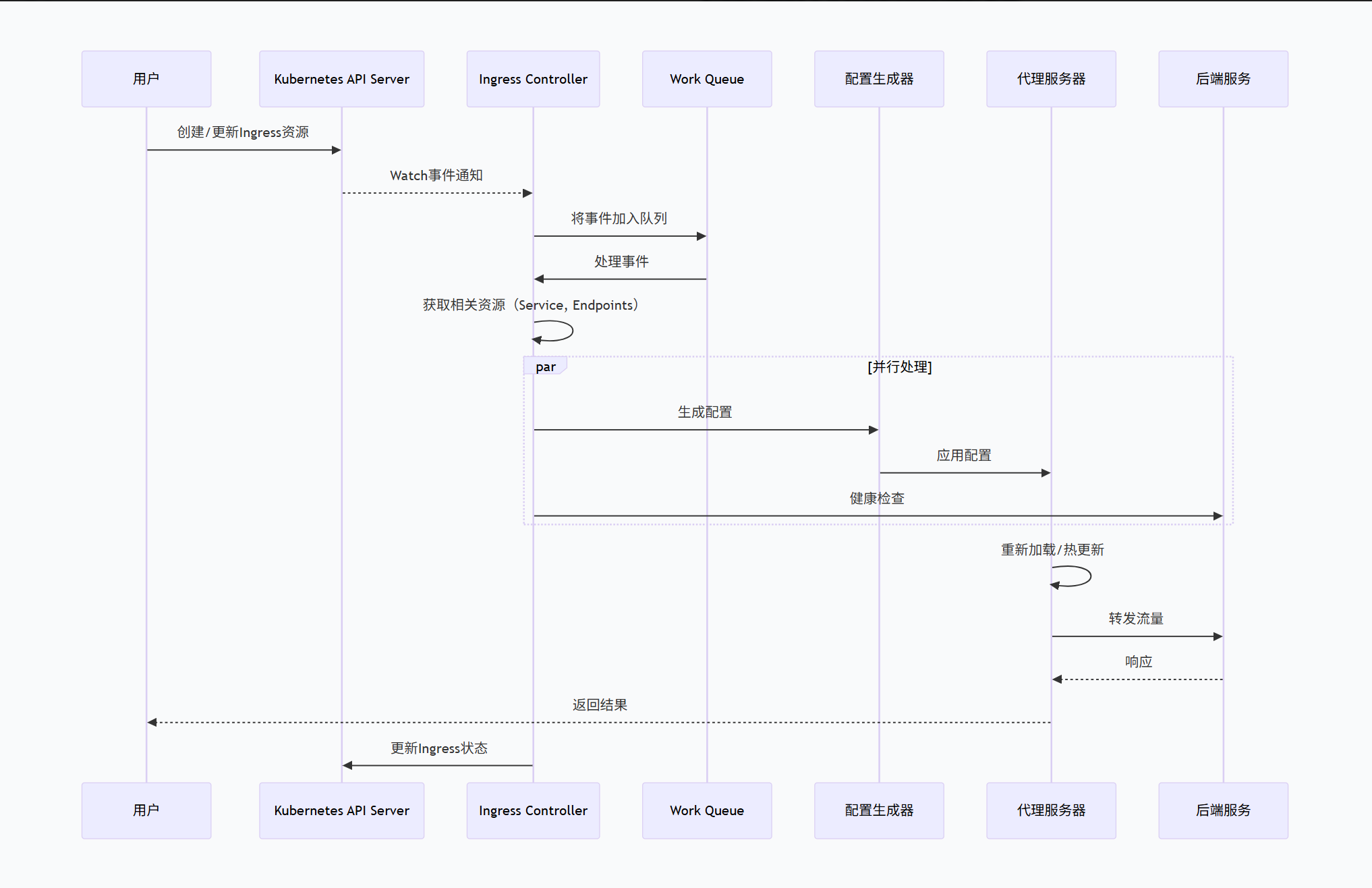
2. Ingress Controller工作流程
3. Nginx Ingress Controller实现细节
(1) 核心循环
// Nginx Ingress Controller主循环
func (n *NGINXController) syncIngress(key string) error {
    // 1. 从队列获取事件
    namespace, name, err := cache.SplitMetaNamespaceKey(key)

    // 2. 获取Ingress对象
    ingress, err := n.ingressLister.Ingresses(namespace).Get(name)

    // 3. 验证Ingress
    if !n.isValidIngress(ingress) {
        return fmt.Errorf("invalid ingress")
    }

    // 4. 获取相关资源
    service, err := n.getService(ingress)
    endpoints, err := n.getEndpoints(ingress)
    secret, err := n.getTLSSecret(ingress)

    // 5. 生成Nginx配置
    config := n.generateNginxConfig(ingress, service, endpoints, secret)

    // 6. 更新Nginx
    if n.configChanged(config) {
        // 写入配置文件
        n.writeConfig(config)

        // 测试配置
        if err := n.testConfig(); err != nil {
            n.rollbackConfig()
            return err
        }

        // 重载Nginx
        n.reloadNginx()
    }

    // 7. 更新状态
    n.updateIngressStatus(ingress)

    return nil
}
(2) 配置生成
// Nginx配置生成逻辑
func (n *NGINXController) generateNginxConfig(ingress *networkingv1.Ingress, service *v1.Service, endpoints *v1.Endpoints, secret *v1.Secret) NginxConfig {
    config := NginxConfig{}

    // 1. 生成Upstream配置
    config.Upstreams = n.generateUpstreams(service, endpoints)

    // 2. 生成Server配置
    for _, rule := range ingress.Spec.Rules {
        server := NginxServer{
            Host: rule.Host,
            SSL:  false,
        }

        // TLS配置
        for _, tls := range ingress.Spec.TLS {
            if contains(tls.Hosts, rule.Host) {
                server.SSL = true
                server.SSLCertificate = n.getCertificatePath(secret)
                server.SSLCertificateKey = n.getPrivateKeyPath(secret)
                break
            }
        }

        // Location配置
        for _, path := range rule.HTTP.Paths {
            location := NginxLocation{
                Path:     path.Path,
                PathType: *path.PathType,
                Upstream: path.Backend.Service.Name,
            }

            // 应用注解
            if rewrite, ok := ingress.Annotations["nginx.ingress.kubernetes.io/rewrite-target"]; ok {
                location.Rewrite = rewrite
            }

            // 限流配置
            if limit, ok := ingress.Annotations["nginx.ingress.kubernetes.io/limit-rps"]; ok {
                location.RateLimit = limit
            }

            server.Locations = append(server.Locations, location)
        }

        config.Servers = append(config.Servers, server)
    }

    // 3. 全局配置
    config.GlobalConfig = n.getGlobalConfig(ingress)

    return config
}
(3) Nginx配置模板
# 生成的Nginx配置示例
# nginx.conf

events {
    worker_connections 1024;
    use epoll;
}

http {
    # 全局配置
    include /etc/nginx/mime.types;
    default_type application/octet-stream;

    # Upstream配置
    upstream my-service {
        least_conn;
        server 10.244.1.3:8080 max_fails=3 fail_timeout=30s;
        server 10.244.1.4:8080 max_fails=3 fail_timeout=30s;
        server 10.244.1.5:8080 max_fails=3 fail_timeout=30s;

        # 健康检查
        check interval=3000 rise=2 fall=5 timeout=1000;
    }

    # Server配置
    server {
        listen 80;
        server_name api.example.com;

        # 重定向到HTTPS
        return 301 https://$server_name$request_uri;
    }

    server {
        listen 443 ssl http2;
        server_name api.example.com;

        # SSL证书
        ssl_certificate /etc/nginx/ssl/tls.crt;
        ssl_certificate_key /etc/nginx/ssl/tls.key;
        ssl_protocols TLSv1.2 TLSv1.3;

        # Location配置
        location /v1/users {
            proxy_pass http://my-service;
            proxy_set_header Host $host;
            proxy_set_header X-Real-IP $remote_addr;
            proxy_set_header X-Forwarded-For $proxy_add_x_forwarded_for;
            proxy_set_header X-Forwarded-Proto $scheme;

            # 连接超时
            proxy_connect_timeout 5s;
            proxy_read_timeout 60s;
            proxy_send_timeout 60s;

            # 缓冲
            proxy_buffering on;
            proxy_buffer_size 4k;
            proxy_buffers 8 4k;

            # 限流
            limit_req zone=mylimit burst=10 nodelay;
        }

        location /health {
            access_log off;
            return 200 "healthy\n";
        }
    }
}
4. Traefik Ingress Controller实现
(1) Traefik架构特点
// Traefik动态配置管理
type TraefikController struct {
    // Provider系统
    providers []Provider

    // 配置聚合
    configurationChan chan dynamic.Message

    // 路由器
    routerManager RouterManager

    // 中间件链
    middlewareChain MiddlewareChain
}

// Provider接口
type Provider interface {
    Provide(configurationChan chan<- dynamic.Message) error
}

// Kubernetes Provider实现
type KubernetesProvider struct {
    kubernetesClient kubernetes.Interface
    ingressClasses   []string
    watchNamespaces  []string
}

func (k *KubernetesProvider) Provide(configurationChan chan<- dynamic.Message) error {
    // 监视Ingress、Service、Endpoint等资源
    // 生成Traefik配置

    config := dynamic.Config{
        HTTP: &dynamic.HTTPConfiguration{
            Routers:     make(map[string]*dynamic.Router),
            Services:    make(map[string]*dynamic.Service),
            Middlewares: make(map[string]*dynamic.Middleware),
        },
        TCP: &dynamic.TCPConfiguration{},
    }

    // 构建路由
    for _, ingress := range ingresses {
        routerName := fmt.Sprintf("%s-%s", ingress.Namespace, ingress.Name)

        config.HTTP.Routers[routerName] = &dynamic.Router{
            EntryPoints: []string{"web", "websecure"},
            Rule:        buildRule(ingress),
            Service:     ingress.Spec.Rules[0].HTTP.Paths[0].Backend.Service.Name,
            Middlewares: getMiddlewares(ingress),
            TLS:         buildTLSConfig(ingress),
        }
    }

    // 发送配置更新
    configurationChan <- dynamic.Message{
        ProviderName:  "kubernetes",
        Configuration: config,
    }

    return nil
}
(2) Traefik配置示例
# Traefik动态配置(YAML格式)
http:
  routers:
    myapp-router:
      rule: "Host(`api.example.com`) && PathPrefix(`/api`)"
      service: myapp-service
      middlewares:
        - rate-limit
        - auth
      tls:
        certResolver: letsencrypt

  services:
    myapp-service:
      loadBalancer:
        servers:
          - url: "http://10.244.1.3:8080"
          - url: "http://10.244.1.4:8080"
        healthCheck:
          path: "/health"
          interval: "30s"

  middlewares:
    rate-limit:
      rateLimit:
        average: 100
        burst: 50
    auth:
      forwardAuth:
        address: "http://auth-service.default.svc.cluster.local:8080"
        trustForwardHeader: true

tcp:
  routers:
    mysql-router:
      rule: "HostSNI(`mysql.example.com`)"
      service: mysql-service
      tls: true

  services:
    mysql-service:
      loadBalancer:
        servers:
          - address: "10.244.2.10:3306"
三、OpenShift Route控制器详解
1. OpenShift Route架构
// OpenShift Router控制器架构
type OpenShiftRouter struct {
    // 1. 客户端
    openshiftClient openshiftclient.Interface

    // 2. 监听器
    routeLister     routev1listers.RouteLister
    routeSynced     cache.InformerSynced

    // 3. HAProxy管理器
    haproxyManager  HAProxyManager

    // 4. 证书管理器
    certManager     CertificateManager

    // 5. 状态管理器
    statusManager   RouteStatusManager
}

// HAProxy管理器
type HAProxyManager struct {
    configDir      string
    templateDir    string
    pidFile        string
    reloadStrategy ReloadStrategy
}

// 重载策略
type ReloadStrategy string

const (
    ReloadStrategyDaemon    ReloadStrategy = "daemon"     // 使用HAProxy守护进程
    ReloadStrategySocket    ReloadStrategy = "socket"     // 使用Runtime API
    ReloadStrategyContainer ReloadStrategy = "container"  // 重启容器
)
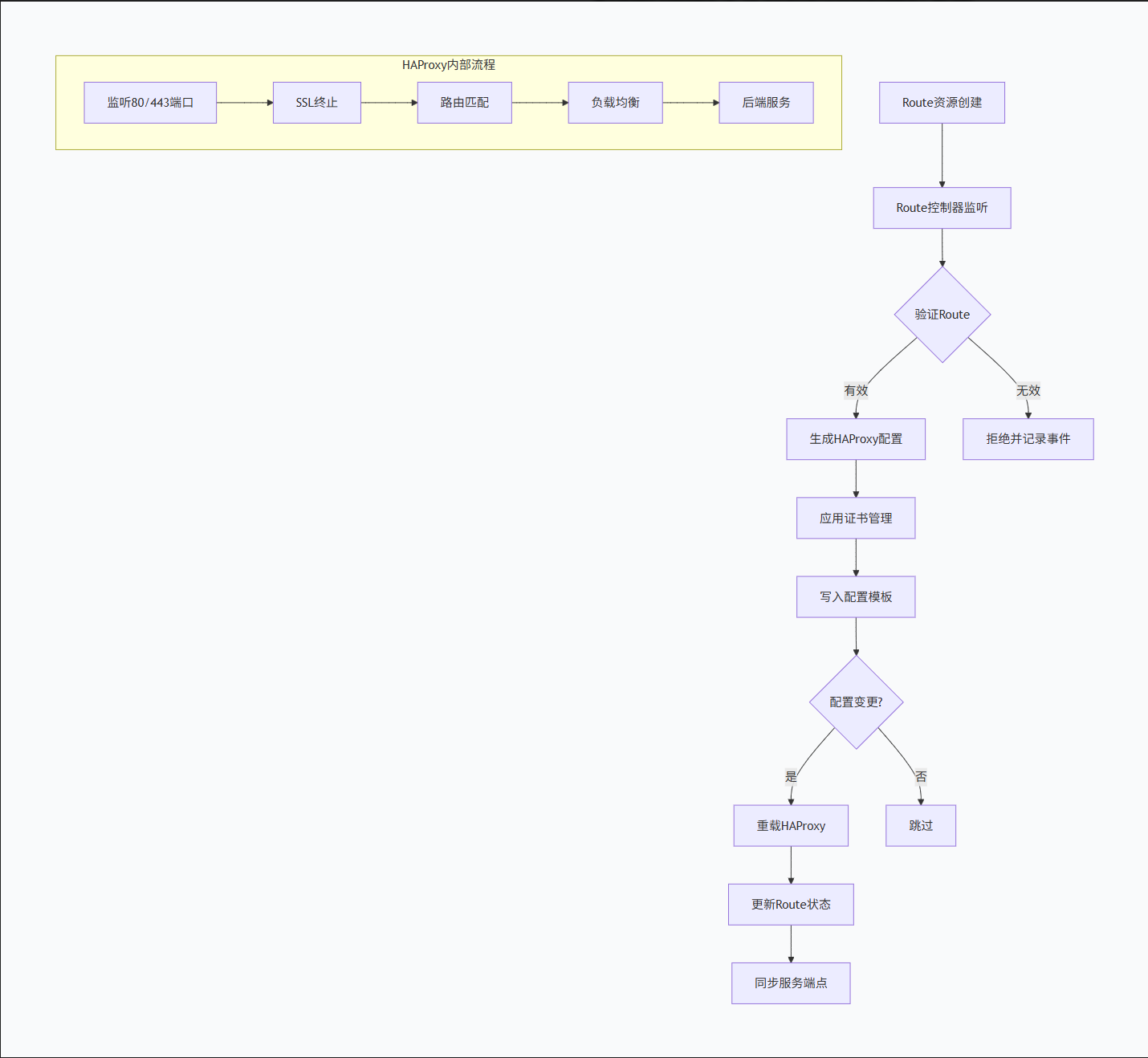
2. OpenShift Route工作流程
3. Route配置生成
// Route到HAProxy配置转换
func (r *OpenShiftRouter) generateHAProxyConfig(route *routev1.Route, endpoints []string) HAProxyConfig {
    config := HAProxyConfig{}

    // 1. 前端配置
    frontend := HAProxyFrontend{
        Name:        route.Name,
        BindAddress: ":80",
        Mode:        "http",
    }

    // 如果是TLS路由
    if route.Spec.TLS != nil {
        frontend.BindAddress = ":443 ssl crt /var/lib/haproxy/certs/"

        switch route.Spec.TLS.Termination {
        case routev1.TLSTerminationEdge:
            // 边缘终止
            frontend.SSLOptions = "no-sslv3 no-tlsv10 no-tlsv11"
        case routev1.TLSTerminationPassthrough:
            // 透传模式
            frontend.Mode = "tcp"
        case routev1.TLSTerminationReencrypt:
            // 重新加密
            frontend.SSLOptions = "verify required ca-file /etc/ssl/certs/ca-bundle.crt"
        }
    }

    // 2. 后端配置
    backend := HAProxyBackend{
        Name:       route.Name,
        Balance:    "roundrobin",
        Mode:       "http",
    }

    for _, endpoint := range endpoints {
        backend.Servers = append(backend.Servers, HAProxyServer{
            Name:    endpoint,
            Address: endpoint,
            Check:   true,
        })
    }

    // 3. 路由规则
    rule := ""

    // 基于主机的路由
    if route.Spec.Host != "" {
        rule += fmt.Sprintf("hdr(host) -i %s", route.Spec.Host)
    }

    // 基于路径的路由
    if route.Spec.Path != "" {
        rule += fmt.Sprintf(" path_beg %s", route.Spec.Path)
    }

    config.Frontends = append(config.Frontends, frontend)
    config.Backends = append(config.Backends, backend)
    config.ACLs = append(config.ACLs, HAProxyACL{
        Name:  route.Name,
        Rule:  rule,
        Use:   "backend " + backend.Name,
    })

    return config
}
4. OpenShift Router示例配置
# OpenShift Route资源
apiVersion: route.openshift.io/v1
kind: Route
metadata:
  name: myapp-route
  namespace: myapp
  annotations:
    haproxy.router.openshift.io/balance: roundrobin
    haproxy.router.openshift.io/ip_whitelist: 192.168.1.0/24
    haproxy.router.openshift.io/timeout: 2m
spec:
  host: myapp.example.com
  path: /api
  to:
    kind: Service
    name: myapp-service
    weight: 100
  port:
    targetPort: 8080
  tls:
    termination: edge
    certificate: |
      -----BEGIN CERTIFICATE-----
      MIIE...
      -----END CERTIFICATE-----
    key: |
      -----BEGIN PRIVATE KEY-----
      MIIJ...
      -----END PRIVATE KEY-----
    insecureEdgeTerminationPolicy: Redirect
  wildcardPolicy: None
四、Gateway API控制器
1. Gateway API架构
// Gateway API控制器架构
type GatewayAPIController struct {
    // 1. Gateway API客户端
    gatewayClient gatewayclient.Interface

    // 2. 网关类管理器
    gatewayClassManager GatewayClassManager

    // 3. 网关管理器
    gatewayManager GatewayManager

    // 4. 路由管理器
    routeManager RouteManager

    // 5. 状态协调器
    statusReconciler StatusReconciler
}

// Gateway管理器
type GatewayManager struct {
    gatewayLister   gatewayv1beta1listers.GatewayLister
    gatewayClasses  map[string]*gatewayv1beta1.GatewayClass
    implementation  GatewayImplementation
}

// Gateway实现接口
type GatewayImplementation interface {
    CreateGateway(gateway *gatewayv1beta1.Gateway) error
    UpdateGateway(old, new *gatewayv1beta1.Gateway) error
    DeleteGateway(gateway *gatewayv1beta1.Gateway) error
    GetGatewayStatus(gateway *gatewayv1beta1.Gateway) (gatewayv1beta1.GatewayStatus, error)
}
2. Gateway API工作流程
// Gateway API控制器协调循环
func (c *GatewayAPIController) reconcileGateway(key string) error {
    // 1. 解析key
    namespace, name, err := cache.SplitMetaNamespaceKey(key)

    // 2. 获取Gateway
    gateway, err := c.gatewayLister.Gateways(namespace).Get(name)

    // 3. 验证GatewayClass
    gatewayClass, err := c.validateGatewayClass(gateway.Spec.GatewayClassName)

    // 4. 检查控制器是否负责此GatewayClass
    if gatewayClass.Spec.ControllerName != c.controllerName {
        return nil // 不处理
    }

    // 5. 获取关联的HTTPRoutes
    httpRoutes, err := c.getHTTPRoutesForGateway(gateway)

    // 6. 生成基础设施配置
    infraConfig := c.generateInfrastructureConfig(gateway, httpRoutes)

    // 7. 调用实现层
    if gateway.DeletionTimestamp != nil {
        // 删除网关
        err = c.implementation.DeleteGateway(gateway)
    } else {
        // 创建或更新网关
        if c.gatewayExists(gateway) {
            err = c.implementation.UpdateGateway(c.getExistingGateway(gateway), gateway)
        } else {
            err = c.implementation.CreateGateway(gateway)
        }
    }

    // 8. 更新Gateway状态
    status, err := c.implementation.GetGatewayStatus(gateway)
    c.updateGatewayStatus(gateway, status)

    // 9. 更新HTTPRoute状态
    c.updateHTTPRouteStatuses(httpRoutes, gateway)

    return nil
}
3. Gateway API配置示例
# Gateway API配置示例
apiVersion: gateway.networking.k8s.io/v1beta1
kind: GatewayClass
metadata:
  name: istio
spec:
  controllerName: istio.io/gateway-controller
  description: "Istio GatewayClass"
  parametersRef:
    group: networking.istio.io
    kind: IstioGatewayClassParameters
    name: default-parameters

---
apiVersion: gateway.networking.k8s.io/v1beta1
kind: Gateway
metadata:
  name: internet-gateway
  namespace: default
spec:
  gatewayClassName: istio
  listeners:
  - name: http
    port: 80
    protocol: HTTP
    allowedRoutes:
      namespaces:
        from: All
  - name: https
    port: 443
    protocol: HTTPS
    tls:
      mode: Terminate
      certificateRefs:
      - name: wildcard-cert
    allowedRoutes:
      namespaces:
        from: Same

---
apiVersion: gateway.networking.k8s.io/v1beta1
kind: HTTPRoute
metadata:
  name: http-app-route
  namespace: app
spec:
  parentRefs:
  - name: internet-gateway
    namespace: default
    port: 443
  hostnames:
  - "app.example.com"
  rules:
  - matches:
    - path:
        type: PathPrefix
        value: /api
    filters:
    - type: RequestHeaderModifier
      requestHeaderModifier:
        add:
        - name: X-API-Version
          value: "v2"
    backendRefs:
    - name: api-service
      port: 8080
      weight: 90
    - name: api-service-v2
      port: 8080
      weight: 10
五、Route控制器的核心功能实现
1. 负载均衡算法实现
// 负载均衡器接口
type LoadBalancer interface {
    Next(endpoints []Endpoint) Endpoint
    Name() string
}

// 轮询负载均衡
type RoundRobinLoadBalancer struct {
    currentIndex int
    mu           sync.Mutex
}

func (rr *RoundRobinLoadBalancer) Next(endpoints []Endpoint) Endpoint {
    rr.mu.Lock()
    defer rr.mu.Unlock()

    if len(endpoints) == 0 {
        return Endpoint{}
    }

    endpoint := endpoints[rr.currentIndex]
    rr.currentIndex = (rr.currentIndex + 1) % len(endpoints)

    return endpoint
}

// 最少连接负载均衡
type LeastConnLoadBalancer struct {
    connectionCount map[string]int64
    mu              sync.RWMutex
}

func (lc *LeastConnLoadBalancer) Next(endpoints []Endpoint) Endpoint {
    lc.mu.RLock()
    defer lc.mu.RUnlock()

    if len(endpoints) == 0 {
        return Endpoint{}
    }

    var minEndpoint Endpoint
    var minCount int64 = math.MaxInt64

    for _, endpoint := range endpoints {
        count := lc.connectionCount[endpoint.Address]
        if count < minCount {
            minCount = count
            minEndpoint = endpoint
        }
    }

    // 更新连接数
    go func() {
        lc.mu.Lock()
        lc.connectionCount[minEndpoint.Address]++
        lc.mu.Unlock()
    }()

    return minEndpoint
}

// 加权轮询负载均衡
type WeightedRoundRobinLoadBalancer struct {
    currentWeight int
    gcdWeight     int
    maxWeight     int
    currentIndex  int
}

func (wrr *WeightedRoundRobinLoadBalancer) Next(endpoints []Endpoint) Endpoint {
    for {
        wrr.currentIndex = (wrr.currentIndex + 1) % len(endpoints)
        if wrr.currentIndex == 0 {
            wrr.currentWeight = wrr.currentWeight - wrr.gcdWeight
            if wrr.currentWeight <= 0 {
                wrr.currentWeight = wrr.maxWeight
                if wrr.currentWeight == 0 {
                    return Endpoint{}
                }
            }
        }

        if endpoints[wrr.currentIndex].Weight >= wrr.currentWeight {
            return endpoints[wrr.currentIndex]
        }
    }
}
2. 健康检查实现
// 健康检查器
type HealthChecker struct {
    checkInterval time.Duration
    timeout       time.Duration
    checkers      map[string]Checker
    results       map[string]HealthStatus
    mu            sync.RWMutex
}

// 健康检查接口
type Checker interface {
    Check(endpoint Endpoint) (bool, error)
    Type() string
}

// HTTP健康检查
type HTTPHealthChecker struct {
    path   string
    method string
    client *http.Client
}

func (h *HTTPHealthChecker) Check(endpoint Endpoint) (bool, error) {
    url := fmt.Sprintf("http://%s%s", endpoint.Address, h.path)

    req, err := http.NewRequest(h.method, url, nil)
    if err != nil {
        return false, err
    }

    resp, err := h.client.Do(req)
    if err != nil {
        return false, err
    }
    defer resp.Body.Close()

    return resp.StatusCode >= 200 && resp.StatusCode < 300, nil
}

// TCP健康检查
type TCPHealthChecker struct {
    timeout time.Duration
}

func (t *TCPHealthChecker) Check(endpoint Endpoint) (bool, error) {
    conn, err := net.DialTimeout("tcp", endpoint.Address, t.timeout)
    if err != nil {
        return false, err
    }
    defer conn.Close()

    return true, nil
}

// 健康检查管理器
func (hc *HealthChecker) Run() {
    ticker := time.NewTicker(hc.checkInterval)
    defer ticker.Stop()

    for range ticker.C {
        hc.performChecks()
    }
}

func (hc *HealthChecker) performChecks() {
    hc.mu.Lock()
    defer hc.mu.Unlock()

    for endpointID, checker := range hc.checkers {
        go func(id string, c Checker) {
            endpoint := hc.getEndpoint(id)
            healthy, err := c.Check(endpoint)

            hc.mu.Lock()
            if healthy {
                hc.results[id] = HealthStatus{
                    Healthy:   true,
                    Timestamp: time.Now(),
                }
            } else {
                hc.results[id] = HealthStatus{
                    Healthy:   false,
                    Error:     err.Error(),
                    Timestamp: time.Now(),
                }
            }
            hc.mu.Unlock()
        }(endpointID, checker)
    }
}
3. 证书管理
// 证书管理器
type CertificateManager struct {
    cache      map[string]*tls.Certificate
    secrets    map[string]*v1.Secret
    watchNames []string
    mu         sync.RWMutex
}

// 证书自动续期
func (cm *CertificateManager) autoRenew() {
    ticker := time.NewTicker(1 * time.Hour)
    defer ticker.Stop()

    for range ticker.C {
        cm.checkAndRenewCertificates()
    }
}

func (cm *CertificateManager) checkAndRenewCertificates() {
    cm.mu.RLock()
    defer cm.mu.RUnlock()

    for secretName, cert := range cm.cache {
        // 检查证书是否快要过期
        if cm.isCertificateExpiring(cert, 30*24*time.Hour) { // 30天
            go cm.renewCertificate(secretName)
        }
    }
}

// 证书发现和加载
func (cm *CertificateManager) discoverCertificates() error {
    // 从Kubernetes Secrets加载证书
    secrets, err := cm.kubernetesClient.CoreV1().Secrets("").List(context.TODO(), metav1.ListOptions{
        LabelSelector: "cert-manager.io/certificate-name",
    })

    if err != nil {
        return err
    }

    for _, secret := range secrets.Items {
        if secret.Type == v1.SecretTypeTLS {
            cert, err := tls.X509KeyPair(secret.Data["tls.crt"], secret.Data["tls.key"])
            if err != nil {
                log.Printf("Failed to load certificate from secret %s: %v", secret.Name, err)
                continue
            }

            cm.mu.Lock()
            cm.cache[secret.Name] = &cert
            cm.secrets[secret.Name] = &secret
            cm.mu.Unlock()
        }
    }

    return nil
}
4. 流量管理和策略
// 流量策略管理器
type TrafficPolicyManager struct {
    policies map[string]*TrafficPolicy
}

// 流量策略
type TrafficPolicy struct {
    // 限流策略
    RateLimit *RateLimitPolicy

    // 熔断策略
    CircuitBreaker *CircuitBreakerPolicy

    // 重试策略
    RetryPolicy *RetryPolicy

    // 超时策略
    TimeoutPolicy *TimeoutPolicy

    // 故障注入
    FaultInjection *FaultInjectionPolicy
}

// 限流策略实现
type RateLimiter struct {
    limiter *rate.Limiter
}

func NewRateLimiter(rps int, burst int) *RateLimiter {
    return &RateLimiter{
        limiter: rate.NewLimiter(rate.Limit(rps), burst),
    }
}

func (rl *RateLimiter) Allow() bool {
    return rl.limiter.Allow()
}

// 熔断器实现
type CircuitBreaker struct {
    failureThreshold int
    successThreshold int
    timeout          time.Duration

    failures   int
    successes  int
    state      CircuitBreakerState
    lastChange time.Time
    mu         sync.RWMutex
}

type CircuitBreakerState string

const (
    StateClosed   CircuitBreakerState = "closed"
    StateOpen     CircuitBreakerState = "open"
    StateHalfOpen CircuitBreakerState = "half-open"
)

func (cb *CircuitBreaker) Execute(fn func() error) error {
    cb.mu.RLock()
    state := cb.state
    cb.mu.RUnlock()

    if state == StateOpen {
        if time.Since(cb.lastChange) > cb.timeout {
            cb.mu.Lock()
            cb.state = StateHalfOpen
            cb.lastChange = time.Now()
            cb.mu.Unlock()
        } else {
            return fmt.Errorf("circuit breaker is open")
        }
    }

    err := fn()

    cb.mu.Lock()
    defer cb.mu.Unlock()

    if err != nil {
        cb.failures++
        cb.successes = 0

        if cb.failures >= cb.failureThreshold {
            cb.state = StateOpen
            cb.lastChange = time.Now()
        }

        return err
    }

    cb.successes++
    cb.failures = 0

    if cb.state == StateHalfOpen && cb.successes >= cb.successThreshold {
        cb.state = StateClosed
    }

    return nil
}
六、Route控制器的高级特性
1. 金丝雀发布支持
// 金丝雀发布管理器
type CanaryManager struct {
    config        CanaryConfig
    trafficRouter TrafficRouter
    metrics       MetricsCollector
}

// 金丝雀配置
type CanaryConfig struct {
    Service       string
    PrimaryWeight int
    CanaryWeight  int
    MatchRules    []MatchRule
    Metrics       []MetricCheck
    Steps         []CanaryStep
}

// 流量路由
func (cm *CanaryManager) routeTraffic(request Request) (string, error) {
    // 检查匹配规则
    for _, rule := range cm.config.MatchRules {
        if cm.matchesRule(request, rule) {
            // 基于权重选择后端
            if cm.shouldRouteToCanary() {
                return cm.config.CanaryBackend, nil
            }
            break
        }
    }

    return cm.config.PrimaryBackend, nil
}

// 权重计算
func (cm *CanaryManager) shouldRouteToCanary() bool {
    total := cm.config.PrimaryWeight + cm.config.CanaryWeight
    if total == 0 {
        return false
    }

    // 基于权重的随机选择
    randValue := rand.Intn(total)
    return randValue < cm.config.CanaryWeight
}

// 自动推进逻辑
func (cm *CanaryManager) autoAdvance() {
    for {
        // 收集指标
        metrics := cm.metrics.Collect()

        // 检查指标是否达标
        if cm.checkMetrics(metrics) {
            // 增加金丝雀权重
            cm.increaseCanaryWeight()

            // 检查是否完成
            if cm.config.CanaryWeight >= 100 {
                cm.promoteCanary()
                return
            }
        } else {
            // 回滚
            cm.rollbackCanary()
            return
        }

        time.Sleep(cm.config.StepInterval)
    }
}
2. A/B测试支持
// A/B测试管理器
type ABTestManager struct {
    experiments map[string]*Experiment
    router      ABTestRouter
}

// 实验配置
type Experiment struct {
    Name        string
    Variants    []Variant
    TrafficSplit map[string]int // 变体名称 -> 流量百分比
    Duration    time.Duration
    StartTime   time.Time
    Metrics     []ExperimentMetric
}

// 变体
type Variant struct {
    Name     string
    Backend  string
    Features map[string]interface{}
}

// 路由决策
func (m *ABTestManager) routeToVariant(request Request, experimentName string) (Variant, error) {
    experiment, exists := m.experiments[experimentName]
    if !exists {
        return Variant{}, fmt.Errorf("experiment not found")
    }

    // 基于用户ID的稳定路由
    userID := getUserID(request)
    if userID == "" {
        // 如果没有用户ID,使用随机路由
        return m.routeRandomly(experiment), nil
    }

    // 使用一致性哈希确保同一用户总是路由到同一变体
    hash := fnv.New32a()
    hash.Write([]byte(userID + experimentName))
    hashValue := hash.Sum32() % 100

    cumulative := 0
    for variantName, percentage := range experiment.TrafficSplit {
        cumulative += percentage
        if int(hashValue) < cumulative {
            for _, variant := range experiment.Variants {
                if variant.Name == variantName {
                    return variant, nil
                }
            }
        }
    }

    return experiment.Variants[0], nil
}
3. 服务网格集成
// 服务网格集成控制器
type ServiceMeshController struct {
    meshClient    meshclient.Interface
    routeLister   routev1listers.RouteLister
    configStore   meshconfig.Store
}

// 将Route转换为服务网格配置
func (c *ServiceMeshController) convertToMeshConfig(route *routev1.Route) (*meshconfig.VirtualService, error) {
    vs := &meshconfig.VirtualService{
        Hosts: []string{route.Spec.Host},
    }

    // 转换为HTTP路由
    for _, rule := range route.Spec.Rules {
        httpRoute := &meshconfig.HTTPRoute{
            Match: []*meshconfig.HTTPMatchRequest{
                {
                    Uri: &meshconfig.StringMatch{
                        MatchType: &meshconfig.StringMatch_Prefix{
                            Prefix: rule.Path,
                        },
                    },
                },
            },
            Route: []*meshconfig.HTTPRouteDestination{
                {
                    Destination: &meshconfig.Destination{
                        Host: route.Spec.To.Name,
                        Port: &meshconfig.PortSelector{
                            Number: uint32(route.Spec.Port.TargetPort.IntValue()),
                        },
                    },
                    Weight: 100,
                },
            },
        }

        // 添加超时和重试
        if timeout, ok := route.Annotations["mesh.retry.timeout"]; ok {
            if timeoutMs, err := strconv.ParseInt(timeout, 10, 32); err == nil {
                httpRoute.Timeout = &duration.Duration{
                    Seconds: timeoutMs / 1000,
                    Nanos:   int32(timeoutMs%1000) * 1000000,
                }
            }
        }

        vs.Http = append(vs.Http, httpRoute)
    }

    return vs, nil
}
七、Route控制器的最佳实践
1. 性能优化配置
# Nginx Ingress性能优化配置
controller:
  config:
    # 连接优化
    worker-processes: "auto"
    worker-connections: "10240"
    keepalive-requests: "10000"
    keepalive-timeout: "75s"

    # 缓冲优化
    proxy-buffer-size: "16k"
    proxy-buffers: "8 16k"
    proxy-busy-buffers-size: "32k"

    # 超时优化
    proxy-connect-timeout: "5s"
    proxy-read-timeout: "60s"
    proxy-send-timeout: "60s"

    # 压缩优化
    gzip: "on"
    gzip-types: "text/plain text/css application/json application/javascript text/xml application/xml application/xml+rss text/javascript"
    gzip-min-length: "1024"

    # 日志优化
    log-format-upstream: '$remote_addr - $remote_user [$time_local] "$request" $status $body_bytes_sent "$http_referer" "$http_user_agent" $request_length $request_time [$proxy_upstream_name] [$proxy_alternative_upstream_name] $upstream_addr $upstream_response_length $upstream_response_time $upstream_status'
    access-log-path: "/dev/stdout"
    error-log-path: "/dev/stderr"

    # 上游优化
    upstream-keepalive: "64"
    upstream-keepalive-requests: "100"
    upstream-keepalive-timeout: "60s"
2. 高可用性配置
# 高可用Ingress Controller部署
apiVersion: apps/v1
kind: Deployment
metadata:
  name: nginx-ingress-controller
  namespace: ingress-nginx
spec:
  replicas: 3
  selector:
    matchLabels:
      app: nginx-ingress
  strategy:
    type: RollingUpdate
    rollingUpdate:
      maxSurge: 1
      maxUnavailable: 1
  template:
    metadata:
      labels:
        app: nginx-ingress
    spec:
      serviceAccountName: nginx-ingress-serviceaccount
      terminationGracePeriodSeconds: 300
      affinity:
        podAntiAffinity:
          preferredDuringSchedulingIgnoredDuringExecution:
          - weight: 100
            podAffinityTerm:
              labelSelector:
                matchExpressions:
                - key: app
                  operator: In
                  values:
                  - nginx-ingress
              topologyKey: kubernetes.io/hostname
      containers:
      - name: nginx-ingress-controller
        image: k8s.gcr.io/ingress-nginx/controller:v1.3.0
        args:
        - /nginx-ingress-controller
        - --election-id=ingress-controller-leader
        - --ingress-class=nginx
        - --configmap=$(POD_NAMESPACE)/nginx-configuration
        - --tcp-services-configmap=$(POD_NAMESPACE)/tcp-services
        - --udp-services-configmap=$(POD_NAMESPACE)/udp-services
        - --publish-service=$(POD_NAMESPACE)/ingress-nginx
        - --annotations-prefix=nginx.ingress.kubernetes.io
        env:
        - name: POD_NAME
          valueFrom:
            fieldRef:
              fieldPath: metadata.name
        - name: POD_NAMESPACE
          valueFrom:
            fieldRef:
              fieldPath: metadata.namespace
        ports:
        - name: http
          containerPort: 80
          protocol: TCP
        - name: https
          containerPort: 443
          protocol: TCP
        - name: webhook
          containerPort: 8443
          protocol: TCP
        livenessProbe:
          httpGet:
            path: /healthz
            port: 10254
            scheme: HTTP
          initialDelaySeconds: 10
          periodSeconds: 10
          timeoutSeconds: 1
          successThreshold: 1
          failureThreshold: 5
        readinessProbe:
          httpGet:
            path: /healthz
            port: 10254
            scheme: HTTP
          initialDelaySeconds: 10
          periodSeconds: 10
          timeoutSeconds: 1
          successThreshold: 1
          failureThreshold: 3
        resources:
          requests:
            cpu: 100m
            memory: 90Mi
          limits:
            cpu: 1000m
            memory: 1024Mi
3. 监控和可观测性
# Prometheus监控配置
apiVersion: monitoring.coreos.com/v1
kind: ServiceMonitor
metadata:
  name: nginx-ingress-controller
  namespace: monitoring
  labels:
    app: nginx-ingress
spec:
  selector:
    matchLabels:
      app: nginx-ingress
  namespaceSelector:
    matchNames:
    - ingress-nginx
  endpoints:
  - port: metrics
    interval: 30s
    scrapeTimeout: 10s
    path: /metrics
    honorLabels: true
    metricRelabelings:
    - sourceLabels: [__name__]
      regex: 'nginx_ingress_controller_.*'
      action: keep

---
# 监控指标告警规则
apiVersion: monitoring.coreos.com/v1
kind: PrometheusRule
metadata:
  name: nginx-ingress-alerts
  namespace: monitoring
spec:
  groups:
  - name: nginx-ingress.rules
    rules:
    - alert: NginxIngressDown
      expr: up{job="nginx-ingress"} == 0
      for: 5m
      labels:
        severity: critical
      annotations:
        summary: "Nginx Ingress controller is down"
        description: "{{ $labels.instance }} of job {{ $labels.job }} has been down for more than 5 minutes."

    - alert: NginxIngressHighLatency
      expr: histogram_quantile(0.99, rate(nginx_ingress_controller_request_duration_seconds_bucket[5m])) > 1
      for: 5m
      labels:
        severity: warning
      annotations:
        summary: "High request latency on Nginx Ingress"
        description: "99th percentile request latency on {{ $labels.instance }} is above 1 second."

    - alert: NginxIngressHighErrorRate
      expr: rate(nginx_ingress_controller_requests{status=~"5.."}[5m]) / rate(nginx_ingress_controller_requests[5m]) > 0.05
      for: 5m
      labels:
        severity: warning
      annotations:
        summary: "High error rate on Nginx Ingress"
        description: "Error rate on {{ $labels.instance }} is above 5%."
八、总结
Route控制器的核心运作机制:
-
监听和同步:通过Kubernetes Informer机制监听API对象变化
-
配置生成:将声明式配置转换为具体代理配置
-
动态应用:热加载或重启代理应用新配置
-
状态反馈:更新资源状态,提供反馈
-
健康检查:持续监控后端服务健康状态
关键设计模式:
-
控制器模式:持续的协调循环,确保实际状态与期望状态一致
-
观察者模式:通过Watch机制监听资源变化
-
策略模式:支持多种负载均衡、路由算法
-
模板模式:使用配置模板生成最终配置
发展趋势:
-
标准化:Gateway API正在成为新的标准
-
智能化:基于AI/ML的自动流量管理和优化
-
无服务器化:与Knative等无服务器平台集成
-
边缘计算:支持边缘场景的轻量级路由
-
零信任:集成零信任安全模型
Route控制器作为Kubernetes网络栈的关键组件,承担着外部流量进入集群的第一道关口的角色。理解其工作原理对于设计高性能、高可用的云原生应用架构至关重要。