方法1:暴力法
- 时间:O(n²) ------ 最坏情况(递减序列)需比较 n(n-1)/2 次
- 空间:O(1) ------ 仅输出数组
python
# encoding = utf-8
# 开发者:Alen
# 开发时间: 11:04
# "Stay hungry,stay foolish."

class Solution(object):
    def dailyTemperatures(self, temperatures):
        """
        :type temperatures: List[int]
        :rtype: List[int]
        """
        # 2026 - 1 - 7
        result = [0] * len(temperatures)
        for i in range(len(temperatures)):
            for j in range(i+1, len(temperatures)):
                if temperatures[i] < temperatures[j]:
                    result[i] = j - i
                    break

        return result
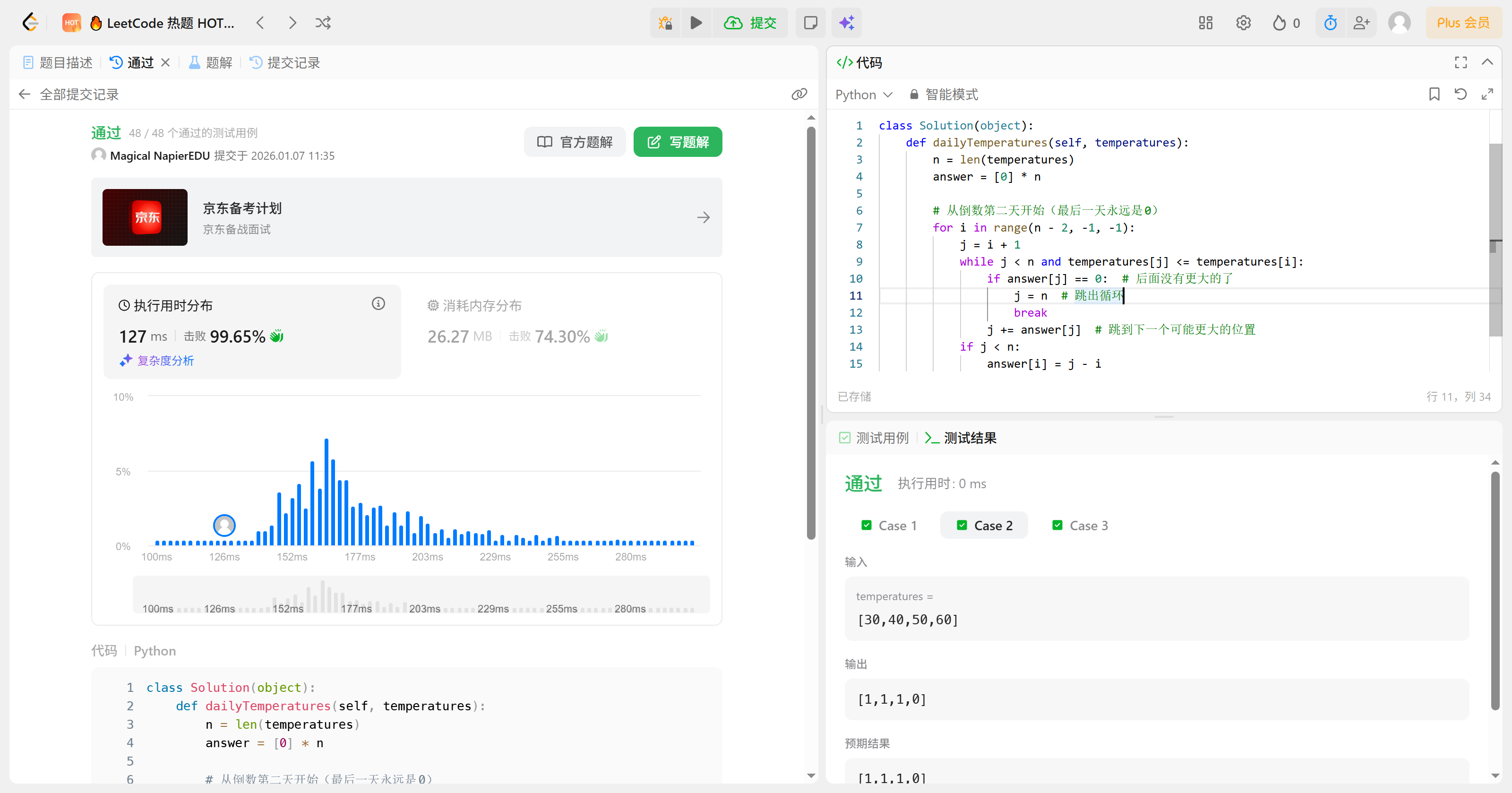
方法2:预处理 + 逆序优化(超有趣,本题的最强算法)
- 时间 :平均 O(n),最坏 O(n²)(如
[5,4,3,2,1,6]) - 空间:O(1)
python
# encoding = utf-8
# 开发者:Alen
# 开发时间: 11:04
# "Stay hungry,stay foolish."

class Solution(object):
    def __init__(self, temperatures):
        self.temperatures = temperatures
    def dailyTemperatures(self, temperatures):
        """
        :type temperatures: List[int]
        :rtype: List[int]
        """
        n = len(temperatures)
        answer = [0] * n

        # 从倒数第二天开始(最后一天永远是0)
        for i in range(n - 2, -1, -1):
            j = i + 1
            while j < n and temperatures[j] <= temperatures[i]:
                if answer[j] == 0:  # 后面没有更大的了
                    j = n  # 跳出循环
                    break
                j += answer[j]  # 跳到下一个可能更大的位置
            if j < n:
                answer[i] = j - i
        return answer

sol = Solution([73,74,75,71,69,72,76,73])
print(sol.dailyTemperatures([73,74,75,71,69,72,76,73]))

# i = 6(76)
# j = 7 → 73 ≤ 76
# answer[7] == 0 → break
# 👉 answer[6] = 0
#
# i = 5(72)
# j = 6 → 76 > 72
# 👉 找到!
# answer[5] = 6 - 5 = 1
#
# i = 4(69)
# j = 5 → 72 > 69
# 👉 answer[4] = 1
#
# i = 3(71)
# j = 4 → 69 ≤ 71
# answer[4] = 1 → j = 4 + 1 = 5
# j = 5 → 72 > 71
# 👉 answer[3] = 5 - 3 = 2
#
# i = 2(75)
# j = 3 → 71 ≤ 75
# answer[3] = 2 → j = 3 + 2 = 5
# j = 5 → 72 ≤ 75
# answer[5] = 1 → j = 5 + 1 = 6
# j = 6 → 76 > 75
# 👉 answer[2] = 4
方法3:单调栈(标准算法)
- 时间:O(n) ------ 每个元素入栈出栈各一次
- 空间:O(n) ------ 栈最多存 n 个索引
python
# encoding = utf-8
# 开发者:Alen
# 开发时间: 11:04
# "Stay hungry,stay foolish."

class Solution(object):
    def dailyTemperatures(self, temperatures):
        """
        :type temperatures: List[int]
        :rtype: List[int]
        """
        # 2026 - 1 - 7
        result = [0] * len(temperatures)
        stack = [] # [temp,index]
        for i, temp in enumerate(temperatures):
            while stack and temp > stack[-1][0]:
                stackT, stackInd = stack.pop()
                result[stackInd] = i - stackInd
            stack.append((temp, i))
        return result
结果
解题步骤:www.bilibili.com