方法一:哈希表计数
时间复杂度 :O(n)
空间复杂度:O(n)
python
# encoding = utf-8
# 开发者:Alen
# 开发时间: 13:28
# "Stay hungry,stay foolish."

class Solution(object):
    def majorityElement(self, nums):
        """
        :type nums: List[int]
        :rtype: int
        """
        from collections import Counter

        counts = Counter(nums)
        n = len(nums)
        for num,count in counts.items():
            if count > n//2:
                return num
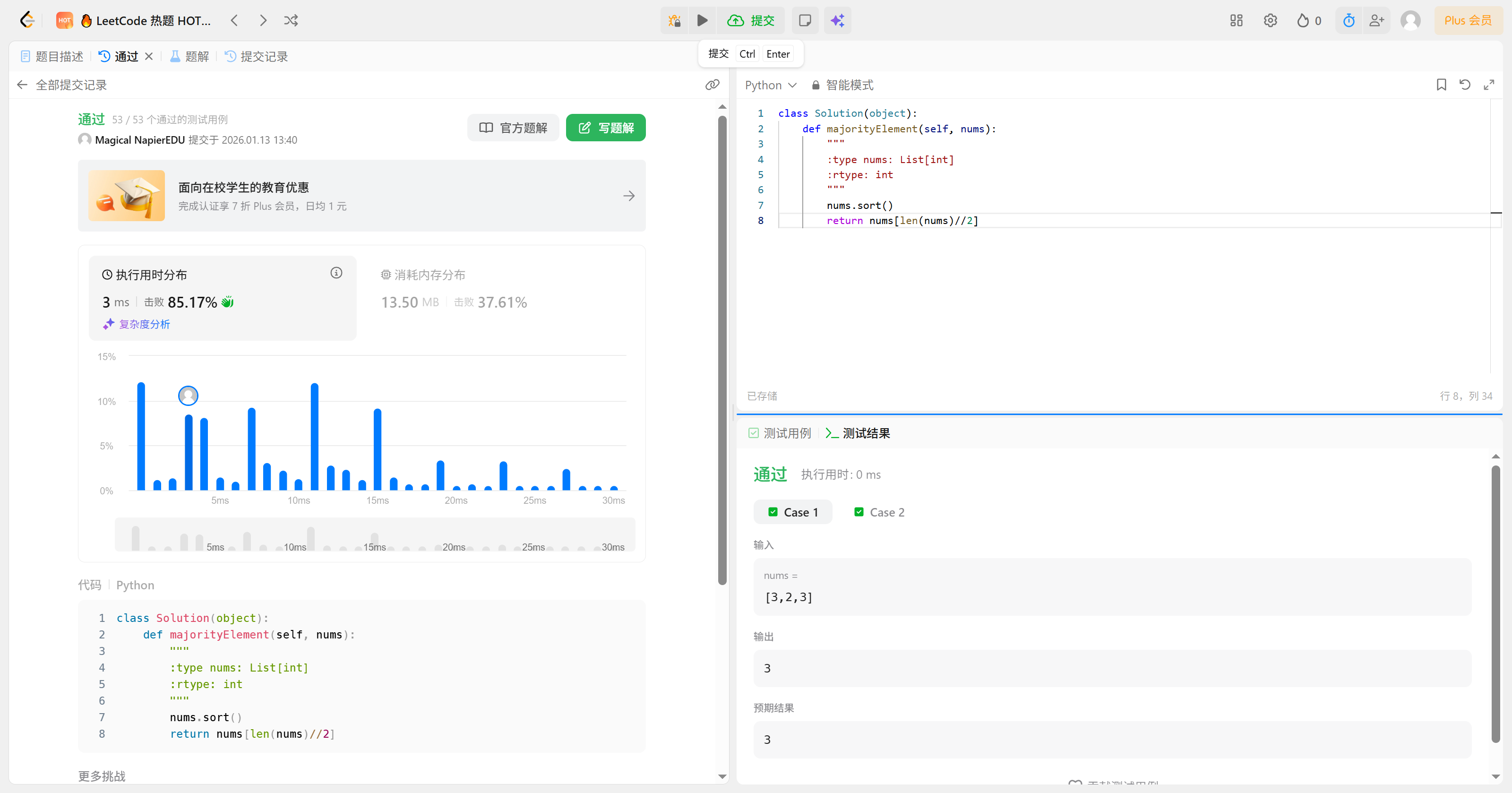
方法二:排序法
时间复杂度 :O(n log n)(排序)
空间复杂度:O(1)(如果原地排序)
python
# encoding = utf-8
# 开发者:Alen
# 开发时间: 13:28
# "Stay hungry,stay foolish."

class Solution(object):
    def majorityElement(self, nums):
        """
        :type nums: List[int]
        :rtype: int
        """
        nums.sort()
        return nums[len(nums)//2]
方法三:随机化(概率法)
期望时间复杂度 :O(n)(平均情况)
最坏时间复杂度 :理论上可能无限(但概率极低)
空间复杂度:O(1)
python
# encoding = utf-8
# 开发者:Alen
# 开发时间: 13:28
# "Stay hungry,stay foolish."
import random


class Solution(object):
    def majorityElement(self, nums):
        """
        :type nums: List[int]
        :rtype: int
        """
        n = len(nums)
        while True:
            candidate = random.choice(nums)
            if nums.count(candidate) > n//2:
                return candidate
结果
解题步骤:https://www.bilibili.com/video/BV1QarCByEKS/