前言
2026年的亚马逊搜索引擎已经完成了从传统信息检索到认知智能的跨越。本文将从技术视角深度解析COSMO(Common Sense Knowledge Generation)算法和Rufus AI助手的工作原理,并提供基于算法逻辑的Amazon Listing精细化优化方案。
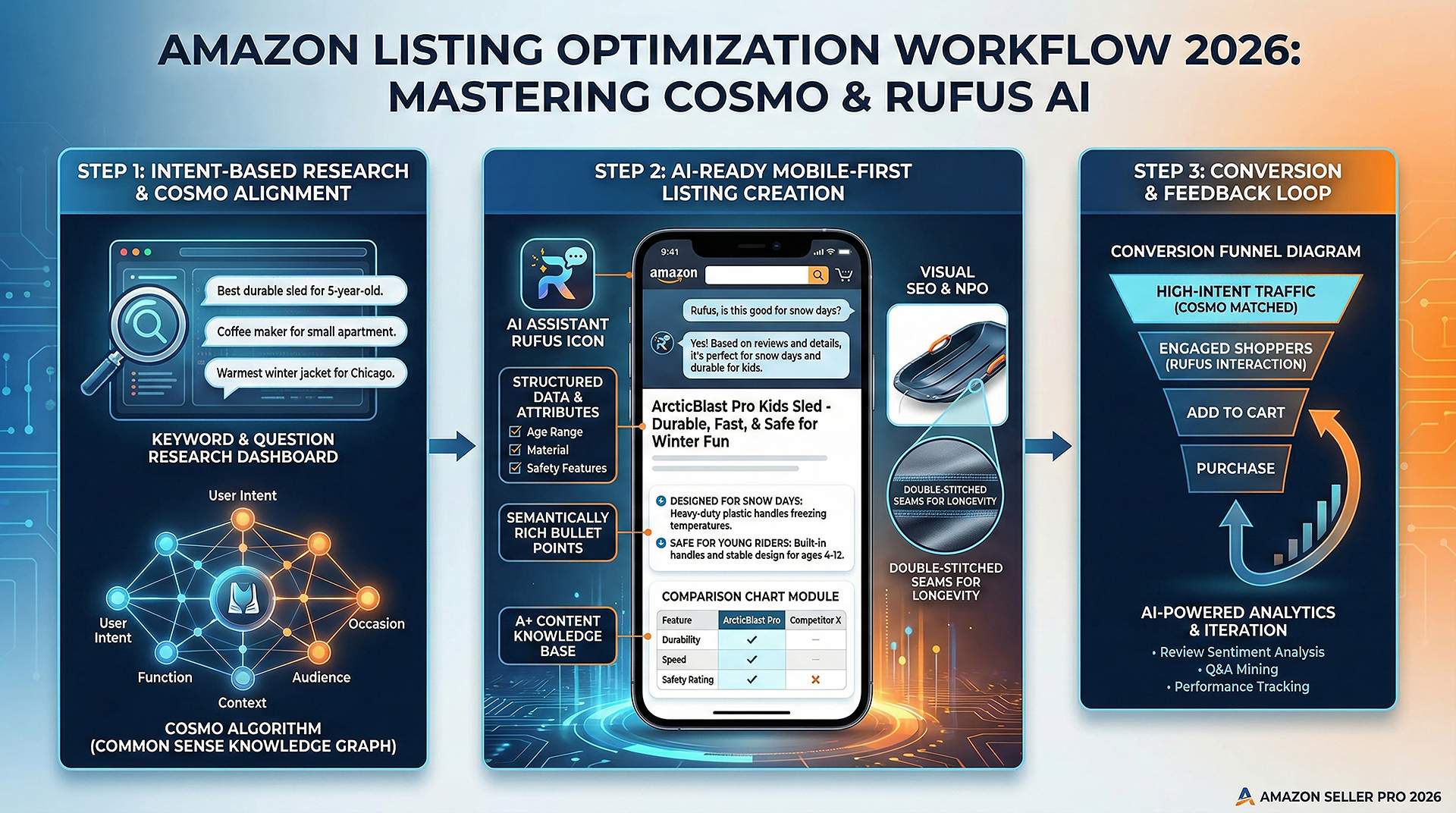
作为一名长期从事电商数据采集和分析的技术从业者,我将结合实际案例和代码示例,帮助开发者和技术型卖家理解2026年亚马逊搜索引擎的底层机制,构建数据驱动的Listing优化体系。
技术背景:从词汇匹配到语义理解的范式转移
传统A9算法的局限性
亚马逊早期的A9算法本质上是一个基于TF-IDF和协同过滤的推荐系统:
python
# 简化的A9算法相关性计算逻辑
def calculate_relevance_score(query, listing):
    # 1. 词汇匹配得分
    keyword_match_score = tfidf_similarity(query, listing['title'] + listing['bullets'])

    # 2. 历史CTR权重
    ctr_weight = listing['historical_ctr'] * 0.3

    # 3. 转化率权重
    cvr_weight = listing['conversion_rate'] * 0.4

    # 4. 评分和评论数
    review_score = (listing['rating'] * listing['review_count']) * 0.3

    return keyword_match_score + ctr_weight + cvr_weight + review_score
这种方法的问题在于:
- 语义鸿沟:无法理解"Running Shoes"和"Jogging Sneakers"是同义表达
- 意图盲区:搜索"孕妇鞋"时,无法推理出"防滑"、"宽楦"是隐性需求
- 冷启动困境:新品缺乏历史数据,难以获得曝光
COSMO算法:基于知识图谱的常识推理
COSMO的核心突破在于构建了一个包含"实体-属性-意图"的知识图谱(Knowledge Graph):
python
# COSMO知识图谱的简化表示
knowledge_graph = {
    "maternity_shoes": {
        "implicit_attributes": [
            {"name": "non_slip", "weight": 0.9, "reason": "pregnancy_safety"},
            {"name": "wide_fit", "weight": 0.85, "reason": "foot_swelling"},
            {"name": "slip_on", "weight": 0.8, "reason": "difficulty_bending"}
        ],
        "related_scenarios": ["pregnancy", "postpartum", "foot_edema"],
        "pain_points": ["safety_concern", "comfort", "ease_of_use"]
    }
}

def cosmo_semantic_match(query, listing):
    # 1. 提取查询意图
    intent = extract_intent(query)  # "maternity_shoes"

    # 2. 从知识图谱获取隐性需求
    implicit_needs = knowledge_graph[intent]["implicit_attributes"]

    # 3. 检查Listing是否满足隐性需求
    match_score = 0
    for need in implicit_needs:
        if check_attribute_in_listing(need["name"], listing):
            # 不仅检查关键词,还检查因果关系描述
            if check_causal_explanation(need["name"], need["reason"], listing):
                match_score += need["weight"] * 1.5  # 有因果解释加权
            else:
                match_score += need["weight"]

return match_score关键洞察:COSMO不仅匹配关键词,更看重你是否在Listing中解释了"为什么这个属性能解决用户的痛点"。
Rufus AI:基于RAG的检索增强生成
Rufus采用了RAG(Retrieval-Augmented Generation)架构:
python
# Rufus的简化工作流程
class RufusAssistant:
    def __init__(self):
        self.llm = LargeLanguageModel("amazon-rufus-2026")
        self.vector_db = VectorDatabase()  # 存储所有Listing的向量表示

    def answer_question(self, user_question, context_asins):
        # 1. 从相关Listing中检索信息片段
        relevant_chunks = []
        for asin in context_asins:
            listing_data = self.get_listing_data(asin)

            # 提取高价值数据片段
            chunks = [
                listing_data['title'],
                listing_data['bullets'],  # 五点描述
                listing_data['qa_pairs'],  # Q&A
                listing_data['top_reviews']  # 高赞评论
            ]

            # 向量相似度检索
            for chunk in chunks:
                similarity = self.vector_db.similarity(user_question, chunk)
                if similarity > 0.7:
                    relevant_chunks.append({
                        'content': chunk,
                        'source': asin,
                        'similarity': similarity
                    })

        # 2. 按相似度排序,取Top 5
        top_chunks = sorted(relevant_chunks, key=lambda x: x['similarity'], reverse=True)[:5]

        # 3. 构建Prompt并生成答案
        prompt = f"""
        User Question: {user_question}

        Relevant Information:
        {self.format_chunks(top_chunks)}

        Please provide a concise answer based on the above information.
        """

        answer = self.llm.generate(prompt)
        return answer

    def format_chunks(self, chunks):
        # 将检索到的片段格式化为LLM可理解的上下文
        formatted = ""
        for i, chunk in enumerate(chunks):
            formatted += f"[Source {i+1} - ASIN: {chunk['source']}]\n{chunk['content']}\n\n"
return formatted优化启示:
- 事实密度优先:五点描述要包含具体参数,避免空洞形容词
- 结构化表达:用"问题-解决方案"的格式,便于AI提取
- Q&A战略地位:Rufus优先引用Q&A内容,必须提前布局
技术实现:基于数据的Listing优化工作流
第一步:竞品数据采集与分析
使用API批量采集竞品数据:
python
import requests
import json

class AmazonCompetitorAnalyzer:
    def __init__(self, api_key):
        self.api_key = api_key
        self.base_url = "https://api.pangolinfo.com/v1"

    def collect_competitor_data(self, keyword, num_pages=3):
        """采集搜索结果页的竞品ASIN"""
        asins = []

        for page in range(1, num_pages + 1):
            response = requests.post(
                f"{self.base_url}/amazon/search",
                headers={"Authorization": f"Bearer {self.api_key}"},
                json={
                    "keyword": keyword,
                    "page": page,
                    "marketplace": "US"
                }
            )

            data = response.json()
            asins.extend([item['asin'] for item in data['results']])

        return asins

    def analyze_titles(self, asins):
        """分析竞品标题的名词短语结构"""
        import spacy
        nlp = spacy.load("en_core_web_sm")

        noun_phrases = []
        for asin in asins:
            listing = self.get_listing_detail(asin)
            doc = nlp(listing['title'])

            # 提取名词短语
            for chunk in doc.noun_chunks:
                noun_phrases.append({
                    'phrase': chunk.text,
                    'asin': asin,
                    'position': chunk.start_char
                })

        # 统计高频名词短语
        from collections import Counter
        phrase_freq = Counter([np['phrase'] for np in noun_phrases])

        return phrase_freq.most_common(20)

    def extract_pain_points(self, asins):
        """从差评中提取痛点"""
        pain_points = []

        for asin in asins:
            # 采集1-3星评论
            reviews = self.get_reviews(asin, rating_filter="1-3")

            for review in reviews:
                # 使用情感分析提取负面短语
                negative_phrases = self.sentiment_analysis(review['text'])
                pain_points.extend(negative_phrases)

        # 统计高频痛点
        from collections import Counter
        pain_point_freq = Counter(pain_points)

        return pain_point_freq.most_common(10)

    def get_listing_detail(self, asin):
        """获取Listing详情"""
        response = requests.post(
            f"{self.base_url}/amazon/product",
            headers={"Authorization": f"Bearer {self.api_key}"},
            json={"asin": asin, "marketplace": "US"}
        )
        return response.json()

    def get_reviews(self, asin, rating_filter=None):
        """获取评论数据"""
        response = requests.post(
            f"{self.base_url}/amazon/reviews",
            headers={"Authorization": f"Bearer {self.api_key}"},
            json={
                "asin": asin,
                "rating_filter": rating_filter,
                "marketplace": "US"
            }
        )
        return response.json()['reviews']

# 使用示例
analyzer = AmazonCompetitorAnalyzer(api_key="your_api_key")

# 采集"Running Shoes"的竞品数据
competitor_asins = analyzer.collect_competitor_data("Running Shoes", num_pages=3)

# 分析标题结构
top_noun_phrases = analyzer.analyze_titles(competitor_asins)
print("高频名词短语:", top_noun_phrases)

# 提取痛点
pain_points = analyzer.extract_pain_points(competitor_asins)
print("高频痛点:", pain_points)
第二步:标题优化------名词短语优化(NPO)
python
def optimize_title_npo(product_info, keyword_research):
    """
    基于名词短语优化(Noun Phrase Optimization)生成标题
    """
    # 1. 核心名词短语(前70字符内)
    core_phrase = f"{product_info['brand']} {product_info['product_type']}"

    # 2. 添加最强差异化卖点
    key_differentiator = product_info['top_selling_point']

    # 3. 添加目标人群/场景
    target_context = product_info['target_audience']

    # 构建标题(确保前70字符包含核心信息)
    title = f"{core_phrase}, {key_differentiator} for {target_context}"

    # 4. 在剩余空间添加次要卖点
    if len(title) < 150:
        secondary_features = ", ".join(product_info['secondary_features'][:2])
        title += f", {secondary_features}"

    return title[:200]  # 亚马逊标题限制200字符

# 示例
product = {
    'brand': 'YourBrand',
    'product_type': 'Running Shoes',
    'top_selling_point': 'Breathable Mesh Upper with Arch Support',
    'target_audience': 'Marathon Training',
    'secondary_features': ['Lightweight Design', 'Shock Absorption']
}

optimized_title = optimize_title_npo(product, None)
print(optimized_title)
# 输出: "YourBrand Running Shoes, Breathable Mesh Upper with Arch Support for Marathon Training, Lightweight Design, Shock Absorption"
第三步:五点描述生成------RAG就绪格式
python
def generate_rag_ready_bullets(product_info, competitor_pain_points):
    """
    生成符合RAG检索逻辑的五点描述
    """
    bullets = []

    # 模板:大写标题 + 竞品痛点 + 功能 + 场景 + 利益
    template = "{headline}: Unlike {competitor_pain}, our {product} features {feature}. This ensures {benefit} during {scenario}, providing you with {outcome}."

    # 示例:针对"出汗打滑"痛点
    bullet_1 = template.format(
        headline="SWEAT-PROOF GRIP TECHNOLOGY",
        competitor_pain="standard PVC mats that become slippery when wet",
        product="yoga mat",
        feature="dual-layer texture with moisture-wicking channels",
        benefit="stable grip",
        scenario="hot yoga sessions",
        outcome="safety and confidence"
    )
    bullets.append(bullet_1)

    # 可以根据不同痛点生成多条
    for pain_point in competitor_pain_points[:5]:
        bullet = generate_bullet_for_pain_point(product_info, pain_point)
        bullets.append(bullet)

    return bullets

def generate_bullet_for_pain_point(product, pain_point):
    # 基于痛点生成针对性描述的逻辑
    # 这里可以接入GPT等LLM来自动生成
    pass
第四步:后台数据完整性检查
python
def audit_backend_attributes(listing_data):
    """
    审计后台属性完整性
    """
    required_attributes = [
        'item_type',
        'target_audience',
        'material_type',
        'specific_uses',
        'care_instructions',
        'color',
        'size',
        'brand'
    ]

    missing_attributes = []
    for attr in required_attributes:
        if not listing_data.get(attr) or listing_data[attr] == "":
            missing_attributes.append(attr)

    if missing_attributes:
        print(f"警告:以下属性为空,将导致AI过滤: {missing_attributes}")
        return False

    # 检查是否使用标准值
    non_standard_values = []
    for attr, value in listing_data.items():
        if not is_taxonomy_value(attr, value):
            non_standard_values.append({attr: value})

    if non_standard_values:
        print(f"警告:以下属性未使用标准值: {non_standard_values}")
        return False

    print("✓ 后台属性完整性检查通过")
    return True

def is_taxonomy_value(attribute, value):
    # 检查是否为亚马逊标准分类值
    # 实际应用中需要对接亚马逊的分类API
    taxonomy_db = load_amazon_taxonomy()
    return value in taxonomy_db.get(attribute, [])
第五步:SQP数据驱动的持续优化
python
class SQPAnalyzer:
    """搜索查询表现(Search Query Performance)分析器"""

    def __init__(self, sqp_data):
        self.data = sqp_data

    def diagnose_funnel_issues(self):
        """诊断转化漏斗问题"""
        issues = []

        for keyword_data in self.data:
            impressions = keyword_data['impressions']
            clicks = keyword_data['clicks']
            atc = keyword_data['add_to_cart']
            orders = keyword_data['orders']

            # 计算各阶段转化率
            ctr = clicks / impressions if impressions > 0 else 0
            atc_rate = atc / clicks if clicks > 0 else 0
            cvr = orders / atc if atc > 0 else 0

            # 诊断逻辑
            if impressions > 1000 and ctr < 0.005:  # CTR < 0.5%
                issues.append({
                    'keyword': keyword_data['keyword'],
                    'issue': 'low_ctr',
                    'recommendation': '优化主图或标题前70字符',
                    'priority': 'high'
                })

            if ctr > 0.01 and atc_rate < 0.1:  # ATR < 10%
                issues.append({
                    'keyword': keyword_data['keyword'],
                    'issue': 'low_atc',
                    'recommendation': '优化五点描述,检查差评,增加A+对比图',
                    'priority': 'high'
                })

            if atc_rate > 0.15 and cvr < 0.3:  # CVR < 30%
                issues.append({
                    'keyword': keyword_data['keyword'],
                    'issue': 'low_cvr',
                    'recommendation': '添加Coupon,检查Prime配送',
                    'priority': 'medium'
                })

        return issues

    def generate_ppc_strategy(self, issues):
        """基于SQP问题生成PPC策略"""
        ppc_campaigns = []

        for issue in issues:
            if issue['issue'] == 'low_impressions':
                # 曝光不足,加大PPC投放
                ppc_campaigns.append({
                    'keyword': issue['keyword'],
                    'match_type': 'exact',
                    'bid_adjustment': '+50%',
                    'reason': '提升自然排名信号'
                })

        return ppc_campaigns

# 使用示例
sqp_data = load_sqp_report()  # 从亚马逊后台导出的SQP数据
analyzer = SQPAnalyzer(sqp_data)

issues = analyzer.diagnose_funnel_issues()
for issue in issues:
    print(f"关键词: {issue['keyword']}")
    print(f"问题: {issue['issue']}")
    print(f"建议: {issue['recommendation']}\n")

ppc_strategy = analyzer.generate_ppc_strategy(issues)
常见问题与解决方案
Q1: 如何批量采集竞品数据?
A: 我们可以选择自建爬虫或者使用专业的数据采集API。以Pangolinfo Scrape API为例:
python
# 批量采集竞品Listing数据
import requests

api_endpoint = "https://api.pangolinfo.com/v1/amazon/batch"
headers = {"Authorization": "Bearer YOUR_API_KEY"}

asins = ["B08N5WRWNW", "B07XJ8C8F5", "B09B8RJQN3"]  # 竞品ASIN列表

response = requests.post(
    api_endpoint,
    headers=headers,
    json={
        "asins": asins,
        "data_points": ["title", "bullets", "reviews", "qa", "images"],
        "marketplace": "US"
    }
)

competitor_data = response.json()
Q2: 如何监控关键词排名变化?
A: 使用可视化监控工具,如AMZ Data Tracker,可以实时追踪:
- 关键词自然排名
- BSR变化趋势
- 评论增长速度
- 竞品动态
Q3: 后台搜索词(Search Terms)如何优化?
A: 250字节的Search Terms应该:
- 不重复标题和五点中的词
- 包含同义词(如"sneakers"对应"shoes")
- 包含常见拼写错误(如"pilliow")
- 包含西班牙语同义词(美国站)
- 直接空格分隔,不用逗号
python
def optimize_search_terms(title, bullets, max_bytes=250):
    """优化后台搜索词"""
    # 1. 提取标题和五点中的词
    existing_words = set(extract_words(title + " ".join(bullets)))

    # 2. 生成同义词
    synonyms = generate_synonyms(existing_words)

    # 3. 添加常见拼写错误
    misspellings = generate_common_misspellings(existing_words)

    # 4. 添加西班牙语同义词(针对美国站)
    spanish_synonyms = translate_to_spanish(existing_words)

    # 5. 合并并去重
    search_terms = list(set(synonyms + misspellings + spanish_synonyms) - existing_words)

    # 6. 控制在250字节内
    result = ""
    for term in search_terms:
        if len((result + " " + term).encode('utf-8')) <= max_bytes:
            result += " " + term
        else:
            break

    return result.strip()
性能优化建议
1. 图片OCR优化
确保卖点图上的文字能被AI识别:
python
from PIL import Image, ImageDraw, ImageFont

def create_ocr_friendly_infographic(product_features):
    """创建OCR友好的信息图"""
    img = Image.new('RGB', (1500, 1500), color='white')
    draw = ImageDraw.Draw(img)

    # 使用大号清晰字体
    font = ImageFont.truetype("Arial.ttf", 48)

    y_position = 100
    for feature in product_features:
        # 确保文字清晰、对比度高
        draw.text((100, y_position), feature['text'], fill='black', font=font)
        y_position += 150

    img.save('infographic_ocr_ready.jpg', quality=95)
2. A+页面ALT文本优化
python
def generate_alt_text(image_description, keywords):
    """生成SEO友好的ALT文本"""
    # 不要堆砌关键词,要写成自然的句子
    alt_text = f"{image_description}"

    # 自然融入1-2个关键词
    if keywords:
        alt_text += f" featuring {keywords[0]}"

    return alt_text[:125]  # ALT文本建议不超过125字符

# 示例
alt = generate_alt_text(
    "Close-up view of waterproof zipper on black travel backpack",
    ["water-resistant design", "durable construction"]
)
print(alt)
# 输出: "Close-up view of waterproof zipper on black travel backpack featuring water-resistant design"
总结
2026年的Amazon Listing优化已经从文案技巧进化为算法工程。理解COSMO的知识图谱推理机制和Rufus的RAG检索逻辑,是构建高转化Listing的前提。
核心技术要点:
- 名词短语优化(NPO):用自然语言结构替代关键词堆砌
- 因果链条表达:在五点描述中显性化"功能-痛点-利益"关系
- 结构化数据完整性:后台属性零空值,使用标准分类值
- RAG就绪文案:高事实密度,便于AI提取的结构化表达
- 数据驱动迭代:基于SQP报告持续优化
对于需要大规模数据支撑的技术团队,推荐使用Pangolinfo的API解决方案,实现从数据采集到分析的全链路自动化。
原创技术文章 | 转载请注明出处
#Amazon #Listing优化 #COSMO算法 #RufusAI #电商数据 #API开发