回顾与引言
在前四章中,我们学习了线性回归和逻辑回归的基础知识。本章将深入探讨更高级的主题:
- 实现多分类逻辑回归(Softmax回归)
- 学习正则化技术在逻辑回归中的应用
1. Softmax回归(多分类逻辑回归)
Softmax回归是逻辑回归的多分类扩展,适用于目标变量有多个类别的情况。
数学原理
Softmax函数将线性输出转换为概率分布:
其中 k 是类别数量。
成本函数(交叉熵)
其中
梯度计算
代码实现:Softmax回归
python
import numpy as np
import matplotlib.pyplot as plt
from sklearn.datasets import make_classification
from sklearn.model_selection import train_test_split
from sklearn.preprocessing import StandardScaler, LabelBinarizer
from sklearn.linear_model import LogisticRegression as SklearnLogisticRegression
from sklearn.metrics import accuracy_score, confusion_matrix, classification_report

class SoftmaxRegression:
    """
    手动实现Softmax回归(多分类逻辑回归)
    """

    def __init__(self, learning_rate=0.01, n_iterations=1000, lambda_=0.1, reg_type='l2'):
        """
        初始化Softmax回归模型

        参数:
        learning_rate -- 学习率 α
        n_iterations -- 迭代次数
        lambda_ -- 正则化参数
        reg_type -- 正则化类型 ('l1', 'l2', 或 None)
        """
        self.learning_rate = learning_rate
        self.n_iterations = n_iterations
        self.lambda_ = lambda_
        self.reg_type = reg_type
        self.theta = None  # 参数矩阵 (n_features, n_classes)
        self.cost_history = []  # 成本函数历史
        self.n_classes = None  # 类别数量

    def _softmax(self, z):
        """
        Softmax函数: 将输出转换为概率分布

        参数:
        z -- 输入矩阵 (m, n_classes)

        返回:
        概率矩阵 (m, n_classes)
        """
        # 数值稳定性处理:减去最大值防止指数溢出
        exp_z = np.exp(z - np.max(z, axis=1, keepdims=True))
        return exp_z / np.sum(exp_z, axis=1, keepdims=True)

    def _add_intercept(self, X):
        """
        在特征矩阵前添加一列1,用于截距项

        参数:
        X -- 特征矩阵 (m, n)

        返回:
        添加截距项后的特征矩阵 (m, n+1)
        """
        intercept = np.ones((X.shape[0], 1))
        return np.concatenate((intercept, X), axis=1)

    def _compute_cost(self, X, y):
        """
        计算交叉熵成本函数(带正则化)

        参数:
        X -- 特征矩阵 (包含截距项)
        y -- 目标矩阵 (one-hot编码)

        返回:
        成本函数值
        """
        m = len(y)
        h = self._softmax(X.dot(self.theta))

        # 计算交叉熵损失
        cost = (-1 / m) * np.sum(y * np.log(h + 1e-15))  # 添加小值防止log(0)

        # 添加正则化项
        if self.reg_type == 'l2':
            # L2正则化: λ/2m * Σθ² (不包括截距项)
            reg_term = (self.lambda_ / (2 * m)) * np.sum(self.theta[1:, :] ** 2)
            cost += reg_term
        elif self.reg_type == 'l1':
            # L1正则化: λ/m * Σ|θ| (不包括截距项)
            reg_term = (self.lambda_ / m) * np.sum(np.abs(self.theta[1:, :]))
            cost += reg_term

        return cost

    def fit(self, X, y):
        """
        使用梯度下降训练Softmax回归模型

        参数:
        X -- 特征矩阵 (m, n)
        y -- 目标向量 (m,)
        """
        # 添加截距项
        X_b = self._add_intercept(X)

        # 获取类别信息并转换为one-hot编码
        self.n_classes = len(np.unique(y))
        lb = LabelBinarizer()
        y_onehot = lb.fit_transform(y)

        # 初始化参数矩阵 (n_features+1, n_classes)
        self.theta = np.zeros((X_b.shape[1], self.n_classes))

        m = len(y)
        self.cost_history = []

        # 梯度下降迭代
        for iteration in range(self.n_iterations):
            # 计算预测概率
            z = X_b.dot(self.theta)
            h = self._softmax(z)

            # 计算梯度
            gradient = (1 / m) * X_b.T.dot(h - y_onehot)

            # 添加正则化梯度
            if self.reg_type == 'l2':
                # L2正则化梯度: λ/m * θ (不包括截距项)
                reg_gradient = (self.lambda_ / m) * self.theta
                reg_gradient[0, :] = 0  # 不对截距项正则化
                gradient += reg_gradient
            elif self.reg_type == 'l1':
                # L1正则化梯度: λ/m * sign(θ) (不包括截距项)
                reg_gradient = (self.lambda_ / m) * np.sign(self.theta)
                reg_gradient[0, :] = 0  # 不对截距项正则化
                gradient += reg_gradient

            # 更新参数
            self.theta -= self.learning_rate * gradient

            # 记录成本值
            cost = self._compute_cost(X_b, y_onehot)
            self.cost_history.append(cost)

            # 每100次迭代打印进度
            if iteration % 100 == 0:
                print(f"Iteration {iteration}: Cost = {cost:.6f}")

    def predict_proba(self, X):
        """
        预测概率值

        参数:
        X -- 特征矩阵

        返回:
        预测概率矩阵 (m, n_classes)
        """
        X_b = self._add_intercept(X)
        return self._softmax(X_b.dot(self.theta))

    def predict(self, X):
        """
        预测类别

        参数:
        X -- 特征矩阵

        返回:
        预测类别
        """
        probabilities = self.predict_proba(X)
        return np.argmax(probabilities, axis=1)

    def plot_cost_history(self):
        """
        绘制成本函数下降曲线
        """
        plt.figure(figsize=(10, 6))
        plt.plot(self.cost_history)
        plt.xlabel('Iterations')
        plt.ylabel('Cost')
        plt.title('Cost Function History')
        plt.grid(True)
        plt.show()

# 示例使用
if __name__ == "__main__":
    # 生成多分类数据
    np.random.seed(42)
    X, y = make_classification(n_samples=1000, n_features=4, n_informative=4,
                              n_redundant=0, n_classes=3, n_clusters_per_class=1,
                              random_state=42)

    # 数据预处理
    scaler = StandardScaler()
    X_scaled = scaler.fit_transform(X)

    # 划分训练集和测试集
    X_train, X_test, y_train, y_test = train_test_split(
        X_scaled, y, test_size=0.2, random_state=42
    )

    print("数据形状:")
    print(f"训练集: {X_train.shape}, 测试集: {X_test.shape}")
    print(f"类别数量: {len(np.unique(y))}")

    # 训练Softmax回归模型
    print("\n=== 训练Softmax回归模型 ===")
    softmax_model = SoftmaxRegression(learning_rate=0.1, n_iterations=1000, lambda_=0.1, reg_type='l2')
    softmax_model.fit(X_train, y_train)

    # 训练scikit-learn多分类逻辑回归模型
    print("\n=== 训练scikit-learn多分类逻辑回归模型 ===")
    sklearn_model = SklearnLogisticRegression(multi_class='multinomial', solver='lbfgs')
    sklearn_model.fit(X_train, y_train)

    # 评估模型
    y_pred_softmax = softmax_model.predict(X_test)
    y_pred_sklearn = sklearn_model.predict(X_test)

    accuracy_softmax = accuracy_score(y_test, y_pred_softmax)
    accuracy_sklearn = accuracy_score(y_test, y_pred_sklearn)

    print(f"\n=== 模型评估 ===")
    print(f"Softmax回归准确率: {accuracy_softmax:.4f}")
    print(f"Scikit-learn准确率: {accuracy_sklearn:.4f}")

    # 可视化成本函数下降
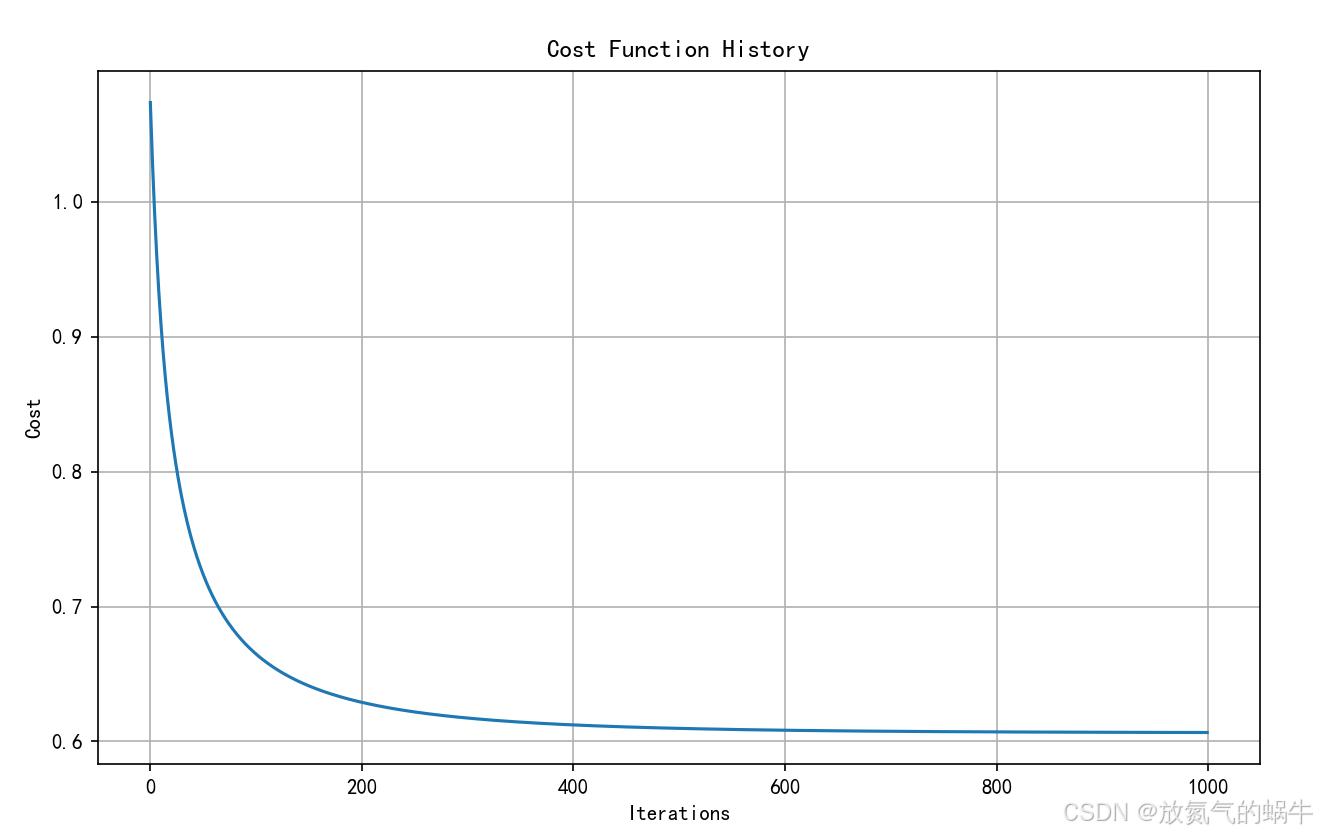
    softmax_model.plot_cost_history()

    # 查看模型参数
    print(f"\nSoftmax模型参数形状: {softmax_model.theta.shape}")
数据形状:
训练集: (800, 4), 测试集: (200, 4)
类别数量: 3
=== 训练Softmax回归模型 ===
Iteration 0: Cost = 1.073610
Iteration 100: Cost = 0.664719
Iteration 200: Cost = 0.628946
Iteration 300: Cost = 0.617297
Iteration 400: Cost = 0.612204
Iteration 500: Cost = 0.609652
Iteration 600: Cost = 0.608272
Iteration 700: Cost = 0.607490
Iteration 800: Cost = 0.607035
Iteration 900: Cost = 0.606763
=== 训练scikit-learn多分类逻辑回归模型 ===
- /lib/python3.12/site-packages/sklearn/linear_model/_logistic.py:1247: FutureWarning: 'multi_class' was deprecated in version 1.5 and will be removed in 1.7. From then on, it will always use 'multinomial'. Leave it to its default value to avoid this warning.
- warnings.warn(
=== 模型评估 ===
Softmax回归准确率: 0.7700
Scikit-learn准确率: 0.770
Softmax模型参数形状: (5, 3)
训练流程解析
一、整体结构概览
这个 SoftmaxRegression 类实现了:
- 多分类(3类及以上)
- 带 L1/L2 正则化
- 使用梯度下降优化
- 与
sklearn的LogisticRegression(multi_class='multinomial')对比
它的流程依然是:
bash
训练数据 → 损失函数 → 计算梯度 → 更新参数 θ → 收敛后得到最优 θ
                                     ↓
新样本 → 代入预测公式(Softmax)→ 输出概率 → 取最大概率类别二、自定义类:SoftmaxRegression
1. 初始化方法:__init__
python
def __init__(self, learning_rate=0.01, n_iterations=1000, lambda_=0.1, reg_type='l2'):
    self.learning_rate = learning_rate
    self.n_iterations = n_iterations
    self.lambda_ = lambda_      # 正则化强度
    self.reg_type = reg_type    # 正则化类型
    self.theta = None           # 参数矩阵
    self.cost_history = []
    self.n_classes = None       # 类别数
说明:
lambda_: 控制正则化项的权重reg_type: 支持'l1'或'l2'正则化,防止过拟合theta: 不再是向量,而是 矩阵(n_features+1, n_classes)------ 每一列对应一个类的参数
2. 私有方法:_softmax(z)
python
def _softmax(self, z):
    exp_z = np.exp(z - np.max(z, axis=1, keepdims=True))
    return exp_z / np.sum(exp_z, axis=1, keepdims=True)
核心公式(Softmax 函数):

作用:
- 将线性输出 z=Xθ 转换为 概率分布
- 所有类的概率和为 1
- 数值稳定性技巧:减去每行最大值,防止
exp()溢出
举例:若某样本的 z=2.0,1.0,0.1,Softmax 输出可能是 0.65,0.25,0.10,表示最可能是第 0 类。
3. 私有方法:_add_intercept(X)
python
def _add_intercept(self, X):
    intercept = np.ones((X.shape[0], 1))
    return np.concatenate((intercept, X), axis=1)
作用:
- 添加截距项(偏置项),即 x0=1
- 输入
(m, n)→ 输出(m, n+1) - 使得参数矩阵 θθ 中第一行对应所有类的截距项
4. 私有方法:_compute_cost(X, y)
python
def _compute_cost(self, X, y):
    m = len(y)
    h = self._softmax(X.dot(self.theta))  # 预测概率
    cost = (-1 / m) * np.sum(y * np.log(h + 1e-15))  # 交叉熵损失
核心公式(交叉熵损失函数,多分类):
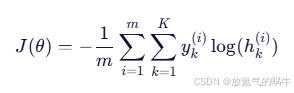
- yk(i): 第 i 个样本是否属于第 k 类(one-hot 编码)
- hk(i): 模型预测该样本属于第 k 类的概率
这就是"数据放进去训练"的那个公式!
加上正则化项:
python
if self.reg_type == 'l2':
    reg_term = (self.lambda_ / (2 * m)) * np.sum(self.theta[1:, :] ** 2)
    cost += reg_term
elif self.reg_type == 'l1':
    reg_term = (self.lambda_ / m) * np.sum(np.abs(self.theta[1:, :]))
cost += reg_term- L2 正则化:
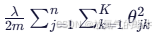 (不包括截距)
 - L1 正则化:

正则化目的:防止过拟合,提升泛化能力
5. 训练方法:fit(X, y)
python
def fit(self, X, y):
    X_b = self._add_intercept(X)

    # 转换 y 为 one-hot 编码
    self.n_classes = len(np.unique(y))
    lb = LabelBinarizer()
    y_onehot = lb.fit_transform(y)

    # 初始化参数矩阵
    self.theta = np.zeros((X_b.shape[1], self.n_classes))

    for iteration in range(self.n_iterations):
        z = X_b.dot(self.theta)           # 线性输出 (m, K)
        h = self._softmax(z)              # 概率输出 (m, K)
        gradient = (1 / m) * X_b.T.dot(h - y_onehot)  # 基础梯度

        # 加上正则化梯度
        if self.reg_type == 'l2':
            reg_gradient = (self.lambda_ / m) * self.theta
            reg_gradient[0, :] = 0  # 截距项不正则化
            gradient += reg_gradient
        elif self.reg_type == 'l1':
            reg_gradient = (self.lambda_ / m) * np.sign(self.theta)
            reg_gradient[0, :] = 0
            gradient += reg_gradient

        # 更新参数
        self.theta -= self.learning_rate * gradient

        # 记录损失
        cost = self._compute_cost(X_b, y_onehot)
        self.cost_history.append(cost)
训练流程详解:
| 步骤 | 公式 | 说明 |
|---|---|---|
| 1️⃣ 加截距 | Xb=1,x1,x2,...,xn | 构造设计矩阵 |
| 2️⃣ One-hot 编码 | y→yonehoty | 把标签转为向量,如 2 → [0,0,1] |
| 3️⃣ 初始化 | θ=0 | 参数矩阵初始化 |
| 4️⃣ 线性输出 | Z=Xbθ | 每个样本对每个类有一个得分 |
| 5️⃣ Softmax | H=Softmax(Z) | 得分 → 概率分布 |
| 6️⃣ 计算梯度 |  |
多分类梯度公式 |
| 7️⃣ 加正则化梯度 | L2/L1 梯度 | 控制模型复杂度 |
| 8️⃣ 更新参数 | θ:=θ−α∇J | 梯度下降 |
训练过程:把训练数据
(X, y)放进交叉熵损失函数,不断调整theta
6. 预测概率方法:predict_proba(X)
python
def predict_proba(self, X):
    X_b = self._add_intercept(X)
return self._softmax(X_b.dot(self.theta))- 输出:每个样本属于每个类的概率
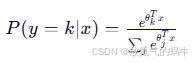
- 使用公式:
7. 预测类别方法:predict(X)
python
def predict(self, X):
    probabilities = self.predict_proba(X)
return np.argmax(probabilities, axis=1)- 对每一行(一个样本)取概率最大的类别索引
- 例如
[0.1, 0.8, 0.1]→1
8. 可视化方法:plot_cost_history()
- 绘制
cost_history,观察损失是否收敛
三、流程图
测试样本 x1, x2, x3, x4
↓
添加截距 → 1, x1, x2, x3, x4
↓
计算每个类的线性得分:
score_0 = θ₀₀ + θ₁₀*x1 + ... + θ₄₀*x4
score_1 = θ₀₁ + θ₁₁*x1 + ... + θ₄₁*x4
score_2 = θ₀₂ + θ₁₂*x1 + ... + θ₄₂*x4
↓
Softmax: e\^score_0, e\^score_1, e\^score_2 → 归一化 → p0, p1, p2
↓
预测类别 = argmax(p0, p1, p2)
四、总结图解
训练阶段:
训练数据 X, y
↓
y → one-hot 编码
↓
放入 交叉熵损失函数 J(θ)
↓
计算梯度 ∇J(θ) = (1/m) X_b^T (H - Y)
↓
更新 参数矩阵 θ
↓
直到损失最小 → 得到最优 θ
↘
→ 预测公式: P(y=k\|x) = softmax(θ_k\^T x)
↗
预测阶段:
新样本 x₁,x₂,x₃,x₄ → 代入预测公式 → 输出概率 → 取最大概率 → 输出类别
2. 正则化技术在逻辑回归中的应用
正则化是防止过拟合的重要技术,主要有两种类型:
L2正则化(岭回归)
成本函数:
梯度:
L1正则化(Lasso回归)
成本函数:
梯度(次梯度):
代码实现:正则化
python
import numpy as np
import matplotlib.pyplot as plt
from sklearn.datasets import make_regression, make_classification
from sklearn.model_selection import train_test_split, learning_curve
from sklearn.preprocessing import StandardScaler, PolynomialFeatures
from sklearn.linear_model import Ridge, Lasso, ElasticNet, LogisticRegression
from sklearn.metrics import mean_squared_error, accuracy_score
from sklearn.pipeline import Pipeline

class RegularizedLinearRegression:
    """
    实现带正则化的线性回归
    """

    def __init__(self, regularization_type='l2', lambda_=1.0, learning_rate=0.01, n_iterations=1000):
        """
        初始化正则化线性回归模型

        参数:
        regularization_type -- 正则化类型: 'l1', 'l2', 'elasticnet'
        lambda_ -- 正则化强度
        learning_rate -- 学习率
        n_iterations -- 迭代次数
        """
        self.regularization_type = regularization_type
        self.lambda_ = lambda_
        self.learning_rate = learning_rate
        self.n_iterations = n_iterations
        self.theta = None
        self.cost_history = []

    def _add_intercept(self, X):
        """添加截距项"""
        intercept = np.ones((X.shape[0], 1))
        return np.concatenate((intercept, X), axis=1)

    def _compute_cost(self, X, y):
        """计算带正则化的成本函数"""
        m = len(y)
        predictions = X.dot(self.theta)
        error = predictions - y

        # 均方误差部分
        mse_cost = (1 / (2 * m)) * np.sum(error ** 2)

        # 正则化部分(不惩罚截距项)
        if self.regularization_type == 'l2':
            reg_cost = (self.lambda_ / (2 * m)) * np.sum(self.theta[1:] ** 2)
        elif self.regularization_type == 'l1':
            reg_cost = (self.lambda_ / m) * np.sum(np.abs(self.theta[1:]))
        elif self.regularization_type == 'elasticnet':
            l1_cost = (self.lambda_ / m) * np.sum(np.abs(self.theta[1:]))
            l2_cost = (self.lambda_ / (2 * m)) * np.sum(self.theta[1:] ** 2)
            reg_cost = l1_cost + l2_cost
        else:
            reg_cost = 0

        return mse_cost + reg_cost

    def _compute_gradient(self, X, y):
        """计算带正则化的梯度"""
        m = len(y)
        predictions = X.dot(self.theta)
        error = predictions - y

        # 基础梯度
        gradient = (1 / m) * X.T.dot(error)

        # 添加正则化梯度(不惩罚截距项)
        if self.regularization_type == 'l2':
            reg_gradient = (self.lambda_ / m) * self.theta
            reg_gradient[0] = 0  # 不惩罚截距项
            gradient += reg_gradient
        elif self.regularization_type == 'l1':
            reg_gradient = (self.lambda_ / m) * np.sign(self.theta)
            reg_gradient[0] = 0  # 不惩罚截距项
            gradient += reg_gradient
        elif self.regularization_type == 'elasticnet':
            l1_gradient = (self.lambda_ / m) * np.sign(self.theta)
            l2_gradient = (self.lambda_ / m) * self.theta
            reg_gradient = l1_gradient + l2_gradient
            reg_gradient[0] = 0  # 不惩罚截距项
            gradient += reg_gradient

        return gradient

    def fit(self, X, y):
        """训练模型"""
        X_b = self._add_intercept(X)
        self.theta = np.zeros(X_b.shape[1])
        self.cost_history = []

        for iteration in range(self.n_iterations):
            gradient = self._compute_gradient(X_b, y)
            self.theta -= self.learning_rate * gradient

            cost = self._compute_cost(X_b, y)
            self.cost_history.append(cost)

            if iteration % 100 == 0:
                print(f"Iteration {iteration}: Cost = {cost:.6f}")

    def predict(self, X):
        """预测"""
        X_b = self._add_intercept(X)
        return X_b.dot(self.theta)

class RegularizedLogisticRegression:
    """
    实现带正则化的逻辑回归
    """

    def __init__(self, regularization_type='l2', lambda_=1.0, learning_rate=0.01, n_iterations=1000):
        self.regularization_type = regularization_type
        self.lambda_ = lambda_
        self.learning_rate = learning_rate
        self.n_iterations = n_iterations
        self.theta = None
        self.cost_history = []

    def _sigmoid(self, z):
        return 1 / (1 + np.exp(-z))

    def _add_intercept(self, X):
        intercept = np.ones((X.shape[0], 1))
        return np.concatenate((intercept, X), axis=1)

    def _compute_cost(self, X, y):
        m = len(y)
        h = self._sigmoid(X.dot(self.theta))

        # 交叉熵损失
        cross_entropy = -np.mean(y * np.log(h) + (1 - y) * np.log(1 - h))

        # 正则化项(不惩罚截距项)
        if self.regularization_type == 'l2':
            reg_term = (self.lambda_ / (2 * m)) * np.sum(self.theta[1:] ** 2)
        elif self.regularization_type == 'l1':
            reg_term = (self.lambda_ / m) * np.sum(np.abs(self.theta[1:]))
        else:
            reg_term = 0

        return cross_entropy + reg_term

    def _compute_gradient(self, X, y):
        m = len(y)
        h = self._sigmoid(X.dot(self.theta))
        gradient = (1 / m) * X.T.dot(h - y)

        # 添加正则化梯度
        if self.regularization_type == 'l2':
            reg_gradient = (self.lambda_ / m) * self.theta
            reg_gradient[0] = 0
            gradient += reg_gradient
        elif self.regularization_type == 'l1':
            reg_gradient = (self.lambda_ / m) * np.sign(self.theta)
            reg_gradient[0] = 0
            gradient += reg_gradient

        return gradient

    def fit(self, X, y):
        X_b = self._add_intercept(X)
        self.theta = np.zeros(X_b.shape[1])
        self.cost_history = []

        for iteration in range(self.n_iterations):
            gradient = self._compute_gradient(X_b, y)
            self.theta -= self.learning_rate * gradient

            cost = self._compute_cost(X_b, y)
            self.cost_history.append(cost)

    def predict_proba(self, X):
        X_b = self._add_intercept(X)
        return self._sigmoid(X_b.dot(self.theta))

    def predict(self, X, threshold=0.5):
        return (self.predict_proba(X) >= threshold).astype(int)

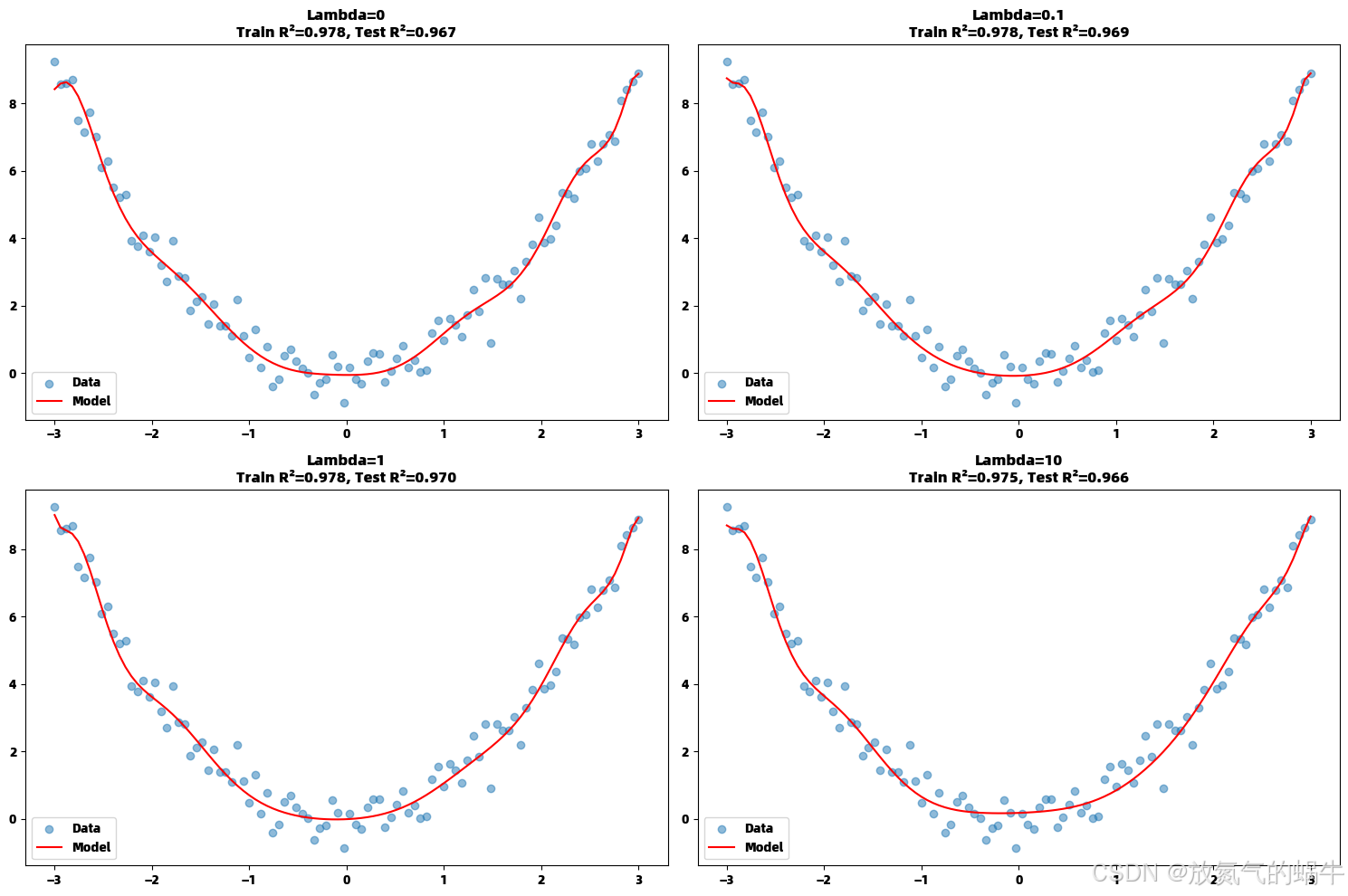
def demonstrate_overfitting():
    """演示过拟合现象"""
    np.random.seed(42)

    # 生成数据
    X = np.linspace(-3, 3, 100).reshape(-1, 1)
    y = X.ravel() ** 2 + np.random.normal(0, 0.5, 100)

    # 创建多项式特征
    poly = PolynomialFeatures(degree=15)
    X_poly = poly.fit_transform(X)

    # 划分训练测试集
    X_train, X_test, y_train, y_test = train_test_split(X_poly, y, test_size=0.3, random_state=42)

    # 训练不同正则化强度的模型
    lambdas = [0, 0.1, 1, 10]
    models = []

    for lambda_ in lambdas:
        model = Ridge(alpha=lambda_)
        model.fit(X_train, y_train)
        models.append(model)

        train_score = model.score(X_train, y_train)
        test_score = model.score(X_test, y_test)
        print(f"Lambda={lambda_}: Train R²={train_score:.3f}, Test R²={test_score:.3f}")

    # 绘制结果
    plt.figure(figsize=(15, 10))
    X_plot = np.linspace(-3, 3, 100).reshape(-1, 1)
    X_plot_poly = poly.transform(X_plot)

    for i, (lambda_, model) in enumerate(zip(lambdas, models)):
        plt.subplot(2, 2, i+1)
        plt.scatter(X, y, alpha=0.5, label='Data')
        plt.plot(X_plot, model.predict(X_plot_poly), 'r-', label='Model')
        plt.title(f'Lambda={lambda_}\nTrain R²={model.score(X_train, y_train):.3f}, Test R²={model.score(X_test, y_test):.3f}')
        plt.legend()

    plt.tight_layout()
    plt.show()

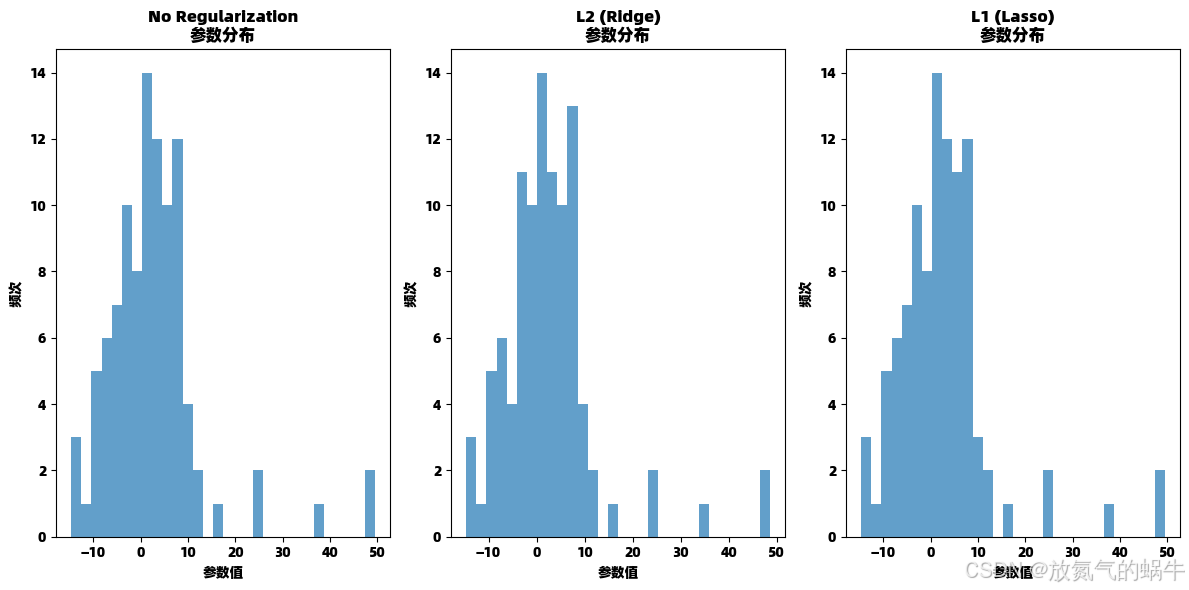
def compare_regularization_methods():
    """比较不同正则化方法"""
    # 生成高维数据
    X, y = make_regression(n_samples=100, n_features=100, n_informative=10, noise=0.1, random_state=42)
    X_train, X_test, y_train, y_test = train_test_split(X, y, test_size=0.3, random_state=42)

    # 不同正则化方法
    methods = {
        'No Regularization': RegularizedLinearRegression(regularization_type='none', lambda_=0),
        'L2 (Ridge)': RegularizedLinearRegression(regularization_type='l2', lambda_=1.0),
        'L1 (Lasso)': RegularizedLinearRegression(regularization_type='l1', lambda_=0.1),
    }

    results = {}
    for name, model in methods.items():
        model.fit(X_train, y_train)
        train_pred = model.predict(X_train)
        test_pred = model.predict(X_test)

        train_mse = mean_squared_error(y_train, train_pred)
        test_mse = mean_squared_error(y_test, test_pred)

        results[name] = {
            'train_mse': train_mse,
            'test_mse': test_mse,
            'theta': model.theta
        }

        print(f"{name}: Train MSE={train_mse:.4f}, Test MSE={test_mse:.4f}")

    # 绘制参数大小比较
    plt.figure(figsize=(12, 6))
    for i, (name, result) in enumerate(results.items()):
        plt.subplot(1, 3, i+1)
        plt.hist(result['theta'][1:], bins=30, alpha=0.7)
        plt.title(f'{name}\n参数分布')
        plt.xlabel('参数值')
        plt.ylabel('频次')

    plt.tight_layout()
    plt.show()

    return results

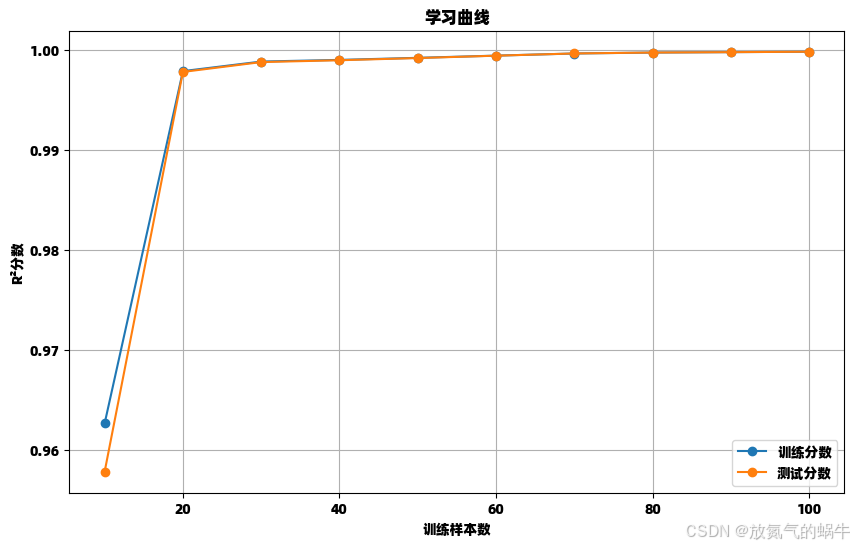
def plot_learning_curves():
    """绘制学习曲线"""
    X, y = make_regression(n_samples=100, n_features=1, noise=0.1, random_state=42)

    train_sizes = np.linspace(0.1, 1.0, 10)
    train_scores = []
    test_scores = []

    for train_size in train_sizes:
        size = int(train_size * len(X))
        X_train, y_train = X[:size], y[:size]

        model = Ridge(alpha=1.0)
        model.fit(X_train, y_train)

        train_scores.append(model.score(X_train, y_train))
        test_scores.append(model.score(X, y))

    plt.figure(figsize=(10, 6))
    plt.plot(train_sizes * len(X), train_scores, 'o-', label='训练分数')
    plt.plot(train_sizes * len(X), test_scores, 'o-', label='测试分数')
    plt.xlabel('训练样本数')
    plt.ylabel('R²分数')
    plt.title('学习曲线')
    plt.legend()
    plt.grid(True)
    plt.show()

# 示例使用
if __name__ == "__main__":
    print("=== 演示过拟合现象 ===")
    demonstrate_overfitting()

    print("\n=== 比较正则化方法 ===")
    results = compare_regularization_methods()

    print("\n=== 绘制学习曲线 ===")
    plot_learning_curves()

    # 逻辑回归正则化示例
    print("\n=== 逻辑回归正则化 ===")
    X, y = make_classification(n_samples=100, n_features=20, n_informative=5, random_state=42)
    X_train, X_test, y_train, y_test = train_test_split(X, y, test_size=0.3, random_state=42)

    # 标准化数据
    scaler = StandardScaler()
    X_train_scaled = scaler.fit_transform(X_train)
    X_test_scaled = scaler.transform(X_test)

    # 训练不同正则化强度的逻辑回归
    for lambda_ in [0, 0.1, 1, 10]:
        model = RegularizedLogisticRegression(regularization_type='l2', lambda_=lambda_)
        model.fit(X_train_scaled, y_train)

        train_acc = accuracy_score(y_train, model.predict(X_train_scaled))
        test_acc = accuracy_score(y_test, model.predict(X_test_scaled))

        print(f"Lambda={lambda_}: Train Acc={train_acc:.3f}, Test Acc={test_acc:.3f}")
=== 演示过拟合现象 ===
Lambda=0: Train R²=0.978, Test R²=0.967
Lambda=0.1: Train R²=0.978, Test R²=0.969
Lambda=1: Train R²=0.978, Test R²=0.970
Lambda=10: Train R²=0.975, Test R²=0.966
=== 比较正则化方法 ===
Iteration 0: Cost = 9690.857737
Iteration 100: Cost = 496.288737
Iteration 200: Cost = 187.405795
Iteration 300: Cost = 105.408628
Iteration 400: Cost = 69.986436
Iteration 500: Cost = 50.450349
Iteration 600: Cost = 37.961404
Iteration 700: Cost = 29.270814
Iteration 800: Cost = 22.923681
Iteration 900: Cost = 18.151277
No Regularization: Train MSE=29.0523, Test MSE=9051.8558
Iteration 0: Cost = 9690.897007
Iteration 100: Cost = 550.161090
Iteration 200: Cost = 253.243035
Iteration 300: Cost = 176.796888
Iteration 400: Cost = 144.740938
Iteration 500: Cost = 127.569600
Iteration 600: Cost = 116.902674
Iteration 700: Cost = 109.687672
Iteration 800: Cost = 104.564992
Iteration 900: Cost = 100.820361
L2 (Ridge): Train MSE=38.6537, Test MSE=9037.9862
Iteration 0: Cost = 9690.881719
Iteration 100: Cost = 497.123914
Iteration 200: Cost = 188.303378
Iteration 300: Cost = 106.328689
Iteration 400: Cost = 70.927166
Iteration 500: Cost = 51.406526
Iteration 600: Cost = 38.930708
Iteration 700: Cost = 30.250578
Iteration 800: Cost = 23.912109
Iteration 900: Cost = 19.146383
L1 (Lasso): Train MSE=29.0818, Test MSE=9034.9739
=== 绘制学习曲线 ===
=== 逻辑回归正则化 ===
Lambda=0: Train Acc=0.829, Test Acc=0.800
Lambda=0.1: Train Acc=0.829, Test Acc=0.800
Lambda=1: Train Acc=0.843, Test Acc=0.800
Lambda=10: Train Acc=0.814, Test Acc=0.767
训练流程解析
一、整体结构概览
| 模块 | 功能 |
|---|---|
RegularizedLinearRegression |
手动实现带 L1/L2/ElasticNet 正则化的线性回归 |
RegularizedLogisticRegression |
手动实现带 L1/L2 正则化的逻辑回归 |
demonstrate_overfitting() |
展示高阶多项式+无正则化 → 过拟合 |
compare_regularization_methods() |
对比不同正则化对参数的影响 |
plot_learning_curves() |
绘制学习曲线,判断模型是否收敛 |
if __name__ == "__main__": |
主程序,运行所有演示 |
二、第一部分:带正则化的线性回归
python
class RegularizedLinearRegression:
    def __init__(...): ...
    def _add_intercept(self, X): ...
    def _compute_cost(self, X, y): ...
    def _compute_gradient(self, X, y): ...
    def fit(self, X, y): ...
    def predict(self, X): ...
1. _add_intercept(X)
python
def _add_intercept(self, X):
    intercept = np.ones((X.shape[0], 1))
    return np.concatenate((intercept, X), axis=1)
作用: 添加截距项 x0=1
- 输入:
(m, n)→ 输出:(m, n+1) - 使得模型可以学习偏置项 θ0θ0
2. _compute_cost(X, y):损失函数(关键!)
python
mse_cost = (1 / (2 * m)) * np.sum(error ** 2)核心公式(MSE 损失):
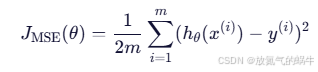
其中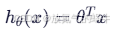
3. _compute_gradient(X, y):梯度计算
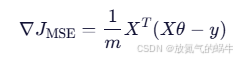
python
gradient = (1 / m) * X.T.dot(error) # 基础梯度基础梯度(MSE):