Python 列表 实用事务
本文聚焦 Python 列表的去重、计数与统计操作,包含多种去重方法、高效计数技巧及常用统计函数。
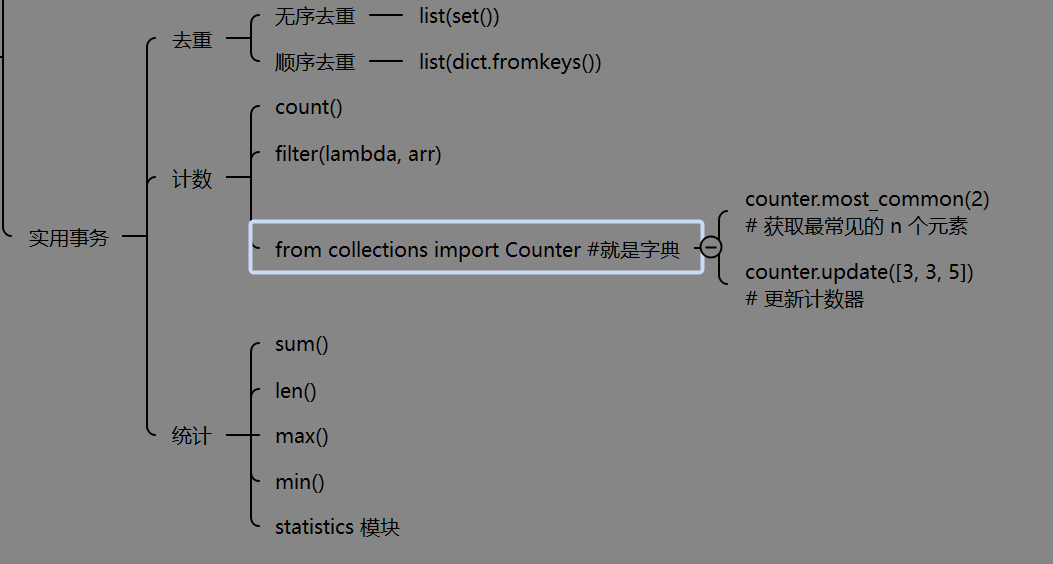
我也将给出个人思维导图
一、去重
1.1 使用 set()
最简单的去重方法,利用集合的特性:
python
nums = [1, 2, 2, 3, 3, 3, 4]

# 转为集合再转回列表
unique = list(set(nums))
# [1, 2, 3, 4] - 顺序可能改变

# 字符串去重
chars = list('hello')
unique = list(set(chars))
# ['h', 'e', 'l', 'o']
注意 :
set()不保证顺序,元素顺序可能改变。
1.2 保持顺序去重
python
# 方法 1:使用 dict.fromkeys()(Python 3.7+,推荐)
nums = [1, 2, 2, 3, 3, 3, 4]
unique = list(dict.fromkeys(nums))
# [1, 2, 3, 4] - 保持原顺序

# 方法 2:列表推导式(巧妙但不易读)
def unique_ordered(lst):
    seen = []
    return [x for x in lst if not (x in seen or seen.append(x))]

# 逐行解释 [x for x in lst if not (x in seen or seen.append(x))]:
# 遍历 lst = [1, 2, 2, 3]:
#
#   x = 1:  (1 in seen) = False ← 事件流 A:没见过
#           → 继续执行右边:seen.append(1) → seen = [1],返回 None
#           → (False or None) = None(假值)
#           → not None = True
#           → 结果:保留 1
#
#   x = 2:  (2 in seen) = False ← 事件流 A:没见过
#           → 继续执行右边:seen.append(2) → seen = [1, 2],返回 None
#           → (False or None) = None
#           → not None = True
#           → 结果:保留 2
#
#   x = 2:  (2 in seen) = True  ← 事件流 B:已经见过了
#           → 短路!不执行右边(不 append,seen 保持不变)
#           → (True or ...) = True
#           → not True = False
#           → 结果:过滤掉这个 2
#
# 事件流 A:x in seen 为 False(没见过)
#   1. 继续计算 or 右边:seen.append(x)
#   2. append() 将 x 加入 seen,返回 None
#   3. (False or None) = None
#   4. not None = True → 保留 x
#
# 事件流 B:x in seen 为 True(已见过)
#   1. or 短路,不计算右边(不执行 append)
#   2. (True or ...) = True
#   3. not True = False → 过滤 x
#
# 关键技巧:
# - or 短路:左边为真就不算右边
# - append() 返回 None(假值)
# - not None = True(保留),not True = False(过滤)

# 等价的传统写法(更易理解):
# def unique_ordered(lst):
#     result = []
#     for x in lst:
#         if x not in result:      # 如果 x 没见过
#             result.append(x)     # 添加到结果
#     return result

nums = [1, 2, 2, 3, 3, 3, 4]
unique = unique_ordered(nums)
# [1, 2, 3, 4]

# 方法 3:使用 set 辅助(更高效)
def unique_ordered_set(lst):
    seen = set()
    result = []
    for item in lst:
        if item not in seen:
            seen.add(item)
            result.append(item)
    return result
1.3 字符串列表去重
python
words = ['apple', 'banana', 'apple', 'cherry', 'banana']

# 基础去重
unique = list(set(words))
# ['cherry', 'banana', 'apple'] - 顺序可能改变

# 保持顺序
unique = list(dict.fromkeys(words))
# ['apple', 'banana', 'cherry']

# 不区分大小写去重
words = ['Apple', 'apple', 'BANANA', 'banana']
unique = list(dict.fromkeys(word.lower() for word in words))
# ['apple', 'banana']
1.4 嵌套列表去重
python
# 嵌套列表(可哈希)
matrix = [[1, 2], [3, 4], [1, 2], [5, 6]]

# 方法 1:转为元组去重
unique = [list(x) for x in set(tuple(x) for x in matrix)]
# [[1, 2], [3, 4], [5, 6]] - 顺序可能改变

# 方法 2:保持顺序
def unique_nested(lst):
    seen = set()
    result = []
    for item in lst:
        t = tuple(item)
        if t not in seen:
            seen.add(t)
            result.append(item)
    return result

matrix = [[1, 2], [3, 4], [1, 2], [5, 6]]
unique = unique_nested(matrix)
# [[1, 2], [3, 4], [5, 6]]
1.5 按条件去重
python
# 按某个属性去重(嵌套列表)
students = [['Alice', 20], ['Bob', 22], ['Alice', 21]]

# 按姓名去重(保留第一次出现)
def unique_by_key(lst, key_func):
    seen = set()
    result = []
    for item in lst:
        key = key_func(item)
        if key not in seen:
            seen.add(key)
            result.append(item)
    return result

unique = unique_by_key(students, lambda x: x[0])
# [['Alice', 20], ['Bob', 22]]

# 按值去重(数值列表)
nums = [1, -1, 2, -2, 1, 2]

# 按绝对值去重
unique = list(dict.fromkeys(nums, key=abs))
# [1, -1, 2, -2]
二、计数
2.1 count() 方法
列表内置的计数方法:
python
nums = [1, 2, 2, 3, 3, 3, 4]

# 统计单个元素出现次数
nums.count(3)   # 3
nums.count(5)   # 0

# 字符串列表
words = ['apple', 'banana', 'apple', 'cherry']
words.count('apple')  # 2

# 统计多个元素
nums = [1, 2, 2, 3, 3, 3]
counts = {x: nums.count(x) for x in set(nums)}
# {1: 1, 2: 2, 3: 3}
注意 :
count()时间复杂度为 O(n),大量统计时效率较低。
2.2 collections.Counter
更高效的计数工具:
python
from collections import Counter

nums = [1, 2, 2, 3, 3, 3, 4, 4, 4, 4]

# 创建计数器
counter = Counter(nums)
# Counter({4: 4, 3: 3, 2: 2, 1: 1})

# 获取元素出现次数
counter[3]      # 3
counter.get(5, 0)  # 0(不存在返回默认值)

# 获取最常见的 n 个元素
counter.most_common(2)
# [(4, 4), (3, 3)]

# 更新计数器
counter.update([3, 3, 5])
# Counter({4: 4, 3: 5, 2: 2, 1: 1, 5: 1})
注意 :
Counter是dict的子类,Python 3.7+ 中保持插入顺序,元素按首次出现的顺序排列。
2.3 统计所有元素
python
from collections import Counter

words = ['apple', 'banana', 'apple', 'cherry', 'banana', 'apple']

# 方法 1:Counter
counter = Counter(words)
# Counter({'apple': 3, 'banana': 2, 'cherry': 1})

# 转为字典
dict(counter)
# {'apple': 3, 'banana': 2, 'cherry': 1}

# 方法 2:字典推导式
counts = {word: words.count(word) for word in set(words)}
# {'apple': 3, 'banana': 2, 'cherry': 1}

# 方法 3:循环统计
def count_all(lst):
    counts = {}
    for item in lst:
        counts[item] = counts.get(item, 0) + 1
    return counts
2.4 条件计数
python
nums = [1, 2, 3, 4, 5, 6, 7, 8, 9]

# 统计偶数个数
sum(1 for x in nums if x % 2 == 0)  # 4

# 统计大于 5 的个数
sum(1 for x in nums if x > 5)  # 4

# 使用 len + filter
len(list(filter(lambda x: x % 2 == 0, nums)))  # 4
三、统计
3.1 基本统计函数
python
nums = [1, 2, 3, 4, 5, 6, 7, 8, 9, 10]

# 求和
sum(nums)           # 55

# 个数
len(nums)           # 10

# 最大值
max(nums)           # 10

# 最小值
min(nums)           # 1

# 最大值的索引
nums.index(max(nums))  # 9
3.2 statistics 模块
Python 标准库的统计模块:
python
import statistics

nums = [1, 2, 3, 4, 5, 6, 7, 8, 9, 10]

# 平均值
statistics.mean(nums)       # 5.5

# 中位数
statistics.median(nums)     # 5.5

# 众数(出现最频繁)
data = [1, 2, 2, 3, 3, 3, 4]
statistics.mode(data)      # 3

# 标准差
statistics.stdev(nums)      # 3.027...

# 方差
statistics.variance(nums)   # 9.166...
3.3 列表推导式统计
python
# 提取嵌套数据统计
students = [['Alice', 85], ['Bob', 92], ['Charlie', 78]]

# 平均成绩
sum(s[1] for s in students) / len(students)  # 85.0

# 最高分学生
max(students, key=lambda s: s[1])  # ['Bob', 92]

# 及格人数
sum(1 for s in students if s[1] >= 80)  # 2
3.4 分组统计
python
from collections import defaultdict

scores = [
    ['Alice', 'A', 85],
    ['Bob', 'B', 92],
    ['Charlie', 'A', 78],
    ['David', 'B', 88],
]

# 按班级分组
by_class = defaultdict(list)
for name, cls, score in scores:
    by_class[cls].append(score)

# 各班平均分
{cls: sum(scores) / len(scores) for cls, scores in by_class.items()}
# {'A': 81.5, 'B': 90.0}
四、性能对比
4.1 去重方法性能
python
import timeit

TEST_LIST = "list(range(10000)) * 10"  # 100000 个元素

# set() 去重
timeit.timeit("list(set(lst))", setup="lst = " + TEST_LIST, number=100)
# 相对速度:1.0x(最快)

# dict.fromkeys() 去重
timeit.timeit("list(dict.fromkeys(lst))", setup="lst = " + TEST_LIST, number=100)
# 相对速度:1.2x

# 循环判断去重
timeit.timeit("unique_ordered_loop(lst)", setup="from __main__ import unique_ordered_loop; lst = " + TEST_LIST, number=100)
# 相对速度:10x(最慢)| 方法 | 是否保持顺序 | 相对速度 | 适用场景 |
|---|---|---|---|
set() |
否 | 1.0x | 顺序无关 |
dict.fromkeys() |
是 | 1.2x | 保持顺序 |
| 循环判断 | 是 | 10x | 小数据量 |
4.2 计数方法性能
| 方法 | 时间复杂度 | 适用场景 |
|---|---|---|
list.count() |
O(n) | 单个元素计数 |
Counter |
O(n) | 多元素计数(推荐) |
| 字典推导式+count | O(n²) | 不推荐(效率低) |
五、常见陷阱
5.1 set() 改变顺序
python
# 问题:set() 不保证顺序
nums = [3, 1, 2, 1, 4, 3]
list(set(nums))  # [1, 2, 3, 4] - 顺序改变

# 解决:使用 dict.fromkeys()
list(dict.fromkeys(nums))  # [3, 1, 2, 4]
5.2 不可哈希元素去重
python
# 错误:嵌套列表无法用 set()
matrix = [[1, 2], [3, 4], [1, 2]]
set(matrix)  # TypeError: unhashable type: 'list'

# 解决:转为元组
set(tuple(x) for x in matrix)  # {(1, 2), (3, 4)}
5.3 count() 效率问题
python
# 不推荐:多次调用 count()
nums = [1, 2, 2, 3, 3, 3]
counts = {x: nums.count(x) for x in set(nums)}  # O(n²)

# 推荐:使用 Counter
from collections import Counter
counts = Counter(nums)  # O(n)
六、总结
| 操作 | 推荐方法 | 注意事项 |
|---|---|---|
| 简单去重 | list(set(lst)) |
顺序可能改变 |
| 保持顺序去重 | list(dict.fromkeys(lst)) |
Python 3.7+ |
| 嵌套去重 | 转元组 + set | 需处理不可哈希问题 |
| 单个计数 | lst.count(x) |
- |
| 多个计数 | Counter(lst) |
高效,推荐使用 |
| 条件计数 | sum(1 for x in lst if ...) |
列表推导式 |
| 基本统计 | sum/len/max/min |
内置函数 |
| 高级统计 | statistics 模块 |
需导入模块 |