AI之Agent之VibeCoding:《Vibe Coding Kills Open Source》翻译与解读
导读 :本文提出并量化了一个关键而被低估的风险:当 AI 代理(vibe coding)大幅降低使用与组合软件的成本时,它同时可能替代维系 OSS 的"可货币化参与"渠道,导致开发者分享意愿下降、项目品种与平均质量受损,最终产出一个看似悖论性的结局------生产力提升但长期 OSS 供给与社会福利下降。要维持现有 OSS 生态与其带来的公共价值,需要平台、企业与政策层面在可归因性、支付机制和流量分配上做出制度性改变。
>> 背景痛点:
● 生产与参与脱钩:vibe coding(AI代理自动选取/组装开源组件)显著降低开发者使用与组合已有 OSS 的成本,但同时让最终用户与上游维护者的直接互动(阅读文档、提 issue、在社区问答、产生可被货币化的可见度)被替代,导致维护者难以通过"可视参与"捕获私有回报。
● 依赖参与的货币化脆弱性:许多 OSS 项目靠可见度带来的咨询、招聘、付费支持或企业服务变现;当这些互动被 AI 代理替代,变现通道会被侵蚀。
● 结果高度集中:OSS 成果呈重尾分布------多数仓库几乎无人问津,少数头部占据大部分使用量;因此任何削弱分享/进入的冲击,会被放大。
● 双重渠道的矛盾:AI 一方面通过降低使用成本提高生产力(正向),另一方面通过替代直接 engagement 削弱维护者激励(负向),两者在一般均衡下交互,可能导致看似矛盾的总体效果(生产力上升但 OSS 供给与福利下降)。
>> 具体的解决方案(论文的方法与检验方式):
● 建模框架:作者建立一个包含内生进入、项目质量异质性(Pareto 分布)、软件作为可扩展中间投入,以及用户在"直接使用 / AI 中介"之间嵌套选择的均衡模型,用以刻画 vibe coding 的双通道效应。
● 比较情景与拓展:论文不仅分析基线(大众化 vibe coding)下的长期均衡,还给出两个对照或拓展情形------(1)仅开发者使用 AI(不直接介入最终消费者),(2)允许替代货币化/商业模式,以判定哪些政策或商业模式能维持 OSS 供给。
● 校准与定量化:小论文用可观测参数校准模型(例如软件份额 β≈1/3、质量异质性 γ≈3、包替代性 σ≈1.5、使用模式替代性 θ≈3--4),并用经验证据(如 Stack Overflow 与 Tailwind 的参与/流量趋势、GitHub 上 AI 生成代码的普及)来约束模型冲击强度与用户对 AI 能力的响应度。
>> 核心思路步骤(模型与推理流程):
● 构建要素与行为者:区分用户(选择软件包并决定是否通过 AI 代理使用)与开发者(承担前期开发成本、抽取质量并决定是否公开分享),将 OSS 视为非竞争性、可作为中间品的投入。
● 两大通道识别:明确"生产力通道"(AI 降低使用/组合成本,提升用户效用与下游产出)与"需求转移通道"(AI 中介减少可货币化的直接参与,从而压缩维护者回报)。
● 内生进入与选择效应:分析开发者在预期回报下降时的退出/不分享决策;模型显示当可货币化参与下降,达到分享门槛的项目数量和质量都会下降,形成反馈回路。
● 均衡与福利对比:求解短期(开发者采用 AI 但用户未广泛中介)与长期(广泛中介)均衡;对比基线、开发者专用 AI 情形、以及引入替代货币化机制后的均衡与社会福利。
>> 优势(模型与分析的贡献):
● 理论与实证连接紧密:模型设计直接对应行业观测(AI 采纳迅速、参与替代的证据、OSS 的重尾分布),便于将少量可测参数校准为量化结论。
● 捕捉复杂反馈:通过内生进入与选择,该框架能解释为何即便总体使用量上升,供给与福利仍可下降------强调了需求表达方式(是否可被维护者捕获)的重要性。
● 政策可操作性:模型能定量给出"为维持当前 OSS 规模所需的最低每用户货币化水平",为平台设计与公共政策提供具体目标。
>> 该论文的一些结论和观点(侧重经验与建议):
● 结论:vibe coding 在传统以 engagement 为主的 OSS 货币化模式下,会降低 OSS 的共享与进入、收缩品种并降低平均被共享项目质量,从而可能造成社会福利下降(尽管生产力提高)。作者强调:生产力提升并不自动等同于长期福利提升,因维护激励被侵蚀会反向削弱供给。
● 对照结论:若 AI 主要为开发者内部工具(不介入最终用户消费),则不存在需求转移通道,AI 会促进更多进入与更高平均质量------这解释了短期/局部观察(AI 当助理提升生产力)与长期风险之间的差别。
● 经验性建议(对平台与政策制定者):
●● 建立或强化可追溯与可归因的使用/贡献信号机制,让被 AI 选用的上游项目仍能获得可见度与信用(例如自动报告来源、文档访问回传、使用统计)。
●● 探索直接或混合的货币化路径(按使用计费、微支付、平台分成、企业级订阅或托管服务),使维护者不再过度依赖公开互动产生的机会型回报。
●● 对 AI 服务提供者/平台施加设计义务或激励(例如要求在生成或自动组装时暴露所用第三方组件、为维护者提供推荐流量),以减少 engagement 被抽走导致的"窃取机制"。
●● 加强监测与指标化(量化 mediated usage 与 direct engagement 的比率,及时评估 AI 能力进步对参与度的影响),用于制定动态补偿或平台规则。
目录
[《Vibe Coding Kills Open Source》翻译与解读](#《Vibe Coding Kills Open Source》翻译与解读)
[Figure 1:Adoption of AI across industries and within software development.图 1:各行业及软件开发领域对人工智能的采用情况。](#Figure 1:Adoption of AI across industries and within software development.图 1:各行业及软件开发领域对人工智能的采用情况。)
[6 Conclusion](#6 Conclusion)
《Vibe Coding Kills Open Source》翻译与解读
|------------|--------------------------------------------------------------------------------------------------------------------------------------------------------------------------|
| 地址 | 论文地址:https://arxiv.org/abs/2601.15494 |
| 时间 | 2026年01月21日 |
| 作者 | 中欧大学(Central European University) 匈牙利经济与区域研究中心(KRTK) 欧洲经济政策研究中心(CEPR) CESifo经济研究中心(CESifo) 比勒费尔德大学(Bielefeld University) 基尔世界经济研究所(Kiel Institute for the World Economy) |
Abstract
|-----------------------------------------------------------------------------------------------------------------------------------------------------------------------------------------------------------------------------------------------------------------------------------------------------------------------------------------------------------------------------------------------------------------------------------------------------------------------------------------------------------------------------------------------------------------------------------------------------------------------------------------------------------------------------------------------------------------------------------------------------------------------------------------------------------------------------------------------------------------------------------------------------------------------------------------------------------------------------------------------------------------------------------------------------------------------------------------|---------------------------------------------------------------------------------------------------------------------------------------------------------------------------------------------------------------------------------------------------------------------------------------------------------------------------------------------------------------------|
| Generative AI is changing how software is produced and used. In vibe coding, an AI agent builds software by selecting and assembling open-source software (OSS), often without users directly reading documentation, reporting bugs, or otherwise engaging with maintainers. We study the equilibrium effects of vibe coding on the OSS ecosystem. We develop a model with endogenous entry and heterogeneous project quality in which OSS is a scalable input into producing more software. Users choose whether to use OSS directly or through vibe coding. Vibe coding raises productivity by lowering the cost of using and building on existing code, but it also weakens the user engagement through which many maintainers earn returns. When OSS is monetized only through direct user engagement, greater adoption of vibe coding lowers entry and sharing, reduces the availability and quality of OSS, and reduces welfare despite higher productivity. Sustaining OSS at its current scale under widespread vibe coding requires major changes in how maintainers are paid. | 生成式人工智能正在改变软件的生产与使用方式。在"氛围编程"中,人工智能代理通过选择和组合开源软件(OSS)来构建软件,通常用户无需直接阅读文档、报告漏洞或以其他方式与维护者互动。我们研究了氛围编程 对开源软件生态系统的影响。我们构建了一个模型,其中包含内生进入和异质项目质量,开源软件是生产更多软件的可扩展投入。用户选择直接使用开源软件还是通过氛围编程使用。氛围编程通过降低使用和基于现有代码进行开发的成本来提高生产率,但它也削弱了维护者通过用户互动获得回报的途径。当开源软件仅通过直接用户互动实现盈利时,氛围编程的更广泛应用会降低进入和共享,减少开源软件的可用性和质量,并降低福利,尽管生产率有所提高。在广泛采用氛围编程的情况下,要维持当前规模的开源软件,需要对维护者的支付方式做出重大改变。 |
1、Introduction
|----------------------------------------------------------------------------------------------------------------------------------------------------------------------------------------------------------------------------------------------------------------------------------------------------------------------------------------------------------------------------------------------------------------------------------------------------------------------------------------------------------------------------------------------------------------------------------------------------------------------------------------------------------------------------------------------------------------------------------------------------------------------------------------------------------------------------------------------------------------------------------------------------------------------------------------------------------------------------------------------------------------------------------------------------------------------------------------------------------------------------------------------------------------------------------------------------------------------------------------------------------------------------------------------------------------------------------------------------------------------------------------------------------------------------------------------------------------------------------------------------------------------------------------------------------------------------------------------------------------------------------------------------------------------------------------------------------------------------------------------------------------------------------------------------------------------------------------------------------------------------------------------------------------------------------------------------------------------------------------------------------------------------------------------------------------------------------------------------------------------------------------|-----------------------------------------------------------------------------------------------------------------------------------------------------------------------------------------------------------------------------------------------------------------------------------------------------------------------------------------------------------------------------------------------------------------------------------------------------------------------------------------------------------------------------------------------------------------------------------------------------------------------------------------------------------------------------------------------------------------------|
| Generative AI is reshaping software development. AI coding assistants such as Claude Code, Cursor, and Lovable let users translate intent into working applications with little or no manual coding. This AI-mediated mode of building software is often called "vibe coding." Vibe coding reduces the cost of producing software, but it also changes how users interact with the software ecosystem. Traditionally, a developer selects packages, reads documentation, and interacts with maintainers and other users. Under vibe coding, an AI agent can select, compose, and modify packages end-to-end, and the human developer may not know which upstream components were used. This shift raises a general equilibrium question about the sustainability of open source software (OSS). OSS is a nonrival input into producing more software, and it generates large social value relative to its direct production cost (Hoffmann et al., 2024). Yet many OSS projects rely on visibility and engagement from direct users---documentation visits, bug reports, public Q&A, and reputation---to sustain maintenance and capture private returns (Lerner and Tirole, 2002; Jones, 2020). If AI mediation substitutes for direct interaction, then the technology that makes software easier to use may simultaneously erode the engagement-based channel that funds and motivates its supply. We ask whether the productivity gains from vibe coding outweigh the loss of appropriable demand once developer entry and selection respond. | 生成式人工智能 正在重塑软件开发。诸如 Claude Code、Cursor 和 Lovable 等 AI 编码助手让用户能够将意图转化为可运行的应用程序,而无需或只需少量手动编码。这种由 AI 中介的软件构建模式通常被称为"氛围编程 "。氛围编程降低了软件生产的成本,但它也改变了用户与软件生态系统互动的方式。传统上,开发人员会挑选软件包、阅读文档,并与维护者和其他用户进行互动。而在氛围编程模式下,AI 代理可以端到端地选择、组合和修改软件包,而人类开发人员可能并不知道使用了哪些上游组件。 这种转变引发了一个关于开源软件(OSS)可持续性的总体均衡问题。开源软件是非竞争性的软件生产投入,其产生的社会价值远高于直接生产成本(Hoffmann 等人,2024 年)。然而,许多开源项目依赖于直接用户的可见性和参与度------文档访问、错误报告、公共问答以及声誉------来维持维护工作并获取私人回报(Lerner 和 Tirole,2002 年;Jones,2020 年)。如果人工智能调解取代了直接互动,那么使软件更易于使用的技术可能会同时削弱基于参与度的渠道,而这一渠道为开源软件的供应提供资金并激励其发展。我们探讨了在开发者进入和选择做出反应后,从氛围编程中获得的生产率提升是否能抵消可获取需求的损失。 |
| We build a tractable model of the OSS ecosystem in the spirit of monopolistic competition with endogenous variety (Krugman, 1980) and heterogeneous-project selection (Melitz, 2003). Developers incur an up-front development cost before project quality is realized, draw project quality from a Pareto distribution, and then decide whether to release the project as OSS by paying a fixed sharing cost. Users value variety and choose among available packages under a discrete-choice demand system. In addition, after selecting a package, users choose whether to interact with it directly or through an AI agent. This nested choice captures that vibe coding is a usage technology that affects both user utility and the degree of engagement that maintainers can monetize. Vibe coding affects the OSS ecosystem through two channels. The first is a productivity channel: by reducing the effective cost of using a given package, AI raises user utility and lowers the cost of producing new software that builds on existing components. Even before state-of-the-art vibe coding tools, field experiments documented sizable productivity gains from AI coding assistance (Peng et al., 2023; Cui et al., 2025). The second is a demand-diversion channel: when users rely on AI agents rather than direct interaction, maintainers capture less engagement and therefore less private return per unit of usage. These channels interact because entry and sharing are endogenous. Better usage technology raises the value of the ecosystem as an intermediate input and would tend to increase entry. But a contraction in monetizable engagement shrinks the effective market for OSS maintainers and discourages sharing and entry. Since "customer demand motivates the supply of energy that drives software ecosystems" (Jones, 2020), a technology that alters how demand is expressed can reshape supply even if total usage rises. | 我们构建了一个开源软件生态系统的可处理模型,其精神类似于具有内生多样性的垄断竞争(克鲁格曼,1980 年)和异质项目选择(梅利茨,2003 年)。开发者在项目质量实现之前会承担前期开发成本,从帕累托分布中抽取项目质量,然后决定是否通过支付固定共享成本将项目作为开源软件发布。用户重视多样性,并在离散选择需求系统下从可用软件包中进行选择。此外,在选择软件包后,用户决定是直接与之互动还是通过人工智能代理进行互动。这种嵌套选择反映了氛围编程是一种使用技术,它既影响用户效用,也影响维护者能够货币化的参与度程度。 氛围编程通过两个渠道影响开源软件生态系统。首先是一条生产力渠道:通过降低使用特定软件包的有效成本,人工智能提高了用户效用,并降低了基于现有组件开发新软件的成本。甚至在最先进的代码生成工具出现之前,实地实验就已证明,人工智能代码辅助带来了显著的生产力提升(彭等人,2023 年;崔等人,2025 年)。其次是需求转移渠道:当用户依赖人工智能代理而非直接交互时,维护者获得的参与度降低,因此每单位使用量的私人回报也减少。这些渠道相互作用,因为进入和共享是内生的。更好的使用技术提高了生态系统作为中间投入的价值,并且往往会增加进入。但可货币化的参与度收缩会缩小开源软件维护者的有效市场,从而抑制共享和进入。由于"客户需求激励了驱动软件生态系统的能量供应"(琼斯,2020 年),即使总使用量上升,改变需求表达方式的技术也可能重塑供应。 |
| Our main result is that under traditional OSS business models, where maintainers primarily monetize direct user engagement (higher visibility leading to paid opportunities or other forms of appreciation), higher adoption of vibe coding reduces OSS provision and lowers welfare. In the long-run equilibrium, mediated usage erodes the revenue base that sustains OSS, raises the quality threshold for sharing, and reduces the mass of shared packages. Variety shrinks and the average quality of shared OSS falls, so user utility can decline despite better AI. The decline can be rapid because the same magnification mechanism that amplifies positive shocks to software demand also amplifies negative shocks to monetizable engagement. In other words, feedback loops that once accelerated growth now accelerate contraction. The key intuition behind the negative channel is that when mediated adoption is responsive to AI capability, direct engagement can fall faster than development costs decline. Utility falls because entry decisions generate a business-stealing externality: when a new package enters, it attracts users away from existing packages, but the entrant does not internalize that this diversion reduces the engagement-based returns that other maintainers rely on. The strength of this diversion depends on how responsive users are to improvements in AI capability: when AI tools get better, how quickly do users switch away from direct interaction? The rapid diffusion of AI coding assistants suggests high responsiveness; in the policy section, we discuss how to quantify it using adoption and usage data (Demirer et al., 2025). | 我们的主要研究结果表明,在传统的开源软件商业模式中,维护者主要通过直接用户参与来实现盈利(更高的可见度带来付费机会或其他形式的回报),在这种情况下,采用"氛围编程"的程度越高,开源软件的供应就越少,福利水平也就越低。在长期均衡状态下,中介使用会侵蚀支撑开源软件的收入基础,提高共享的质量门槛,并减少共享软件包的数量。软件的多样性会减少,共享开源软件的平均质量会下降,因此尽管人工智能有所改进,但用户效用仍可能降低。这种下降可能会很快发生,因为放大软件需求正向冲击的相同机制也会放大可盈利参与度的负向冲击。换句话说,曾经加速增长的反馈循环现在会加速收缩。 "负面渠道"的关键直觉在于,当中介采用率对人工智能能力做出反应时,直接参与度的下降速度可能会快于开发成本的下降速度。效用下降是因为进入决策产生了业务分流的外部性:当一个新的软件包进入时,它会吸引用户从现有的软件包转移过来,但新进入者并未将这种转移导致其他维护者所依赖的基于用户参与度的收益减少这一情况内部化。这种分流的程度取决于用户对人工智能能力提升的响应程度:当人工智能工具变得更好时,用户多快会从直接交互转向使用这些工具?人工智能编码助手的迅速普及表明用户响应度很高;在政策部分,我们讨论了如何利用采用和使用数据来量化这一响应度(Demirer 等人,2025 年)。 |
| We also analyze two extensions. First, we consider a benchmark in which vibe coding is used only by professional software developers and does not directly mediate final-user consumption. In this case, the demand-diversion channel is absent: AI lowers development costs without eroding engagement-based monetization. The equilibrium features higher entry and higher average quality of shared OSS. This benchmark helps interpret short-run dynamics in which AI is primarily a developer productivity tool, while vendors increasingly target non-developer users as well (Anthropic, 2026). Second, we allow for alternative monetization arrangements and ask what is the lowest per-user monetization that sustain OSS entry at its current level. This can be lower than the current level, because the increase in productivity partly offsets the loss of developer reward. But, under plausible parameters, per-user monetization must remain very close to current levels to avoid large declines in OSS provision. To keep the analysis tied to how OSS is produced and used, we tailor the model to four salient industry features: large fixed costs and nonrivalry, user love of variety, heavy-tailed heterogeneity in project outcomes with endogenous selection into sharing, and software as an intermediate input into producing more software (a "software-begets-software" feedback). These features are quantitatively important for OSS, where most repositories attract no attention and a small upper tail accounts for a large share of usage. The remainder of this paper is structured as follows. Section 2 documents industry trends and institutional details that motivate the model, including rapid AI diffusion, engagement substitution under AI mediation, and concentration in OSS outcomes. Section 3 develops the model and derives equilibrium and welfare results in the baseline economy and under vibe coding. Section 4 discusses parameter choices and illustrates the quantitative implications. Section 5 concludes and discusses implications for platform design and policy. | 我们还分析了两个扩展情况。首先,我们考虑一个基准,在该基准中,氛围编程仅由专业软件开发人员使用,并且不直接介导最终用户的消费。在这种情况下,需求分流渠道不存在:人工智能降低了开发成本,而不会侵蚀基于用户参与度的盈利模式。在这种均衡状态下,进入率更高,共享开源软件的平均质量也更高。这一基准有助于解读短期内的动态,在这种动态中,人工智能主要是一种开发者生产力工具,而供应商越来越多地将非开发者用户作为目标(Anthropic,2026)。其次,我们考虑了其他盈利模式,并询问在当前开源软件(OSS)进入水平下,维持其进入所需的最低每用户盈利水平是多少。这可能低于当前水平,因为生产力的提高在一定程度上抵消了开发者奖励的损失。但是,在合理的参数下,每用户盈利水平必须保持在接近当前的水平,以避免开源软件供应的大幅下降。 为了使分析与开源软件的生产和使用方式保持一致,我们将模型调整为四个显著的行业特征:巨大的固定成本和非竞争性、用户对多样性的喜爱、项目成果的重尾异质性以及内生选择共享,以及软件作为生产更多软件的中间投入(一种"软件生软件"的反馈)。这些特征对于开源软件来说在数量上非常重要,因为大多数存储库都无人问津,而一小部分处于上尾的项目占据了很大的使用份额。 本文的其余部分结构如下。第 2 节记录了推动该模型的行业趋势和机构细节,包括人工智能的迅速扩散、在人工智能中介下的参与替代以及开源软件成果的集中。第 3 节构建了模型,并在基准经济和 vibe 编码下推导出均衡和福利结果。第 4 节讨论了参数选择,并说明了其定量影响。第 5 节总结了全文,并讨论了对平台设计和政策的影响。 |
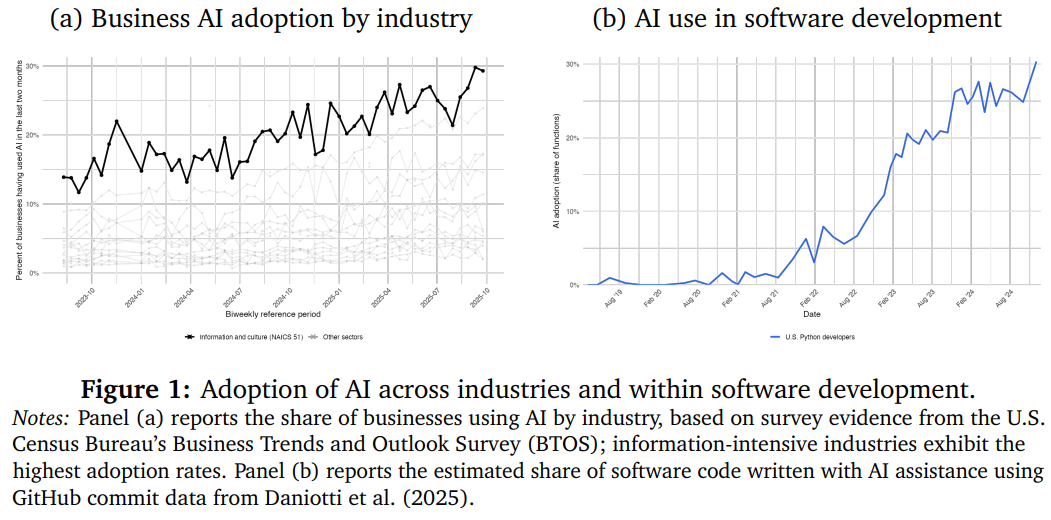
Figure 1:Adoption of AI across industries and within software development.图 1:各行业及软件开发领域对人工智能的采用情况。
6 Conclusion
|----------------------------------------------------------------------------------------------------------------------------------------------------------------------------------------------------------------------------------------------------------------------------------------------------------------------------------------------------------------------------------------------------------------------------------------------------------------------------------------------------------------------------------------------------------------------------------------------------------------------------------------------------------------------------------------------------------------------------------------------------------------------------------------------------------------------------------------------------------------------------------------------------------------------------------------------------------------------------------------------------------------------------------------------------------------------------------------------------------------------------------------------------------------------------------------------------------------------------------------------------------------------------------------------------------------------------------------------------------------|---------------------------------------------------------------------------------------------------------------------------------------------------------------------------------------------------------------------------------------------------------------------------------------------------------------------------------------------------------------------------------------------------------------------------------------------|
| Open source software is a critical modern industry whose economic impact has been widely underappreciated. This sector grew rapidly over the past two decades, only to face the shock of AI-mediated software development, or "vibe coding." This paper studies what happens to this ecosystem following a technological shock that is extremely large, extremely fast, and extremely important for the sector. We develop a general equilibrium model of the open source software ecosystem that captures four key economic features. First, software production exhibits strong economies of scale. Second, users value variety. Third, projects differ substantially in quality, and developers observe quality ex post, leading to selection in which projects are released. Fourth, software is an intermediate input into producing more software---a richer ecosystem of existing packages lowers the cost of building new ones, creating positive feedback. In equilibrium, user adoption and developer entry jointly determine the variety and quality of available packages. | 开源软件是现代产业中至关重要的一环,其经济影响却一直被严重低估。过去二十年间,该领域发展迅速,却突然遭遇了由人工智能驱动的软件开发,即"氛围编程"的冲击。本文研究了在这一对行业影响巨大、发展迅猛且极为重要的技术冲击下,开源软件生态系统会发生何种变化。 我们构建了一个开源软件生态系统的一般均衡模型,该模型涵盖了四个关键的经济特征。首先,软件生产具有很强的规模经济效应。其次,用户重视多样性。第三,项目质量差异显著,开发者在事后才能观察到质量,从而导致项目发布时的选择性。第四,软件是生产更多软件的中间投入品------现有软件包的生态系统越丰富,开发新软件包的成本就越低,从而形成正反馈。在均衡状态下,用户采用和开发者进入共同决定了可用软件包的多样性和质量。 |
| Vibe coding enters the model as an AI-mediated mode of interacting with software that operates through two channels. The cost channel raises productivity: users can adopt packages more easily, and developers can build on existing code more efficiently. The demand-diversion channel shifts users from direct interaction---reading documentation, filing bug reports, engaging with maintainers---toward AI-mediated usage. Under traditional open source business models based on visibility and engagement, this diversion erodes the revenue base that sustains contribution. The model's central result is a horse race between these two channels. The critical threshold is the vibe discount ρ, which measures how much monetization falls when users switch from direct to vibe-coded interaction. When ρ exceeds the ratio of substitutability parameters σ/θ, quality declines with vibe coding adoption. Under the traditional business model where ρ=1, collapse is inevitable as adoption approaches universality. The same magnification logic that made open source explode---lower costs leading to more entry, more variety, and self-reinforcing growth---operates in reverse. When monetizable demand contracts, entry falls, variety shrinks, and the resulting decline in ecosystem quality further weakens incentives for sharing. | 氛围编程作为人工智能驱动的软件交互模式进入模型,通过两个渠道发挥作用。成本渠道提高了生产力:用户能够更轻松地采用软件包,开发者也能更高效地基于现有代码进行开发。需求转移渠道则将用户从直接交互(阅读文档、提交错误报告、与维护者互动)转向由人工智能介导的使用方式。在基于可见性和参与度的传统开源商业模式下,这种转移会侵蚀支撑贡献的收入基础。 该模型的核心结果是这两个渠道之间的竞争。关键阈值是 vibe 折扣 ρ,它衡量了当用户从直接交互转向 vibe 编码交互时,货币化程度下降的程度。当 ρ 超过替代性参数的比率 σ/θ 时,随着 vibe 编码的采用,质量会下降。在传统商业模式中,当 ρ = 1 时,随着采用率接近普遍化,崩溃不可避免。使开源得以爆发的相同放大逻辑------成本降低导致更多进入、更多多样性以及自我强化的增长------在此则反向运作。当可变现的需求萎缩时,新加入者减少,种类缩减,由此导致的生态系统质量下降进一步削弱了分享的激励。 |