文章目录
-
- [1、144 二叉树的前序遍历(递归版)](#1、144 二叉树的前序遍历(递归版))
- [2、94 二叉树的中序遍历(递归版)](#2、94 二叉树的中序遍历(递归版))
- [3、145 二叉树的后序遍历(递归版)](#3、145 二叉树的后序遍历(递归版))
- [4、144 二叉树的前序遍历(迭代版)](#4、144 二叉树的前序遍历(迭代版))
-
- [1. 观察切入点:手动维护"待办清单"](#1. 观察切入点:手动维护“待办清单”)
- [2. 核心原理:右孩子先入栈](#2. 核心原理:右孩子先入栈)
- [3. C 语言实现代码](#3. C 语言实现代码)
- [4. 逻辑推演:为什么顺序不会乱?](#4. 逻辑推演:为什么顺序不会乱?)
- [5. 避坑指南](#5. 避坑指南)
- [🚀 进阶思考](#🚀 进阶思考)
- [1. 核心原理:为什么要用 `**`(二级指针)?](#1. 核心原理:为什么要用
**(二级指针)?) - [2. 内存布局拆解](#2. 内存布局拆解)
- [3. 避坑指南:它在迭代中是怎么干活的?](#3. 避坑指南:它在迭代中是怎么干活的?)
- 总结
- [5、94 二叉树的中序遍历(迭代版)](#5、94 二叉树的中序遍历(迭代版))
-
- [1. 观察切入点:处理时机的滞后性](#1. 观察切入点:处理时机的滞后性)
- [2. 核心原理:先推入,后弹出](#2. 核心原理:先推入,后弹出)
- [3. C 语言代码实现](#3. C 语言代码实现)
- [4. 思路推演:逻辑是怎么"丝滑"起来的?](#4. 思路推演:逻辑是怎么“丝滑”起来的?)
- [5. 避坑指南:中序迭代的"精髓"](#5. 避坑指南:中序迭代的“精髓”)
- [📊 三大遍历迭代法对比总结](#📊 三大遍历迭代法对比总结)
- [6、145 二叉树的后序遍历(迭代版)](#6、145 二叉树的后序遍历(迭代版))
- [7、102 二叉树的层序遍历](#7、102 二叉树的层序遍历)
-
- [1. 核心模型:队列 (Queue)](#1. 核心模型:队列 (Queue))
- [2. 关键技巧:固定窗口大小 (Batch Processing)](#2. 关键技巧:固定窗口大小 (Batch Processing))
- [3. C 语言实现的难点:内存管理](#3. C 语言实现的难点:内存管理)
- [4. 思路推演:BFS 模板](#4. 思路推演:BFS 模板)
- 内存结构深度详解
- 为什么这个解法很快?
- 提交前的最后检查
- [8、107 二叉树的层序遍历②](#8、107 二叉树的层序遍历②)
- [9、199 二叉树的右视图](#9、199 二叉树的右视图)
- [10、637 二叉树的层平均值](#10、637 二叉树的层平均值)
- [11、429 N叉树的层序遍历](#11、429 N叉树的层序遍历)
-
- [1. 核心区别:观察节点结构](#1. 核心区别:观察节点结构)
- [2. 解题思路:从二叉树平移到 N 叉树](#2. 解题思路:从二叉树平移到 N 叉树)
- [3. C 语言代码实现的关键点](#3. C 语言代码实现的关键点)
- [4. 总结](#4. 总结)
- [12、515 在每个树行中找最大值](#12、515 在每个树行中找最大值)
- [13、116 填充每个节点的下一个右侧节点指针](#13、116 填充每个节点的下一个右侧节点指针)
-
- [1. 思路解析:利用"上帝视角"的横向连接](#1. 思路解析:利用“上帝视角”的横向连接)
- [2. 完整代码实现 (C 语言)](#2. 完整代码实现 (C 语言))
- [3. 逻辑推演:为什么不需要队列?](#3. 逻辑推演:为什么不需要队列?)
- [4. 复杂度对比](#4. 复杂度对比)
- [5. 避坑指南](#5. 避坑指南)
- [14、117 填充每个节点的下一个右侧节点指针](#14、117 填充每个节点的下一个右侧节点指针)
- [15、104 二叉树的最大深度](#15、104 二叉树的最大深度)
-
- [1. 递归思路:自底向上的"高度汇报"](#1. 递归思路:自底向上的“高度汇报”)
- [2. 迭代思路:层序遍历计数(BFS)](#2. 迭代思路:层序遍历计数(BFS))
- [3. C 语言代码实现](#3. C 语言代码实现)
- [4. 复杂度分析](#4. 复杂度分析)
- [💡 深度思考:深度 (Depth) vs 高度 (Height)](#💡 深度思考:深度 (Depth) vs 高度 (Height))
- 总结
- [16、111 二叉树的最小深度](#16、111 二叉树的最小深度)
-
- [1. 核心陷阱:什么是"最小深度"?](#1. 核心陷阱:什么是“最小深度”?)
- [2. 思路一:递归法(DFS)](#2. 思路一:递归法(DFS))
- [3. 思路二:层序遍历(BFS)------ 推荐方案](#3. 思路二:层序遍历(BFS)—— 推荐方案)
- [4. BFS 迭代法实现逻辑](#4. BFS 迭代法实现逻辑)
- [💡 总结对比](#💡 总结对比)
- [17、226 翻转二叉树](#17、226 翻转二叉树)
-
- [1. 递归思路:自顶向下的"镜像反转"](#1. 递归思路:自顶向下的“镜像反转”)
- [2. 迭代思路:层序遍历(BFS)](#2. 迭代思路:层序遍历(BFS))
- [3. C 语言代码实现](#3. C 语言代码实现)
- [4. 深度解析:为什么这能行?](#4. 深度解析:为什么这能行?)
- [5. 复杂度分析](#5. 复杂度分析)
- [💡 总结建议](#💡 总结建议)
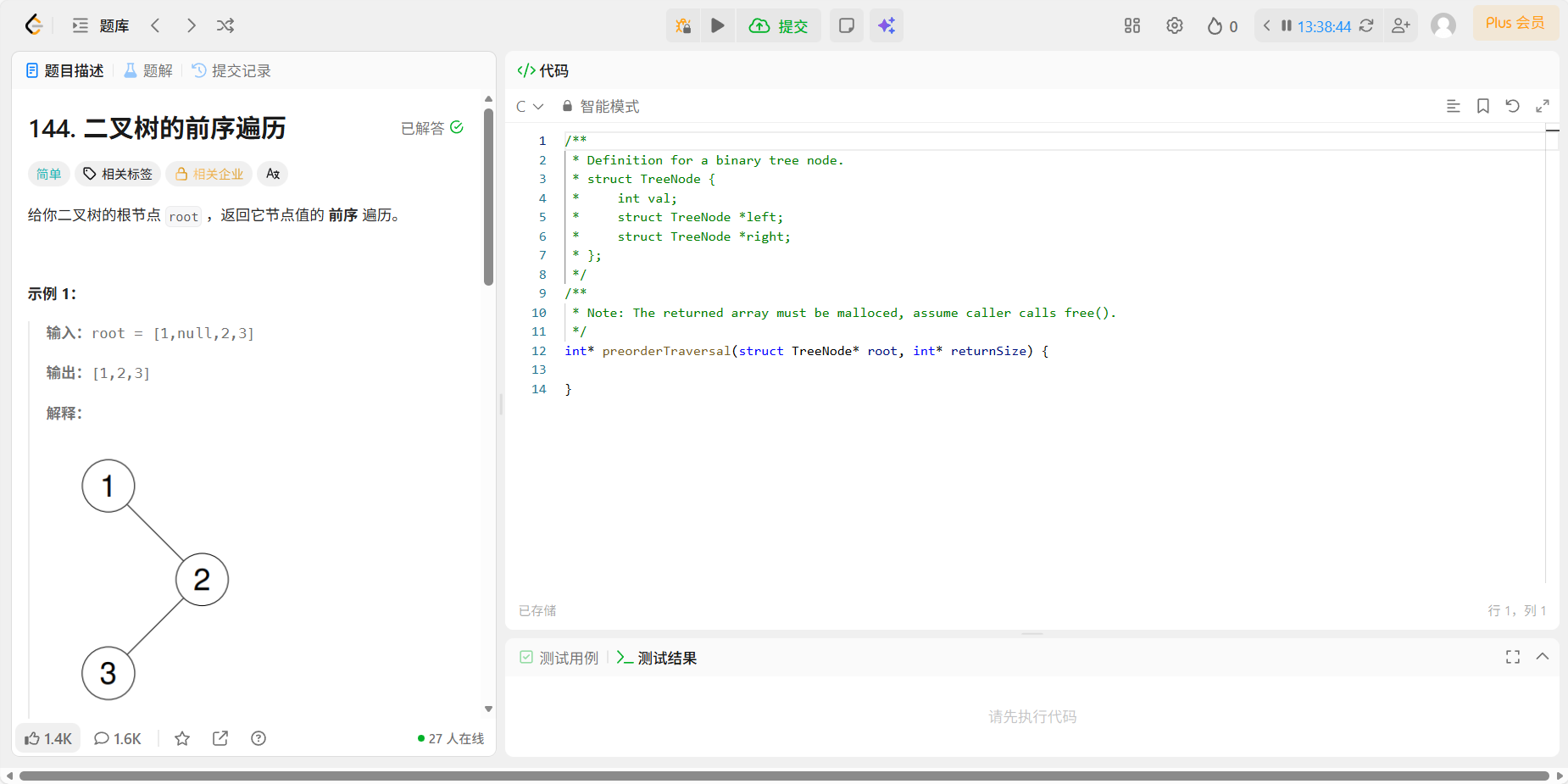
1、144 二叉树的前序遍历(递归版)
题目:
代码:
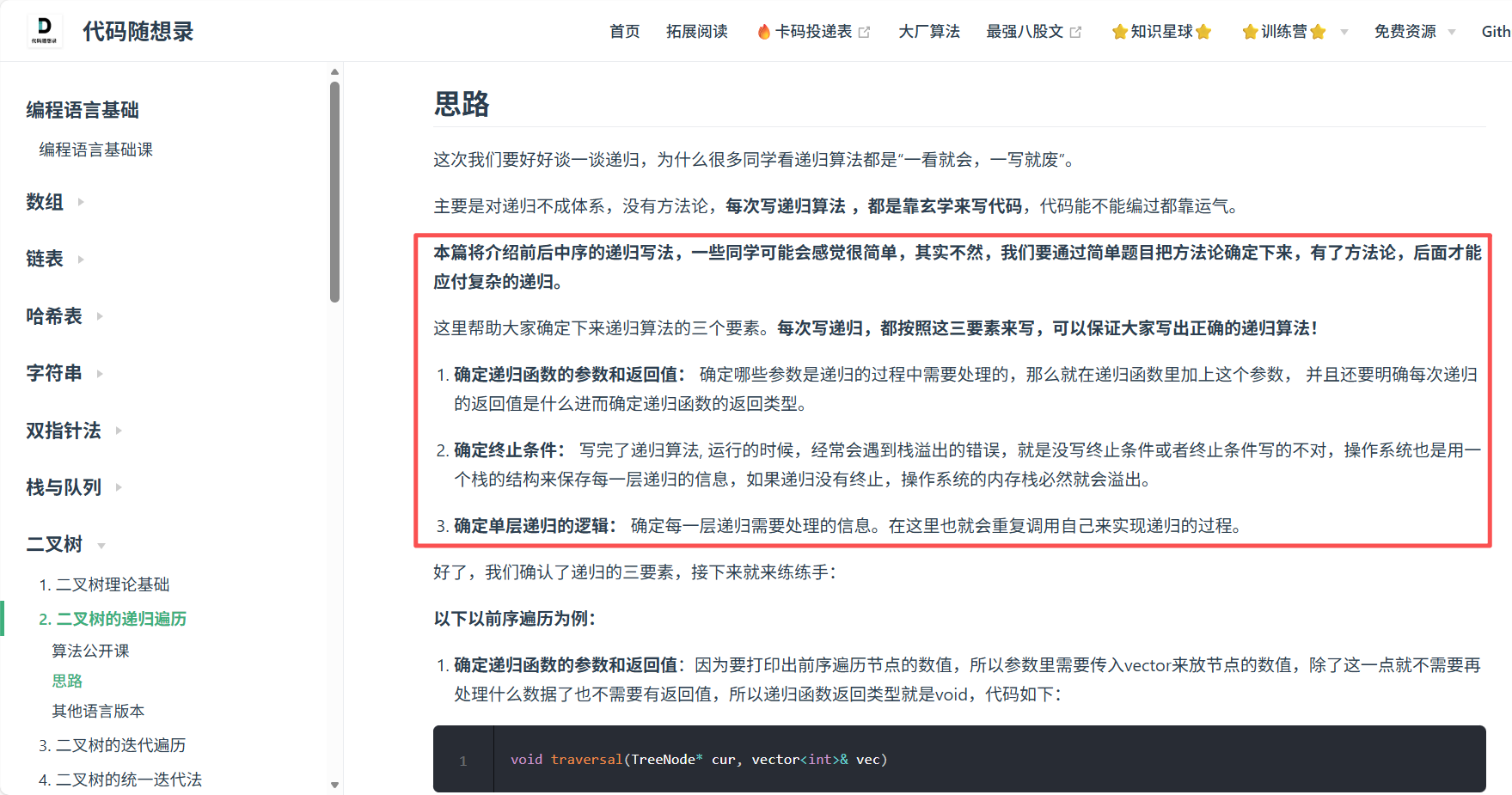
递归三要素:
c
/**
 * Definition for a binary tree node.
 * struct TreeNode {
 *     int val;
 *     struct TreeNode *left;
 *     struct TreeNode *right;
 * };
 */
/**
 * Note: The returned array must be malloced, assume caller calls free().
 */
 void preorder(struct TreeNode* root,int* res,int* returnSize){
    if(root == NULL){
        return;
    }
    res[(*returnSize)++] = root->val;
    preorder(root->left,res,returnSize);
    preorder(root->right,res,returnSize);
 }
int* preorderTraversal(struct TreeNode* root, int* returnSize) {
    int* res = (int*)malloc(sizeof(int)*100);
    *returnSize = 0;
    preorder(root,res,returnSize);
    return res;
}前序遍历的逻辑顺序非常直观,即:根节点 -> 左子树 -> 右子树。
思路推演:逻辑是怎么流动的?
假设有一棵树:[1, 2, 3](1是根,2是左,3是右)。
- 调用
preorder(1)
res[0] = 1,returnSize变为 1。- 去左边:调用
preorder(2)。
- 调用
preorder(2):
res[1] = 2,returnSize变为 2。- 再去 2 的左边(NULL),返回;去 2 的右边(NULL),返回。
- 回到
preorder(1):
- 左边执行完了,去右边:调用
preorder(3)。
- 调用
preorder(3):
res[2] = 3,returnSize变为 3。- 左右皆 NULL,返回。
- 结束 :得到
res = [1, 2, 3]。
时间复杂度: O ( n ) O(n) O(n)
空间复杂度: O ( n ) O(n) O(n)
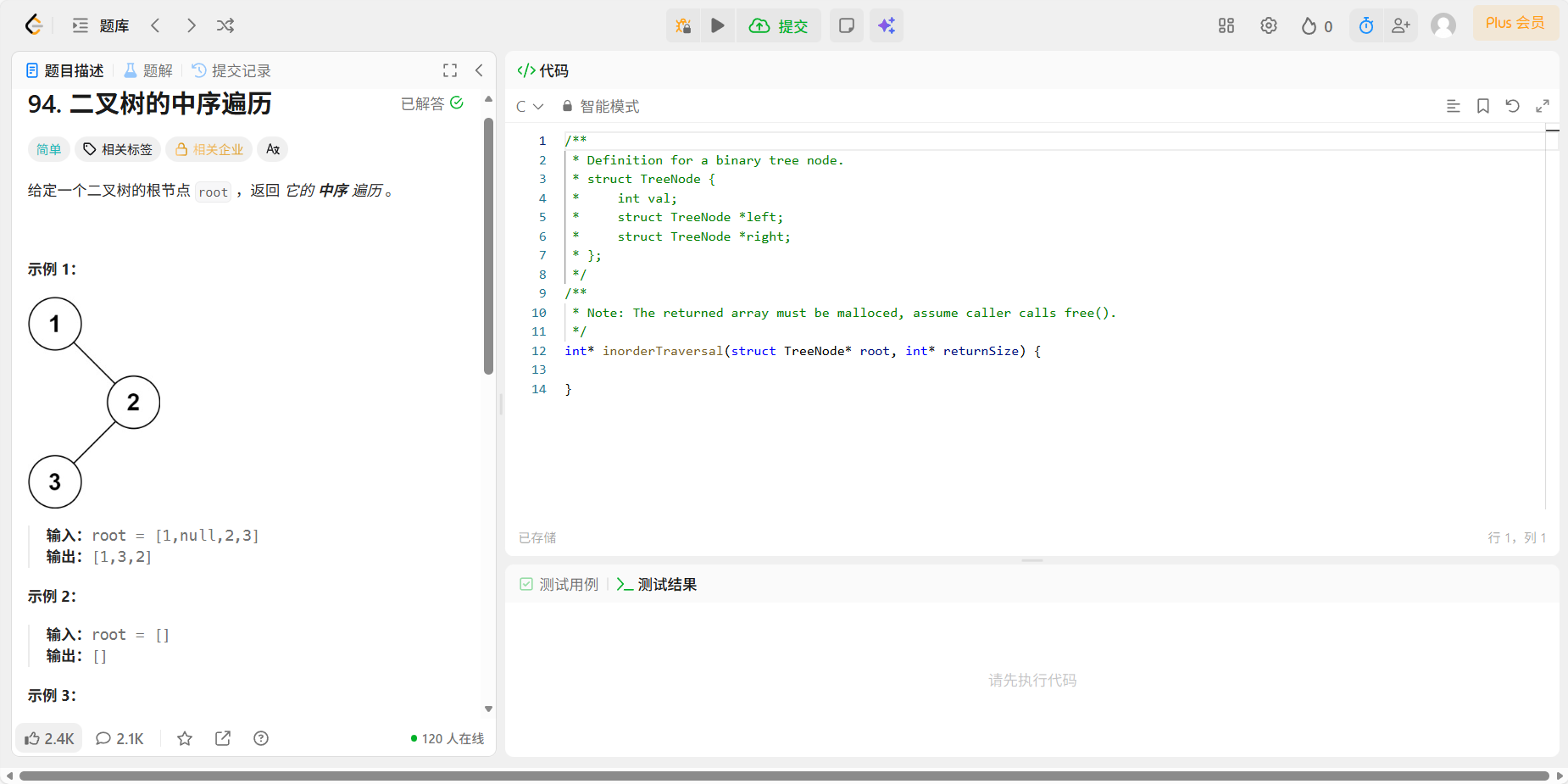
2、94 二叉树的中序遍历(递归版)
题目:
代码:
如果把前序递归弄懂了其实中序和后序就是res(\*returnSize)++ = root->val;这行代码换了个位置而已。
c
/**
 * Definition for a binary tree node.
 * struct TreeNode {
 *     int val;
 *     struct TreeNode *left;
 *     struct TreeNode *right;
 * };
 */
/**
 * Note: The returned array must be malloced, assume caller calls free().
 */
 void inorder(struct TreeNode* root,int* res,int* returnSize){
    if(root == NULL){
        return;
    }
    inorder(root->left,res,returnSize);
    res[(*returnSize)++] = root->val;
    inorder(root->right,res,returnSize);
 }
int* inorderTraversal(struct TreeNode* root, int* returnSize) {
    int* res = (int*)malloc(sizeof(int)*100);
    *returnSize = 0;
    inorder(root,res,returnSize);
    return res;
}
时间复杂度: O ( n ) O(n) O(n)
空间复杂度: O ( n ) O(n) O(n)
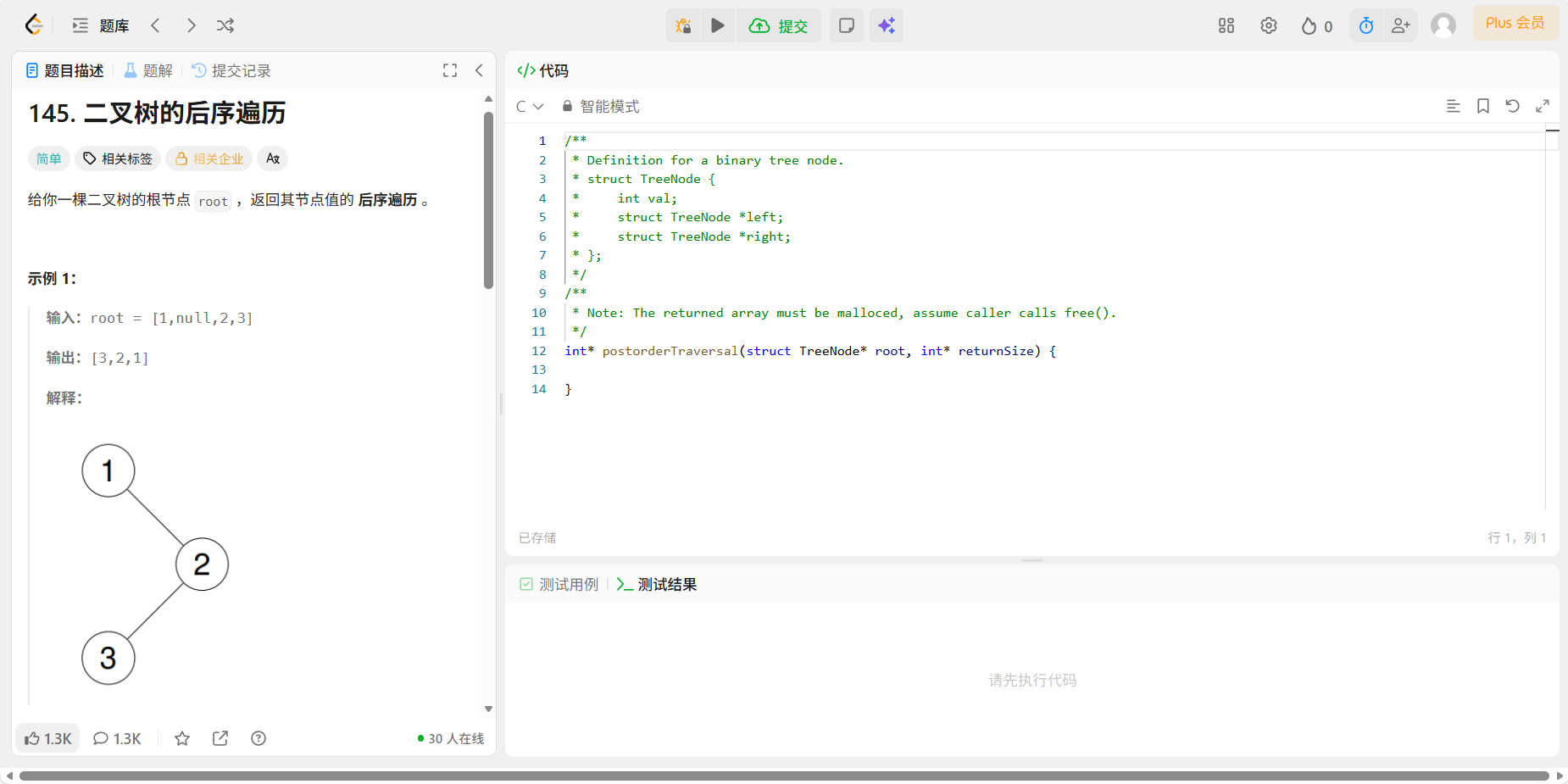
3、145 二叉树的后序遍历(递归版)
题目:
代码:
c
/**
 * Definition for a binary tree node.
 * struct TreeNode {
 *     int val;
 *     struct TreeNode *left;
 *     struct TreeNode *right;
 * };
 */
/**
 * Note: The returned array must be malloced, assume caller calls free().
 */
 void postorder(struct TreeNode* root,int* res,int* returnSize){
    if(root == NULL){
        return;
    }
    postorder(root->left,res,returnSize);
    postorder(root->right,res,returnSize);
    res[(*returnSize)++] = root->val;
 }
int* postorderTraversal(struct TreeNode* root, int* returnSize) {
    int* res = (int*)malloc(sizeof(int)*100);
    *returnSize = 0;
    postorder(root,res,returnSize);
    return res;
}
时间复杂度: O ( n ) O(n) O(n)
空间复杂度: O ( n ) O(n) O(n)
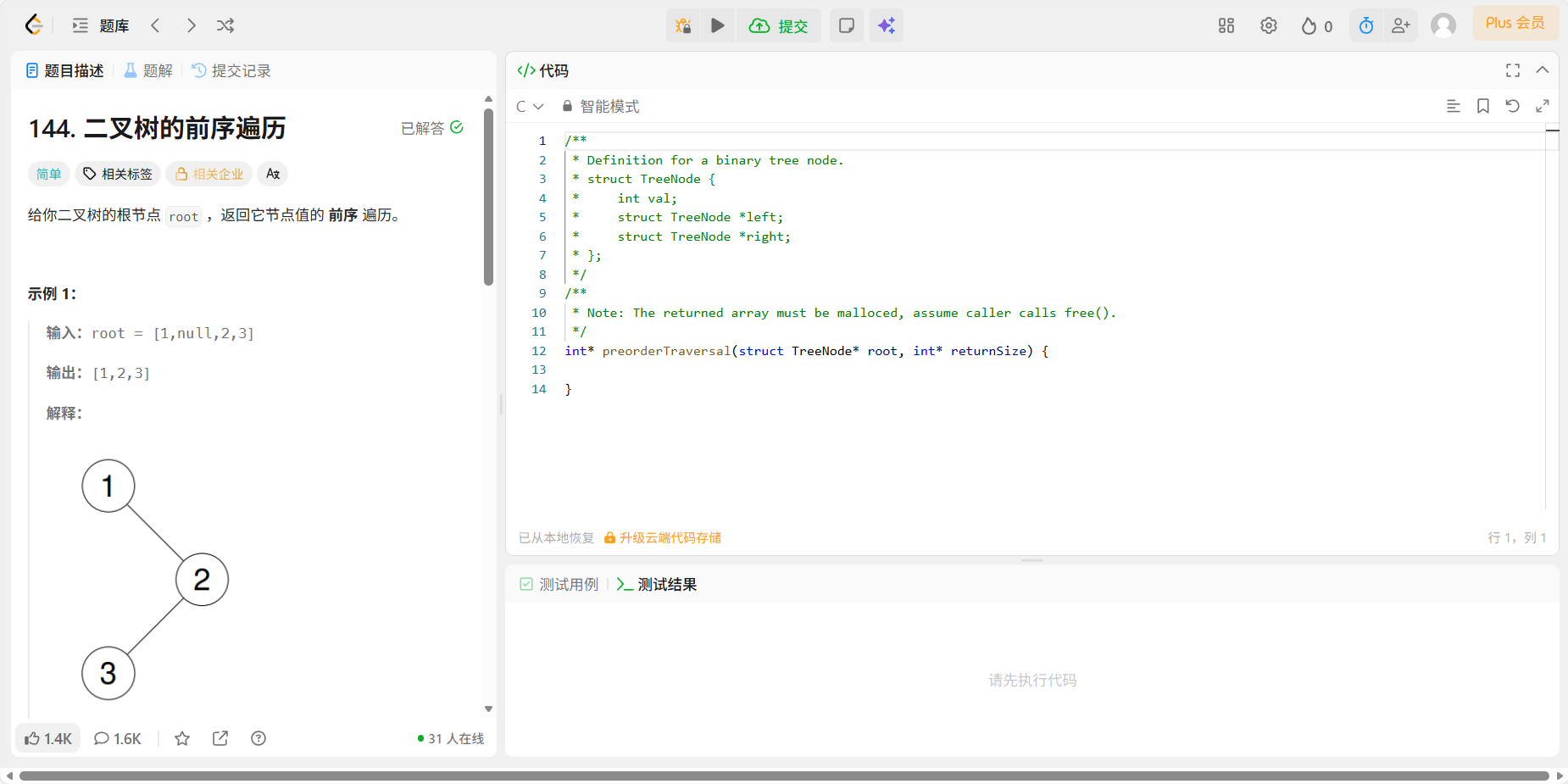
4、144 二叉树的前序遍历(迭代版)
题目:
代码:
1. 观察切入点:手动维护"待办清单"
- 递归的逻辑:系统自动帮我们记住了"处理完左边,还要回来处理右边"。
- 迭代的矛盾:当我们向下访问左子树时,如果不把右子树"存起来",我们就再也找不回它了。
- 工具选择 :我们需要一个栈(Stack) 。栈的特性是"后进先出",这完美契合了:后看到的右子树,要在处理完左边后,先被拿出来处理。
2. 核心原理:右孩子先入栈
前序遍历是 根 -> 左 -> 右 。
当我们把根节点弹出并处理后,为了让左孩子 先被处理,根据栈的特性,我们必须先让右孩子入栈,再让左孩子入栈。这样,左孩子就会位于栈顶,下次循环优先弹出。
3. C 语言实现代码
在 C 语言中,我们需要手动模拟一个简单的栈。
c
/**
 * Definition for a binary tree node.
 * struct TreeNode {
 * int val;
 * struct TreeNode *left;
 * struct TreeNode *right;
 * };
 */

int* preorderTraversal(struct TreeNode* root, int* returnSize) {
    *returnSize = 0;
    if (root == NULL) return NULL;

    // 1. 初始化结果数组和辅助栈
    int* res = (int*)malloc(sizeof(int) * 100); // 节点数不超过100
    struct TreeNode** stack = (struct TreeNode**)malloc(sizeof(struct TreeNode*) * 100);
    int top = 0;

    // 2. 根节点入栈
    stack[top++] = root;

    // 3. 开始迭代推演
    while (top > 0) {
        // 弹出栈顶元素
        struct TreeNode* node = stack[--top];

        // 访问当前节点(根)
        res[(*returnSize)++] = node->val;

        // 关键:先压入右孩子,再压入左孩子
        // 这样弹出的顺序就是:左 -> 右
        if (node->right != NULL) {
            stack[top++] = node->right;
        }
        if (node->left != NULL) {
            stack[top++] = node->left;
        }
    }

    free(stack); // 释放辅助栈空间
    return res;
}
4. 逻辑推演:为什么顺序不会乱?
假设树结构为:1 是根,2 是左,3 是右。
- 初始状态 :栈
[1]。 - 第一次循环 :弹出
1,存入结果。
- 把
1的右孩子3压入,栈[3]。 - 把
1的左孩子2压入,栈[3, 2]。
- 第二次循环 :弹出栈顶
2(左孩子),存入结果。
2没有子节点,不压栈。栈剩下[3]。
- 第三次循环 :弹出栈顶
3(右孩子),存入结果。 - 结束 :结果数组
[1, 2, 3]。
5. 避坑指南
- 空树处理 :迭代法必须先判断
if (root == NULL),否则在压栈时会出错。 - 入栈顺序:这是最容易写反的地方。记住**"先进后出"**,想先访问左,就必须后压左。
- 栈的大小:在 C 语言中,栈的深度最坏情况下等于树的高度(退化成链表时为 n)。
🚀 进阶思考
迭代法的真正威力在于:它能让我们在中途停下来 。比如我们要找二叉树中第一个值大于 10 的节点,迭代法找到就可以立刻跳出循环,而递归法需要多层 return 嵌套。
时间复杂度: O ( n ) O(n) O(n)
空间复杂度: O ( n ) O(n) O(n)
struct TreeNode** stack = (struct TreeNode**)malloc(sizeof(struct TreeNode*) * 100);详解这段话
这句话是 C 语言中处理二叉树迭代 最核心的基础,它实际上是在手动搭建一个"存放指针的货架"。
我们可以通过你的思维模型,从三个维度拆解这句"套娃式"的代码:
1. 核心原理:为什么要用 **(二级指针)?
-
观察点:栈里存的是什么?
-
我们要存的是二叉树的节点。
-
在 C 语言中,一个节点是用
struct TreeNode*表示的。 -
推演过程:
-
如果你要存一个整数,你需要
int*来指向一块内存。 -
如果你要存一堆 整数,你需要
int**或int array[]。 -
同理,我们要存一堆节点指针 ,所以我们需要一个指向"节点指针"的指针,即
struct TreeNode**。
形象化理解:
struct TreeNode是书本的内容。struct TreeNode*是书的索引(指针)。struct TreeNode**是索引目录(栈)。
2. 内存布局拆解
我们将这行代码从右向左"切开"来看:
sizeof(struct TreeNode*):
- 计算的是一个指针的大小(在 64 位系统下通常是 8 字节)。
- 注意:这里不是计算节点本身的大小,因为栈里只存地址。
* 100:
- 在堆区开辟连续的空间,足以容纳 100 个地址。
(struct TreeNode**):
- 强制类型转换 。
malloc返回的是无意义的void*,我们要告诉编译器:"请把这块地皮看作是一个专门存放TreeNode指针的数组。"
struct TreeNode** stack:
- 定义一个名叫
stack的变量,它指向这个数组的开头。
3. 避坑指南:它在迭代中是怎么干活的?
在你的迭代代码中,stack 的用法如下:
-
压栈 (
stack[top++] = root): -
实际上是把
root这个地址,填进了stack数组的第top个格子。 -
出栈 (
node = stack[--top]): -
从
stack数组里把地址取出来,赋给临时变量node。
这里有一个面试常问的坑:
问:为什么不直接定义 struct TreeNode stack[100]?
答:
- 如果定义
struct TreeNode stack[100],栈里存的是整个节点的内容。 - 压栈时会发生大量的数据拷贝(把整个结构体复制一遍),效率极低。
- 而使用
struct TreeNode*数组,压栈时只拷贝一个 8 字节的地址,这才是工业级的标准写法。
总结
这行代码本质上是:在内存中申请了一块连续的空间,专门用来当作"暂存二叉树节点地址"的保险箱。
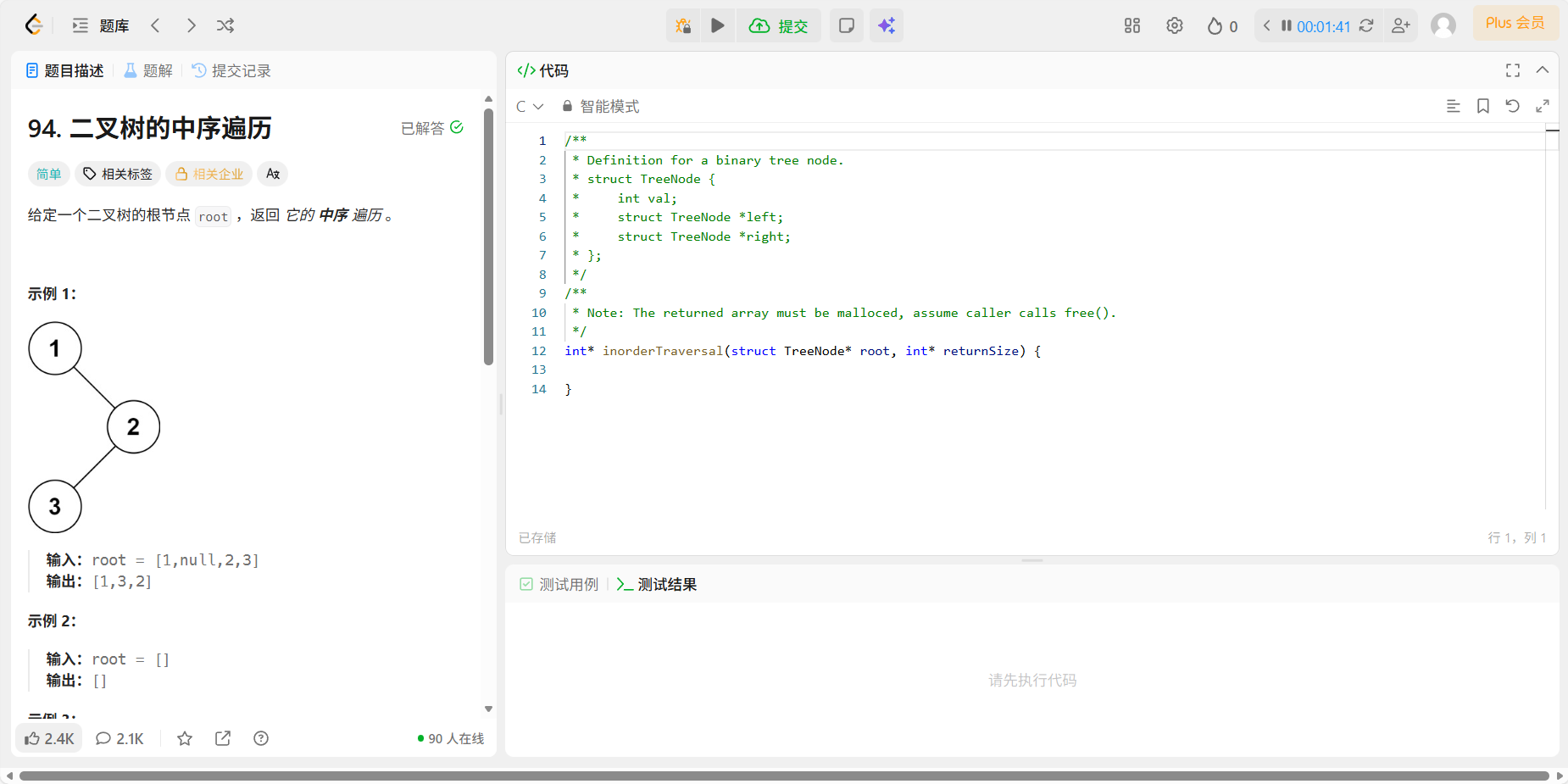
5、94 二叉树的中序遍历(迭代版)
题目:
代码:
中序遍历(Inorder Traversal)的顺序是 左 -> 根 -> 右。
在迭代法中,它的逻辑和前序遍历大不相同。前序遍历是"边走边打印",而中序遍历必须**"一路向左钻到底,憋着不发,等撞了南墙(NULL)再回过头来收割"**。
1. 观察切入点:处理时机的滞后性
- 核心矛盾:当你遇到根节点时,你不能立刻处理它,因为它的左子树里所有的值都比它小,必须先处理左边。
- 解决方案 :我们需要一个指针
curr带着我们冲锋,再用一个栈作为我们的"回生药",把经过的每一个根节点都存起来,方便以后"回头"。
2. 核心原理:先推入,后弹出
- 向左冲锋 :只要
curr不为空,就把它压入栈,然后走向curr->left。 - 触底反弹 :当
curr为空时,说明左边到头了。此时从栈中弹出的那个节点,就是当前最左的节点(根)。 - 收割并右转 :打印这个节点,然后把
curr指向它的右孩子,重复上述过程。
3. C 语言代码实现
c
/**
 * Definition for a binary tree node.
 * struct TreeNode {
 * int val;
 * struct TreeNode *left;
 * struct TreeNode *right;
 * };
 */

int* inorderTraversal(struct TreeNode* root, int* returnSize) {
    *returnSize = 0;
    if (root == NULL) return NULL;

    int* res = (int*)malloc(sizeof(int) * 100); // 假设节点数上限
    struct TreeNode** stack = (struct TreeNode**)malloc(sizeof(struct TreeNode*) * 100);
    int top = 0;

    struct TreeNode* curr = root;

    // 核心逻辑:curr 不为空或者栈不为空,循环就不能停
    while (curr != NULL || top > 0) {
        // 步骤 A:一路向左钻到底,路过的全部进栈
        while (curr != NULL) {
            stack[top++] = curr;
            curr = curr->left;
        }

        // 步骤 B:走到头了,从栈里弹出一个(这是目前最左的根)
        curr = stack[--top];
        res[(*returnSize)++] = curr->val; // 收割!

        // 步骤 C:转向右子树
        // 如果右子树为空,下一轮循环会直接进入步骤 B,继续弹出上层的根
        curr = curr->right;
    }

    free(stack);
    return res;
}
4. 思路推演:逻辑是怎么"丝滑"起来的?
假设树为:1 是根,2 是左孩子,3 是右孩子。
- 初始 :
curr = 1,栈为空。 - 钻左边:
1进栈,curr变成2。2进栈,curr变成NULL(2 的左边)。
- 反弹收割:
- 弹出
2,结果数组[2]。 curr变成2的右孩子,即NULL。
- 继续收割:
- 因为
curr为空但栈里有1,弹出1,结果数组[2, 1]。 curr变成1的右孩子,即3。
- 处理右边:
3进栈,然后再弹出3,结果数组[2, 1, 3]。
- 结束 :栈空且
curr为空,大功告成。
5. 避坑指南:中序迭代的"精髓"
-
循环条件 :一定要写
curr != NULL || top > 0。 -
如果只写
top > 0,初始状态循环就进不去。 -
如果只写
curr != NULL,当你从左边回来准备处理根时,curr正好是NULL,循环会意外终止。 -
无需
prev指针: -
相比于后序遍历,中序遍历不需要
prev标记。因为中序遍历在处理完根之后,直接就去右边了,不需要第二次回到根节点。
📊 三大遍历迭代法对比总结
| 遍历方式 | 栈的应用策略 | 关键点 |
|---|---|---|
| 前序 (根左右) | 入栈即处理,先压右再压左 | 利用栈的 FILO 实现左先右后 |
| 中序 (左根右) | 一路向左压栈,弹出才处理 | 必须"钻"到最左端再回头 |
| 后序 (左右根) | 根右左 + 反转,或使用 prev |
是迭代法中最难的一类 |
时间复杂度: O ( n ) O(n) O(n)
空间复杂度: O ( n ) O(n) O(n)
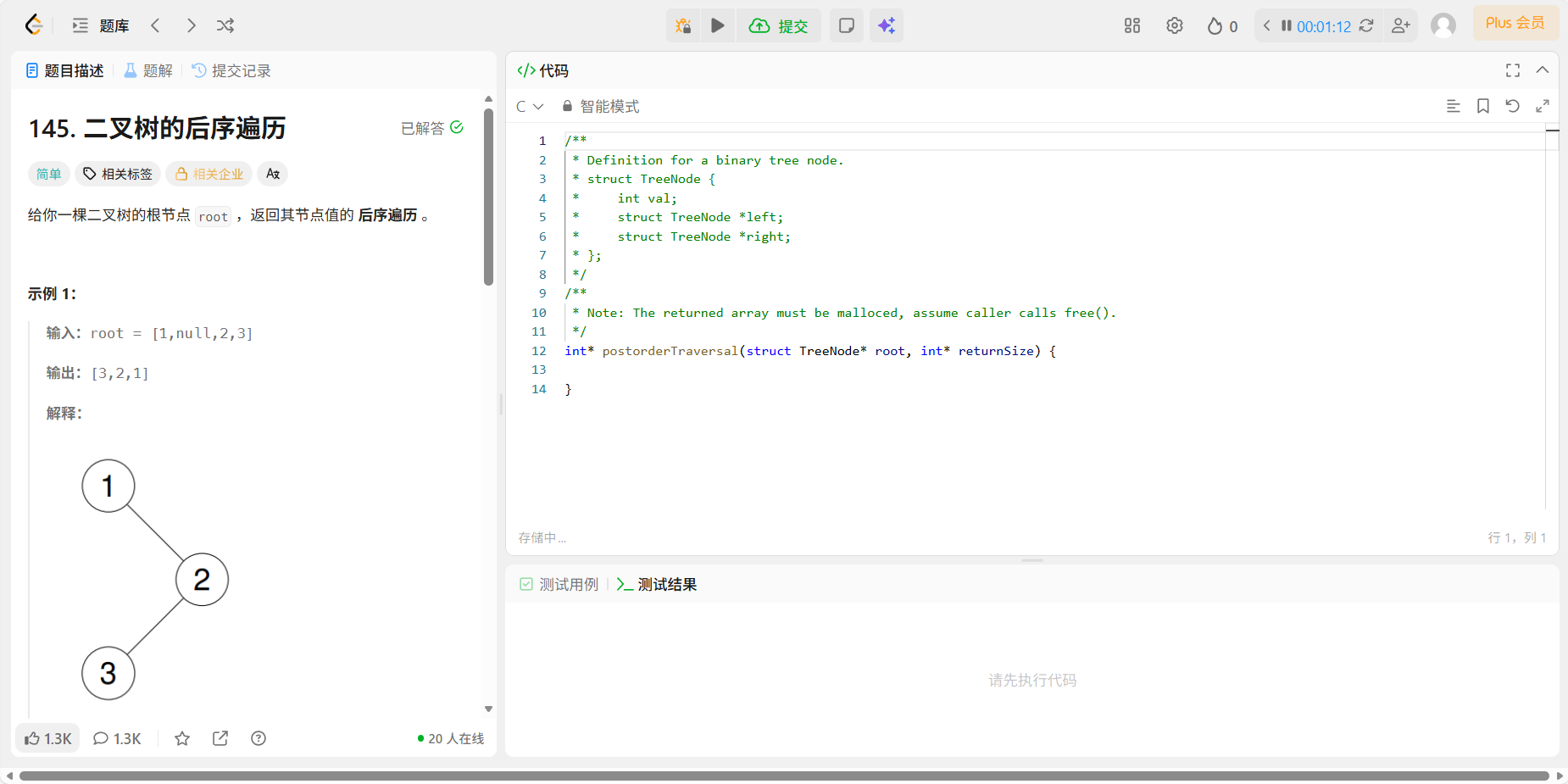
6、145 二叉树的后序遍历(迭代版)
题目:
代码:
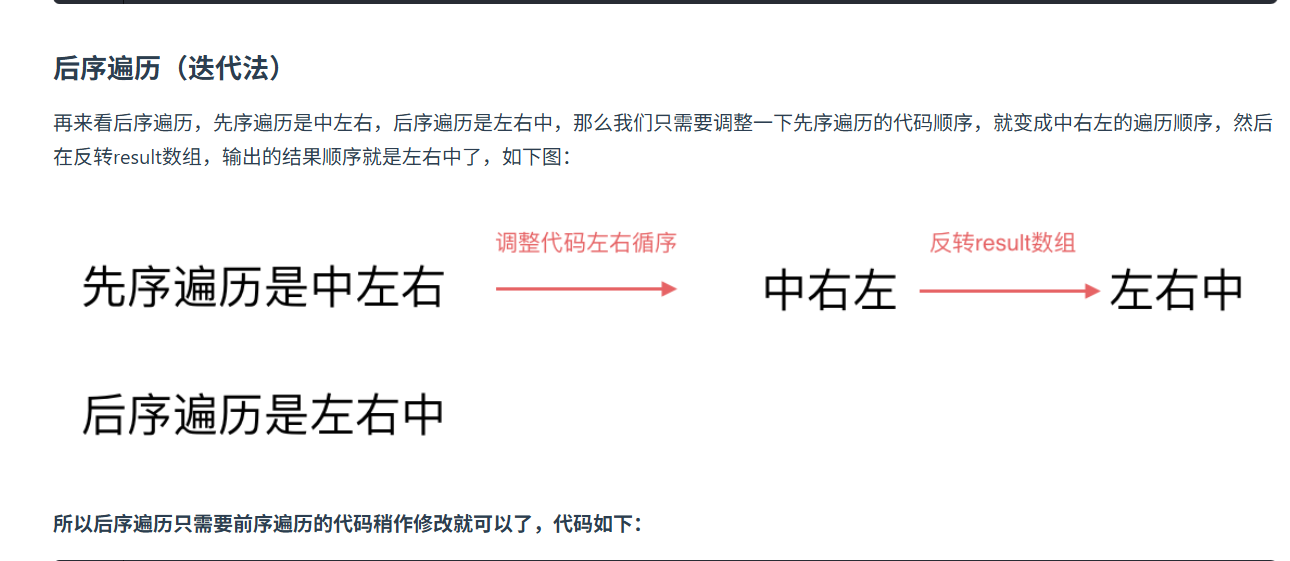
前序弄懂的话,后序就是变了一下,先序遍历是中左右,后序遍历是左右中,那么我们只需要调整一下先序遍历的代码顺序,就变成中右左的遍历顺序,然后再反转result数组,输出的结果顺序就是左右中了~
c
/**
 * Definition for a binary tree node.
 * struct TreeNode {
 *     int val;
 *     struct TreeNode *left;
 *     struct TreeNode *right;
 * };
 */
/**
 * Note: The returned array must be malloced, assume caller calls free().
 */
 void reverse(int* res,int returnSize){
    int left = 0;
    int right = returnSize-1;
    while(right > left){
        int tmp = res[right];
        res[right] = res[left];
        res[left] = tmp;
        left++;
        right--;
    }
 }

int* postorderTraversal(struct TreeNode* root, int* returnSize) {
    *returnSize = 0;
    if(root == NULL){
        return NULL;
    }
    int* res = (int*)malloc(sizeof(int)*100);
    struct TreeNode** stack = (struct TreeNode**)malloc(sizeof(struct TreeNode*)*100);
    int top = 0;
    stack[top++] = root;
    while(top > 0){
        struct TreeNode* node = stack[--top];
        res[(*returnSize)++] = node->val;
        if(node->left != NULL){
            stack[top++] = node->left;
        }
        if(node->right != NULL){
            stack[top++] = node->right;
        }
    }
    reverse(res,*returnSize);
    free(stack);
    return res;
}
时间复杂度: O ( n ) O(n) O(n)
空间复杂度: O ( n ) O(n) O(n)
7、102 二叉树的层序遍历
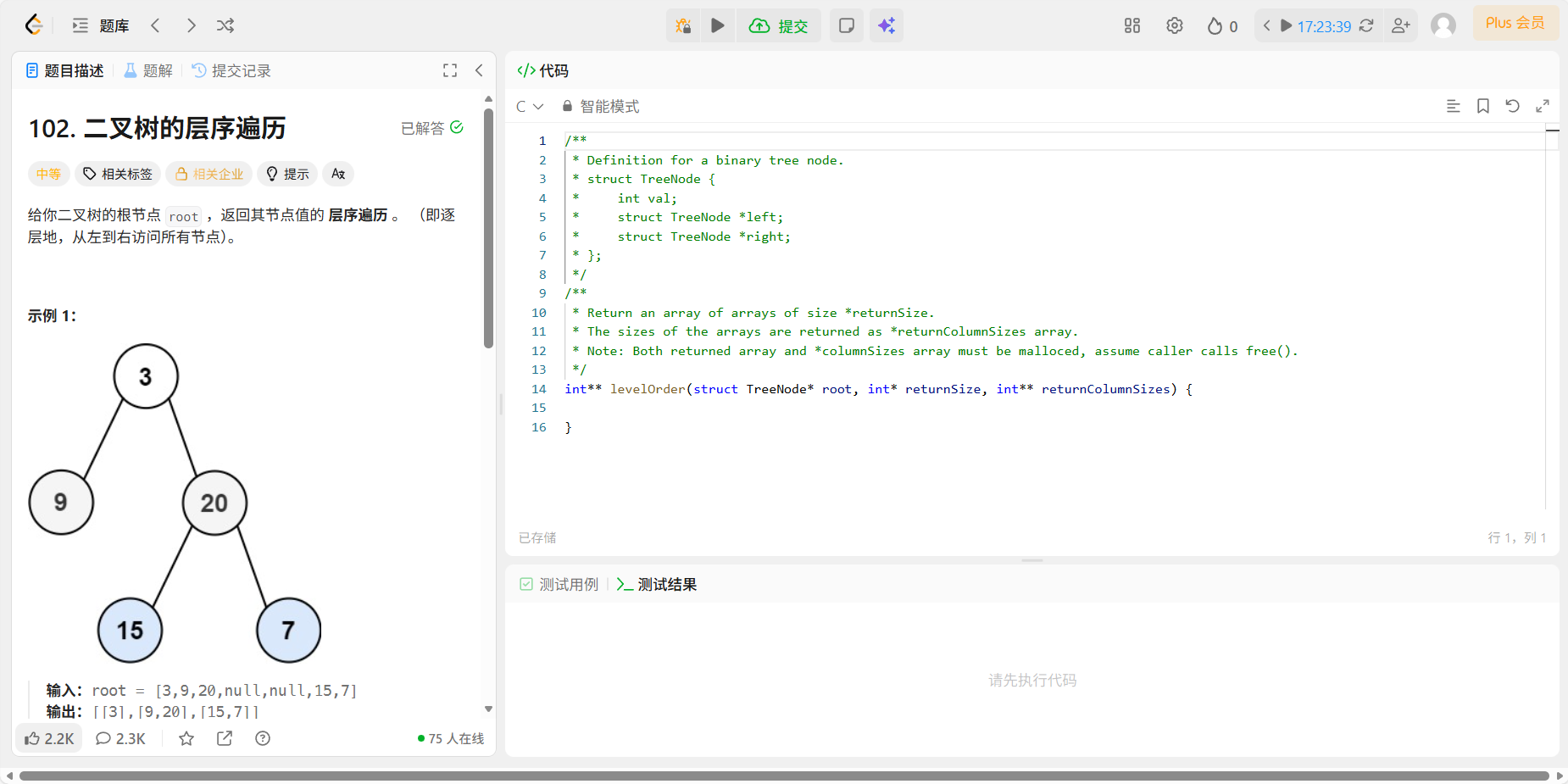
题目:
代码:
如果说前序、中序、后序遍历是"纵向"的深度优先搜索 (DFS) ,那么层序遍历就是典型的"横向"广度优先搜索 (BFS)。
1. 核心模型:队列 (Queue)
层序遍历的本质是"先进先出"。
- 逻辑:当我们访问某一层的节点时,为了不丢失下一层的信息,我们需要把当前节点的子节点按顺序放入一个容器中。
- 工具 :队列是最佳选择。
- 父亲出队时,它的左孩子和右孩子依次进队。
- 这样队列中排队的顺序自然就是从左到右、从上到下的。
2. 关键技巧:固定窗口大小 (Batch Processing)
BFS 本身会将树"拉平",但题目要求按层输出(返回 [[1], [2,3], [4,5,6,7]])。如何区分哪些节点属于同一层呢?
核心思路:在处理每一层之前,先数一数队列里有多少个元素。
- 开始处理新的一层。
- 记录当前队列长度
size = tail - head。这个size就是当前层的所有节点数。 - 只连续弹出
size个节点。 - 这
size个节点的孩子会进入队列,但它们排在后面,不会在这一轮被处理,而是留到下一轮。
3. C 语言实现的难点:内存管理
在 C 语言中,这道题的挑战在于处理复杂的返回类型:int** 和 int* returnColumnSizes。
int** result:这是一个指针数组,每个元素指向一个代表"层"的动态数组。int* returnColumnSizes:这是一个一维数组,你需要告诉调用者每一层具体有多少个元素。- 模拟队列 :由于树节点总数有限(通常为 2000),我们可以直接开辟一个足够大的数组
struct TreeNode* queue[2000],配合head和tail指针,避免手写链表队列。
4. 思路推演:BFS 模板
c
// 1. 根节点入队
// 2. While (队列不为空) {
//      当前层的节点数 size = tail - head;
//      为这一层申请结果内存: malloc(sizeof(int) * size);
//
//      For (i = 0 到 size - 1) {
//          节点出队;
//          把值存入当前层的数组;
//          如果左孩子存在,左孩子入队;
//          如果右孩子存在,右孩子入队;
//      }
//
//      层数计数 returnSize++;
// }
C语言代码
c
/**
 * Definition for a binary tree node.
 * struct TreeNode {
 * int val;
 * struct TreeNode *left;
 * struct TreeNode *right;
 * };
 */

/**
 * returnSize: 返回的层数(纵向长度)
 * returnColumnSizes: 返回每一层有多少个节点(横向长度数组)
 */
int** levelOrder(struct TreeNode* root, int* returnSize, int** returnColumnSizes) {
    *returnSize = 0;
    if (root == NULL) return NULL;

    // 1. 初始化:预分配最大可能的层数空间
    int** result = (int**)malloc(sizeof(int*) * 2000);
    *returnColumnSizes = (int*)malloc(sizeof(int) * 2000);

    // 2. 模拟队列:存放节点指针
    struct TreeNode* queue[2000];
    int head = 0, tail = 0;

    // 根节点入队
    queue[tail++] = root;

    // 3. 开始 BFS
    while (head < tail) {
        // 当前层的节点个数
        int size = tail - head;
        // 记录当前层的列数
        (*returnColumnSizes)[*returnSize] = size;
        // 为当前层分配存放 int 值的空间
        result[*returnSize] = (int*)malloc(sizeof(int) * size);

        for (int i = 0; i < size; i++) {
            // 出队
            struct TreeNode* curr = queue[head++];
            result[*returnSize][i] = curr->val;

            // 将下一层节点入队
            if (curr->left)  queue[tail++] = curr->left;
            if (curr->right) queue[tail++] = curr->right;
        }

        // 处理完一层,层数自增
        (*returnSize)++;
    }

    return result;
}
C 语言处理这道题最坑的地方就在于多级指针的内存分配 。很多同学逻辑写对了,但因为没处理好 returnColumnSizes 的解引用导致报错。
内存结构深度详解
为了让你彻底明白 int** 和 *returnColumnSizes 到底在干什么,请参考下图:
result(二级指针) :它指向一个数组,数组里存的是int*指针。每个指针指向堆区的一行数据。*returnColumnSizes:这其实是一个一维数组。由于函数参数是int**,意味着你要修改外部那个指针的指向。所以代码里写成*returnColumnSizes = malloc(...),然后用(*returnColumnSizes)[i]来访问。
避坑指南 :千万不要写成
*returnColumnSizes[i],因为[]优先级高,这会被解释为先取下标再解引用,导致内存访问错误。
为什么这个解法很快?
- 数组模拟队列 :避免了频繁调用
malloc创建链表节点的开销。 - 一次性分配指针空间:虽然预留 2000 个位置看起来有点浪费,但在算法竞赛中,这种"空间换时间"且规避复杂内存管理的做法非常稳健。
- **线性时间复杂度 **:每个节点只进出队列一次,且没有冗余的遍历。
提交前的最后检查
- 空树处理 :
if (root == NULL)必须返回NULL且*returnSize = 0。 - 层数统计 :
*returnSize是通过(*returnSize)++逐层累加的,确保了它反映的是树的深度。
时间复杂度: O ( n ) O(n) O(n)
空间复杂度: O ( n ) O(n) O(n)
8、107 二叉树的层序遍历②
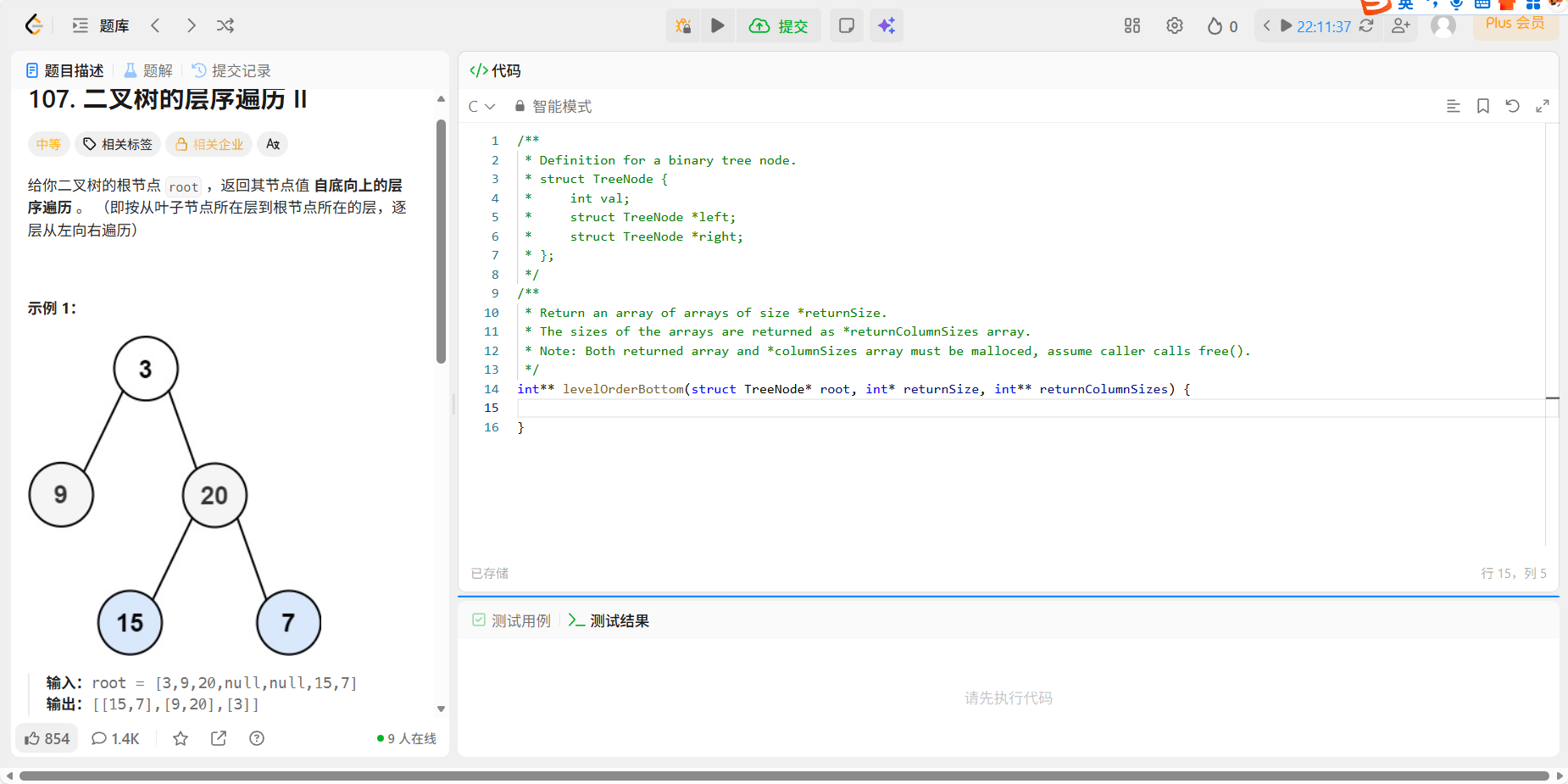
题目:
代码:
先正常层序遍历,最后统一翻转指针。
c
/**
 * Definition for a binary tree node.
 * struct TreeNode {
 *     int val;
 *     struct TreeNode *left;
 *     struct TreeNode *right;
 * };
 */
/**
 * Return an array of arrays of size *returnSize.
 * The sizes of the arrays are returned as *returnColumnSizes array.
 * Note: Both returned array and *columnSizes array must be malloced, assume caller calls free().
 */
int** levelOrderBottom(struct TreeNode* root, int* returnSize, int** returnColumnSizes) {
    *returnSize = 0;
    if(root == NULL){
        return NULL;
    }
    int** result = (int**)malloc(sizeof(int*)*2000);
    *returnColumnSizes = (int*)malloc(sizeof(int)*2000);
    struct TreeNode* queue[2000];
    int head = 0;
    int tail = 0;
    queue[tail++] = root;
    while(head < tail){
        int size = tail - head;
        (*returnColumnSizes)[*returnSize] = size;
        result[*returnSize] = (int*)malloc(sizeof(int)*size);
        for(int i = 0;i < size;i++){
            struct TreeNode* curr = queue[head++];
            result[*returnSize][i] = curr->val;
            if(curr->left){
                queue[tail++] = curr->left;
            }
            if(curr->right){
                queue[tail++] = curr->right;
            }
        }
        (*returnSize)++;
    }
    int left = 0;
    int right = (*returnSize)-1;
    while(left < right){
        int* temp = result[left];
        result[left] = result[right];
        result[right] = temp;
        int tempSize = (*returnColumnSizes)[left];
        (*returnColumnSizes)[left] = (*returnColumnSizes)[right];
        (*returnColumnSizes)[right] = tempSize;
        right--;
        left++;
    }
    return result;
}
为什么必须交换 returnColumnSizes?
这是很多同学容易忽略的细节。
-
result 决定了每一层的数据在哪。
-
returnColumnSizes 告诉力扣系统每一层有多少个数。 如果你只反转了 result 而没反转 returnColumnSizes,系统会用第一层的人数去读最后一层的数据,导致输出混乱甚至溢出。
将反转代码封装成函数:
c
/**
 * Definition for a binary tree node.
 * struct TreeNode {
 *     int val;
 *     struct TreeNode *left;
 *     struct TreeNode *right;
 * };
 */
/**
 * Return an array of arrays of size *returnSize.
 * The sizes of the arrays are returned as *returnColumnSizes array.
 * Note: Both returned array and *columnSizes array must be malloced, assume caller calls free().
 */
 void reverse(int** result,int* returnSize,int** returnColumnSizes){
    int left = 0;
    int right = (*returnSize)-1;
    while(left < right){
        int* temp = result[left];
        result[left] = result[right];
        result[right] = temp;
        int tempSize = (*returnColumnSizes)[left];
        (*returnColumnSizes)[left] = (*returnColumnSizes)[right];
        (*returnColumnSizes)[right] = tempSize;
        right--;
        left++;
    }
 }
int** levelOrderBottom(struct TreeNode* root, int* returnSize, int** returnColumnSizes) {
    *returnSize = 0;
    if(root == NULL){
        return NULL;
    }
    int** result = (int**)malloc(sizeof(int*)*2000);
    *returnColumnSizes = (int*)malloc(sizeof(int)*2000);
    struct TreeNode* queue[2000];
    int head = 0;
    int tail = 0;
    queue[tail++] = root;
    while(head < tail){
        int size = tail - head;
        (*returnColumnSizes)[*returnSize] = size;
        result[*returnSize] = (int*)malloc(sizeof(int)*size);
        for(int i = 0;i < size;i++){
            struct TreeNode* curr = queue[head++];
            result[*returnSize][i] = curr->val;
            if(curr->left){
                queue[tail++] = curr->left;
            }
            if(curr->right){
                queue[tail++] = curr->right;
            }
        }
        (*returnSize)++;
    }
    reverse(result,returnSize,returnColumnSizes);
    return result;
}
时间复杂度: O ( n ) O(n) O(n)
空间复杂度: O ( n ) O(n) O(n)
9、199 二叉树的右视图
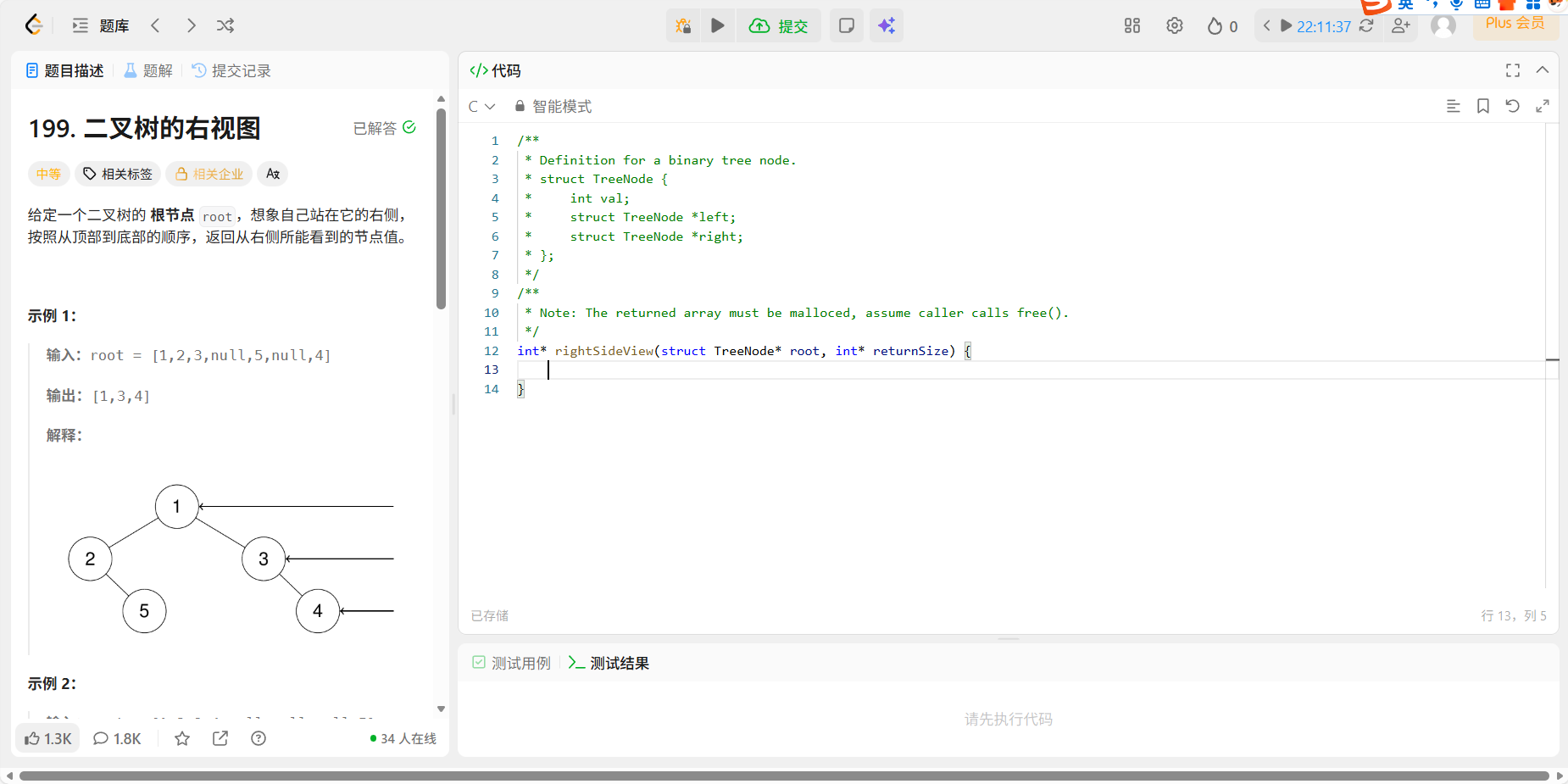
题目:
代码:
就是在层序遍历的时候,加一个判断当是该行的最后一个元素时,加入result数组即可。
c
/**
 * Definition for a binary tree node.
 * struct TreeNode {
 *     int val;
 *     struct TreeNode *left;
 *     struct TreeNode *right;
 * };
 */
/**
 * Note: The returned array must be malloced, assume caller calls free().
 */
int* rightSideView(struct TreeNode* root, int* returnSize) {
    *returnSize = 0;
    if(root == NULL){
        return NULL;
    }
    int* result = (int*)malloc(sizeof(int)*101);
    struct TreeNode* queue[105];
    int head = 0;
    int tail = 0;
    queue[tail++] = root;
    int count = 0;
    while(head < tail){
        int size = tail - head;
        for(int i= 0;i < size;i++){
            struct TreeNode* curr = queue[head++];
            if(i == size-1){
                result[count++] = curr->val;
            }
            if(curr->left){
                queue[tail++] = curr->left;
            }
            if(curr->right){
                queue[tail++] = curr->right;
            }
        }
    }
    *returnSize = count;
    return result;
}
时间复杂度: O ( n ) O(n) O(n)
空间复杂度: O ( n ) O(n) O(n)
如果是求二叉树的左视图
可以将上述判断条件改为 i == 0 是最直接的方法。
在 BFS(从左往右) 的遍历过程中:
- 每一层的 第一个 元素(
i == 0)就是左视图。 - 每一层的 最后一个 元素(
i == size - 1)就是右视图。
除了改 i == 0,还有另一种"骚操作":
如果你依然想保留 i == size - 1 的判断,但又想得到左视图,你可以改变孩子入队的顺序:
- 右视图逻辑:先放左孩子,后放右孩子 每一层最后出来的就是最右边的。
- 左视图逻辑 :先放右孩子 ,后放左孩子 每一层最后出来的就是最左边的。
c
// 这种入队顺序下,i == size - 1 拿到的就是左视图
if (curr->right) queue[tail++] = curr->right;
if (curr->left)  queue[tail++] = curr->left;
10、637 二叉树的层平均值
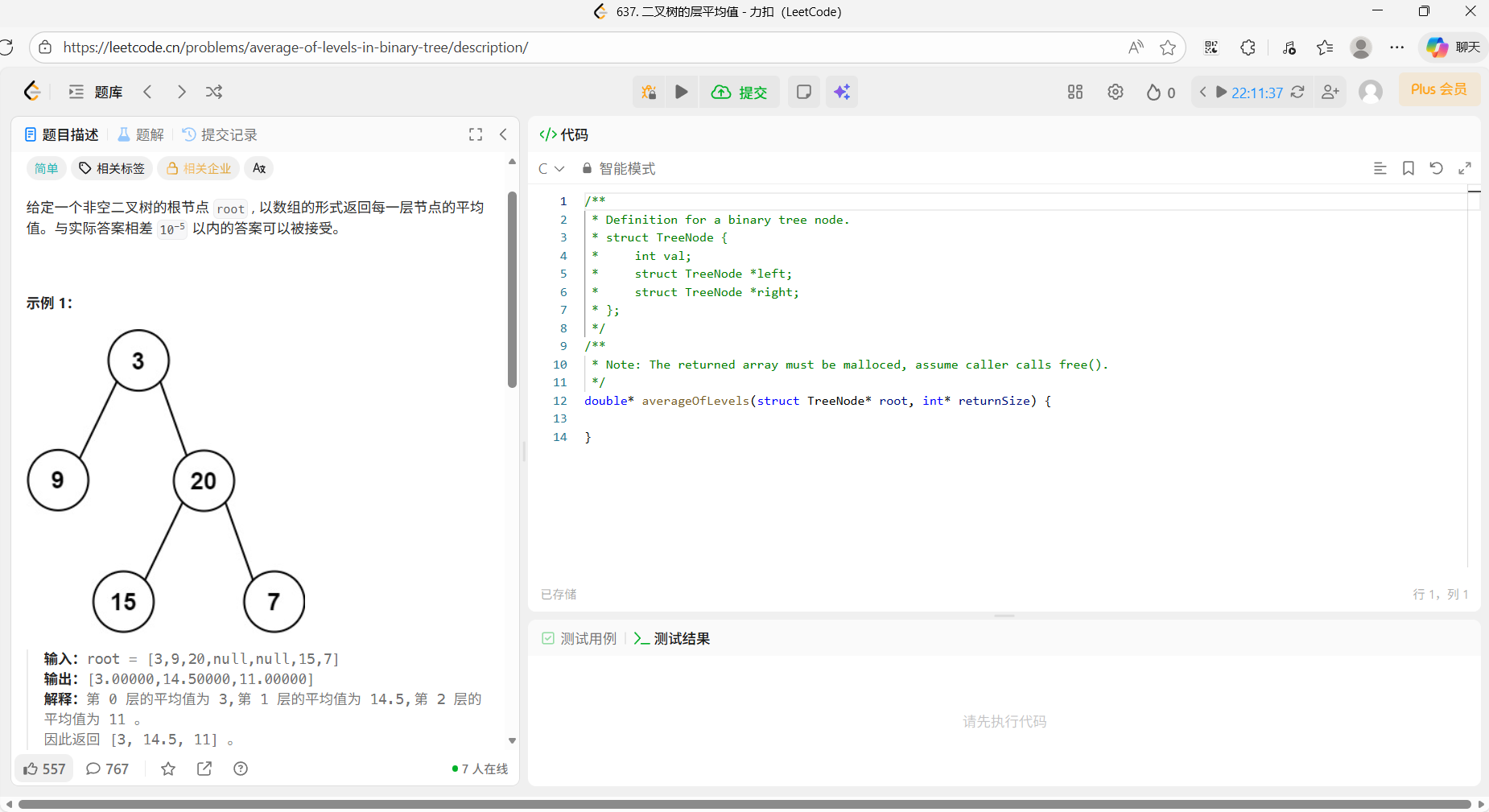
题目:
代码:
也是在层序遍历的基础上,计算每一层的和然后计算均值解决问题。
c
/**
 * Definition for a binary tree node.
 * struct TreeNode {
 *     int val;
 *     struct TreeNode *left;
 *     struct TreeNode *right;
 * };
 */
/**
 * Note: The returned array must be malloced, assume caller calls free().
 */
double* averageOfLevels(struct TreeNode* root, int* returnSize) {
    *returnSize = 0;
    if(root == NULL){
        return NULL;
    }
    double* result = (double*)malloc(sizeof(double)*10000);
    struct TreeNode* queue[10000];
    int head = 0;
    int tail = 0;
    int count = 0;
    queue[tail++] = root;
    while(head < tail){
        int size = tail - head;
        double sum = 0;
        for(int i = 0;i < size;i++){
            struct TreeNode* curr = queue[head++];
            sum += curr->val;
            if(curr->left){
                queue[tail++] = curr->left;
            }
            if(curr->right){
                queue[tail++] = curr->right;
            }
        }
        result[count++] = sum/size;
    }
    *returnSize = count;
    return result;
}
时间复杂度: O ( n ) O(n) O(n)
空间复杂度: O ( n ) O(n) O(n)
11、429 N叉树的层序遍历
题目:
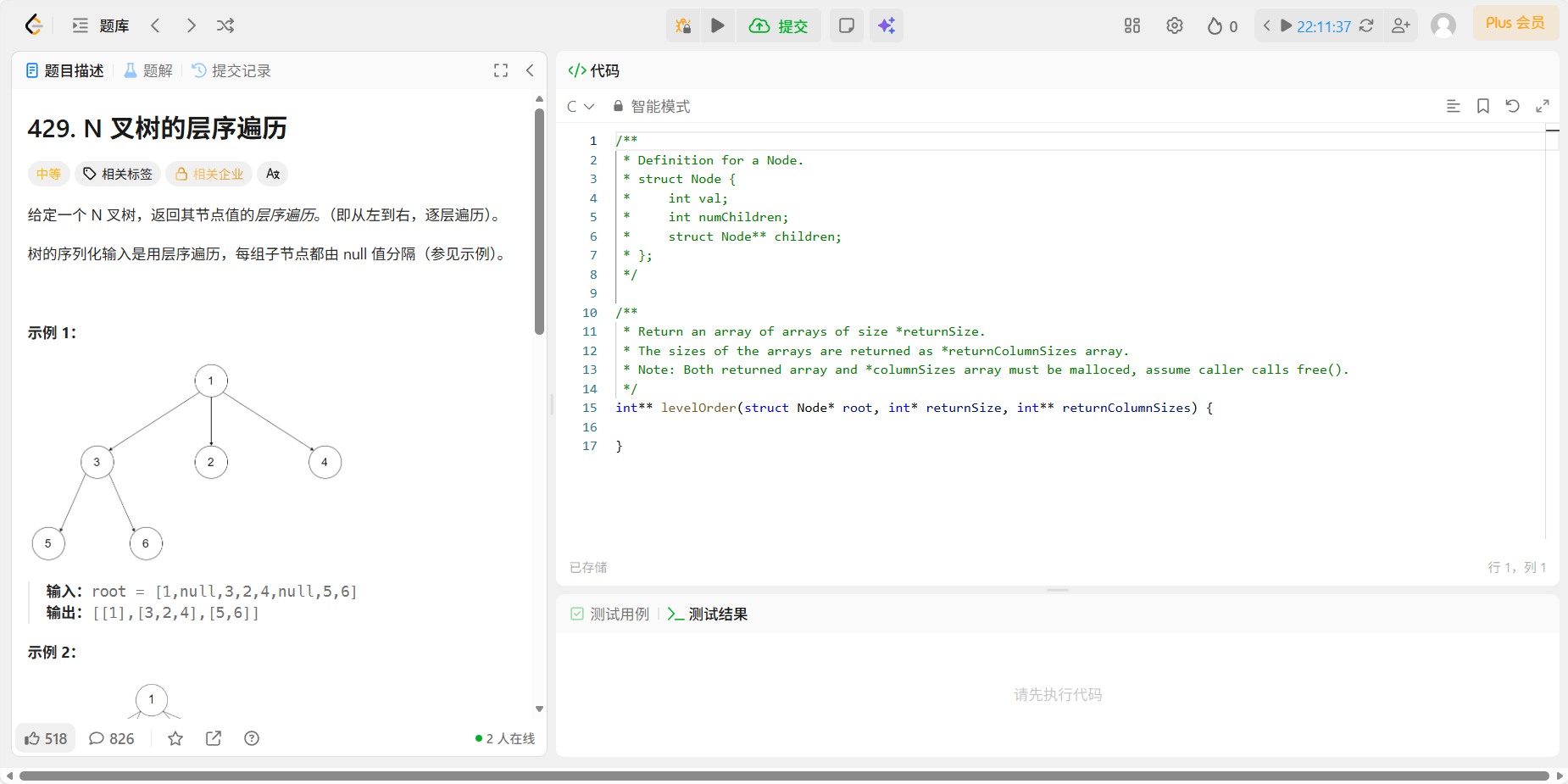
代码:
在力扣(LeetCode)第 429 题"N 叉树的层序遍历"中,判断它是几叉树并不需要你通过代码去"算"出来,而是通过数据结构的定义直接体现出来的。
1. 核心区别:观察节点结构
在二叉树中,节点结构通常只有 left 和 right。但在 N 叉树中,节点使用一个列表或数组来存储所有的子节点。
C 语言的结构体定义通常如下:
c
struct Node {
    int val;
    int childrenSize;        // 重点:这个变量告诉了你当前节点有几个孩子
    struct Node** children;   // 重点:这是一个指向指针数组的指针,存放了所有孩子
};- 如何判断? :通过
childrenSize。 - 每一个节点的
childrenSize可能都不一样。有的节点可能有 3 个孩子,有的可能有 0 个(叶子节点)。 - "N 叉树"的 N 是指最大限制 ,但在实际编程中,我们只需要遍历
0到childrenSize - 1即可。
2. 解题思路:从二叉树平移到 N 叉树
解决这道题的思路和你之前做的 102 题(二叉树层序遍历)几乎一模一样,唯一的区别就在于"入队"的那一步。
逻辑对比:
- 二叉树:
c
if (curr->left) queue[tail++] = curr->left;
if (curr->right) queue[tail++] = curr->right;- N 叉树:
c
for (int j = 0; j < curr->childrenSize; j++) {
    queue[tail++] = curr->children[j];
}
3. C 语言代码实现的关键点
由于 N 叉树的层序遍历同样需要返回 int** 和 int* returnColumnSizes,你可以复用 102 题的模板:
c
/**
 * Definition for a Node.
 * struct Node {
 *     int val;
 *     int numChildren;
 *     struct Node** children;
 * };
 */

/**
 * Return an array of arrays of size *returnSize.
 * The sizes of the arrays are returned as *returnColumnSizes array.
 * Note: Both returned array and *columnSizes array must be malloced, assume caller calls free().
 */
int** levelOrder(struct Node* root, int* returnSize, int** returnColumnSizes) {
    *returnSize = 0;
    if(root == NULL){
        *returnColumnSizes = NULL;
        return NULL;
    }
    int** result = (int**)malloc(sizeof(int*)*10001);
    *returnColumnSizes = (int*)malloc(sizeof(int)*10001);

    struct Node* queue[20001];
    int head = 0;
    int tail = 0;
    queue[tail++] = root;
    while(head < tail){
        int size = tail - head;
        (*returnColumnSizes)[*returnSize] = size;
        result[*returnSize] = (int*)malloc(sizeof(int)*size);
        for(int i = 0;i < size;i++){
            struct Node* curr = queue[head++];
            result[*returnSize][i] = curr->val;
            for(int j = 0;j < curr->numChildren;j++){
                if(curr->children[j]){
                    queue[tail++] = curr->children[j];
                }
            }
        }
        (*returnSize)++;
    }
    return result;
}
4. 总结
- 不需要预先知道是几叉树 :代码逻辑是通用的。只要按照
childrenSize遍历children数组即可。 - 动态性:N 叉树的"N"是动态的。同一个树里,A 节点可以是 3 叉,B 节点可以是 2 叉。
- 空间预估 :N 叉树通常比二叉树更"宽",所以模拟队列的数组(
queue)建议开得稍微大一些。
时间复杂度: O ( n ) O(n) O(n)
空间复杂度: O ( n ) O(n) O(n)
12、515 在每个树行中找最大值
题目:
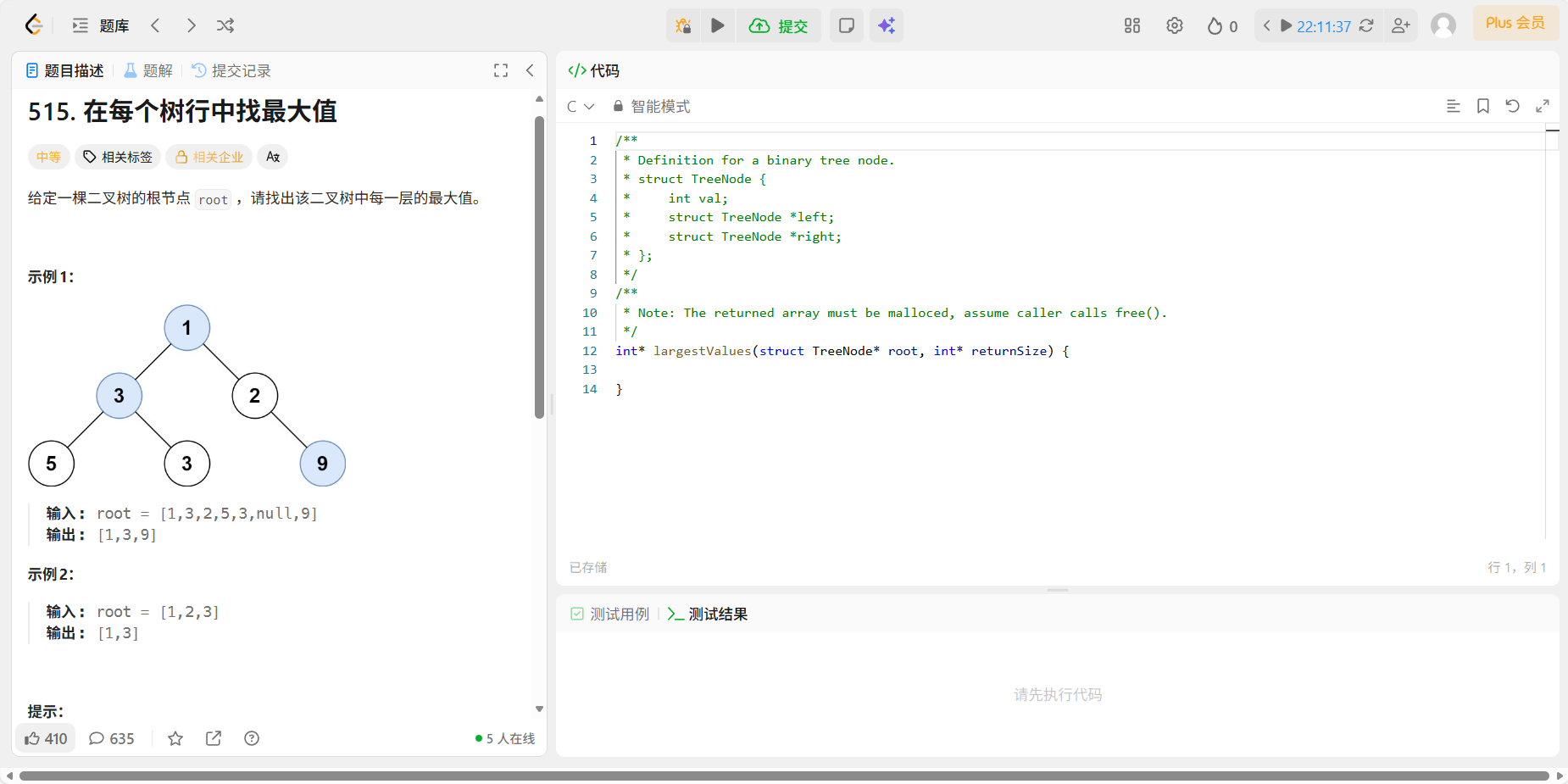
代码:
依然是在层序遍历的基础上,在每一层初始化max为INT_MIN(int的最小值),判断该节点是否为该层最大节点。
c
/**
 * Definition for a binary tree node.
 * struct TreeNode {
 *     int val;
 *     struct TreeNode *left;
 *     struct TreeNode *right;
 * };
 */
/**
 * Note: The returned array must be malloced, assume caller calls free().
 */
int* largestValues(struct TreeNode* root, int* returnSize) {
    *returnSize = 0;
    if(root == NULL){
        return NULL;
    }
    int* result = (int*)malloc(sizeof(int)*10000);
    struct TreeNode* queue[10000];
    int head = 0;
    int tail = 0;
    queue[tail++] = root;
    while(head < tail){
        int size = tail - head;
        int max = INT_MIN;
        for(int i = 0;i < size;i++){
            struct TreeNode* curr = queue[head++];
            if(curr->val > max){
                max = curr->val;
            }
            if(curr->left){
                queue[tail++] = curr->left;
            }
            if(curr->right){
                queue[tail++] = curr->right;
            }
        }
        result[(*returnSize)++] = max;
    }
    return result;
}
时间复杂度: O ( n ) O(n) O(n)
空间复杂度: O ( n ) O(n) O(n)
13、116 填充每个节点的下一个右侧节点指针
题目:
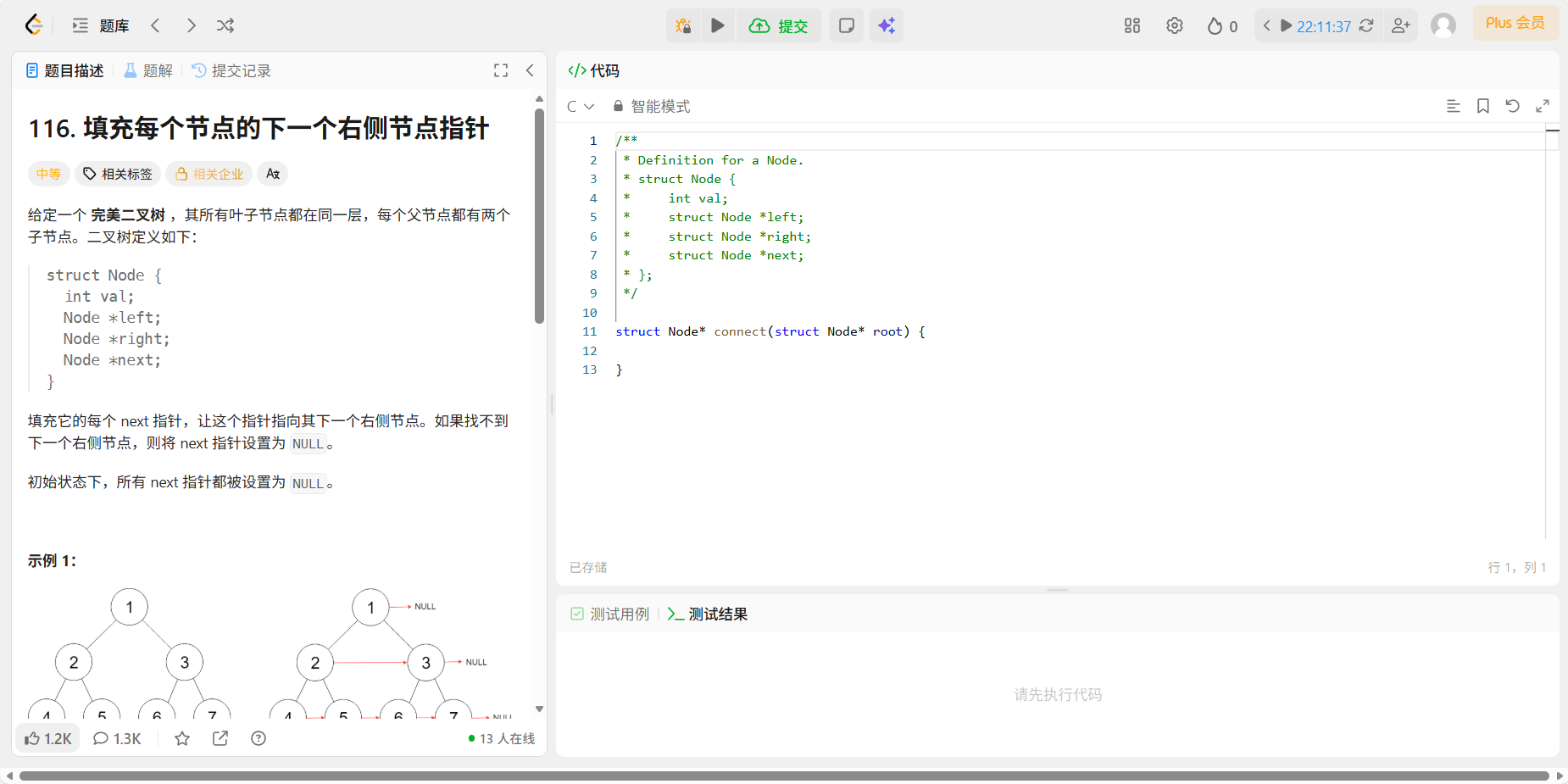
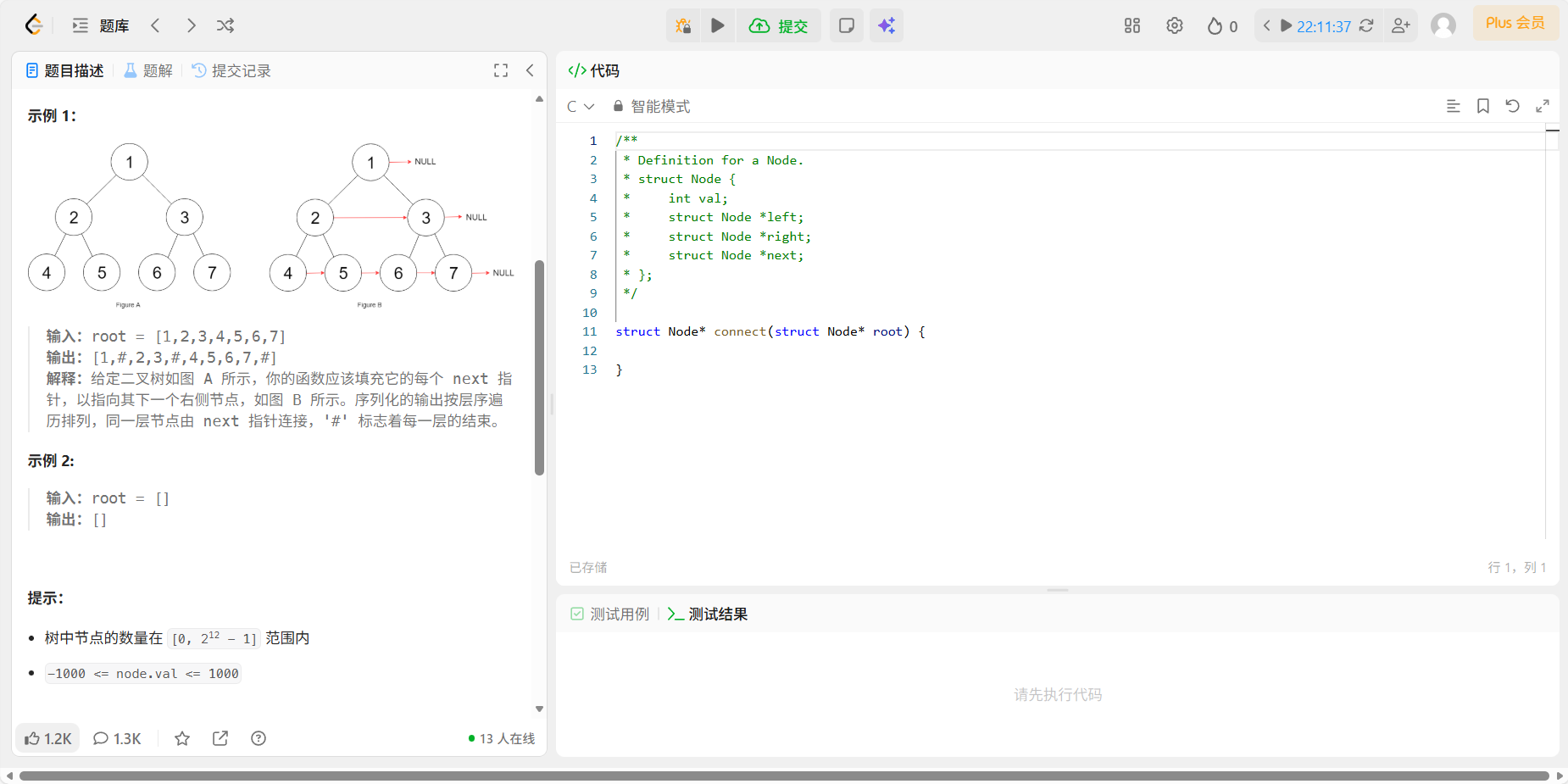
代码:
感觉就是层序遍历,然后将该层的每个节点的next指针指向后一个节点,最后每层的最后节点设置为NULL。
c
/**
 * Definition for a Node.
 * struct Node {
 *     int val;
 *     struct Node *left;
 *     struct Node *right;
 *     struct Node *next;
 * };
 */

struct Node* connect(struct Node* root) {
	if(root == NULL){
        return NULL;
    }
    struct Node* queue[5000];
    int head = 0;
    int tail = 0;
    queue[tail++] = root;
    while(head < tail){
        int size = tail - head;
        for(int i = 0;i < size;i++){
            struct Node* curr = queue[head++];
            if(i < size-1){
                struct Node* nextnode = queue[head];
                curr->next = nextnode;
            }
            else{
                curr->next = NULL;
            }
            if(curr->left){
                queue[tail++] = curr->left;
            }
            if(curr->right){
                queue[tail++] = curr->right;
            }
        }
    }
    return root;
}
时间复杂度: O ( n ) O(n) O(n)
空间复杂度: O ( n ) O(n) O(n)
另解
力扣 116 题的"大神写法"核心在于:利用已经建立好的 next 指针,像拉链一样缝合下一层的节点。
这种方法不需要队列,因此空间复杂度能从 O ( N ) O(N) O(N) 降到 O ( 1 ) O(1) O(1)。
1. 思路解析:利用"上帝视角"的横向连接
在普通的层序遍历中,我们必须依赖队列来记住"下一层有哪些节点"。但在本题中,题目给出的是完美二叉树 ,且已经定义了 next 指针。
如果我们已经把第 i i i 层的所有节点通过 next 指针连成了一个单链表 ,那么在处理第 i i i 层时,我们就可以直接通过这一层的 next 关系,去把第 i + 1 i+1 i+1 层的所有孩子连起来。
核心逻辑分为两种连接情况:
- 同父连接(内部连接) :
同一个父亲的左孩子指向右孩子。
- 公式 :
node->left->next = node->right
- 跨父连接(外部连接) :
父亲的右孩子指向"父亲的邻居"的左孩子。
- 公式 :
node->right->next = node->next->left(前提是node->next存在)
2. 完整代码实现 (C 语言)
c
/**
 * Definition for a Node.
 * struct Node {
 * int val;
 * struct Node *left;
 * struct Node *right;
 * struct Node *next;
 * };
 */

struct Node* connect(struct Node* root) {
    if (root == NULL) return NULL;

    // leftmost 记录每一层的第一个节点(最左节点)
    struct Node* leftmost = root;

    // 当还没到最后一层(叶子层)时,继续循环
    while (leftmost->left != NULL) {

        // head 指针负责横向遍历当前已连好的层
        struct Node* head = leftmost;

        while (head != NULL) {
            // 1. 同父连接:连接自己的左右孩子
            head->left->next = head->right;

            // 2. 跨父连接:如果当前节点右边还有邻居
            // 那么把自己的右孩子连到邻居的左孩子上
            if (head->next != NULL) {
                head->right->next = head->next->left;
            }

            // 指针横向移动到本层的下一个节点
            head = head->next;
        }

        // 本层处理完,下移到下一层的最左节点
        leftmost = leftmost->left;
    }

    return root;
}
3. 逻辑推演:为什么不需要队列?
假设我们正在处理第 2 层(节点 2 和 3 已经连好):
- 初始化 :
leftmost指向2。 - 横向遍历开始 :
head指向2。
- 执行
2->left->next = 2->right(即4连向5)。 - 因为
2->next是3,执行2->right->next = 3->left(即5连向6)。
- 横向移动 :
head移动到3。
- 执行
3->left->next = 3->right(即6连向7)。 3->next是NULL,跨父连接跳过。
- 下移 :
leftmost移动到4,继续下一层循环。
4. 复杂度对比
| 维度 | BFS 队列写法 | O ( 1 ) O(1) O(1)指针写法 |
|---|---|---|
| 时间复杂度 | O ( N ) O(N) O(N) | O ( N ) O(N) O(N)(每个节点访问一次) |
| 空间复杂度 | O ( N ) O(N) O(N) | O ( 1 ) O(1) O(1) (仅需两个指针) |
| 适用范围 | 任意二叉树 | 仅限带 next 指针且结构较规律的树 |
5. 避坑指南
- 终止条件 :
while (leftmost->left != NULL)。因为我们在当前层连接下一层,所以当我们已经在最后一层(叶子层)时,不需要再往下了,否则访问leftmost->left会报错。 - 完美二叉树的特权 :这种写法极度依赖"完美二叉树"的对称性。如果是普通的二叉树(力扣 117 题),这种写法需要加入更复杂的判断(因为
head->next的孩子可能不存在)。
恭喜你! 你现在已经掌握了从基础 BFS 到进阶 指针操作的跨越。
14、117 填充每个节点的下一个右侧节点指针
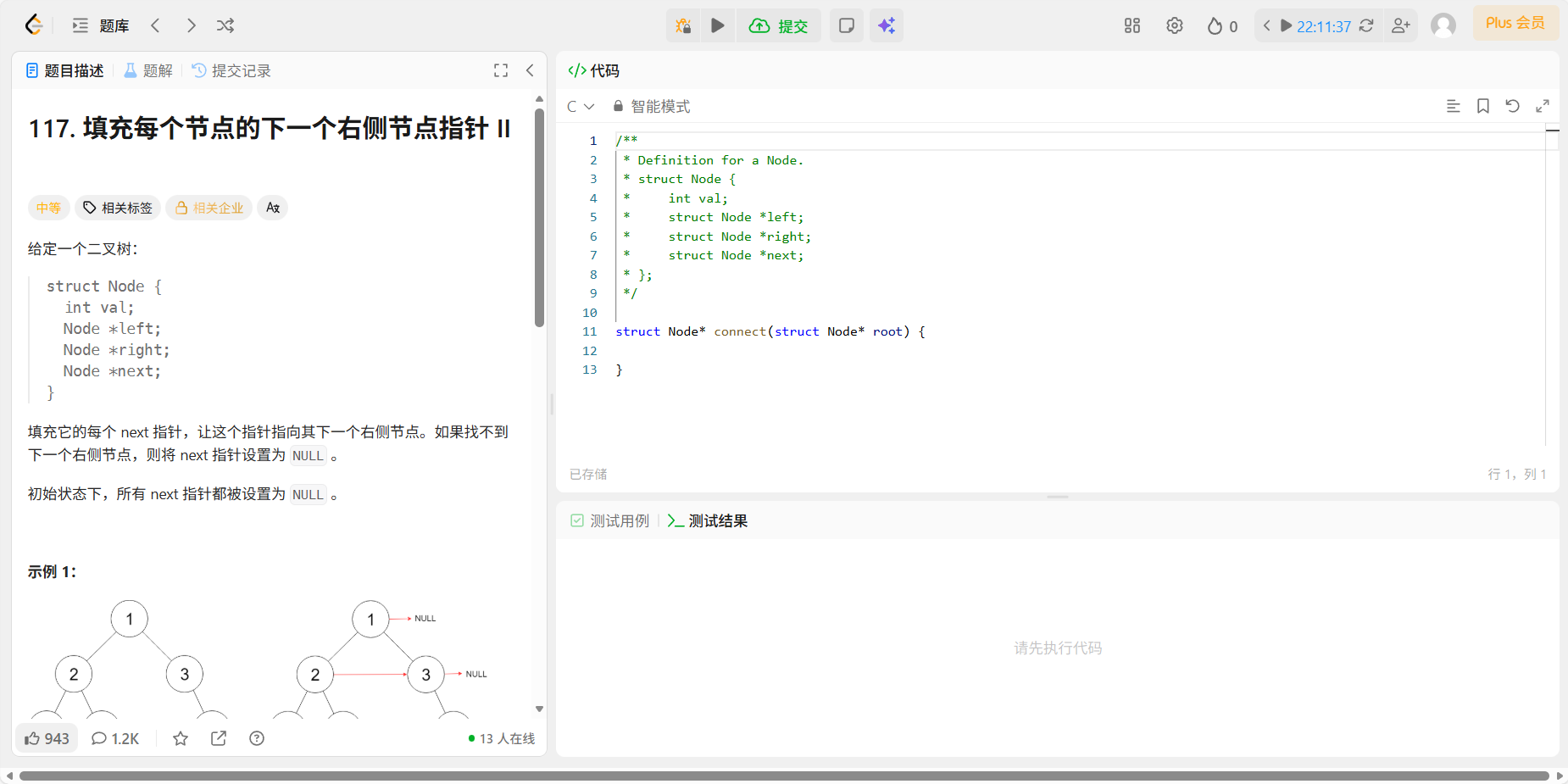
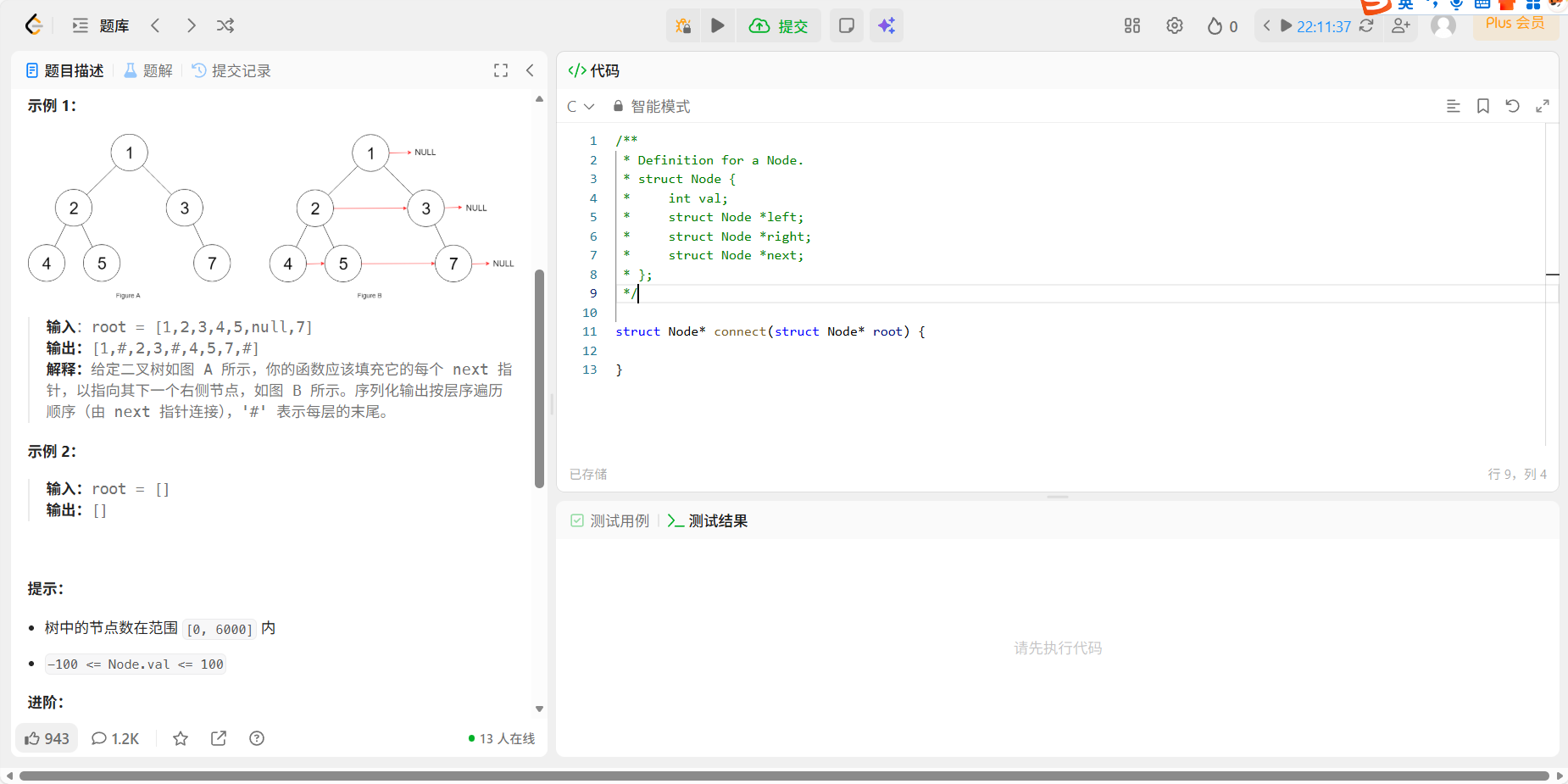
题目:
代码:
这个就用不了大神代码,只能创建队列老老实实层序遍历队列了。
c
/**
 * Definition for a Node.
 * struct Node {
 *     int val;
 *     struct Node *left;
 *     struct Node *right;
 *     struct Node *next;
 * };
 */

struct Node* connect(struct Node* root) {
	if(root == NULL){
        return NULL;
    }
    struct Node* queue[6000];
    int head = 0;
    int tail = 0;
    queue[tail++] = root;
    while(head < tail){
        int size = tail - head;
        for(int i = 0;i < size;i++){
            struct Node* curr = queue[head++];
            if(i < size-1){
                curr->next = queue[head];
            }
            if(curr->left){
                queue[tail++] = curr->left;
            }
            if(curr->right){
                queue[tail++] = curr->right;
            }
        }
    }
    return root;
}
时间复杂度: O ( n ) O(n) O(n)
空间复杂度: O ( n ) O(n) O(n)
15、104 二叉树的最大深度
题目:
代码:
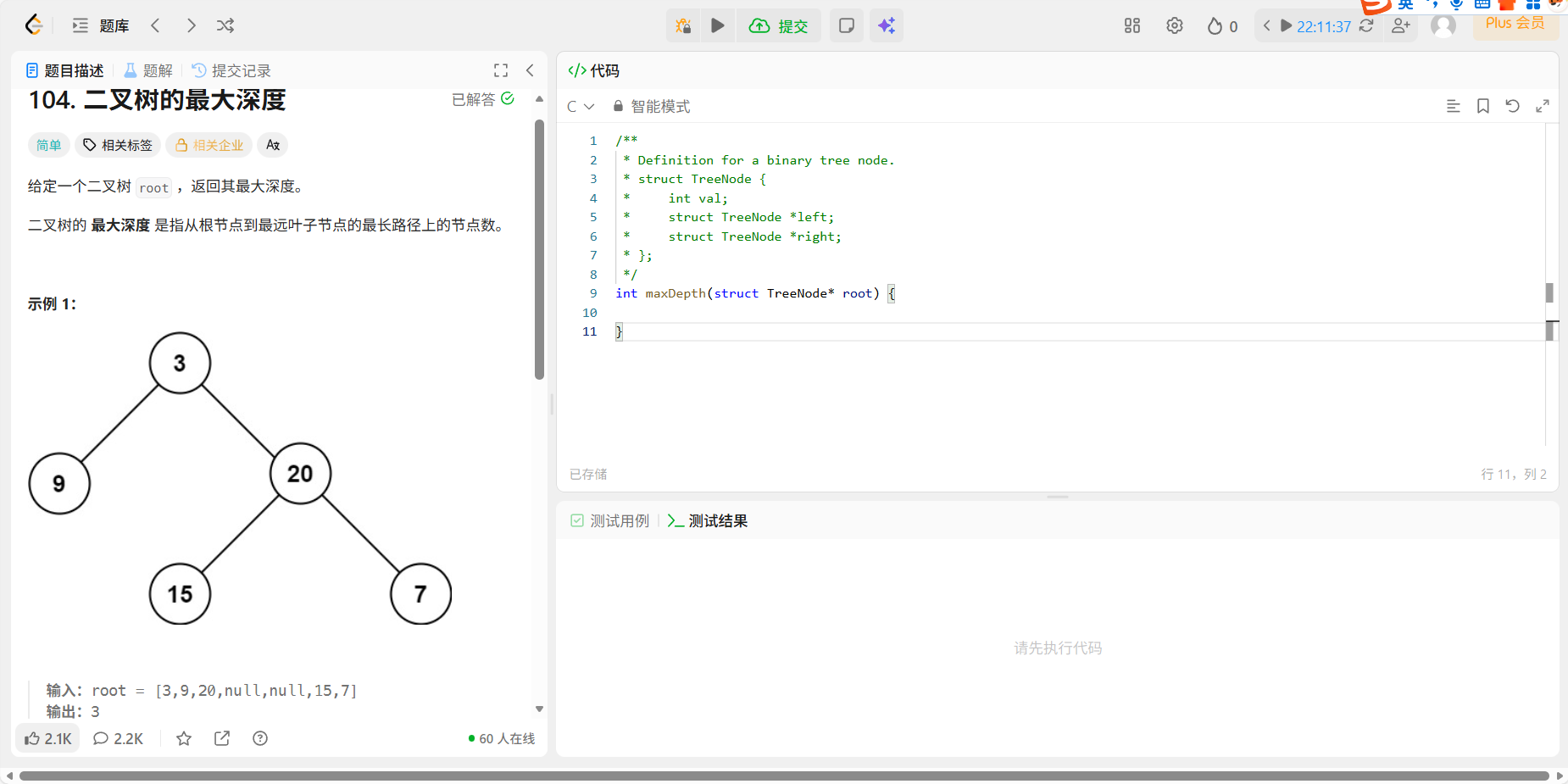
力扣第 104 题 "二叉树的最大深度" (Maximum Depth of Binary Tree) 是理解递归思想的绝佳入门题。
解决这道题有两种主流思维:一种是**"自底向上"的递归(DFS),另一种是"按层计数"的迭代(BFS)**。
1. 递归思路:自底向上的"高度汇报"
这是最优雅、代码量最少的写法。
- 核心矛盾:整棵树的最大深度是多少?
- 拆解逻辑:
- 如果我是空节点,我的深度是 0。
- 如果我不是空节点,我的深度等于:左子树深度和右子树深度中的较大者,再加 1(加上我自己这一层)。
- 数学公式 :
D e p t h ( r o o t ) = max ( D e p t h ( r o o t → l e f t ) , D e p t h ( r o o t → r i g h t ) ) + 1 Depth(root) = \max(Depth(root \rightarrow left), Depth(root \rightarrow right)) + 1 Depth(root)=max(Depth(root→left),Depth(root→right))+1
2. 迭代思路:层序遍历计数(BFS)
如果你对之前的层序遍历(102题)已经很熟悉了,那么这道题对你来说就是"换汤不换药"。
- 核心逻辑:
- 使用队列进行层序遍历。
- 每完整处理完一层(即内循环结束),深度计数器
ans就加 1。 - 当队列为空时,计数器就是最大深度。
- 适用场景:当你担心树的深度过大导致递归栈溢出时,BFS 是更稳健的选择。
3. C 语言代码实现
(递归版)
这是面试中最推荐的写法,只需三行逻辑:
c
/**
 * Definition for a binary tree node.
 * struct TreeNode {
 * int val;
 * struct TreeNode *left;
 * struct TreeNode *right;
 * };
 */

int maxDepth(struct TreeNode* root) {
    // 1. 终止条件:空树深度为 0
    if (root == NULL) {
        return 0;
    }

    // 2. 递归获取左右子树的最大深度
    int leftHeight = maxDepth(root->left);
    int rightHeight = maxDepth(root->right);

    // 3. 返回较大者 + 1
    return (leftHeight > rightHeight ? leftHeight : rightHeight) + 1;
}
(迭代版)
c
/**
 * Definition for a binary tree node.
 * struct TreeNode {
 *     int val;
 *     struct TreeNode *left;
 *     struct TreeNode *right;
 * };
 */
int maxDepth(struct TreeNode* root) {
    if(root == NULL){
        return 0;
    }
    struct TreeNode* queue[10000];
    int head = 0;
    int tail = 0;
    queue[tail++] = root;
    int count = 0;
    while(head < tail){
        int size = tail - head;
        for(int i = 0;i < size;i++){
            struct TreeNode* curr = queue[head++];
            if(curr->left){
                queue[tail++] = curr->left;
            }
            if(curr->right){
                queue[tail++] = curr->right;
            }
        }
        count++;
    }
    return count;
}
4. 复杂度分析
- 时间复杂度 : O ( N ) O(N) O(N)。每个节点都必须且仅被访问一次。
- 空间复杂度:
- 最坏情况 : O ( N ) O(N) O(N)(树退化成链表,递归栈深度为 )。
- 最好情况 : O ( log N ) O(\log N) O(logN)(平衡二叉树,递归栈深度为树高)。
💡 深度思考:深度 (Depth) vs 高度 (Height)
虽然这道题求的是深度,但在递归实现中,我们实际上是在求高度。
- 深度:从根节点往下看(自顶向下)。
- 高度 :从叶子节点往上看(自底向上)。
对于整棵树来说,根节点的高度 = 树的最大深度。
总结
- 如果你追求代码简洁和直观,用递归。
- 如果你追求在大数据量下的稳定性,用BFS 迭代。
时间复杂度: O ( n ) O(n) O(n)
空间复杂度: O ( n ) O(n) O(n)
16、111 二叉树的最小深度
题目:
代码:
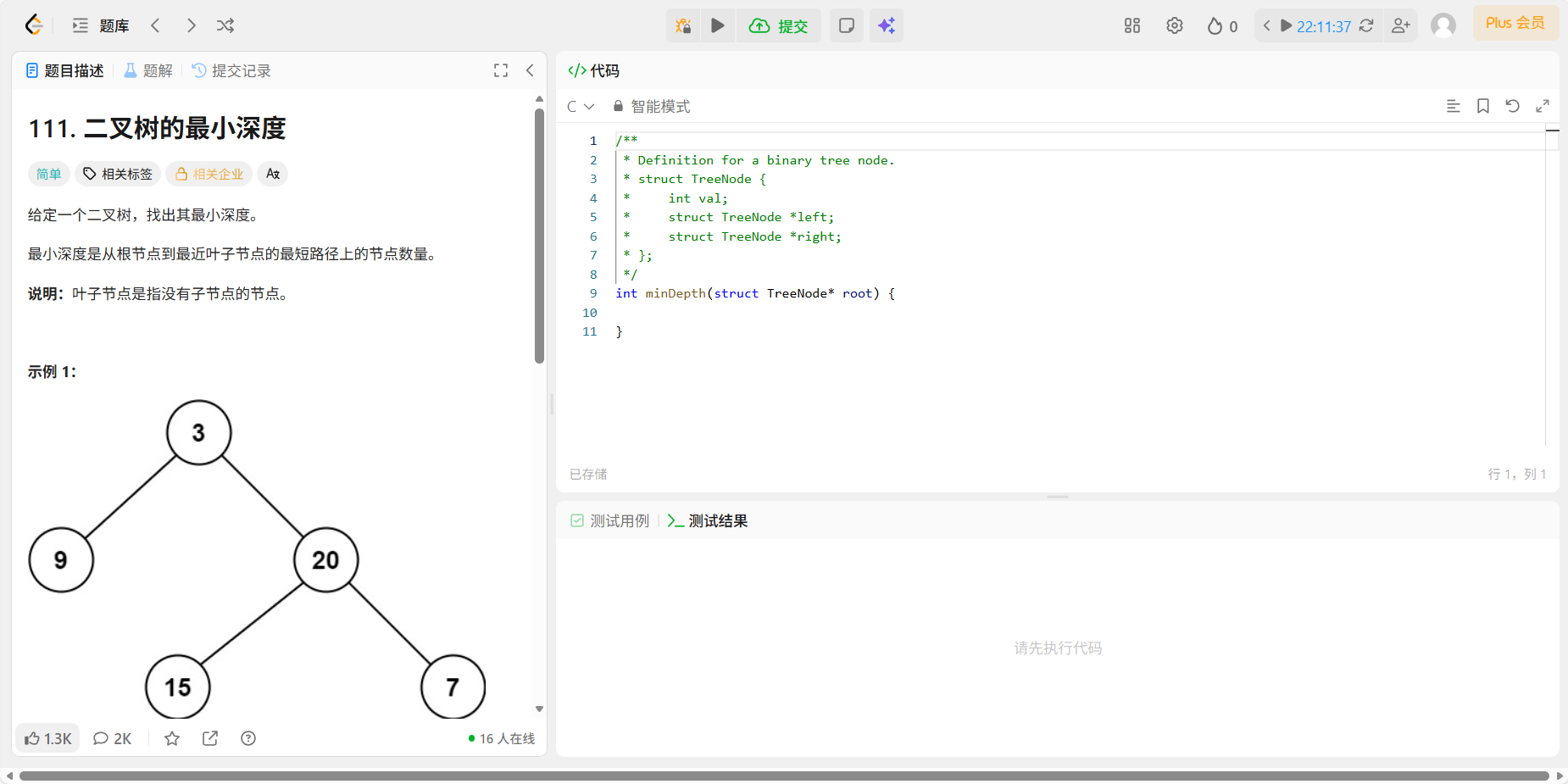
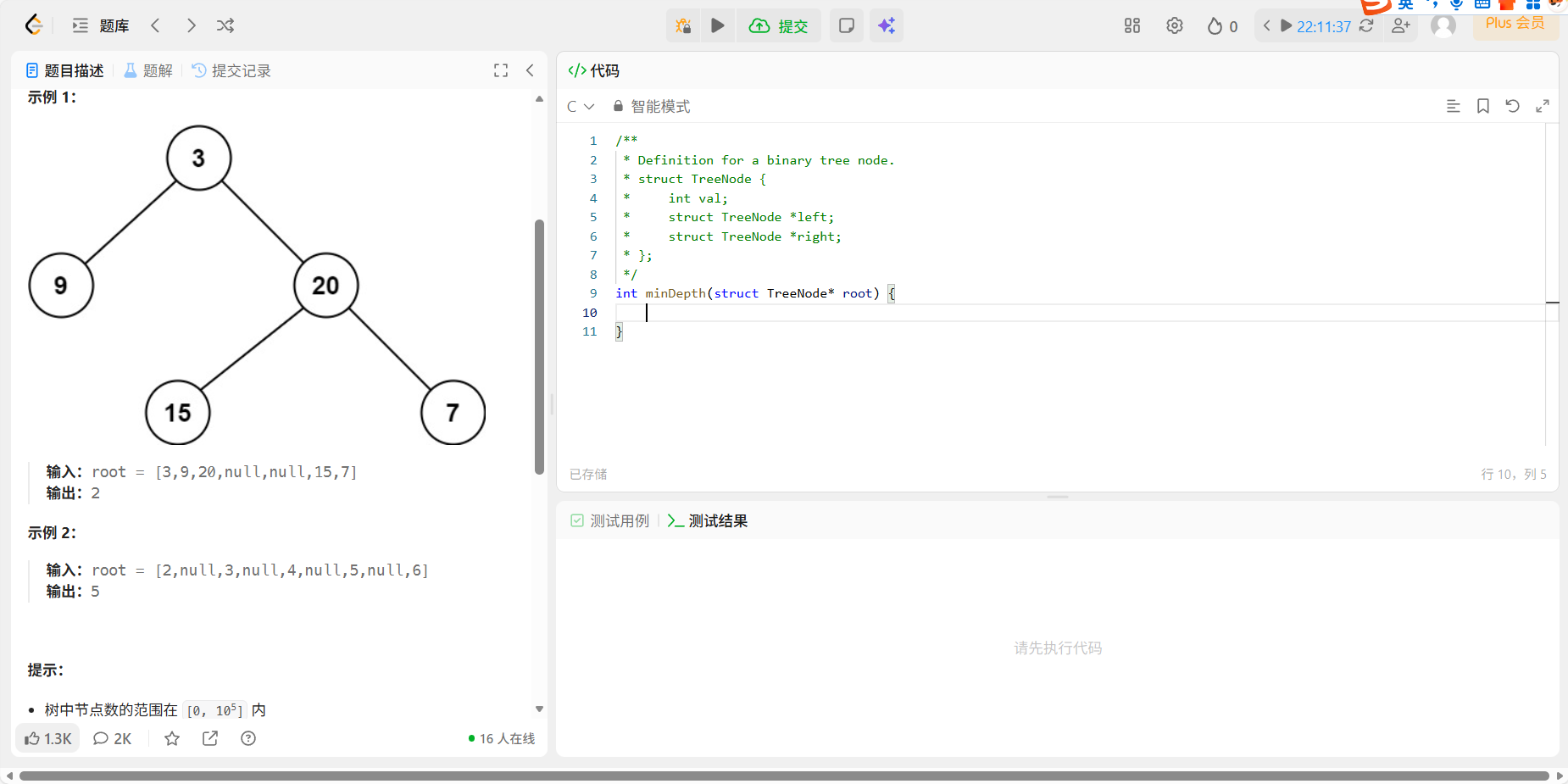
力扣第 111 题 "二叉树的最小深度" (Minimum Depth of Binary Tree) 看起来和 104 题(最大深度)几乎一样,但它隐藏了一个极其容易翻车的陷阱。
1. 核心陷阱:什么是"最小深度"?
题目定义:最小深度是从根节点到最近叶子节点的最短路径上的节点数量。
- 叶子节点的定义 :左孩子和右孩子都为空的节点。
容易出错的点:
如果一个节点的左子树为空,右子树不为空(比如像一个 L 型的长条),你不能说它的最小深度是 1(即它自己)。你必须继续走到右子树的叶子节点才行。
2. 思路一:递归法(DFS)
我们需要对递归逻辑做精细化的分情况讨论:
- 节点为空 :返回
0。 - 叶子节点(左右都空) :返回
1。 - 单边为空:
- 如果左子树为空,最小深度是 右子树最小深度 + 1。
- 如果右子树为空,最小深度是 左子树最小深度 + 1。
- 左右都不为空 :返回 左右子树深度的较小值 + 1。
C 语言代码片段:
c
int minDepth(struct TreeNode* root) {
    if (root == NULL) return 0;

    // 如果左子树为空,必须去右子树找叶子
    if (root->left == NULL) return minDepth(root->right) + 1;
    // 如果右子树为空,必须去左子树找叶子
    if (root->right == NULL) return minDepth(root->left) + 1;

    // 左右都不为空,取较小者
    int leftMin = minDepth(root->left);
    int rightMin = minDepth(root->right);
    return (leftMin < rightMin ? leftMin : rightMin) + 1;
}
3. 思路二:层序遍历(BFS)------ 推荐方案
对于"找最短路径"这类问题,BFS 其实比 DFS 更高效。
- 原理 :我们按层扫描。一旦遇到第一个叶子节点,它所在的层数就是我们要找的最小深度。
- 优势:
- 比如一棵树左边很浅,右边极深。DFS 会先钻到右边最深处再回来,而 BFS 扫描到左边浅处直接就返回结果了。
- 效率更高:不需要遍历完整棵树。
4. BFS 迭代法实现逻辑
- 使用队列进行层序遍历,初始
depth = 1。 - 大循环处理每一层。
- 内循环处理当前层节点时,检查:
- 如果是叶子节点 (
curr->left == NULL && curr->right == NULL) :直接返回当前depth。
- 如果没有遇到叶子节点,将子节点入队。
- 处理完一层,
depth++。
c语言代码
c
/**
 * Definition for a binary tree node.
 * struct TreeNode {
 *     int val;
 *     struct TreeNode *left;
 *     struct TreeNode *right;
 * };
 */
int minDepth(struct TreeNode* root) {
    if(root == NULL){
        return 0;
    }
    struct TreeNode* queue[10000];
    int head = 0;
    int tail = 0;
    int depth = 1;
    queue[tail++] = root;
    while(head < tail){
        int size = tail - head;
        for(int i = 0;i < size;i++){
            struct TreeNode* curr = queue[head++];
            if(curr->left == NULL && curr->right == NULL){
                return depth;
            }
            if(curr->left){
                queue[tail++] = curr->left;
            }
            if(curr->right){
                queue[tail++] = curr->right;
            }
        }
        depth++;
    }
    return depth;
}
💡 总结对比
| 维度 | 最大深度 (104) | 最小深度 (111) |
|---|---|---|
| 递归逻辑 | max(left, right) + 1 |
分情况处理(避开非叶子节点) |
| BFS 行为 | 必须跑完所有层 | 遇到首个叶子即停止 |
| 关键点 | 找最远的路径 | 找最近的叶子路径 |
这个"单边为空"的陷阱是面试官最爱考察的细节。
时间复杂度: O ( n ) O(n) O(n)
空间复杂度: O ( n ) O(n) O(n)
17、226 翻转二叉树
题目:
代码:
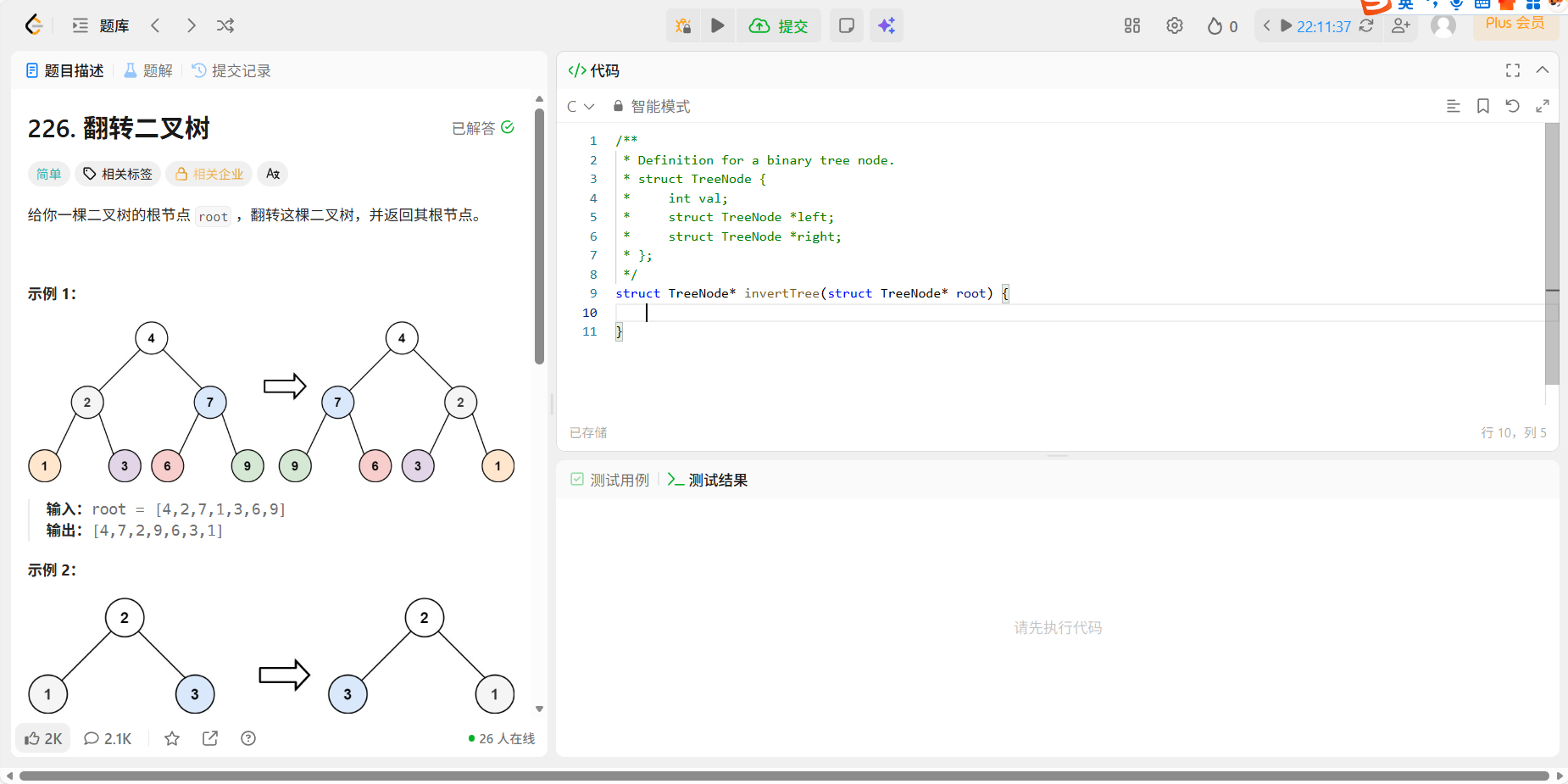
力扣第 226 题 "翻转二叉树" (Invert Binary Tree) 是一道极具传奇色彩的题目(Homebrew 的作者 Max Howell 曾因没在白板上写出这道题而被 Google 拒绝)。
但其实,它的核心逻辑非常简单:对于每一个节点,交换它的左孩子和右孩子。
1. 递归思路:自顶向下的"镜像反转"
这是最直观的写法。想象你面前有一面镜子,树的左边变成了右边,右边变成了左边。
- 核心步骤:
- 终止条件:如果节点为空,直接返回。
- 交换 :将当前节点的
left指针和right指针互换。 - 递归:对左子树进行翻转,对右子树进行翻转。
2. 迭代思路:层序遍历(BFS)
如果你不想用递归,完全可以用你最擅长的 BFS 模板 来搞定。
- 逻辑:
- 把根节点放入队列。
- 当队列不为空时,弹出一个节点
curr。 - 交换
curr->left和curr->right。 - 如果子节点不为空,把它们加入队列。
- 重复直到队列为空。
这种方法的本质:我们不管层级,只要见到一个节点,就把它那两个"胳膊"(左右孩子)换个位置。
3. C 语言代码实现
(递归版)
递归写法简洁得像一首诗:
c
struct TreeNode* invertTree(struct TreeNode* root) {
    // 1. 基础情况:空树不需要翻转
    if (root == NULL) {
        return NULL;
    }

    // 2. 交换当前节点的左右子树指针
    struct TreeNode* temp = root->left;
    root->left = root->right;
    root->right = temp;

    // 3. 递归处理子节点
    invertTree(root->left);
    invertTree(root->right);

    return root;
}
(迭代版)
c
/**
 * Definition for a binary tree node.
 * struct TreeNode {
 *     int val;
 *     struct TreeNode *left;
 *     struct TreeNode *right;
 * };
 */
struct TreeNode* invertTree(struct TreeNode* root) {
    if (root == NULL) {
        return NULL;
    }
    struct TreeNode* queue[100];
    int head = 0;
    int tail = 0;
    queue[tail++] = root;
    while(head < tail){
        int size = tail - head;
        for(int i = 0;i < size;i++){
            struct TreeNode* curr = queue[head++];
            struct TreeNode* temp = curr->left;
            curr->left = curr->right;
            curr->right = temp;
            if(curr->left){
                queue[tail++] = curr->left;
            }
            if(curr->right){
                queue[tail++] = curr->right;
            }
        }
    }
    return root;
}
4. 深度解析:为什么这能行?
很多初学者会担心:"我刚把左边换到右边,递归进去的时候顺序不就乱了吗?"
其实不会。因为二叉树是递归定义的结构。当你交换了根节点的左右指针后,原先整个左子树(作为一个整体)已经跑到了右边。接下来的递归只是在这些已经换过位置的"大块"内部进行细节调整。
5. 复杂度分析
- 时间复杂度 : O ( N ) O(N) O(N)。每个节点都被访问并交换一次。
- 空间复杂度:
- 递归 : O ( H ) O(H) O(H), H是树的高度(系统栈消耗)。
- 迭代 (BFS) : O ( W ) O(W) O(W), W是树的最大宽度(队列消耗)。
💡 总结建议
这道题是二叉树"结构操作"的基础。掌握了它,你就掌握了处理二叉树指针变换的通用方法。