深度学习网络从入门到入土 使用块的网络VGG
个人导航
知乎:https://www.zhihu.com/people/byzh_rc
CSDN:https://blog.csdn.net/qq_54636039
注:本文仅对所述内容做了框架性引导,具体细节可查询其余相关资料or源码
参考文章:各方资料
文章目录
- [深度学习网络从入门到入土 使用块的网络VGG](#[深度学习网络从入门到入土] 使用块的网络VGG)
- 个人导航
- 参考资料
- 背景
- 架构(公式)
-
-
-
- [1. VGG Block 的形式](#1. VGG Block 的形式)
- [2. 为什么坚持用 3×3?](#2. 为什么坚持用 3×3?)
- [3. 典型的 VGG16 配置](#3. 典型的 VGG16 配置)
-
-
- 创新点
-
-
-
- [1. ==提出"块"作为结构单位==](#1. ==提出“块”作为结构单位==)
- [2. 小卷积核堆叠替代大卷积核](#2. 小卷积核堆叠替代大卷积核)
- [3. 强迁移能力(经典 backbone)](#3. 强迁移能力(经典 backbone))
-
-
- 代码实现
- 项目实例
参考资料
Very Deep Convolutional Networks for Large-Scale Image Recognition.
背景
AlexNet(2012)之后,大家发现 CNN "更深"通常更强,但当时"怎么加深"并不统一:
- AlexNet 用较大的卷积核(11×11、5×5)
- GoogLeNet 用 Inception(结构更复杂)
- 那时还没有 ResNet 的残差结构,深网络训练更难
VGG 提出的核心思想非常"工程化":用简单、统一、可重复堆叠的卷积块,把网络堆深
用大量 3×3 小卷积核 替代大卷积核,并用**Block(块)**的方式组织网络
-> 使结构更规整、易于扩展、易于迁移(也因此成为经典 backbone)
架构(公式)
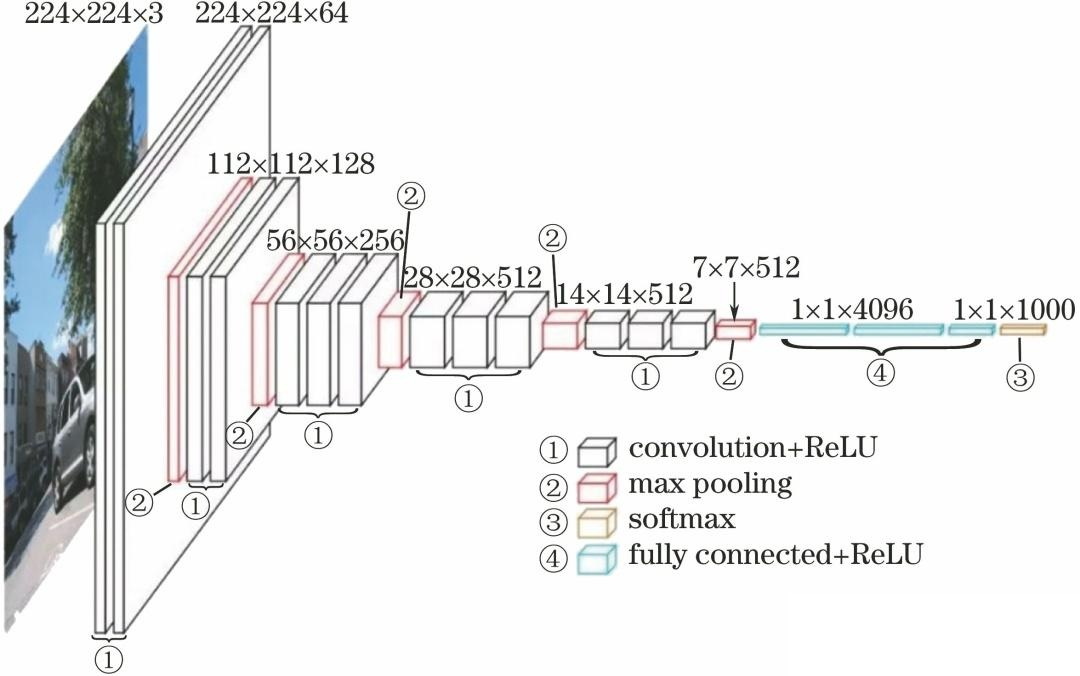
1. VGG Block 的形式
一个 VGG 块通常是:
( Conv 3 × 3 + ReLU ) × n ⏟ 同一尺度下堆叠 → MaxPool 2 × 2 , s = 2 \underbrace{(\text{Conv }3\times3 + \text{ReLU}) \times n}_{\text{同一尺度下堆叠}} \; \rightarrow \; \text{MaxPool }2\times2, s=2 同一尺度下堆叠 (Conv 3×3+ReLU)×n→MaxPool 2×2,s=2
也就是:同分辨率下做多次 3×3 卷积,然后池化缩小一半。
2. 为什么坚持用 3×3?
用多个 3×3 叠加可以替代大卷积核,并且非线性更多:
- 一个 5×5 卷积的感受野,可由两个 3×3 叠加得到 3 × 3 + 3 × 3 ⇒ 5 × 5 感受野 3\times3 \;+\; 3\times3 \Rightarrow 5\times5 \text{ 感受野} 3×3+3×3⇒5×5 感受野
- 一个 7×7 卷积的感受野,可由三个 3×3 叠加得到 3 × 3 + 3 × 3 + 3 × 3 ⇒ 7 × 7 3\times3 \;+\; 3\times3 \;+\; 3\times3 \Rightarrow 7\times7 3×3+3×3+3×3⇒7×7
好处:
- 参数更少
- 非线性层(ReLU)更多 → 表达能力更强
- 结构统一,方便堆深
3. 典型的 VGG16 配置
论文里用 "配置表" 表示(最常见是 VGG16 / VGG19):
- VGG16:
[2,2,3,3,3]个卷积层分布在 5 个块里 - 通道数:
64, 128, 256, 512, 512 - 每个块后面一个
2×2 maxpool
最后是分类头:FC 4096 -> FC 4096 -> FC num_classes
创新点
1. 提出"块"作为结构单位
VGG 的结构非常规整:每个 Block 做特征提取 + 下采样,重复堆叠即可
这让"深度"变成了一种可控超参数(11/13/16/19)
2. 小卷积核堆叠替代大卷积核
多个 3×3 代替 一个大核:
- 同等感受野下参数更少
- 非线性更多(表达力更强)
3. 强迁移能力(经典 backbone)
虽然 VGG 参数量大、计算慢,但其特征泛化强,早期大量检测/分割方法都用它做 backbone
代码实现
py
import torch
import torch.nn as nn
import torch.nn.functional as F

from byzh.ai.Butils import b_get_params

# -----------------------------
# VGG 各版本的"配置表"
# 用数字表示输出通道数,用 'M' 表示 MaxPool
# -----------------------------
cfgs = {
    # VGG11: 8个conv + 3个linear(论文叫 11 层)
    "VGG11": [
        64, "M",
        128, "M",
        256, 256, "M",
        512, 512, "M",
        512, 512, "M"
    ],
    # VGG13: 10个conv
    "VGG13": [
        64, 64, "M",
        128, 128, "M",
        256, 256, "M",
        512, 512, "M",
        512, 512, "M"
    ],
    # VGG16: 13个conv(最常用)
    "VGG16": [
        64, 64, "M",
        128, 128, "M",
        256, 256, 256, "M",
        512, 512, 512, "M",
        512, 512, 512, "M"
    ],
    # VGG19: 16个conv
    "VGG19": [
        64, 64, "M",
        128, 128, "M",
        256, 256, 256, 256, "M",
        512, 512, 512, 512, "M",
        512, 512, 512, 512, "M"
    ],
}


def make_vgg_features(cfg, use_bn=False):
    """
    根据 cfg 列表构建 VGG 的卷积特征提取部分 features
    - cfg: cfgs["VGG16"] 这种列表
    - use_bn: 是否在每个卷积后加 BN(原论文中 无BN)
    """
    layers = []
    in_channels = 3  # 输入 RGB 三通道

    for v in cfg:
        if v == "M":
            # 最大池化:把 H,W 各减半
            layers.append(nn.MaxPool2d(kernel_size=2, stride=2))
        else:
            # 3×3 卷积(VGG 固定用 3×3,padding=1 -> 保持尺寸不变)
            conv = nn.Conv2d(in_channels, v, kernel_size=3, padding=1)

            if use_bn:
                layers.extend([conv, nn.BatchNorm2d(v), nn.ReLU()])
            else:
                layers.extend([conv, nn.ReLU()])

            in_channels = v

    return nn.Sequential(*layers)

class B_VGG11_Paper(nn.Module):
    """
    VGG11:features + classifier

    input shape: (N, 3, 224, 224)
    """
    def __init__(self, num_classes=1000, use_bn=False):
        super().__init__()

        # 卷积特征提取部分
        self.features = make_vgg_features(cfgs["VGG11"], use_bn=use_bn)

        # 自适应池化到 7×7
        self.avgpool = nn.AdaptiveAvgPool2d((7, 7))

        # 分类头
        self.classifier = nn.Sequential(
            nn.Linear(512 * 7 * 7, 4096),
            nn.ReLU(),
            nn.Dropout(p=0.5),

            nn.Linear(4096, 4096),
            nn.ReLU(),
            nn.Dropout(p=0.5),

            nn.Linear(4096, num_classes),
        )

    def forward(self, x):
        x = self.features(x)      # N, 512, 7, 7(对 224 输入来说)
        x = self.avgpool(x)       # 强制变成 N, 512, 7, 7(更稳)
        x = torch.flatten(x, 1)   # N, 512*7*7
        x = self.classifier(x)    # N, num_classes
        return x

class B_VGG13_Paper(nn.Module):
    """
    VGG13:features + classifier

    input shape: (N, 3, 224, 224)
    """
    def __init__(self, num_classes=1000, use_bn=False):
        super().__init__()

        # 卷积特征提取部分
        self.features = make_vgg_features(cfgs["VGG13"], use_bn=use_bn)

        # 自适应池化到 7×7
        self.avgpool = nn.AdaptiveAvgPool2d((7, 7))

        # 分类头
        self.classifier = nn.Sequential(
            nn.Linear(512 * 7 * 7, 4096),
            nn.ReLU(),
            nn.Dropout(p=0.5),

            nn.Linear(4096, 4096),
            nn.ReLU(),
            nn.Dropout(p=0.5),

            nn.Linear(4096, num_classes),
        )

    def forward(self, x):
        x = self.features(x)      # N, 512, 7, 7(对 224 输入来说)
        x = self.avgpool(x)       # 强制变成 N, 512, 7, 7(更稳)
        x = torch.flatten(x, 1)   # N, 512*7*7
        x = self.classifier(x)    # N, num_classes
        return x

class B_VGG16_Paper(nn.Module):
    """
    VGG16:features + classifier

    input shape: (N, 3, 224, 224)
    """
    def __init__(self, num_classes=1000, use_bn=False):
        super().__init__()

        # 卷积特征提取部分
        self.features = make_vgg_features(cfgs["VGG16"], use_bn=use_bn)

        # 自适应池化到 7×7
        self.avgpool = nn.AdaptiveAvgPool2d((7, 7))

        # 分类头
        self.classifier = nn.Sequential(
            nn.Linear(512 * 7 * 7, 4096),
            nn.ReLU(),
            nn.Dropout(p=0.5),

            nn.Linear(4096, 4096),
            nn.ReLU(),
            nn.Dropout(p=0.5),

            nn.Linear(4096, num_classes),
        )

    def forward(self, x):
        x = self.features(x)      # N, 512, 7, 7(对 224 输入来说)
        x = self.avgpool(x)       # 强制变成 N, 512, 7, 7(更稳)
        x = torch.flatten(x, 1)   # N, 512*7*7
        x = self.classifier(x)    # N, num_classes
        return x

class B_VGG19_Paper(nn.Module):
    """
    VGG19:features + classifier

    input shape: (N, 3, 224, 224)
    """
    def __init__(self, num_classes=1000, use_bn=False):
        super().__init__()

        # 卷积特征提取部分
        self.features = make_vgg_features(cfgs["VGG19"], use_bn=use_bn)

        # 自适应池化到 7×7
        self.avgpool = nn.AdaptiveAvgPool2d((7, 7))

        # 分类头
        self.classifier = nn.Sequential(
            nn.Linear(512 * 7 * 7, 4096),
            nn.ReLU(),
            nn.Dropout(p=0.5),

            nn.Linear(4096, 4096),
            nn.ReLU(),
            nn.Dropout(p=0.5),

            nn.Linear(4096, num_classes),
        )

    def forward(self, x):
        x = self.features(x)      # N, 512, 7, 7(对 224 输入来说)
        x = self.avgpool(x)       # 强制变成 N, 512, 7, 7(更稳)
        x = torch.flatten(x, 1)   # N, 512*7*7
        x = self.classifier(x)    # N, num_classes
        return x


if __name__ == "__main__":
    # 测试 VGG11 输入输出
    model = B_VGG11_Paper(num_classes=1000)
    x = torch.randn(2, 3, 224, 224)
    y = model(x)
    print("VGG16 输出形状:", y.shape)  # torch.Size([2, 1000])
    print(f"参数量: {b_get_params(model)}")  # 132_863_336

    # 测试 VGG13 输入输出
    model = B_VGG13_Paper(num_classes=1000)
    x = torch.randn(2, 3, 224, 224)
    y = model(x)
    print("VGG16 输出形状:", y.shape)  # torch.Size([2, 1000])
    print(f"参数量: {b_get_params(model)}")  # 133_047_848

    # 测试 VGG16 输入输出
    model = B_VGG16_Paper(num_classes=1000)
    x = torch.randn(2, 3, 224, 224)
    y = model(x)
    print("VGG16 输出形状:", y.shape)  # torch.Size([2, 1000])
    print(f"参数量: {b_get_params(model)}")  # 138_357_544

    # 测试 VGG19 输入输出
    model = B_VGG19_Paper(num_classes=1000)
    x = torch.randn(2, 3, 224, 224)
    y = model(x)
    print("VGG16 输出形状:", y.shape)  # torch.Size([2, 1000])
    print(f"参数量: {b_get_params(model)}")  # 143_667_240
项目实例
库环境:
numpy==1.26.4
torch==2.2.2cu121
byzh-core==0.0.9.21
byzh-ai==0.0.9.53
byzh-extra==0.0.9.12
...
VGG训练MNIST数据集:
py
# copy all the codes from here to run

import torch
import torch.nn.functional as F
from uploadToPypi_ai.byzh.ai.Bdata import b_stratified_indices

from byzh.ai.Btrainer import B_Classification_Trainer
from byzh.ai.Bdata import B_Download_MNIST, b_get_dataloader_from_tensor
# from uploadToPypi_ai.byzh.ai.Bmodel.study_cnn import B_VGG16_Paper
from byzh.ai.Bmodel.study_cnn import B_VGG16_Paper
from byzh.ai.Butils import b_get_device

##### hyper params #####
epochs = 10
lr = 1e-3
batch_size = 32
device = b_get_device(use_idle_gpu=True)

##### data #####
downloader = B_Download_MNIST(save_dir='D:/study_cnn/datasets/MNIST')
data_dict = downloader.get_data()
X_train = data_dict['X_train_standard']
y_train = data_dict['y_train']
X_test = data_dict['X_test_standard']
y_test = data_dict['y_test']
num_classes = data_dict['num_classes']
num_samples = data_dict['num_samples']

indices = b_stratified_indices(y_train, num_samples//10)
X_train = X_train[indices]
X_train = F.interpolate(X_train, size=(224, 224), mode='bilinear')
X_train = X_train.repeat(1, 3, 1, 1)
y_train = y_train[indices]

indices = b_stratified_indices(y_test, num_samples//10)
X_test = X_test[indices]
X_test = F.interpolate(X_test, size=(224, 224), mode='bilinear')
X_test = X_test.repeat(1, 3, 1, 1)
y_test = y_test[indices]

train_dataloader, val_dataloader = b_get_dataloader_from_tensor(
    X_train, y_train, X_test, y_test,
    batch_size=batch_size
)

##### model #####
model = B_VGG16_Paper(num_classes=num_classes)

##### else #####
optimizer = torch.optim.Adam(model.parameters(), lr=lr)
criterion = torch.nn.CrossEntropyLoss()

##### trainer #####
trainer = B_Classification_Trainer(
    model=model,
    optimizer=optimizer,
    criterion=criterion,
    train_loader=train_dataloader,
    val_loader=val_dataloader,
    device=device
)
trainer.set_writer1('./runs/vgg16/log.txt')

##### run #####
trainer.train_eval_s(epochs=epochs)

##### calculate #####
trainer.draw_loss_acc('./runs/vgg16/loss_acc.png', y_lim=False)
trainer.save_best_checkpoint('./runs/vgg16/best_checkpoint.pth')
trainer.calculate_model()