1.为什么要使用基数树?
核心痛点:锁竞争
在高并发内存池中,页号到 Span 的映射 (MapObjectToSpan)是高频操作:
内存分配:需要找到合适的 Span 来切分小对象
内存释放:需要根据地址找到对应的 Span 来归还
而使用 unordered_map 或 map 的问题 :
-
线程不安全:需要加锁保护,大量线程竞争导致性能瓶颈
-
结构不稳定:插入/删除时可能触发 rehash(哈希表)或旋转(红黑树),影响并发读
-
查找开销:哈希计算或树遍历有一定开销
基数树的优势:
O(1) 直接寻址:数组索引,无需哈希计算
结构稳定:写操作不改变树结构(预先分配节点),读操作无需加锁
读写分离:写时提前开好空间,读时直接访问
那说了半天,基数树是什么呢?
2.基数树
结构:直接用一个数组存储所有页号的映射
template <int BITS>
class TCMalloc_PageMap1 {
private:
    static const int LENGTH = 1 << BITS;  // 2^BITS 个槽位
    void** array_;  // 指针数组,每个位置存 Span*

public:
    void* get(Number k) const {
        if ((k >> BITS) > 0) return nullptr;
        return array_[k];  // O(1) 直接寻址
    }

    void set(Number k, void* v) {
        array_[k] = v;  // O(1) 直接写入
    }
};
这里只实现32位系统的,如果想实现64位的要写三层基数树
#pragma once
#include"Common.h"

// Single-level array
template <int BITS>
class TCMalloc_PageMap1 {
private:
	static const int LENGTH = 1 << BITS;
	void** array_;

public:
	typedef uintptr_t Number;

	//explicit TCMalloc_PageMap1(void* (*allocator)(size_t)) {
	explicit TCMalloc_PageMap1() {
		//array_ = reinterpret_cast<void**>((*allocator)(sizeof(void*) << BITS));
		size_t size = sizeof(void*) << BITS;
		size_t alignSize = SizeClass::_RoundUp(size, 1 << PAGE_SHIFT);
		array_ = (void**)SystemAlloc(alignSize >> PAGE_SHIFT);
		memset(array_, 0, sizeof(void*) << BITS);
	}

	// Return the current value for KEY.  Returns NULL if not yet set,
	// or if k is out of range.
	void* get(Number k) const {
		if ((k >> BITS) > 0) {
			return NULL;
		}
		return array_[k];
	}

	// REQUIRES "k" is in range "[0,2^BITS-1]".
	// REQUIRES "k" has been ensured before.
	//
	// Sets the value 'v' for key 'k'.
	void set(Number k, void* v) {
		array_[k] = v;
	}
};

// Two-level radix tree
template <int BITS>
class TCMalloc_PageMap2 {
private:
	// Put 32 entries in the root and (2^BITS)/32 entries in each leaf.
	static const int ROOT_BITS = 5;
	static const int ROOT_LENGTH = 1 << ROOT_BITS;

	static const int LEAF_BITS = BITS - ROOT_BITS;
	static const int LEAF_LENGTH = 1 << LEAF_BITS;

	// Leaf node
	struct Leaf {
		void* values[LEAF_LENGTH];
	};

	Leaf* root_[ROOT_LENGTH];             // Pointers to 32 child nodes
	void* (*allocator_)(size_t);          // Memory allocator

public:
	typedef uintptr_t Number;

	//explicit TCMalloc_PageMap2(void* (*allocator)(size_t)) {
	explicit TCMalloc_PageMap2() {
		//allocator_ = allocator;
		memset(root_, 0, sizeof(root_));

		PreallocateMoreMemory();
	}

	void* get(Number k) const {
		const Number i1 = k >> LEAF_BITS;
		const Number i2 = k & (LEAF_LENGTH - 1);
		if ((k >> BITS) > 0 || root_[i1] == NULL) {
			return NULL;
		}
		return root_[i1]->values[i2];
	}

	void set(Number k, void* v) {
		const Number i1 = k >> LEAF_BITS;
		const Number i2 = k & (LEAF_LENGTH - 1);
		ASSERT(i1 < ROOT_LENGTH);
		root_[i1]->values[i2] = v;
	}

	bool Ensure(Number start, size_t n) {
		for (Number key = start; key <= start + n - 1;) {
			const Number i1 = key >> LEAF_BITS;

			// Check for overflow
			if (i1 >= ROOT_LENGTH)
				return false;

			// Make 2nd level node if necessary
			if (root_[i1] == NULL) {
				//Leaf* leaf = reinterpret_cast<Leaf*>((*allocator_)(sizeof(Leaf)));
				//if (leaf == NULL) return false;
				static ObjectPool<Leaf>	leafPool;
				Leaf* leaf = (Leaf*)leafPool.New();

				memset(leaf, 0, sizeof(*leaf));
				root_[i1] = leaf;
			}

			// Advance key past whatever is covered by this leaf node
			key = ((key >> LEAF_BITS) + 1) << LEAF_BITS;
		}
		return true;
	}

	void PreallocateMoreMemory() {
		// Allocate enough to keep track of all possible pages
		Ensure(0, 1 << BITS);
	}
};

// Three-level radix tree
template <int BITS>
class TCMalloc_PageMap3 {
private:
	// How many bits should we consume at each interior level
	static const int INTERIOR_BITS = (BITS + 2) / 3; // Round-up
	static const int INTERIOR_LENGTH = 1 << INTERIOR_BITS;

	// How many bits should we consume at leaf level
	static const int LEAF_BITS = BITS - 2 * INTERIOR_BITS;
	static const int LEAF_LENGTH = 1 << LEAF_BITS;

	// Interior node
	struct Node {
		Node* ptrs[INTERIOR_LENGTH];
	};

	// Leaf node
	struct Leaf {
		void* values[LEAF_LENGTH];
	};

	Node* root_;                          // Root of radix tree
	void* (*allocator_)(size_t);          // Memory allocator

	Node* NewNode() {
		Node* result = reinterpret_cast<Node*>((*allocator_)(sizeof(Node)));
		if (result != NULL) {
			memset(result, 0, sizeof(*result));
		}
		return result;
	}

public:
	typedef uintptr_t Number;

	explicit TCMalloc_PageMap3(void* (*allocator)(size_t)) {
		allocator_ = allocator;
		root_ = NewNode();
	}

	void* get(Number k) const {
		const Number i1 = k >> (LEAF_BITS + INTERIOR_BITS);
		const Number i2 = (k >> LEAF_BITS) & (INTERIOR_LENGTH - 1);
		const Number i3 = k & (LEAF_LENGTH - 1);
		if ((k >> BITS) > 0 ||
			root_->ptrs[i1] == NULL || root_->ptrs[i1]->ptrs[i2] == NULL) {
			return NULL;
		}
		return reinterpret_cast<Leaf*>(root_->ptrs[i1]->ptrs[i2])->values[i3];
	}

	void set(Number k, void* v) {
		ASSERT(k >> BITS == 0);
		const Number i1 = k >> (LEAF_BITS + INTERIOR_BITS);
		const Number i2 = (k >> LEAF_BITS) & (INTERIOR_LENGTH - 1);
		const Number i3 = k & (LEAF_LENGTH - 1);
		reinterpret_cast<Leaf*>(root_->ptrs[i1]->ptrs[i2])->values[i3] = v;
	}

	bool Ensure(Number start, size_t n) {
		for (Number key = start; key <= start + n - 1;) {
			const Number i1 = key >> (LEAF_BITS + INTERIOR_BITS);
			const Number i2 = (key >> LEAF_BITS) & (INTERIOR_LENGTH - 1);

			// Check for overflow
			if (i1 >= INTERIOR_LENGTH || i2 >= INTERIOR_LENGTH)
				return false;

			// Make 2nd level node if necessary
			if (root_->ptrs[i1] == NULL) {
				Node* n = NewNode();
				if (n == NULL) return false;
				root_->ptrs[i1] = n;
			}

			// Make leaf node if necessary
			if (root_->ptrs[i1]->ptrs[i2] == NULL) {
				Leaf* leaf = reinterpret_cast<Leaf*>((*allocator_)(sizeof(Leaf)));
				if (leaf == NULL) return false;
				memset(leaf, 0, sizeof(*leaf));
				root_->ptrs[i1]->ptrs[i2] = reinterpret_cast<Node*>(leaf);
			}

			// Advance key past whatever is covered by this leaf node
			key = ((key >> LEAF_BITS) + 1) << LEAF_BITS;
		}
		return true;
	}

	void PreallocateMoreMemory() {
	}
};
3.性能测试
到这里我们的项目就基本上完成了,下面进行项目测试:
我们的测试内容为,多线程并发执行多轮次,对比tcmalloc 和malloc的效率差多少,比较二者时间!
测试聚焦小对象高频分配这一典型场景------在实际业务中,这种场景最为常见(如游戏服务器的消息对象、Web服务的请求上下文等)。固定分配16字节内存,通过4个线程并发执行,每线程进行10轮测试,每轮完成1000次分配与释放操作。
测试代码:
#include"ConcurrentAlloc.h"

// ntimes 一轮申请和释放内存的次数
// rounds 轮次
void BenchmarkMalloc(size_t ntimes, size_t nworks, size_t rounds)
{
	std::vector<std::thread> vthread(nworks);
	std::atomic<size_t> malloc_costtime = 0;
	std::atomic<size_t> free_costtime = 0;

	for (size_t k = 0; k < nworks; ++k)
	{
			vthread[k] = std::thread([&, k]() {
			std::vector<void*> v;
			v.reserve(ntimes);

			for (size_t j = 0; j < rounds; ++j)
			{
				size_t begin1 = clock();
				for (size_t i = 0; i < ntimes; i++)
				{
					v.push_back(malloc(16));
					//v.push_back(malloc((16 + i) % 8192 + 1));
				}
				size_t end1 = clock();

				size_t begin2 = clock();
				for (size_t i = 0; i < ntimes; i++)
				{
					free(v[i]); //malloc出来的函数  你在调用我们写的释放函数
				}
				size_t end2 = clock();
				v.clear();

				malloc_costtime += (end1 - begin1);
				free_costtime += (end2 - begin2);
			}
			});
	}

	for (auto& t : vthread)
	{
		t.join();
	}

	printf("%u个线程并发执行%u轮次,每轮次malloc %u次: 花费:%u ms\n",
		nworks, rounds, ntimes, malloc_costtime.load()); //这里是编译器变严格了导致的

	printf("%u个线程并发执行%u轮次,每轮次free %u次: 花费:%u ms\n",
		nworks, rounds, ntimes, free_costtime.load());

	printf("%u个线程并发malloc&free %u次,总计花费:%u ms\n",
		nworks, nworks * rounds * ntimes, malloc_costtime.load() + free_costtime.load());
}


// 单轮次申请释放次数 线程数 轮次
void BenchmarkConcurrentMalloc(size_t ntimes, size_t nworks, size_t rounds)
{
	std::vector<std::thread> vthread(nworks);
	std::atomic<size_t> malloc_costtime = 0;
	std::atomic<size_t> free_costtime = 0;

	//自己测试
	//vthread[0] = std::thread([&]() {
	//	std::vector<void*> v;
	//	v.reserve(ntimes);
	//	v.push_back(ConcurrentAlloc(16));
	//	ConcurrentFree(v[0]);
	//	v.clear();
	//	}

	for (size_t k = 0; k < nworks; ++k)
	{
		vthread[k] = std::thread([&]() {
			std::vector<void*> v;
			v.reserve(ntimes);

			for (size_t j = 0; j < rounds; ++j)
			{
				size_t begin1 = clock();
				for (size_t i = 0; i < ntimes; i++)
				{
					v.push_back(ConcurrentAlloc(16));
					//v.push_back(ConcurrentAlloc((16 + i) % 8192 + 1));
				}

				size_t end1 = clock();

				size_t begin2 = clock();
				for (size_t i = 0; i < ntimes; i++)
				{
					ConcurrentFree(v[i]);
				}

				size_t end2 = clock();
				v.clear();

				malloc_costtime += (end1 - begin1);
				free_costtime += (end2 - begin2);
			}
			});
	}


	for (auto& t : vthread)
	{
		t.join();
	}


	printf("%u个线程并发执行%u轮次,每轮次concurrent alloc %u次: 花费:%u ms\n",
		nworks, rounds, ntimes, malloc_costtime.load());

	printf("%u个线程并发执行%u轮次,每轮次concurrent dealloc %u次: 花费:%u ms\n",
		nworks, rounds, ntimes, free_costtime.load());

	printf("%u个线程并发concurrent alloc&dealloc %u次,总计花费:%u ms\n",
		nworks, nworks * rounds * ntimes, malloc_costtime.load() + free_costtime.load());

}


int main()
{
	size_t n = 1000;
	cout << "==========================================================" << endl;
	BenchmarkConcurrentMalloc(n, 4, 10);
	cout << endl << endl;

	BenchmarkMalloc(n,4 , 10); //测试不是这个哈
	cout << "==========================================================" << endl;

	return 0;
}
结果显示:
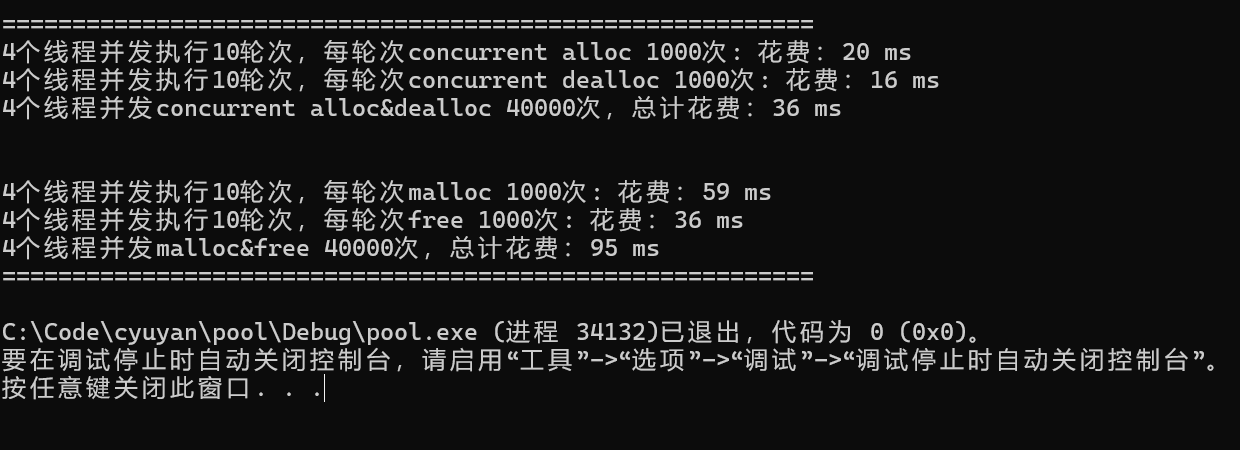
我们发现tcmalloc的性能确实快了不少!
好了本项目到此结束~
项目链接:
cyuyan: C语言的相关代码 https://gitee.com/ren-zhihan/cyuyan/tree/master/pool/pool
项目技术总结:
第一层:ThreadCache(线程本地缓存)
核心机制
-
线程隔离:每个线程拥有独立的内存缓存,通过TLS(线程本地存储)实现无锁访问
-
208个自由链表:按对象大小分级管理,覆盖8B到256KB
-
头插/头删策略:分配和释放都在链表头部操作,O(1)时间复杂度
关键计算公式
| 计算项 | 公式 | 说明 |
|---|---|---|
| 对齐后大小 | ((size + align - 1) / align) × align |
向上取整到对齐粒度 |
| 大小类索引 | 分段计算 + 累积偏移 | 根据5个区间分别映射到0-207 |
| 批量获取数量 | min(当前maxSize, 理论计算值) |
慢启动策略,逐步增长 |
| 慢启动增长 | maxSize = maxSize + 1 |
每次满载后增加下次获取量 |
技术亮点
-
慢启动批量获取:初始只获取1个对象,后续逐步增加,避免内存浪费
-
GC自动回收:当某个链表长度超过阈值,批量归还CentralCache
-
无锁设计:TLS确保每个线程访问自己的缓存,无需任何同步原语
第二层:CentralCache(中央缓存)
核心机制
-
桶锁细粒度并发:每个大小类独立加锁,减少锁竞争范围
-
Span管理单元:以连续页(Span)为单位组织内存,批量分配和回收
-
双向循环链表:管理非空Span和空Span,支持O(1)插入删除
关键操作流程
获取对象(FetchRangeObj):
-
加桶锁(锁定当前大小类)
-
查找非空Span(有可用对象的内存块)
-
从Span切分batchNum个对象
-
返回1个给ThreadCache,剩余缓存到ThreadCache
-
解锁
归还对象(ReleaseListToSpans):
-
加桶锁
-
通过基数树查询每个对象所属的Span
-
头插法归还到对应Span的自由链表
-
若Span完全空闲(useCount=0),移出链表准备归还PageHeap
-
解锁
关键计算公式
| 计算项 | 公式 | 说明 |
|---|---|---|
| 切分对象数 | Span总大小 / 对象大小 |
1页8KB切分16B对象得512个 |
| Span使用计数 | useCount += 实际分配数 |
跟踪Span内活跃对象 |
| 空闲判断 | useCount == 0 |
表示Span可归还PageHeap |
第三层:PageHeap(页堆)
核心机制
-
128个空闲链表:按页数1-128分类管理Span
-
大Span单独存储:超过128页的Span用有序集合管理
-
伙伴系统合并:释放时尝试与前后相邻Span合并,减少碎片
-
基数树映射:O(1)时间从地址查询所属Span
关键操作流程
申请Span(NewSpan):
-
检查对应页数的空闲链表,有直接返回
-
无则查找更大页数的链表,分裂后返回所需部分
-
都无则向系统申请128页大Span,插入链表后重新分配
释放Span(ReleaseSpanToPageCache):
-
向前合并:检查pageId-1是否为空闲Span,是则合并
-
向后合并:检查pageId+n是否为空闲Span,是则合并
-
合并后插入对应空闲链表
-
更新基数树映射(首尾页都映射)
关键计算公式
| 计算项 | 公式 | 说明 |
|---|---|---|
| 页号计算 | pageId = address >> 13 |
8KB页,右移13位 |
| 地址还原 | address = pageId << 13 |
页号转起始地址 |
| 分裂操作 | k页给请求者,(n-k)页挂回n-k链表 |
大Span分裂利用 |
| 合并限制 | 合并后页数 ≤ 128 |
防止Span过大 |
| 基数树索引 | 直接数组寻址或分层索引 | 32位单层,64位三层 |
三层协作核心机制
对象分配流程
用户请求 → ThreadCache命中?→ 直接返回(无锁)
                ↓ 未命中
         CentralCache获取批量 → 填充ThreadCache后返回
                ↓ Central无Span
         PageHeap获取/分裂Span → 交给CentralCache切分
                ↓ PageHeap无Span
         系统调用申请内存 → 更新基数树
对象释放流程
用户释放 → ThreadCache缓存(头插法)
                ↓ 链表过长
         批量归还CentralCache → 分散到各Span
                ↓ Span完全空闲
         归还PageHeap → 尝试前后合并
                ↓ 空闲内存过多
         延迟归还给OS(madvise释放物理页)
关键技术亮点总结
| 技术点 | 作用 | 实现位置 |
|---|---|---|
| TLS无锁访问 | 消除线程竞争 | ThreadCache |
| 慢启动批量 | 平衡内存占用与性能 | ThreadCache ↔ CentralCache |
| 桶锁细粒度 | 减少锁冲突 | CentralCache |
| Span延迟归还 | 避免频繁系统调用 | CentralCache |
| 伙伴系统合并 | 减少外部碎片 | PageHeap |
| 基数树O(1)映射 | 快速地址到Span查询 | PageHeap |
| 分层基数树 | 适配32/64位地址空间 | PageMap |
| 大页对齐 | 适配HugePage,减少TLB miss | SystemAlloc |
性能优化核心思想
-
分层缓存:高频操作在最上层无锁处理,低频操作下沉到下层批量处理
-
空间换时间:ThreadCache的内存冗余换取分配速度
-
延迟计算:批量获取、延迟合并、后台GC,摊平开销
-
硬件亲和:缓存行对齐、HugePage、NUMA感知
-
确定性优先:牺牲极端最优,换取99%场景的稳定表现