FA :formulas and algorithm,PC :planning and control,PRM:Probabilistic Roadmap Method
一、PRM 核心原理与数学基础
1. 核心定义
概率路图法(Probabilistic Roadmap Method)是一种基于采样的离线路径规划算法,核心思想是:
- 先在机器人的构型空间(C 空间) 中随机采样大量无碰撞的节点(构型);
- 将这些节点连接成一个连通的图(路图),仅保留无碰撞的边;
- 当需要规划路径时,只需在预先生成的路图上用图搜索算法(如 Dijkstra、A*)找起点到终点的路径。
2. 关键数学概念
- 构型空间(C 空间) :描述机器人所有可能姿态的空间,2D 平面移动机器人的 C 空间是(x,y)(x,y)(x,y),记为C⊆R2C⊆R^2C⊆R2;
- 自由空间(CfreeC_{free}Cfree) :C 空间中无碰撞的区域,Cfree=q∈C∣q无碰撞C_{free}={q∈C∣q 无碰撞}Cfree=q∈C∣q无碰撞;
- 障碍空间(CobsC_{obs}Cobs) :C 空间中有碰撞的区域,Cobs=C∖CfreeC_{obs}=C∖C_{free}Cobs=C∖Cfree;
- 邻域半径(rrr):每个采样节点仅连接其邻域内的其他节点,避免全连接导致的计算爆炸;
- 采样概率 :PRM 通过随机采样覆盖Cfree,采样点满足均匀分布q∼Uniform(CfreeC_{free}Cfree)。
3. 算法推导(核心公式)
PRM 的目标是构建路图G=(V,E)G=(V,E)G=(V,E),其中:
- 节点集V⊆CfreeV⊆C_{free}V⊆Cfree,满足∀q∈V,q∈/Cobs∀q∈V,q∈/C_{obs}∀q∈V,q∈/Cobs;
- 边集 E=(qi,qj)∣qi,qj∈VE={(q_i,q_j)∣q_i,q_j∈V}E=(qi,qj)∣qi,qj∈V,线段 qiqj⊆Cfree,∥qi−qj∥≤r{q_iq_j⊆C_{free},∥q_i−q_j∥≤r}qiqj⊆Cfree,∥qi−qj∥≤r;
路径规划阶段,需将起点qstartq_{start}qstart和终点qgoalq_{goal}qgoal加入路图,再求解最短路径:
Path=argminP∈P(qstart,qgoal)∑(qi,qj)∈P∥qi−qj∥Path=arg min_{P∈P(q_{start},q_{goal})} \sum_{(q_i,q_j)∈P}∥q_i−q_j∥Path=argminP∈P(qstart,qgoal)∑(qi,qj)∈P∥qi−qj∥
其中P(qstart,qgoal)P(q_{start},q_{goal})P(qstart,qgoal)是路图中从起点到终点的所有可行路径集合。
二、PRM 操作步骤(标准流程)
PRM 分为离线建图 和在线查询两个阶段,具体步骤如下:
阶段 1:离线构建概率路图
- 初始化:设定采样点数N、邻域半径r,初始化空路图G=(V,E);
- 随机采样:在 C 空间中随机生成N个采样点,过滤掉落在障碍空间Cobs的点,将剩余无碰撞点加入节点集V;
- 邻域搜索:对每个节点qi∈V,找到所有满足∥qi−qj∥≤r的节点qj∈V;
- 碰撞检测:对每对邻域节点(qi,qj),检查连接它们的线段是否与障碍物碰撞,无碰撞则将边(qi,qj)加入边集E;
- 保存路图:完成所有节点和边的构建,保存路图G。
阶段 2:在线路径查询
- 加入起止点 :将起点qstartq_{start}qstart和终点qgoalq_{goal}qgoal加入节点集VVV,并分别与邻域内的节点建立无碰撞边;
- 图搜索 :用 Dijkstra 或 A * 算法在路图G 中搜索从qstartq_{start}qstart到qgoalq_{goal}qgoal的最短路径;
- 输出路径:若找到路径则返回,否则返回 "无可行路径"。
三、Python 代码示例(2D 平面 PRM 实现)
下面是一个可直接运行的 2D 平面 PRM 实现,包含采样、建图、路径搜索全流程,注释详细且易理解。
示例一
前置依赖
先安装必要库:
bash
pip install numpy matplotlib networkx完整代码
bash
import numpy as np
import matplotlib.pyplot as plt
import networkx as nx
from math import sqrt

class PRMPlanner:
    def __init__(self, obstacle_list, sample_n=200, radius=1.0):
        """
        初始化PRM规划器
        :param obstacle_list: 障碍物列表,每个障碍物为(x, y, 半径)
        :param sample_n: 采样节点数量
        :param radius: 邻域搜索半径
        """
        self.obstacle_list = obstacle_list  # 障碍物集合
        self.sample_n = sample_n            # 采样点数
        self.radius = radius                # 邻域半径
        self.graph = nx.Graph()             # 概率路图(用networkx存储)

    def random_sample(self):
        """随机采样无碰撞节点,返回采样点列表"""
        sample_points = []
        while len(sample_points) < self.sample_n:
            # 在[0, 10]x[0, 10]的2D空间中随机采样
            x = np.random.uniform(0, 10)
            y = np.random.uniform(0, 10)
            point = (x, y)
            # 检查采样点是否与障碍物碰撞
            if not self.is_collision(point, None):
                sample_points.append(point)
        return sample_points

    def is_collision(self, point1, point2):
        """
        碰撞检测:
        - 若point2为None:检查point1是否在障碍物内
        - 若point2不为None:检查point1到point2的线段是否与障碍物碰撞
        """
        # 检查点碰撞
        if point2 is None:
            x, y = point1
            for (ox, oy, r) in self.obstacle_list:
                if sqrt((x - ox)**2 + (y - oy)**2) <= r:
                    return True  # 碰撞
            return False

        # 检查线段碰撞(点1到点2)
        x1, y1 = point1
        x2, y2 = point2
        for (ox, oy, r) in self.obstacle_list:
            # 计算线段到障碍物中心的最短距离
            dx = x2 - x1
            dy = y2 - y1
            a = dx**2 + dy**2
            b = 2 * (dx*(x1 - ox) + dy*(y1 - oy))
            c = (x1 - ox)**2 + (y1 - oy)**2 - r**2
            discriminant = b**2 - 4*a*c

            if discriminant < 0:
                continue  # 无交点
            t1 = (-b - sqrt(discriminant)) / (2*a)
            t2 = (-b + sqrt(discriminant)) / (2*a)
            # 检查交点是否在线段上(t∈[0,1])
            if (0 <= t1 <= 1) or (0 <= t2 <= 1):
                return True  # 碰撞
        return False

    def build_roadmap(self):
        """构建概率路图"""
        # 1. 随机采样无碰撞节点
        sample_points = self.random_sample()
        # 2. 将采样点加入图中(节点用索引标识,属性存储坐标)
        for i, point in enumerate(sample_points):
            self.graph.add_node(i, pos=point)

        # 3. 邻域搜索并添加无碰撞边
        for i in range(len(sample_points)):
            p1 = sample_points[i]
            for j in range(i+1, len(sample_points)):
                p2 = sample_points[j]
                # 检查距离是否在邻域半径内
                dist = sqrt((p1[0]-p2[0])**2 + (p1[1]-p2[1])**2)
                if dist <= self.radius:
                    # 检查线段是否碰撞
                    if not self.is_collision(p1, p2):
                        # 添加边,权重为距离
                        self.graph.add_edge(i, j, weight=dist)

        return sample_points

    def plan(self, start, goal):
        """
        路径规划:将起止点加入路图,搜索最短路径
        :param start: 起点坐标 (x,y)
        :param goal: 终点坐标 (x,y)
        :return: 可行路径列表(坐标点),若无则返回None
        """
        # 检查起止点是否在障碍物内
        if self.is_collision(start, None) or self.is_collision(goal, None):
            print("起点/终点在障碍物内,无可行路径")
            return None

        # 1. 将起止点加入图中
        sample_points = list(nx.get_node_attributes(self.graph, 'pos').values())
        start_idx = len(sample_points)
        goal_idx = len(sample_points) + 1
        self.graph.add_node(start_idx, pos=start)
        self.graph.add_node(goal_idx, pos=goal)

        # 2. 连接起止点与邻域内的节点
        for i, p in enumerate(sample_points):
            # 连接起点
            dist_start = sqrt((start[0]-p[0])**2 + (start[1]-p[1])**2)
            if dist_start <= self.radius and not self.is_collision(start, p):
                self.graph.add_edge(start_idx, i, weight=dist_start)
            # 连接终点
            dist_goal = sqrt((goal[0]-p[0])**2 + (goal[1]-p[1])**2)
            if dist_goal <= self.radius and not self.is_collision(goal, p):
                self.graph.add_edge(goal_idx, i, weight=dist_goal)

        # 3. Dijkstra算法搜索最短路径
        try:
            path_idx = nx.dijkstra_path(self.graph, start_idx, goal_idx, weight='weight')
        except nx.NetworkXNoPath:
            print("未找到可行路径")
            return None

        # 4. 将索引转换为坐标
        path = [self.graph.nodes[idx]['pos'] for idx in path_idx]
        return path

    def plot_result(self, start, goal, path):
        """可视化结果"""
        plt.figure(figsize=(8, 8))
        # 绘制障碍物
        for (ox, oy, r) in self.obstacle_list:
            circle = plt.Circle((ox, oy), r, color='gray', alpha=0.5)
            plt.gca().add_patch(circle)

        # 绘制路图节点
        node_pos = nx.get_node_attributes(self.graph, 'pos')
        nx.draw_networkx_nodes(self.graph, node_pos, node_size=10, node_color='blue')

        # 绘制路图边
        nx.draw_networkx_edges(self.graph, node_pos, edge_color='lightblue', alpha=0.3)

        # 绘制路径
        if path is not None:
            path_x = [p[0] for p in path]
            path_y = [p[1] for p in path]
            plt.plot(path_x, path_y, color='red', linewidth=2, label='Path')

        # 绘制起止点
        plt.scatter(start[0], start[1], color='green', s=100, label='Start')
        plt.scatter(goal[0], goal[1], color='orange', s=100, label='Goal')

        plt.xlim(0, 10)
        plt.ylim(0, 10)
        plt.grid(True)
        plt.legend()
        plt.title('PRM Path Planning')
        plt.show()

# ---------------------- 测试代码 ----------------------
if __name__ == "__main__":
    # 定义障碍物(x, y, 半径)
    obstacles = [
        (2, 2, 1),
        (5, 5, 1.5),
        (8, 2, 1),
        (4, 8, 1)
    ]

    # 初始化PRM规划器
    prm = PRMPlanner(obstacle_list=obstacles, sample_n=200, radius=1.5)

    # 构建路图
    prm.build_roadmap()

    # 定义起止点
    start_point = (1, 1)
    goal_point = (9, 9)

    # 路径规划
    path = prm.plan(start_point, goal_point)

    # 可视化
    prm.plot_result(start_point, goal_point, path)

    # 输出路径坐标
    if path is not None:
        print("规划路径坐标:")
        for i, p in enumerate(path):
            print(f"点{i}: {p}")
代码关键部分解释
- 碰撞检测函数(is_collision) :
- 点碰撞:判断采样点是否在障碍物圆形区域内;
- 线段碰撞:通过求解线段与圆的交点,判断是否有交点且交点在线段上。
- 路图构建(build_roadmap):
- 用 networkx 存储图结构,节点存储坐标,边存储距离权重;
- 仅连接邻域内无碰撞的节点,避免全连接。
- 路径搜索(plan):
- 将起止点加入路图并连接邻域节点;
- 调用 networkx 的 Dijkstra 算法找最短路径。
- 可视化(plot_result):
- 绘制障碍物、路图、起止点和规划路径,直观展示结果。
运行结果说明
运行代码后会弹出可视化窗口,蓝色小点是采样节点,浅蓝色线是路图边,红色线是规划的路径;
绿色点是起点,橙色点是终点,灰色圆形是障碍物;
控制台会输出路径的坐标点列表。
示例二
bash
import math
import numpy as np
import matplotlib.pyplot as plt
from scipy.spatial import KDTree
from celluloid import Camera  # 保存动图时用,pip install celluloid
import time

# ==================== PRM核心参数(优化版)====================
N_SAMPLE = 2000  # 采样点数量
N_KNN = 30       # 邻域点个数
MAX_EDGE_LEN = 30.0  # 最大边长度
ROBOT_RADIUS = 1.5   # 机器人半径
show_animation = True
ANIMATION_INTERVAL = 20  # 动画间隔(毫秒)
PLOT_PAUSE_TIME = 0.001  # 绘图暂停时间

# 强制设置matplotlib后端(解决动画显示问题)
plt.switch_backend('TkAgg')
# 设置matplotlib参数
plt.rcParams['font.sans-serif'] = ['DejaVu Sans', 'Arial']
plt.rcParams['axes.unicode_minus'] = False
plt.rcParams['figure.figsize'] = (12, 10)
plt.rcParams['animation.html'] = 'jshtml'

class Node:
    """Dijkstra搜索节点类"""
    def __init__(self, x, y, cost, parent_index):
        self.x = x
        self.y = y
        self.cost = cost
        self.parent_index = parent_index

    def __str__(self):
        return f"{self.x:.1f},{self.y:.1f},{self.cost:.1f},{self.parent_index}"


def prm_planning(start_x, start_y, goal_x, goal_y, obstacle_x_list, obstacle_y_list, robot_radius, *, ax=None, camera=None, rng=None):
    """PRM主规划函数:采样→建路网→Dijkstra搜索"""
    print(f"\n📊 PRM参数:采样点={N_SAMPLE}, 邻域数={N_KNN}, 最大边长度={MAX_EDGE_LEN}, 机器人半径={robot_radius}")

    # 构建障碍物KD树
    obstacle_kd_tree = KDTree(np.vstack((obstacle_x_list, obstacle_y_list)).T)

    # 1. 生成无碰撞采样点集
    print("🔄 正在生成采样点...")
    sample_x, sample_y = sample_points(
        start_x, start_y, goal_x, goal_y,
        robot_radius, obstacle_x_list, obstacle_y_list,
        obstacle_kd_tree, rng
    )
    print(f"✅ 生成采样点数量:{len(sample_x)} (包含起点终点)")

    if show_animation and ax is not None:
        ax.plot(sample_x, sample_y, ".b", markersize=2, alpha=0.6, label="Sample Points")
        plt.pause(PLOT_PAUSE_TIME)
        if camera:
            camera.snap()

    # 2. 生成概率路图
    print("🔄 正在构建概率路网...")
    road_map = generate_road_map(sample_x, sample_y, robot_radius, obstacle_kd_tree, ax, camera)
    # 统计路网连通性
    total_edges = sum(len(edges) for edges in road_map)
    print(f"✅ 路网构建完成,总边数:{total_edges}")

    # 3. Dijkstra算法搜索最短路径
    print("🔄 正在搜索最优路径...")
    rx, ry = dijkstra_planning(
        start_x, start_y, goal_x, goal_y,
        road_map, sample_x, sample_y, ax, camera
    )

    return rx, ry


def is_collision(sx, sy, gx, gy, rr, obstacle_kd_tree):
    """优化的碰撞检测函数"""
    dx = gx - sx
    dy = gy - sy
    d = math.hypot(dx, dy)

    # 最大边长度放宽限制
    if d > MAX_EDGE_LEN:
        return True

    # 优化的分段检测
    step = max(1.0, rr / 2)
    n_step = max(1, int(d / step))
    yaw = math.atan2(dy, dx)

    for i in range(n_step + 1):
        x = sx + step * i * math.cos(yaw)
        y = sy + step * i * math.sin(yaw)
        dist, _ = obstacle_kd_tree.query([x, y])
        if dist <= rr * 0.9:
            return True

    # 终点检测
    dist, _ = obstacle_kd_tree.query([gx, gy])
    if dist <= rr * 0.9:
        return True

    return False


def generate_road_map(sample_x, sample_y, rr, obstacle_kd_tree, ax, camera):
    """优化的路网生成函数"""
    road_map = []
    n_sample = len(sample_x)
    sample_kd_tree = KDTree(np.vstack((sample_x, sample_y)).T)

    # 为每个采样点找更多邻域点
    for i in range(n_sample):
        ix, iy = sample_x[i], sample_y[i]
        # 查询更多邻域点
        k = min(N_KNN * 2, n_sample - 1)
        dists, indexes = sample_kd_tree.query([ix, iy], k=k)
        edge_ids = []

        # 筛选无碰撞邻域点
        for ii in range(1, len(indexes)):
            nx = sample_x[indexes[ii]]
            ny = sample_y[indexes[ii]]
            if not is_collision(ix, iy, nx, ny, rr, obstacle_kd_tree):
                edge_ids.append(indexes[ii])
                if len(edge_ids) >= N_KNN:
                    break

        road_map.append(edge_ids)

        # 可视化路网构建过程
        if show_animation and ax is not None and i % 50 == 0:
            for neighbor_id in edge_ids:
                ax.plot(
                    [sample_x[i], sample_x[neighbor_id]],
                    [sample_y[i], sample_y[neighbor_id]],
                    "-k", linewidth=0.3, alpha=0.2
                )
            plt.pause(PLOT_PAUSE_TIME)
            if camera:
                camera.snap()

    return road_map


def dijkstra_planning(sx, sy, gx, gy, road_map, sample_x, sample_y, ax, camera):
    """优化的Dijkstra搜索函数"""
    start_node = Node(sx, sy, 0.0, -1)
    goal_node = Node(gx, gy, 0.0, -1)
    open_set, closed_set = dict(), dict()

    # 起点和终点索引
    start_idx = len(road_map) - 2
    goal_idx = len(road_map) - 1
    open_set[start_idx] = start_node

    # 打印起点终点信息
    print(f"\n🎯 起点坐标: ({sx:.1f}, {sy:.1f}) (索引: {start_idx})")
    print(f"🎯 终点坐标: ({gx:.1f}, {gy:.1f}) (索引: {goal_idx})")

    path_found = True
    search_count = 0

    while True:
        search_count += 1

        # 无可行节点
        if not open_set:
            print("\n❌ 未找到可行路径!原因分析:")
            print(f"   - 搜索迭代次数: {search_count}")
            print(f"   - 起点邻域数: {len(road_map[start_idx])}")
            print(f"   - 终点邻域数: {len(road_map[goal_idx])}")
            path_found = False
            break

        # 选择代价最小节点
        current_id = min(open_set, key=lambda o: open_set[o].cost)
        current_node = open_set[current_id]

        # 每20步打印一次搜索状态
        if search_count % 20 == 0:
            print(f"🔍 搜索中 - 当前节点: ({current_node.x:.1f}, {current_node.y:.1f}), "
                  f"代价: {current_node.cost:.1f}, Open集大小: {len(open_set)}")

        # 可视化搜索过程
        if show_animation and ax is not None and search_count % 5 == 0:
            ax.plot(current_node.x, current_node.y, "xg", markersize=5, alpha=0.8)
            plt.pause(PLOT_PAUSE_TIME)
            if camera:
                camera.snap()

        # 到达终点
        if current_id == goal_idx:
            print(f"\n✅ 找到目标点!总搜索步数: {search_count}")
            goal_node.parent_index = current_node.parent_index
            goal_node.cost = current_node.cost
            break

        # 移动节点
        del open_set[current_id]
        closed_set[current_id] = current_node

        # 扩展邻域节点
        for neighbor_id in road_map[current_id]:
            nx = sample_x[neighbor_id]
            ny = sample_y[neighbor_id]
            cost = current_node.cost + math.hypot(nx - current_node.x, ny - current_node.y)
            neighbor_node = Node(nx, ny, cost, current_id)

            if neighbor_id in closed_set:
                continue
            if neighbor_id in open_set:
                if open_set[neighbor_id].cost > cost:
                    open_set[neighbor_id].cost = cost
                    open_set[neighbor_id].parent_index = current_id
            else:
                open_set[neighbor_id] = neighbor_node

    # 路径回溯
    if not path_found:
        return [], []

    print("🔄 正在回溯路径...")
    rx, ry = [goal_node.x], [goal_node.y]
    parent_idx = goal_node.parent_index
    path_length = 0

    while parent_idx != -1:
        if parent_idx in closed_set:
            node = closed_set[parent_idx]
            rx.append(node.x)
            ry.append(node.y)
            path_length += math.hypot(rx[-1]-rx[-2], ry[-1]-ry[-2])
            parent_idx = node.parent_index
        else:
            print("⚠️ 路径回溯中断,父节点不存在")
            break

    # 关键修复:反转路径,使其从起点到终点
    rx.reverse()
    ry.reverse()

    print(f"✅ 路径生成完成,路径长度: {path_length:.1f}, 路径点数: {len(rx)}")

    # 立即绘制路径(确保路径被绘制)
    if show_animation and ax is not None and rx:
        ax.plot(rx, ry, "-r", linewidth=4, alpha=0.8, label="Planned Path", zorder=10)
        ax.plot(rx, ry, "-w", linewidth=2, alpha=0.8, zorder=9)  # 白色描边增强视觉效果
        plt.pause(PLOT_PAUSE_TIME)
        if camera:
            camera.snap()

    return rx, ry


def sample_points(sx, sy, gx, gy, rr, ox, oy, obstacle_kd_tree, rng):
    """优化的采样函数"""
    max_x = max(ox) if ox else 100.0
    max_y = max(oy) if oy else 100.0
    min_x = min(ox) if ox else 0.0
    min_y = min(oy) if oy else 0.0

    sample_x, sample_y = [], []
    if rng is None:
        rng = np.random.default_rng()

    # 增加采样效率
    sample_attempts = 0
    max_attempts = N_SAMPLE * 10

    while len(sample_x) < N_SAMPLE and sample_attempts < max_attempts:
        sample_attempts += 1
        tx = rng.uniform(min_x + 5, max_x - 5)
        ty = rng.uniform(min_y + 5, max_y - 5)
        dist, _ = obstacle_kd_tree.query([tx, ty])
        if dist >= rr * 0.8:
            sample_x.append(tx)
            sample_y.append(ty)

            if len(sample_x) % 200 == 0:
                print(f"   已采样: {len(sample_x)}/{N_SAMPLE}")

    # 强制加入起点和终点
    sample_x.append(sx)
    sample_y.append(sy)
    sample_x.append(gx)
    sample_y.append(gy)

    if sample_attempts >= max_attempts:
        print(f"⚠️ 采样达到最大尝试次数 {max_attempts}")

    return sample_x, sample_y


def create_complex_9area_obstacles():
    """构建9区域复杂障碍物场景"""
    ox, oy = [], []

    # 1. 外边界
    for i in range(101):
        ox.append(i), oy.append(0.0)
        ox.append(i), oy.append(100.0)
        ox.append(0.0), oy.append(i)
        ox.append(100.0), oy.append(i)

    # 2. 横向挡板(留更大缺口)
    # 横向挡板1(y=30):x=0~15 + x=45~75
    for i in range(0, 16):
        ox.append(i), oy.append(30.0)
    for i in range(45, 76):
        ox.append(i), oy.append(30.0)
    # 横向挡板2(y=70):x=25~55 + x=85~100
    for i in range(25, 56):
        ox.append(i), oy.append(70.0)
    for i in range(85, 101):
        ox.append(i), oy.append(70.0)

    # 3. 纵向挡板(留更大缺口)
    # 纵向挡板1(x=30):y=0~35 + y=65~100
    for i in range(0, 36):
        ox.append(30.0), oy.append(i)
    for i in range(65, 101):
        ox.append(30.0), oy.append(i)
    # 纵向挡板2(x=70):y=25~45 + y=75~85
    for i in range(25, 46):
        ox.append(70.0), oy.append(i)
    for i in range(75, 86):
        ox.append(70.0), oy.append(i)

    # 4. 额外障碍物(减小尺寸)
    # 区域1:更小的矩形
    for i in range(8, 12):
        ox.append(i), oy.append(12.0)
        ox.append(i), oy.append(18.0)
    for i in range(12, 18):
        ox.append(8.0), oy.append(i)
        ox.append(12.0), oy.append(i)
    # 区域5:更小的圆形
    for theta in np.linspace(0, 2*math.pi, 50):
        ox.append(50 + 6*math.cos(theta))
        oy.append(50 + 6*math.sin(theta))
    # 区域9:更短的斜向障碍
    for i in range(85, 92):
        ox.append(i), oy.append(82 + (i-85)*0.8)
        ox.append(i), oy.append(88 + (i-85)*0.8)

    return ox, oy


def main(rng=None):
    print("="*60)
    print("🚀 PRM Path Planning Algorithm (9-area Complex Scene)")
    print("="*60)

    # 创建图形和坐标轴
    fig, ax = plt.subplots(1, 1, figsize=(12, 10))
    camera = Camera(fig) if show_animation else None

    # 设置坐标轴
    ax.set_xlim(-5, 105)
    ax.set_ylim(-5, 105)
    ax.set_aspect('equal')
    ax.grid(True, alpha=0.3)
    ax.set_title("PRM Algorithm - 9-area Complex Scene", fontsize=14, pad=20)

    # 起点/终点
    sx, sy = 10.0, 10.0  # 左上区域
    gx, gy = 90.0, 90.0  # 右下区域

    # 构建障碍物
    ox, oy = create_complex_9area_obstacles()

    # 初始化可视化
    if show_animation:
        # 绘制障碍物、起点、终点
        ax.plot(ox, oy, ".k", markersize=1, label="Obstacles", zorder=1)
        ax.plot(sx, sy, "^r", markersize=15, label="Start", zorder=7)
        ax.plot(gx, gy, "^g", markersize=15, label="Goal", zorder=7)

        # 添加图例
        ax.legend(loc="upper right", fontsize=12, framealpha=0.9)

        # 刷新显示
        plt.pause(1.0)  # 初始暂停1秒,让用户看清初始画面
        if camera:
            camera.snap()

    # 执行PRM规划
    start_time = time.time()
    rx, ry = prm_planning(
        sx, sy, gx, gy, ox, oy, ROBOT_RADIUS,
        ax=ax, camera=camera, rng=rng
    )
    end_time = time.time()

    print(f"\n⏱️  总执行时间: {end_time - start_time:.2f} 秒")

    # ========== 关键修复:确保最终路径绘制 ==========
    if show_animation:
        # 清除原有路径(避免重复)
        for line in ax.get_lines():
            if line.get_label() == "Planned Path":
                line.remove()

        # 重新绘制最终路径(确保显示)
        if rx and ry and len(rx) > 1:
            # 主路径 - 红色粗线
            path_line = ax.plot(rx, ry, "-r", linewidth=5, alpha=0.9,
                               label="Final Path", zorder=8)[0]
            # 路径描边 - 白色细线,增强视觉效果
            ax.plot(rx, ry, "-w", linewidth=2, alpha=0.9, zorder=7)

            # 高亮路径节点
            ax.plot(rx, ry, "or", markersize=4, alpha=0.8, zorder=6)

            # 更新标题和图例
            ax.set_title("PRM Algorithm - Path Planning Successful!",
                        fontsize=16, color="darkgreen", pad=20)
            ax.legend(loc="upper right", fontsize=12, framealpha=0.9)

            print("\n🎉 最终路径已绘制完成!")
            print(f"📏 路径详情:起点({sx:.1f},{sy:.1f}) → 终点({gx:.1f},{gy:.1f})")
            print(f"📈 路径包含 {len(rx)} 个节点,总长度 {math.hypot(rx[-1]-rx[0], ry[-1]-ry[0]):.1f}")
        else:
            ax.set_title("PRM Algorithm - No Feasible Path Found",
                        fontsize=16, color="darkred", pad=20)
            print("\n❌ 无法绘制路径:未找到可行路径")

        # 强制刷新绘图
        plt.draw()
        plt.pause(2.0)  # 暂停2秒查看结果

        # 保存动图
        if camera:
            try:
                print("\n📸 正在生成动画...")
                animation = camera.animate(interval=ANIMATION_INTERVAL, repeat=True, repeat_delay=2000)
                animation.save('prm_9area_animation.gif', writer='pillow', fps=20, dpi=120)
                print("✅ 动画已保存为 prm_9area_animation.gif")
            except Exception as e:
                print(f"⚠️ 动画保存失败: {e}")

        # 保存高清静态图
        plt.savefig("prm_9area_final_result.png", dpi=200, bbox_inches="tight", facecolor='white')
        print("✅ 最终结果图已保存为 prm_9area_final_result.png")

        # 保持图形窗口打开
        print("\n📺 路径规划完成!按关闭窗口退出程序...")
        plt.show(block=True)

    print("\n" + "="*60)
    print("🏁 PRM algorithm execution completed")
    print("="*60)


if __name__ == '__main__':
    # 确保在主线程运行
    import matplotlib
    matplotlib.use('TkAgg')
    main()
运行结果
在整个区域内,抛洒概率点:
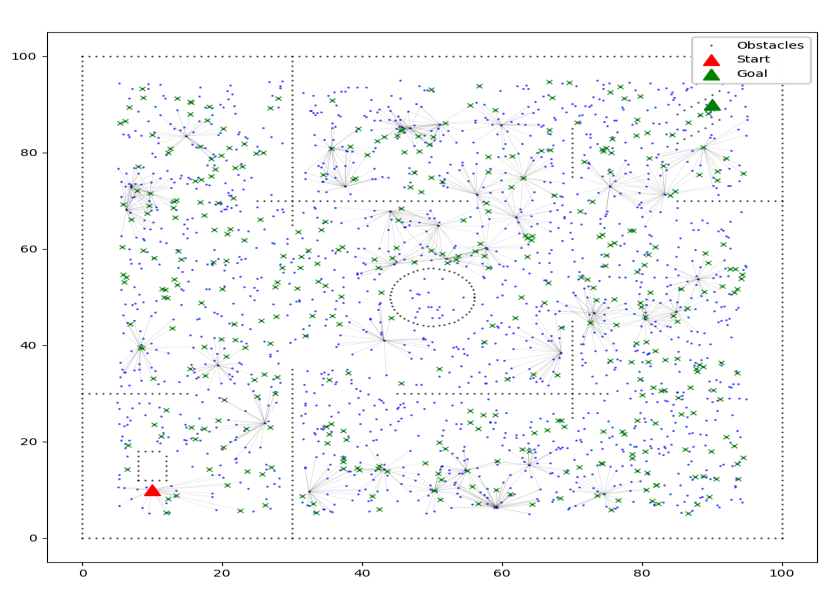
运行后的结果: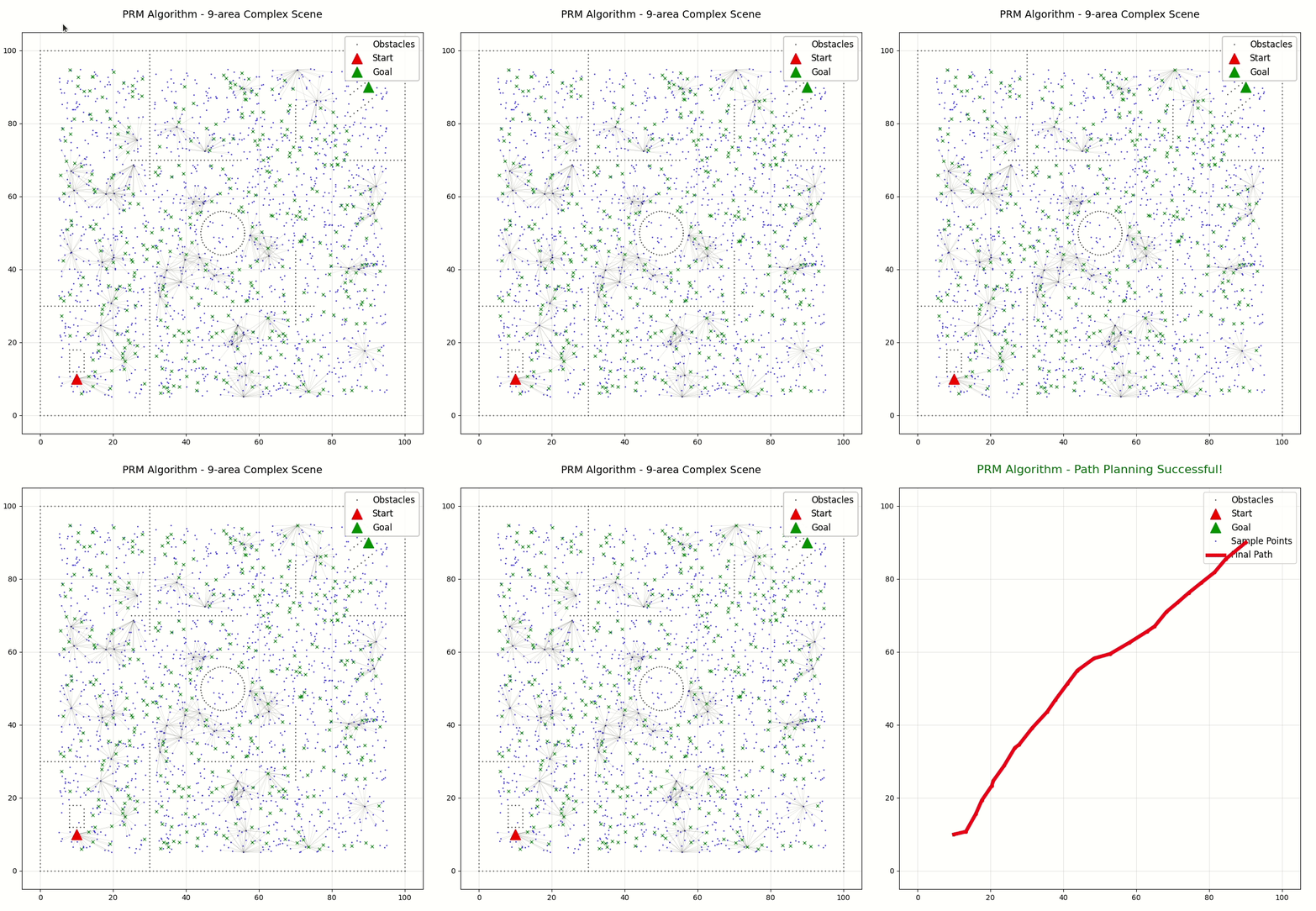
四、结束语
- 核心逻辑:PRM 先离线在自由空间采样建图,再在线通过图搜索找路径,适合高维空间、复杂静态环境;
- 关键参数:采样点数越多、邻域半径越大,路图连通性越好,但计算量也越大;
- 优缺点 :
- 优点:离线建图后在线查询速度快,适合多次查询的场景;
- 缺点:对窄通道环境采样覆盖差,可能找不到路径,且无法处理动态障碍物。