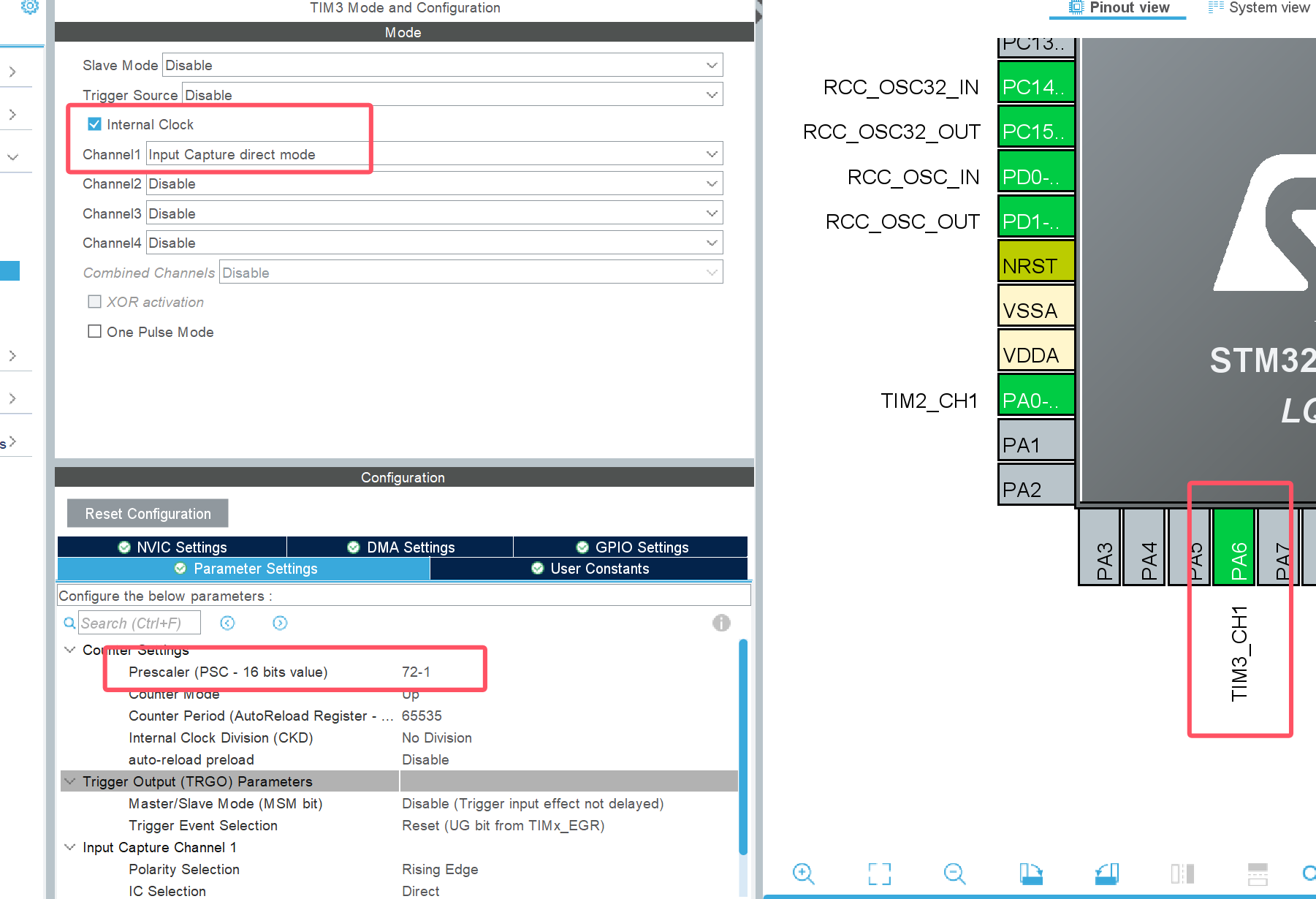
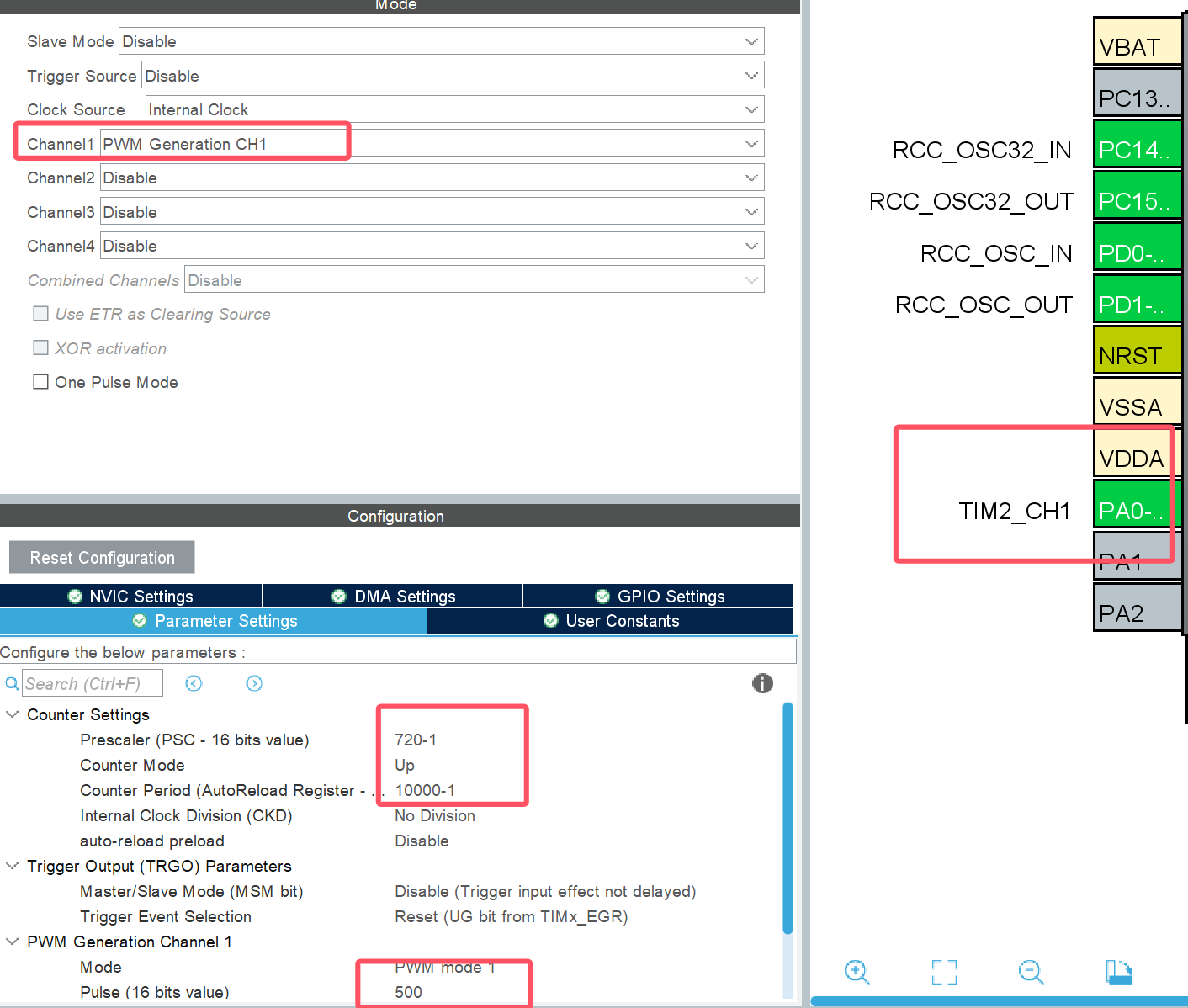
#include "user.h"

#include "oled.h"

char rx_buf[128];
extern DMA_HandleTypeDef hdma_usart1_rx;


// Global variables
// TIM3 捕获溢出全局变量
uint32_t rise_time1 = 0;       // 第一个上升沿时间
uint32_t fall_time = 0;        // 下降沿时间
uint32_t rise_time2 = 0;       // 第二个上升沿时间
uint32_t rise_time1_overflow = 0; // 第一个上升沿时的溢出次数
uint32_t fall_time_overflow = 0;  // 下降沿时的溢出次数
uint32_t rise_time2_overflow = 0; // 第二个上升沿时的溢出次数
uint8_t capture_cnt = 0;       // 捕获阶段计数
uint8_t capture_flag = 0;      // 捕获完成标志
float pwm_frequency = 0;       // 最终计算的PWM频率
float pwm_duty = 0;            // 最终计算的占空比

extern volatile uint32_t tim3_overflow_count; // 声明在 stm32f1xx_it.c 中的溢出计数

void app(void){
  //OLED
  OLED_Init();
  OLED_Clear();
  OLED_Refresh();

  //UART
  HAL_UARTEx_ReceiveToIdle_DMA(&huart1,(uint8_t*)rx_buf,128);
  __HAL_DMA_DISABLE_IT(&hdma_usart1_rx,DMA_IT_HT);

  // 确保初始极性为上升沿
  __HAL_TIM_SET_CAPTUREPOLARITY(&htim3, TIM_CHANNEL_1, TIM_INPUTCHANNELPOLARITY_RISING);

  //TIM2 start
  HAL_TIM_PWM_Start(&htim2, TIM_CHANNEL_1);
  //TIM3 IC start
  HAL_TIM_IC_Start_IT(&htim3, TIM_CHANNEL_1);

  while(1){
    if (capture_flag)
    {
      print("Freq: %.2f Hz, Duty: %.2f%%\r\n", pwm_frequency, pwm_duty);
      capture_flag = 0;
    }
  }
}

//uart Idle DMA
void HAL_UARTEx_RxEventCallback(UART_HandleTypeDef *huart, uint16_t Size){
  if(huart == &huart1){
    print("Received: %s",rx_buf);

    memset(rx_buf,0,128);
    HAL_UARTEx_ReceiveToIdle_DMA(&huart1,(uint8_t*)rx_buf,128);
    __HAL_DMA_DISABLE_IT(&hdma_usart1_rx,DMA_IT_HT);
  }
}

//TIM2->PWM->TIM3
void HAL_TIM_IC_CaptureCallback(TIM_HandleTypeDef *htim){
  if (htim->Instance == TIM3 && htim->Channel == HAL_TIM_ACTIVE_CHANNEL_1)
  {
    if (capture_cnt == 0)
    {
      // 第一个上升沿
      rise_time1 = HAL_TIM_ReadCapturedValue(htim, TIM_CHANNEL_1);
      rise_time1_overflow = tim3_overflow_count; // 记录溢出次数
      __HAL_TIM_SET_CAPTUREPOLARITY(htim, TIM_CHANNEL_1, TIM_INPUTCHANNELPOLARITY_FALLING);
      capture_cnt = 1;
    }
    else if (capture_cnt == 1)
    {
      // 下降沿
      fall_time = HAL_TIM_ReadCapturedValue(htim, TIM_CHANNEL_1);
      fall_time_overflow = tim3_overflow_count; // 记录溢出次数
      __HAL_TIM_SET_CAPTUREPOLARITY(htim, TIM_CHANNEL_1, TIM_INPUTCHANNELPOLARITY_RISING);
      capture_cnt = 2;
    }
    else if (capture_cnt == 2)
    {
      // 第二个上升沿
      rise_time2 = HAL_TIM_ReadCapturedValue(htim, TIM_CHANNEL_1);
      rise_time2_overflow = tim3_overflow_count; // 记录溢出次数

      uint32_t high_time_total;
      uint32_t period_total;

      // 计算高电平时间 (考虑溢出)
      if (fall_time_overflow == rise_time1_overflow) {
          high_time_total = fall_time - rise_time1;
      } else {
          high_time_total = (fall_time_overflow - rise_time1_overflow) * (0xFFFF + 1) + fall_time - rise_time1;
      }

      // 计算周期 (考虑溢出)
      if (rise_time2_overflow == rise_time1_overflow) {
          period_total = rise_time2 - rise_time1;
      } else {
          period_total = (rise_time2_overflow - rise_time1_overflow) * (0xFFFF + 1) + rise_time2 - rise_time1;
      }

      // 重置溢出计数器,确保下一次测量从0开始
      tim3_overflow_count = 0;

      if (period_total > 0)
      {
        pwm_frequency = 1000000.0f / (float)period_total; // TIM3 频率为 1MHz (1us/tick)
        pwm_duty = ((float)high_time_total * 100.0f) / (float)period_total;
        capture_flag = 1;
      }

      capture_cnt = 0;
    }
  }
}


void print(const char *format, ...){
    char buf[128];
    va_list args;
    va_start(args,format);
    vsnprintf(buf,128-1,format,args);
    va_end(args);
    HAL_UART_Transmit(&huart1,(uint8_t*)buf,strlen(buf),1000);
}